Lucrări ştiinţifice Zootehnie şi Biotehnologii, vol.
40(2),
(2007), TimişoaraELABORATION AND EXPERIMENT OF THE
TECHNOLOGY OF STIMULATING FEEDING OF FEMALE
SHEEP YOUTH FOR EARLY COUPLING
ELABORAREA
Ş
I EXPERIMENTAREA TEHNOLOGIEI DE
HR
Ă
NIRE STIMULATIV
Ă
A TINERETULUI OVIN FEMEL
ÎN VEDEREA MONTEI TIMPURII
*NEACSU CORNELIU, *NEACSU GABI, *VICOVAN A., *ARDELEANU D.
*Institute of Research – Development for Sheep and Goat Breeding Palas Constanţa
In order to precociously introduce the female sheep youth from the population specialized in the milk production in the economic circuit; we proceeded to elaborating and testing optimum technologies of foddering which to evidence the maximum exteriorizing of the genetic potential. The experience was developed on three lots of female sheep youth. The lots were analogue and homogenous under the aspect of the genetic type, age and body weigh. The 1st lot was fed with green
mass by grazing, the 2nd lot with grazing + 200g of concentrated
fodders/animal/day, and the 3rd lot III with green mass by grazing + 300 g
concentrated fodders/animal/day. At the 1st and the 2nd lot the consumption of dry
substance was of 1.02-1.05 kg/animal/day, and at the 3rd lot, of 1.13
kg/animal/day, the latter consuming with approximately 9.7% more comparatively to the first two lots. At the date of introducing to coupling, the body weigh was 60.6% at the 1st lot, 66.8% at the 2nd lot and 70.4% at the 3rd lot, from the body
weigh specific to the adult female. At the first sexual cycle, the proportion of females which entered the sexual heating was bigger at the 2nd lot with 30% and at
the 3rd lot with 40% comparatively to the 1st lot. From the total of females from
each lot, 33.3% at the 1st and the 2nd lot and 46.7% at the 3rd lot were supposed to
be pregnant. The female sheep youth which have at the age of 10-11 months a body weigh of at least 65%, manifest a sexual cycle in a proportion of 70-80% and become pregnant in a proportion of 55-65%.
Key words: female sheep youth, fodder ratios, stimulating feeding, early coupling
Introduction
Material and method
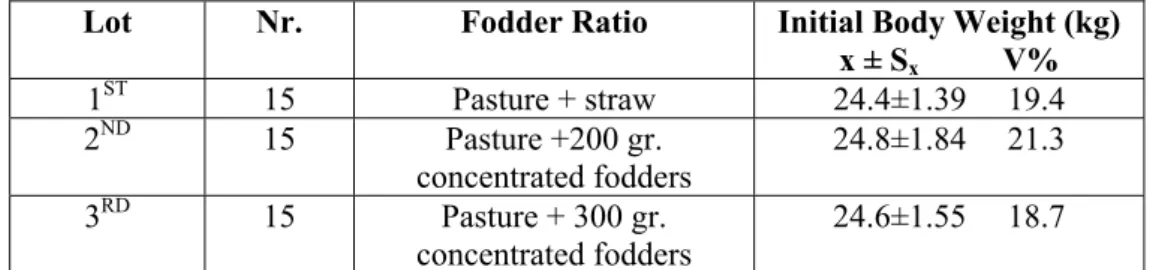
Experience was mate at ICDCOC PALAS-CONSTANŢA, on female young sheep of current year, from the Milk Line - Palas. The lots on which the scientific researches were made were homogenous and analogue under the aspect of the genetic type, age and body weight. The experience was made after the experimental scheme presented in Table 1.
Table 1 Experimental scheme
Lot Nr. Fodder Ratio Initial Body Weight (kg) x ± Sx V%
1ST 15 Pasture + straw 24.4±1.39 19.4
2ND 15 Pasture +200 gr.
concentrated fodders
24.8±1.84 21.3
3RD 15 Pasture + 300 gr.
concentrated fodders
24.6±1.55 18.7
The botanical composition of pastures was dominated by grained plants (80%), mainly couch grass which had a rate of 70-75%. Leguminous plants had a rate of approximately 12%, being represented by various species of clover (Trifolium sp.).
Results and discussions
The consumption of fodders and nutritive substances is presented in Table 2.
Table 2 The consumption of fodders and nutritive substances
Specification UM 1st Lot 2nd Lot 3rd Lot
Green fodder kg 5.20 5.20 5.20
Wheat Straw kg 0.17 - -
Barley kg - 0.20 0.30
Dry substance kg 1.02 1.05 1.13
UNC - 0.99 1.14 1.24
PDI (PDIN-PDIE)
g 100/93 110/100 116/107
the latter having a consumption of 1.13 kg dry substance.The consumption of energetic substances (UNC) was of 0.99 UNC at the 1st lot and bigger with 15.2%
at the 2nd lot (1.14 UNC) and with 25.3% (1.24 UNC) at the 3rd lot, comparatively
to the 1st lot.The level of protein based on azoth, in all cases was bigger than level
of protein based on energy. The 2nd and the 3rd lots had a bigger consumption of
protein substances, comparatively to the 1st lot, with 10.7-7.5% and respectively
7.5-15%.
The body weight in the beginning of the experiment was between 24.4-24.8 kg (Table 3).
Table 3 The body weight of the female young sheep
Lot n
Body weight % of adult weight Beginning of the
experiment
Beginning of coupling
x±Sx V% x±Sx V%
1st 15 24.4±1.39 19.4 30.3±2.11 20.1 60.6
2nd 15 24.8±1.84 21.3 33.4±1.97 20.8 66.8
3rd 15 24.6±1.55 18.8 35.2±2.07 19.7 70.4
In the beginning of coupling, the body weight increased differently in the three lots, depending on the feeding type. So, the 2nd lot had a body weight of 33.4
kg, and the 3rd of 35.2 kg, with 10.2% and respectively 16.2% bigger
comparatively to the 1st lot which did not receive supplement of concentrated
fodders.At the date of introducing at coupling, the female young sheep from the milk line of Palas had the body weight of 60.6% at the 1st lot, 66.8% at the 2nd lot
and 70.4% at the 3rd lot from the body weight of the adult female.These results
demonstrate the necessity and the importance of supplementing grazing with concentrated fodders, for preparing the female young sheep, admitted to reproduction, with good results, at the age of less than one year.
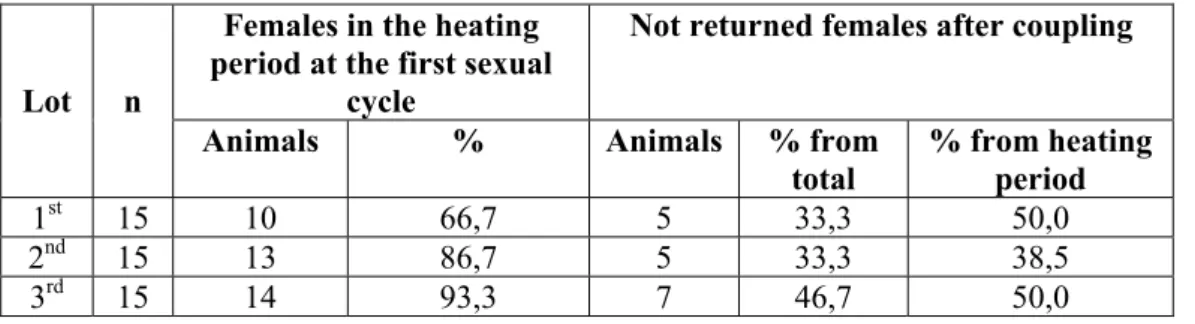
The reproduction indicators of the female young sheep are represented in Table 4.
Table 4 The activity of reproduction of the female young sheep
Lot n
Females in the heating period at the first sexual
cycle
Not returned females after coupling
Animals % Animals % from total
% from heating period
1st 15 10 66,7 5 33,3 50,0
2nd 15 13 86,7 5 33,3 38,5
At the first sexual cycle, the proportion of females in the heating period was of 66.7% at the 1st lot, 86.7% at the 2nd lot and 93.3% at the 3rd lot. The
females from the 2nd and the 3rd lots entered the heating period with 30% and
respectively 40% more, comparatively to the 1st lot. From the total of females in
each lot, 33.3% were supposed to be pregnant at the 1st and 2nd lots and 46.7% at
the 3rd lot.
The level of foddering and respectively the body weight at the date of accepting the female young sheep for coupling significantly influences the proportion of female young sheep in the heating period. The proportion of females which were supposed to be pregnant, reported to the females in the heating period is not influenced by the foddering level, the differences between lots being small and not significant.
Conclusions
Based on the obtained experimental results regarding the elaboration and experiment of the technology of stimulating feeding of the female young sheep for early coupling the following conclusions can be drawn:
The supplementation of food assured by grazing with concentrated fodders with 75 days before coupling of the female young sheep at the age of 6-7 months stimulates the increase and development of the body and improves the reproduction indicators.
The body weight of the female young sheep increased from 24.3 kg to 30.3 kg, that meaning with 24.18% at the females which were foddered only on pasture, while the increase of the body weight at the youth which received fodder supplement was from 24.8 kg to 33.4 kg, that meaning with 34.68% at a supplement of 200 g of concentrated fodders and from 24.6 kg to 35.2 kg, that meaning with 43.10% at a supplement of 300 g of concentrated fodders.
In the beginning of coupling the average body weight was of 30.3 kg at the first lot (without supplement), 33.4 kg at the 2nd (200 g of concentrated
fodders) and of 35.2 kg at the 3rd lot (300 g of concentrated fodders).
The female young sheep at the age of 10-11 months, introduced to coupling, manifested heating in a proportion of 66.7% at the 1st lot
(without supplement), 86.7% at the 2nd lot (200g of concentrated fodders)
and 93.3% at the 3rd lot (300 g of concentrated fodders).
The manifestation of the reproduction function is correlated to the body weight of the youth.
The proportion of youth which is supposed to be pregnant is not influenced by the body weight of the youth.
Bibliography
1. Burlacu Gh. – Guide for making the food ratios at milk cows, young cattle, sheep, goats and horses. IBNA-SIAT– BUCUREŞTI, 1998
2. Halga P. And Team – Animal nutrition and alimentation. Ed.Alfa - IAŞI, 2005
3. Halga P. And Team – Alimentation and reproduction at domestic herbivores. Ed.Dosoftei – IAŞI, 1999
4. Church C. – Basic animal nutrition and feeding - NEW YORK, 1999.
ELABORAREA
Ş
I EXPERIMENTAREA TEHNOLOGIEI DE
HR
Ă
NIRE STIMULATIV
Ă
A TINERETULUI OVIN FEMEL
ÎN VEDEREA MONTEI TIMPURII
*NEACSU CORNELIU, *NEACSU GABI, *VICOVAN A., *ARDELEANU D.
*Institute of Research – Development for Sheep and Goat Breeding Palas Constanţa
In vederea introducerii precoce în circuitul economic a tineretului ovin femel din populaţia specializată pentru producţia de lapte, s-a procedat la elaborarea şi testarea de tehnologii optime de furajare care să pună în evidenţă exteriorizarea maximă a potenţialului genetic. Experienţa s-a desfaşurat pe trei loturi de tineret femel ovin. Loturile au fost analoage şi omogene sub aspectul tipului genetic, vârstei şi greutăţii corporale. Lotul I a fost hrănit cu masă verde prin păşunat, lotul II cu păşune + 200g concentrate/cap/zi, iar lotul III cu masă verde prin păşunat + 300 g concentrate /cap/zi. La lotul I şi II consumul de substanţă uscată a fost de 1,02-1,05 kg/cap/zi, iar la lotul III de 1,13 kg/cap/zi, acesta din
urmă consumând cu circa 9,7% mai mult comparativ cu primele două loturi. La data
introducerii la montă, greutatea corporală a reprezentat 60,6% la lotul I, 66,8% la lotul II şi 70,4% la lotul III, din greutatea corporală specifică femelei adulte. La primul ciclu sexual, proporţia de femele intrate în călduri a fost mai mare la lotul II cu 30%, iar la lotul III cu 40% comparativ cu lotul I. Din totalul femelelor din fiecare lot au fost presupuse gestante 33,3% la lotul I şi II 46,7% la lotul III. Tineretul ovin femel care realizează la vârsta de 10-11 luni luni o greutate corporală de cel puţin 65% din greutatea de adult, manifestă ciclu sexual în proporţie de 70-80% şi rămâne gestant în proporţie de 55-65%.