http://www.ijmedicine.com pISSN 2349-3925 | eISSN 2349-3933
Original Research Article
Clinical profile and outcome of severe
P. Falciparum
malaria
Ramrao Mundhe, Maroti S. Karale*, Chandrakant Usendi, Siddhant Yadav
INTRODUCTION
Malaria is a public health problem in more than 90 countries. According to the latest estimates of WHO, released in December 2015, there were 214 million cases of malaria in 2015 and 438 000 deaths.1 In India, during 2011, the malaria incidence was around 1.31 million cases, 0.67 million P. falciparum (Pf) cases and 754 deaths while during 2014 (till October), 0.85 million cases, 0.54 Pf cases and 316 deaths have been reported.2 Malaria is a public health problem in several parts of the country. About 95% population in the country resides in
malaria endemic areas and 80% of malaria reported in the country is confined to areas consisting of 20% of population residing in tribal, hilly, difficult and inaccessible areas. Majority of studies of malaria are from endemic or hyper endemic areas of India. This study is of malaria in a tertiary care center in South Maharashtra, a hypo endemic area for falciparum malaria. The number of atypical presentations of malaria has gradually increased during the past few decades. Several factors have been attributed to increased morbidity and mortality in malaria with altered hematological and coagulation parameters, playing an important role. ABSTRACT
Background: Malaria is a public health problem in more than 90 countries. According to the latest estimates of WHO, released in December 2015, there were 214 million cases of malaria in 2015 and 438 000 deaths. The aim was to study clinical profile and outcome of severe falciparum malaria in patients at tertiary health care centre.
Methods: In this prospective study, total 125 clinically diagnosed severe malaria cases admitted during period of November 2013 to October 2015, were enrolled excluding patients below 12 years of age. Detailed history and clinical examination was carried out to assess clinical severity and complications of malaria.
Results: Of the 125 cases studied 110 cases were of severe malaria produced by Plasmodium falciparum infection diagnosed on peripheral smear examination or by antigen detection test. The remaining 15 cases were excluded from the study. In this study, seventy six (69.1%) cases were males and thirty four (30.9%) cases were females, with male: female ratio of 2.23:1. Common symptoms found were fever, chills and rigors, altered sensorium, jaundice and nausea or vomiting while most common complication was jaundice, seen in 45.45%. Mortality due to severe falciparum malaria observed was 13.63%.
Conclusions: In this study of severe falciparum malaria, most common symptoms found were fever, chills and rigors, altered sensorium, jaundice, nausea and vomiting while most common signs were pallor, splenomegaly, icterus, hepatomegaly, bleeding tendencies and in a few cases neck stiffness and hypotension. Jaundice, renal failure, impaired consciousness and cerebral malaria were most common complications of severe falciparum malaria.
Keywords: Clinical profile, Jaundice, Malaria, Plasmodium falciparum
Department of Medicine, Government Medical College, Latur, Maharashtra, India
Received: 30 August 2016
Accepted: 29 September 2016
*Correspondence:
Dr. Maroti S. Karale,
E-mail: [email protected]
Copyright: © the author(s), publisher and licensee Medip Academy. This is an open-access article distributed under the terms of the Creative Commons Attribution Non-Commercial License, which permits unrestricted non-commercial use, distribution, and reproduction in any medium, provided the original work is properly cited.
Being associated with most serious complications, early diagnosis and prompt treatment is of paramount importance to reduce the mortality and morbidity and also for drug resistance associated with it. Microscopy remains the reference standard for diagnosis of malaria, but this requires availability of a good microscope, significant technical skills, good-quality reagents and clean slides which is difficult to maintain in remote and poorly resourced areas.3 This study was aimed to study the clinical profile and outcome of severe falciparum malaria and to observe any prognostic factors if present.
METHODS
This is a prospective and observational study conducted in medicine at GMCH, Latur, Maharashtra, India during the period from November 2013 to October 2015. Total 125 suspected severe malaria cases of age above 12 years admitted in medicine wards of all units were included in the study. Ethics committee of the institution approved the study. Informed consent was taken from patients/next of kin. Patients with uncomplicated falciparum malaria, non-falciparum malaria and who have taken antimalarial treatment in previous four weeks were excluded from study.
Each patient’s baseline data, age, demography was recorded. A detailed history was taken followed by a detailed clinical examination to assess clinical severity and complications of malaria. All patients were subjected to peripheral smear microscopy and Paracheck Pf antigen detection test (immunochromatographic test).4 Other laboratory investigations carried out were complete blood count, liver function tests, kidney function tests, random blood sugar, arterial blood gas, chest x-ray and ultrasonography. Patients were classified as severe falciparum malaria based on WHO 2015 guidelines for malaria.5
Most of the patients were treated with combination of artesunate, clindamycin, or other artemether based combination therapy as per the respective medical unit protocols and WHO 2015 guidelines for malaria.5 Other general and specific measures taken were 25% dextrose for hypoglycemia, blood transfusion for severe anemia, anticonvulsants and diazepam for seizures, peritoneal dialysis and ventilatory support in selected patients. Outcome of severe malaria was categorized as recovery and death.
Statistical analysis
Data was analyzed using Epi-info 3.4.3 statistical software and MS Excel.
RESULTS
Of the 125 cases studied 110 cases proved to be cases of severe malaria produced by plasmodium falciparum infection diagnosed on peripheral smear examination or
by antigen detection test. The remaining 15 cases were excluded from study due to negative result for both the tests. Maximum number of patients were found in the age group of 20-29 years and 30-39 years representing 38 (34.55%) and 27 (24.55% ) respectively, with mean age of 33.80 ± 11.85 years (Table 1).
In this study, seventy six (69.1%) cases were males and thirty four (30.9%) cases were females with a male to female ratio of 2.23:1. The number of patients from rural area and urban area were 74(67.27%) and 36(32.73%) respectively. Percentage of patients from rural area and urban area were 67.27% and 32.73% respectively indicating high incidence in rural area.
Table 1: Age distribution of severe falciparum malaria cases.
Age group Number of cases Percentage (%)
12-19 13 11.82
20-29 38 34.55
30-39 27 24.55
40-49 17 15.45
50-59 11 10.00
≥60 04 03.63
Total 110 100
Table 2: Symptoms in severe falciparum malaria.
Symptom Number of cases
Percentage (%)
Fever 110 100
Chills / rigors 99 90
Nausea / vomiting 45 40.90
Pain in abdomen 22 20
Headache 31 28.18
Jaundice 50 45.45
Cough 15 13.63
Breathlessness 17 15.45
Altered sensorium 54 49.09
Convulsions 04 3.6
Diarrhoea 10 9.09
Decreased urine output 28 25.45
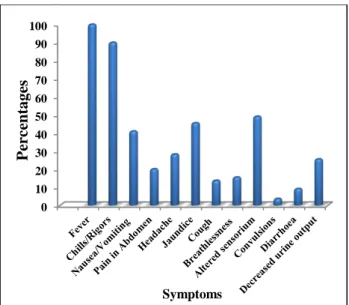
The most common symptom was fever seen in 100% of patients, followed by chills and rigors which were present in overall 90% of patients.
Altered sensorium was seen in 49.09% patients and jaundice was presenting complaint in 45.45% of cases. Nausea or vomiting and abdominal pain was present in overall 40.90% and 20% of patients respectively.
Figure 1: Distribution of symptoms in severe falciparum malaria.
Pallor was most common sign; present in 68.18% of cases fallowed by splenomegaly which was seen in 50% of cases. Icterus was seen in 45.15% of cases. Ten cases (9.09%) had bleeding tendencies in the form of haematuria, epistaxis, ecchymosis and subconjunctival bleed. Hepatomegaly was present in 45.45% of patients. Periorbital or pedal oedema was found in overall 25.45% of cases. Eleven cases (10%) patients had crackles in lungs on auscultation. Hypotension (SBP < 80 mmHg)
was seen in 2.72% of patients. Five cases (4.54%) had neck stiffness at presentation.
In patients with severe falciparum malaria, 70 of the 110 cases (63.63%) had single complication and 40 (36.36%) cases had multiple complications. Most common manifestation of severe malaria was jaundice (Sr. bilirubin >3 mg/dl) seen in 45.45% cases followed by renal failure (Sr. creatinine >3 mg/dl) and impaired consciousness in 25.45% of patients each.
Table 3: Signs in severe falciparum malaria.
Signs Number of
cases Percentage (%)
Pallor 75 68.18
Icterus 50 45.45
Bleeding 10 9.09
Edema feet 28 25.45
SBP < 80 mmHg 03 2.72
Neck stiffness 05 4.54
Splenomegaly 55 50.00
Hepatomegaly 50 45.45
Crackles 11 10.00
Cerebral malaria was seen in 23.63% of patients with severe falciparum malaria. Hypoglycaemia and hypotension was present in 1.82% and 2.72% of patients respectively. Total 9.09% of patients had significant bleeding in the form of haematuria, epistaxis, ecchymosis and subconjunctival haemorrhage.
Table 4: Manifestations in severe falciparum malaria.
Manifestations
Alone/ single manifestation (No. of cases)
Combined*/multiple complications (No. of cases )
Total (No.) Percentage (%)
Jaundice ( Sr. Bilirubin > 3 mg /dl ) 26 24 50 45.45
Renal failure ( Sr. Creat > 3 mg /dl ) 13 15 28 25.45
Cerebral malaria 19 07 26 23.63
Impaired consciousness /arousable 11 17 28 25.45
ARDS _ 11 11 10.00
Significant bleeding _ 10 10 9.09
Severe anaemia (Hb < 5 gm/dl or pcv <
15) _ 06 06 5.45
Metabolic acidosis ( PH <7.25) _ 09 09 8.18
Hypoglycaemia ( RBS < 40 mg /dl) _ 02 02 1.82
SBP < 80 mmHg systolic _ 03 03 2.72
Convulsions > 2 in 24 hours 01 04 04 3.63
*Occurrence with one or more other complications
Severe anaemia (Hb <5 g/dl) was present in 5.45% of patients. ARDS was present in 10% of patients. Metabolic acidosis (PH < 7.25) was seen in 8.18% of patients and generalised tonic clonic seizures were present in 3.63% of patients.
Mortality in malaria was significantly associated with multi-organ (≥2 organs) involvement as compared to single organ involvement, in cases of severe falciparum malaria (P value=0.000002). Total mortality in severe falciparum malaria was 13.63%. Mortality was significantly higher in ARDS (lung) as compared to 0
10 20 30 40 50 60 70 80 90 100
Percent
ages
cerebral, hepatic and renal involvement (P value = 0.000025) in cases of severe falciparum malaria.
Table 5: Number of organs involved and mortality in severe falciparum malaria.
Organs involved Number Death Percentage (%)
One 81 02 2.46
Two 24 08 33.33
Three 04 04 100
Four 01 01 100
Total 110 15 13.63
Table 6: Organ involvement and mortality in severe falciparum malaria.
Organ Number Death Percentage (%)
Hepatic 50 11 22.00
Renal 28 03 10.71
Cerebral 56 11 19.64
Lung 11 09 81.81
DISCUSSION
In the present study most common age group affected was 20-39 years comprising 59.10% of cases and mean age was 33.80 (SD±11.85) years (Table 1). The working group is the age group which is predominantly affected, because this is the group which is exposed to the mosquito bites especially in the fields and outdoors. The most common symptoms observed in our study (Table 2) were fever (100%), chills and rigors (90%), altered sensorium (49.09%), jaundice (45.45%) and nausea/vomiting (40.90%). Other less common symptoms found were headache (28.18%), decreased urine output (25.45%), pain in abdomen (20%), breathlessness (15.45%), cough (13.63%), diarrhea (9.09%) and convulsions (3.6%).
Of the 110 cases 70 (63.63%) cases had single complication and 40 (36.36%) cases had multiple complications. Most common presentation was jaundice which was present in 45.45% of cases. This is consistent with the finding of Mishra SK, et al.6 Severe jaundice in falciparum malaria results from hemolysis of both parasitized and non-parasitized red cells, hepatocyte injury and cholestasis6. Renal failure was present in 25.45% of patients (Table 4) which was comparable with studies conducted by Murthy GL, et al.7 The pathophysiology of renal failure in malaria has been described by Sitprija et al.8 It is thought that cytoadherence, multifactorial changes in cortical perfusion, cytokine release and hypovolemia lead to tubular necrosis.9 Cerebral malaria was present in 23.63% of patients (Table 4) in our study which was comparable with the study conducted by Kochar D, et al.10 ARDS was present in 10% of patients in our study which was
comparable with the study conducted by Patil VC.11 The pathogenesis of ARDS is related to sequestration of parasitized red cells in the lung and increased leakage from pulmonary vasculature resulting from cytokine release.12 Severe anemia ( Hb < 5 gm/dl ) was present in 5.45% of patients (Table 4) in our study which was comparable to studies done by Wasnik PN, et al.13 The pathophysiology of anemia in malaria is multifactorial. It results from accelerated red cell destruction and removal by the spleen in conjunction with ineffective erythropoiesis.14
Case fatality rate observed in our study was 13.63 % (Table 4). It was highest in multi organ involvement as compared to single organ involvement. Case fatality rate was highest in ARDS (81.81%) as compared to jaundice (22%), cerebral malaria (19.64%) and renal failure (10.71%). Similar findings were noted by Kochar D, et al and Patil VC.10,11
CONCLUSION
Most common symptoms seen in severe falciparum malaria were fever, chills and rigors, altered sensorium, jaundice, nausea and vomiting while most common signs noticed were pallor, splenomegaly, icterus, hepatomegaly, bleeding tendencies and in a few cases neck stiffness and hypotension. The common complications of severe falciparum malaria were jaundice, renal failure, impaired consciousness and cerebral malaria. Higher mortality was associated with presence of complications like anemia, jaundice, renal failure, disseminated intravascular coagulation, adult respiratory distress syndrome (ARDS) and septicemia. Most of the deaths were encountered in patients with multi organ involvement as compared to single organ involvement. ARDS was most common cause of death though most common manifestations seen in severe falciparum malaria were jaundice, renal failure and cerebral malaria.
Funding: No funding sources Conflict of interest: None declared
Ethical approval: The study was approved by the institutional ethics committee
REFERENCES
1. WHO, Fact sheet no. 94, Recent advances in research and development of malaria. 2015.
2. Govt. of India. Malaria, Magnitude of the problem NVBDCP, DGHS, Ministry of Health and Family Welfare, New Delhi. 2015.
3. World Health Organization (WHO). Guidelines for the treatment of malaria Geneva, Switzerland: WHO, 2010.
5. WHO Guidelines for the treatment of malaria. Third edition. 2015.
6. Mishra SK, Mohanty S, Satpathy SK, Mohapatra DN. Cerebral malaria in adults - a description of 526 cases admitted to Ispat General Hospital in Rourkela, India. Ann Trop Med Parasitol. 2007;101(3):187-93.
7. Murthy GL, Sahay RK, Srinivasan VR, Upadhaya AC, Shantaram V, Gayatri K. Clinical profile of falciparum malaria in a tertiary care hospital. J Indian Med Assoc. 2000;98(4):160-9.
8. Visith S. Nephropathy in falciparum malaria. Kidney International. 1988;34:867-77.
9. Barsoum RS. Malarial acute renal failure. J Am Soc Nephrol. 2000;11:2147.
10. Kochar D, Kumawat BL, Karan S. Severe and complicated malaria in Bikaner, western India”. Southeast Asian J Tropical Med. 1997;28(2):259-67.
11. Patil V. Complicated falciparum Malaria in western Maharashtra. Trop Parasitol. 2012;2(1):49-54. 12. Warrell DA, Molyneux ME, Beasles PF. Severe and
complicated malaria. Trans Roy Soc Trop Med Hyg 1990;84:1.
13. Wasnik PN, Manohar TP, Humaney NP, Salkar HR. Study of clinical profile of falciparum malaria in a tertiary referral centre in central india. j assoc physicians India. 2012;60:33-6.
14. White NJ. Malaria. Manson’s Tropical Disease. 22nd editionn. London: Saunders Elsevier. 2009:1201-81.