
281
THE STRUCTURE OF THE AVAILABILITY AND TOTAL CONSUMPTION
OF SUNFLOWER OIL IN ROMANIA (2011-2013)
PÂNZARU R.L., MEDELETE D.M.
Faculty of Agronomy, University of Craiova
Key words: production, import, export, stock, availability, consumption
ABSTRACT
Today there is a wide variety of vegetable oils and sometimes we find it hard to understand which oil is useful and which not too.
First method-cold pressed oil at low temperatures. It is the most "natural " method to get the vegetable oil with the help of a presses. The seeds are placed in a press, and due to the strong pressure, the press is warming itself. The oil obtained does not heat over 40-42C: Such a low temperature will allow it to retain all useful components.
The second method is the cold pressing after prior treatment. With this method of production, the seeds are first processed at high temperatures. For manufacturers This method is certainly advantageous: so, they can get not 27%, but 43% of the total amount of oil contained in the final product.
The third method is extraction. This method is a fairytale for all manufacturers: with it can get 98% of raw material oil.
From the point of view of the component elements of the balance is noteworthy of its unitary character.
The production predominating (140.37%), but the implications of export and import operations are not to be neglected, in this respect the surplus trade balance should be established.
INTRODUCTION
Sunflower oil, is one of the foods with beneficial body properties, which is why it is used worldwide.
It has been scientifically proven that sunflower oil contains certain extremely useful fatty acids for the body.
Following studies, it has been shown that if sunflower oil is regularly consumed, the body will be less exposed to cardiovascular diseases. Despite the fact that there is not enough evidence to confirm the beneficial effects against arthritis, sunflower oil is increasingly used in certain medicines and treatments.
The circuit, at Sunflower and its derivatives, can be structured in stages delimited as follows: seed production, processing (which usually takes place within the industrialization units), packaging, distribution and consumption.
On the balance sheet of oil and margarine for the last period in Romania,
there have been reports of trends that can be presented as follows: A relative stability of oil production and increased production of margarine; Increased imports of oil and margarine and an insignificant export; A sharp reduction in oil stocks and stock shortage in recent years, especially in situations where export has been made; A tendency to increase oil and margarine consumption in the last period.
From here it can be concluded that in Romania there has been a significant increase in sunflower production that has trained an important volume for processing in modernized and retrofitting factories.
282
METHOD AND MATERIAL
The establishment of total domestic availability shall consider the following components: Total production, imports, stocks and exports (expressed in natural units of measurement – thousand tones). Determination of the level of total domestic availability – according to the FAO regulations, takes into account the summation of the level of production with the level of imports and stocks, which decreases the volume of exports. If the level of stocks is negative, it shall be deducted from the sum of total production and imports.
For the determination of total consumption, the following component elements shall be considered: feed consumption, seed or planting material, food consumption, processed raw materials, other uses, losses (expressed in thousand t). According to the FAO methodology, the determination of the total level of consumption is done by summing up the abovementioned elements. In the present case, sunflower oil, total consumption is composed of: human consumption, processed raw materials, other uses and losses.
Effective determination of the balance, considering the achievement of the difference between the total volume of the internal availability and the total
volume of consumption. Depending on the values of total consumption and total availability, the balance sheet may be surplus, deficient or a balance can be met between the two elements – basic – constituents.
In the case of total domestic availability and total consumption, taking into account their component elements and their way of participation in the establishment of the general level of the two indicators, the structure, percentage, distinct, both for the total domestic and total consumption.
The dynamics of the indicators is highlighted by the use of fixed and mobile base indices, which transpose, in practice, the method of compaction over time (dynamic series consisting of four terms: 2011, 2012, 2013 and the average period). Comparison can also be made in space by reporting national indicators to global and EU-specific situations.
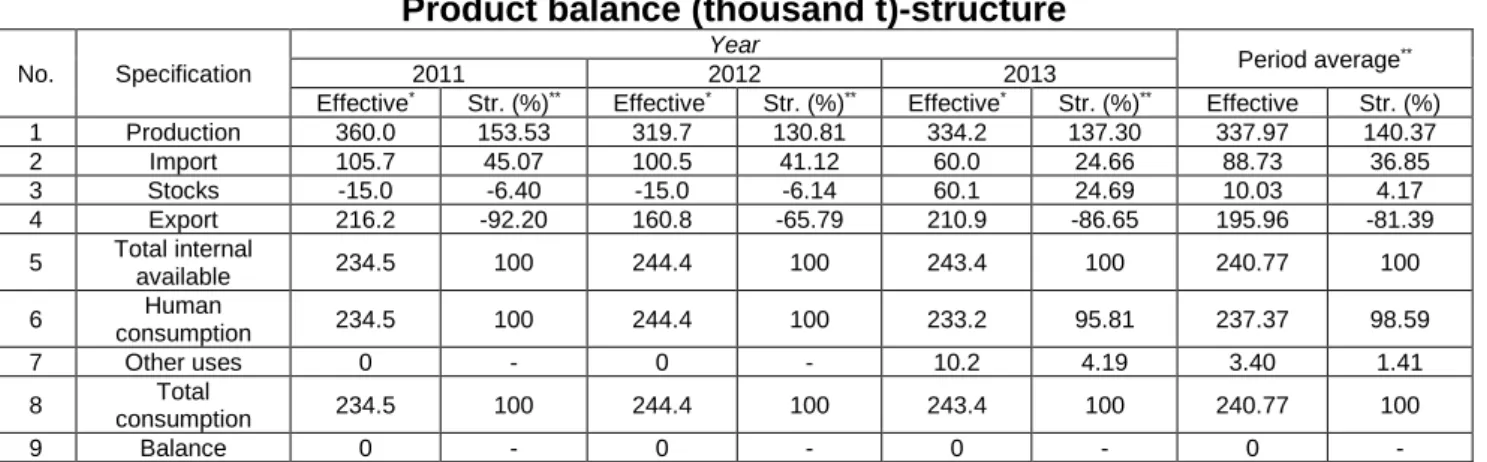
RESULTS AND DISCUSSIONS Table 1 shows the component elements of the national balance for sunflower oil. It can be noted that in total consumption it is predominantly human consumption, except for the year 2013 when there are also quantities related to other uses.
Table 1.
Product balance (thousand t)-structure
No. Specification
Year
Period average**
2011 2012 2013
Effective* Str. (%)** Effective* Str. (%)** Effective* Str. (%)** Effective Str. (%)
1 Production 360.0 153.53 319.7 130.81 334.2 137.30 337.97 140.37
2 Import 105.7 45.07 100.5 41.12 60.0 24.66 88.73 36.85
3 Stocks -15.0 -6.40 -15.0 -6.14 60.1 24.69 10.03 4.17
4 Export 216.2 -92.20 160.8 -65.79 210.9 -86.65 195.96 -81.39
5 Total internal
available 234.5 100 244.4 100 243.4 100 240.77 100
6 consumption Human 234.5 100 244.4 100 233.2 95.81 237.37 98.59
7 Other uses 0 - 0 - 10.2 4.19 3.40 1.41
8 Total
consumption 234.5 100 244.4 100 243.4 100 240.77 100
9 Balance 0 - 0 - 0 - 0 -
*http://www.fao.org/faostat/fr/#data/BC (25.11.2018) **my calculation
For the year 2011, it can be observed that the balance was a balanced one, the availability being equal
283
105.7 thousand t Imports (45.07 %), 216.2 thousand t exports (-92.90%),-15.0 thousand t stocks (-6.40%). In the formation of total consumption, it contributed exclusively to human consumption.
At the level of 2012, the total domestic availability was 244.4 thousand T, level at which, the component elements had the following percentage quotas: 130.81% production (319.7 thousand t), 41.12% Imports (100.5 thousand t),-4.14% stocks (-15.0 thousand t),-65.79% Exports (160.8 thousand t). Total consumption was equal to the existing availability, which was based only on human consumption.
In the case of 2013, there is a balance between available and consumption, with each indicator reaching the level of 243.4 thousand t. For the total availability, they acted: production – 334.2 thousand t (137.30%), import – 60.0 thousand t (24.66%), stocks – 60.1 thousand t (24.69%) and exports – 210.9 thousand t (-86.65%). The formation of total consumption is based on variable quantities of the product used as follows: 10.2 thousand t other uses (4.19%) and 233.2 thousand t human consumption (95.81%).
Determining the average of the period analyzed, a unified balance is found. This situation leaves a total available of 240.77 thousand t, which had the following structure (Fig. 1): 140.37% Production (337.97 thousand t); 36.85% Imports (88.73 thousand t); 4.17% Stocks (10.03 thousand t); -81.39% Exports (195.96 thousand t).
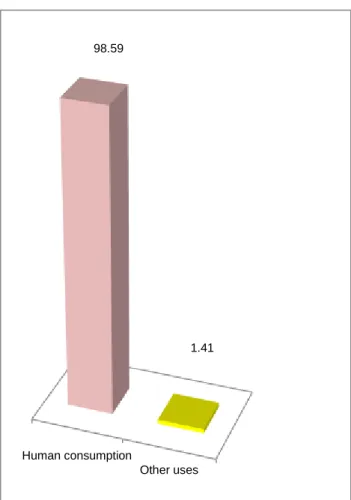
Total consumption reached 240.77 thousand t, its structure presenting itself (Fig. 2): 1.41% Other uses (3.40 thousand t); 98.59% human consumption (237.37 thousand t).
Fig. 1.The total national available - structure, period average (%)
Human consumption
Other uses 98.59
1.41
284
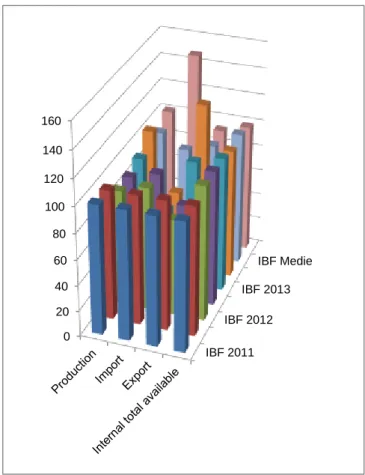
The dynamics of the component elements of the national balance for sunflower oil is presented in table 2.
Production decreased by 11.19% at the level of 2012 compared to 2011, which changed in 2013 (+ 4.54% compared to the previous term of the dynamic series). Average of the period, was lower than the first reporting base by 6.12% and above the second by 1.13%.
Regarding the import, one can observe a downward evolution, the dynamics presenting a single super unitarian value of the component indices (those with the mobile base for the average period - 147.88%). The successive annual decreases, specific for 2012 and 2013, compared to the previous terms of the dynamic series were: 4.92 and 40.30% respectively.
Table 2.
Dynamics of the product balance elements *
No. Specifiction
Year Period average
2011 2012 2013
Ibf Ibm Ibf Ibm Ibf Ibm Ibf Ibm
1 Production 100 100 88.81 88.81 92.83 104.54 93.88 101.13
2 Import 100 100 95.08 95.08 56.76 59.70 83.95 147.88
3 Stocks 100 100 74.38 74.38 97.55 131.16 90.64 92.92
4 Export 100 100 104.22 104.22 103.80 99.59 102.67 98.92
7 Total internal
available 100 100 104.22 104.22 99.45 95.42 101.22 101.79
8 Human
consumption - - - - 100 100 33.33 33.33
9 Other uses 100 100 104.22 104.22 103.80 99.59 102.67 98.92
*my calculation
The export has evolved fluctuating. It decreased in 2012 compared to 2011 (25.62%), after which in 2013 increased compared to the second reporting base (+ 31.16%). For the average period, subunit levels of both categories of indices (-9.36 and 7.08% respectively) are found.In the case of the total domestic availability, there is a non-uniform evolution, the specific increases for 2012 (+ 4.22%) compared to 2011, followed by decreases in 2013 (-0.41% compared to the previous term of the dynamic series). In these conditions, the average period was super unitarian for fixed base indices (102.67%) and subunit for mobile base indices (98.92%).
Figure 3 shows the dynamics of the component elements of the total Romanian domestic available of sunflower oil.
At the level of human consumption, it is worth noting the uneven evolution. Specific increases for 2012 (+ 4.22% compared to 2011), followed by decreases in 2013 (-0.55 and -4.58% respectively). The average of the period
IBF 2011 IBF 2012
IBF 2013 IBF Medie
0 20 40 60 80 100 120 140 160
Fig. 3.Dynamics of the components of the total national domestic availability
285
exceeded both terms of comparison with 1.22 and 1.79% respectively.
For other uses, the average of the period represented one third of the level of 2013 (the only year in which the present indicator appears).
Regarding the dynamics of the total consumption, the trend similar to the one registered for the total availability is observed, this being determined by the similarity between the values of the two indicators - for all the terms of the dynamic series.
CONCLUSIONS
At national level, a number of conclusions can be formulated, such as:
- from the point of view of the elements of the balance, it is worth noting, its equivocal nature, a situation different from the world, but identical to the regional one. In the availability, production predominating (140.37%), but not to be neglected and the implications of export and import operations, from this point of view, the surplus trade balance is to be observed;
- total consumption is prevalent, human consumption (98.59%), other uses with a very modest contribution (1.41%);
- some elements of the balance have uneven developments (production, export, total domestic availability, human consumption, total consumption), trend from which imports and other uses with downward tendencies are exempt;
- total domestic availability and total consumption, represents 1.83% of the global indicator level and 6.94% of the Community level;
- for Romania, it would be worth noting the need for greater recovery of the existing potential for sunflower culture, in terms of the possibilities of increasing productive potential – especially if reconsideration of nature is taking place Technology (cultivation used, rotation, fertilization, care work, etc.);
- it is not to be neglected, nor the processing potential of the food industry,
which by appropriate measures (investment, re-technologization, modernization), can be a lever to improve the economic situation of the national space.
BIBLIOGRAPHY
1. Asworth S., Fraser N., Leat P., 2003,
Theagri-food chain in Romania on the road to accession, MAPAM Bucharest. 2. Constantin M., et al., 2009, Marketing of Agro-Food Production, Agro Tehnica Publishing House, Bucharest.
3. Constantin M., 2017, Marketing of Agro-Food Production, Publishing house of the Romanian Academy of Scientists, Bucharest.
4. Constantin M., 2018, Explanatory dictionary of agromarketing, Publishing Economic Tribune, Bucharest
5. Manole. V. et al., 2002, Marketing diagnosis on the agricultural product chain, EvenimentulRomânesc Publishing House, Bucharest
6. Pânzaru R.L., Medelete D.M., 2005,
Agrarian Economy - Applications, Universitaria Publishing House, Craiova, 7. Pânzaru R. L., M. D. Medelete, G. Ștefan, 2009, Economics of vegetable production, University Publishing House, Craiova
8. Ștefan G., D. Bodescu, A. D. Toma, R. L. Pânzaru, 2007, The economy and the branch of agro-food production, Alfa Publishing House, Iasi.
9.
http://ecology.md/md/page/3-metode-de-producere-a-uleiului
10.http://www.fao.org/
11. http://www.foodart.ro/articole/uleiul-de-floarea-soarelui/
![Second ACP-EEC Convention. Collected Acts [Lome], Vol. II. 31 December 1982](data:image/gif;base64,R0lGODlhAQABAIAAAP///wAAACH5BAEAAAAALAAAAAABAAEAAAICRAEAOw==)