doi: 10.14203/jet.v17.19-24
Classification of Radar Environment Using Ensemble Neural
Network with Variation of Hidden Neuron Number
Klasifikasi Lingkungan Radar Menggunakan
Jaringan Syaraf Tiruan Ensemble dengan
Variasi Jumlah Neuron Tersembunyi
Budiman P.A. Rohman * and Dayat Kurniawan
Pusat Penelitian Elektronika dan Telekomunikasi, Lembaga Ilmu Pengetahuan Indonesia.Komplek LIPI Gd 20, Jl Sangkuriang 21/54D, Bandung 40135, Indonesia
Abstract
Target detection is a mandatory task of radar system so that the radar system performance is mainly determined by its detection rate. Constant False Alarm Rate (CFAR) is a detection algorithm commonly used in radar systems. This method is divided into several approaches which have different performance in the different environments. Therefore, this paper proposes an ensemble neural network based classifier with a variation of hidden neuron number for classifying the radar environments. The result of this research will support the improvement of the performance of the target detection on the radar systems by developing such an adaptive CFAR. Multi-layer perceptron network (MLPN) with a single hidden layer is employed as the structure of base classifiers. The first step of this research is the evaluation of the hidden neuron number giving the highest accuracy of classification and the simplicity of computation. According to the result of this step, the three best structures are selected to build an ensemble classifier. On the ensemble structure, all of those three MLPN outputs then be collected and voted for getting the majority result in order to decide the final classification. The three possible radar environments investigated are homogeneous, multiple-targets and clutter boundary. According to the simulation results, the ensemble MLPN provides a higher detection rate than the conventional single MLPNs. Moreover, in the multiple-target and clutter boundary environments, the proposed method is able to show its highest performance.
Keywords: radar environment, homogeneity, ensemble neural network, hidden neuron number, CFAR.
Abstrak
Deteksi target merupakan fungsi utama dari sistem radar sehingga unjuk kerja dari sebuah sistem ini ditentukan oleh tingkat akurasi deteksi targetnya. Constant False Alarm Rate (CFAR) merupakan algoritma deteksi yang umum digunakan pada sistem radar. Algoritma ini terbagi menjadi beberapa pendekatan metode komputasi yang memiliki performansi berbeda untuk lingkungan radar yang berbeda. Oleh karena itu, pada makalah ini akan diajukan sebuah struktur jaringan syaraf tiruan (JST) ensemble dengan variasi jumlah neuron tersembunyi untuk klasifikasi lingkungan radar. Hasil penelitian ini akan dapat mendukung peningkatan akurasi deteksi target radar pada semacam CFAR adaptif. Struktur dari JST basis yang digunakan adalah multi-layer perceptron network (MLPN) dengan satu lapisan tersembunyi. Tahap pertama dari metode yang diusulkan adalah melakukan evaluasi terhadap jumlah neuron tersembunyi yang paling efektif dalam tingkat akurasi dan kompleksitas komputasi. Berdasarkan tahap evaluasi ini, tiga struktur basis terbaik dipilih untuk selanjutnya membentuk struktur ensemble. Pada struktur ensemble, ketiga keluaran struktur basis dikumpulkan dan dilakukan voting untuk mendapatkan hasil mayoritas yang menentukan hasil klasifikasi final. Tiga lingkungan radar yang dikaji pada makalah ini adalah homogen, target jamak, dan perbatasan clutter. Berdasarkan hasil simulasi, hasil klasifikasi lingkungan radar dari JST ensemble lebih baik dari struktur kovensional MLPN tunggal. Selain itu, pada lingkungan target jamak dan perbatasan clutter, metode yang diajukan dapat mengklasifikasi homogenitas lingkungan radar secara hampir sempurna.
Kata kunci: lingkungan radar, homogenitas, jaringan syaraf tiruan ensemble, jumlah neuron tersembunyi, CFAR.
I. INTRODUCTION
Target detection is the mandatory task of radar systems. Therefore, the performance of radar is mainly determined by the accuracy of the target detection. However, the existence of interferences and various
environments become a serious obstacle to the radar system performance. Besides, the differences in performance among Constant False Alarm Rate (CFAR) types, the algorithm commonly employed for target detection in radar, which performs well in only specific environments also become the further obstacle on the radar target detection process [1], [2].
There are some popular classical CFAR methods such as Cell Averaging (CA), Ordered Statistics (OS), Smallest-of (SO) and Greatest-of (GO). Each of those * Corresponding Author.
Email: [email protected]
Received: December 5, 2016 ; Revised: December 6, 2016 Accepted: ; Published: December 20, 2016 2017 PPET - LIPI
25-32
* Corresponding Author.
Email: [email protected]
Received: July 24, 2017 ; Revised: August 25, 2017 Accepted: August 25, 2017 ; Published: August 31, 2017 2017 PPET - LIPI
algorithms has a high performance just in one or two specific cases such as CA-CFAR that are the most popular method providing the highest detectability in the homogeneous background but it has low performance in the non-homogeneous environment. Others, OS-CFAR outperforms when it faces the
non-homogeneous environments but its performance degrades in the homogenous background [2], [3], [4], [5] (See Table 1). Consequently, the development of an adaptive selection CFAR in different possible radar environments became very popular and it interests many researchers.
Some attempts to develop an adaptive and/or selective CFAR based on reference cell values had been conducted. Variability Index-CFAR is a composite of CA-CFAR, GO-CFAR and SO-CFAR. The selection of those three CFARs is based on the variability index of windowed reference cell values [6]. Other, in 2012, NNCAOS-CFAR was designed using artificial neural network whether it was a homogeneous or multi-target condition. According to that detection result, the algorithm will select the best CFAR algorithm. The options of CFAR algorithms provided were CA-CFAR 32 cells, OS-CFAR 22 cells and OS-CFAR 31 cells [7]. Then in 2015, the switching algorithm between CA-CFAR and OS-CA-CFAR has been designed and proposed using multi-layer perceptron network (MLPN). This algorithm will select based on the pattern of CA-CFAR, OS-CFAR, and Cell Under Test (CUT) value. According to the simulation results, this proposed method could select the CFAR properly depend on the radar environments [8].
On the other hand, the concept of an ensemble of classifier has shown the better performance than the single neural network [9], [10], [11]. The base of this technique is the diversity of individual classifier [11]. Some of the ensemble models are built and implemented as follows. In 1997, Naftaly, Intrator, and Horn revealed that the ensemble averaging was a powerful procedure which, when used correctly, improved on single network performance [12]. In 2004,
the ensemble of various neural networks consisted of MLPN, Elman recurrent neural network, radial basis function network and Hopfield model was proposed for building a robust weather forecasting [13]. The further development of ensemble classifier also had been conducted in 2012 employing the weighting on local learning and diversity [14]. Then, in 2013, the ensemble with hierarchical fusion and ten-fold cross validation were proposed for digital mammogram classification. This research showed a significant improvement over the single neural network and ADABOOST algorithm [15]. In the same year, Barrow and Crone proposed the use of cross-validation data splitting for model averaging and assessed different forms of cross-validation for creating model diversity [16]. Then, the development of neural network ensemble optimized with PSO integrated Fuzzy Type 1 and 2 for time series prediction was conducted [17].
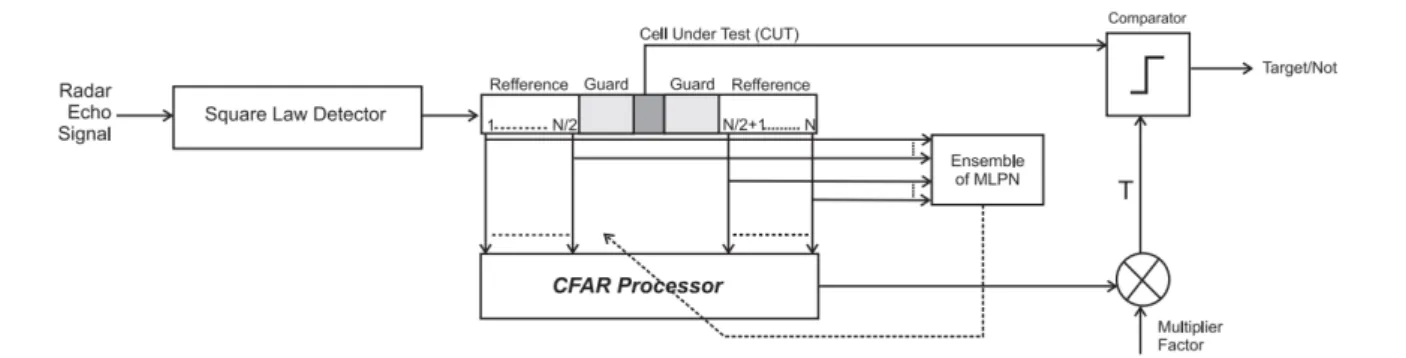
This research proposes the implementation of an ensemble model of MLPNs with varied hidden neuron number for building a homogeneity classifier of radar environment. The result of this classifier is the information of homogeneity of radar background signal. Using this classification, the selection of detection algorithm CFAR can be more effective and accurate. Although some adaptive CFAR designs have been proposed in previous research, the focus was on the detection accuracy only. In contrast, this research will focus on the improvement of classification accuracy as part of the development of such selective CFARs. The very high classification of radar environment will lead the high performed adaptive CFAR. This will initiate a different perspective and new paradigm in the development of high-performance radar target detection system focusing in the classification of radar environment. Figure 1 shows the possible implementation of the proposed classifier in the adaptive selection CFAR for improving radar target detection. In that scheme, the classifier is processed prior to the CFAR threshold process. The result of classification then will select the best match CFAR algorithm depending on the radar environment. For example, if the classifier results in a h omogeneous environment status, the systems will select CA-CFAR for threshold process while the classifier detects a non-homogeneous environment, the system can select OS-CFAR, VI-CFAR or others. However, there are also many other possible schemes for integrating the proposed classification with target detector design.
TABLE 1
CFARALGORITHM IN THREE POSSIBLE ENVIRONMENTS
CFAR
Radar environment Homog
eneous
Multi- target
Clutter boundary
1. CA X - -
2. GO - - X
3. SO - X -
4. OS - X -
The rest of this paper is organized as follows: section II describes radar environment and multi-layer perceptron network. The methodology of this research is explained in section III followed by results and discussion in section IV. Then the last part, section V, gives the conclusion obtained from all conducted studies explained in this paper.
II. RADAR ENVIRONMENT AND MULTI-LAYER PERCEPTRON NETWORK
A. Radar Environment
In radar systems, the electromagnetic wave is transmitted to and from an object. The returned wave is called echo which will be processed further to determine the object parameters such as position and velocity. Commonly, radar systems consist of a transmitter, receiver, signal generator and a s ignal processor (See Figure 2).
A radar target detector is aimed to be able to maintain the predetermined probability of false alarm
against homogeneous and non-homogeneous
interference. CFAR detector estimates the statistic of those interferences to calculate the threshold value in order to keep the false alarm rate constant. However, in the response to the presence of high interferences including noise and clutter, the higher threshold can maintain the false alarm rate but it will degrade the detection probability. That is the main problem of target detector designing.
Generally, the radar environment can be separated into three types [1], [2], [4] as follows (See Figure 3), 1) Homogeneous
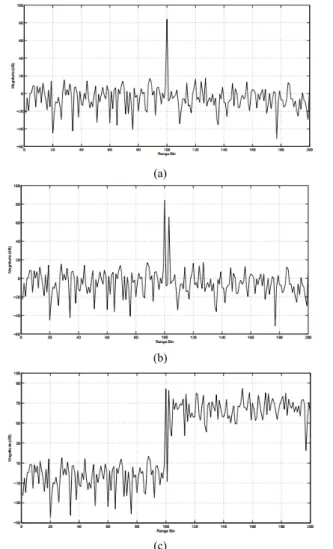
In the homogeneous condition, the interference in both leading and lagging windows of CFAR and in the CUT is Independent Identical Distributed. This condition is illustrated in Figure 3a which target is located in cell index 100 (CUT) with the signal to noise ratio (SNR) value is 30dB. The leading and lagging cells (besides of cell index 100) do not contain any returns from other targets which will bias the threshold estimate of CFAR. Actually, this condition is too restrictive with the real conditions [5]. The highest performed CFAR algorithm for this condition is CA-CFAR..
2) Multi-target
Target masking happens when there are one or more targets are located in surround the CUT. The illustration of this condition is illustrated in Figure 3b. In this figure, the target is located in cell index 101
(CUT) and this target is masked by another target located in cell index 102. If the energy of the masking target is higher than or about the same as that of the target in CUT, it will decrease the threshold process. 3) Clutter Boundary
Instead of thermal noise and jamming, the clutter interferences can make the radar echoes become non-homogeneous. The radar signal can be echoed by some possible areas such as open land, forest or water area. When the CUT is located in the surround of clutter cells which have different reflectivity, this will affect to statistic value of leading and lagging cells. As the result, this will affect the false alarm rate in the CFAR processing [4]. F igure 3c shows this condition which
Figure 2. General Design Of Radar Systems
(a)
(b)
(c)
Figure 3. Three Radar Environments in 200 Cells With Target in Cell Index 100 (a) Homogeneous, SNR=30dB (b) Target Masking
In Cell Index 102 SNR=30dB (c) Clutter Wall Since Cell Index 102 to The End SNR=30dB
commonly used are Gaussian, Rayleigh, Weibull, lognormal and K-distribution. Those distributions will be selected based on some backgrounds such as level of grazing angle terrain, imagery resolution, and reflection from other sources. In this research, the radar system is assumed to have a low grazing angle and low resolution so that the environment can be assumed as Rayleigh distributed [18]. However, after passing the square law detector, it becomes exponential distribution.
The Rayleigh distribution is mathematically defined as below,
𝑓𝑓(𝑥𝑥) =𝜎𝜎𝑥𝑥2𝑒𝑒− 𝑥𝑥2
2 𝜎𝜎2,𝑥𝑥 ≥0 (1) where 𝑥𝑥 is feature data and 𝜎𝜎 is scale factor. If scale factor is equal 2, the distribution became Weibull distribution. Then the exponential distribution employed in this research as below,
𝑓𝑓(𝑥𝑥) =𝛽𝛽1𝑒𝑒−(𝑥𝑥−𝜇𝜇𝛽𝛽 ),𝑥𝑥 ≥ 𝜇𝜇;𝛽𝛽> 0 (2) where 𝜇𝜇 is the location parameter and 𝛽𝛽 is the scale parameter. If the 𝜇𝜇 = 0 and 𝛽𝛽 = 1 the distribution is called as standard exponential distribution.
C. Multi-layer Perceptron Network
MLPN is a popular type of artificial neural networks. This neural network has one or more hidden layer between its input and output layer [19]. Other than the hidden layer, MLPN also has other components like common neural network structure including layer, neuron, weight and activation function. The layer is a set of neurons. A neuron is a place for multiplying the weight and input then running the activation function. The weight is the multiplier value of input in the neural network. See Figure 4, 𝑥𝑥𝑗𝑗 is input of neural network.
The summation of weighted input 𝑣𝑣𝑘𝑘, can be computed
as,
𝑣𝑣𝑘𝑘=∑𝑝𝑝𝑗𝑗=1𝑤𝑤𝑘𝑘𝑗𝑗𝑥𝑥𝑗𝑗 (3)
The output of the neurons 𝑦𝑦𝑘𝑘would therefore be the
outcome of some selected activation function on the value of 𝑣𝑣𝑘𝑘.
III. RESEARCH METHODOLOGY
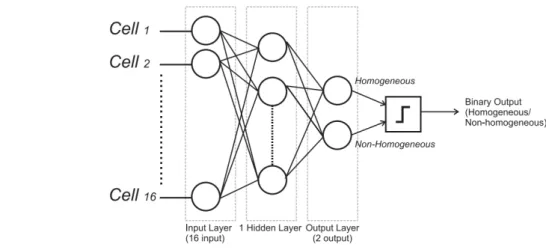
The artificial neural network used in this research was MLPN with one hidden layer. The input to those neural networks is as many as reference cells number commonly used in CFAR algorithm which is 16 cells for limiting the computation complexity (see Figure 5). The possible output of MLPN is two conditions/status. They are for the homogeneous and non-homogeneous environments. The number of the hidden neurons will be evaluated which is limited from 1 to 16 neurons.
According to the evaluation of performances of MLPN, the best three MLPN structures will be selected. Those three MLPN will be a p art of the proposed ensemble of the classifier. Then, the selected classifier will be trained with training data as many as 1.8 × 10⁵ that consists of homogeneous and non-homogeneous environments (target masking and clutter boundary). In the evaluation step, the ensemble was evaluated by testing data as many as 2.4 × 10⁵. The signal qualities investigated have SNR ranged from 0dB to 20dB while CNR is within 5dB to 20dB. The result of individual MLPN will be voted to decide the final result whether the background is homogeneous or not based on the majority results. Figure 6 is the illustration of the proposed ensemble MLPN.
Figure 4. Common Structure of MLPN
Noise signal will be assumed to come from thermal effects which will be assumed to be Gaussian distributed. Then, the clutter signal will be assumed as Rayleigh distribution. Both signals will pass the square law detector and are converted to be exponentially distributed. The target is assumed as Swerling I/II target. The evaluation of this method was investigated by comparing the final classification with single MLPN.
IV. RESULTS AND DISCUSSIONS A. Evaluation of Hidden Neuron Number
Firstly, the variable of a number of hidden neurons has to be determined based on i ts best performance. Based on the comparison in Table 2, it can be seen clearly that a higher number of hidden neuron has a higher level of classification accuracy. The aim of this evaluation is to select the best three models which have high accuracy and simple structure.
The first step of this selection is conducted by separating those models into three smaller groups. Roughly, depending on the accuracy, the models can be divided into three groups that are a group which has accuracy lower than 85%, between 85%-89%, and more than 89%. In the first group, it can be seen clearly that the member are the models with 1 to 5 hidden neurons. Among those models, the model with 4 hidden neurons has high detection rate with a simple structure. Comparing with 5 hidden neuron model, this model has slightly lower accuracy but has a s impler structure. Therefore, the 4 hidden neuron model is selected. Then, in the second group, the members are MLPN with 6 to 11 hidden neuron. The 8 hidden neuron model is considered as the best one since this model has high accuracy. Using similar method, the model with 12 hidden neurons is selected among the third group members because its accuracy is almost same with the highest value of the group but it has the simplest model. In consequence, those three models (4, 8 and 12 hidden neurons) were used for building an ensemble classifier.
B. Building, Training, and Evaluation The Ensemble Model of MLPN
Then we test the developed ensemble MLPN by using homogeneous and non-homogeneous environment
scenarios. Table 3 shows the comparison of classification result of the proposed classifier and individual classifier using single layer MLPN. According to those simulation results, the proposed method has relatively higher performance than the single MLPN based classifier. The improvement of homogeneity classification accuracy is about 12% in all possible radar environments.
In the non-homogeneous environment including clutter boundary and target masking, the ensemble classifier has relatively higher performance than the individual classifier. Moreover, in the target masking case, it can be seen that the individual classifier cannot classify well especially single MLPN with 32 hidden neurons. This shows that the proposed ensemble
TABLE 2
TRAINING AND EVALUATION OF MLPN
No Hidden Neuron
MSE on Training
Detection
Rate (%) Selected
1 1 68,1 61.875
2 2 25,5 77.575
3 3 17,3 78.342
4 4 13,2 84.342 Selected
5 5 7,4 84.467
6 6 7,75 85.458
7 7 7,75 87.717
8 8 6,28 89.642 Selected
9 9 6,8 89.033
10 10 5,57 89.967
11 11 4,5 88.533
12 12 4,28 90.717 Selected
13 13 3,87 91.033
14 14 3,95 90.733
15 15 3,18 90.792
16 16 2.084 90.858
TABLE 3
COMPARISON OF CLASSIFICATION RATE
No
Classifier Model
Rate of Classification
All Homo-geneous
Clutter Boundary
Multi- target 1 MLPN 4 79,83 67,46 97,26 65,68 2 MLPN 8 82,37 83,96 96,39 66,55 3 MLPN 12 82,25 91,35 95,39 59,79 4 MLPN 16 82,65 88,02 95,87 63,89 5 MLPN 32 82,81 92,46 94,89 60,64 6 Ensemble 4-8-12 94,75 84,17 100 100 Figure 6. Structure of Ensemble Neural Network
two conditions. Since the ensemble aims to increase the accuracy by reducing the variance in prediction errors, it can be ascertained that the variance of prediction error in the homogeneous cases is larger than in the non-homogeneous.
Thus, regarding the result of classification using the proposed method mentioned above, the further implementation of adaptive CFAR potentially will provide higher detection accuracy than the conventional ones. Then, since that this proposed method is developed for classifying the environment homogeneity so that the adaptive approach can be like the adaptive selection between the best match for those both conditions. As mentioned in the beginning of this article, the possible design of CFAR implementing this classification can be like Figure 1 which the detector can select adaptively between two or more different CFARs depend the result of classification.
V. CONCLUSIONS
We have described the implementation of ensemble classifier for radar environment classification in this paper. The ensemble structure employs three single MLPNs with 4, 8 and 12 hidden neurons and majority voting as combining method. The input of this classifier is the reference cells as many as 16 cells commonly used in the CFAR algorithm. The three possible radar environments considered for evaluating this classification detection rate are homogeneous, target masking and clutter boundary. According to the simulation results, the proposed classifier outperforms the conventional MLPN based classifier. Overall conditions, the improvement of the classification accuracy using ensemble method is up to 12% than the single ones. Moreover, in the clutter and target masking environments, the proposed method can classify the homogeneity of the radar environment almost perfectly.
ACKNOWLEDGEMENT
This research was supported by Research Center for Electronics and Telecommunication, Indonesian Institute of Sciences (PPET-LIPI). Then, authors would like to thank the colleagues who supported this research.
homogeneous background,” Aerospace and Electronic Systems, IEEE Transactions, Vol. 24, No. 4, pp 427– 445, July 1988.
[5] B. M. Keel, “Chapter 16 Constant false alarm rate detectors,” in
Principles of Modern Radar: Basic Principles. SciTech Pub.,
2010.
[6] M. E. S mith, and P. K. Varshney, “VI-CFAR: A n ovel CFAR algorithm based on data variability,” in Proc. IEEE National Radar Conference, pp. 263 – 268, 1997.
[7] N.B. Gálvez, et al., “Improved neural network based CFAR detection for non homogeneous background and multiple target situations,” Latin American applied research, vol 42, no. 4, pp.
343-350, 2012.
[8] B. P. A. Rohman, D. Kurniawan and M.T. Miftahusudur, “Switching CA/OS CFAR for radar target detection in non-homogeneous environment,” in Proc. of 17th IEEE International
Electronic Symposium, 2015.
[9] L. Rokach, “Ensemble-based classifiers,” Artificial Intelligence Review, vol. 33, no. 1-2, pp. 1-39, 2012.
[10] L. K. Hansen and P. Salamon, “Neural Network Ensembles,”
IEEE Transactions on Pattern Analysis and Machine Intelligence, vol. 12, pp. 993-1001, Oct 1990.
[11] A. Rahman, S. Tasnim, “Ensemble classifiers and their applications: a r eview,” International Journal of Computer Trends and Technology (IJCTT), Vol. 10 No.1, pp. 31-35, April
2014.
[12] U. Naftaly, N. Intrator and D. Horn, “Optimal ensemble averaging of neural networks,” Network: Computation in Neural Systems, pp. 283-296, 1997.
[13] I. Maqsood, M. R. Khan, A. Abraham, “An ensemble of neural networks for weather forecasting,” Neural Computing and Applications, Vol. 13, No. 2, pp 112–122, Jun. 2004.
[14] Y. Li, S. Gao, and S. Chen, “Ensemble feature weighting based on local learning and diversity,” in Proc. 26th AAAI Conf. Artificial Intelligence, 2012, pp. 1019–1025.
[15] P. McLeod, B. Verma, "Variable hidden neuron ensemble for mass classification in digital mammograms," IEEE Computational Intelligence Magazine, Vol. 8, Issue. 1, pp 68-76,
Feb. 2013.
[16] D. K. Barrow, S. F. Crone, "Crogging (cross-validation aggregation) for forecasting - A novel algorithm of neural network ensembles on time series subsamples," in Proc. The 2013 International Joint Conference on Neural Networks (IJCNN), 2013.
[17] M. Pulido, P. Melin, “Ensemble neural network optimization using the particle swarm algorithm with type-1 and type-2 fuzzy integration for time series prediction,” Recent Advances on Hybrid Approaches for Designing Intelligent Systems, Springer
International Publishing, 2014, pp 99-112
[18] M. Sekine, Y. Mao, “Weibull Radar Clutter”, United Kingdom:
Peter Peregrinus Ltd., 1990.