Modelling Emergency Evacuation of Classroom with Different
Age Profiles
Lakshmi Devi Vanumu
1, Aditya Arya
2, Hari Krishna Gaddam
3, K. Ramachandra Rao
41,2,3,4 Indian Institute of Technology, Delhi Hauz Khas, New Delhi, India
[email protected]; [email protected]; [email protected]; [email protected]
Abstract - Evacuation characteristics of pedestrians can be captured under two different conditions - one in immediate and another in non-immediate. The safe and quick evacuation of pedestrians from a building in any situation depends on pedestrian and building characteristics. Understanding the behaviour of pedestrians in emergency situations such as earthquake or fire accident helps in designing buildings for safe evacuation. In view of the limited research on this problem in the Indian subcontinent, this study aims to capture the pedestrian flow characteristics in emergency situations by conducting several experiments in a classroom environment. As a part of the experimental study, the students were instructed to behave as if they were in an emergency evacuation situation. Data was collected on pedestrians with different age profiles such as high school, under graduate and post graduate students considering various scenarios that includes different door widths. Several factors such as number of pedestrians, width of the door, average age of the pedestrians, Body Mass Index, proportion of females, number of students and classroom capacity are considered and their influence on evacuation characteristics was analysed. Based on the observations, an evacuation model has been developed using least square error method. Results show that the variables such as door width and number of students are crucial in representing evacuation time of the classroom. It was found that the relationship between total evacuation time (TET) and door width is represented by power function. This is contrast to the findings of existing literature which shows that the relationship between flow and door width is linear. Our results are best supported by the fact that the TET is exponentially varying with door width till a particular value and remains constant for further increase in door width which is realistic in nature. It is anticipated that the results of the study would provide guidelines to various agencies on managing evacuations. This can also lead to suggestions on optimization of layouts while designing various building access facilities in an academic environment.
Keywords: Emergency Evacuation, Classroom, Total Evacuation Time, Pedestrian flow characteristics, Experiments
1. Background
Understanding the evacuation behaviour of pedestrians during emergency situations is important to prepare evacuation management strategies. Due to the lack of experience and being new to the situation, evacuees tries to get out of the risk zone as quickly as possible where available exits gets crowded and restricts proper evacuation. Most of the researchers studied the pedestrian evacuation characteristics in emergency situations by conducting several experiments in laboratory under controlled conditions.
decisions when assessing the fastest exit to evacuate. Another outcome of this study was that the egress time of the whole crowd turns out to be shorter when the evacuees behave egoistically instead of behaving cooperatively. Chen et al., [4] conducted several experiments to examine the route choice behaviour of pedestrians during evacuation of a class room having two exits. They proposed a microscopic pedestrian model based on cellular automata. The simulation results shows that the evacuation time is linearly increasing with the number of pedestrians. Li et al., [5] used social force model to simulate the emergency evacuation of a classroom during Ya’an earthquake of China in 2013. Authors tried to understand the behaviour of pedestrians in real-life emergency situation. Further, they calibrated and optimized the parameters of social force model by using a differential evolution algorithm. Bernardini et al., [6] propose an innovative database for earthquake evacuation models based on previous studies. The quantities such as speed, acceleration and distance from the obstacles were also provided. The results demonstrate how people prefer moving with an average speed of about 2.3 to 3 m/s. Moreover, fundamental diagrams obtained during earthquake emergency conditions show how, density values being equals, speeds and flows are higher in comparison to previous studies (in particular: fire evacuation and evacuation drill). Cuesta and Gwynne [7] in their study provided the data related to five evacuation experiments from the same school where Children from 4 to 16 years old were involved in the drills. A number of different performance data-sets were collected: pre-evacuation times, travel speeds, route use and evacuation arrival curves etc. Nicolas and Marcelo [8]also aimed to study the impact of behaviour of pedestrians while evacuating through the narrow exit. They aimed to study the effect of polite vs selfish behaviour of pedestrians on the process of evacuation of the heterogeneous crowd and to establish a link between complexities of humans with this behaviour. The results show that there was no collision when selfish participants were nil and with increase of selfish participants soft collision and pushing increased. It was also found that selfish behaviour of certain people is not good for rest but it enhanced the rate of flow. In summary, they found that the global flow rate enhanced monotonically with increase in selfish agents and hence supporting 'faster-is-faster' effect. Concurrently stronger intermittency is displayed in evacuation with high selfish agents. Gu et al., [9] analyse school students’ emergency evacuation behaviour in earthquakes using data extracted from videos of real emergency evacuation. Comparison between students behaviour under normal and emergency conditions were studied using regression models. The analysis revealed that student’s behaviour in normal conditions is linear whereas in emergency it is convex. However, reaction time is lower than those observed in other studies and ‘faster- is-slower’ effect has not been observed. Li et al., [10] study proposed a stair-unit model to depict the topologies of a stairwell and the results were compared with the real evacuation drills. The outcomes proved the consistency of the proposed model in representing the real behaviour. Han and Liu [11], in their paper introduced the information transmission mechanism into the social force model to simulate pedestrian behaviour in an emergency, especially when most pedestrians were unfamiliar with the evacuation environment. Results show that the pedestrians can choose the correct direction of movement with the help of information transmission mechanism and that the new model can represent the actual pedestrian behaviour during an emergency evacuation.
can assume that due to lack of experience, majority of human beings are ill-prepared in such situations and head to the nearest exit as quickly as possible in a chaotic manner.
2. Methodology
The first phase of this study deals with the experimental setup and data extraction, while the second phase deals with the model development. Further this study considered the individual characteristics of students such as gender, age, evacuation time, number of students, speeds along with different classroom characteristics such as area of the classroom, number and placement of exits, desk and chair arrangements.
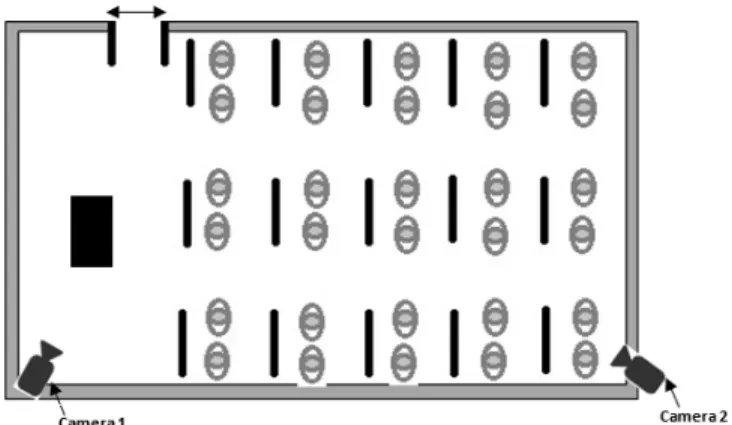
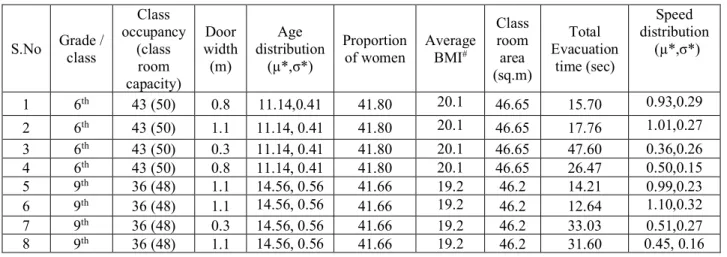
As a part of this study, seventeen experiments have been carried out in a classroom environment with different age groups of pedestrians and varying door widths. The data collected from these experiments was used to analyse the pedestrian evacuation characteristics and for the model development. The data was collected at two different places (University class room and public school class room, Delhi, India), in order to consider different age groups of pedestrians, Post-graduate (PG), Under-graduate (UG) and higher secondary school) with all possible scenarios were considered. The higher secondary school classrooms consist of movable tables and chairs on a level floor. There was only one exit provided at the entrance of the classroom. The PG and UG classrooms consist of arrangement of movable tables and chairs on a level floor with two exits. In all these experiments, students were instructed to evacuate the room from the shortest path to the exit. The evacuees were informed about the evacuation procedure before conducting the study and asked them to behave as if they were in an emergency situation. The data collection for the study was performed using video graphic technique. Videos were recorded from convenient vantage points (Fig. 1) and then data was extracted using MATLAB® based tool (Singh et al. [12]). Data analysis was carried out using Microsoft Excel and R statistical tool (R Core Team [13]). Snapshots and evacuation time details of 6th grade class room and undergraduate class room are shown in Fig.2.The data from the evacuation experiments such as flow, composition, individual travel times, individual speeds and total evacuation times were obtained and used in developing the relationship between evacuation time and characteristics of evacuees. Individual speeds of pedestrians followed normal distribution. From Fig. 2(b) it can clearly be seen that when both the doors were open, the evacuation time was less compared to other scenarios. Similarly, for UG class room, it was observed that (Fig. 2(d)) when both the exits were open, the time taken by students to evacuate the room was lowest. The details of evacuation experiments are given in Table 1. In first set of experiments, forty three students and thirty six students from sixth and ninth grade respectively have participated. There was only one exit provided at the entrance of the classroom. In second set of experiments, students from Indian Institute of Technology Delhi have participated. In the experiments, thrity eight students from UG and twelve students from PG classes were involved. In all the above experiments (both school and Univeristy) the classrooms consist of movable tables and chairs on a level floor with exits.
(a)
(b)
(c)
(d)
Fig. 2: (a) Snapshot of 6th Grade classroom (b) Cumulative evacuation times for different door widths for 6th Grade classroom; (c) Snapshot of the undergraduate class room (d) Cumulative evacuation times for
different door widths for undergraduate class room (In Fig.2 (b): big door = 0.8 m, both doors =1.1 m, small door = 0.3 m, In Fig.2 (d): two small door = 1.2 m, both doors = 3.0 m, two big doors = 1.8 m, 1 big
and 1 small = 1.5 m)
Table 1: Details of the evacuation experiments
S.No Grade / class
Class occupancy (class room capacity) Door width (m) Age distribution (µ*,σ*) Proportion
of women Average BMI#
Class room area (sq.m) Total Evacuation time (sec) Speed distribution (µ*,σ*)
1 6th 43 (50) 0.8 11.14,0.41 41.80 20.1 46.65 15.70 0.93,0.29
2 6th 43 (50) 1.1 11.14, 0.41 41.80 20.1 46.65 17.76 1.01,0.27
3 6th 43 (50) 0.3 11.14, 0.41 41.80 20.1 46.65 47.60 0.36,0.26
4 6th 43 (50) 0.8 11.14, 0.41 41.80 20.1 46.65 26.47 0.50,0.15
5 9th 36 (48) 1.1 14.56, 0.56 41.66 19.2 46.2 14.21 0.99,0.23
6 9th 36 (48) 1.1 14.56, 0.56 41.66 19.2 46.2 12.64 1.10,0.32
7 9th 36 (48) 0.3 14.56, 0.56 41.66 19.2 46.2 33.03 0.51,0.27 0 10 20 30 40 50
0 10 20 30 40
Ev ac uat ion Ti m e (se c)
Number of students
S1 (big door) S2 (both door)
0 5 10 15 20
0 10 20 30 40
Ev ac uatio n time (s ec )
Number of Students
9 UG& 38 (60) 1.2 23.80,1.20 10.50 22.5 87.86 16.80 0.93,0.38
10 UG 38 (60) 1.8 23.80,1.20 10.50 22.5 87.86 13.00 1.26,0.42 11 UG 38 (60) 1.5 23.80,1.20 10.50 22.5 87.86 11.80 1.23,0.34 12 UG 38 (60) 1.5 23.80,1.20 10.50 22.5 87.86 12.30 1.43, 0.32 13 UG 38 (60) 3.0 23.80,1.20 10.50 22.5 87.86 9.20 1.53,0.38
14 PG+ 12 (30) 1.2 25.42, 6.76 33.30 22.7 38.97 9.00 0.89,0.25
15 PG 12 (30) 1.8 25.42, 6.76 33.30 22.7 38.97 5.77 1.03,0.20 16 PG 12 (30) 1.5 25.42, 6.76 33.30 22.7 38.97 6.00 0.99, 0.22 17 PG 12 (30) 3.0 25.42, 6.76 33.30 22.7 38.97 7.20 1.33, 0.66
* µ=mean, σ=standard deviation; # BMI = Body Mass Index, &UG=Under Graduate, + PG=Post-Graduate,
2.1. Model Development
Several factors including number of pedestrians, width of the door (m), average age of pedestrians, BMI, proportion of females, class occupancy and classroom capacity were considered and their influence on evacuation characteristics were analysed. Correlation matrix between these factors was obtained. From the matrix (Fig.3), it was found that the BMI and average age are highly correlated with each other. Thus in the model development only one variable out of the two should be considered. It also shows a good correlation between evacuation time, door width, class occupancy, and BMI. Further, it is also evident that the total evacuation time of the class room is highly correlated with the door width and class occupancy i.e. number of students in the class room. Therefore the door width and class occupancy are the variables considered for model development. Based on the observations, an evacuation model (Eq. 1) was developed using least square error method (𝑅𝑅2 = 0.80).
Fig.3: Correlation Matrix between different variables in the experiment
y = 15.532*Door Width-0.78
R² = 0.7015
0 10 20 30 40 50 60
0 0,5 1 1,5 2 2,5 3 3,5
To
tal Ev
ac
uatio
n Time
(S
ec
)
3. Conclusion
Based on the evidence presented and the data analysis, the following conclusions were drawn from the study:
1. Door width, class occupancy or number of students in the class room shows significant effect on the total evacuation time (TET) of the evacuees. A non-linear relationship is observed between total evacuation time and door width where TET is exponentially decreases up to a particular door width and remains constant afterwards. It was observed that the bottleneck situation leads to increase the pushing and crushing between the pedestrians. Further, ‘faster-is-slower’ effect behaviour was also observed in the evacuation experiments.
2. The experiments were conducted on different age profiles in various class rooms. The results show that the age has little or no effect on the outcomes. However, this result cannot be generalised, whereas more variation in the age might have significant effect on the evacuation time.
3. It was found there is an inadequacy in the evacuation guidelines where they are good at improving safety but lacking in quick evacuation from the school building. These are evacuation route maps in the class rooms. More experimental studies are required to provide safety guidelines for the educational environment especially at school level.
4. It is anticipated that the results of this study could formulate better guidelines to various agencies on managing evacuations. This can also lead to suggestions on optimization of layouts while designing various building access facilities in an academic environment.
Acknowledgements
This research did not receive any specific grant from funding agencies in the public, commercial, or not-for-profit sectors. The authors would like to thank the Principal, Lancers Convent Public School, New Delhi for necessary permissions to conduct the evacuation drills.
References
[1] X.Yang, Z.Wu and Y.Li, “Difference between real-life escape panic and mimic exercises in simulated situation with implications to the statistical physics models of emergency evacuation: The 2008 Wenchuan earthquake,” Phys. A Stat. Mech. its Appl., vol.390, no.12, pp.2375-2380, 2011.
[2] W.Daamen and S. Hoogendoorn, “Calibration of Pedestrian Simulation Model for Emergency Doors for Different Pedestrian Types,” Proc. Trans. Res. Board 91st Ann. Meet., Washington D. C., USA, 2012.
[3] S.Heliövaara, J. M.Kuusinen, T.Rinne, T.Korhonen and H.Ehtamo, “Pedestrian behavior and exit selection in evacuation of a corridor–An experimental study,” Saf. Sci., vol.50, no.2, pp.221-227, 2012.
[4] L. Chen, R. Y. Guo and N.Ta, “Simulation and experimental results of evacuation of pedestrian flow in a classroom with two exits,” Acta Phy. Sin., vol.62, Issue (5): 050506, 2013. doi: 10.7498/aps.62.050506
[5] M. Li, Y.Zhao, L.He, W.Chen and X.Xu, “The parameter calibration and optimization of social force model for the real-life 2013 Ya’an earthquake evacuation in China,” Saf. Sci.,vol. 79, pp.243-253, 2015.
[6] G.Bernardini, E.Quagliarini, and M. D’Orazio, “Towards creating a combined database for earthquake pedestrians’ evacuation models,” Saf. Sci., vol.82, pp.77-94, 2016.
[8] A.Nicolas and N.Marcelo, “Influence of selfish and polite behaviours on a pedestrian evacuation
through a narrow exit : A quantitative characterisation,” arXiv : 1608 . 04863v2 [ physics . soc-ph ],
vol.18. 2016.
[9] Z. Gu, Z.Liu, N.Shiwakoti, and M.Yang, “Video-based analysis of school students’ emergency evacuation behavior in earthquakes,” Int. J. Disaster Risk Reduct., vol.18, pp. 1-11, 2016.
[10] W.Li, Y.Li, P.Yu, J.Gong, S.Shen, L.Huang and J.Liang , “Modeling, simulation and analysis of the evacuation process on stairs in a multi-floor classroom building of a primary school,” Phys. A Stat.
Mech. its Appl., vol.469, pp.157-172, 2017.
[11] Y.Han, and H.Liu, “Modified social force model based on information transmission toward crowd evacuation simulation,” Phys. A Stat. Mech. its Appl.,vol.469, pp.499-509, 2017.
[12] M. K Singh, H.K.Gaddam, L.D.Vanumu, and K.R.Rao. “Traffic Data Extraction Using MATLAB® Based Tool,” TPMDC Int. Conf., IIT Bombay, 2016.
[13] R Core Team. R: “A language and environment for statistical computing,” R Foundation for Statistical Computing, Vienna, Austria. 2015. URL https://www.R-project.org/.