61
VERIFICATION OF BEHAVIOR OF VARIETIES OF PLUM TREES IN
TERMS OF PHYSIOLOGICAL ASPECT
CICHI M1., DANIELA CICHI2
1
University of Craiova, Faculty of Agronomy, Agricultural Technology & Forestry, Street Libertății 19, Craiova, Romania; [email protected] 2
University of Craiova, Faculty of Horticulture, Horticulture & Food Science Department, Street A.I.Cuza 13, Craiova, Romania; [email protected]
Keywords: variety, rootstock, physiological processes
ABSTRACT
In the country there are many areas favorable to the plum species, and the Oltenia area has proved to be an area with particularly favorable climatic conditions. Leaves are the main organ in which photosynthesis, respiration, sweating processes take place. The intensity of the photosynthesis process is influenced by both internal and external factors. The variety and rootstock have a particular influence on the intensity of the photosynthesis process, especially the Miroval rootstock. The varieties that
showed greater intensity of
photosynthesis were Anna Spath, Diana. The intensity of the respiration process varies depending on variety, rootstock, and phenophase. The plum varieties grafted on the Miroval rootstock
recorded higher values of the respiration process. Chlorophyll content of the leaves varies with phenophase and the a/b chlorophyll ratio was higher in the phenophase of intense growth of shoots (CIL).
The leaf carotenoid pigment had a mean value over the vegetation period ranging from 8.68 mg/100 g to the intense growth of shoots (CIL), 9.49 mg/100 g in the slowing down the growth of shoots (ICL) and 8.88 mg/100 g at the fruit ripening (IPF). In all three phenophases, there is a total content in pigments larger in the case of grafted varieties on the Miroval rootstock, followed by those on the Oteşani 8 and Pixy rootstocks.
INTRODUCTION
An important role in the growth and fruiting of fruit trees is the carrying out of the physiological processes, but also the influence of the variety, the rootstock on the growth, the fruiting and the obtaining of quality fruits. Studies, research on plum species culture have covered various aspects.
The study of the physiological processes of fruit trees was also dealt with by Burzo I. et al. (1999), which presents the physiological bases of tree multiplication, tree organ growth, and the main physiological processes that occur in fruit trees. Also, Gucci R. et al. (1989), according to the results obtained, indicate that the intensity of the photosynthesis
process varies also depending on the light radiation received by the leaves, which depends on the position of the leaves in the crown of the tree.
Some researches carried out by Sams C.E. et al. (1982), point out that during the growing season of trees, the photosynthesis process is intensified with the growth of the leaves. This process decreases with the transition to the senescence phase.
62
Julien A on the growth of the Avalon, Edda, Excalibur, Jubileum, Reeves and Victoria varieties. Varieties grafted on Pixy gave the highest yield except for the Victoria variety.
Kaufmane E. et al. (2007), study the influence of rootstocks on plum varieties in terms of growth, fruiting and productivity. The Kometa variety was more productive than the Minjona variety grafted on the Saint Julien A rootstock.
Voiculescu N. et al. (2006),
conducted a case study on 5 plum varieties, namely Stanley, Tuleu gras, Anna Spath, Vânăt de Italia and Vânăt Românesc on 18 soils in four different climatic locations, where they studied the structure of production and the quality of plum fruits.
Milusheva S. et al. (2011), studied the resistance of some hybrids to the
plum-pox virus. After 5 years of
cultivation, the results showed that the H 21-47 hybrid remained free of PPV symptoms, whereas in the other 3 hybrids, namely the 3, 55 and 21-67 the virus was detected in 7.7 %, 23.5% and 42.1% of the plants tested.
Botu M. et al. (2017), study the physiological characteristics of some European plum varieties in Oltenia area. They studied some parameters, namely the photosynthesis rate, the transpiration rate, the active photosynthetic radiation from the leaf surface. The physiological factors have varied according to the varieties and the time of recording the data.
Manganaris G.A. et al. (2010), studied the causes of redness of pulp in
stone fruits, including plum species. The authors conclude that the redness of the pulp is not due to refrigeration but due to some aspects of fruit storage.
Other authors studied the
variety/rootstock combination, so
Pedersen B.H. (2010), investigated the behavior of two plum varieties Ive and Kirke on 13 rootstocks. The best growth was provided by Ishtara Ferciana and GF 655-2. The most productive rootstocks were GF 655-2 x Ive and Ishtara Ferciana with the Kirke variety.
Gaudillere J. et al. (1990), mention in their paper that the growth rate of a variety and a sort is influenced by the rootstock, and the amount of chlorophyll was higher on the Marianna rootstock than on Pixy small rootstock.
Research has shown that
sometimes leaf chlorophyll content has a positive correlation with the intensity of the photosynthesis process (Cappellini P. et al., 1992). Not always the content of
chlorophyll is correlated with the
photosynthesis process.
Gaudillere, J. et al. (1992), specify that the saturation limit for light radiations
is 900 μmol/m2
/ s for heliophilous plants. Dettori S. (1985), specifies in his research that the intensity of the
transpiration process decreases
proportionally with the decrease in soil water content. Decrease of soil moisture
causes a decrease in stomatal
conductance.
Plant growth is strictly conditioned by physiological parameters, with a role in the shape and size of plants, the structure of the crown, in external production.
MATERIAL AND METHOD
The experience was located in Oltenia (in the southern area of the country), comprising seven varieties (Diana, Silvia, Tuleu Gras, Renclod Althan, Alina, Valor and Anna Spath) with the crown of a superimposed vessel grafted on three rootstocks, namely Oteşani 8, Pixy and Miroval. The planting distance between the rows was 4.0 m
and among the trees in a row of 4.0 m. Maintenance works were applied, the plum species specific treatments (10-12), cuttings applied to the trees during the rest period.
63
the variant. The objectives of this experience were:
- Analysis of physiological
processes, photosynthesis, respiration, chlorophyll a/b ratio, carotenoid content in leaves and total pigments content, respectively.
All these phenomens have been studied in three final phenophases, and namely: intense growth of shoots (CIL), slowing down the growth of shoots (ICL) and fruit ripening (IPF).
In interpreting the physiological processes we harvested plum leaves from the stems located at the base, in the
middle and on the top of the trees. Also, the leaves harvested from these stems were harvested from the middle of the stem.
Statistical processing of individual data was carried out with the help of CSS Statistica.
The experience was located near the City of Craiova, on a reddish preluvosoil, with a pH of 6.5-6.7 medium supplied in macro and microelements. The data was recorded over a three-year period.
RESULTS AND DISCUSSIONS
Results on the photosynthesis process:
The Miroval rootstock achieves an average of the intensity of photosynthesis higher than the other two rootstocks Oteşani 8 and Pixy in all three final phenophases.
Thus, in the intense growth of shoots (CIL), the seven plum varieties grafted on the Miroval rootstock recorded an average of the photosynthesis process of 212.5 mg CO2/dm2, on the Oteşani 8 rootstock the average of photosynthesis was 208.4 mg CO2/dm2 and on the Pixy
rootstock the intensity of the
photosynthesis was the lowest, that is 202.5 mg CO2/dm2.
At the slowing down the growth of shoots (ICL) plum varieties on Miroval had a photosynthesis value of 222.6 mg
CO2/dm2, on Oteşani 8 rootstock of 216.5
mg CO2/dm2 and on the Pixy rootstock a
photosynthesis value of 208.8 mg CO2/dm2.
At the fruit ripening, the values recorded were the following:
- on Miroval - the intensity of
photosynthesis was 229.6 mg CO2/dm2;
- on Oteşani 8 - the intensity of
photosynthesis was 223.7 mg CO2/dm2;
- on Pixy - the intensity of
photosynthesis was 218.1 mg CO2/dm2.
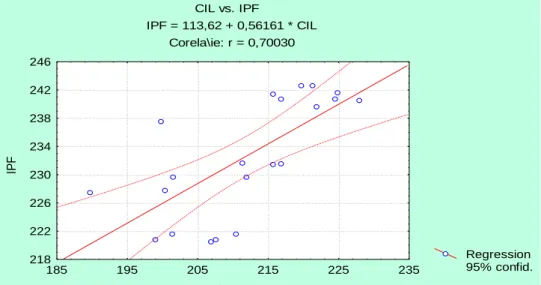
The varieties that showed a higher intensity of photosynthesis were Anna Spath, Diana followed by Alina, Valor, Tuleu Gras, Renclod Althan and Silvia. There were very significant correlations between the three phenophases (Figure 1, Figure 2 and Figure 3).
Regression 95% confid. CIL vs. ICL
ICL = 65,690 + 0,75050 * CIL Corela\ie: r = 0,83481
CIL
IC
L
208 214 220 226 232 238 244
185 195 205 215 225 235
64
The Anna Spath variety had a high photosynthesis intensity at the slowing down the growth of shoots phenophase (ICL), so the values were: Anna
Spath/Oteşani 8 - 230.5 mg CO2
/dm2,
Anna Spath/Pixy - 221.6 mg CO2/dm2
and Anna Spath/Miroval - 236.8 mg CO2/dm2.
Regression 95% confid. CIL vs. IPF
IPF = 113,62 + 0,56161 * CIL Corela\ie: r = 0,70030
CIL
IP
F
218 222 226 230 234 238 242 246
185 195 205 215 225 235
Fig. 2 - Correlations between intense growth of shoots (CIL) and fruit ripening (IPF)
Regression 95% confid. ICL vs. IPF
IPF = 46,845 + 0,82678 * ICL Corela\ie: r = 0,92683
ICL
IP
F
218 222 226 230 234 238 242 246
208 214 220 226 232 238 244
Fig. 3 - Correlations between slowing down the growth of shoots (ICL) and fruit ripening (IPF)
Results on the intensity of the respiration process of plum varieties leaves:
The plum varieties grafted on the Miroval rootstock recorded higher values of the respiration process in all three phenophases, but also in the three analyzed years. In the intense growth of shoots (CIL) the average respiration intensity of the seven varieties on the
Miroval rootstock was 298.5 mg CO2/
kg/h, on Oteşani 8 rootstock was 292.5
mg CO2/kg/h and on Pixy rootstock, the
respiration intensity was 284.2 mg CO2/ Kg/h.
Of the varieties studied, two plum varieties were revealed with a more intense respiration process in all three phenophases, namely Diana and Renclod Althan.
The smallest values of the intensity of this process had the variety Tuleu Gras on all three rootstocks and all three phenophases, presenting values ranging
65
284.1 - 300.0 mg CO2/ kg/h on Oteşani 8
and 287.8 - 308.2 on Miroval rootstock. In the slowing down the growth of shoots phenophase (ICL), an average of respiration process is recorded of 301.3 mg CO2/ kg/h, higher than in the intense growth of shoots phenophase (CIL) - 291.5 mg CO2/kg/h as a result of normal foliage formation.
Also, in the final organ harvesting phenophase, namely fruit ripening (IPF), the respiration process is more intense
(313.2 mg CO2/kg/h), than the two
vegetative final phenophases: intense growth of shoots (CIL) and slowing down
the growth of shoots (ICL) - (291.5, 301.3
mg CO2/Kg/h). This aspect shows that
the leaves begin to age, and the assimilations are directed to the fruits.
There are very significant positive correlations between phenophases, such as the intense growth of stems (CIL) and the slowing down the growth of shoots (ICL) - (r = +0.90), between the intense growth of shoots (CIL) and the fruit ripening (IPF) (r = +0.88), between fruit ripening (IPF) and slowing down the growth of shoots (ICL) - (r = +0.93) in the respiration process, (Table 1).
Table 1
Correlations between CIL, ICL and IPF
Variable
Marked correlations are significant at p < 0.05
Intense growth of shoots (CIL)
Slowing down the growth of shoots
(ICL)
Fruit ripening
(IPF) Intense growth
of shoots (CIL)
1,00 0,906* 0,887*
N=21 N=21* N=21*
p= --- p=0,00* p=0,00*
Slowing down the growth of
shoots (ICL)
0,906* 1,00 0,931*
N=21* N=21 N=21*
p=0,00* p= --- p=0,00*
Fruit ripening (IPF)
0,887* 0,931* 1,00
N=21* N=21* N=21
p=0,00* p=0,00* p= ---
Results regarding the pigment content of plum leaves in the studied varieties:
Chlorophyll a/b ratio: This ratio varies according to phenophase, species, variety, rootstock. Based on the results obtained, it was found that the mean value of the chlorophyll a/b ratio, was higher in the intense growth of shoots phenophase (CIL) than at the slowing down the growth of shoots (ICL). The explanation is the greater biosynthesis of chlorophyll a compared to chlorophyll b.
By analyzing only the effect of the variety on the chlorophyll a/b ratio, we found that some varieties such as Alina,
Renclod Althan, Valor, Tuleu Gras and Anna Spath showed a lower value of this ratio in slowing down the growth of shoots phenophase (ICL).
Analyzing the rootstock effect on the chlorophyll a/b ratio, we noticed that only two rootstocks namely Miroval and Oteşani 8, have a greater influence on the ratio especially in fruit ripening phenophase (IPF).
A significantly positive correlation was established between the intense
growth of shoots (CIL) from the
66
Table 2 Correlations between CIL (Respiration) and IPF (Ratio of chlorophyll a/b)
Variable
Marked correlations are signicant at
p < 0.05
Ratio of chlorophyll a/b – Fruit ripening (IPF) Respiration - Intense growth
of shoots (CIL)
0.6244 N=21 p=0,002
Carotenoids:
In the two analyzed years, the seven plum varieties on the three rootstocks had a carotenoid pigment content in the leaves an average value of 8.68 mg/100g for the intense growth of shoots (CIL) and of 9.49 mg/100g for s slowing down the growth of shoots (ICL). On the fruit ripening (IPF), the average value of the content was 8.88 mg/100g.
Varieties grafted on the Miroval rootstock had the highest content of carotenoid pigments compared to the
other two rootstocks in all three
phenophases.
Practically in the slowing down the growth of shoots phenophase (ICL), there is the highest increase in carotenoid pigments in the three analyzed years and on all three rootstocks.
A significantly positive correlation is achieved between ICL (photosynthesis) and ICL (carotene) where r = + 0.4509 and between ICL (photosynthesis) and IPF (carotene) where r = + 0.5046, (Table 3).
Table 3
Correlations between ICL (photosynthesis) and ICL, IPF (carotene)
VARIABLE Marked correlations are signicant at
p < 0.05
(Carotene) - Slowing down the growth of shoots (ICL)
(Carotene) - Fruit ripening
(IPF) (Photosynthesis) - Slowing down
the growth of shoots (ICL)
0,4509* 0,5046*
N=21* N=21*
p=0,04* p=0,02*
Total content of pigments
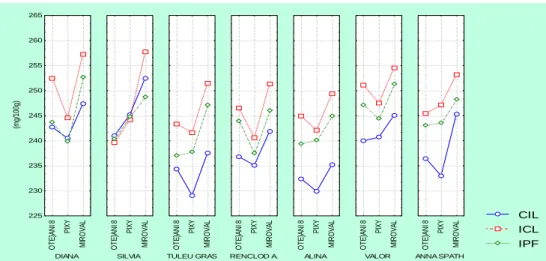
(chlorophyll a + chlorophyll b + carotene) (Figure 4):
The highest average value in total pigment content showed all the varieties found on the Miroval rootstock in all three phenophases, this being 241.1 mg/100g.
Then followed the varieties on the Oteşani 8 rootstock, where the average value was 237.5 mg/100g. Varieties of Pixy rootstock recorded the lowest value of 232.4 mg/100g.
A total pigment content is achieved in all the three years analyzed for the final
vegetative phenophase, namely the
slowing down the growth of shoots (ICL) being 245.9 mg/100g.
It is highlighted with a high content of total pigments in intense growth of shoots (CIL) the following combinations:
Silvia/Miroval (254,1 mg/100g),
Silvia/Pixy (241,6 mg/100g) and
67 CIL ICL IPF DIANA (m g/ 10 0g ) 225 230 235 240 245 250 255 260 265 O T E }A NI 8 P IX Y M IRO V A L SILVIA O T E }A NI 8 P IX Y M IRO V A L TULEU GRAS O T E }A NI 8 P IX Y M IRO V A L RENCLOD A. O T E }A NI 8 P IX Y M IRO V A L ALINA O T E }A NI 8 P IX Y M IRO V A L VALOR O T E }A NI 8 P IX Y M IRO V A L ANNA SPATH O T E }A NI 8 P IX Y M IRO V A L
Fig. 4 - Total pigments content to several varieties of plum
The rootstock is distinctly
significantly positive correlation with the
total pigment content of the two
vegetative final phenophases: slowing
down the growth of shoots (ICL) - (r = +0.5765) and fruit ripening (IPF) - (r = +0, 6033), (Table 4).
Table 4
Correlations between rootstock and ICL, IPF (total pigments content)
Variable Marked correlations are signicant at
p < 0.05
Slowing down the growth of shoots (ICL) – Total pigments
content
Fruit ripening (IPF) – Total pigments content
Rootstock 0,576* 0,603*
N=21* N=21*
p=0,00* p=0,00*
CONCLUSIONS
1. Based on the recorded data we
found that the intensity of the
photosynthesis process oscillates each year and can be influenced by the variety, the rootstocks and the variety x rootstock combination.
2. In the two vegetative
phenophases the intense growth of shoots (CIL) and the slowing down the growth of shoots (ICL), the intensity of photosynthesis was higher at the second phenophase (ICL), because growth and formation of new leaves, lead to greater assimilation or greater intensity of photosynthesis.
3. The rootstock has a particular
influence on the intensity of the
photosynthesis process, and the Miroval
rootstock which induce greater vigour to the varieties, shows a higher intensity of photosynthesis.
4. The Pixy rootstock falls with the
lowest values of the intensity of
photosynthesis, both in vegetative
phenophases and generative
phenophase after the Miroval and Oteşani 8 rootstocks.
5. The Diana and Renclod Althan varieties showed a stronger respiration than the other varieties in all the phenophases and on all three rootstocks.
6. The Tuleu Gras variety showed the least intensity of the respiration process in all phenophases and on all three rootstocks.
68
rootstock was greater than the Pixy and Miroval rootstocks refering to chlorophyll a/b ratio in the phenophases: intense growth of shoots (CIL) and the slowing down the growth of shoots (ICL).
8. The varieties found on Pixy rootstock recorded the smallest content of
carotenoids in the three phenophases. 9. Varieties on Pixy rootstock were highlighted with the smallest values of total pigment content.
10. All seven varieties of plums have found optimal conditions for growing and fruiting in conditions in Oltenia area.
BIBLIOGRAPHY
1. Botu, M., Stephen, F., Botu, I., Manthos, I., Nicholas, I., 2017.
Physiological characteristics of several cultivars of European plum (Prunus Domestica) in the conditions of northern Oltenia-Romania. Acta Horticulturae (ISHS) 1175:61-66, Vol. 1.
2. Burzo, I., Toma, S., Olteanu, I., Dejeu, I., Elena Delian, Hoza, D., 1999.
Fiziologia plantelor de cultură, vol. 3, Fiziologia pomilor fructiferi și a viței de vie, 9-252.
3. Capellini, P., Dettori, M.T., 1992. The photosynthetic activity of different peach genotypes, ISHS Acta Horticulturae 315: Peach, XXIII IHC, 71-80.
4. Dettori, S., 1985. Leaf water potential, stomatal resistance and transpiration response to different watering in almond, peach and Pixy plum, (ISHS) Acta Horticulturae 171: I International Symposium on Water Relations in Fruit Crops, 181-186.
5. Gaudillere, J., Moing, A., Renaud, R., Carbone, F., 1990.
Comparison of carbon assimilation and partitioning of two varieties of Prunus Domestica L. grafted on four differenr rootstocks. (ISHS) Acta Horticulturae 283: IV International Symposium on Plum and Prune Genetics, Breeding and Pomology, 163-172, vol. 1.
6. Gaudillere, J., Moing, A., 1992.
Photosynthesis of peach leaves: light adaptation, limiting factors and sugar content. ISHS Acta Horticulturae 315: Peach, XXIII IHC, 103-110.
7. Gucci, R., Grappadelli, L.C., 1989. Riv. Fruttic. Ortofloric., 12, 75-80.
8. Kaufmane, E., Rubauskis , E., Skrivele, M., 2007. Influence of different rootstocks on the growth and yield of plum cultivars, Acta Horticulturae (ISHS) 734:387-391, Vol. 1.
9. Manganaris, G.A., Vicente, A. R., Crisosto, C. H., Labavitch, J.M., 2010. Some evidence about the physiological basis of flesh redenning symptoms in plum fruit. (ISHS) Acta Horticulturae 874: International Symposium on Plum and Prune Genetics, Breeding and Pomology, 137-140, vol. 1.
10. Meland, M., Moe, M.E., 2007.
Early performance of four plum rootstocks to six european plum cultivars growing in a northern climate. Acta Horticulturae (ISHS) 734:235-241, Vol. 1.
11. Milusheva, S., Zhivondov, A., 2011. Tests of plum hybrids for resistance to plum pox virus. (ISHS) Acta Horticulturae 899: International Symposium on Plum Pox virus, 109-112.
12. Pedersen, B.H., 2010. Early performance of two european plum cultivars on thirteen plum rootstocks.
(ISHS) Acta Horticulturae 874:
International Symposium on Plum and Prune Genetics, Breeding and Pomology, 261-268, vol. 1.
13. Sams, C.E., Flore, J.A., 1982.
Amer. Soc. Hort. Sci., 107, 339-344.