Soica C. et al./Scientific Papers: Animal Science and Biotechnologies, 2019, 52 (1)
116
Effect of the Dietary Oil Mixture for Laying Hens on the
Apparent Absorption Coefficients of Some Trace Elements
Cristina Soica, Petru Alexandru Vlaicu, Arabela Untea, Iulian Stanel
National Research-Development Institute for Biology and Animal Nutrition (IBNA), Balotesti, Romania
Abstract
A 4-week feeding trial was conducted on 48 Lohmann Brown layers (55 weeks) to evaluate the effect on zootechnical parameters and coefficients of apparent absorption of micronutrients (Cu, Fe, Mn, Zn). The layers, assigned to 2 groups, were housed in three-tier digestibility cages (4 layers/cage) which allowed the daily recording of the feed intake and excreta, located in an experimental hall under controlled environmental conditions (temperature: 22.41±0.980C; humidity: 66.35±5.68%; ventilation/chick 0.50±0.24%; CO2 level 686.39±104.38 ppm)
and 16h/24h light regimen. The control group (C) received a conventional diet (2760 kcal/kg metabolizable energy and 16.8% crude protein). Compared to C formulation, the experimental diet (E) included 0.50% oils mixture (20% buckthorn oil, 20% sesame oil, 20% rosehip oil, 20% grape oil and 20% walnut oil). The daily feed intake (at weeks 3 and 4) recorded significant decreases (P≤0.05) in group E (113.29 respectively 114.38 g/chick/day) compared to C group (115 respectively 116.13 g/chick/day). Copper absorption in E group was significantly (P≤0.05) higher (with 32.21%) than in C group, which means that the concentrations of Cu in the excreta significantly (P≤0.05) decreased in E group (0.36 mg/chick/day) compared to C group (0.52 mg/chick/day). This is a positive aspect regarding the soil pollution with Cu. For Fe and Mn, the mineral concentrations in the excretion did not differ significantly (P≥0.05), showing that the supplement administered in the E diet did not affect the possible mineral load at the soil level.
Keywords: nutrient digestibility, oils, performances, poultry.
1. Introduction
Various medical plants have been used for years in daily life to treat disease all over the world [1]. Also, they have served humans for a wide variety of purposes for many years [2]. According to a
study performed by the World Human
Organization (WHO) based on publications on pharmacopoeias and medical plants in 91 countries, the plants that inhibit microorganisms and are important for human health have been researched in laboratories since 1926 [3]. Essential oils are already used as feed supplements to improve growth performance under intensive management systems [4]. Generally, these essential oils are admitted as safe by the Food and
Drug Administration (FDA). They inhibit
microbial growth in the gut and enhance nutrient
* Cristina Soica - email: [email protected]
117 those few reports available, supplementation of layer diets with herbal essential oils may affect performance parameters such as egg production rate, egg weight, feed intake and feed conversion ratio [9,10,11]. Layers diets are often supplemented with oils to meet the energy demands of modern genotypes [12]. Although there are many studies treating the use of by-products of these plants in animal feeding, but those regarding dietary nutrients digestibility are rather few. Rosehips oils contains carotenoids and phenols, which are important antioxidants [12; 13], sesame oil has high phytic acid content is deficient in lysine but high in other essential amino acids [14]. The buckthorn oils are rich in vitamins E, K [15; 16], carotenoids (lycopene, β-carotene), tocopherols (α-tocopherol is the most abundant), tocotrienols and sterols [17;18]. Nut oils have extremely variable nutrient levels (protein, lipids and fibre), depending on the extraction process [19]. Grape oil contains a wide range of bioactive compounds (polyphenols and flavonoids) which can offer many beneficial properties [20; 21]. However, the effects of oils mixture (OM) on performances and nutrient digestibility of laying hens have not been studied extensively. The purpose of this study, was to test the effect of an OM consisting of rosehip, sesame, grape, buckthorn and walnut oils on layers performances and coefficients of apparent absorption of micronutrients.
2. Materials and methods
The feeding trial was conducted in the experimental halls of the National Research-Development Institute of Animal Biology and Nutrition (IBNA-Balotesti, Romania) according to a protocol approved by the Commission of Ethics of the institute. The chicks from the two experimental groups (C and E) were housed in digestibility cages (4 chicks/cage) stacked in 3 tiers, which allowed the daily recording of the feed ingestion and of the excretion.
The trial was conducted in an experimental hall with controlled environmental conditions (average temperature/total growth period 22.41 ± 0.980C; humidity 66.35±5.68%; ventilation/chick 0.50±0.24%; CO2 level 686.39±104.38 ppm). The
light regimen was adequate to layers age (16h light). The chicks had free access to the feed and water. The objective of the feeding trial, the age
and feeding requirements of the birds (Lohman Brown Guide) were taken into consideration when the diet formulations were developed.
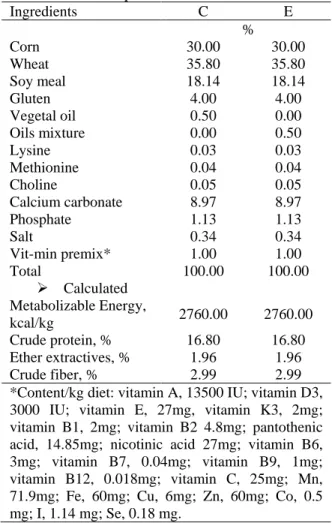
All diets were composed mainly of maize, soybean meal and sunflower meal (Table 1), with a standard vitamin premix. Compared to the formulation for group C, the E group formulations included 0.50% OM (rosehip, sesame, grape, buckthorn and walnut oils) in equal proportions (0.20%) (Table 1). Samples of the finished compound feeds (about 500 g/group) were collected for chemical analyses. The coefficients of apparent absorption of the nutrients were determined using the balance technique in week 4. The amounts of ingested feed and of excreted droppings were recorded for 5 consecutive days. The droppings were collected daily, for 5 days, at the same hour, weighed and stored in refrigerator (4OC); average weekly samples (6 samples/group) were formed, homogenized and dried in the drying oven, for 48 h, at 65OC.
Table 1. Compound feeds formulations
Ingredients C E
%
Corn 30.00 30.00
Wheat 35.80 35.80
Soy meal 18.14 18.14
Gluten 4.00 4.00
Vegetal oil 0.50 0.00
Oils mixture 0.00 0.50
Lysine 0.03 0.03
Methionine 0.04 0.04
Choline 0.05 0.05
Calcium carbonate 8.97 8.97
Phosphate 1.13 1.13
Salt 0.34 0.34
Vit-min premix* 1.00 1.00
Total 100.00 100.00
Calculated Metabolizable Energy,
kcal/kg 2760.00 2760.00
Crude protein, % 16.80 16.80
Ether extractives, % 1.96 1.96
Crude fiber, % 2.99 2.99
*Content/kg diet: vitamin A, 13500 IU; vitamin D3, 3000 IU; vitamin E, 27mg, vitamin K3, 2mg; vitamin B1, 2mg; vitamin B2 4.8mg; pantothenic acid, 14.85mg; nicotinic acid 27mg; vitamin B6, 3mg; vitamin B7, 0.04mg; vitamin B9, 1mg; vitamin B12, 0.018mg; vitamin C, 25mg; Mn, 71.9mg; Fe, 60mg; Cu, 6mg; Zn, 60mg; Co, 0.5 mg; I, 1.14 mg; Se, 0.18 mg.
Soica C. et al./Scientific Papers: Animal Science and Biotechnologies, 2019, 52 (1)
118 analysed for the matter, at 65-1030C (DM); protein (CP); fat (EE); fibre (CF); Ash (ash). The chemical analyses were performed according to Regulation (CE) no. 152/ 2009 (Sampling and analytical methods for the official inspection of feeds): gravimetric method for the dry matter (DM); the Kjeldahl method for the crude protein (CP); extraction in organic solvents for the ether extractives (EE); acid hydrolysis followed by alkaline hydrolysis for the crude fibre (CF); gravimetric method for the ash (Ash). The recorded data on the amounts of ingested feeds and excreted droppings, corroborated with the analytical data regarding the concentrations of nutrients in the feeds and droppings, allowed making the balance calculations. The absorbed amount was considered to be the difference between the ingested amount of nutrients and the amount of excreted droppings. The coefficient of apparent absorption was calculated as the ratio of the absorbed amount of nutrient to the amount of ingested nutrient, multiplied by 100.
Statistical analysis: The analytical data were compared by variance analysis (Anova), using StatView for Windows (SAS, version 6.0). The differences between the average values within the groups were considered significant for P <0.05.
3. Results and discussion
The trance minerals (Cu, Fe, Mn, Zn) from compound feeds were analysed from one batch. The concentrations of trace minerals from the two experimental diets did not exceed the requirements specific to the species and category and are detailed in table 2. Because of the regulatory restrictions, the dietary Cu level is limited; solutions are sought for indirect stimulation of Cu absorption in the organism [22], its absorption being limited by homeostatic mechanisms after the requirement was met.
Table 2. Content of trace elements in the compound feeds
Item C E
ppm
Copper (Cu) 7.06 6.45
Iron (Fe) 499.55 490.17
Manganese (Mn) 124.67 121.33
Zinc (Zn) 103.58 107.23
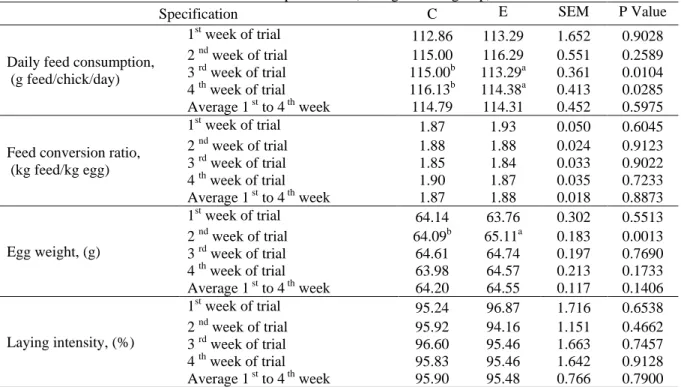
Throughout the experimental period, the following zootechnical parameters were monitored: daily feed consumption (g feed/chick/day); feed conversion ratio (kg feed/ kg egg); the egg weight (g) and the intensity of laying (%). Table 3 shows layer performance.
Table 3. Zootechnical parameters (average values/group)
Specification C E SEM P Value
Daily feed consumption, (g feed/chick/day)
1st week of trial 112.86 113.29 1.652 0.9028
2 nd week of trial 115.00 116.29 0.551 0.2589
3 rd week of trial 115.00b 113.29a 0.361 0.0104
4 th week of trial 116.13b 114.38a 0.413 0.0285
Average 1 st to 4 th week 114.79 114.31 0.452 0.5975
Feed conversion ratio, (kg feed/kg egg)
1st week of trial 1.87 1.93 0.050 0.6045
2 nd week of trial 1.88 1.88 0.024 0.9123
3 rd week of trial 1.85 1.84 0.033 0.9022
4 th week of trial 1.90 1.87 0.035 0.7233
Average 1 st to 4 th week 1.87 1.88 0.018 0.8873
Egg weight, (g)
1st week of trial 64.14 63.76 0.302 0.5513
2 nd week of trial 64.09b 65.11a 0.183 0.0013
3 rd week of trial 64.61 64.74 0.197 0.7690
4 th week of trial 63.98 64.57 0.213 0.1733
Average 1 st to 4 th week 64.20 64.55 0.117 0.1406
Laying intensity, (%)
1st week of trial 95.24 96.87 1.716 0.6538
2 nd week of trial 95.92 94.16 1.151 0.4662
3 rd week of trial 96.60 95.46 1.663 0.7457
4 th week of trial 95.83 95.46 1.642 0.9128
Average 1 st to 4 th week 95.90 95.48 0.766 0.7900
119
overall experimental period, there were no significant differences between the two groups. Feed conversion ratio (kg feed/kg egg) and laying percentage (%) were not affected by the experimental diet. The average egg weight (g)
was significantly (P≤0.05) higher in
experimental week 2 in E group than in C group, but there were no statistically significant differences for the overall experimental period. The average egg weight for E group was 0.54% than for C group, but the difference was not statistically significant (P≥0.05%). According to [23], dietary oil mixture supplementation has no effect on body weight gain, egg production, egg weight, egg mass, feed intake, feed conversion ratio, and mortality during the experiment (P>0.05). These results are in agreement with the findings of [8;24], and [25] who showed that essential oil mixture had no effect on performance in laying hens. On the other hand, some researches have showed the positive effect of essential oils on performance in laying hens [9;8]. Bolukbasi [9], reported that egg weight and feed conversion ratio were improved by supplementation of thyme, sage, and rosemary oil in laying hens. Bozkurt [26] reported similar results. Çabuk [27] also confirmed that supplementation with oil mixture to the basal diet significantly increased egg production and improved (P<0.01) feed conversion ratio.
The same author, stated that the addition of OM, to the layer diet did not affect the daily feed intake of the laying hens significantly, but regarding the feed conversion ratio, there were significant differences between the treatment groups. Bozkurt [26] also stated that the egg production rate of hens fed a diet supplemented with OM was 2.19% higher, than that of hens receiving the standard control diet (P<0.01) and the egg production did not differ for hens on the OM supplemented diet.
Table 4 shows the manure content of trace elements (Cu, Fe, Mn and Zn). Copper is an essential trace element for animals, present in many enzyme systems in the body, [28] where it serves as a co-factor.
Iron (Fe) 1715.21 1713.59 8.752 0.9313
Manganese (Mn) 405.49 434.14 7.809 0.0627
Zinc (Zn) 318.02b 332.62a 3.114 0.0102
*Where: a-b mean values within a row having different superscripts are significantly different by least significant difference test (P<0.05);
Soica C. et al./Scientific Papers: Animal Science and Biotechnologies, 2019, 52 (1)
120
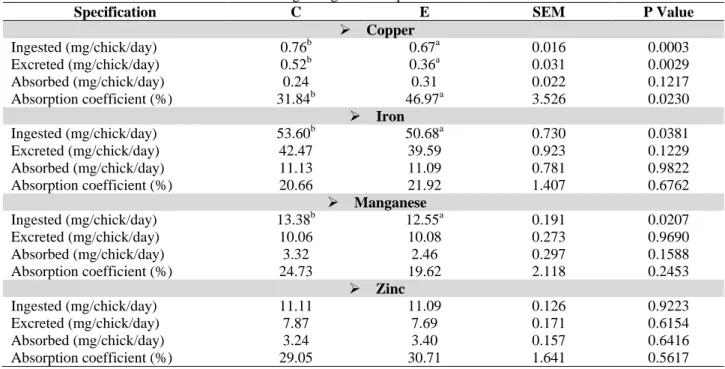
Table 5. Data regarding the absorption of trace elements
Specification C E SEM P Value
Copper
Ingested (mg/chick/day) 0.76b 0.67a 0.016 0.0003
Excreted (mg/chick/day) 0.52b 0.36a 0.031 0.0029
Absorbed (mg/chick/day) 0.24 0.31 0.022 0.1217
Absorption coefficient (%) 31.84b 46.97a 3.526 0.0230
Iron
Ingested (mg/chick/day) 53.60b 50.68a 0.730 0.0381
Excreted (mg/chick/day) 42.47 39.59 0.923 0.1229
Absorbed (mg/chick/day) 11.13 11.09 0.781 0.9822
Absorption coefficient (%) 20.66 21.92 1.407 0.6762
Manganese
Ingested (mg/chick/day) 13.38b 12.55a 0.191 0.0207
Excreted (mg/chick/day) 10.06 10.08 0.273 0.9690
Absorbed (mg/chick/day) 3.32 2.46 0.297 0.1588
Absorption coefficient (%) 24.73 19.62 2.118 0.2453
Zinc
Ingested (mg/chick/day) 11.11 11.09 0.126 0.9223
Excreted (mg/chick/day) 7.87 7.69 0.171 0.6154
Absorbed (mg/chick/day) 3.24 3.40 0.157 0.6416
Absorption coefficient (%) 29.05 30.71 1.641 0.5617
*Where: a-b mean values within a row having different superscripts are significantly different by least significant difference test (P<0.05); SEM-standard error of the mean.
Table 5 shows the results for trace element balance parameters. There were statistically significant differences between the experimental and control treatments regarding the ingested Cu (P<0.05), Fe (P<0.05) and Mn (P<0.05). The digestibility parameters of Cu showed a significant decrease for the excreted copper. The digestibility parameters of Cu showed a significant improvement for the E group. Copper is a trace element essential to animal health, but this element must be used in very low amounts. Exceeding the recommended dose leads to hazardous health effects [37]. It is an essential trace element that fulfils a very large variety of functions in animal organisms. Cu and Zn are synergistic elements, Zn functions being improved by copper-containing enzymes. For example, lysyl oxidase is an enzyme that contains copper, helping to synthesize collagen-derived proteins. With the occurrence of Cu deficiency, elastin and collagen cannot be synthesized, leading to problems with the elasticity of the cardiovascular system and the skeletal system [38]. From the data presented, it can be concluded that supplements used (0.50% OM) in the experimental diets of the laying hens improved the absorption of Cu and Zn, thus reducing the negative impact of manure on the environment. The Fe and Mn levels were also modified by the dietary supplementation with OM, but the effects were not observed clearly. The
results of this feeding trial show a higher copper absorption in the organism under the influence of an OM.
4. Conclusions
The average daily feed intake (g feed/bird/day), was significantly (P≤0.05) higher in group C than in group E in the experimental weeks 3 and 4. Feed conversion ratio (kg feed/kg egg) and laying percentage (%), were not affected by the experimental diet formulation. The average egg weight (g) was significantly (P≤0.05) higher in the second experimental week, in group E compared to group C. The average egg weight in group E was 0.54% higher than in group C, but the difference was not statistically significant.
The excreted amounts of Cu decreased
significantly (P≤0.05) in group E compared to group C, which is a good thing in terms of environmental pollution with Cu.
5. Acknowledgements
121
Performance-Projects funding excellence in R&D, Contract no.17 PFE"
References
1. Ates, D. A., & Erdogrul, O. T. (2003). Antimicrobial Activities of Various Medicinal and Commercial Plant Extracts. Turkish Journal of Biology, 27(3).
2. Jones, F.A. (1996) Herbs – useful plants. Their role in history and today. European Journal of Gastroenterology and Hepatology 8, 1227–1231.
3. Erdogrul Ö.T. (2002) Antibacterial Activities of Some Plant Extracts Used in Folk Medicine. Pharm. Biol. 40: 269-273.
4. William, P., Losa, R., 2001. The use of essential oils and their compounds in poultry nutrition. World Poultry 17 (4), 14–15.
5. Kamazeri, T. S. A. T., Samah, O. A., Taher, M., Susanti, D., & Qaralleh, H. (2012). Antimicrobial activity and essential oils of Curcuma aeruginosa, Curcuma mangga, and Zingiber cassumunar from Malaysia. Asian Pacific journal of tropical medicine, 5(3), 202-209.
6. Saini, R., S. Davis, and W. Dudley-Cash. (2003a). Oregano essential oil reduces the expression of coccidiosis in broilers. Pages 97–98 in Proc. 52th Western Poult. Dis. Conf., Sacramento, CA.
7. Saini, R., S. Davis, and W. Dudley-Cash. 2003b. Oregano essential oil reduces necrotic enteritis in broilers. Pages 95–97 in Proc. 52th Western Poult. Dis. Conf., Sacramento, CA.
8. Bozkurt M, Kucukyilmaz K, Pamukcu M, Cabuk M, AlcicekA, Catlı AU (2012b) Long-term effects of dietary supplementation with an essential oil mixture on the growth and laying performance of two layer strains. Ital J Anim Sci 11:23–28.
9. Bölükbaşı, Ş.C., Erhan, M.K., Kaynar, Ö., (2007). Effect of dietary thyme oil on laying hens performance, cholesterol ratio of egg yolk and Escherichia coli concentration in feces. Int. J. Nat. Eng. Sci. 1:55-58. 10. Bölükbaşı, Ş.C., Erhan, M.K., Kaynar, Ö., (2008). The Effect of feeding thyme, sage and rosemary on laying hen performance, cholesterol and some proteins ratio of egg yolk and Escherichiac coli count in feces. Arch. Geflugelkd. 72:231-237.
11. Bölükbaşı, Ş.C., Kaynar, Ö., Erhan, M.K., Ürüşan, H., (2009). Effect of feeding Nigella sativa on
hen performance, cholesterol and some proteins ratio of egg yolk and Escherichia Coli count in feces. Arch. Geflugelkd. 73:167-172.
12. Loetscher, Y., Kreuzer, M., & Messikommer, R. E. (2013). Oxidative stability of the meat of broilers supplemented with rosemary leaves, rosehip fruits, chokeberry pomace, and entire nettle, and effects on performance and meat quality. Poultry science, 92(11), 2938-2948.
13. Vlaicu, P. A., Panaite, T. D., Dragotoiu, D., Ropota, M., Bobe, E., Olteanu, M., & Criste, R. D. (2017). Feeding quality of the meat from broilers fed with dietary food industry by-products (flaxseed, rapeseeds and buckthorn meal, grape pomace). Scientific Papers: Series D, Animal Science-The International Session of Scientific Communications of the Faculty of Animal Science, 60.
14. Ahammad, M. U., Swapon, M. S. R., Yeasmin, T., Rahman, M. S., & Ali, M. S. (2003). Replacement of sesame oil cake by duckweed (Lemna minor) in broiler diet. Pak. J. Biol. Sci, 6(16), 1450-1453.
15. Vlaicu, P. A., Panaite, T. D., Criste, R. D., Olteanu, M., Ropota, M., Criste, V., Vasile, G., & Grosu, I. (2017). Production parameters, carcass development and blood parameters of the broiler chick fed diets which include rapeseed, flax, grape and buckthorn meals. Scientific Papers Animal Science and Biotechnologies, 50(1), 37-45.
16. Zeb A. (2006). Anticarcinogenic potential of lipids from hippophae – Evidence from the recent literature. Asian Pac J Cancer P. 7: 32-34.
17. Cenkowski S, Yakimishen R., Przybylski R., Muir W. E. (2006). Quality of extracted sea buckthorn (Hippophae rhamnoides L.) seed and pulp oil. Can Biosyst Eng. 48: 3.9-3.16
18. Kumar R., Kumar G. P., Chaurasia O. P., Singh S. B. (2011). Phytochemical and pharmacological profile of Seabuckthorn oil: a review. Res J Med Plant. 5: 491-499.
19. Panaite, T. D., Criste, R. D., Ropota, M., Olteanu, M., Mitoi, M., Varzaru, I., & Untea, A. (2017). Effect of using nuts meal in diet formulations on layer performance and egg quality. Lucrări Științifice-Universitatea de Științe Agricole și Medicină Veterinară, Seria Zootehnie, 67, 156-160.
20. Turcu, R. P., Olteanu, M., Ropota, M., Mitoi, M., & Drăgotoiu, D. (2018). Characterization of some Winery by-Products Used in Animal Feeds. Scientific Papers: Animal Science & Biotechnologies/Lucrari Stiintifice: Zootehnie si Biotehnologii, 51(1), 55-61.
21. Olteanu, M., Criste, R. D., Panaite, D. T., Ropota, M., Vlaicu, P. A., & Turcu, R. P. (2017). Bioproductive parameters and fatty acids profile of the meat from broilers treated with flax meal and grape seeds meal. Scientific Papers Animal Science and Biotechnologies, 50(1), 15-21.
22. Fang, Y. Z., Yang, S., & Wu, G. (2002). Free radicals, antioxidants, and nutrition. Nutrition, 18(10), 872-879.
23. Olgun, O., & Yıldız, A. Ö. (2014). Effect of dietary supplementation of essential oils mixture on performance, eggshell quality, hatchability, and mineral excretion in quail breeders. Environmental Science and Pollution Research, 21(23), 13434-13439.
Soica C. et al./Scientific Papers: Animal Science and Biotechnologies, 2019, 52 (1)
122
of dietary mannan oligosaccharide and herbal essential oil blend supplementation on performance and oxidative stability of eggs and liver in laying hens. Ital J Anim Sci 11:223–229.
25. Kaya A, Kaya H, Macit M, Celebi S, Esenbuga N, Yoruk MA, Karaoglu M (2013) Effects of dietary inclusion of plant extract mixture and copper into layer diets on egg yield and quality, yolk cholesterol and fatty acid composition. Kafkas Univ Vet Fak Derg 19:673–679
26. Bozkurt M, Kucukyilmaz K, PamukcuM, Cabuk M, AlcicekA, Catlı AU (2012b) Long-term effects of dietary supplementation with an essential oil mixture on the growth and laying performance of two layer strains. Ital J Anim Sci 11:23–28.
27. Cabuk M, Bozkurt M, Alcicek A, Catli AU, Baser KHC (2006). Effect of a dietary essential oil mixture on performance of laying hens in the summer season. S Afr J Anim Sci 36:215–221
28. Kim, G.B., Seo, Y.M., Shin, K.S., Rhee, A.R., Han, J. and Paik, I.K. (2011) Effects of supplemental
copper-methionine chelate and copper-soy proteinate on the performance, blood parameters, liver mineral content, and intestinal microflora of broiler chickens. The Journal of Applied Poultry Research 20: 21-32. 29. Skřivan, M., Skřivanová, V., & Marounek, M. (2005). Effects of dietary zinc, iron, and copper in layer feed on distribution of these elements in eggs, liver, excreta, soil, and herbage. Poultry Science, 84(10), 1570-1575.
30. Salim, H.M., Jo, C. and Lee, B.D. (2008) Zinc in broiler feeding and nutrition. Avian Biology Research 1:5-18.
31. Underwood, E.J. and Suttle, N.F. (1999) The mineral nutrition of livestock. CAB International, Wallingford, UK.
32. Petrescu, M. (2009). Tratat de știința și ingineria materialelor metalice vol 3. Metale. Aliaje. Materiale speciale. Materiale compozite, Editura Agir, București, 2009.
33. Yan F, Waldroup PW (2006) Evaluation of
Mintrex® manganese as a source of manganese for young broilers. Int J Poult Sci 5:708–713.
34. Keen, C.L., Enunsha, J.L., Watson, M.H., Baly, D.L., Donovan, S.M., Monaco, M.H. and Clegg, M.S. (1999) Nutritional aspects of manganese from experimental studies. Neurotoxicology 20: 213- 223. 35.Keen, C.L., Enunsha, J.L. and Clegg, M.S. (2000) Manganese metabolism in animals and humans
including the toxicity of manganese. Metal Ions in Biological Systems 37: 89-121.
36. Yildiz, A.O., Cufadar, Y. and Olgun, O. (2011) Effects of dietary organic and inorganic manganese supplementation on performance, egg quality and bone mineralisation in laying hens. Revue de Medecine Veterinaire 162: 482-488.
![Table 4 shows the manure content of trace elements (Cu, Fe, Mn and Zn). Copper is an essential trace element for animals, present in many enzyme systems in the body, [28] where it serves as a co-factor](https://thumb-us.123doks.com/thumbv2/123dok_us/8042613.2129604/4.893.446.830.122.252/content-elements-copper-essential-element-animals-present-systems.webp)