Original Research Article
Study of prevalence and pattern of peripheral neuropathy in patients
with liver cirrhosis
Mahim Mittal, Pavan Kumar Singh, Sonu Kurian*
INTRODUCTION
Cirrhosis of liver is a major health problem and leads to several complications. Cirrhosis is the final pathway for a wide variety of chronic liver diseases characterized by diffuse hepatic fibrosis with replacement of normal liver architecture by nodules. Etiology of cirrhosis can be usually identified by patient’s history combined with laboratory, imaging and histologic evaluation. Alcohol, Hepatitis B and C related cirrhosis are the leading causes of cirrhosis with varying prevalence in different geographic areas.1 Cirrhosis has an array of mild to
encephalopathy, esophageal varices, gastric varices and variceal bleed to name a few. Both peripheral neuropathy and autonomic neuropathy are reported in cirrhosis.2-7
These studies have shown variable prevalence of peripheral neuropathy in cirrhosis from 19-80%. The relation of peripheral neuropathy to etiology of cirrhosis is also poorly defined. A predominant sensory type with axonal type more predominant than demyelination peripheral neuropathy was shown in several studies.2,4,7,8
The studies on relation of peripheral neuropathy to the severity of cirrhosis also show variability in
ABSTRACT
Background: Peripheral neuropathy is not an uncommon complication of liver cirrhosis but it is not given much clinical relevance. The pattern and prevalence of peripheral neuropathy has also not been studied extensively. Alcohol use, coexisting diseases and nutritional deficiency have been postulated as factors responsible for neuropathy. The aim of this study was to define the pattern and prevalence of neuropathy in cirrhosis and to determine any etiologic correlation.
Methods: 85 patients of cirrhosis of liver were studied. Apart from routine investigations, serum vitamin B12 estimation was also done in these patients. Electrophysiological studies were done in 46 patients.
Results: Alcohol was the most common etiology of cirrhosis (57.6%). Hepatitis B related (11.8%) and Hepatitis C (4.7%) were other etiologies. The prevalence of peripheral neuropathy by electrophysiological studies was found to be 67.39% in cirrhosis of any etiology, of which 43.5% had sensorimotor type and the predominant pattern of peripheral neuropathy was mixed axonal degeneration and demyelination. The peripheral neuropathy was significantly more (p=0.01) in child class C than other child classes. Prevalence of neuropathy had no significant difference (p=1.00) between alcoholic and non-alcoholic cirrhosis. No correlation was present with either serum vitamin B12 levels or blood glucose levels.
Conclusions: Peripheral neuropathy is present in more than half of cirrhosis patients and is unrelated to etiology and nutritional status but related to the severity of cirrhosis.
Keywords: Diabetes mellitus, Liver cirrhosis, Peripheral neuropathy, Serum vitamin B12 Department of Medicine, BRD Medical College, Gorakhpur, Uttar Pradesh, India
Received: 04 May 2017 Accepted: 29 May 2017
*Correspondence: Dr. Sonu Kurian,
E-mail: [email protected]
Copyright: © the author(s), publisher and licensee Medip Academy. This is an open-access article distributed under the terms of the Creative Commons Attribution Non-Commercial License, which permits unrestricted non-commercial use, distribution, and reproduction in any medium, provided the original work is properly cited.
This study was carried out to find the prevalence and pattern of peripheral neuropathy and their etiological correlation in a rural teaching tertiary care hospital in north India.
METHODS
All the consenting patients with cirrhosis of any etiology admitted in Medicine department during the study period from January 2016- January 2017 with the approval of Institutional ethical committee were taken up for the study. Cirrhosis was diagnosed on a clinical basis along with a combination of supporting laboratory tests, ultrasonographic evidence of cirrhosis-shrunken or nodular liver, portal vein dilation, splenomegaly and ascites or by endoscopic evidence of esophageal varices. Apart from patients with pedal edema hampering electrophysiological test all the rest were taken up for electrophysiological tests.
Detailed clinical examination was done and apart from basic liver function tests, other special tests like serum vitamin B12 was also done. Motor and sensory electrophysiological tests were performed in the upper and lower limbs on right ulnar, median, common peroneal posterior tibial and sural nerves using Neuroperfect plus-4Ch EMG/ NCV/ EP (Medicaid systems) machine and the motor and sensory nerve conduction results were charted. The results were analysed and interpreted based on the normal nerve conduction values as detailed in standard references.18
Data entry and analysis was done by using IBM SPSS version 22 software. The qualitative data were expressed in proportion and percentages and the quantitative data as mean and standard deviation. The difference in proportion was analysed using Fisher exact test wherever applicable and the difference in means was analysed using Student’s T test. Significance level for tests was
determined as 95% (p < 0.05). The difference was significant if p <0.05. 2×2 Fisher exact test was used to find the significance of study parameters on categorical scale between two groups.
RESULTS
85 patients of cirrhosis were studied, of which electrophysiological tests were done in 46 patients. Among 85 patients, 72 (84.7%) of them were males and 13 (15.3%) were females. Alcoholic cirrhosis was the most common etiology accounting for 57.6% of cases, followed by Hepatitis related cirrhosis. 11.8% were Hepatitis B related and 4.7% were Hepatitis C related cirrhosis. In 25.9% of cases the cause of cirrhosis could not be ascertained. There were 13(15.3%) diabetic patients and 72 (84.7%) non-diabetic patients.
Diabetic patients were mostly on oral hypoglycemic drugs and their mean HbA1c was 5.43±0.37. Clinical features found were ascites (95.29%), splenomegaly (60.0%), icterus (35.3%), hepatic encephalopathy (32.9%), Spider nevi (27.1%), clubbing (11.8%) and caput medusa (14.1%). Alanine transaminase (ALT) levels were abnormal in a higher number (75.29%) of patients than abnormal Aspartate transaminase (AST) levels (42.35%). Serum Bilirubin levels were within two times upper limit of normal in most patients (76.47%). 9 (10.6%) were in Child A class, 26 (30.6%) in Child B and 50 (58.8%) in Child C class.
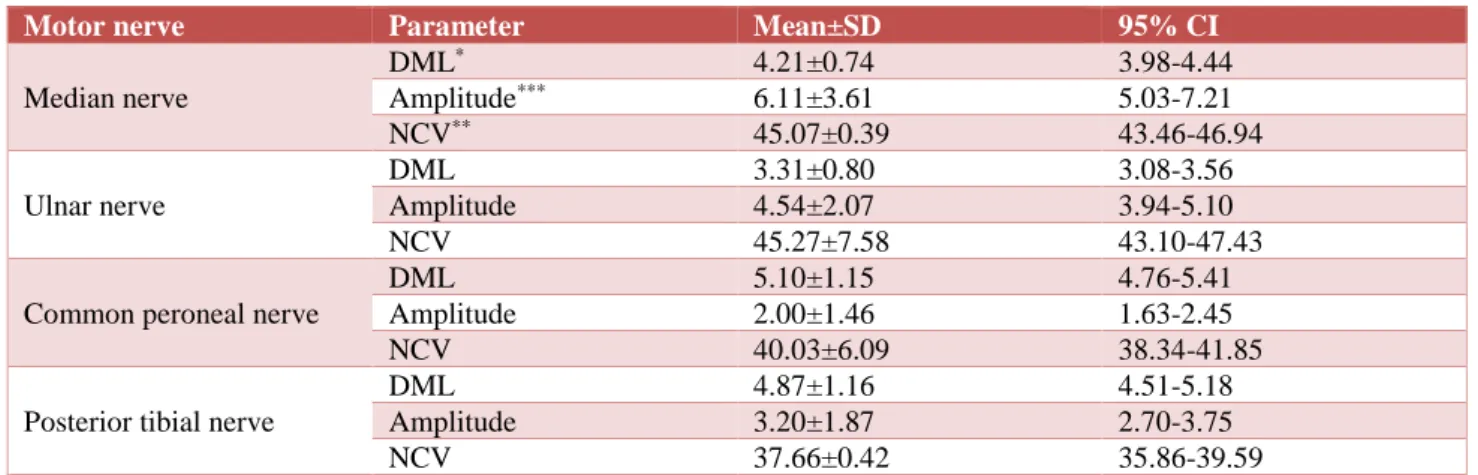
Tables 1 and 2 show the results of electrophysiological studies. Among 46 patients, 31 (67.39%) had peripheral neuropathy. 9 (29.03%) had sensory pattern, 3 (9.67%) had motor pattern and 2 0 (64.51%) had mixed sensorimotor pattern of peripheral neuropathy. Electrophysiological tests showed that 4 (12.90%) had axonal, 3 (9.67%) had demyelination and 24 (77.41%) had mixed pattern of peripheral neuropathy.
Table 1: Results of motor nerve conduction studies.
Motor nerve Parameter Mean±SD 95% CI
Median nerve
DML* 4.21±0.74 3.98-4.44
Amplitude*** 6.11±3.61 5.03-7.21
NCV** 45.07±0.39 43.46-46.94
Ulnar nerve
DML 3.31±0.80 3.08-3.56
Amplitude 4.54±2.07 3.94-5.10
NCV 45.27±7.58 43.10-47.43
Common peroneal nerve
DML 5.10±1.15 4.76-5.41
Amplitude 2.00±1.46 1.63-2.45
NCV 40.03±6.09 38.34-41.85
Posterior tibial nerve
DML 4.87±1.16 4.51-5.18
Amplitude 3.20±1.87 2.70-3.75
NCV 37.66±0.42 35.86-39.59
Table 2: Results of sensory nerve conduction studies.
Sensory nerve Parameter Mean±SD 95% CI
Median nerve
Amplitude* 16.89±3.10 13.74-21.11 NCV** 40.30±7.64 36.47-43.54
Ulnar nerve
Amplitude 13.63±5.07 12.18-15.13 NCV 36.87±4.28 32.86-40.87
Sural nerve
Amplitude 6.99±5.28 5.48-8.58 NCV 30.03±7.20 25.46-35.51
*in millivolts (mV), **Nerve conduction velocity in meter/seconds (m/s), CI-confidence interval
Table 3 shows the distribution of peripheral neuropathy among three Child classes. With regards to etiology, there was no statistically significant difference (p=1.00) in prevalence of peripheral neuropathy between alcoholic (66.66%) and non-alcoholic (68.42%) etiology of cirrhosis. Peripheral neuropathy was present in all
cirrhotic patients with diabetes and in 61.53% without diabetes but there was no significant difference (p=0.078). The mean serum vitamin B12 levels in patients with peripheral neuropathy was 1425±128pg/mL and in patients without neuropathy was 1390±147 pg/mL with no significant difference (p=0.5626) between them.
Table 3: Distribution of peripheral neuropathy among child classes.
Child Pugh class
Presence of neuropathy
Fisher’s exact test
Neuropathy present
Grouped Neuropathy absent
Grouped
N (n %) N (n %)
Child A 2 (6.89%)
8 2 (13.33%) 10
P value = 0.0113 Child B 6 (20.68%) 8 (53.33%)
Child C 23 (79.31%) 23 5 (0.34%) 5
DISCUSSION
The most common etiology of cirrhosis was found to be alcohol related (57.6%). Most of the Indian studies have showed a predominant alcohol related cirrhosis but studies in western population showed a predominant Hepatitis B and C related cirrhosis.7,10,12,13-15
Cirrhosis has been postulated to be associated with abnormality of glucose metabolism. This results in a higher prevalence of Diabetes mellitus (DM) in cirrhosis. The prevalence of DM in cirrhosis has been reported from 20-60%.16-19 In our study, the prevalence of DM
was 15.3%. Apart from a higher prevalence in cirrhotic, DM is also associated with more incidence of hypoglycemia, especially with oral hypoglycemic agents (OHA) and hence insulin is recommended for its control.20 The mean HbA1c was 5.43±0.37. HbA1c
although considered to be a good marker of glucose control, may be falsely low in cirrhotics.21-24
Laboratory parameter like low serum albumin which is considered specific in patients with cirrhosis, was found to be present only in 54.1% of the cirrhotic patients indicating its low sensitivity as a marker of cirrhosis. Ascites was the most common clinical finding, followed by hepatic encephalopathy. This may be due to the fact that the study was done in a tertiary hospital attending
sicker patients. Similar reason may account for the fact that most of the patients had child score C (58.8%). Splenomegaly was clinically appreciable only in 60% of cirrhotic patients indicating its low sensitivity for clinically diagnosing cirrhosis.
Sensorimotor type neuropathy was more common in our study. Similar predominance of sensorimotor damage has been shown in a recent study by Jain et al but most of the studies has shown a predominant sensory type peripheral neuropathy.2,4,7,25
A predominant demyelination type of peripheral neuropathy has been found in studies done by Chari VR et al and Dayan et al.3,26 The other set of studies have
shown that the changes in peripheral neuropathy were predominantly axonal.2,4,8,9 Most of the patients in our
study had a mixed pattern of neuropathy.
There was a significant relation (p=0.0113) between the severity of neuropathy in Child C when compared to combined Child A and B classes. Similar reports of more prevalence of neuropathy in Child's C than in class-B cirrhosis have been shown in studies by Jain et al, Chaudhry et al and few others.2,7-9,12 Studies by
Even though few probable etiological factors of peripheral neuropathy in cirrhosis like vitamin B12 deficiency, diabetes, alcohol induced neuropathy were studied, but a direct correlation with the peripheral neuropathy did not exist. As Dayan et al has suggested, the nerve damage might be due to unidentified toxic metabolites or to disordered insulin metabolism caused by the hepatic damage, we also found evidence for the same.26 Neuropathy was related to severity of liver
cirrhosis but not with any other factors. These unknown factors might warrant further investigations for its elucidation.
CONCLUSION
Peripheral neuropathy is a common complication of liver cirrhosis unrelated to the etiology of cirrhosis, presence of coexisting diabetes mellitus or serum vitamin B12 levels. The peripheral neuropathy found in liver cirrhosis is of a predominant sensorimotor, mixed axonal degeneration and demyelinating type. Routine investigations for assessing peripheral neuropathy may still not be indicated since the clinical implications are not studied extensively.
Funding: No funding sources Conflict of interest: None declared
Ethical approval: The study was approved by the institutional ethics committee
REFERENCES
1. Feldman M, Friedman LS, Lawrence JB, Sleisenger and Fordtran’s gastointestinal and liver disease - Pathophysiology/Diagnosis/Management 10th edition; Philadelphia. Saunders 2016;1254-74. 2. Chaudhry V, Corse AM, O'Brian R, Cornblath DR,
Klein AS, Thuluvath PJ. Autonomic and peripheral (sensorimotor) neuropathy in chronic liver disease: a clinical and electrophysiologic study. Hepatol. 1999;29(6):1698-703.
3. Chari VR, Katiyar BC, Rastogi BL, Bhattacharya SK. Neuropathy in hepatic disorders. A clinical, electrophysiological and histopathological appraisal. J Neurol Sci. 1977;31:93-111.
4. Kharbanda PS, Chawla YK, Das CP, Syal P. Peripheral neuropathy in liver cirrhosis. J Gastroenterol Hepatol. 2003;18:922-6.
5. Hendrickse MT, Thuluvath PJ, Triger DR. Natural history of autonomic neuropathy in chronic liver disease. Lancet. 1992;339(8807):1462-4.
6. Bajaj BK, Agarwal MP, Ram BK. Autonomic neuropathy in patients with hepatic cirrhosis. Postgrad Med J. 2003;79(933):408-11.
7. Jain J, Singh R, Banait S, Verma N, Waghmare S. Magnitude of peripheral neuropathy in cirrhosis of liver patients from central rural India. Annals Ind Academy Neurol. 2014Oct;17(4):409.
8. Perretti A, Gentile S, Balbi P, Persico M, Caruso G. Peripheral neuropathy in liver cirrhosis. A clinical
and electrophysiological study. Ital J Gastroenterol. 1995;27:349-54.
9. Knill-Jones RP, Goodwill CJ, Dayan AD, Williams R. Peripheral neuropathy in chronic liver disease: Clinical, electrodiagnostic, and nerve biopsy findings. J Neurol Neurosurg Psychiatry. 1972;35:22-30.
10. Ahmed S, Payeng D, Das AK. Etiological profile of cirrhosis of liver from north east India with reference to their anti-hepatitis A virus seroprevalence. Oncol, Gastroenterol and Hepatol Reports. 2015;4(1).
11. Electrophysiologic and laboratory aids in the diagnosis of neuromuscular disease. In: Ropper AH, Samuels MA, Klein JP, eds. Adams and Victor's Principles of Neurology, 10th ed. New York: McGraw Hill: Medical Pub. Division; 2014:1289-1390.
12. Joge NP, Kumar V, Verma S, Gupta K, Misra. Vitamin B12 associated peripheral neuropathy in cirrhosis of liver: a cross sectional study, IOSR JDMS, 2016;15(12):73-77.
13. Wiegand J, Berg T. The etiology, diagnosis and prevention of liver cirrhosis, part 1 of a Series on liver cirrhosis. Dtsch Arztebl Int. 2013;110(6):85-91.
14. Perz JF, Armstrong GL, Farrington LA, Hutin YJ, Bell BP. The contributions of hepatitis B virus and hepatitis C virus infections to cirrhosis and primary liver cancer worldwide. J Hepatol. Epub. 2006 Jun 23;45(4):529-38.
15. Scaglione S, Kliethermes S, Cao G, Shoham D, Durazo R, Luke A, et al. The epidemiology of cirrhosis in the United States: a population-based study, J Clin. Gastroenterol. 2015;49(8):690-6. 16. Tolman KG, Fonseca V, Dalpiaz A, Tan MH.
Spectrum of liver disease in type 2 diabetes and management of patients with diabetes and liver disease. Diabetes Care. 2007;30:734-43.
17. Holstein A, Hinze S, Thiessen E, Plaschke A, Egberts EH. Clinical implications of hepatogenous diabetes in liver cirrhosis. J Gastroenterol Hepatol. 2002;17:677-81.
18. Merli M, Leonetti F, Riggio O. Glucose intolerance and insulin resistance in cirrhosis are normalized after liver transplantation. Hepatol. 1999;30:649-54. 19. Nishida T, Tsuji S, Tsujii M. Oral glucose tolerance test predicts prognosis of patients with liver cirrhosis. Am J Gastroenterol. 2006;101:70–5. 20. Garcia-Compean D, Jaquez-Quintana JO,
Gonzalez-Gonzalez JA, Maldonaldo-Garza H. Liver cirrhosis and diabetes: risk factors, pathophysiology, clinical implications and management. World J Gastroenterol. 2009;15(3):280-8.
21. Clarkea M, Benmoussaa J, Penmetsaa AB. inaccuracies of hemoglobin A1c in liver cirrhosis: A Case Report. J Endocrinol Metab. 2016;6(1):30-2. 22. Bonora E, Tuomilehto J. The pros and cons of
23. Blendea MC, Thompson MJ, Malkani S. Diabetes and chronic liver disease: etiology and pitfalls in monitoring. Clinical Diabetes. 2010;28(4):139-44. 24. Koga M, Kasayama S, Kanehara H, Bando Y. CLD
(chronic liver diseases)-HbA1C as a suitable indicator for estimation of mean plasma glucose in patients with chronic liver diseases. Diabetes Res Clin Pract. 2008;81(2):258-62.
25. Fierro B, Raimondo D, Castiglione MG, Migneco G, Scoppa F, Savettieri G. Peripheral nerve involvement in chronic liver disease. Clinical and
electrophysiological study, Ital J Neurol Sci. 1986;7:589-90.
26. Dayan AD, Williams R. Demyelinating peripheral neuropathy and liver disease. Lancet. 1967;2:133-4.