VOLUME 16 ISSUE 1 (2018), Page 105 – 117
DISASTER RISK MANAGEMENT IN MALAYSIA: ISSUES AND CHALLENGES FROM THE PERSEPCTIVE OF AGENCIES
Noraini Omar Chong1 & Khairul Hisyam Kamarudin2
1,2
UTM Razak School of Engineering and Advanced Technology UNIVERSITI TEKNOLOGI MALAYSIA
Abstract
Disaster is a major threat that could jeopardise the development of economic, social and physical elements of a nation as well as the well-being of its people. The damage and loss of property and life caused by disasters are overwhelming and least desired by any country. Review of literature as presented in this research indicated that by having a good disaster risk management (DRM) plan and well-coordinated efforts and commitment among related disaster management agencies at all levels and local stakeholders, would potentially lead to disaster risk reductions, increase preparedness and response, and reduction of damage to assets and loss of life. With a long list of agencies and aid bodies that are currently involved in various stages of DRM, putting the idea into reality has proven to be highly challenging particularly on establishing good coordination between agencies and with other stakeholders for a more effective DRM process. This paper identified three major issues and challenges in DRM in Malaysia, particularly from the perspective of agencies. These issues and challenges include (1) disaster management planning imbalanced between top-down and bottom-up approaches, (2) lack of coordination in disaster management cycle, with greater focus only on the disaster emergency response stage and, (3) lack of planning of long-term recovery (post-disaster) process, which resulted in low level community and stakeholders’ resilience to disasters.
Keyword: disaster risk management, issues and challenges in Malaysia,
INTRODUCTION
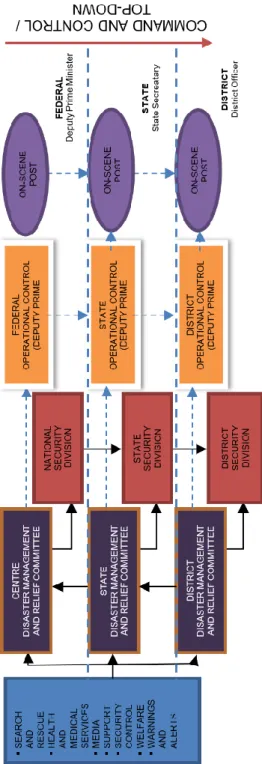
Gearing sustainable development goals (SDGs) into practice is essentially dependent, among others, on the planning and coordination of disaster risk management at various levels of administration. Therefore, the disaster management cycle as well as the top-down and bottom-up approaches have been established over the years and integrated into the disaster risk management (DRM) area (Coetzee & Van Niekerk, 2012). In Malaysia, management of disaster risks are regulated by Directive No. 20, under the auspice of the National Disaster Management Agency (NADMA). Concurrent with Malaysia's three-tier government administration system, the disaster management hierarchy is also regulated under three different levels, namely federal, state and district (Figure 1) (Chan, 2012; CEDMHA, 2016). Under Directive No.20, there are five (5) stages in the disaster management cycle consisting of prevention, mitigation, preparedness, response, and recovery which promotes practices and accommodates practitioners with multi-disciplinary backgrounds (CEDMHA, 2016). Even with the availability of such legally binding documents, there are pertinent issues that require further attention, as identified in this research. These issues are, (1) imbalanced of planning approaches in disaster risk management between top-down and bottom-up approaches, (2) lack of coordination in executing disaster risk management cycle and (3) lack of long-term planning (particularly for recovery / post-disaster) that resulted in low community and stakeholders’ resilience to disasters.
Figure 1: Malaysia disaster management structure
ISSUES AND CHALLENGES FOR AGENCIES IN DISASTER RISK MANAGEMENT IN MALAYSIA
DRM Approaches Imbalance between Top-down and Bottom-up
According to Chan (1995), the Malaysian government approach for managing disasters is based on a top-down government-centric model where the NSC (under the Prime Minister's Department) will be responsible for matters related to policies on DRM. As mentioned earlier, the CDMRC was established at the federal level to manage and monitor progress and DRM programs at the national level. However, the NSC has three major roles in national security, which are (1) to defend national sovereignty and strategic importance, (2) management of crises and disasters, and (3) border management. With the magnitude of disasters that have occurred in Malaysia recently, it is crucial to have an agency particularly for disaster management. Hence, in 2015, the government established NADMA for managing and coordinating efforts in between various government agencies, host communities and NGOs.
As previously mentioned, there are 79 agencies involved in DRM. The authors then established categorization of the roles of all agencies in DRM into top-down or bottom-up planning approaches based on two main criteria namely (1) agency’s compliment to seven themes of DRM services under Directive No.20 which are (a) search and rescue, (b) health and medical services, (c) media, (d) support, (e) security control, (f) welfare, and (g) warnings and alert; and (2) proactive roles and initiatives by agencies that reflected their role as a committee member of CDMRC, including drill exercises for creating public awareness, hazard mapping and zonation, and community-based disaster risk management (CBDRM).
communication, July 2017). Because of these limitations, agencies are having difficulties in upscaling DRM programs, particularly community-based disaster prevention trainings as well as the establishment of CDERTC for the whole country. Similar limitations are also experienced by MERCY i.e. the non-governmental agency responsible to provide response aid (health and medication) to any affected communities during and immediately after the disaster at the evacuation centre.
Lack of Coordination in Executing Disaster Management Cycle (DMC) between Agencies
A total of 68 agencies (with exclusion of 11 agencies from the original 79 agencies identified in literature review) have been further determined and categorised in terms of their roles in DRM cycles namely (1) prevention, (2) mitigation, (3) preparedness, (4) response, and (5) recovery. This categorization was carried out based on the ADRC detailed measures involved in each phase in DMC (Table 1 until Table 3).
Table 1: Summary of the roles and responsibilities of agencies according to DRM Cycle – federal level
List of agencies
DRM cycle
Pre-disaster Post-disaster
Pre
v
en
tio
n
Mitig
atio
n
Pre
p
ar
ed
n
ess
R
esp
o
n
se
R
ec
o
v
er
y
Agencies at Federal Level
1. Malaysia Armed Force (ATM) ✓ ✓
2. Royal Malaysia Police (PDRM) ✓ ✓
3. Ministry of Finance ✓ ✓ ✓
4. Ministry of Women, Family and Community Development
✓ ✓
5. Ministry of Communication and Multimedia
✓
6. Ministry of Tourism and Culture ✓
7. Ministry of Health Malaysia ✓ ✓
8. National Disaster Management Agency (NADMA)
✓ ✓ ✓ ✓ ✓
9. Fire and Rescue Department Malaysia (JPBM)
List of agencies
DRM cycle
Pre-disaster Post-disaster
Pre v en tio n Mitig atio n Pre p ar ed n ess R esp o n se R ec o v er y
10. Malaysia Civil Defence Force (APM)
✓ ✓
11. Malaysian Maritime
Enforcement Agency (MMEA)
✓
12. Federal Department of Town and Country Planning
Department Peninsular Malaysia
✓
13. Department of Broadcasting ✓
14. Department of Information ✓
15.Public Works Department ✓ ✓ ✓ ✓ ✓
16. Department of Environment ✓
17. Department of Social Welfare ✓ ✓
18. Department of Meteorology Malaysia (METMalaysia)
✓ ✓
19. Department of Civil Aviation Malaysia
✓
20.Department of Irrigation and Drainage (JPS)
✓ ✓ ✓ ✓ ✓
21. Atomic Energy Licensing Board ✓
22. Mineral and Geoscience Department Malaysia
✓
23. Volunteers Department of Malaysia
✓ ✓
24. Department of Occupational Safety and Health Malaysia
✓
25. Department of Water Supply ✓ ✓
26. Attorney General's Chambers of Malaysia
✓
27. Malaysian Communications and Multimedia Commission
✓
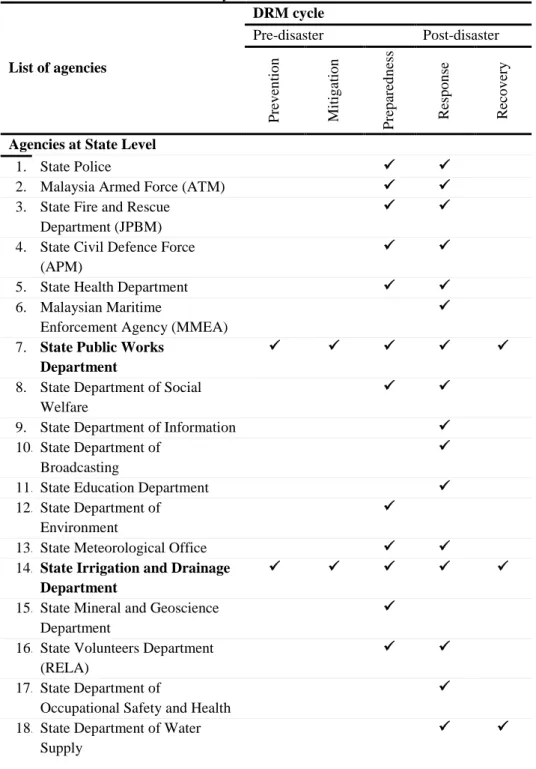
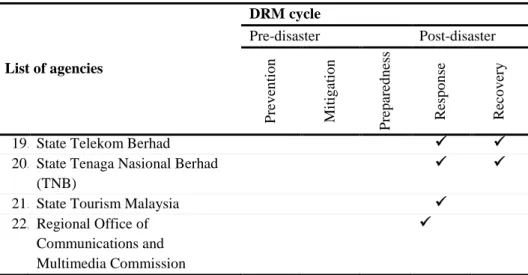
Table 2: Summary of the roles and responsibilities of agencies according to DRM Cycle - state level
List of agencies
DRM cycle
Pre-disaster Post-disaster
Pre v en tio n Mitig atio n Pre p ar ed n ess R esp o n se R ec o v er y
Agencies at State Level
1. State Police ✓ ✓
2. Malaysia Armed Force (ATM) ✓ ✓
3. State Fire and Rescue Department (JPBM)
✓ ✓
4. State Civil Defence Force (APM)
✓ ✓
5. State Health Department ✓ ✓
6. Malaysian Maritime
Enforcement Agency (MMEA)
✓
7. State Public Works Department
✓ ✓ ✓ ✓ ✓
8. State Department of Social Welfare
✓ ✓
9. State Department of Information ✓
10. State Department of Broadcasting
✓
11. State Education Department ✓
12. State Department of Environment
✓
13. State Meteorological Office ✓ ✓
14.State Irrigation and Drainage Department
✓ ✓ ✓ ✓ ✓
15. State Mineral and Geoscience Department
✓
16. State Volunteers Department (RELA)
✓ ✓
17. State Department of
Occupational Safety and Health
✓
18. State Department of Water Supply
List of agencies
DRM cycle
Pre-disaster Post-disaster
Pre v en tio n Mitig atio n Pre p ar ed n ess R esp o n se R ec o v er y
19. State Telekom Berhad ✓ ✓
20. State Tenaga Nasional Berhad (TNB)
✓ ✓
21. State Tourism Malaysia ✓
22. Regional Office of Communications and Multimedia Commission
✓
Source:Review of literature (Department of Mineral and Geoscience Malaysia, 2017; Malaysia Drainage and Irrigation Department, 2017; MERCY, 2016; Mohamad et al., 2015; National Security Council, 2012; National Security Council, 1997)
Table 3: Summary of the roles and responsibilities of agencies and non-governmental organizations (NGOs) according to DRM Cycle - district level
List of agencies
DRM cycle
Pre-disaster Post-disaster
Pre v en tio n Mitig atio n Pre p ar ed n ess R esp o n se R ec o v er y
Agencies at District Level
1. District Police ✓ ✓
2. District Office ✓ ✓ ✓
3. District Fire and Rescue Department (JPBM)
✓ ✓
4. District Health Department ✓ ✓
5. District Social Welfare Office ✓ ✓ 6. District Department of
Environment
✓
7. Malaysia Armed Force (ATM) ✓ ✓
8. Regional Malaysian Maritime Enforcement Agency (MMEA)
✓
9. Local Authority ✓ ✓
10. District Civil Defence Force (APM)
List of agencies
DRM cycle
Pre-disaster Post-disaster
Pre
v
en
tio
n
Mitig
atio
n
Pre
p
ar
ed
n
ess
R
esp
o
n
se
R
ec
o
v
er
y
11. District Information Office ✓
12. District Education Office ✓
13.District Public Works Office ✓ ✓ ✓ ✓ ✓
14.District Irrigation and Drainage Office
✓ ✓ ✓ ✓ ✓
15. District Volunteers Office ✓
16. District Telekom Berhad ✓ ✓
17. District Tenaga Nasional Berhad
✓ ✓
Non-Governmental Organisation (NGOs)
18. MERCY ✓ ✓ ✓
19. Malaysian Red Crescent (BSMM)
✓
Source:Review of literature ( Malaysia Drainage and Irrigation Department, 2017; MERCY, 2016; Mohamad et al., 2015; National Security Council, 2012; National Security Council, 1997)
The pertinent role and responsibility of various agencies in DMC is summarised and presented in Table 1, 2 and 3. It became obvious that majority of agencies (63 agencies) are involved in disaster response i.e. in the post-disaster phase in DMC. Activities in the response phase could include welfare (food and water), health and medication, and logistic and communication supports which requires preparation (such as in the preparedness phase). On the other hand, a total of 25 agencies are involved in preparedness (pre-disaster) and response (post-disaster) phases. It is worth to highlight that only NADMA, the Public Works Department (PWD) (at the federal, state and district level) and the Department of Irrigation and Drainage (DID) (also at the federal, state and district level) have involved in all five (5) phases of DMC. However, measures taken by the PWD, DID, and MERCY were only in DMC, especially for reconstruction phase (on critical infrastructure such as road, retaining walls and public amenities) whereas no particular measures were taken by these agencies to reconstruct individual assets, such as dwellings.
allocation by federal government, state government and NGOs. This slow recovery progress shows that the affected communities might be highly vulnerable and not resilient towards disasters as they were not able to recover to their original state (i.e. before disaster strikes).
Agencies’ Lack of Planning for Long-Term Recovery (Post-Disaster) With reference to the roles and responsibilities of various agencies involved in DRM as presented in Table 4, it is worth mentioning that none of these agencies have actively involved by taking appropriate measures for improving livelihood and individual asset support of the affected communities. As detail out by ADRC, an appropriate and long term measures are needed in reconstruction phase. This is because livelihood support is important to ensure all affected individuals and communities can continue their daily life. In this sense, individuals and communities shall be involved in DRM as a bottom-up approach and to ensure their understanding of DRM cycle, hence able to play their role during disasters.
Table 4: Summary of agencies inclination in DMC - percentage (%) by DRM phases
Agencies Inclination in DMC (by phases)
Number of
agencies % (estimation)
Pre-Disaster
1. Prevention 7 10.30
2. Mitigation 7 0.30
3. Preparedness 40 58.80
Post-Disaster
4. Response 63 92.60
5. Recovery 16 23.50
Pre-Disaster and Post-Disaster
6. Prevention + Mitigation + Preparedness + Response + Recovery
7 10.30
7. Preparedness + Response + Recovery
3 4.40
8. Preparedness + Response 25 36.80
CONCLUSION
The establishment of NADMA in 2015 as a focal point agency for DRM has proven that the government has addressed the need for an appropriate disaster management agency. Various agencies that involve in DRM have been given mandate and responsibilities prior to their appointment as members in CDMRC, SDMRC and DDMRC to carry out measures and activities in DRM under the coordination of NADMA. Each and every agency listed as a disaster management agency shall utilise their resources and expertise for creating desirable impacts to communities affected by disasters. This research however has indicated that more attention are given on expert knowledge and top down approach which might undermine the importance of local knowledge and bottom-up community involvement in strengthening DRM process. Only four (4) agencies were identified as applying bottom-up approach i.e. engaging local communities as compared to over 79 agencies which strongly indicate the use of top-down approach. In addition, only few agencies have their roles and responsibilities clearly stated in DRM, while other agencies only function as committee members. Review of literature also indicated that it is not clearly stated how often the committee shall meet to discuss matters related to disaster management and pertinent issues. Between agencies, such as APM and JKM, they have produced their own standard operating procedures, which could jeopardise the effective coordination among agencies in DRM. With more than 90 percent of agencies focusing on the response phase and almost 60 percent on the preparedness phase, leaving only 30 percent or less for agencies involvement in other phases of the DRM.
ACKNOWLEDGEMENT
REFERENCES
Center for Excellence in Disaster Management and Humanitarian Assistance [CFE-DMHA] (2016). Malaysia: Disaster Management Reference Handbook 2016. Chan, N. W. (1995). Flood disaster management in Malaysia: An evaluation of the
effectiveness of government resettlement schemes. Disaster Prevention and Management: An International Journal. 4(4), 22-29.
Chan, N.W. (2012). Impacts of disasters and disasters risk management in Malaysia: The case of floods. In Y. Sawada & S. Oum (Eds.), Economic and welfare impacts of disasters in East Asia and policy responses (pp.503-551). Tokyo: ERIA.
Coetzee, C., & Van Niekerk, D. (2012). Tracking the evolution of the disaster management cycle: A general system theory approach. Jàmbá: Journal of Disaster Risk Studies, 4(1), 9
Department of Mineral and Geoscience Malaysia (2017). Slope hazard and risk mapping, Malaysia: JMG, KSAASM.
Khailani, D. K., & Perera, R. (2013). Mainstreaming disaster resilience attributes in local development plans for the adaptation to climate change induced flooding: A study based on the local plan of Shah Alam City, Malaysia. Land Use Policy, 30(1), 615-627.
Malaysia Drainge and Irrigation Department (2017). Flood management - programme and activities - flood management in malaysia. Retrieved July 27, 2017 from
http://www.water.gov.my/our-services-mainmenu-252/flood-mitigation-mainmenu-323/programme-aamp-activities-mainmenu-199?lang=en&start=1 MERCY (2016). 2016 Annual Report Building Resilience- Empowering Community.
Kuala Lumpur: MERCY.
Mohamad, Z., Razak, K. A., Ahmad, F., & Manap, M. A. (2015, April). Slope Hazard and risk assessment in the tropics: Malaysia Experience. EGU General Assembly 2015. April 12-17, 2015, Vienna, Austria.
Nasional Security Council (2012). Civil defence emergency response team (cdert). Retrieved July 27, 2017 from http://www.civildefence.gov.my/perkhidmatan/civil-defence-emergency-response-team-cdert/
National Security Council [NSC] (1997). Directive No.20. Malaysia: National Security Council, Prime Minister Department.
Pengarah Pembangunan Negeri Kelantan (2015). Pengalaman PKOB Negeri Kelantan: Banjir 2014/2015,
PLANMalaysia (2016)(a). National Physical Plan 3. Peninsular Malaysia & Federal Territories of Labuan: PLANMalaysia, KPKT.
PLANMalaysia (2016)(b). National Rural Physical Planning Policy 2030, Peninsular Malaysia & Federal Territories of Labuan: PLANMalaysia, KPKT.
Shaluf, I. M., & Ahmadun, F. -R. (2006). Disaster types in Malaysia: An overview.
Disaster Prevention and Management,15(2), 286-298.