Solving the Class Responsibility
Assignment Problem
Using Metaheuristic Approach
Goran Glava
s and Kre
ˇ
ˇ
simir Fertalj
Faculty of Electrical Engineering and Computing, University of Zagreb, Croatia
Assigning responsibilities to classes is among first and arguably most important steps when creating object-oriented software design. This step depends greatly on human judgment and experience. In this paper our objec-tive is to automatize assigning responsibilities to classes using metaheuristic optimization algorithms. Four differ-ent algorithms(simple genetic algorithm, hill climbing, simulated annealing and particle swarm optimization), using class coupling and cohesion metrics, were imple-mented and their results are compared. Impleimple-mented algorithms take semantically annotated responsibility dependency graph as input. This paper describes respon-sibility dependency graph, implemented algorithms and used coupling and cohesion metrics in detail. Paper also reports on a performed case study. Ultimately, based on results obtained from all implemented algorithms, conclusions on search landscape of class responsibility assignment problem are drawn.
Keywords: class responsibility assignment, genetic algo-rithm, hill climbing, simulated annealing, particle swarm optimization
1. Introduction
Obtaining good software design in general is a difficult task and creating object-oriented(OO) software design is a very complex process that includes several steps. Initial steps include rec-ognizing key abstraction in problem domain (i.e. class candidates) and assigning respon-sibilities of a system to them [3]. Initial de-sign, with responsibilities assigned to classes, serves as basis for applying more advanced OO mechanisms like inheritance, interfaces, ab-stract classes etc. Having responsibilities as-signed and fine-tuning mechanisms like inter-faces and inheritance applied experienced de-signer could, finally, add design patterns and
possibly architectural styles to further improve design. However, poor assignment of responsi-bilities to classes cannot be fixed by inheritance or design patterns. Admittedly, there are well-described methodologies created to help recog-nize responsibilities of a system[13]as well as assign them to classes [6], but all of them rely on human reasoning.
In this paper we address class responsibility as-signment as a search problem, making it fit for application of metaheuristic(MH) algorithms. Our objective is to compare different MH algo-rithms and investigate how suitable they are for solving class responsibility assignment prob-lem. We use responsibility dependency graph (RDG) as a starting point for design creation opposed to much more often used approach of improving existing assignment of respon-sibilities to classes (i.e. OO design refactor-ing). Our work primarily focuses on domain model classes and assigning responsibilities on a higher level of abstraction.
Our work includes implementation of four dif-ferent search algorithms: genetic algorithm (GA), hill climbing(HC), simulated annealing (SA) and particle swarm optimization (PSO). All algorithms use same class coupling and cohesion metrics in order to find optimal or near-optimal solution to class responsibility as-signment problem. Implementation of several different MH algorithms(with different search characteristics)and comparing their results on a case study offers insight to the nature of search landscape.
pro-vides details on our representation of the prob-lem, semantically annotated RDG and cohesion and coupling metrics used for evaluation. In Section 4 we describe all four implemented MH algorithms. Case study and performance results MH algorithms are provided in Section 5. Dis-cussion of results and conclusions are drawn in Section 6.
2. Related Work
During the last decade there has been a signifi-cant tendency to formulate software engineering problems as search problems, making them suit-able for metaheuristic search algorithms appli-cation. Large variety of problems, throughout all phases of software engineering project’s life-cycle, have been formulated and dealt with as search problems [8, 10]. However, the amount of search-related work in the subfield of soft-ware architecture and design has been signifi-cantly lower than in other subfields (like test-ing and maintenance) of software engineering [11]. Also, most of the work considering design and architecture can be categorized as software maintenance or re-engineering[17]. There has been very little work reported on metaheuristic design synthesis from requirements.
In [18] genetic algorithm with fairly complex chromosome, encoding is used to synthesize object-oriented architecture of a system based on requirements given in the form of responsi-bility dependency graph. We follow this idea of RDG being an input for MH algorithms, but we expand RDG with semantic annotations. We argue that these annotations are not domain spe-cific and therefore our approach can be applied in general. However, work in [18] is among the first focused on generating design from re-quirements and not refactoring existing design. Authors in [4]focus on class responsibility as-signment problem and try to solve it using multi-objective genetic algorithm. Existing design is used as input and GA tries to improve the design considering different class cohesion and cou-pling metrics. Opposite to [18] and similar to [4], our approach focuses solely on class respon-sibility assignment problem, but we concentrate on creating initial OO design from requirements rather than refactoring existing design.
Most of the work in the field of search-based software design generation and refactoring
im-plement solely genetic algorithms(or some sim-ilar evolutionary techniques)without providing argumentation on the choice of MH method [1, 4, 18]. In [14] authors report that HC out-performs GA on the problem of software mod-ule clustering. We notice significant similari-ties between software module clustering lem and class responsibility assignment prob-lem. Hence, we implement four different search techniques and argue that simple GA is not the best choice for class responsibility assignment problem.
3. Class Responsibility Assignment as Search Problem
In order to make problem suitable for appli-cation of search-based optimisation algorithms, there are only two prerequisites required[11]: 1. The choice of the representation(i.e.
encod-ing)of the problem
2. The definition of the fitness function. We chose the simplest and most obvious way to represent the candidate solution(i.e. encoding). Each responsibility of a system is represented by one gene in the chromosome. Chromosomes are simply arrays of integer values where the position of the gene in the chromosome denotes the responsibility of a system and the gene’s in-teger value denotes the class the responsibility is assigned to. Though simple, this encoding ensures that there are no empty classes in the design and that every responsibility is assigned to exactly one class. The choice of fitness func-tion was, however, much less obvious. There are very few(if any)OO metrics that can be seen as standard and are generally accepted[17]. We chose multi-objective optimization, normaliz-ing and combinnormaliz-ing three different couplnormaliz-ing and cohesion measurements into a single aggregated fitness function.
3.1. Semantically Annotated
Responsibility Dependency Graph
types of responsibilities: data (DR) and func-tional(FR). These relate to attributes and meth-ods of a class respectively, but on a higher level of abstraction (e.g. one functional responsibil-ity might be implemented as several methods in the implementation phase). In order to pro-vide more data for MH algorithms to work on helping them find better solutions, we further annotate RDG. Let us first define our notation that will be used throughout the rest of the pa-per. LetRbe the set of all responsibilities,FR set of functional and DR set of data responsi-bilities in RDG. Let Dbe the set of all depen-dencies in RDG. LetCbe the set of classes the responsibilities are assigned to,cbeing a single class. R(c), FR(c), DR(c) then represent all responsibilities, functional responsibilities and data responsibilities assigned to a class c re-spectively. We introduce six different types of dependencies between responsibilities, giving each type different coupling significance. Data dependency(DD(fr, dr)|fr∈FR∧dr∈DR) is a dependency between a functional responsi-bility and data responsiresponsi-bility(meaning function uses data). Dependencies between two func-tional responsibilities can be of four different types:
1. simple call dependency
(SCD(fr1,fr2) | fr1,fr2 ∈ FR) – source
function simply initiates destination func-tion.
2. parametrized call dependency
(PCD(fr1,fr2) | fr1,fr2 ∈ FR) – source
function initiates destination function and sends required data.
3. simple call waiting for result
(SCR(fr1,fr2) | fr1,fr2 ∈ FR) – source
function initiates destination function and uses the result of its execution.
4. parametrized call waiting for result
(PCR(fr1,fr2) | fr1,fr2 ∈ FR) – source
function initiates destination function send-ing required data and then uses the result of its execution.
Sometimes good object oriented design means putting together(i.e. in the same class) seman-tically related responsibilities, though there are no direct dependencies between them. This im-proves understandability of the design, but it also degrades both cohesion and coupling as-pects of the design. Conceptual dependency (CD(dr1,dr2)|dr1,dr2 ∈FR)was introduced
in order to express such semantically related
data responsibilities. Each dependency type has the value of unit coupling assigned to it. Unit coupling of a dependency (uc(d) | d ∈ D) is a measure of coupling that single dependency introduces to the design. Unit coupling of two responsibilities is defined as follows:
uc(r1,r2) =
uc(d(r1,r2)) ifd(r1,r2)∈D
0 otherwise
(1) All of the described semantic annotations of a responsibility dependency graph serve as fine-tuning mechanisms for better assignment of re-sponsibilities to classes.
3.2. Fitness Measurement
There are many different coupling and cohe-sion measures [5, 7]. Our approach is also driven by coupling and cohesion metrics, but we also introduce measurement for assignment of conceptually(semantically)related responsibil-ities. Three measures that we use( modulariza-tion quality, positive cohesion of methods and conceptual data cohesion)are explained in de-tail. Aggregated fitness function was designed as a linear combination of these individual mea-sures.
Modularization quality (MQ) was first intro-duced in [9]for module clustering problem. It consists both of coupling and cohesion mea-sures called inter-connectivity (coupling) and intra-connectivity(cohesion). Acknowledging significant similarities between module cluster-ing problem and class responsibility assignment problem we use adjusted MQ. For a classc intra-connectivity is defined as follows:
A(c) =
r∈R(c)
s∈R(c)
uc(r,s)
ucaverage|R(c)|2 (
2)
For classes c1 and c2 inter-connectivity is
de-fined as follows:
E(c1,c2) =
r∈R(c1)
s∈R(c2)
uc(r,s)
2ucaverage|R(c1)||R(c2)| (3)
over all classes and scaled averaged value of inter-connectivity over all pairs of classes:
MQ=a1
|C|
i=1
A(ci)
|C| −a2 |C|−1
i=1
|C|
j=i+1
Eci,cj
|C|
2
(4) wherea1anda2are scaling factors for
express-ing relative influence of cohesion and couplexpress-ing respectively. The value of MQ is increased by increasing cohesion and lowering coupling of the design.
Positive cohesion of methods (PCOM) was in-spired both by lack of cohesion of methods (LCOM) [7] and tight class cohesion (TCC) [5] measures. PCOM can be thought of as in-verse of LCOM. While LCOM punishes solu-tions where methods of the same class do not use same class attributes, PCOM rewards solutions where functional responsibilities of the same class are dependent on the same data respon-sibilities of the class. Similar to TCC, PCOM of a class is defined as the percentage of pairs of functional responsibilities of the class with common usage of data responsibilities of the class. Let us define common data responsibility set for two functional responsibilities fr1 and
fr2of the same classc:
CDR(c,fr1,fr2) ={dr∈DR(c)|
d(fr1,dr)∈D∧d(fr2,dr)∈D}
Positive cohesion of methods for a pair of func-tional responsibilities of the same class is de-fined as follows:
pcom(c,fr1,fr2)
=
1 if|CDR(c,fr1,fr2)|>0
0 otherwise (5)
Positive cohesion of methods for a class is then defined as follows:
Pcom(c) =
fr1∈FR(c)
fr2∈FR(c)
pcom(c,fr1,fr2)
FR(c)
2
(6) PCOM of a solution design is then averaged value ofPcomvalues for all classes.
As described earlier, in the semantically anno-tated RDG there may exist special conceptual dependency between two data responsibilities
expressing that they semantically relate (i.e. both are part of the same real world abstraction). We introduceconceptual data cohesion(CDC) as a measure that rewards solutions which group conceptually dependent data responsibilities to-gether(i.e. in the same class). We define con-ceptual connection between data responsibili-ties as a transitive relation: if responsibility A is conceptually connected to responsibility B and responsibility B is conceptually connected to responsibility C, then A is also conceptually connected to C, but with a lower weight value assigned to that dependency since connection is not direct. Conceptual data cohesion for a class cis defined as follows:
Cdc(c) =
dr1∈DR(c)
dr2∈DR(c)
cdc(c,dr1,dr2)
DR(c)
2
(7) wherecdc(dr1,dr2) has value 1 ifdr1 anddr2
are directly connected, value 0 if there is no con-nection (not even transitive) between dr1 and
dr2and value between 0 and 1(proportional to
distance) if dr1 and dr2 are remotely
concep-tually connected. CDC of a solution design is then averaged value ofCdcvalues for all classes in the solution.
4. Implementation
In order to compare performance and applica-bility of different MH algorithms on the class responsibility assignment problem, we created theClass Responsibility Deployer(CRD)tool. CRD provides support for drawing semantically annotated RDG, executing MH algorithms and presenting best found solution vector in the form of class diagram. Here we describe four imple-mented MH algorithms in more detail. Perfor-mance results of each implemented algorithm are given in Section 5. We chose to create our own implementations of aforementioned algo-rithms rather than use existing frameworks.
4.1. Genetic Algorithm
and uniform crossover. We used roulette wheel as selection operator. The most obvious mu-tation, considering our encoding of candidate solutions, was to randomly reassign responsibil-ities to different classes. All classes had equal probability of responsibility being reassigned to them. Mutation was applied on a gene level. Mutation rate was experimented with.
Our choice of the population size was propor-tional to the size of the search landscape. We set population size to be 4 times number of responsibilities in the RDG. Two special case chromosomes - having only one class and each having responsibility in its own class were al-ways added in the initial population. GA per-formed better with 1-point crossover than with uniform crossover. Considering mutation, GA performed best with gene-level mutation proba-bility of 1/(length)wherelengthis the number of genes in chromosome. GA also performed better with elitism supported.
4.2. Hill Climbing
Hill climbing starts from a randomly chosen chromosome. In every iteration of the algorithm the neighbourhood of the current chromosome is searched in order to find fitter solution. Defi-nition of search neighbourhood is problem spe-cific. We define neighbourhood of a chromo-some as all chromochromo-somes that are exactly “one mutation away”(i.e. compared to current solu-tion, exactly one responsibility is assigned to a different class). We implemented two main ap-proaches for choosing the fitter neighbour: next ascent hill climbingwhere the first fitter neigh-bour is selected andsteepest ascent hill climbing where entire neighbourhood is examined and the neighbour solution that gives the greatest in-crease in fitness is selected. Hill climbing ends when there is no fitter neighbour in the neigh-bourhood. The biggest shortcoming of the hill climbing is that it finishes in the local optimum closest to the random initial point. This can be resolved by repeatedly restarting the algo-rithm at different starting points. This is called multiple-ascent hill climbing(MAHC). We im-plemented both next ascent MAHC and steepest ascent MAHC. Next ascent MAHC had, natu-rally, significantly lower execution time, but it was also able to find fitter solutions than steep-est ascent MAHC.
4.3. Simulated Annealing
Simulated annealing algorithm is similar to hill climbing but it allows less fit neighbour to be selected for next iteration. This way, simu-lated annealing reduces the possibility of end-ing in the closest local optimum of the start-ing point. The probability of acceptstart-ing less fit neighbour is bigger in the earlier iterations of algorithm(traversing through search landscape more freely)and decreases progressively. It is also inversely proportional with the decrease in fitness that neighbour presents compared to the current solution. Probability of accepting less fit neighbour is defined as follows:
p=ef n−Tf c (8)
4.4. Particle Swarm Optimization
Particle swarm optimization (PSO) algorithm was inspired by social behaviour of some ani-mal species(e.g. flock of birds). Every speci-men(particle)in the group (flock, herd, pack, . . .)can benefit from the discoveries and previ-ous experience of all other members during the search for the food[12].
PSO algorithm starts with a population of par-ticles where each particle’s initial position is a random solution in the search landscape. In each iteration of the algorithm every particle changes its position based on both cognitive and social influence. Cognitive influence is deter-mined by the best solution found by particle itself. Social influence is determined by the best solution found by all particles in the neigh-bourhood. The definition of neighbourhood is problem specific.
and particle’s current solution. Global proba-bility is proportional to social coefficient and difference in fitness between neighbourhood’s best found solution and particle’s current so-lution. In case that both gene values ( parti-cle’s best solution gene value and neighbour-hood’s best solution gene value)are accepted, the applied value gets chosen according to the ratio of cognitive coefficient and social coeffi-cient. We implemented two different versions of the algorithm regarding definition of neigh-bourhood. Global neighbourhood PSO defines entire swarm as one neighbourhood. Local neighbourhood PSO defines neighbourhood of a particle to be only a smaller part of the en-tire swarm. Global neighbourhood PSO dis-played faster convergence, but often led to non-satisfactory local optimum. Local neighbour-hood PSO with neighbourneighbour-hood size of 5-10% of swarm’s overall size generally resulted with
significantly better solutions. PSO algorithm achieved best results with cognitive coefficient value of 0.8 and social coefficient value of 0.2.
5. Case Study
The objective of the case study was to deter-mine up to what level are implemented MH al-gorithms able to recognize main abstractions in problem domain (i.e. class candidates) and assign responsibilities to them. Case study also served to evaluate how relevant chosen fit-ness measures are for good OO design. Com-pletely objective analysis of the results would, however, require optimal reference model for comparison. The optimality of OO design is very hard (if possible at all) to define, hence all the different (and often contradictory) ex-isting evaluation metrics. But our goal was
not set to formalize optimal OO design, but to investigate whether MH algorithms can pro-duce design close to what human judgment would consider satisfactory. Therefore, our ref-erence model was known, human created satis-factory design. Comparing best-fitted solutions considering chosen metrics to reference model can then serve to evaluate how appropriate the choice of metrics was as well.
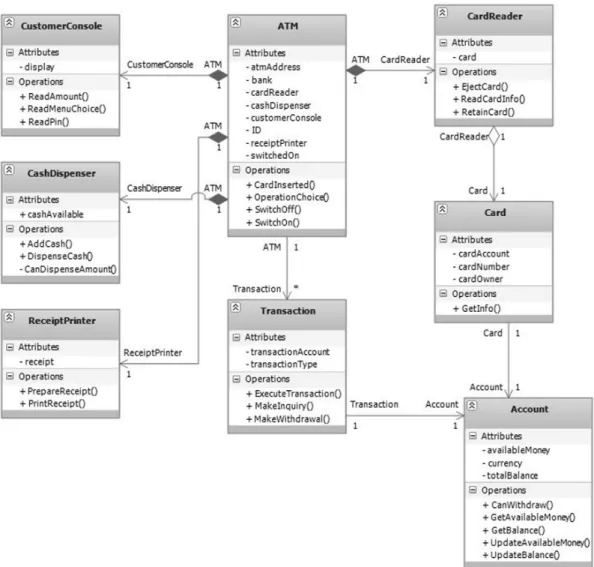
In order to increase objectivity of our approach, it was necessary to choose a domain model in-dependent of our research. We selected ATM Simulation domain model [2] since it comes with recognized responsibilities and dependen-cies from which we can form RDG. However, we considered entire ATM Simulation model to be too large for initial case study, so we selected logical subset of responsibilities and adequate subdesign for reference model(Figure 1). Our reference model contained 8 classes having 44 responsibilities(20 data and 24 functional) as-signed to them.
In order to keep generality, maximal possible number of classes in the solution has to be
equal to number of responsibilities which makes the size of search space considerably large – 4444. To confirm that search problem is not
triv-ial and search space is considerably large, we performed random search of 500000 iterations along with four implemented MH algorithms.
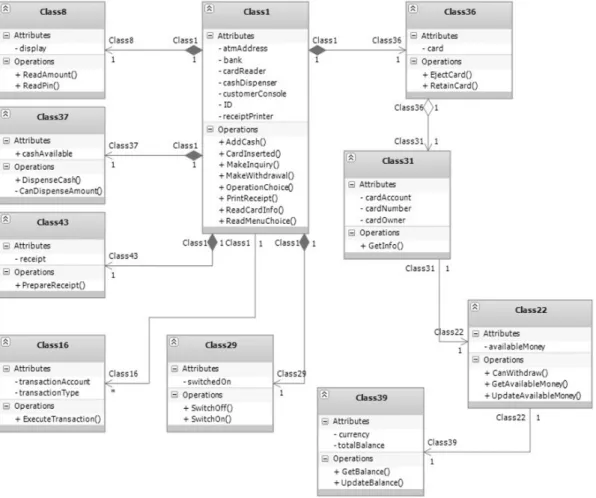
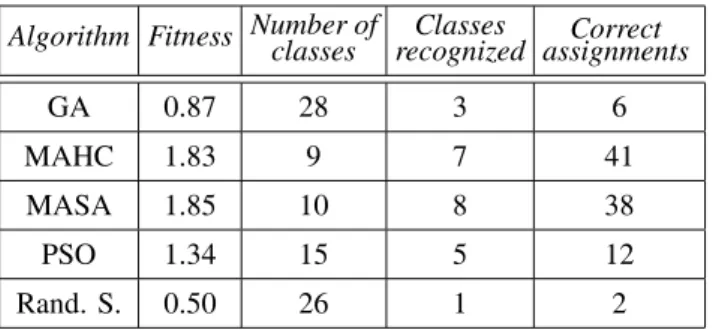
All four algorithms performed better than ran-dom search (i.e., passed the “sanity check”). MAHC and MASA managed to find signifi-cantly better solutions than PSO. Simple GA performed worst. MAHC and MASA were able to recognize main abstractions(i.e. classes)and assign most of the responsibilities “correctly” (Figure 2). PSO recognized some of the ab-stractions, while GA was able to group some dependent responsibilities together, but hardly recognized classes from the reference model. Table 1 describes best found solution for each algorithm (including random search): fitness, total number of classes, number of recognized classes, number of correctly assigned responsi-bilities and number of incorrect assignments. By human judgment, solutions produced by
MAHC and MASA that had better fitness were also recognized as closer to satisfactory design. This indicates that metrics constructing aggre-gate fitness function were well selected. Still, fitness of reference design (1.77) is slightly smaller than fitness of best designs produced by MASA and MAHC. However, human judg-ment evaluates reference design to be slightly better than those solutions. This means there is room for further improvement of selected fit-ness metrics.Correlation between good fitfit-ness and close to satisfactory design was increased when intra-connectivity component of MQ was reduced, i.e. a1 a2 in (4). This is
under-standable since both other measures (PCOM and CDC)target cohesion as well, so cohesion was initially over-expressed by aggregated fit-ness function.
Algorithm Fitness Number ofclasses recognizedClasses assignmentsCorrect
GA 0.87 28 3 6
MAHC 1.83 9 7 41
MASA 1.85 10 8 38
PSO 1.34 15 5 12
Rand. S. 0.50 26 1 2
Table 1. Performance results of algorithms
6. Discussion
In the discussion, we focus on analyzing the search landscape of class responsibility assign-ment problem. Conclusions drawn regarding the nature of search landscape provide an ex-planation of results produced by implemented metaheuristic algorithms. Let us observe fitness of a chromosome as aggregation of fitnesses of individual genes. Fitness of a single gene in our encoding depends not only on the value of that particular gene, but also on values of all genes that represent dependent responsibilities (i.e. fitness contribution of responsibility r be-ing assigned to classcis determined by assign-ment of all responsibilities dependent onr and of all responsibilities r is dependent on). An NK landscape is a function defined on encod-ings of fixed length and is characterized by two parameters: n for the overall number of genes andkfor the neighborhood size. For each gene, k neighbour genes influence its fitness contri-bution [16]. There has been research showing
that with increasing k, crossover-based algo-rithms are outperformed by mutation-based al-gorithms[15]. Though the neighbourhood size kis not constant for all genes, search landscape of class responsibility assignment can be con-sidered close to NK-landscape problem. This explains why simple crossover-based GA is out-performed by mutation-based algorithms like HC and SA. Furthermore, HC and SA were executed in multi-ascent manner, escaping its local nature to some extent. This is also the rea-son why GA with uniform crossover performed even worse than GA with single-point crossover. There are, however, reports of more robust GAs performing better than hill climbers on a wide variety of NK-landscape problems [16]. Such GAs should also be applied to class responsibil-ity assignment problem. PSO also recombines genes from two chromosomes(best individual solution and best global solution), but it is more mutation-based than GA, thus performing better than GA, but worse than MAHC and MASA. Regarding evaluation metrics, our research leads to a conclusion that solely coupling and cohe-sion metrics are not enough to produce sound designs. One of important characteristics of good OO design is understandability. However, to produce designs that are human understand-able, some semantics must be provided as in-put as well. We introduced conceptual depen-dencies as a way to mark semantically related concepts. Admittedly, this can be considered designing itself. Though often considered in related work, we find usage of MQ for class re-sponsibility assignment problem doubtful since we obtained better designs minimizing influ-ence of its cohesion component. It is very hard to point out, and even harder to formalize in the form of measurements, all aspects of good OO design. All this implicates that partially auto-mated creation of OO design is a much more likely approach than fully automated one.
7. Conclusion and Future Work
good designs can hardly be obtained in an auto-mated way, using only structural measures and that some semantics must be provided as input too. Next steps in our research will further ex-plore appropriate measures reflecting good OO design, but will also focus on applying more advanced features of OO design, such as inheri-tance, abstract classes and interfaces using MH algorithms.
References
[1] M. AMOUI, S. MIRARAB, S. ANSARI ANDC. LUCAS,
A genetic algorithm approach to design evolution using design pattern transformation, International Journal of Information Technology and Intelligent Computing, vol. 1, no. 1, pp. 235–245, 2006. [2] R. BJORK, An example of Object-oriented Design:
An ATM Simulation, Department of Mathematics and Computer Science, Gordon University,
http://www.math-cs.gordon.edu/courses/ cs211/ATMExample/, 2004.
[3] G. BOOCH, R. MAKSIMCHUK, M. ENGLE, B. YOUNG,
J. CONALLEN AND K. HOUSTON, Object-oriented
analysis and design with applications, Addison-Wesley Professional, 2007.
[4] M. BOWMAN, L. C. BRIAND ANDY. LABICHE,
Multi-objective genetic algorithm to support class respon-sibility assignment, Software Maintenance, 2007. ICSM 2007. IEEE International Conference on. IEEE, pp. 124–133, 2007.
[5] L. C. BRIAND, J. W. DALY ANDJ. W ¨UST, A unified framework for cohesion measurement in object-oriented systems,Empirical Software Engineering, Springer, vol. 3, no. 1, pp. 65–117, 1998.
[6] B. BRUEGGE ANDA. H. DUTOIT, Object-oriented
software engineering, Prentice Hall, 2000, vol. 553. [7] S. R. CHIDAMBER ANDC. F. KEMERER, A metrics suite for object oriented design, Software Engi-neering, IEEE Transactions on, vol. 20, no. 6, pp. 476–493, 1994.
[8] J. CLARKE, J. J. DOLADO, M. HARMAN, R. HI
-ERONS, B. JONES, M. LUMKIN, B. MITCHELL, S.
MANCORIDIS, K. REES, M. ROPER ET AL.,
Reformu-lating software engineering as a search problem,
Software, IEE Proceedings-, IET, 2003, vol. 150, no. 3, pp. 161–175.
[9] D. DOVAL, S. MANCORIDIS AND B. S. MITCHELL,
Automatic clustering of software systems using a genetic algorithm, Software Technology and En-gineering Practice, 1999. STEP’99. Proceedings, IEEE, 1999, pp. 73–81.
[10] M. HARMAN, The current state and future of search
based software engineering, 2007 Future of Soft-ware Engineering, IEEE Computer Society, 2007, pp. 342–357.
[11] M. HARMAN, S. A. MANSOURI AND Y. ZHANG,
Search based software engineering: A compre-hensive analysis and review of trends techniques and applications,Department of Computer Science, Kingo`s College London, Tech. Rep. TR-09-03, 2009.
[12] J. KENNEDY ANDR. EBERHART, Particle swarm
op-timization, Neural Networks, 1995. Proceedings., IEEE International Conference on, IEEE, 1995, vol. 4, pp. 1942–1948.
[13] C. LARMAN ANDP. KRUCHTEN,Applying UML and
patterns, Prentice Hall PTR, 2002.
[14] B. S. MITCHELL ANDS. MANCORIDIS, On the auto-matic modularization of software systems using the Bunch tool,IEEE Transactions on Software Engi-neering, Published by the IEEE Computer Society, 2006, pp. 193–208.
[15] P. MERZ ANDB. FREISLEBEN, On the effectiveness
of evolutionary search in high-dimensional NK-landscapes, Evolutionary Computation Proceed-ings, 1998. IEEE World Congress on Computa-tional Intelligence., The 1998 IEEE InternaComputa-tional Conference on, IEEE, 1998, pp. 741–745.
[16] M. PELIKAN, Analysis of estimation of distribution
algorithms and genetic algorithms on NK land-scapes,Proceedings of the 10th annual conference on Genetic and evolutionary computation, ACM, 2008, pp. 1033–1040.
[17] O. R ¨AIHA¨, A survey on search-based software de-sign,Computer Science Review, Elsevier, 2010. [18] O. R ¨AIHA¨, Applying genetic algorithms in software
architecture design,University of Tampere Depart-ment of Computer Sciences, Citeseer, 2008.
Received:June, 2011 Accepted:November, 2011
Contact addresses: Goran Glavaˇs Faculty of Electrical Engineering and Computing University of Zagreb Zagreb, Croatia
e-mail:[email protected]
Kreˇsimir Fertalj Faculty of Electrical Engineering and Computing University of Zagreb Zagreb, Croatia
e-mail:[email protected]
GORANGLAVASˇis a PhD student at the Department of Electronics, Microelectronics, Computer and Intelligent Systems at the Faculty of Electrical Engineering and Computing, University of Zagreb. He grad-uated and received his B.Sc. and M.Sc. degrees in computing from the same institution. His professional and scientific interest is in intelligent software systems, especially in natural language processing and search optimization algorithms.