Actually, What Does “Ontology” Mean?
A Term Coined by Philosophy in the Light
of Different Scienti
fi
c Disciplines
Johannes Busse
1, Bernhard Humm
2, Christoph L¨ubbert
3, Frank Moelter
4,
Anatol Reibold
5, Matthias Rewald
6, Veronika Schl¨uter
3, Bernhard Seiler
6,
Erwin Tegtmeier
7, Thomas Zeh
31University of Applied Sciences Landshut, Landshut, Germany 2University of Applied Sciences Darmstadt, Darmstadt, Germany 3Darmstadt, Germany
4Essen, Germany
5Cogia intelligence GmbH, Frankfurt, Germany 6Technical University Darmstadt, Darmstadt, Germany 7University Mannheim, Mannheim, Germany
1. Introduction
This article is a fictitious, moderated dialogue between an information scientist, a philosopher, and a psychologist. They explore the term “on-tology” from the point of view of their own dis-cipline, with the object of learning from each other. The target audience of this article are laypersons with respect to the specific disci-plines – but who have a scientific background. The authors work in the fields of computer sci-ence, knowledge engineering, electrical engi-neering, mathematics, neurobiology, philoso-phy, and psychology. They are members of the interdisciplinary “Darmst¨adter Ontologenkreis” (Darmstadt Circle of Ontologists). The article is based on the results of several colloquiums dealing with the concept of ontology in different scientific fields, taking place at the “Darmstadt University of Applied Sciences” since 2010. The workshop participants discussed the ques-tion of how the term “ontology” is used in dif-ferent scientific disciplines: identically, as a metaphor, or with entirely different meanings. This article is an aggregation of selected collo-quium results. The authors try to avoid
subject-specific terms, with respect to the interdisci-plinary nature of the topic.
Ontology – what does the term actually mean? Philosopher: The term means the “science of being”. Ontology is the most comprehensive of all sciences, insofar as it covers everything that exists. I will go into details later on, but for now: Among philosophers, there is no com-monly agreed concept of ontology. The inter-pretations of philosophers differ just like the multiple ways of looking at “being”.
Information scientist: This is also true for computer science. I have found as many as ten essential definitions of ontology. They differ significantly. For examples[1–4], see Table 1: Selected definitions for “Ontology”.
We, computer scientists, have adopted the tech-nical term “ontology” from philosophy and use it as an analogy or metaphor. We understand the formal definition of concepts and their rela-tionships as a basis for a common understand-ing. This is useful for knowledge-based appli-cations.
Psychologist: We rarely use the technical term “ontology” in psychology. However, we
T. R. Gruber: “An ontology is a formal explicit specification of a shared conceptu-alization”[1]
M. Uschold, M. Gruninger: “An ontology is a shared understanding of some domain of inter-est.” [2]
H. Herre et al.: “Formal Ontology is the sci-ence that is concerned with the systematic de-velopment of axiomatic theories describing forms, modes, and views of being at differ-ent levels of abstraction and granularity.”[3]
G. Pickert: “An Ontology is a seven-tuple, O:=(L, C, R, F, G, H, A)”[5].
With:
C: A set of concepts
R: Set of binary relations on C (Relationships between concepts)
F: Function connecting symbol sets to sets of terms
G: Function connecting symbol sets to sets of relations
T: Taxonomy for the partial ordering of C in generic concepts/narrower concepts A: Set of axioms(constraints): statements
with elements of C and R.
Table 1.Selected definitions for “Ontology”.
sively deal with concepts and their relationships. We are particularly interested in the question of how people develop concepts and improve them over time.
2. Ontology Applications and the Semantic Web
How are Ontologies Utilised in Information Science?
Information scientist: Basically, wherever you deal with semantics, i.e., the meaning of infor-mation. Often, ontologies are used in computer science in the context of the “Semantic Web” [9]. I would like to illustrate the idea behind the Semantic Web by means of an example.
If you go to see a travel agent and ask for a child-friendly hotel at the beach in Northern Germany, the travel agent will offer you family-friendly hotels that have access to North Sea or Baltic Sea beaches. Of course, he knows that North and Baltic Sea are the two beach areas in Northern Germany.
When I entered “child-friendly hotel at the beach in Northern Germany” at Google a while ago, I found a website with the review of a hotel in Dubai. It was detected because it contained the words “beach”, “Germany”, and “children”. Upon closer inspection I noticed, however, that Germany was the country of origin of the cus-tomer who wrote the review, and his profile said “children: none” – hence the match for “chil-dren”.1
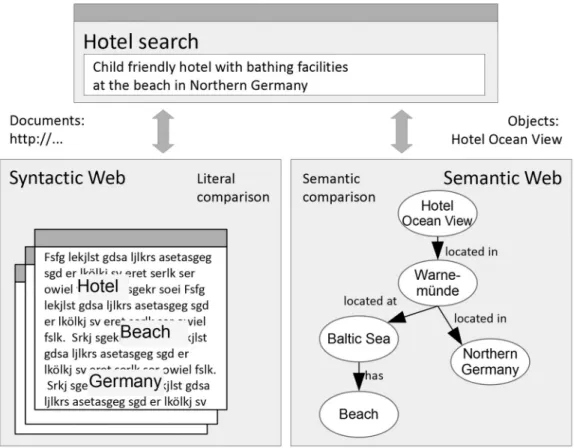
The travel agent understands the meaning of your question – while a classic search engine just checks for matches of words. I call this a “Syntactic Web”: the stupid matching of char-acters without understanding their meaning. Semantic Web tries to go a step further. A se-mantic application for hotel search could deal with the customer’s request “child-friendly ho-tel at the beach in Northern Germany” as fol-lows:
• Linguistic analysis of the request, for exam-ple, “Hotel” is a noun, “child-friendly” is an adjective and “with swimming at the beach” and “Northern Germany” are adverbial par-ticles.
• Synonym substitution, for example, “family-friendly” is something similar to “child-fri-endly”.
• Reasoning, as Northern Germany is a part of Germany, adjoins both North and Baltic sea, seas have beaches etc.
• Matching, in this case, finding hotels that come as close as possible to the description. So, in contrast to the Syntactic Web, an appli-cation of the Semantic Web tries – similar to us humans – to understand and draw conclusions. See also Figure 1: Comparing “Syntactic Web” and “Semantic Web”.
Sounds interesting. . .
1The experiment was made in German language in 2012. As Google successively introduces semantic aspects into its search,
Figure 1.Comparing “Syntactic Web” and “Semantic Web”.
Information scientist: Yes, indeed! And that’s just the tip of the iceberg.
Since theWorld Wide Web Consortiumhas stan-dardized description languages like theWeb On-tology Language (OWL), many domain experts all over the world have started formalizing their knowledge in form of ontologies. Hotel owners offer machine-readable semantic descriptions of their accommodations on the web; biologists publish newly discovered genome sequences not only in journal articles, but also in ontolo-gies; laws, court decisions and precedents are specified in a machine-readable form so that they can be processed further. And with intel-ligent applications based on this information, questions can be automatically answered such as
• Are there family-friendly hotels at the beach in Northern Germany?
• Have genome sequences already been found
that are similar to my biological research re-sults? or
• Is there a precedent to my current trial?
How are ontologies utilized for semantic ap-plications?
Information scientist: Ontologies are the ba-sis for computer applications to communicate among each other and with humans. They even can help humans to communicate among each other [5]. Ontologies are always concerned with a specific domain of interest, for exam-ple tourism, biology or law. Ontologies, thus, form a basis for understanding and counteract the confusion of tongues.
In computer science we call an ontology a for-mal definition of concepts and their relation-ships, related to a domain of interest. “Formal” means in a language with well-defined syntax and semantics which can be processed by com-puter programs.
statements are possible and allowed. Both, on-tology schema and facts, are expressed in a for-mal language, e.g., RDFS (Resource
Descrip-tion Framework Schema) or OWL (Web
On-tology Language). Of course, the formal lan-guages aren’t visible to the end user – but they are necessary for internal processing.
Example of an ontology schema(excerpt):
:Hotel rdf:type rdfs:Class.
Meaning: Hotel is of type “class”, hence a con-cept with instances such as “Hotel Ocean View”.
:Location rdf:type rdfs:Class.
“Location” also is a class
:locatedIn rdf:type owl:TransitiveProperty.
“locatedIn” is a relation, more precisely, a tran-sitive relation.
Examples for facts:
:HotelOceanView rdf:type :Hotel.
“HotelOceanView” is an individual, an instance of the class “hotel”
:Warnem¨unde rdf:type :Location.
“Warnem¨unde” is an instance of the class “Lo-cation”(a town at the Baltic Sea).
:HotelOceanView :locatedIn :Warnem¨unde.
“Hotel Ocean View” is located in Warnem¨unde
:Warnem¨unde :locatedIn :MecklenburgVorpommern.
Warnem¨unde is located in Mecklenburg Vor-pommern, a state in the north east of Germany.
:MecklenburgVorpommern :locatedIn :NorthernGermany.
“Mecklenburg Vorpommern” is located in “North-ern Germany”
Questions can be answered with a query
lan-guage, for example SPARQL:
SELECT ?hotel WHERE
{?hotel :locatedIn :Warnem¨unde}
→returns the result
:HotelOceanView, ...
In the simplest case, the knowledge base works like a conventional database: you can ask for
the stored facts (here: “Hotel Ocean View is located in Warnem¨unde”).
Things become interesting when inference comes into play. Inference allows inferring new state-ments from facts by applying inference rules. A simple inference rule is the transitivity rule: If a relationpis declared as transitive and xpy and ypz are given, then xpz can be inferred. In our example:
:locatedIn rdf:type owl:TransitiveProperty. :HotelOceanView :locatedIn Warnem¨unde.
:Warnem¨unde :locatedIn MecklenburgVorpommern.
→inference result
:HotelOceanView :locatedIn :MecklenburgVorpommern.
By multiply applying the transitivity rule, the request for hotels in Northern Germany is an-swered as follows.
SELECT ?hotel WHERE
{?hotel :locatedIn :NorthernGermany}
→yields the result
:HotelOceanView, ...
The transitivity rule is only one of many rules that can be utilized in an inference engine. Such rules allow complex conclusions from given facts. In addition, the ontology developer can specify new, domain-specific rules in a rule lan-guage. An example in natural language: “If a hotel has a playground, is offering baby cots and menus for children, then it is considered to be child-friendly”. An inference engine uses these domain-specific rules in addition to the built-in rules.
How does an inference engine work?
Information scientist: Design and function of an inference engine are somewhat complex. Simplified, it works as follows.
e.g., statements are always specified in the form <subject> < predicate> <object> , as in
:HotelOceanView :locatedIn :Warnem¨unde
Furthermore, the input needs to be syntactically correct. Even small syntactic deviations such as the use of a semicolon instead of a period will result in errors and get rejected.
2. The inference engine loads the ontology sche-ma and facts and represents them internally as a graph. The above example can be illus-trated as a graph as in Figure 2.
Figure 2.Graphical representation of a statement.
3. A query engine uses an algorithm for match-ing graphs.
?hotel :locatedIn :Warnem¨unde
is a query graph, which can be matched with the graph
:HotelOceanView :locatedIn :Warnem¨unde
by replacing the variable?hotelby :HotelOceanView
4. Reasoning is done by chaining a set of rules. A rule is of the form: condition→ conclu-sion – just as explained in the example on transitivity.
The application of rules is done by an algo-rithm for matching graphs. If the condition of a rule can be matched with a sub-graph of the knowledge base, then the inferred statements are added to the knowledge base.
3. Ontology in Philosophy
Computer scientists make use of the concept of ontology from philosophy – what does it mean there?
Philosopher: Literally, “ontology” means “the science of being”. The term “ontology” was in-troduced by Christian Wolf not before the 18th century. But discussing the way how things ex-ist, in a theoretical way – i.e., trying to grasp the
world – has been done for at least 2500 years. “To on”, the Greek expression for “being”, is the most general thing you can say about a subject. The Greek presocratic philosopherParmenides
(∼520− ∼460 BC)was the first one to men-tion this issue in his essay “On Being”. It is ultimately a system of structure in the world of objects and their relations. Categorical on-tology, classifying by categories, claims to be an all-encompassing classification system( ac-cording to[4]).
Can you, please, give examples?
Philosopher: Parmenides regards being as “the one” without anything missing. This being is the precondition of any perception.
About 100 years later, Plato(∼ 428− ∼ 348 BC)developed a dualistic understanding of be-ing: On one hand the(perfect)world of ideas, and on the other hand the imperfect world of things – still derived from the world of ideas by man. The inspection of ideas, the percep-tion, is the substantiation of understanding the world. His allegory of the cave illustrates how, after various concerted and partly painful steps of perception(the blinding sun as a metaphor), true knowledge can eventually be gained – a goal that only a few strive for and achieve. This also shows that any finding which is achieved also means that you cannot possibly “return into the cave”.
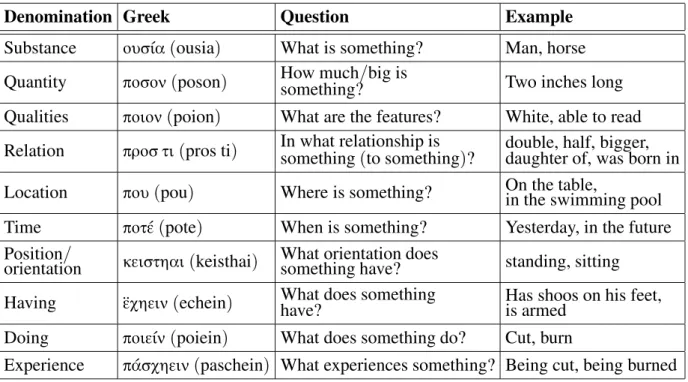
Plato’s student Aristotle(384 – 322 BC), how-ever, categorizes the world by defining ten cate-gories(see Table 2: The ten categories of Aris-totle), the most important of which is substance. Substances are organisms with essential and ac-cidental properties. Acac-cidental properties are temporary, non-essential properties(second to tenth category).
Aristotle, actually, was mainly interested in liv-ing organisms. Only his successors attempted to make a more comprehensive classification based on his categories. The categories of sub-stance and accidents were kept for centuries, but with fewer and fewer varieties. Descartes only distinguishes between mental and physical properties without any further categorical dis-tinctions.
Denomination Greek Question Example
Substance ´(ousia) What is something? Man, horse
Quantity (poson) How muchsomething?/big is Two inches long
Qualities (poion) What are the features? White, able to read
Relation (pros ti) In what relationship issomething(to something)? double, half, bigger,daughter of, was born in
Location (pou) Where is something? On the table,in the swimming pool
Time ´(pote) When is something? Yesterday, in the future
Position/
orientation (keisthai) What orientation doessomething have? standing, sitting
Having ¨(echein) What does somethinghave? Has shoos on his feet,is armed
Doing ´(poiein) What does something do? Cut, burn
Experience ´ (paschein) What experiences something? Being cut, being burned
Table 2.The ten categories of Aristotle.
Can you really classify everything there is by means of substances and properties?
Philosopher: For quite a long time it has, deed, been argued so. Other categories were in-troduced as subcategories only. But you are cor-rect, at some point in time philosophers found out that something is still missing. Relation-ships and what whole sentences express are not covered. Therefore, in the 19th century, the additional category “facts” was added.
What are facts?
Philosopher: The ontologists use them in a broader sense. Not only is it considered to be a fact that A phoned B on May 23rd, 2012 at 2:11pm, but also that all matter underlies grav-itational force. Or, similarly, that exactly one natural number is less than 2 and that all natural numbers are either even or odd. Traditional on-tologies without fact can only describe the first example in a satisfying way. They tend to shift natural laws into the cognitive awareness or into language.
Well, but what is it good for, classifying the world into things, properties and facts? Philosopher: Well, these are just subsump-tions. Science doesn’t just classify. Science primarily searches for laws. The classification
is done with respect to these laws in order to avoid categorical mistakes in reasoning, e.g., assuming that a property is located in a particu-lar place.
Take, for example, the green of the leaves of a tree. The green color as an attribute is different from the color layer on a body. The layer only has the characteristic of green color, it is not the property itself. The color layer, in fact, is localized; the abstract property “green” is not, because there are many other things having the same property, but in different places.
Information scientist: Yes, based on our on-tologies we have been able to discuss exactly those kinds of questions. Formalized categor-ical ontologies are called base-ontologies or
foundational-ontologies. Base-ontologies are cross-domain-ontology schemes with general concepts such as physical object, property, or
range.
which, in turn, may be linked to the class “color region”.
So, ontology in philosophy helps me think more precisely. But as there are different on-tologies with different categories, which one should I use?
Philosopher: Ontology is an attempt to rec-ognize the world of things and facts in an all-encompassing way and to categorize and name everything. Various philosophers have different emphases. In philosophy, as in all sciences, you always find competing theories and a permanent change of theory. If you are looking for orien-tation, just look for one of the currently popular and accepted ontological theories yourself. The number of choices is not that large.
Information scientist: This similarly applies to base-ontologies in computer science. How-ever, there is no base-ontology claiming to be all-encompassing. So-calledbridge-ontologies
have been developed to connect different base-ontologies. The project “WonderWeb”, in which DOLCE has been developed, provides such bridge ontologies(see Figure 4: Base-Ontologi-es and Domain-OntologiBase-Ontologi-es).
But base-ontologies are not most important for semantic applications. They don’t help to an-swer questions about tourism, biology or law. Additional domain-ontologies are indispensable for that, and these are geared towards their in-tended use. For example, the ontology
“Har-moNET”(The Harmonization Network for the
Exchange of Travel and Tourism Information,
http://euromuse.harmonet.org) contains a
detailed set of terms for describing the features of a hotel.
4. How People Develop Concepts
Essential components of ontologies are cepts. How do people actually develop con-cepts?
Psychologist: When we talk about concepts, two kinds need to be distinguished. Personal conceptsare based on the personal experience of a person. This shouldn’t be confused with
conventional concepts– they are neither identi-cal nor congruent.
Conventional concepts are achieved by agree-ment among people. Their meaning is attached
Figure 3.Modelling in DOLCE: “The leave is green”(according to[10, Fig. 3]).
to certain symbols, usually words. Their mean-ing must be negotiated and roughly defined. The product of negotiation is always an ide-alized simplification of meanings of the people involved.
Conventional concepts only become personal concepts or knowledge when a single person picks them up and interprets and understands them in his own context. This can never be more than an approximation of the conventional concept. People don’t think and judge in terms of conventional concepts – even if they try to get close to this ideal – but always in terms of their personal knowledge.
Personal concepts are not based on the intro-jection of conventional terms used by the en-vironment, society and culture. Also, personal concepts are not just transferred by language. Personal concepts are independent and specific knowledge and thinking units of each subject. They have been constructed by actively engag-ing with the environment, but also accordengag-ing to the cultural and linguistic background of the social partners.
The question of how human knowledge and hu-man concepts emerge and evolve is explored, among others, by the field ofcognitive develop-mental psychology. It is related to the question of the origins of world-views. Different move-ments of psychologists give different answers to your question about the formation of concepts. I can answer it – with respect to the genesis and evolution of personal concepts – in my view and somewhat simplified[11-13]as follows. The knowledge of people runs through an evo-lutionary process. The quality of knowledge changes as this process progresses. The evolu-tion starts from simple sensomotoric structures, while adopting the world by acting and perceiv-ing. These structures can be transformed grad-ually to inner ideas and intuitive knowledge. In what we call “concepts”, intuitive knowledge is processed to abstract entities that can be referred to by language. The process of knowledge ac-quisition is substantially driven by the cognitive structures themselves, by dealing with the per-ceived and experienced reality and the socio-cultural environment, e.g., at school. The ( lin-guistic)input from the social environment is not passively collected, but can only be adapted and processed on the basis of already existing know-ledge structures. A metaphor: concepts are like
icebergs in the sea of our intuitive knowledge and imagination.
Knowledge acquisition is a tedious process that never ends. Concerning transfer and under-standing of conventional (cultural, scientific, linguistic) knowledge, this process can never be more than a process of approximation.
How is this process initiated? How does a child develop its world-view and the related concepts?
Psychologist: A child develops its world-view by dealing with the experienced reality. The social environment is an essential part of this reality. The child playfully makes hypotheses, gives them a try, and confirms or rejects them. Although a large part of our conceptual know-ledge is not based on personal experience, it must be related to our own experience, to our intuitive and pre-existing personal concepts.
Is this also true for an adult?
Psychologist: Also in adults concepts develop by interacting with the environment – how-ever more consciously, complex, and culturally shaped. Concepts are constantly changing due to the socio-cultural environment and adapt to it. Concepts are in constant flow, within the individual as well as in society.
Imagine an actor playing the role of a doctor in a soap opera telling the audience what he is doing during surgery. Would you trust him to re-move your appendix? Of course not! Knowing the text doesn’t mean you deeply understand its meaning. Similarly, you cannot transfer know-ledge by means of textual definitions.
However, definitions are useful to structure know-ledge which has already been acquired, to syn-chronize it between individuals, and to back it up. Processes as in a brainstorming session may give an idea of what is needed in addition to formally learned knowledge: finding analo-gies, but not just following strict schedules. It is important to learn to differentiate.
like tourism, biology or law, get to a common understanding of concepts and terms? Psychologist: A common understanding of conventional concepts may evolve by continu-ously using them within a community. Later on, concepts and terms may be more formally de-fined, e.g., by standardization agencies. How-ever, this requires a common understanding of the subject.
There are some steps that help to achieve this, e.g.
• Set concepts in relation to other concepts • Define concepts in contrast to similar
con-cepts
• Compare and find differences
Above all, agreements and standards must prove useful in reality and in interaction with others!
5. Ontology Engineering: Developing and Communicating Ontologies
Writing down concepts to formalize them looks like a challenging job to me. How do information scientists go about it?
Information scientist: This is challenging, in-deed. The psychologist’s metaphor of concepts as icebergs in a sea of our intuitive knowledge and our ideas illustrates this well. Usually, “we don’t know what we know”.
Knowledge acquisitionis the activity, so-called
knowledge engineers are performing: in co-operation with domain experts, they verbalize knowledge and write it down. Knowledge must be extracted from the experts’ minds, and put on paper or into software tools. The value of an ontology will stand or fall with the level of recognition and approval in the community of experts [7]. In operational practice, verbaliza-tion of knowledge is usually connected to the goal to share it, systematically trying to make it conveyable. In a nutshell: An ontology that can not be communicated is a dead ontology.
Our conclusion: knowledge acquisition and
knowledge communicationare two sides of the same coin, and they are inseparable.
When we, as knowledge engineers, develop an ontology, or more precisely anontology schema,
then the most difficult step is usually the first. An ontology is always bound to amission, and must support this mission. It would be great if we had criteria to judge whether or not an ontology supports its mission and leads to the intended direction. This, however, would re-quire a complete understanding of the problem domain – an understanding that is often labori-ously obtained during the course of the ontology project.
A common mistake is to first write down every-thing you know and to model whatever can be modeled. Instead, you should always ask for the benefits and only model what is needed for a specific solution to a problem.
Does this mean that you have no method-ology for systematically determining which knowledge is missing to solve a particular problem?
Information scientist: Yes, I’m afraid so. This is why we apply methods of knowledge creation where we try to avoid precise definitions in the interim. For this purpose, we start verbalizing knowledge in an informal, “soft” way. A wiki, which is gradually developed, is well suited for this purpose. Terms with fuzzy definitions hap-pen to occur in individual descriptions. They will, eventually, get an entry of their own when they are more precisely defined. They will get interlinked and a semantic network comes into existence.
This wiki approach also corresponds with the observation that a large part of our knowledge cannot completely be represented in a formal way. Instead, formal knowledge always is em-bedded in knowledge that is communicated in everyday language.
Concepts are almost always fuzzy in human communication. This applies to the extent of a concept(Are roller skates vehicles?), as well as to its characteristics (“Land vehicles have wheels. But what about sleighs?”).
Are ontologies really the best form of know-ledge representation?
Information scientist: As I said before, all de-pends on the task. Ontologies actually don’t al-ways adequately represent our knowledge. Of-ten, diagrams, maps, or other knowledge repre-sentation mechanisms are better suited to com-municate knowledge.
Becoming aware of our own knowledge is usu-ally done on many levels. Within an organiza-tion, it is important to identify knowledge hold-ers(people)and sources(media). This is often a project in itself!
Knowledge in organizations is usually estab-lished in diverse forms: explicitly in written documents, implicitly in software systems, for-mal or inforfor-mal procedures, organizational struc-tures, etc. Imagine you try to find out which business processes are actually established in an organization. This is far more difficult than modeling a process from scratch.
And once we have modeled something concep-tually beautiful: How do we share our know-ledge with others? How do we document mod-els? How do we communicate them? What can we do in case well-defined concepts are misun-derstood by the users? Do we have procedures to improve our models, in particular to find out where they don’t work as intended?
I can guess what you mean to say. To find out if an ontology is not appropriate is like having a hammer at hand while dealing with a bolt.
Information scientist: Precisely! Just that hammer and bolt physically refuse to work, whereas conceptual systems – and even more ontologies – are determining our thinking itself. So it is far more difficult to realize its quirks and limits.
Ontologies need to be recorded and read like di-agrams or maps. Without appropriate software tools, this quickly becomes a Sisyphean chal-lenge. As with the hammer, the question arises: How can tools support? And where do they be-come cumbersome and mislead you down the wrong path?
It is best to allow for a diversity of knowledge representations instead of committing to a sin-gle one. This is true even in the field of ontology
engineering. What we need are different ontolo-gies you can play with, rather than choosing the one ontology which enforces you to subordinate your thoughts and the world.
Who decides on the extent of an ontology? When is an ontology “finished”?
Information scientist: The extent of an ontol-ogy in an IT application is always determined by the context of the application and its goal. The ontology is finished when it delivers the expected benefit to the user. To say that is rela-tively easy, but this may be difficult in practice. For it raises questions such as: What exactly is the expected benefit? How will expectations develop in future?
I would like to give you an example. In the tourism application mentioned above, one of the requirements was to find matching hotels to questions such as “child-friendly hotel at the beach in Northern Germany”. In future, the ex-pectation could be that the application may ask back to the user, e.g., “How old are the chil-dren?” in order to find an even better match. Anyway, the use case is limited to hotel search. This means that the ontology must contain con-cepts such as hotel, features, location, landmark, etc., as well as statements such as “Hotel Ocean View is located in Warnem¨unde”. But there is no need to include statements like “Hotel work-ers are humans(homo sapiens)”, “humans be-long to the order of primates, to the class of mammals, etc., They have a heart, a lung, a liver” and the kind. To include those kinds of (biologically correct)statements in the tourism ontology would not only be unnecessary, but wrong! They do not contribute to the applica-tions purpose and, even worse, cause unneces-sary costs for development and maintenance. So, onlyrelevantaspects should be modeled in an ontology. Relevant is what has benefit. The user (client, stakeholder) decides the use case and, thus, defines what is relevant and what is not.
6. Summary
Psychologist: We deal with the emergence of concepts and terms in the human minds. How-ever, we use the term “ontology” rarely.
Philosopher, Information scientist: Ontolo-gies describe the world or excerpts thereof in both disciplines. They form the basis for a com-mon understanding and thus facilitate commu-nication. Overall,ontologies help to clarify. In both disciplines, the world is described by
substances and their properties – even though different philosophical schools and computer scientists use different terms. See Table 3: Cor-respondences between the disciplines.
Philosophy Computer Science
Substance Class, entity, concept
Accidents Attribute, property
Facts Fact, statement,proposition, relation
Ontology Base-ontology,foundational ontology
Table 3.Correspondences between the disciplines.
What are the differences?
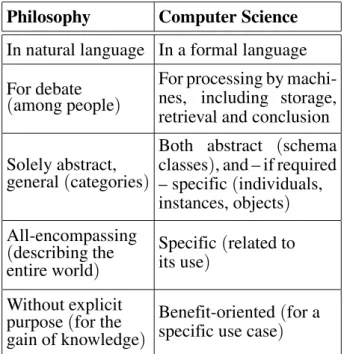
Philosopher, Information scientist: Ontology in philosophy lays claim to being all-encom-passing– applying to the whole world. On the other hand, it is without explicit purpose. In contrast, an ontology in information science al-waysaims at benefits. It is usually specific for a domain of interest. This distinction is also reflected in the use of the plural form “ontolo-gies”. When philosophers speak of ontologies, they mean all-encompassing world views of var-ious philosophers, e.g., the ontologies of Aris-totle, Husserl, etc. When information scientists talk of ontologies, they mean formalizations of different domains (subsets) of the world, e.g., an ontology for tourism, one for biology, or for law.
Do information scientists use the term “on-tology” in the same way as philosophers do, or do they use the same term for a different concept (homonym)?
Philosopher, Information scientist: Neither nor. The fact that philosophers and computer scientists do not use the identical concept for
the term should have become clear during our discussion(see “Table 4: Differences between the disciplines“). On the other hand, how-ever, the concepts show close similarities(see “Table 3: Correspondences between the dis-ciplines“), hence ahomonymis also out of the question, ratheranalogyormetaphor. The tech-nical term is used in computer science, not in its original, but in a metaphorical meaning. There is a similarity between the two, an association which helps to understand. In computer sci-ence, being a young discipline, metaphors from older disciplines are used often. Examples are “architecture”(architecture of buildings→ soft-ware architecture), “surfing”(sport→internet research), “virus”(biological virus→computer virus)or “mouse”(animal→computer mouse).
What have you learned from this dialogue? Information scientist: We have already men-tioned that we stand on the shoulders of the philosophers when it comes to ontologies. An essential insight from this dialogue is the distinction between personal and conventional concepts, which is made in psychology. It helps to deal with practical problems in knowledge engineering. Computer science is a young dis-cipline, in particular its sub-discipline of know-ledge engineering. Today, we work like the craftsmen in medieval times when they built cathedrals. Our work is based on experience,
Philosophy Computer Science
In natural language In a formal language
For debate (among people)
For processing by machi-nes, including storage, retrieval and conclusion
Solely abstract, general(categories)
Both abstract (schema
classes), and – if required – specific(individuals, instances, objects)
All-encompassing (describing the entire world)
Specific(related to its use)
Without explicit purpose(for the gain of knowledge)
Benefit-oriented(for a specific use case)
“best practices”, although our results are cer-tainly nothing to be ashamed of. But a scientific foundation to our approach – as the laws of stat-ics for the construction of cathedrals – does not yet exist. For this, I wish and hope for further improvements.
Psychologist: I became aware, again, of the im-portance of multidisciplinarity. I am happy that as a psychologist, I can contribute to the matu-ration of a discipline like information science. On the other hand, as said before, in psychol-ogy we hardly ever use the term ontolpsychol-ogy. Still, quite familiar to me is the Babylonian confu-sion between psychologists: different terms are used for the same concept and – even worse – the same term is used for different concepts.
What I have learned today is that other disci-plines, like tourism, biology, and law, benefit from the normalization of their terminology by means of ontologies. This could be useful in psychology too, e.g., for indexing and finding scientific publications.
Philosopher: This would be of benefit for philosophy also – in particular for the field of analytical philosophy (e.g., Gottlob Frege, Bertrand Russell and the early Ludwig Wittgen-stein). In analytical philosophy, precise concept distinctiveness is most important. Precise con-cepts require precise tools. Here, the formal ontologies of computer science may be of assis-tance.
How do you judge the relevance of ontologies in the future?
Philosopher, Psychologist, Information Sci-entist: Different disciplines need to grow to-gether more and more. The major challenges of our time – scientific and social – can only be solved interdisciplinarily. To be successful, it is vital that we manage to find results of vari-ous teams in varivari-ous disciplines worldwide and to integrate them reasonably. Ontologies are of vital importance for this: by the power of stan-dardizing terms, their meanings, and relations; furthermore, by the possibility of integrating different domain-ontologies; and, last but not least, by supporting the semantic web in search, reasoning and integration with computer appli-cations. This is why we expect the importance of ontologies to grow significantly in future.
References
[1] T. R. GRUBER, A translation approach to portable
ontologies.Knowledge Acquisition,5(2), pp. 199– 220, 1993.
[2] M. USCHOLD, M. GRUNINGER, Ontologies: Princi-ples, Methods and Applications.Knowledge Engi-neering Review,11(2), June 1996.
[3] H. HERRE ET AL., General Formal Ontology(GFO):
A Foundational Ontology Integrating Objects and Processes. Technical Report, 8, University of Leipzig, 2006.
[4] R. GROSSMANN, The Categorial Structure of the
World, Bloomington, 1983.
[5] G. PICKERT, Einf¨uhrung in Ontologien,
http://www.dbis.informatik.hu-berlin.de /dbisold/lehre/WS0203/SemWeb/artikel/2 /Pickert Ontologien final.pdf
[6] S. POLLANDT, Fuzzy-Begriffe, Formale
Begriffs-analyse unscharfer Daten, Springer-Verlag, 1997.
[7] W. HESSE, Aktuelles Schlagwort – Ontologie(n).
Informatik Spektrum,25(6), pp. 477–480, Springer-Verlag, Dezember 2002.
[8] Wikipedia – Die freie Enzyklop¨adie: Kategorien,
http://dewikipediaorg/wiki/Kategorien
[9] T. BERNERS-LEE, J. HENDLER, O. LASSILA, The
Se-mantic Web.Scientific American,284(5), pp. 34–43, 2001.
[10] C. MASOLO et al., WonderWeb Deliverable D17:
The WonderWeb Library of Foundational Ontolo-gies,http://wwwloaistccnrit/Papers /DOLCE2.1-FOLpdf
[11] TH. B. SEILER, Begreifen und Verstehen. Ein Buch ¨uber Begriffe und Bedeutungen.Darmst¨adter Schriften zur Allgemeinen Wissenschaft. Verlag All-gemeine Wissenschaft, Darmstadt, 2001.
[12] TH. B. SEILER, Wissen zwischen Sprache,
Informa-tion, Bewusstsein. Probleme mit dem Wissensbe-griff.MV Wissenschaft, M¨unster, 2008.
[13] TH. B. SEILER, Evolution des Wissens, Bd. 1,
Evo-lution der Erkenntnisstrukturen, Bd. 2, EvoEvo-lution der Begriffe.LIT-Verlag, M¨unster, 2012.
Received:October, 2014
Accepted:October, 2014
Contact address:
PROF. DR. JOHANNESBUSSEis currently Professor of Knowledge Man-agement at the University of Applied Sciences(HAW)of Landshut, Germany. Before, he held a professorship in Teaching and Learning in Higher Education at the University of Applied Sciences(THM)in Giessen/Friedberg, Germany. He received his diploma and doctorate (Ph.D.), both in Informatics, in 1991 and 1999, respectively, from Tue-bingen University, and continued to study at the Graduate College of the T¨ubingen Interdepartmental Centre for Ethics in Science and Humani-ties. Following a postdoc position at Heidelberg University, where he focused on blended learning environments in adult education, Johannes Busse worked as Senior Reseracher with Ontoprise GmbH(Karlsruhe) and as free-lance scientific consultant in the areas of semantic web, knowledge management, and ontology engineering.www.jbusse.de
PROF. DR. BERNHARD HUMM is a professor of software engineer-ing and project management at the Computer Science Department of Hochschule Darmstadt – University of Applied Sciences, Germany. He received a Ph.D. from the University of Wollongong, Australia and the degree Dipl.-Inform. from Kaiserslautern University, Germany. His research focus is on semantic applications, software architecture, and programming languages. He is member of the Board of Directors of the Institute of Applied Informatics, Darmstadt(aIDa)and Ph.D. coordi-nator. He is running several national and international research projects in cooperation with industry and research organizations and is publish-ing his results regularly. For 11 years, he worked in the IT industry as a software architect, chief consultant, IT manager and head of the research department of a large software company.
www.fbi.h-da.de/∼b.humm
DR.HABIL. CHRISTOPHL ¨UBBERT, born in 1938, studied mathematics at Technical University Darmstadt and Ludwig-Maximilians-Universit¨at in Munich. He received a doctorate degree in 1969. He was an as-sociate professor of mathematics at Haile Selassie University of Addis Abeba(Ethiopia), and Universidad Nacional del Centro de la Provincia de Buenos Aires(Argentina). Later he worked as a consultant i.a. for the European Commission and the Ministry of the Interior.
www.cl-diesunddas.de
DR. FRANKMOELTER, born in 1965 at the Lower Rhine, studied biology
in D¨usseldorf with the focus on neuroinformatics and neurophysiology. After getting the diploma in biology in 1997 he worked as doctoral can-didate and project manager in image processing and pattern recognition at the DMT GmbH in Essen. There he developed a complete OCR sys-tem as commercial product, based on parallel artificial neural networks. For the theoretical work he got in 2001 the grade as PhD from the Westf¨alische Willhelms University in M¨unster. Since 2003 he taught for 5 years project management and applied computer science at the Technical University of Applied Sciences in Bochum. He is currently working as a freelance IT consultant for enterprise modeling, IT archi-tecture, project- process- and quality management. In his spare time he works independently on ontology topics and artificial intelligence.
www.moelter.cc
ANATOLREIBOLD, born in 1959, graduated in mathematics and me-chanics from the University of Novosibirsk. Passionate mathematician with expertise in logic, category theory, ontology engineering, semantic web, data analysis, data science, cryptography, GABEK, polycontextu-ral logic and polyductive theory.www.ontoport.de/?q=de/node/3
MATTHIASREWALD, Dipl.-Ing., born in 1955, studied electrical engi-neering at the Technical University Darmstadt. Worked in the fields of software development, process engineering, computer aided man-ufacturing, software ergonomics, project management, document and information management and training. At present: running the business of the “Ernst-Schr¨oder-Zentrum f¨ur begriffliche Wissenverarbeitung” (Ernst Schr¨oder Center for Conceptual Knowledge Processing)and tutor.www.ernstschroederzentrum.de
DR. VERONIKASCHLUTER¨ was born in Wilhelmshaven. She studied philosophy, French language and literature and Geography at the uni-versities in Kiel, Saarbr¨ucken, Paris and Poitiers. She made a Phd in philosophy and worked on categories. (“ ¨Uber Kategorien und ihre Herausbildung”). She completed her university studies with a state examination and worked as a teacher at a Grammar School. She is now a retired person, but continues to work on philosophy, ontology and teleology. She has two children and two grand-children.
PROF. DR. THOMASBERNHARDSEILERis a Professor emeritus of Psy-chology at the Technical University Darmstadt. Born in 1925 at Di-etikon near Zurich, Switzerland, he first studied philosophy and theol-ogy, then received degrees in mathematics, physics, botanic and French literature. Finally he had concentrated on psychological sciences at the Universities of Fribourg(Switzerland), Paris and Berlin, and written a thesis on reversibility. In 1971 he obtained the position of Professor of Developmental Psychology at the Free University of Berlin, and in 1976 went to Darmstadt. His main research topic was the development of concepts and word meanings. In the last years he concentrated on philosophical and psychological theories of concepts and meanings.
www.seiler-auerbach.de
PROF. DR. ERWINTEGTMEIERgraduted from the University of Frank-furt(supervisor Habermas), majors: Sociology and Social Psychol-ogy, minors: Political Science and East European History. PhD with Hans Albert in Philosophy of Science. Current position: Professor of Philosophy at the University of Mannheim. Areas of research: phi-losophy of science, ontology and its history, theory of knowledge.
www.metaphysica.de/personen/e-tegtmeier.htm
![Figure 3. Modelling in DOLCE: “The leave is green” (according to [10, Fig. 3]).](https://thumb-us.123doks.com/thumbv2/123dok_us/8039310.2128704/7.892.217.682.691.929/figure-modelling-dolce-leave-green-according-fig.webp)