ABSTRACT
It is essential to obtain valuable information during drilling from the formation that is being drilled for rate optimization. In the drilling operation, the process of lithology and formation determination is extremely obscurant and it seems machine learning, as a novel prediction method that can model complicated situations having a high degree of uncertainty, could be beneficial. In this work, the real-time drilling data was applied to predict the formation type and lithology while drilling that formation using a genetic algorithm and Taguchi design of experiment optimized artificial neural network. Drilling data of twelve wells in one of Iranian gas fields were applied for this work. 47500 sets of data were selected, and after data control, 31200 data sets were selected as valid data and imported to artificial neural networks. For performing this research, by changing the network features and optimizing the structure of the network using the Taguchi method and optimizing the weight and biases of the network using the genetic algorithm, a unique artificial neural network was designed. The results show that the developed hybrid machine learning method can predict formation and lithology with a high degree of accuracy.
Keywords: : Real-Time Drilling Data, Formation Lithology, Virtual Intelligence, genetic algorithm, design of experiment
Alireza Moazzeni, Ehsan Khamehchi*
Department of petroleum engineering, Amirkabir University, Tehran, Iran
Drilling Rate Optimization by Automatic Lithology Prediction Using
Hybrid Machine Learning
*Corresponding author Ehsan Khamehchi
Email: [email protected] Tel: +98 21 6454 5154 Fax: +98 21 6454 5154
Article history
Received: September 09, 2019
Received in revised form: October 15, 2019 Accepted: October 16, 2019
Available online: December 20, 2019 DOI: 10.22078/jpst.2019.3877.1614
INTRODUCTION
A formation is the basic unit of lithostratigraphy. A formation is composed of some layers or strata with some similar or comparable properties such as lithology or color. The lithology of a rock unit is representative of physical features of this rock such as color, texture, grain size, and composition [1, 2]. Having enough information of the formation under the bit, is very significant for bit selection
active shales are existing in the wellbore, shale swelling and wellbore instability can be a common problem.
Onyia in 1988 [6] shows that a close relation between log data and lithology of a formation is existing; however, getting a good relation between log data and geological properties of the rock is impossible due to the high nonlinearity of the rock properties. Some conventional statistical methods such as box and whisker plots, histograms, the analysis of average and variance and cross plots, were used by Reed et al. in 1997 [7], Killeen in 1997 [8], McDowell et al in 1988 and 2004 [9, 10], and Vella and Emerson in 2009 [11] to find out the physical properties of the rock and relate them to the geology of the formation. These methods do not provide accurate means to predict lithology [5, 6, 12-14].
Because of conventional techniques limitation on solving complicated issues, in recent years, several researchers started to use the multi-variable pattern recognition methods for predicting properties of a formation [15-19].
The neural network successfully applied to downhole logging data [16-26]. At the newest attempt, Corina and Hovda in 2018 [27] tried to predict lithology from log data using the kernel density estimation method. Although their work was satisfactory, it needs measurement while drilling (MWD) tools during drilling operations. Benaouda et al. in 1999 [17] and Ojha and Maiti in 2013 [21] applied the first time the artificial neural network in ocean drilling to predict lithology in a situation where drilling core recovery is not suitable.
For finding the relation between real-time drilling data and formation lithology, a feed-forward back
propagation neural network with high ability of learning can be applied. In this work at the first trial, we tried to predict the formation type and lithology of one of the Iranian gas fields using the back-propagation neural network. Although the results were kind to some extent, they were not satisfactory. Therefore, in the next attempt, we designed a Genetic algorithm optimized the neural network in conjunction with the Taguchi experiment design method to improve the results.
EXPERIMENTAL PROCEDURE
Approach
Many techniques and procedures can be found in the literature for forecasting lithology and formation type during or after drilling. Collecting cuttings from the shale shaker and analyzing them by the geologists is the most common method. Although in this method, lithology can be specified precisely, but there is a considerable lag time in this determination and can cause some severe problems. For example, formation change can cause a blowout or loss of circulation if it is not diagnosed quickly. One of the other important methods of lithology determination is logging, but previously mentioned problems still exist. Other technique is employing adjacent well data. Although it can be accompanied by some significant uncertainties but it is more applicable [28].
http://jpst.ripi.ir Journal of Petroleum Science and Technology2019, 9(4), 77-88
although there are some other inputs such as drilling fluid properties [32], weight on bit and rpm of bit. Therefore, in this work, first, all variables affecting the rate of penetration (ROP) will be determined by us, and then the formation constant will be replaced with ROP.
The Bourgoyne and Young Method [30] (Figure 1) is one of the important Rete of penetration methods since it is based the past drilling parameters. Equation 1 gives the common form of relation of rate of penetration introduced by Bourgoyne and Young in 1974 [31]:
ROP=f1 f2 f3 f4 f5 f6 f7 f8 (1) Equation 1 can be rearranged as follows:
1
2 3 4 5 6 7 8
= ROP
f
f f f f f f f (2)
Moreover, solving this equation is not easy due to the lack of constants a1- a8, so the artificial neural network (ANN) will be used for the approach. In this method, ROP and also effective parameters on functions f2 to f8 would be introduced to ANN, and effective parameters on f1 are calculated.
In this work, the current well real-time drilling data and adjacent well were introduced to the optimized ANN to detecting lithology and formation exactly Figure 1: drilling parameter items considered to affect the rate of penetration (equations from Bourgoyne and Young in 1974 [31])
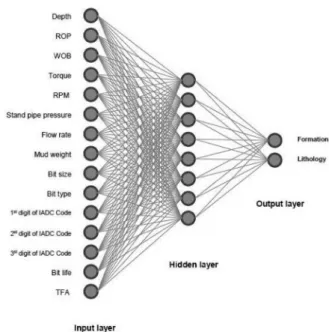
while drilling. Input parameters to the ANN and output parameters are shown in Figure 2.
Figure 2: Feed-forward back-propagation artificial neural network used in this work.
Optimizing ANN using GA
The complexity and non-continuity of geological problems make the genetic algorithm a more useful and preferable tool over the traditional backpropagation method for finding weight and bias of an ANN. The researches by Van Rooij et al. in 1996 [33] and Vonk et al. in 1997 [34] have proposed using metaheuristic methods such as genetic algorithm or ant colony algorithm to regenerate ANN structure as well as its weights and bias.
Figure 3: South Pars Gas Field, South of Iran [28].
Table 1: Encountered formation in the South Pars gas field and assigned codes to these formations.
Code Formation Code Formation Code Formation Code Formation 19 Neyriz 13 Fahlyan 7 Mishrif 1 Gachsaran 20 Dashtak 14 Hith 8 Hamadi 2 Asmari 21 Kangan 15 Arab 9 Mauddud 3 Jahrom 22 Dalan 16 Daran 10 Kazhdomi 4 Sachun 23 Nar 17 Dyiab 11 Darian 5 Halul 18 Surmeh 12 Gadvan 6 Lafan
For generating code for the lithologies, encountered lithologies in the drilled formation in this field was studied precisely. It was noted that there are ten primary lithologies in the encountered formations. So, a number between 1 and 6 was allocated to lithology. In Table 2, the encountered lithology and assigned codes are shown to each one.
Therefore as it can be seen in Table 3, a number between 1 and 24 would be representative of the formation type and a number between 1 and 6 would shows the lithology.
Table 2: Encountered lithology in the South Pars gas field and assigned codes to these lithologies.
lithology code Lithology Code
Limestone 1 Argillaceous limestone 1.5
Dolomite 2 Dolomite/limestone 2.5
Anhydrite 3 Anhydrite/Dolomite 3.5
Shale 4 Shale/limestone 4.5
Marl 5 Clay 6
addition, the required code for solving the problem was developed by MATLAB R2015B software.
Input Parameters of the Neural Network
Burgoyne at 1991 [36] showed that some parameters such as bit rotating speed, weight on bit, pump flow rate and pump pressure as well as formation type and lithology can affect the drilling rate. This idea will be used for finding lithology and type of formation. This means that when drilling a particular formation, the drilling rate would be constant when drilling parameters are constant. In other words, drilling rate change shows lithology change during drilling with constant drilling parameters. Therefore, drilling parameters and ROP would be introduced to the GA-ANN network as the input and lithology and formation would be considered as the output of the network. In this work, 47000 sets of data from twelve wells in the South Pars gas field (Figure 3) were selected (Figure 2). After the effective parameters on Equation 1 were considered, some parameters were chosen as the most effective parameters on the drilling rate. Selected parameters which can also use as an indicator for formation and lithology change are: bit depth, drilling rate, torque on bit, WOB, rotating speed (RPM) of bit, pressure of pump, flow rate of pump, size of bit, and type of bit.Output Parameters of the Neural Network
This network was designed for formation type and lithology prediction. Therefor a two-digit code representing formation type and lithology can be used as the output. First, a code to all encountered formation was assigned by us as South Pars gas field wells were being drilled. Moreover Table 1 showshttp://jpst.ripi.ir Journal of Petroleum Science and Technology2019, 9(4), 77-88
Table 3: Generated output code for determining formation type and lithology.
Formation type (1 to 24) Lithology type (1 or 6)
Optimizing Network Parameters Using
Taguchi Method
Taguchi method is one of important procedures of design of experiment introduced by the Japanese engineer Genichi Taguchi [39, 40]. Using this method relation between input and output
parameters can be obtained with fewer energy, try or experiments. For this purpose, there are also other methods, such as full factorial design, fractional factorial design, etc. [38].
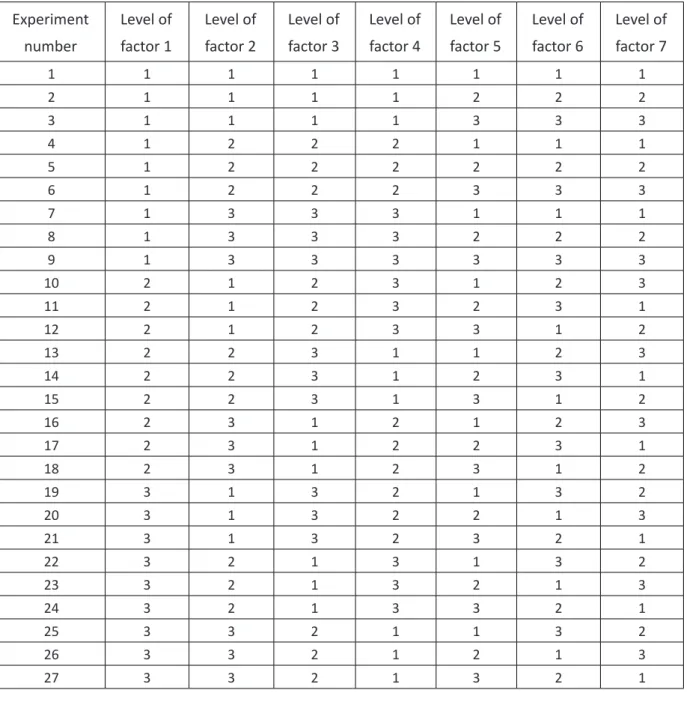
Moreover, tables of orthogonal arrays were provided by Taguchi to be used as statistical designs that were well suited for estimating the main effects. In Table 4, the Taguchi method flowchart and an example of L27 orthogonal array are shown.
Table 4: Taguchi L27 arrays with seven factors, each one in 3 levels. Experiment
number
Level of factor 1
Level of factor 2
Level of factor 3
Level of factor 4
Level of factor 5
Level of factor 6
Level of factor 7
1 1 1 1 1 1 1 1
2 1 1 1 1 2 2 2
3 1 1 1 1 3 3 3
4 1 2 2 2 1 1 1
5 1 2 2 2 2 2 2
6 1 2 2 2 3 3 3
7 1 3 3 3 1 1 1
8 1 3 3 3 2 2 2
9 1 3 3 3 3 3 3
10 2 1 2 3 1 2 3
11 2 1 2 3 2 3 1
12 2 1 2 3 3 1 2
13 2 2 3 1 1 2 3
14 2 2 3 1 2 3 1
15 2 2 3 1 3 1 2
16 2 3 1 2 1 2 3
17 2 3 1 2 2 3 1
18 2 3 1 2 3 1 2
19 3 1 3 2 1 3 2
20 3 1 3 2 2 1 3
21 3 1 3 2 3 2 1
22 3 2 1 3 1 3 2
23 3 2 1 3 2 1 3
24 3 2 1 3 3 2 1
25 3 3 2 1 1 3 2
26 3 3 2 1 2 1 3
RESULTS AND DISCUSSION
In the first attempt, a conventional feed-forward back-propagation artificial neural network was designed to solve the problem.
For solving the model, it is common to divide input data into three parts of training, validation and test. For training the network, the group of training data would be used, but the group of validation data would be used to prevent over-fitting. For this purpose, training will be continued until the MSE related to the data group of validation continue to decrease. In other words, when MSE of validation data starts to increase, training of the network stops, since overfitting and memorization begin to grow in the network [40].
For data modeling the neural network toolbox of Matlab R2015b software was applied.
At the first trial, as published in 2015 [28], all 47500 available set data were introduced to various ANNs. By changing parameters of the network’s output, results were changed and in the best conditions (selecting a 3 layer network with 15 neuron and Tansig activation function in first layer, 8 neuron and Tansig activation function in second layer and 2 neurons and Purelin activation function in third layer), results for R-value for training, testing, and validation data were 0.88, 0.87 and 0.87 respectively. Also, the best value of the MSE was 0.012.
Designed ANN was not satisfactory, so data refining and data quality control performed. Therefore, from the 47500 data set, 31200 data sets were selected as valid data for which 20800 data were selected for training, 5200 for validation, and 5200 for testing. Furthermore, a GA optimized ANN was designed to find weights and biases of the selected
ANN. Fitness function of the designed network is the average difference between predicted and expected values for the lithology and formation. The cost of the fitness function of a chromosome in the GA can be calculated using equation 3:
(
)
(
)
(
)
21 1
1 , ,
= =
= −
×
∑∑
N M
k j
U Target j k Output j k
N M (3)
where e is the sum of the MSE, b is the number of output nodes, a is the number of training samples, Target (j, k) is the expected output, and Output (j, k) is the actual output. Thus minimization of the sum of MSE (e) can lead to the fitness function value be closer to zero. Every time that fitness value of all chromosomes is calculated, a new population of new chromosomes might be reproduced through one of these operators: selection, crossover, and mutation.
The action of selection in the genetic algorithm can be performed using roulette-wheel selection, tournament selection, or random selection. In the crossover process, two chromosomes would randomly exchange part of their information. In the mutation process, information of one gen would be changed randomly. Aim of the mutation is giving local random search ability to the genetic algorithm.
http://jpst.ripi.ir Journal of Petroleum Science and Technology2019, 9(4), 77-88
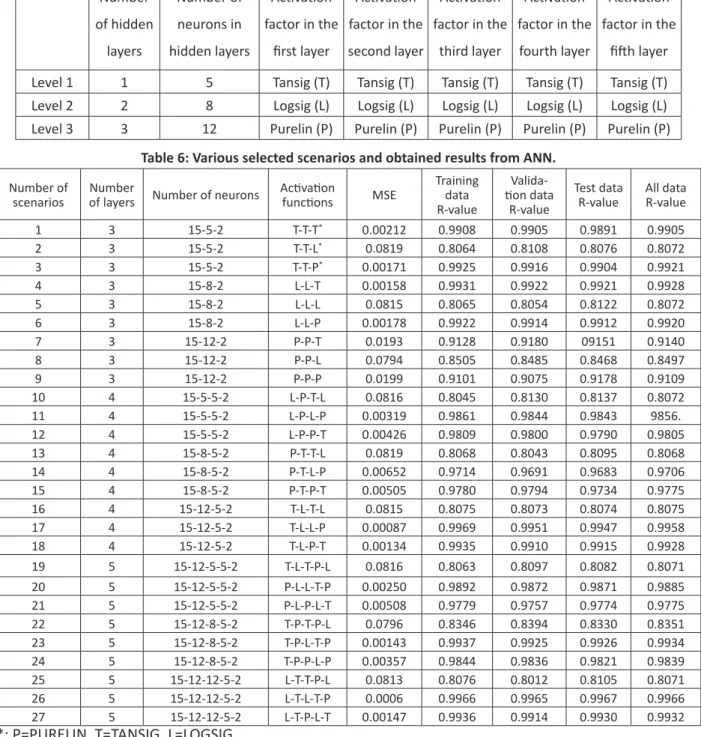
functions (as it is shown in Table 5), 2187 types of networks should be tested. As it is impossible to simulate all of these scenarios, the Taguchi experiment design approach can be employed to reduce the number of experiments from 2187 to just 27, as it is shown in Table 6.
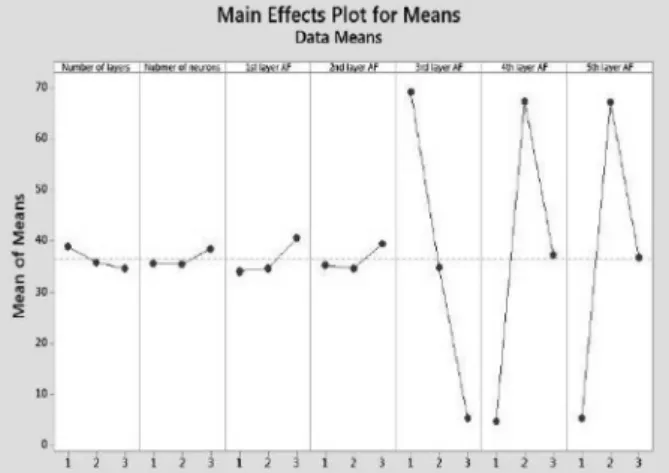
For considering the effect of each factor on the
obtained results from the network, an analysis of Taguchi designed experiments was performed with Minitab software. Also, the obtained results are shown in Figure 4. As can be seen, the last three factors have a drastic effect on the network design, and on the contrary, the first four factors have a negligible effect.
Table 5: Selected factors for Optimizing the structure of ANN and various levels for each factor.
Number of hidden
layers
Number of neurons in hidden layers
Activation factor in the
first layer
Activation factor in the second layer
Activation factor in the
third layer
Activation factor in the fourth layer
Activation factor in the
fifth layer
Level 1 1 5 Tansig (T) Tansig (T) Tansig (T) Tansig (T) Tansig (T)
Level 2 2 8 Logsig (L) Logsig (L) Logsig (L) Logsig (L) Logsig (L)
Level 3 3 12 Purelin (P) Purelin (P) Purelin (P) Purelin (P) Purelin (P) Table 6: Various selected scenarios and obtained results from ANN.
Number of
scenarios Number of layers Number of neurons Activation functions MSE
Training data R-value
Valida-tion data
R-value
Test data
R-value All data R-value
1 3 15-5-2 T-T-T* 0.00212 0.9908 0.9905 0.9891 0.9905
2 3 15-5-2 T-T-L* 0.0819 0.8064 0.8108 0.8076 0.8072
3 3 15-5-2 T-T-P* 0.00171 0.9925 0.9916 0.9904 0.9921
4 3 15-8-2 L-L-T 0.00158 0.9931 0.9922 0.9921 0.9928
5 3 15-8-2 L-L-L 0.0815 0.8065 0.8054 0.8122 0.8072
6 3 15-8-2 L-L-P 0.00178 0.9922 0.9914 0.9912 0.9920
7 3 15-12-2 P-P-T 0.0193 0.9128 0.9180 09151 0.9140
8 3 15-12-2 P-P-L 0.0794 0.8505 0.8485 0.8468 0.8497
9 3 15-12-2 P-P-P 0.0199 0.9101 0.9075 0.9178 0.9109
10 4 15-5-5-2 L-P-T-L 0.0816 0.8045 0.8130 0.8137 0.8072
11 4 15-5-5-2 L-P-L-P 0.00319 0.9861 0.9844 0.9843 9856.
12 4 15-5-5-2 L-P-P-T 0.00426 0.9809 0.9800 0.9790 0.9805
13 4 15-8-5-2 P-T-T-L 0.0819 0.8068 0.8043 0.8095 0.8068
14 4 15-8-5-2 P-T-L-P 0.00652 0.9714 0.9691 0.9683 0.9706
15 4 15-8-5-2 P-T-P-T 0.00505 0.9780 0.9794 0.9734 0.9775
16 4 15-12-5-2 T-L-T-L 0.0815 0.8075 0.8073 0.8074 0.8075
17 4 15-12-5-2 T-L-L-P 0.00087 0.9969 0.9951 0.9947 0.9958
18 4 15-12-5-2 T-L-P-T 0.00134 0.9935 0.9910 0.9915 0.9928
19 5 15-12-5-5-2 T-L-T-P-L 0.0816 0.8063 0.8097 0.8082 0.8071
20 5 15-12-5-5-2 P-L-L-T-P 0.00250 0.9892 0.9872 0.9871 0.9885
21 5 15-12-5-5-2 P-L-P-L-T 0.00508 0.9779 0.9757 0.9774 0.9775
22 5 15-12-8-5-2 T-P-T-P-L 0.0796 0.8346 0.8394 0.8330 0.8351
23 5 15-12-8-5-2 T-P-L-T-P 0.00143 0.9937 0.9925 0.9926 0.9934
24 5 15-12-8-5-2 T-P-P-L-P 0.00357 0.9844 0.9836 0.9821 0.9839
25 5 15-12-12-5-2 L-T-T-P-L 0.0813 0.8076 0.8012 0.8105 0.8071
26 5 15-12-12-5-2 L-T-L-T-P 0.0006 0.9966 0.9965 0.9967 0.9966
27 5 15-12-12-5-2 L-T-P-L-T 0.00147 0.9936 0.9914 0.9930 0.9932
Figure 4: Main effect plot for means of each factor.
Figure 5: structure of constructed artificial neural network and details of network training.
Therefore, a feed-forward backpropagation network with five layers was selected as the solution to this problem. In this network, the number of neurons in layers 1 to 5 is 15, 12, 12, 5, and 2, respectively with activation functions of Logsig, Tansig, Logsig, Tansig, and Purelin, respectively (Figure 5). This network (that is shown in Table 6 by scenario 25 in detail) was solved after 500 iterations by the designed GA-ANN algorithm. In this case, MSE was 0.0006, which was completely acceptable.
Moreover, network results for training, testing, validation, and total data are respectively shown in Figure 6. R-value for all of these four groups is more than 99 percent, as can be seen in Figure 6. Furthermore, after data refining and network optimization, 13% improvement in R-value was achieved.
Figure 6: training result of training, validation, test, and all data of the trained neural network.
CONCLUSIONS
In this work, an approach for rock and formation classification based on real-time drilling data was developed. Moreover, the developed method gives the ability of quick determination of formation and lithology while drilling to the geologist and driller. Furthermore, the proposed methodology helps the drilling engineer to recognize the drilling problems quickly and making correct decisions.
http://jpst.ripi.ir Journal of Petroleum Science and Technology2019, 9(4), 77-88
• Real-time formation and lithology prediction are useful because of controlling numerous drilling problems such as stuck pipe, blow out or loss of circulation before accruing, reducing drilling costs, optimizing drilling operations, determining drilling parameters, and increasing drilling rate.
• A quick, accurate, and not expensive method was developed for diagnosing the formation and lithology change precisely when drilling a rock. • The selected methodology is based on virtual intelligence, specifically artificial neural networks, and the genetic algorithm searching method. They are proven to be able to solve severe, complicated problems containing high degrees of uncertainty. • Moreover, data refinement and quality control of data and optimizing ANN improved the output results by 13%.
• A methodology was explained for network type selection and adjusting the network features using the Taguchi method of DOE.
• The introduced method for finding the best weights and biases of ANN using GA could reduce simulation time and cost and increase the accuracy of the simulation.
• It seems a GA optimized artificial neural network with five layers, in which the number of neurons in layers 1 to 5 are 15, 12, 12, 5, and 2 respectively, and activation functions are Logsig, Tansig, Logsig, Tansig, and Purelin respectively is the best solution. This network was solved after 500 iterations, and its MSE was 0.0006, which is quite acceptable. • Finally, it is recommended to optimize the structure of the ANN using other optimization methods like particle swarm or the artificial bee colony algorithm.
ACKNOWLEDGMENTS
This research was supported by AmirKabir University of Technology. We thank our colleagues from Amirkabir University, who provided insight and expertise that greatly assisted the study, although they may not agree with all of the conclusions of this paper.
NOMENCLATURES
ANN : Artificial Neural Network
BP : Back-propagation
DOE : Design of Experiments
MSE : Mean Squared Error MWD : Measurement While Drilling ROP : Rate of Penetration (ft/h) RPM : Round per Minute
REFERENCES
1. Bates R. J. and Jackson J. A., “Dictionary of Geological Terms (3rd ed.)”, American
Geological Institute, 1984, 584, 299. 2. Allaby A. and Allaby M., “Oxford Dictionary of
Earth Sciences (2nd ed.),” Oxford University Press, 1999, 320.
3. Falconer I. G., Burgess T. M., and Sheppard M. C., “Separating bit and Lithology Effects from Drilling Mechanics Data,” SPE/IADC Drilling Conference held in Dallas, Texas, (SPE paper 17191), 1988 .
4. Moazzeni A. R., Nabaei M., and Kharrat R., “A Breakthrough in Controlling Lost Circulation in a Pay Zone by Optimizing the Particle Size Distribution of Shellfish and Limestone Chips,”
Journal of Petroleum Science and Technology,
2012, 30, 290–306.
5, 242-246.
6. Onyia E. C., “Relationship between Formation Strength, Drilling Strength, and Electric Log Properties,” SPE Annual Technical Conference
and Exhibition held in Houston, Texas, (SPE paper 18166), 1988.
7. Reed L., Taner M., Elliott B., and Killeen P., “A Comparison of Physical Property Borehole Logs with Geology, Mineralogy, and Chemistry in a Borehole at Les Mines Selbaie,” Northwestern Québec, Canada. In: Gubbins, A. (Ed.), Exploration 97: Fourth Decennial International Conference on Mineral Exploration, 1997, 97, 1043–1048. 8. Killeen P., “Borehole Geophysics: Exploring
the third Dimension,” In: Gubbins A. (Ed.), Exploration 97: Fourth Decennial International Conference on Mineral Exploration, 1997, 97, 31–42.
9. McDowell G. M., King A., Lewis R. E., Clayton E. A., and et al., “In-situ Nickel Assay by Prompt Gamma Neutron Activation Wireline Logging,” SEG Annual Meeting, New Orleans, Louisiana, 1988, 772-775.
10. McDowell G., Fenlon K., and King A., “Conductivity-based Nickel Grade Estimation for Grade Control at Inco’s Sudbury Mines,” SEG Annual Meeting. Denver, Colorado, 2004, 1151-1154.
11. Vella L. and Emerson D., “Carrapateena: Physical Properties of a New Iron-oxide Copper–gold Deposit,” Journal Article ASEG Extended
Abstracts, 2009, 1, 1–13.
12. Gstalder S. and Raynal J., “Measurement of Some Mechanical Properties of Rocks and their Relationship to Rock Drillability,” Journal of Petroleum Technology, 1966, 18(8), 991-996.
13. Raynal J. C., Serge A., and Sagot A. M., “Organization of Field Tests and Evaluation of Tricone Bit Performance Using Statistical Analysis and Sonic Logs,” Journal of Petroleum Technology, 1971, 23(4), 506-512.
14. Mason K. L., “Tricone Bit Selection Using Sonic Logs,” SPE Drilling Engineering, 1987, 2(2), 135-142.
15. Rabaute A., Yven B., Chelini W., and Zamora M., “Subsurface Geophysics of the Phlegrean Fields: New Insights from Downhole Measurements, Journal of Geophysical Research, 2003, 108(B3). 16. Qi L. and Carr T. R., “Neural Network Prediction
of Carbonate Lithofacies from Well Logs,” Big
Bow and Sand Arroyo Creek Fields, Southwest Kansas, Comput. Geosci., 2006, 32(7), 947– 964.
17. Benaouda D., Wadge G., Whitmarsh R. B., Rothwell R. G., and MacLeod C., “Inferring the Lithology of Borehole Rocks by Applying Neural Network Classifiers to Downhole Logs: an Example from the Ocean Drilling Program,” Geophysical Journal International, 1999, 136(2), 477-491.
18. Williams N. and Dipple G., “Mapping Subsurface Alteration Using Gravity and Magnetic Inversion Models,” In: Milkereit B. (Ed.), Exploration 07: Fifth Decennial International Conference on Mineral Exploration, 2007, 461–472.
http://jpst.ripi.ir Journal of Petroleum Science and Technology2019, 9(4), 77-88
Chemistry of the Earth, 2011, 36, 1469–1485. 20. Granek J., “Computing Geologically Consistent
Models from Geophysical Data,” University
of British Columbia, BC, Canada, Master of Science Thesis, 2011, 1-149.
21. Ojha M. and Maiti S., “Sediment Classification Using Neural Networks: An Example from the Site-U1344A of IODP Expedition 323 in the Bering Sea,” Deep Sea Research Part II: Topical Studies in Oceanography, 2016, 125, 202-213. 22. Baldwin J., Bateman A., and Wheatley C.,
“Application of Neural Network to the Problem of Mineral Identification from Well Logs,”
Journal of Log Analyst, 1990, 31, 279–293. 23. Wong P., Jian F., and Taggart L., “A Critical
Comparison of Neural Networks and Discriminant Analysis in Lithofacies, Porosity and Permeability Predictions,” Journal of Petroleum Geology, 1995,
18(2), 191–206.
24. Farmer R. and Adams S. J., “Facies Recognition Using Neural Networks. New Zealand Petroleum Conference,” Queenstown, 1998.
25. Maiti S., Tiwari R. K., and Kumpel H. J., “Neural Network Modeling and Classification of Lithofacies Using Well Log Data: a Case Study from KTB Borehole Site,” Geophysical Journal International, 2007, 169, 733–746.
26. Mahmoodi O. and Smith R., “Clustering of Downhole Physical Properties Measurements at the Victoria Property,” Sudbury for the purpose of extracting lithological information. Journal of Applied Geophysics, 2016, 118, 145–154. 27. Corina A. N. and Hovda S., “Automatic Lithology
Prediction from Well-logging Using Kernel Density Estimation,” Journal of Petroleum Science and Engineering, 2018, 170, 664-674.
28. Moazzeni A. and Haffar M., “Artificial Intelligence Lead to Lithology Feature Extraction through the Real-Time Data Analyses,” Journal of Earth Science and Climate Change, 2015, 6, 265. 29. Garnier A. J. and Van Lingen N. H., “Phenomena
Affecting Drilling Rates at Depth,” SPE 1097-G, Annual Fall Meeting of SPE, Houston, TX, 1959. 30. Galle E. M. and Woods A. B., “Best Constant
Weight and Rotary Speed for Rotary Rock Bits,” In Drilling and Production Practice, American Petroleum Institute, API, 1963, 48-73.
31. Bourgoyne A. T. and Young F. S., “A Multiple Regression Approach to Optimal Drilling and Abnormal Pressure Detection,” Society of Petroleum Engineers, 1974.
32. Mirzaei-Paiaman A., Ghassem Al-Askari M. K., Salmani B., Al-Anazi B. D., and Masihi M., “Effect of Drilling Fluid Properties on Rate of Penetration,” Nafta, 2009, 60(3), 129-134. 33. Van Rooij V. A. J. F., Jain L. C., and Johnson R.
P., “Neural Network Training Using Genetic Algorithms (1st ed.),” World Scientific Publishing
Co. Pvt. Ltd, Singapore, 1996.
34. Vonk E., Jain L. C., and Johnson R. P., “Automatic Generation of Neural Network Architecture Using Evolutionary Computation (1st ed.),”
World Scientific Publishing Co. Pvt. Ltd, Singapore, 1997, 14, 1-181.
35. Saemi M., Ahmadi M., and Yazdian V. A., “Design of Neural Networks Using Genetic Algorithm for the Permeability Estimation of the Reservoir,” Journal of Petroleum Science and Engineering, 2007, 0920-4105.
37. Ebrahimi A. and Khamehchi E., “A Robust Model for Computing Pressure Drop in Vertical Multiphase Flow,” Journal of Natural Gas Science and Engineering, 2015, 26, 1306-1316. 38. Taguchi G., “System of Experimental Design:
Engineering Methods to Optimize Quality and Minimize Cost,” UNIPUB/Kraus International, White Plains, NY, 1987.
39. Taguchi G., I”ntroduction to Quality Engineering (1st ed.),” Asian Productivity Organization,
UNIPUB, White Plains, NY, 1986.
40. Swingler K., “Applying Neural Networks: A Practical Guide (3rd ed.),” Academic Press, London,
![Figure 3: South Pars Gas Field, South of Iran [28]. Table 1: Encountered formation in the South Pars gas](https://thumb-us.123doks.com/thumbv2/123dok_us/8033003.2127027/4.892.460.802.224.449/figure-south-field-south-table-encountered-formation-south.webp)