GENERAL REQUIREMENTS
1. SCOPE
1.1 Intent. This standard specification invokes general requirements for conducting ship repair availabilities for Coast Guard vessels.
1.2 Appendices.
PROCESS STANDARD APPENDIX
Requirements For Environmental Protection At Contractor Operated
(Non USCG) Facilities A
Requirements For Environmental Protection At USCG Facilities B
1.3 Acronyms and term definitions. Below are definitions of various acronyms and terms that are used in this standard or may be encountered in work item specifications.
AFFF: Aqueous Film Forming Foam.
Additional safety measure: An impediment to the release of energy or the energization or startup of the machinery, equipment, or system being serviced. Examples of additional safety measures include, but are not limited to, removing an isolated circuit element, blocking a controlling switch, blocking, blanking or bleeding lines, removing a valve handle or wiring it in place, or securing an extra disconnecting device or valve.
ACM: Asbestos and Asbestos Containing Material. Asbestos means actinolite, amosite, antophyllite, chrysotile, crocidolite, and tremolite. Asbestos material means asbestos or any material containing asbestos such as asbestos waste, scrap, debris bags, containers, equipment, and asbestos-contaminated clothing consigned for disposal. Friable asbestos material means any material that contains more than one percent asbestos by weight and that can be crumbled, pulverized, or reduced to powder, when dry, by hand pressure. OSHA defines ACM as any material containing greater than one percent asbestos.
As directed, as required, as permitted, approved, acceptance: Expressions referring to the direction, requirements, permission, approval, or acceptance by the Contracting Officer or a properly designated Contracting Officer’s Representative.
As shown, as indicated, as detailed: Expressions used to refer to particular specified reference documents/drawings/sketches.
ATON: Aids To Navigation.
Barge: A flat-bottomed vessel built mainly for river and canal transport of heavy goods. CG barges are not self-propelled and need to be pushed by tenders or tugboats.
Blank/Blanking: The act of precluding the entry of foreign material, protecting exposed threads or flanges, and removing blanks before reinstalling a system or component(s). Specific requirements of blanking equipment will be as called out in individual work item.
Boat: A Coast Guard ship less than 65 feet in length, with no permanent crew assigned.
CAUTION: Highlights an essential operating or maintenance procedure, practice, condition,
statement, etc., which if not strictly observed, could result in damage to, or destruction of, equipment or loss of mission effectiveness.
Certify: Produce a printed certificate.
Chemical Waste: Includes salts, acids, alkalis, herbicides, pesticides, and organic chemicals.
CFE: Contractor-Furnished Equipment.
CFR: Condition-Found Report. Report submitted to the Contracting Officer’s Representative, either in written or electronic format, describing the condition(s) found while performing a task specified in the work item, such as an inspection.
CG: Coast Guard.
CIR: Critical Inspection Report. Report submitted to the COR within designated percent of the availability contract period, either in written or electronic format, describing the condition(s) found while performing a task specified in the work item, such as an inspection.
CLIN: Contract Line Item Number.
CO/OIC: Commanding Officer/Officer-In-Charge - The commanding officer or senior officer/officer in charge, or the senior petty officer of a vessel.
COC: Certificate of Compliance.
Coast Guard Inspector/CG Inspector: All work items within the contract will be assigned to a Coast Guard Inspector, who is appointed by the Contracting Officer’s Representative. The
Contracting Officer’s Representative will identify the inspector to the Contractor and the inspector or an authorized alternate will be the point of contact for that work item. The inspector's duties are to monitor the assigned work items, to keep informed of how work is progressing, and to ensure that the specifications are being followed. The inspector will witness all tests, measurements and inspections as required.
Coast Guard PA: Designated Coast Guard Property Administrator.
COR: Contracting Officer’s Representative – the person delegated by the KO as the on-scene
representative for matters concerning performance of work; this includes correctness, timeliness, and quality of the Contractor’s work.
Critical-coated surfaces: Areas where premature failure of the coating system cannot be detected by routine observation due to inaccessibility, or areas where restoration of a failed system cannot be undertaken without laying up the ship at an industrial facility or a forward repair site; or areas where restoration of a failed system may subject a vessel to a loss of operational days, in addition to resulting in avoidable repair costs. The following list of Critical- coated surfaces will always be treated as critical-coated surfaces as set forth in the applicable sections of this standard and SFLC Std Spec 6310. Individual work items may place a critical-coated surface designation on additional surfaces. The absence of a coated surfaces list or designation in work items does NOT downgrade, diminish, or relax the critical-coated surface protocols established for the following list;
o Underwater (u/w) body surfaces, including u/w appendages (rudders, struts, stabilizing fins).
o Freeboard, superstructure, masts, and stacks.
o All weather decks, including buoy and helicopter (flight) decks. o Stern ramp, wet notch and door (for patrol class boats).
o All tanks and voids. o Bilges.
o Chain lockers. o Sea bays.
o Forepeak compartments. o Vent plenum ducts and trunks.
o Shaft alleys. o AFFF Stations. o Deck machinery.
Cutter: A Coast Guard ship 65 feet in length or greater, with permanent crew assigned.
Debris: Includes combustible and noncombustible wastes, such as waste materials that result from construction or maintenance and repair work.
Discard: Remove and dispose of as scrap.
DFT: Dry Film Thickness.
EDG: Emergency Diesel Generator.
EO/EPO: Engineering Officer/Engineering Petty Officer.
EPA: Environmental Protection Agency.
Fabricate: Construct or make according to a plan or stated guide.
Fastener: Includes all components for securing. For example, for bolting, the term fastener shall include bolts, nuts, threaded studs, washers, and where applicable, locking devices such as cotter pins and safety wire.
FLOAT: Float is the number of days that the critical paths can be delayed without affecting the final delivery date.
FT: Foot/Linear foot, or feet/linear feet.
Garbage: Refuse and scraps resulting from preparation, cooking, dispensing, and consumption of food.
GFCI: Ground Fault Circuit Interrupter.
GFE: Government-Furnished Equipment.
GFM: Government-Furnished Material.
GFP: Government-Furnished Property.
Hazardous Material (HM): Chemicals defined by 29 CFR 1915.1200 or 49 CFR, Parts 100 through 199.
Hazardous Substance: Substances defined under the Clean Water Act (33 USC. 1251 – 1376) and CERCLA (42 USC 9601 to 9675).
Hazardous Waste/HAZWASTE (HW): Substances which are defined as hazardous, in accordance with 40 CFR Part 261.
HM/HW Coordinator: The HM/HW Coordinator at any particular Coast Guard facility. Host Employer: An employer (the prime contractor) who is in charge of coordinating the shipyard-employment work of other employers, or who hires other employers to perform shipyard-shipyard-employment work or to provide shipyard employment-related services at a multi-employer worksite. Examples:
o When a vessel is in maintenance period at a shipyard, the Contractor is responsible for adhering to the policy and procedures in accordance with 29 CFR § 1915.
o When a vessel is in a homeport maintenance period where work is being performed by non-uniformed military personnel or contractors, the cutter crew is responsible for managing the tag-out lockout procedures in accordance with 29 CFR § 1915.
Hotwork: Any activity involving riveting, welding, burning, the use of power-actuated tools or similar fire-producing operations. Grinding, drilling, abrasive blasting, or similar spark-producing operations are also considered hot work, except when such operations are isolated physically from any atmosphere containing more than 10 percent of the Lower Explosive Limit (LEL) of a flammable
or combustible substance.
HVAC: Heating, Ventilation, and Air Conditioning.
Inspect: Examine an object/component or a space for defects, abnormalities, or deviations from a prescribed standard.
Install: Permanently place in position, for example, by bolting or welding. When used without the term Government-furnished, install implies that the Contractor must furnish what is to be installed.
Interferences: Any part of a vessel, whether permanently installed or portable, that must be moved, isolated or disturbed, to accomplish work specified in a work item; this may include machinery, piping, ducts, wiring, insulation, structure, and anything else which interferes with proper accomplishment of a work item.
IN: Inch(es).
KO: Contracting Officer - a Federal employee with the authority to enter into, administer and/or terminate contracts; make related determinations and findings; and appoint COR. This individual is also authorized, by virtue of position or by appointment, to perform the functions defined by the Federal Acquisition Regulation and the Homeland Security Acquisition Regulation. The KO will make the final decision in all disputes.
LBP: Lead Based Paint is defined as any paint or surface coating that contains any amount of lead, in such a way that would generate airborne levels to which employees may be exposed. It is the
employer's duty to conduct exposure monitoring (or use objective or historical data as defined in 29 CFR 1926.62(d)(3)(iii) through 1926.62(d)(3)(iv)(B) and in 29 CFR 1926.62(n)(4)) to demonstrate that the Lead in Construction standard's action level (30 micrograms/cubic meter of air) is not
exceeded. The results of the exposure assessment then determine whether the employer would need to apply the further protections of that rule. If the levels of lead to which employees are exposed are below the action level (which may occur when the levels of lead in paint are very low and work is being done in such a way as to not disturb the paint and, therefore, generate airborne concentrations of lead), then the further requirements of the standard would not apply.
Licensed Tech Rep: An individual who is technically qualified and a trained employee of the OEM or OEM representative providing assistance in the installation, operation, and maintenance of the applicable equipment or system, with unrestricted access to the OEM current proprietary information, software, and tools. OEM Authorized Tech Rep is an interchangeable term with Licensed Tech Rep. Lockout/ Tags-plus Coordinator: An employee designated by the employer (prime contractor) to coordinate all lockout and tags-plus applications on vessels or vessel sections and at landside facilities when employees are performing multiple servicing operations on the same equipment at the same time, or on vessels and vessel sections when employees are servicing multiple machines, equipment or systems at the same time. The coordinator is responsible for maintaining a lockout/ tag out log for each worksite.
MDE: Main Diesel Engine.
MDFT: Minimum Dry Film Thickness.
MGT: Main Gas Turbine.
MSDS: Material Safety Data Sheet
MTI: Mandatory Turn-in Item. Equipment or repair parts that are generally more economical to repair and restore them to ready for issue condition than to procure replacements so the turn in of the defective part requires designation and tracking of the carcass.
NDE: Nondestructive examination. The act of determining the suitability of a material or a
component for its intended purpose using techniques not affecting its serviceability. Nondestructive inspection (NDI), nondestructive testing (NDT), and nondestructive evaluation are interchangeable
terms for NDE.
NOTE: Highlights an essential operating or maintenance procedure, practice, condition or statement.
ODS: Oxygen Depleting Substances.
OEM: Original Equipment Manufacturer.
OEM Authorized Tech Rep: See Licensed Tech Rep.
Oily Waste: Includes petroleum products and bituminous materials.
Open: To gain access or enter.
OSHA: Occupational Safety and Health Administration.
PA:Property Administrator.
PCL:Paint Containing Lead. Any paint or surface coating that contains any amount of lead, in such a way that would generate airborne levels to which employees may be exposed. See also Lead Based Paint.
PCB: Polychlorinated Biphenyls. Toxic and non-biodegradable materials used extensively under trade names, such as Pyranol or Askarel, as insulating cooling fluids in capacitors and transformers. PCBs (which are known to be hazardous to human health) may be present in various locations on board Coast Guard vessels. These locations include those which contain non-armored electrical cable manufactured prior to 1982 (typically grey PVC jacketed cable), and in Chromelock Tape which may be used with some soft patches, sheathing, pipe hangers and lap-riveted joints. All material with results above 50 ppm and not totally enclosed are considered PCB containing for regulatory purposes.
PE: Port Engineer. The duties of the Port Engineer are to assist the COR in technical aspects of the contract, assist in estimating the price, cost, and time needed for any recommended changes, and keep the COR informed of any potential or actual delays.
PEL: Permissible Exposure Limit.
Post-Consumer Material: A material or finished product that has served its intended use and has been diverted or recovered from waste destined for disposal, having completed its life as a consumer item. Post-consumer material is a part of the broader category of recovered material.
PDM: Program Depot Maintenance.
Preserve/Preservation: When used in context of painting, refers to surface preparation and paint/coating application.
QA: Quality Assurance.
QC: Quality Control.
Qualified Tech Rep: An individual who has provided a résumé demonstrating qualification, training, and prior experience in the installation, operation, and maintenance of the applicable equipment or system; including a list of prior contracts as a OEM Authorized Tech Rep or Qualified Tech Rep with the equipment or system. Additional qualifications may be defined in the applicable requiring Work Item.
Recovered Material: Waste materials and byproducts which have been recovered or diverted from solid waste including post-consumer material, but such term does not include those materials and by-products generated from, and commonly reused within, an original manufacturing process.
Reinstall: Place back in original condition and location, after temporary removal.
Renew: Permanently remove an item and install, in its place, a new and unused item which is identical in material, form, fit, and function; the new item must:
o Have the same shape, size, dimensions, and other physical parameters.
become an integral part of another item.
o Perform the same action or actions original item was designed to perform.
Repair: To correct an identified discrepancy to a given standard of performance.
Replace: To remove the original item and to install in its place a different item, as described in the specification.
Residual fluids/Residues: Liquid, dirt, and other substance remaining after drainage or removal, such as in a tank after loss of suction by installed equipment.
Restore: To bring back to the former, original, or normal condition before alteration or removal.
Restricted interferences: Restricted interferences are systems, components of systems, and vessel components that are vital to the health, well-being, and feeding of the vessel’s crew that, if removed, will result in a dangerous or hazardous condition to the vessel or the environment.
Rubbish: A variety of combustible and noncombustible wastes such as paper, boxes, glass, crockery, metal, lumber, cans, and bones.
Sewage: Waste characterized as domestic sanitary sewage.
SCBA: Self Contained Breathing Apparatus.
SDS: Safety Data Sheet
Solid Waste: Solid waste is any waste as described in 40 CFR Section 260.
SQIN: Square Inch(es).
SQFT: Square Foot/ Feet.
SSDG: Ship’s service diesel generator.
SSMEB: Ship's Structure and Machinery Evaluation Board.
Tags-Plus System: A system for controlling hazardous energy that is comprised of: an energy isolating device with a tag affixed to it and an additional safety measure. When an energy isolating device is capable of being danger tagged and padlocked in the required position, such shall normally be done to isolate the work area; tags-plus measures are implemented in all other cases. Commonly used additional safety measures under the tags-plus system include lock wiring, fuse or hand wheel removal, and blank flange installation.
Tech Rep: Technical Representative.
Ungrounded: A power system where all of the current-carrying conductors and windings (including any neutral connection) are insulated from ground. In contrast, a generator or transformer in which at least one conductor or point (usually the midpoint or corner of a delta winding or the common center of a wyes winding) is intentionally grounded, either solidly or through an impedance, is considered grounded. Note that the distinction concerns only current-carrying conductors; for both ungrounded and grounded power systems, non-current carrying metal parts and equipment grounding conductors are always bonded to earth ground for personnel safety. At non-Governmental facilities, dockside wye connected transformer secondary windings are almost always grounded and are generally not suitable for connection to a Coast Guard cutter without a separate Contractor furnished isolation transformer.
Upgrade: To improve a system or component to a higher grade, quality, or standard.
U/W: Under Water.
Vessel: Vessel is defined as a Coast Guard ships cutter, tender, boat, or barge.
WARNING: Highlights an essential operating or maintenance procedure, practice, condition, statement, etc., which, if not strictly observed, could result in injury to, or death of, personnel or long term health hazards.
WFT: Wet Film Thickness.
XO: Executive Officer.
2. REFERENCES
COAST GUARD DRAWINGS
NAVSEA Drawing 804-5773931, Rev A, Acoustic & Thermal Insulation For Compartments Installation Details
COAST GUARD PUBLICATIONS
Coast Guard Commandant Instruction (COMDTINST) M5100.47 (Series), Safety and Environmental Health Manual
Coast Guard Commandant Instruction (COMDTINST) M9077.1 (Series), Equipment Tag-Out Procedures
CG-TTP 4-11.6 Lead Hazard Awareness and Management
Surface Forces Logistics Center Standard Specification 0450 (SFLC Std Spec 0450), Latest Revision, Electrical Power for Contractor's Tools and Equipment
Surface Forces Logistics Center Standard Specification 0740 (SFLC Std Spec 0740), Latest Revision, Welding and Allied Processes
Surface Forces Logistics Center Standard Specification 0342 (SFLC Std Spec 0342), Latest Revision, Shipboard Electrical Cable Test
Surface Forces Logistics Center Standard Specification 6310 (SFLC Std Spec 6310), Latest Revision, Requirements for Preservation of Ship Structures
Surface Forces Logistics Center Standard Specification 6341 (SFLC Std Spec 6341), Latest Revision, Install New Deck Covering Systems
Surface Forces Logistics Center Standard Specification 8635 (SFLC Std Spec 8635), Latest Revision, Temporary Services
OTHER REFERENCES
American National Standards Institute /American Society Heating Refrigeration and Air Conditioning (ANSI/ASHRAE) 62.1, 2019, Ventilation for Acceptable Indoor Air Quality, Section 6.1 (Ventilation Rate Procedure)
American Society for Heating Refrigeration and Air Conditioning (ASHRAE) Standard 26, 2019, Mechanical Refrigeration and Air-Conditioning Installations aboard Ship, Paragraph 4.9 (Ventilation)
ASTM International (ASTM) 6966, 2018, Standard Practice for Collection of Settled Dust Samples Using Wipe Sampling Methods for Subsequent Determination of Metals ASTM International (ASTM) D3951, 2018, Standard Practice for Commercial Packaging ASTM International (ASTM) F992, 2017, Standard Specification for Valve Label Plates
Code of Federal Regulations (CFR) Title 16, Part 1303, Jan 2019, Ban of Lead-Containing Paint And Certain Consumer Products Bearing Lead-Containing Paints
Code of Federal Regulations (CFR) Title 29, Part 1910, Jul 2019, Occupational Safety and Health Standards
Code of Federal Regulations (CFR) Title 29, Part 1915, Jul 2019, Occupational Safety and Health Standards for Shipyard Employment
Code of Federal Regulations (CFR) Title 29, Part 1926, Jul 2019, Safety and Health Regulations for Construction
Code of Federal Regulations (CFR) Title 33, Jul 2013, Navigation and Navigable Waters Code of Federal Regulations (CFR) Title 40, Jul 2013, Protection of the Environment Code of Federal Regulations (CFR) Title 49, Oct 2013, Transportation
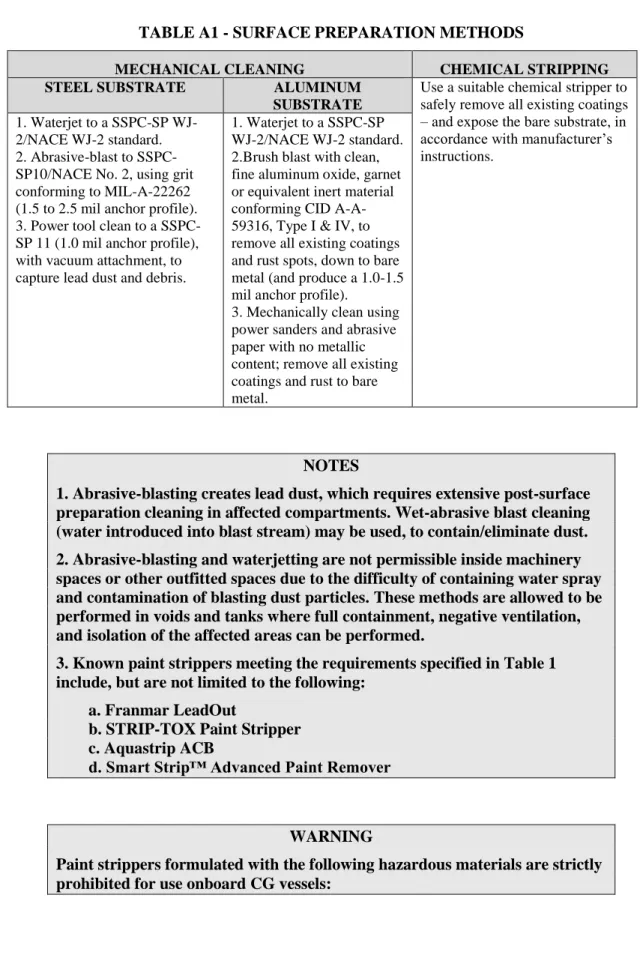
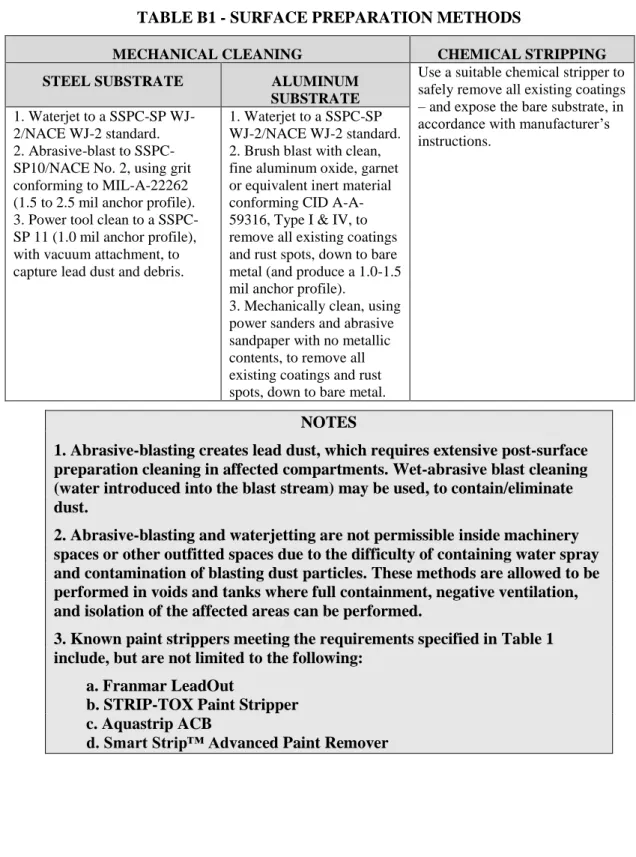
CID A-A-59316, Feb 1999, Abrasive Materials; For Blasting
MIL-A-22262, Mar 1996, Abrasive Blasting Media Ship Hull Blast Cleaning
MIL-STD-1310H, Sep 2009, Standard Practice for Shipboard Bonding, Grounding and other Techniques for Electromagnetic Compatibility and Safety
National Fire Protection Association (NFPA) 51, 2018, Standard for the Design and Installation of Oxygen-Fuel Gas Systems for Welding, Cutting, and Allied Processes
National Fire Protection Association (NFPA) 70, 2020, National Electrical Code (NEC)
National Fire Protection Association (NFPA) 312, 2016, Standard for Fire Protection of Vessels during Construction, Conversion, Repair, and Lay-Up, Chapter 2 (Construction, Conversion, and Repair)
The Society for Protective Coatings (SSPC)/NACE International (NACE) Joint Surface Preparation Standard SSPC-SP WJ-2/NACE WJ-2, 2017, Water Jet Cleaning of Metals – Very Thorough Cleaning
US Code, Title 15 (15 USC), Jan 2012, Commerce and Trade
US Code, Title 33 (33 USC), Jan 2012, Navigation and Navigable Waters US Code, Title 42 (42 USC), Jan 2012, The Public Health and Welfare
3. REQUIREMENTS
3.1 General conformance applicability. The Contractor shall be aware that the General Requirements are a part of the contract specifications, and that the requirements specified herein are an amplification of, or are in addition to, the solicitation provisions and contract clauses; consequently, the Contractor shall be responsible for understanding and complying with all requirements specified herein, and in addition to, the texts of all work items included in the specification package.
3.2 Administrative and work support requirements.
3.2.1 Applicable references and regulations. The Contractor shall be aware that:
All references and regulations applicable to the contract shall be of the issue date or revision indicated in the Consolidated List of Applicable References section of the specification package.
The statutes and regulations listed herein form a part of this specification to the extent referenced.
The publications are referred to in the text by the basic designation only.
3.2.1.1 Order of precedence. In the event of a conflict between the text of the specifications and applicable references, hierarchy, priority, or order of precedence of requirements shall be as follows:
1. The text of the specification work items.
2. The text of the General Requirements specifications. 3. Coast Guard Drawings.
4. Coast Guard Technical Publications. 5. Commercial Drawings.
6. Commercial Technical Manuals. 7. Coast Guard Standards and Instructions. 8. Commercial or Industrial Standards. 9. Commercial Practices.
10. Federal and Military Specifications and Standards.
NOTE
Nothing in the above-listed documents, however, shall supersede applicable laws and regulations unless a specific exemption has been obtained.
3.2.1.2 Drawing deficiencies. Although detailed and dimensioned drawings for precision equipment are generally accurate, and provide sufficient information for estimating, the Contractor shall take into consideration allowance for changes in dimensions, due to changes of equipment and to the structure and arrangement of the vessel. Ensure that all actual installations conform to the specifications.
3.2.2 Arrival conference. After contract award and prior to the start of contract work, the Contractor shall attend an Arrival Conference, scheduled by the KO or a designated representative of the KO, at either the Contractor’s conference facilities near the vessel, or onboard the vessel (time and location of meeting to be at the sole discretion of the KO). Refer to the Arrival Conference Agenda.
NOTE
The Arrival Conference Agenda will be sent to the Contractor by the KO via letter.
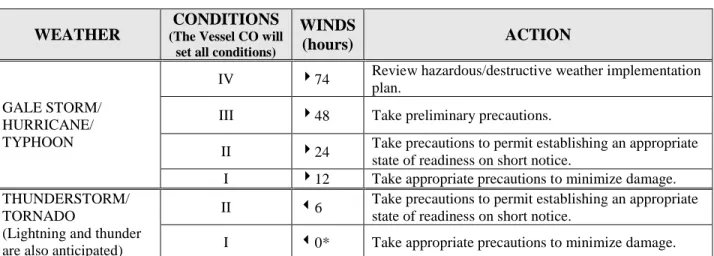
3.2.3 Severe weather plan. The Contractor shall have a written Severe Weather Plan that will be put in effect in the event of gales, storms, hurricanes, and destructive weather. The plan shall contain specific responsibilities and detailed actions to be taken during the conditions listed in Table 1 (Weather Conditions).
TABLE 1 - WEATHER CONDITIONS WEATHER
CONDITIONS (The Vessel CO will
set all conditions)
WINDS
(hours) ACTION
GALE STORM/ HURRICANE/ TYPHOON
IV 74 Review hazardous/destructive weather implementation plan.
III 48 Take preliminary precautions.
II 24 Take precautions to permit establishing an appropriate state of readiness on short notice.
I 12 Take appropriate precautions to minimize damage. THUNDERSTORM/
TORNADO
(Lightning and thunder are also anticipated)
II 6 Take precautions to permit establishing an appropriate state of readiness on short notice.
I 0* Take appropriate precautions to minimize damage. Trend indicates a possible threat of destructive winds within the number of hours shown.
Destructive winds accompanying the phenomenon are reported or expected in the general area within the number of hours shown.
*IMMINENT
3.2.3.1 Minimum inclusions. Ensure the plan contains, at a minimum, the following information as dictated by conditions listed in Table 1 (Weather Conditions):
Steps to be taken to remove or secure staging items or equipment on vessel decks, pier or dry dock, including cranes that could become windborne.
Protection of vessels from damage from other floating equipment, such as barges, doughnuts, work floats and other vessels.
Provisions for security, emergency fire and flooding protection, emergency shipboard dewatering and firemain capability, electrical power generation, and communication.
Steps to be taken, to secure the vessel to the Contractor's pier or drydock, including the following:
o Size, type, and number of lines to be used to secure the vessel.
o Sketch, showing location of all securing devices, including fenders, bumpers, and camels.
o Method to be used to check tension and slack in lines during heavy weather.
Steps to be taken to assure that all openings are made watertight.
Steps to be taken to secure floating piers during high winds or high tides.
The name and telephone number (business and residential) of the Contractor’s single point of contact, who has the authority to commit the contractor to take necessary actions as requested by the vessel’s CO.
Steps to be taken to secure and safeguard all other Government properties, including, but not limited to removed interferences, GFP, and MTI items.
3.2.3.2 Plan submission. Submit a copy of the plan to both the KO and COR within 7 days after contract award.
3.2.4 QC/ QA Program.
3.2.4.1 General. The Contractor shall be aware that QC/QA is the sole responsibility of the Contractor; consequently, the Contractor shall implement a QC/QA Program, to ensure that Contractor work meets the requirements of the specifications, without undue delay and re-work. Be aware that:
The COR may delegate inspection responsibilities to members of the vessel’s crew, to monitor the progress and quality of work done by the Contractor.
If, during the performance of work the Coast Guard Inspectors witness work that fails to meet the specifications, work that is otherwise unsatisfactory, or conditions which may lead to an unsatisfactory end product, the inspectors will alert the KO, who will then advise the Contractor informally of the deficiency. If the deficient work is not corrected within a
reasonable period of time (as approved by the KO), the KO will officially alert the Contractor via a CDR.
3.2.4.2 In-process QC measures for critical-coated surfaces. The Contractor shall abide by the below-specified in-process QC measures during preservation of critical-coated surfaces (see the definition of critical-coated surfaces in paragraph 1.3 (Acronym and term definitions)).
3.2.4.2.1 Painting contractor certification program requirement. Be aware that a QP 1 Certification, in accordance with the SSPC QP 1 Certification Programs, is required for all Contractors or sub-Contractors who engage in preservation (excluding touch-ups) of critical-coated surfaces. Ensure that the QP 1-Certification is in effect prior to contract award, and remains so during any surface preparation or painting of said surfaces. Notify the KO if SSPC QS-1 certification is current or pending. Notify the KO of any change in contractor certification status. In addition, be aware that:
If the certification expires during the performance period, preservation tasks will not be allowed to continue, until said certification has been reissued.
Requests for extension of time for any delay to the completion of the project due to an inactive certification will not be considered.
NOTE
Information on the SSPC certification programs can be found at www.sspc.org
3.2.4.2.2 Coating tech rep. In lieu of meeting the QP 1 Certification requirements, the Contractor may opt to provide the services of a coating Tech Rep, in accordance with the following guidelines:
3.2.4.2.2.1 Qualifications. The Tech Rep shall be a Certified Coating Inspector, having successfully completed the NACE-International Coating Inspector Program (CIP), Level 3 - Peer Review or holds current SSPC QP-5 Certification For Coating And Lining Inspection.
NOTE
Information regarding the CIP may be obtained at www.nace.org
3.2.4.2.2.2 Professional independence. The Tech Rep shall neither be an employee of the Contractor, nor of any coating system manufacturer.
3.2.4.2.2.3 Certification document submission. The Contractor shall submit, to the KO, the QP 1 Certificate or the name of the NACE-Certified Tech Rep, along with Certificate Number, during the pre-award phase of the contract.
3.2.4.2.3 QP 1 inspector or tech rep duties. The Coating Inspector for the QP 1-certified Contractor or the Contractor-provided NACE-certified Tech Rep shall remain on site, to perform the following duties, as applicable, for each work item that involves preservation of critical-coated surfaces:
Verify inspection instrument calibration.
Verify and approve the suitability of ambient conditions before surface preparation is begun, and before each coat of paint is applied.
Verify all aspects of surface preparation – including, but not limited to: o Cleanliness of compressed air.
o Adequacy of solvent cleaning. o Proper handling of blast media. o Actual surface preparation procedure.
Inspect and approve final surface preparation, before application of primer coat.
Supervise and approve coating system preparation and application procedures, including but not limited to: mixing and thinning, stripe coating application, spray techniques, and film thickness measurements and recordings.
Determine when applied coats have sufficiently cured for overcoating or for system service resumption (see paragraph 3.1.17 of SFLC Std Spec 6310 (Critical drying time
requirements)).
Complete and sign the quality assurance (QA) inspection forms, provided in Appendix E of SFLC Std Spec 6310 (Coatings QA Forms/QA-1 thru QA-5).
Submit all completed QA inspection forms to the KO (through the Contractor), upon completion of work.
3.2.4.2.4 The Contractor shall ensure the NACE Inspector is formally informed - via suitable subcontract documentation- and is willing and able to perform all duties listed in above paragraph (QP 1 Inspector or Tech Rep duties). Submit documentation of this contract and assumption of duties to the KO at the Arrival Conference.
NOTE
The NACE Inspector must remain onsite, to fulfill the tasked duties listed above - unless otherwise approved by the KO.
3.2.5 Planning document. The Contractor shall generate a legible Planning Document (PD) with the following characteristics:
Graphical in format (see Fig. 1 (Sample Planning Document Submittal)).
Shows overall period of performance for each CLIN, with start and stop dates of major sub-tasks.
Contains due dates for Critical Inspection Reports (CIR) and any events requiring Coast Guard Inspector presence.
Identifies all work item time periods that require OEM Tech Rep assistance.
Identifies the critical paths for the project.
Shows calculations for the float along the critical paths and labels the critical paths with the number of delay days the critical paths can absorb without affecting the final delivery date. 3.2.5.1 Ensure that the PD also includes the names, contact information, and written commitment from all Tech Reps required by the Contract - indicating they are available for work during the proposed time period.
3.2.5.2 Submit a preliminary electronic copy of the PD to the KO - for Government review - no later than one week after contract award.
3.2.5.3 Submit 3 copies of the PD to the KO, 15 days prior to the start of the performance period, and at all weekly Progress Meetings.
NOTE
A separate document, specifically prepared for the Government is not desired or required. A copy or summary of the Contractor’s internal scheduling document is preferred.
FIG. 1 - SAMPLE PLANNING DOCUMENT SUBMITTAL
3.2.5.4 When the critical path extends beyond or encroaches upon the final delivery date, provide a resource constraint and scheduling evaluation of the critical path before any request for extension will be entertained. Submit the resource constraint and scheduling evaluation via a CFR.
NOTE
The intent of the resource constraint and scheduling evaluation is to identify the resources necessary to ‘crash’ the critical path or make adjustments to the production schedule to meet the delivery date in lieu of a project extension.
3.2.6 Inspection requirements.
3.2.6.1 Time of performance. The Contractor shall ensure that all required readings and inspections are performed within 24 hours after machinery and systems have been tagged-out and opened.
3.2.6.1.1 Advance notice for CG inspector verification. The Contractor shall notify the COR of the time and location of inspections requiring Coast Guard verification 24 hours prior to the inspections, unless such inspections need to be conducted more than 50 road miles from the primary place of contract performance - in which case three working day notice shall be required, in order to make travel arrangements for the CG Inspectors.
3.2.6.1.2 Instrument/tooling calibration. The Contractor shall ensure that all measurements and readings are taken with calibrated measurement and test instruments/equipment. Submit to the COR a list of all instruments to be used for specified inspections and tests, complete with date of calibration (for each instrument) at the Arrival Conference.
3.2.6.1.3 Submission forms. The Contractor shall submit all reports of readings, operational tests, and inspections required by the specifications to the COR, in writing, using a CFR.
NOTE
A sample inspection report form will be provided by the Coast Guard, upon request by the Contractor. The Contractor is encouraged to generate and submit all inspection reports in electronic format.
3.2.6.1.4 Inspection report particulars. The Contractor shall do the following:
3.2.6.1.4.1 Time of submission. Submit all CIRs and CFRs for routine inspections and tests within 24 hours after completing the specified inspections and tests. Submit CFRs for unexpected conditions within 24 hours of discovery.
3.2.6.1.4.2 Report contents. Include the following details, at a minimum, in each report, to facilitate the contract-change process:
Sequential number to indicate order of submission.
CLIN and title to which the condition-found report relates - for example: CLIN 19-D, Propeller Shaft Remove, Inspect, and Reinstall or CLIN 25-O, Propeller Shaft Covering Renew (where D and O stand for Definite and Option, respectively).
A clear statement, definition, and description of the condition found, including but not limited to frame numbers, part numbers, materials, and dimensions as appropriate.
A proposed or recommended repair to correct the defective condition, including but not limited to frame numbers, part numbers, materials, and dimensions as appropriate.
When measurements are taken the Contractor shall, at a minimum, list the measurements taken, list the allowable tolerances and dimensions, and perform the required calculations (e.g., running clearances, interference fit tolerance, etc…), and provide a PASS/FAIL determination for each measurement along with a repair recommendation.
Indication whether the report requires Coast Guard action or if it is provided For Information Only. If action is required, indicate the time and date when the Coast Guard response is required in order to complete the action within the specified contract performance period. If the action cannot be completed within the specified contract period, so state.
When Coast Guard action is required, indicate the response time needed to avoid a contract extension and how many additional days past the scheduled completion date the added work will require.
Space on the form for the Coast Guard designated representative to make comments.
Signature of the Contractor Ship Superintendent, including date of signature and condition-found report submission.
NOTE
The Contractor is encouraged to generate and submit all inspection reports in electronic format. Promptness in taking and reporting readings is particularly important – for example, in underbody work items such as shaft bearing or rudder bearing clearances. Often during the progress of a work item, conditions are discovered by the Contractor which are considered abnormal for reasons of safety, expected reliability, health, or habitability; these conditions must be brought to the attention of the Coast Guard using a CFR. Details provided by the Contractor in a CFR are important because the CFR may result in a contract change.
3.2.7 Contractor-furnished properties and services. The Contractor shall furnish all necessary labor, equipment, materials, staging, fittings, and tools, for proper completion of each item of work, unless otherwise specified as Government-furnished in particular work items.
3.2.7.1 Services include, but are not limited to the below-listed, as required, for completion of Contractor work:
Electrical power (see SFLC Std Spec 0450).
Compressed air
Steam
Crane services
Garbage and refuse disposal
Phones
Office space
Fresh water
Garbage and refuse disposal
NOTE
Services required by the vessel will be listed in the specification package when required.
3.2.8 GFP. The Contractor shall refer to the Government-furnished property clauses in the Master Solicitation document for guidance on handling of GFP.
NOTE
The term GFP may be used interchangeably for GFE and GFM.
3.2.9 Government-loaned equipment. The Contractor shall return all Government-loaned equipment in the same condition as when received, excluding the normal wear and tear. Repair or renew all equipment that is damaged due to improper use when requested by the COR.
3.2.10 Mandatory turn-in items. For each removed equipment/component that is identified as a MTI item in the specification package, the Contractor shall accomplish the following tasks:
3.2.10.1 Package the item and temporarily store the item, to prevent damage. Ensure that all surfaces subject to corrosion, including internal hollow spaces, are coated with a thin film of corrosion
preventative compound, as applicable. Install all blanks or securing hardware provided with the replacement item. In addition, wrap and seal all weather-exposed surfaces with heavy duty, weather/water-proofed, barrier material.
3.2.10.2 Return MTI to the Coast Guard PA, and ensure that all necessary turn-in documents are properly completed and enclosed with the item.
3.2.10.3 Provide heavy lifting services, as applicable, to load item onto a Government-provided vehicle.
NOTE
The Contractor may use the original crate or shipping box, if all previous shipping information is permanently covered or removed.
3.2.11 Temporary sanitary and sewage facilities.
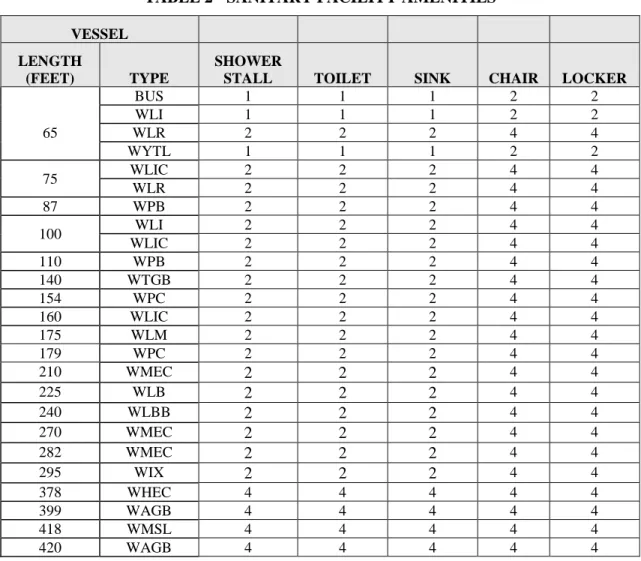
3.2.11.1 Sanitary facilities for vessel-personnel – due to disruption of grey water and sewage systems. When the shipboard grey water and sewage systems are disrupted due to repairs required by contract work, the Contractor shall provide vessel-personnel with a sanitary facility, within a five minute walking distance from the vessel, to include the amenities listed in Table 2(Sanitary Facility Amenities). Ensure the following:
Shower stalls are equipped with privacy screens.
Sinks are provided with fresh hot and cold water.
Electrical convenience GFI receptacles, in accordance with NFPA 70, National Electric Code (NEC), are located in vicinity of sinks.
Toilets have doors or privacy dividers.
TABLE 2 - SANITARY FACILITY AMENITIES VESSEL
LENGTH
(FEET) TYPE
SHOWER
STALL TOILET SINK CHAIR LOCKER
BUS 1 1 1 2 2 65 WLI 1 1 1 2 2 WLR 2 2 2 4 4 WYTL 1 1 1 2 2 75 WLIC 2 2 2 4 4 WLR 2 2 2 4 4 87 WPB 2 2 2 4 4 100 WLI 2 2 2 4 4 WLIC 2 2 2 4 4 110 WPB 2 2 2 4 4 140 WTGB 2 2 2 4 4 154 WPC 2 2 2 4 4 160 WLIC 2 2 2 4 4 175 WLM 2 2 2 4 4 179 WPC 2 2 2 4 4 210 WMEC 2 2 2 4 4 225 WLB 2 2 2 4 4 240 WLBB 2 2 2 4 4 270 WMEC 2 2 2 4 4 282 WMEC 2 2 2 4 4 295 WIX 2 2 2 4 4 378 WHEC 4 4 4 4 4 399 WAGB 4 4 4 4 4 418 WMSL 4 4 4 4 4 420 WAGB 4 4 4 4 4
3.2.11.2 HVAC system. Ensure that the facility is equipped with heating, filtered ventilation, and air conditioning to maintain interior temperatures in the 65 to 78 degree Fahrenheit range, and has local climate control for the user.
3.2.11.3 Janitorial services. Ensure that the facility is cleaned at least once a day, and cleaning shall include, but not be limited to:
Trash removal.
Restocking of consumables (toilet paper, soap, etc.).
Cleaning of toilets, showers and sinks.
All plumbing repairs such as unclogging of toilets and shower and sinks drains.
3.2.11.4 Security. Ensure that the facility is capable of being locked from the outside and is also equipped, on the inside, with a suitable locking mechanism such as a sliding latch. Provide the COR with two keys for each lock.
3.2.11.5 Additional sanitary facility for mixed gender crew. Unless otherwise specified in the
specification package, provide separate facilities for each gender that is completely separate, with its own entrance.
3.2.11.6 Sewage facilities for vessel personnel – due to disruption of sewage system. When the shipboard toilets are unavailable due to contract work, unless otherwise specified in the specification package, the Contractor shall provide vessel personnel with portable toilets as specified in Table 3 (Portable Toilets). Ensure that the toilets are:
Located as close as possible to the vessel, at a distance not to exceed 100 yards.
Cleaned and emptied daily, and restocked with consumables.
TABLE 3 - PORTABLE TOILETS VESSEL PORTABLE TOILETS (QTY) LENGTH (FEET) TYPE BUS 1 65 WLI 2 WLR 2 WYTL 1 75 WLIC 2 WLR 2 87 WPB 2 100 WLI 2 WLIC 2 110 WPB 2 140 WTGB 2 154 WPC 2 160 WLIC 2 175 WLM 3 179 WPC 3 210 WMEC 5 225 WLB 4 240 WLBB 4 270 WMEC 5 282 WMEC 5 295 WIX 3 378 WHEC 6 399 WAGB 6 418 WMSL 6 420 WAGB 6
3.2.12 Sanitary facilities for contractor-personnel. The Contractor shall be responsible for providing sanitary facilities for all Contractor-personnel, ensuring that such facilities are distinct and separate from facilities used by vessel personnel.
3.3 Work control requirements.
3.3.1 Personnel safety and property protection - general. The Contractor shall comply with all applicable sections of 29 CFR 1910 and 29 CFR 1915, all OSHA safety and health regulations for ship repair and any other applicable Federal, state, and local laws, codes, ordinances, and regulations for the protection of both personnel and property.
3.3.1.1 Temporary ventilation. The Contractor shall provide all equipment and services necessary, to ensure continuous positive ventilation in all spaces/compartments (affected directly and indirectly by contract work). Ventilate compartments in accordance with 29 CFR 1910.94, 1926.57, or 1926.353, as applicable; ANSI/ASHRAE 62.1, Section 6.1, and ASHRAE Std 26, Paragraph 4.9. When ventilation is shut down due to contract work, provide ventilation to manned compartments equivalent to the normal zonal ventilation rating for that space. Provide additional exhaust ventilation to spaces contaminated by fumes caused by contract work (welding, preservation, cleaning, adhesive application, etc…). For work areas contaminated with or laden by fumes, the ventilation shall be set up in a net exhaust condition so as to create slightly negative pressure in the compartment as compared to adjacent compartments.
3.3.1.2 Confined or enclosed space entry and hot work.
3.3.1.2.1 Precaution for safe entry. Before entering a tank, void, and any other confined or enclosed space; and before performing manual cleaning and other cold work, the Contractor shall ensure that the space is tested and certified SAFE FOR WORKERS, in accordance with 29 CFR 1915.11-13.
3.3.1.2.2 Precaution for safe hot work. Before performing hot work in a confined or enclosed space, compartment below deck, and on a vessel component, the Contractor shall ensure that the space or component is certified SAFE FOR HOT WORK in accordance with 29 CFR 1915.14 and 1915.51-54. 3.3.1.2.3 Maintenance of safe conditions and warning signs.
3.3.1.2.3.1 The Contractor shall maintain safe conditions, in accordance with 29 CFR 1915.15; ensure that testing is performed, as often as necessary, and all necessary measures (including, but not limited to opening, cleaning, and ventilating) are taken to maintain the safe conditions for the duration of the work being performed. In addition, ensure that Marine Chemist Certificates, Shipyard Competent Person Log of Inspections, and suitable warning signs and labels are posted in view of all affected employees, in accordance with 29 CFR 1915.16.
3.3.1.2.3.2 The Contractor shall post Gas Free Certificates, indicating the current status of all affected compartments, posted on the Quarterdeck and at each open access to the compartments. Submit one copy to the CG Inspector.
3.3.1.3 Fire watch requirements. The Contractor shall ensure that fire watch personnel and fire
extinguishers are provided for all work as required by applicable law or regulation and any work activity meeting the definition of hot work. Be aware that this requirement applies to all work under the scope of the contract, subsequently modified into the contract, and any contract extension periods granted. 3.3.1.3.1 Contractor provided fire watch personnel. When fire watch is to be conducted by Contractor personnel, the Contractor shall provide fire watch personnel with appropriate personal protective gear and necessary functioning equipment, on a per job basis, in accordance with NFPA 312, Chapter 2. Ensure that all Contractor welders, brazers, and ship fitters check in with the COR, with their
Contractor-provided fire watch, prior to commencing any hotwork. Notify the COR upon the completion of hotwork. 3.3.1.3.2 Coast Guard fire watch personnel – provision of fire extinguishers. When fire watch is to be conducted by Coast Guard personnel in lieu of Contractor personnel, the Contractor shall provide fully-charged portable fire extinguishers, on a loan basis, for use by each assigned Coast Guard fire watch personnel. In addition, notify the COR at least 24 hours before hot work is begun, and ensure that all Contractor welders, brazers, and ship fitters check in with the COR, in order to be assigned with a Coast
Guard fire watch personnel. Replace all discharged fire extinguishers with fully charged units, immediately after discharge.
NOTE
Fire watch responsibility will be specified in the General Requirements work item, which is used to invoke this standard specification.
3.3.1.3.3 Lockout/ tags-plus system and logs.
3.3.1.3.3.1 The host employer shall be responsible for implementing and complying with all applicable requirements of 29 CFR §1915.
3.3.1.3.3.2 The host employer shall work with designated Coast Guard or crew members to ensure the coordination of the lockout/ tags-plus system and logs.
NOTES
1. The EO or EPO will verify with shipyard Lockout/Tags-plus Coordinator that tags are hung and signed by appropriate personnel. They shall be tracked in either a joint or separate log signed by the cutter’s Tag-Out coordinator and the contractor’s lockout/ tags-plus coordinator. If a joint log is used, a copy of the log must be retained by the EO or EPO.
2. USCG uniformed personnel may continue to follow COMDINST 9077.1 but must work with the host employer or shipyard to coordinate the use of the instruction alongside the OSHA requirements. The use of COMDINST 9077.1 by USCG uniformed personnel does not alleviate the host employer or
shipyard from complying with 29 CFR §1915. When a cutter or boat is in a homeport maintenance availability where work is being performed by civilian personnel or contractors, the cutter crew is responsible for managing the tag-out locktag-out procedures in accordance with 29 CFR § 1915.
3.3.1.4 Shipboard bonding, grounding and shielding. The Contractor shall restore bonding, grounding or shielding to all equipment or structures which have been disturbed due to any interference work, in accordance with MIL-STD-1310 and SFLC Std Spec 3042.
3.3.1.5 Temporary covers for deck openings. The Contractor shall install a suitable plate or cover over each resulting deck opening, to prevent injury to personnel, and protect the vessel’s interior spaces and equipment against outside contamination. When covering a deck opening left from a removed hatch or scuttle, ensure that the cover is configured to allow normal passage of ship's personnel and equipment. 3.3.1.6 Temporary lines or rails. The Contractor shall install temporary lines or rails to replace all removed lifelines or life rails. Retain temporary lines or rails until replacement tasks have been completed.
3.3.1.7 Illumination. The Contractor shall be aware that adequate illumination is required in walkways, work areas, and access to provide a safe work environment ([29 CFR 1915.82(a)]). Ensure that
permanent, temporary, and emergency lighting are provided, as required. In addition, ensure that the components of the lighting are safe for the location in which it is installed.
3.3.1.7.1 Be aware of the following potential hazards due to inadequate or poor-quality lighting:
Slips, trips, and falls.
Electric shocks and burns.
Inability to exit the space.
Temporary lights must have guards or be recessed to prevent accidental contact with the bulb. [29 CFR 1915.82(b) (1) and 29 CFR 1915.82(c) (1)].
Temporary lights must be as per [29 CFR 1915.82(b)(2)],and as follows: o Be equipped with heavy duty electric cords.
o Not be suspended by their electric cords.
o Have splices equal to the insulation of the cable.
o Cords must be protected from damage [29 CFR 1915.82(b) (3)].
o Exposed non-current-carrying metal parts of temporary lights must be grounded. [29 CFR 1915.82(c)].
o Temporary lights must be equipped with overcurrent protection (such as fuses, circuit breakers). [29 CFR 1915.82(f)].
o Portable emergency lighting (e.g., flashlight, light sticks) must be provided. [29 CFR 1915.82(d)].
o Workers must not enter dark spaces without suitable portable light. [29 CFR 1915.82(e)].
o Temporary lights in tanks that have not been gas free certified must be explosion-proof [29 CFR 1915.36(a) (4)].
3.3.1.8 Exposure to asbestos, lead, and PCB. Refer to Appendix A (Requirements for Environmental Protection) of this document, for requirements applicable to asbestos, lead, and PCB exposure. 3.3.2 Vessel protection.
3.3.2.1 Pier or wharf facility. Unless in drydock or at the vessel’s home pier, the Contractor shall provide a secure pier or wharf during the performance period of the contract. Ensure that the pier or wharf has adequate clearance to safely accommodate the vessel being moored.
3.3.2.1.1 Water depth. Ensure that water depth is sufficient at the pier to allow the vessel's lowest underwater appendage to clear the bottom by at least two feet at:
Ordinary low water mark on non-tidal rivers.
At all tide conditions predicted during the availability for tidal rivers and other navigable waterways (Bay, Lake, etc.).
3.3.2.1.2 Construction. Ensure that the pier or wharf is adequately constructed and conditioned to support weight-handling gear such as cranes, forklifts, and delivery vehicles that are necessary for the completion of the specification requirements; in addition ensure that load limitations are clearly identified and marked in a conspicuous location.
3.3.2.1.3 Collision protection. Provide a fender system to prevent the vessel's sides from chafing and colliding with the pier or wharf while moored at the Contractor's facility. Ensure that no other vessel is moored alongside the vessel without specific permission from the COR.
3.3.3 Vessel component, space, and equipment protection.
3.3.3.1 The Contractor shall take the following protective measures, as applicable, in addition to all other requirements that may be specified in individual work items, to prevent contamination and surface damage of non-affected shipboard equipment, components, and spaces:
Plug, blank, wrap, cover, seal, and mask equipment, components, cables, wire ways, boats, and openings using fire retardant/water repellent materials, and prevent entry of contaminants to machinery, winches, rigging, machinery surfaces, weapons systems, electrical equipment, electronic equipment, valves, vents not in use, and other openings.
Place drain channels in overboard discharges in use, to direct discharges away from the hull.
Provide wooden plugs or coverings for sea chest spool pieces, scuppers and overboard discharges not in use.
Cover all glass (port lights, windows, etc.) adjacent to areas interior and exterior where abrasive blasting, burning, or welding is required or accomplished, to prevent scarring and damage.
Install fire retardant industrial filter material on the intake of supply and exhaust ends of ventilation systems that will be remain in use during performance of work. Maintain all filter materials, to prevent excessive air restriction and/or damage to ventilation motors.
Install double curtain baffles at the entrances of each access where airborne contamination could occur during contamination-producing operations. Install a dirt-collecting mat on the deck directly inside each access.
Provide adequate protection to all deck covering or deck surfaces in areas where the work under items of these specifications is being accomplished and on all main access routes to these areas. Immediately repair or renew any protective coverings which are damaged during the course of work.
NOTE
Acceptable protective deck coverings include heavy cardboard, masonite (fiberboard), flame-retardant polyethylene deck plate with a non-slip
diamond pattern from 10 to 40 mil thickness or plywood installed in sufficient quantities to adequately protect deck surfaces.
3.3.3.1.1 Ensure that temporary coverings are not removed during contamination-producing operations without permission of the COR.
3.3.3.1.2 Inspect the integrity of the protective covering at the beginning of each shift in which
contamination-producing operations will be accomplished. Ensure that equipment and machinery have not been infiltrated by contaminants. Notify the COR immediately by verbal means, followed on the next workday in writing, if contamination or surface damage has occurred. Reseal to prevent further entry of contaminants or surface damage.
3.3.3.1.3 Remove protective coverings upon completion of contamination-producing operations and inspect for presence of contamination or surface damage. Notify the COR immediately by verbal means, followed on the next workday in writing, if contamination or surface damage has occurred, prior to removal of the contamination and repair of damage.
3.3.3.1.4 Dispose of all protective coverings, upon completion of work.
NOTE
Any damage resulting from failure by the Contractor to provide adequate coverings will be repaired at the Contractor’s expense.
3.3.3.2 When removing interference-fit bearings (water lubricated propulsion bearing, bronze sleeves, etc.), the Contractor shall restrict removal to processes/methods that do not cause secondary damage to ship's structures.
NOTES 1. Examples of damage-causing methods:
a). Oxy-acetylene torch to flame cut bronze sleeves out of the struts. This causes the intermediate struts (much less mass than the aft struts) to lose their diametric roundness across the 12 o'clock to 6 o'clock axis forming an egg shape that results in the inability to achieve the proper interference fit and results in a loss of bearing concentricity if the bearing is pressed into the egg shape.
b). Air arc rod (exothermic torch) cutting the lower rudder bearing sleeves out of the rudder housings results in 'gouges' (loss of material from the inside diameter of the housings). This loss of material causes a corrosion concern as water can get behind the bronze sleeve and corrode the mild steel rudder housings.
2. Acceptable alternatives:
a). Hydraulic driven press, employing bearing adapter collars, threaded rod, and a receiver to hydraulically press the bearings out.
b). Reciprocating saw, to parse the bearing shell and collapse the sleeve inward. However, when this is done by an unskilled worker, the reciprocating saw can cut into the housing or damage the packing gland pusher cup (when equipped).
3.3.4 Vessel access. During work at the Contractor’s facility, provide a minimum of two means of access or egress to the vessel, in accordance with 29 CFR 1915, Subpart E; ensure that gangways, at a minimum, have the following:
Adequate walking surface width and strength and be safely secured.
A railing, with a mid-rail, on each side of the gangway, and a turn table if necessary.
Substantial steps properly secured and equipped with at least one handrail, when the upper end of the gangway rests on or is flush with the top of the bulwark of the dock.
Nets or other suitable protection on both sides, when there is a danger of personnel falling between the ship and the dock. Nets and other suitable protection must extend beyond the projected area of the access and egress points so as to catch a personnel that may be falling outward: i.e., the nets must be wider than the gangway.
Proper trimming at all times.
Adequate illumination for their full length.
3.3.4.1 Gangway alternative. If gangways are not practicable, submit to the COR a proposal for a suitable alternative.
3.3.4.2 Obstructions. Do not lay obstructions on or across the means of access/egress. Do not pass loads or cargo over the means of access/egress while personnel are on them.
3.3.5 Interferences. The Contractor shall remove all interferences in way of specified work, as necessary, without regard to whether interferences are listed in applicable work items; restore all removed
interferences upon completion of the specified work. The Contractor may exercise the discretion to work around certain interferences, when possible, so long as the specified work is successfully accomplished. 3.3.5.1 Operational testing. Witness an operational test of all machinery, electronics, and electrical equipment that will be worked on, disturbed or removed as interferences during the availability. Generate
and complete pre-work equipment checks that captures and documents the pre-work condition observed during the pre-work operational testing and submit the pre-work equipment checks via a CFR for final concurrence by the COR. Generate and complete post-work operational checks of all machinery,
electronics and electrical equipment at the end of the availability and compare the post-work checks to the pre-work equipment checks.
3.3.5.1.1 All machinery, electronics and electrical equipment shall be in the same or better condition as the work checks. Be aware that items that were worked on will be in better condition than their pre-work checks and their final post-pre-work condition will be measured against the performance standard(s) in the applicable work items and Change Requests.
3.3.5.2 Handling of restricted interferences. Before removing restricted interferences, submit to the COR a written plan for the removal within 48 hours before that process is begun. Ensure the plan includes:
Procedures for removing the interferences.
Time at which interferences will be restored.
Alternate arrangements, as necessary, to minimize the crew's inconvenience, or to alleviate the hazardous conditions.
3.3.5.3 Labeling and stowing requirements. The Contractor may stow removed interferences onboard the vessel; however, location and condition of stowage shall be approved by the COR. When stowing onboard the vessel is not practical, the Contractor shall stow all interferences in a suitable shore side stowage facility. Ensure that interferences are protected from weather and damage during removal, stowage, and reinstallation. In addition, ensure that all stowed items are tagged with removable tags, or stenciled with non-permanent paint, with the following information:
Vessel name.
Location from which items have been removed.
3.3.5.4 Disturbed hydraulic systems. If a hydraulic system is disturbed as an interference, in a particular work item, the Contractor shall perform all tasks associated with hydraulic system cleanliness, in accordance with SFLC Std Spec 5000.
3.3.5.5 System restoration. The Contractor shall ensure that all ship spaces or compartments, components, or equipment that are damaged or exposed due to interference removal are restored to original conditions in form, fit, function, and appearance. Renew the following components or disturbed portions of systems, as applicable, when reassembling or reinstalling affected systems:
Gasket materials.
Insulation material permanently installed with adhesive (see NAVSEA Drawing 804-5773931).
Disturbed portions of deck covering systems (see SFLC Std Spec 6341).
3.3.6 Welding and brazing requirements. The Contractor shall perform all welding and allied processes, and nondestructive examination (NDE), in accordance with SFLC Std Spec 0740 - whether explicitly stated in work items or not, and for other work subsequently authorized by changes, modifications, or extensions to the contract.
3.3.7 Housekeeping. The Contractor shall accomplish the following, in regards to housekeeping:
Maintain good housekeeping conditions at all times, and provide adequate aisles and
passageways in all work areas. Ensure that all staging platforms, ramps, stairways, walkways, aisles, and passageways on vessels or dry docks are kept clear of all tools, materials, and equipment (except those that are in use), and all debris such as welding rod tips, bolts, nuts, and similar material; ensure that hoses and electric conductors are elevated over or placed under the walkway or working surfaces or covered by adequate crossover planks.
Ensure that all working areas on or immediately surrounding vessels and dry docks, graving docks, or marine railways are kept reasonably free of debris, and construction material. Ensure that materials and debris do not present a hazard to personnel.
Take action to mitigate any slippery condition on walkways or working surfaces.
Maintain free access at all times to all exits and to all fire alarms or fire-extinguishing equipment.
Keep all oils, paint thinners, solvents, waste, rags, or other flammable substances in fire resistant covered containers when not in use.
Take care to prevent job site contamination by materials, equipment, and personnel; provide, when applicable, protective clothing and plastic shoe covers for all Contractor personnel and Coast Guard Inspectors, who must access the work areas, to prevent outside contamination. Upon completion of all work, remove equipment and material from the work site and restore all existing facilities affected by the work to original conditions.
3.3.8 Disposal of non-reusable equipment, components, and materials. During the availability, the Contractor shall dispose of, as scrap, all items or materials removed from the vessel that are not
designated to be: reinstalled, retained and shipped by the Contractor to a Coast Guard authorized facility, or turned over to the COR. Ensure that all item/material disposals are in accordance with applicable Federal, state, and local regulations. Refer to Appendix A (Requirements for Environmental Protection) of this standard, and to the paragraph titled HW Disposal in the General Requirements item, for
requirements pertinent to disposal of hazardous wastes.
3.3.9 Restoration of damaged equipment. The Contractor shall restore, renew, or repair all machinery, piping, wiring, insulation, paint work, deck coverings, and any other article or component removed, moved, disturbed, or damaged by the Contractor in accomplishing the work outlined in the specification package.
3.3.10 Workmanship. The Contractor shall ensure that care is taken to smooth off all ragged edges or burned off edges by grinding or filing to leave a smooth surface. Removal of fixtures, equipment, plating, piping, and fittings shall be made clean to the root and finished off. Where pipes, cables, and fittings are removed, the hole shall be blanked off flush with welded plates of like material and thickness.
3.3.11 Bracket and supports. The Contractor shall ensure that all pipes, cables, duct work, installed furniture, and equipment are bracketed, supported, and/or secured so as to carry the weight, prevent excessive vibration, and withstand inertia forces resulting from rolling and pitching.
3.3.12 Labels/ tags. The Contractor shall provide label plates for all new and redesignated access fittings, compartments, electrical and electronic equipment and fittings, ventilation blowers and systems, valves; and any other equipment and fittings requiring labels or tags indicated on installation drawings, in accordance with the below-provided guidance.
3.3.12.1 Valves. Install label plates on all new valves, in accordance with ASTM F992. 3.3.12.2 Piping.
3.3.12.2.1 Stencil the following onto the pipe surfaces:
Name of the piping system service.
Destination, where feasible.
Direction of flow, indicated by an arrow 3 inches long pointing away from the lettering (for reversible flow, point an arrow away from each end of the lettering).
3.3.12.2.2 Ensure that all lettering and arrow(s) are as follows: