
Conference paper
INRstar: computerised decision support
software for anticoagulation management
in primary care
Robert Treharne Jones
Marketing DirectorMark Sullivan
Technical DirectorDavid Barrett
Chief ExecutiveSullivan Cuff Software Ltd, Helston, Cornwall, UK
History
It was in 1984 that the first algorithm for warfarin doses was announced in the UK by Wilson and James, two haematologists at the Hillingdon Hospital in Middlesex.1They developed the idea that the necess-ary dose of anticoagulation had a direct mathematical correlation with the international normalised ratio (INR) blood test for each patient. As part of their study they also showed that the maintenance of anticoagu-lation by traditional means was laborious and costly, and that the results achieved were often indifferent, while those produced by the computer were at least as good as those achieved using manual systems. Medical and secretarial time was saved by the use of such a system, in which a reports and audit facility also ensured that statistics about the clinic and its efficacy were readily available.
At the time of the publication of the Hillingdon algorithm in theBritish Medical Journal, two authors
(RTJ and MS) were junior hospital doctors. Both made use of the paper algorithm in their clinical practice, but it was to be more than ten years before they transferred the idea to the program which became INRstar.
Background
Warfarin is useful for a number of different clinical conditions which require the clotting ability of the blood to be reduced. Among the most common clin-ical indications is atrial fibrillation, a type of irregular pulse which is linked with an increased risk of stroke, as small clots generated in the heart by the irregularity find their way to the brain, where they become lodged
ABSTRACT
Computerised decision support software (CDSS) for anticoagulation management has become es-tablished practice in the UK, offering significant advantages for patients and clinicians over trad-itional methods of dose calculation. The New GMS Contract has been partly responsible for this shift of management from secondary to primary care, in which INRstar has been the market leader for many
years. In September 2004, INRstar received the John Perry Prize, awarded by the PHCSG for excellence and innovation in medical applications of infor-mation technology.
in the narrowed circulation, causing partial or com-plete blockage of the blood supply to that part of the brain.
Use of warfarin in these and other conditions can significantly reduce the morbidity and mortality of the condition itself, but there are also disadvantages to its use. There is no standard dose which may be given to similar patients with the same condition, as each indi-vidual responds differently to the same dose. This is why patients on warfarin require regular blood tests to monitor their INR – the ratio between their blood clotting time with and without warfarin. According to each INR result their warfarin dose can be adjusted and the date of their next test arranged accordingly. However, each clinical condition requires the INR to be maintained within different ranges. The ideal situ-ation for both patient and clinician is where the INR remains fairly constant for a given dose of warfarin, with the minimal number of tests in a given period of time.
Warfarin dosing has been performed manually in both primary and secondary care for many years, but the evidence suggests that it has not been done very well in either setting.2,3Over the past ten years there has been a gradual shift in clinical care from secondary to primary care for many conditions and treatments, including anticoagulation. Extra funding is sometimes, but not always, made available to support this new responsibility.4There is now strong evidence to sup-port the idea that anticoagulation can reduce the risk of thrombotic stroke in those patients with uncom-plicated atrial fibrillation by up to 90%. This evidence has resulted in a substantial increase in the number of patients taking warfarin on a long-term basis.5
The net result has been that primary care has had to cope with a dramatically increased workload to help prevent a condition with significant morbidity, in an area of clinical medicine where historical evidence sug-gests poor performance, and with little if any add-itional funding being made available.6,7
Software development
The first version of INRstar was initially developed in Cornwall in the early 1990s by one of the authors (MS) in collaboration with a Visual Basic programmer based in the USA. When it was evident that the product had commercial possibilities, the other two authors (RTJ and DB) became part of the team to handle marketing and technical issues respectively. Despite the limit-ations of the early version, which ran on a stand-alone Windows PC, it gained early acceptance across the county in Cornwall, where funding was made avail-able to install it in every practice.
Then began a steady process of development and refinement, to incorporate all the key elements of national guidance from organisations such as the British Society for Haematology and the British Committee for Standards in Haematology, which dictated stan-dard target INR values and durations of treatment for each clinical condition.8As the software became more widely used, practices produced their own wish-lists for advanced functionality, including the requirement to network the software across a whole practice, and to integrate it within their clinical systems. The rate of change in software development proved to be so far ahead of its time that when the criteria were published for enhanced services under the terms of the New GMS Contract, no additional development was necessary for INRstar, as it already met all the national standards, which included:1,9
. Maintenance of a register of patients on warfarin. With
INRstar, practices can maintain an up-to-date register of all anticoagulation monitoring services delivered to patients, indicating patient name; date of birth; the indication for, and length of, treatment; includ-ing the target INR.
. Call and recall. INRstar includes integral func-tionality to ensure that systematic call and recall of patients on the anticoagulation register is taking place.
. Individual management plan. INRstar includes all the necessary information to prepare an individual management plan for each patient, giving the diag-nosis, planned duration and therapeutic range to be obtained.
. Record keeping. INRstar includes the functionality
to helpmaintain records of the performance and outcomes of the service provided, including adverse events such as bleeding episodes requiring hospital admission and deaths caused by anticoagulants.
. Clinical audit. INRstar includes the most
compre-hensive set of audit reports of any software in this market, allowing clinical audit of the care of patients, including untoward incidents. This allows a review of the success of the practice in maintaining its patients within the designated INR range as part of quality assurance.
Current functionality
boundaries between primary and secondary care. This new version also raises the possibility of individual patients logging in and calculating doses when they are geographically remote from their own clinician.
Clinicians log into INRstar from their own work-station and are presented with a splash screen (see Figure 1) to remind them that the software can only provide guidance, and that overall responsibility for clinical decisions rests with the clinician, who may be aware of factors that will skew the algorithm in an unpredictable fashion.
Because of the comprehensive training and edu-cation arranged by Sullivan Cuff Software for new users of INRstar, clinicians do not generally treat the computer suggestions as dogma. Should an adverse event occur, they are reassured by the £3 million of indemnity insurance which the company has arranged to cover such an eventuality.
Each clinician then logs into the system with their own username and password which is linked to a read-only audit trail. In this way all individual actions by users logged into the system can be decrypted for medico-legal purposes should the situation arise.
Patients are added to INRstar through the main registration module, either by copying the demo-graphic details by hand, or by importing the details automatically from the GP clinical system. This func-tionality is currently available for iSoft Synergy and System 6000, and it is expected that before long this degree of integration will also be available for the other leading GP clinical systems.10
The registration screen includes a list of diagnoses, each with its own target INR range based on the current recommendations from the British Society for Haema-tology (see Figure 2). The system is flexible enough to add new diagnoses or customise INR ranges for indi-vidual patients where necessary. Entering the patient’s most recent INR test and the current review interval
allows the program to forecast the right dose and follow-upperiod until the next test is due.
Flexibility to suit different patients and working practices is one of the key aspects of INRstar, so options are available when adding a new patient to give clin-icians the chance to choose how to manage that indi-vidual. For instance, patients may be dosed either in traditional milligrams or in multiples of same-strength warfarin tablets to avoid possible confusion between different strengths and colours. Warfarin control may be further improved by allowing half-tablets in dose regimes; this option may be switched off for those patients who lack the necessary manual dexterity (see Figure 3).
Users also have the option to choose between the original Hillingdon algorithm to manage their patients, or the more recently developed Warwick algorithm, which appears to control INR levels with greater ac-curacy and is now regarded as the gold standard.
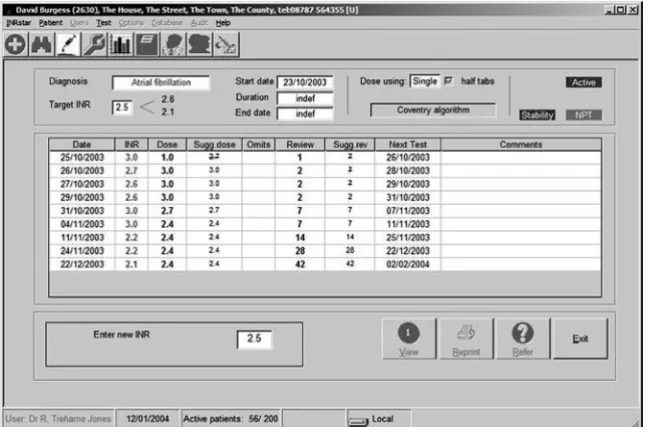
The main monitoring screen (see Figure 4) allows users to enter INR results into the program to allow the software to make suggestions before the patient’s dosage schedule is automatically printed off. How-ever, a computer cannot be dogmatic in this context – it can only make suggestions, which is why INRstar includes the option for the clinician to override the software if they consider that other factors such as concurrent medication or dietary changes might mean that the computer suggestions are inappropriate for the time being.
The algorithm determines the next review interval, so that stable patients are asked to return at longer intervals, upto a maximum of ten weeks. Even the most stable patient will still require four or five tests a year, while less stable patients will be asked to return at more frequent intervals.
Once the INR result and dosing suggestions have been saved to the system, a dosage chart can then be
printed out for the patient to take away as an aide-me´moireuntil their next test is due. The whole process conforms very well with the idea of a one-stopclinic when combined with the use of near-patient testing (NPT) to measure the INR, and in most user practices the whole clinic is run on a day-to-day basis by a suitably trained extended-role nurse.
There will, however, be occasions when the person in charge of the clinic needs further advice by referring patients to a supervising clinician, who may be on site or geographically distant. In either case, the referral can be done electronically from within INRstar, allowing the supervisor to check the results and make further adjust-ments as necessary, without interrupting the workflow
of the clinic nurse, who can remain within the treat-ment room throughout the process.
Clinical system integration
As already mentioned, full integration with GP clinical systems is the next major development for INRstar. That integration has already been achieved for iSoft Synergy and System 6000, and further work is cur-rently in progress to allow integration with EMIS and In Practice Systems.10–12
Figure 2 Default values for target INR for each clinical condition are those recommended by the British Society for Haematology
The integration model means that INR values added to the clinical system will automatically be copied and pasted into INRstar, which will then perform its usual calculations before copying the dose schedule back into the clinical system. New warfarin patients can automatically be generated from the clinical system into INRstar at the touch of a button, without the need to copy registration details across by hand.
Reports and audits
INRstar includes a comprehensive reporting suite for clinical audit purposes. The available functionality includes options for examining the degree of control of individual patients and groups of patients, as well as the entire database. In the web browser version of INRstar, the system supervisor can compare figures across the different organisations within their juris-diction.
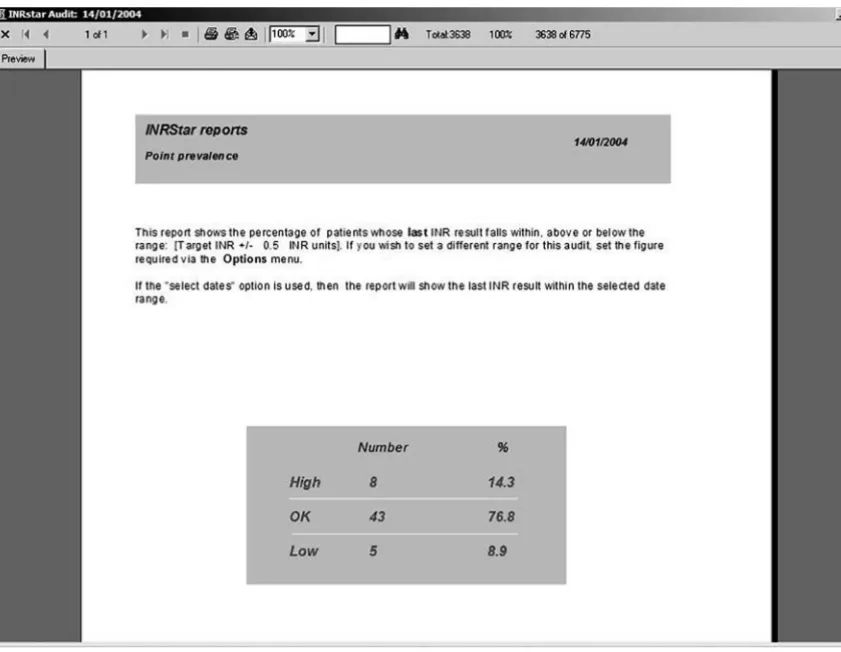
The available options include point prevalence (PP) calculation, the gold standard method of comparing different methods of anticoagulation management (see Figure 5). After the switch to INRstar, all practices show a steady increase in their point prevalence scores, and a national feedback scheme co-ordinated by Sullivan Cuff Software allows practices to compare themselves with other users across the country every quarter. The mean value PP for users of INRstar is currently 80%+ with occasional users achieving a perfect score of 100% (see Figure 6).
Education and training
It has long been recognised that the setting upof anticoagulation clinics in primary care requires many resources other than the necessary software, and with its background in postgraduate medical education, Sullivan Cuff Software makes a number of resources available to its new and existing users.
All hospital and primary care trusts that now form the customer base are offered comprehensive training and education in the use of the software and its inte-gration within the context of a clinical setting. The company website provides useful material for prac-tices taking on this role, including summaries of the evidence base for the use of computerised decision support software; links to many of the main academic papers on the subject; and manuals describing the processes that should be considered when setting up an anticoagulation clinic.13
Benefits to primary care
The ways in which practices and their patients have been shown to benefit from the use of INRstar can be summarised as follows:
. improved anticoagulation control
. reduced number of INR tests required to maintain
good control
. improved patient safety
. reduced potential for errors in dosing . improved patient convenience
. contribution to practice financial income.
Figure 5 Point prevalence data is generated within seconds and provides a useful measure of the degree of warfarin control
In r
ange
0% 10% 20% 30% 40% 50% 60% 70% 80% 90% 100%
027 026 052 022 054 042 053 028 021 002 011 006 047 014 038 010 003 036 045 030 041 005 043 050 048 012 023 020 031 039 004 034 009 019 013 024 025 017
Practice identifier +1 Std
–1 Std Median
ACKNOWLEDGEMENT
This paper was delivered at the PHCSG Annual Conference in Dunchurch, Warwickshire, in September 2004, as the winner of the John Perry Prize.
REFERENCES
1 Wilson R and James AH. Computer-assisted
manage-ment of warfarin treatmanage-ment. British Medical Journal
1984;289:422.
2 McInnes GT and Helenglass G. The performance of
clinics for outpatient control of anticoagulation.Journal
of the Royal College of Physicians of London1987;21:42–5.
3 Pell JP, McIver B, Stuart Pet al. Comparison of
antico-agulant control among patients attending general
prac-tice and a hospital anticoagulant clinic.British Journal of
General Practice1993; 43:152–4. 4 www.bma.org.uk/ap.nsf/Content/
Hubthenewgmscontract
5 Hart RG, Benavente O, McBride R and Pearce LA. Antithrombotic therapy to prevent stroke in patients
with atrial fibrillation: a meta-analysis.Annals of Internal
Medicine1999;131:492–501.
6 Shakespeare J, Fitzmaurice DA, Hobbs FDR and Murray E. Anticoagulation in patients with atrial fibrillation: GPs
struggle to meet demand.British Medical Journal1994;
308:415.
7 Fitzmaurice DA, Hobbs FD, Murray ET, Holder RL, Allan TF and Rose PE. Oral anticoagulation management in primary care with the use of computerized decision
support and near-patient testing: a randomized,
con-trolled trial. Archives of Internal Medicine 2000;160:
2343–8.
8 British Society for Haematology: www.b-s-h.org.uk/ 9 Walton R, Dovey S, Harvey E and Freemantle N. Computer
support for determining drug dose: systematic review
and meta-analysis. British Medical Journal 1999;318:
984–90.
10 iSoft: www.isoftplc.com 11 EMIS: www.emis-online.com/ 12 In Practice Systems: www.inps.co.uk
13 Sullivan Cuff Software: www.anticoagulation.com
CONFLICTS OF INTEREST
None.
ADDRESS FOR CORRESPONDENCE
Dr Robert Treharne Jones Sullivan Cuff Software Ltd 1 Lender Lane
Mullion, Helston, Cornwall TR12 7HS UK
Tel: +44 (0)1326 240518 Fax: +44 (0)1326 240548 Email: [email protected]


![17 Hydroxy 1,8 dimethyl 17 azapentacyclo[6 6 5 02,7 09,14 015,19]nonadeca 2,4,6,9(14),10,12 hexaene 16,18 dione](data:image/gif;base64,R0lGODlhAQABAIAAAP///wAAACH5BAEAAAAALAAAAAABAAEAAAICRAEAOw==)