Conference papers
Multi-ontology sense making:
a new simplicity in decision making
David J Snowden
Founder, Cynefin Centre for Organizational Complexity, UK
Introduction
The purpose of this article is to introduce a new simplicity into acts of decision making and inter-vention design in organisations. That may seem ironic given the title, with its use of the terms ‘ontology’ and ‘sense making’ which may be unfamiliar to readers; but new ideas often need new or at least unfamiliar language and I make no apology for that (although some readers may wish to skip the remainder of this introduction which may only be relevant to academics wishing to situate my language). New language aside, the basic principles that underlie this paper are very easy to understand and are illustrated by the inset example of the children’s party. Multi-ontology sense making is about understanding when to use both methods of management outlined in the story, both the structured and ordered approach based on planned outcomes and the un-ordered, emergent approach focused on starting conditions expressed as barriers, attractors and identities.
Ontologya is derived from the Greek word for being, and it is the branch of metaphysics that con-cerns itself with the nature of things. In this article I am using it to identify different types of system defined by the relationship, if any, between cause and effect. I will later discuss two contrasting types of ontology (order and un-order), each of which requires a different approach to both diagnosis and intervention. In prac-tice, we need to consider three physical and five human ontologies. The three physical ontologies are order, complexity and chaos; in human systems order divides into visible and hidden forms and we add a fifth state of disorder. These are more fully described elsewhere.1Here I will combine complex and chaotic into a single category of un-order and ignore disorder. Imagine organising a birthday party for a group of
young children. Would you agree a set of learning objectives with their parents in advance of the party? Would those objectives be aligned with the mission statement for education in the society to which you belong? Would you create a project plan for the party with clear milestones associated with empirical measures of achievement? Would you start the party with a motivational video so that the children did not waste time in play not aligned with the learning objectives? Would you use PowerPoint to demonstrate to the children that their pocket money is linked to achievement of the empirical measures at each milestone? Would you conduct an after-action review at the end of the party, update your best practice database and revise
standard operating procedures for party manage-ment?
No! Instead, like most parents, you would create barriers to prevent certain types of behaviour, you would use attractors (party games, a football, a videotape) to encourage the formation of beneficial largely self-organising identities; you would disrupt negative patterns early, to prevent the party becom-ing chaotic, or necessitatbecom-ing the draconian impo-sition of authority. At the end of the party you would know whether it had been a success, but you could not have defined (in other than the most general terms) what that success would look like in advance.
From The Cynefin Manifesto, www.cynefin.net
Sense making is most commonly associated with Weick and Dervin and is starting to gain more atten-tion in management circles.2,3 In the context of this paper I am talking about sense making as the way that humans choose between multiple possible explanations of sensory and other input as they seek to conform the phenomenological with the real in order to act in such a way as to determine or respond to the world around them. Multi-ontology sense making is thus a means to achieve a requisite level of diversity in both the way we interpret the world and the way we act in it. Requisite diversity means ensuring the acceptance of a sufficient number of divergent perspectives to enable the sensing of weak signals and avoidance of the all-too-common pattern entrainment of past success, while main-taining a sufficient focus to enable decisive and appropriate action. Above all, it is about ensuring cognitive effectiveness in information processing and thus gaining cognitive edge, or advantage.
The ideas and concepts may be novel and even threatening to a generation of managers, civil servants and academics who have been trained in what I will later define as single-ontology sense making. The dom-inant ideology of management inherits from Taylor a view of the organisation based on the necessity and the probity of order.4In this world things are deemed to be known or knowable through proper investigation, and relationships between cause and effect, once dis-covered, repeat. It is the world of the mechanical metaphors of Taylor and most management theorists who came afterwards; it is the Newtonian universe of predictable relationships between cause and effect which can be calculated; the world of the five-year plan and the explicit performance target; of hypothesis and empirical proof through observation and explanation of events in retrospect. This paper challenges that particularweltanschauungnot by denial, but through bounding and limiting its applicability.
The fad cycle in management
theory and practice
Single ontology sense making is itself in an all too familiar pattern, and it can be summarised (and to a degree satirised) as follows:
. An academic group studies a range of organisations to identify causal linkages between things those organ-isations do and results that they achieve or fail to achieve, from which they derive a hypothesis that forms a definition of best practice. A popular man-agement book then follows and a new ‘fad’ is born.
. Consultants and information technology (IT) providersbproduce industrial strength recipes based on the new idea, ideally involving a consultancy process, followed by a technology implementation and some form of organisational change or cultural alignment with the programme to orientate em-ployees to the new goals.
. Managers go through a process based on the recipe to determine a desired end state, defined in terms of economic performance, behaviour characteristics, etc. They then determine the current state and identify a series of process steps to achieve that goal and roll out the programme, promising substantial im-provements as a result to their stakeholders, many of whom in the ‘employee’ category are already suffering from substantial initiative fatigue. Some years after the fad has run its course in industry and the limitations become apparent, the consultants find a lucrative secondary market in applying ‘in-dustrial best practice’ to government clients.
It is not my intention to argue against management fadsper se; indeed, the different perspectives and novelty that they introduce can be valuable even though in the main they are based on an outdated understanding of science in the context of management and organisa-tions. Equally I am not denying that substantial benefits have been achieved over the years through these new methods and ideas, although the benefits are often over claimed or not sustained beyond their initial novelty value impact.
That said, it is my contention that the vast majority of these methods have been simplistic in their con-ception and execution, in particular when they claim universality of application. I am using simplistic here in a negative sense in contrast to simple, and I will argue later that simplicity can lead to complex solu-tions, while being simplistic leads to over-complication. To illustrate this, one of the dominant fads of the last 50 years, namely business process re-engineering, emerged, as do many methods, from manufacturing, shifting to a horizontal focus on product in contrast with the previous organisation by functional silos.5As such it worked well, but then it was over extended beyond its valid ontological boundary (I will define this term later) to more human less mechanical aspects of the service sector, at which point it started
to fail. A similar point can be made in respect of the ‘learning organisation’, emotional intelligence, know-ledge management and many others.6Multi-ontology sense making argues that different approaches are legitimate, but within boundaries, and that methods and tools that work in one ontology do not necessarily work in another. It is thus an obligation for manage-ment to know in which ontological domain they are operating, and what transitions between domains they wish to achieve.
So, what are the boundaries that exist that legitimise or invalidate methods? To demonstrate this I intend to refer to a categorisation model, ‘The landscape of management’, which is designed to position the vari-ous types of management theory that have evolved over the last century, and discuss some of the impli-cations that arise from that model.
This paper will not cover the sense-making frame-work ‘The Cynefin Model’, which seeks to provide a mechanism for managers to determine the boundaries between ontologies, and the dynamics of cross-boundary movement between ontologies. Readers interested in that model should look to two other papers, both of which can be obtained from www. cynefin.net.1,7
The landscape of management
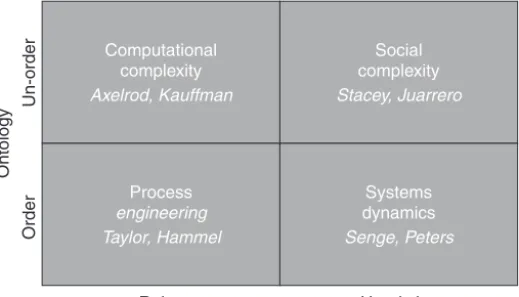
The two-by-two matrix set out in Figure 1 contrasts the nature of systems (ontology) with the nature of the way we know things (epistemology) and accordingly the way we act; I contend that knowledge and action are intimately intertwined.8The matrix was originally produced for a European Union (EU) study on knowledge management and was used to demonstrate that the strategic advantage for Europe (and I would
contend for Africa and Asia) lies not in imitating the USA, but in utilising its multi-culturalism as a petitive advantage through exploitation of social com-plexity in which it currently has an intellectual lead. I have more fully described the matrix and some of its implications elsewhere, and the full report can be obtained from www.cynefin.net.9,10
The vertical dimension of the matrix contrasts two types of system, namely order and un-order. In the earlier story of the children’s party, the first approach, namely that of objectives, planning and best practice, is in effect an illustration of the type of approach that is typically adopted in an ordered system for which it is legitimate. Where there are clearly identified (or identifiable) relationships between cause and effect, which once discovered will enable us to control the future, then the system is ordered. It can be structured on the basis of a desired outcome with structured stages between where I am ‘now’ and where I want to be ‘then’.
This is contrasted with un-order in which the relationships between cause and effect do not repeat, except by accident, and in which the number of agents interacting with other agents is too great to permit predictable outcome-based models, although we can (as is the case with the party) control starting conditions and monitor for emergence. ‘Un’ is used here in the sense that Bram Stoker uses it of Dracula: the un-dead are neither dead nor alive, they are something different that we do not fully understand or comprehend.
At its simplest the difference between management in order and un-order can be summarised as follows. Ordered systems are those in which a desired output can be determined in advance and achieved through the application of planning based on a foundation of good data capture and analysis. In un-ordered systems no output or outcome can be determined in advance in other than the most general terms, but we can manage the starting conditions and may achieve
Ontology
Order
Un-order
Rules Heuristics
Epistemology Computational
complexity
Axelrod, Kauffman
Social complexity
Stacey, Juarrero
Process
engineering Taylor, Hammel
Systems dynamics
Senge, Peters
unexpected and more desirable goals than we could have imagined in advance, or (and this is commonly the case, especially in the case of teenage parties) we could just be more successful in avoiding failure.
Management of ordered systems is biased towards efficiency and stability. Interestingly in nature stability and resilience are opposed and un-ordered systems tend to be more resilient to context shifts and approaches based on efficiency can in practice destroy effective-ness as they reduce adaptive capacity.
While the vertical dimension represents two dis-tinct states, the horizontal dimension is more of a continuum between the low ambiguity of rules that can easily be made explicit and the more ambiguous use of heuristics or rules of thumb, which provide guiding principles but have high levels of ambiguity. This difference can be illustrated by comparing a com-plex US government manual on procurement (anyone who has contracted under US Government rules can take you to highly complicated websites which prescribe all possible circumstances on the basis that anything which is not explicitly permitted is not allowed) with a mission or value statement for an organisation that states broad principles that set expectations, can be comprehended quickly and are easily memorable, as a result of which they can be applied without reference to the rules.
Having established the dimensions, we can use the model to look at the current situation in respect of management theory by taking each of the quadrants in turn, and in doing so look at the limits on their applicability.
Process engineering
Ordered ontology, rule-based
epistemology
In effect the last century of management theory and practice, from Taylor’s scientific management to its logical extreme, business process re-engineering, is most commonly attributed to Hammer and Champy.4,5 A strong mechanical metaphor characterises these approaches. The focus is on efficiency, stripping away all superfluous functions in order to ensure repeat-ability and consistency. The most recent manifestation is Six-Sigmacoriginating in General Electric, which continues the focus on efficiency with a strongly quan-titative approach to measurement although with some cult-like overtones in its imagery: black belts, etc.
It is a common characteristic of engineering ap-proaches that they start in manufacturing processes where they gain their initial success, and then extend to other less structured aspects of an organisation,
at which point problems start to emerge. One of the reasons for this is the important difference between a focus on efficiency and one on effectiveness. The engineering process takes place in a specific context, and once achieved, shifts in that context require the engineering design process to be repeated to some degree before efficiency can be achieved again. Radical shifts in context may make the entire approach re-dundant or lead to catastrophic failure. In the context of a manufacturing plan or a stable industrial sector this is not a problem, or if it is a problem it is shared by all of our competitors. We have to make major investments in process to achieve efficiency and that investment is always a sunk cost. Manufacturing plants, payment systems in a bank and the like are all closed systems that can be structured and standardised without any major issue. We can in effect define best practice. However, when we apply the same techniques to systems with higher levels of ambiguity, for example doctor– patient–nurse interactions and the like, we encounter more difficulties. Some of these arise from the fact that significant aspects of what we know cannot be meas-ured or made explicit: we always know more than we can say, we will always say more than we can write down. Others arise from the impossibility of antici-pating all possible situations and shifting context. In these cases we need a different focus, one of effective-ness in which we leave in place a degree of inefficiency to ensure that the system has adaptive capacity and can therefore rapidly evolve to meet the new circumstances. Examples would include apprentice schemes of know-ledge transfer, maintaining mavericks or misfits, allow-ing people to take trainallow-ing in subjects with no apparent relevance to their current jobs and providing more delegated authority.
Boisot makes the valid point that organisations that invest heavily in knowledge creation tend to assume that the same knowledge will require similar costs for their competitors and thus focus a massive effort on protec-tion through patents, etc.11He calls these N-Learning organisations, in contrast with S-Learning cultures, which see value arising from the exploitation of knowledge, not its possession, and thus tend to share and collab-orate even with competitors. The open source move-ment is a good illustration of the latter. Boisot goes on to demonstrate through several examples the way in which N-Learning cultures fail to adapt to changing circumstances; these include IBM’s failure to see the change to microcomputers until it was almost too late, and the failure to understand the operating systems market to the point where they lost to Microsoft. There are many other examples in other large companies that have tended to adopt engineering processes and built large bureaucracies and enforcement procedures.
There is nothing wrong with an engineering ap-proach; there are many things that need high degrees of order and control. However, taken to excess, and it
has nearly always been so taken, it sacrifices human effectiveness, innovation and curiosity on the altar of mechanical efficiency.
Systems dynamics
Ordered ontology, heuristic-based
epistemology
Towards the end of the last century we saw some rebellion against the mechanic metaphors of scientific management and its successors. Tom Peters in various speeches and books, Senge with Learning Organis-ation, Nonaka with various co-authors in books and articles covering knowledge management represent the more popular examples.6,12,13Systems dynamics challenges the apparent simplicity of process-based approaches and their associated mechanical metaphor, arguing for both non-linear relationships between cause and effect and the greater ambiguity of human systems. We see the birth here of approaches based on articulating mission statements, establishing value systems and idealised behaviour, all of which would then be mandated for employees. Senge argues that employees should sacrifice their individual objects and goals to gain from the assumption of a common identity in the organisation to which they belong; Nonaka recognises the social nature of human know-ledge transfer and the need to separate tacit knowknow-ledge sharing from the process of making tacit knowledge explicit; Peters emphasises motivation and leadership. The ambiguity of human systems is recognised, but the basic concept of central control or planning remains at the heart. Leaders set objectives, they (to use Senge’s metaphor) are the designers of the ship. Competences and behaviours, it is argued, can be taught and learnt and alignment of the individual with the collective is thus possible.
One of the easiest ways to identify a systems thinking approach is to look for the process models – those with lots of boxes, arrows and feedback loops are generally characteristic of systems dynamics. By accepting that the world is more complicated than implied by process re-engineering and the introduc-tion of feedback loops, concepts such as double loop learning and discourse analysis systems dynamics humanised the heirs of Taylor to a degree.4However the basic assumptions of order pertain. Systems are configured based on end-point objectives; humans are seen as assets or capabilities that can be aligned with those objectives. Reductionism still stands; think of the balanced scorecard, another popular manifestation of systems thinking philosophy in which the range of activities of an organisation are reduced to a set of interconnected measurable items in which the whole is assumed to be the sum of the parts. The strength of systems dynamics is its recognition that human systems
are messy, they frequently need focus and alignment; its weakness is that it assumes that the design of that focus and alignment is a top-down objective-based process. Like process engineering, systems dynamics is strongly linked to computer-based automation and modelling. The speed of computers allows the complication of systems dynamics models to be calculated on a con-sistent basis with associated reporting and control mech-anisms. For complicated aspects of an organisation it is very powerful, allowing models to be constructed to enable an understanding of the interrelationships between people, process and technology (a three-fold focus mantra that typifies thinking in this domain). When the number of people, the complication and context changes associated with process and the cap-abilities of technology exceed a threshold level the system shifts from being complicated to being complex, from order to un-order, in which an output cannot be defined in advance and in which the sheer number of relationships means that order emerges from the interaction of the various agents over time, and the nature of that order is unique to each emergence. At this point we shift to the un-ordered quadrants.
Computational complexity
dUn-ordered ontology, rule-based
epistemology
A new awareness of the ancient counterpart to order began over a century ago with Poincare´ and several others, and has surged in recent decades.14–17In fact there is a fascinating kind of order in which no director or designer is in control but which emerges through the interaction of many entities. Emergent order has been found in many natural phenomena: bird flocking behaviour can be simulated on a computer through three simple rules; termites produce elegant nests through the operation of simple behaviours triggered by chemical traces; each snowflake is a unique pattern arising from the interactions of water particles during freezing.18–20The patterns that form are not controlled by a directing intelligence; they are self-organising. The new science of complexity spawned by these find-ings is interdisciplinary, touching fields from math-ematics to evolution to economics to meteorology to telecommunications. In the domain of emergent order, a goal ‘to predict (and thereby control) the behaviour of systems not yet studied (but similar to those that have been studied) under conditions not yet extant and in time periods not yet experienced’ is difficult if not impossible to achieve – but other goals are achievable.21
Awareness of emergent order has as yet had com-paratively little influence on mainstream theory and practice in management and strategy (for a good intro-duction see Axelrod and Cohen22); however there are a growing number of examples. Computer-based simu-lations based on agent models have been used to handle complex issues such as traffic management and package routing for airlines. A growing use is in economical modelling and clustering. The approach is to create a computer simulation in which a population of human agents make decisions based on assumed rules and then observe for emergent patterns of order.
Note a key difference here, unordered systems work bottom-up not top down. Although computational complexity shares the deterministic aspects of rules with process engineering, the rules apply to each agent not to the system as a whole. Patterns, behavioural and otherwise, emerge from the interaction of many agents operating on unarticulated rules with other agents and with the environment; it cannot be determined top down and the patterns do not necessarily repeat except by accident.
We also see one of the most interesting aspects of a complex system, namely its simplicity; a few rules give rise to complex forms of order. This leads to a contrast of simple–complex with simplistic–complicated, which while not universally true is a useful way of looking at the problem.
Of course, not all systems are un-ordered, and applying an un-ordered approach based on agent simu-lation would be dangerous if we used it for something like payment systems in a web-based trading system or for the regulatory processes of the pharmaceutical industry. Accordingly we should resist the universalist claims of some complexity practitioners as much as we resist those of engineering and systems thinkers. There is, however, another limitation to mathematical com-plexity, namely the fact that, other than in a limited set of circumstances, human beings are not the same entities as ants, birds or crystals. I am sometimes amazed that this point has to be made, but have come to the conclusion that many economists and sociologists would like humans to be ants, as then their math-ematical models would work. The differences between human systems and ants are similar to the differences between human systems and the mechanical meta-phors of process which gave rise to systems thinking; this leads us logically to our final quadrant.
Social complexity
Un-ordered ontology, heuristic-based
epistemology
Social complexity shares with computational com-plexity the concept of un-order and emergence, but also shares with systems dynamics the belief that
human systems are different; these differences are summarised in the next section. Social complexity is linked in some cases to postmodernism, and has some strong advocates in the field such as Stacey and Juarrero.23–25It is the main focus of the Cynefin Centre, and offers interesting possibilities for the government and industry alike.
The relevance of social complexity is illustrated by the metaphor of the children’s party with which this article started and which aptly summarises the differ-ences between an ordered and un-ordered approach. The first approach to managing a children’s party is based on the assumption of order, the second is based on un-order. The argument is not that one or other approach is absolutely right or wrong, but that both are right (and wrong) in context.
This awareness of context is not common in man-agement science and consultancy practice, which are dominated by approaches based on an assumption that the systems being researched and managed are essentially ordered in nature. They are thus susceptible to methods based on best practice and the creation of structured top-down approaches. In ordered systems we can create repeatability and scalability with con-sistency. Failure is a failure of design or implemen-tation, not a result of the nature of the system itself.
The importance of learning how to manage in un-ordered environments is easily understood by looking at the dilemma facing governments around the world. On the one hand they face increasing requirements for the provision of public services, but on the other they have static or declining levels of resource. Managing un-order through the manipulation of boundaries, attractors and identity offers a potential path to the resolution of that dilemma; managing un-order on the basis of methods and tools appropriate for ordered systems involves deploying major resources to make things worse. The same dilemma and opportunity exists for not-for-profit and commercial organisations alike.
Unique aspects of human systems
Different schools of thought identify different distin-guishing features of human systems. The following summary has been developed from various sources over the years in the context of creating explainable and comprehensible reasons for management audiences engaged in the early stages of applying thinking from social complexity.e
eThis section is largely extracted from the Stanbridge and Snowden article previously referenced10and published in
Humans make decisions based on
patterns
This builds on naturalistic decision theory, in particu-lar the experimental and observational work of Gary Klein now validated by neuroscience, that the basis of human decision is a first-fit pattern-matching with past experience or extrapolated possible experience.26 Humans see the world both visually and conceptually as a series of spot observations and they fill in the gaps from previous experience, either personal or narrative in nature. Interviewed, they will rationalise the de-cision in whatever way is acceptable to the society to which they belong: ‘a tree spirit spoke to me’ and ‘I made a rational decision having considered all the available facts’ have the same relationship to reality. Accordingly in other than a constrained set of cir-cumstances there are no rules to model.
Humans create and maintain multiple
identities
An individual can be distinguished by their roles, clans or context. We both create and maintain multiple, often parallel, identities, shifting between and amongst them as needed without so much as a second thought. As a male individual I can be father, brother, son or husband, I can switch between work-based identities or home-based ones. My employees if distanced from me may never associate my person with the role I occupy. I am a member of many clans, from sporting clubs, cohort groups, participants in a senior executive programme: there are many examples. Context is of particular interest here: working as a crew in a bush fire is very strongly associated by identity with the role and common threat and I can sustain it for a period of time while I am ‘on watch’; however, such a contextual identity and the behaviours associated with it cannot be transferred outside of the context. Accordingly in other than a constrained set of circumstances there are no clear agents to be modelled.
Humans ascribe intentionality and
cause where none necessarily exist
There is a natural tendency to ascribe intentionality to behaviour in others, whilst assuming that the same others will appreciate that some action on our part was accidental. Equally if a particular accidental or serendipitous set of actions on our part lead to beneficial results we have a natural tendency to ascribe them to intentional behaviour and come to believe that because there were good results, those results arose from meritorious action on our part. In doing so
we are seeking to identify causality for current events. This is a natural tendency in a community entrained in its pattern of thinking by the Enlightenment. Deacon has established that the concept of co-evolution of the brain and language removes the need for a ‘universal grammar’ as an explanation of language, and a similar application of Occam’s razor can remove much of the supposed causality in both government and industry.27 One of the key insights of social complexity is that some things just ‘are’ by virtue of multiple interactions over time, and the concept of a single explanation, ascription of blame or for that matter credit are not necessary and will lead to false security about future actions.
Humans have learnt how to structure
their social interactions to create
order
For the purpose of this article we will avoid the potentially troublesome concept of free will and instead focus on the ability of humans through social struc-tures (and less tangible things such as myth, ritual and taboo) to create stability and predictability in their systems. Depending on where you live it is correct to drive on either the left or right-hand side of the road – we have advanced from the adaptive nature of bird flocking behaviour (fly to the centre of the flock, avoid collision, match speed) as a means of managing traffic to create a predictable form of order that not only provides stability in our day-to-day lives, but also allows planning for road design, etc. This is linked to the human capacity to store knowledge in the external environment, or ‘scaffolding’ to use Clark’s term.28Humans have thus learnt how to move between order and un-order.
Contextual complexity
Couple the above differences with the phenomeno-logical aspects of human perceptions of reality and we see that there are substantial and major differences between human and non-human un-order. This led the Cynefin Centre to coin the term ‘contextual com-plexity’ in contrast with ‘participative comcom-plexity’ from Stacey and colleagues.24Contextual complexity argues that humans have the ability to operate in all quadrants of the model and the ability to move between them as a result of both accidental and deliberate action.
depending on the ontological state. This is contrasted with any single-ontology form of sense making whether based on order, complexity or chaos. Under-standing this concept of ontological switches also helps prevent the degeneration into ‘un-manage-ability’ and fatalism which can occur when people start to understand complexity based thinking.
The order and un-order distinction has many applications and these are summarised in Table 1.
The information in Table 1 summarises material that has already been explained, or implied, in the text above. Some examples are more enigmatic, such as those on measurement, and are covered in referenced articles. The final economic example deserves more explanation and also allows a simple case to form the conclusion of this article and show an exemplar of an un-ordered intervention. The case is drawn from Axelrod and Cohen’s introductory text on social complexity.22
This is the Grameen Bank, which was created in Bangladesh to provide small loans to poor people (the name Grameen comes from the Bangla word for village).29 This is a market which the conventional banking system finds unattractive. Most commercial and private loans are based on credit scoring, an
ordered concept in which the characteristics of good and bad debtors are identified and used as predictors and therefore controls for future lending. This in-creases the cost of lending as the various processes have to be administered, and small loans thus become uneconomic. In the Grameen Bank everyone who took out a loan was required to be a part of a self-regulating borrowers’ group in which each member of the group had to take responsibility for the debts of the others. This simple rule, which costs little to admin-ister, produced a 97% repayment rate, comparable with the best achievements of the large banks; there are now over two million clients of the Grameen Bank, and the approach has proved both scalable and portable.
I find the Grameen Bank an inspiring case, and an illustration of the great benefits that complex or un-ordered thinking can bring. Just as in the case of the children’s party, managing the starting conditions rather than an idealised end state can produce lower-cost, more effective solutions. Complex thinking is a fundamental necessity in modern management. It is a new and exciting way of thinking about the world that, properly understood, does not mean that we abandon any of the ways in which we currently manage, but
Table 1 Comparison of order and un-order
Order Un-order
Focus on rational individuals making choices based on personal self-interest
Focus on identities making decisions based on patterns arising from personal experience and collective knowledge expressed in narrative form
Manage to achieve goals based on ideal models and central planning
Manage starting conditions and monitor for the emergence of pattern to sustain or disrupt
Simplistic–complicated Simple–complex
Efficiency (focus on core capability, outsource the rest)
Effectiveness (requisite diversity, allow inefficiency for adaptability)
Exploitation Exploration
Stable Resilient
Reductionist measures: ROI (return on investment), balanced scorecard, etc.
Indivisible, emergent measures
Measure outcomes based on explicit goal-based criteria
Measure the stability of barriers, the attractiveness of attractors and the stability of identities
Dichotomy and the resolution of dilemmas as an either/or choice
Dialectic and the resolution of paradox to see the world in a different way
Analysis and expert interpretation Stimulated emergence so that the patterns of possibility become more visible
instead understand and apply the boundaries of their applicability. With that change we enter a new sim-plicity in management decision making.
REFERENCES
1 Kurtz C and Snowden D. The new dynamics of strategy: sense making in a complex–complicated world. IBM Systems Journal2003;42:462–83.
2 Weick KE. Sense Making in Organizations.Thousand Oaks, CA: Sage Publications Inc., 1995.
3 Dervin B. Sense making theory and practice: an overview of user interests in knowledge seeking and use.Knowledge Management2:2. MCB University Press, December 1998. 4 Taylor FW.Principles of Scientific Management. Various
publishers, 1911.
5 Hammer M and Champy J.Re-engineering the Corpor-ation.London: Nicholas Brealey Publishing, 1993. 6 Senge P.The Fifth Discipline: the art and practice of the
learning organization. New York: Doubleday Currency, 1990.
7 Snowden D. Strategy in the context of uncertainty. In: Coate P (ed).The Handbook of Business Strategy.Bradford: Emerald Group Publishing, 2004.
8 Snowden D. Complex acts of knowing: paradox and descriptive self-awareness.Journal of Knowledge Man-agement2002;6:100–11.
9 Snowden D. Innovation as an object of knowledge management. Part 1: The Landscape of Management.
Knowledge Management Research and Practice2003;1: 113–19.
10 Stanbridge P and Snowden D. The Landscape of Man-agement: creating the context for understanding social complexity.Emergence2004;6:140–8.
11 Boisot M.Knowledge Assets.Oxford: Oxford University Press, 1998.
12 www.tompeters.com
13 Nonaka I and Nishiguchi T.Knowledge Emergence: social, technical, and evolutionary dimensions of knowledge cre-ation.Oxford: Oxford University Press, 2000.
14 Nicolis G and Prigogine I.Exploring Complexity. New York: WH Freeman, 1989.
15 Lorenz EN.The Essence of Chaos. Washington, DC: Uni-versity of Washington Press, 1993.
16 Holland JH.Emergence: from chaos to order. New York: Perseus Books, 1998.
17 Kauffman SA.Investigations. Oxford: Oxford University Press, 2000.
18 Reynolds CW. Flocks, herds, and schools: a distributed behavioral model.Computer Graphics1987;21(4):25–34 (SIGGRAPH ’87 Conference Proceedings).
19 Camazine S, Deneubourg J-L, Franks NR et al. Self-Organization in Biological Systems. Princeton, NJ: Princeton University Press, 2001.
20 Ball P. The Self-Made Tapestry: pattern formation in nature. Oxford: Oxford University Press, 1999. 21 Arrow H, McGrath JE and Berdahl JL.Small Groups as
Complex Systems: formation, coordination, development, and adaptation. Thousand Oaks, CA: Sage Publications Inc., 2000.
22 Axelrod R and Cohen MD. Harnessing Complexity: organizational implications of a scientific frontier. New York: Free Press, 1999.
23 Cilliers P. Complexity and Postmodernism. London: Routledge, 1998.
24 Stacey RD.Complex Responsive Processes in Organizations: learning and knowledge creation. London: Routledge, 2001. 25 Juarrero A.Dynamics in Action: intentional behavior as a
complex system. Cambridge, MA: MIT Press, 1999. 26 Klein G.Sources of Power: how people make decisions.
Cambridge, MA: MIT Press, 1998.
27 Deacon T.The Symbolic Species. London: Penguin, 1997. 28 Clark A.Being There: putting brain, body, and the world
together again.Cambridge, MA: MIT Press, 1997. 29 Yunas M. The Grameen Bank.Scientific American1999;
281:114–19.
CONFLICTS OF INTEREST
None.
ADDRESS FOR CORRESPONDENCE
David Snowden 51 Lockeridge Marlborough SN8 4EL UK
Email: [email protected] Website: www.cynefin.net