UDC 811.111’243:81’276.1
FOREIGN LANGUAGE TEACHING BASED ON ORGANIZING
PRACTICE-ORIENTED COMMUNICATION IN THE CLASSROOM
(FROM THE EXPERIENCE OF TEACHING MEDICAL ENGLISH)
Galina V. Yurchuk, Anastasiya V. Lakhno, Vladimir A. Yurchuk, Elena O. Petrova, Larisa G. Nosova
Department of Latin and Foreign Languages, Krasnoyarsk State Medical University named after Prof. V.F. Voyno-Yasenetsky, Russia
Phone: +7 (983) 293 64 93, E-Mail: [email protected]
Abstract. The article describes the organization of practice-oriented communication in teaching English as a foreign language to medical students. The study validates the role and meaning of the applied teaching methods: verbal-dialectical, terminological-conceptual, and interactive. It also provides grounds for the use of the following forms and means of the students’ work: case studies, an electronic textbook “English for Pharmacists”, and the teaching and assessing software for organizing practice-oriented communication in a foreign language classroom. The used means and methods increase students’ engagement and their autonomy; intensify the learning process and enriching it with professional knowledge; they also allow students to develop a sufficient level of professionally oriented competence.
Key words:practice-oriented communication, professionally oriented language competence, verbal-dialectical method
1.INTRODUCTION
Technological advancements and the introduction of new information technology to medicine have significantly increased the amount of information containing foreign terms and concepts. The amount of the taught material has also grown, whereas the amount of time allocated to teach it has not considerably changed. In this situation, specialist training is aimed at creative thinking development with the help of new methods of organizing practice-oriented communication in a foreign language classroom, as well as addressing the principles of a competence approach. (Hutmacher 1996, Keen 1992, Moirand 1990). This is critical for the future professional communication (Adolf 2012). Not least crucial is teaching medical English with the primary focus on the medicine and healthcare and putting the language aspects on the second place, thus shifting the traditional paradigm of teaching English to non-English speaking medical students (Antic 2007, Hull 2004). Practice-oriented communication in a foreign language classroom allows the teacher to become a facilitator and grants the students with the autonomy in gaining and processing knowledge.
Submitted April 3
2.ORGANIZATION OF PRACTICE-ORIENTED ACTIVITY IN THE CLASSROOM
2.1 Methods and provisions
Planning the practice-oriented communication (POC) is based on the verbal-dialectical, terminological-conceptual and interactive methods of teaching. It also includes the development of different ways to use these methods.
To organize the students’ POC in a foreign language classroom the following provisions have been created: a verbal-dialectical teaching method and a terminological-conceptual method of work. In addition to this, some teaching materials on how to use the verbal-dialectical teaching method in the foreign language teaching were developed. The following interactive forms and means of work were used: a set of case studies, an electronic textbook
English for Pharmacists, and a teaching and assessing software using Delphi environment. A method to monitor the formation process of professionally oriented competence was also developed.
A verbal-dialectical method implies that the students employ logical methods and the laws of dialectics in their thinking and communicative activities in class (Zorina 2005). These activities include reading specialized texts, working on case studies and participating in the discussions on medical topics using higher-order questions created by the students themselves.
The terminological-conceptual method is based on the students’ purposeful work on the content of a concept, which enhances better memorization of the term and its strictly conditioned use. Precise understanding of the terms provides the learners with an opportunity to immerse themselves deeper into a certain scientific area and consciously master it (Leontiev 2007).
The interactive method of teaching is understood as a shared process of cognition where the knowledge is acquired through collaborative activity in dialogues and discussions. Students’ experience and knowledge is a source of their mutual learning.
Students’ professionally oriented language competence (POLC) is formed by their exposure to professionally-oriented reading, listening and speaking tasks; acquisition of special terms and concepts; and development of the skills which help the students function in the professional sphere in a foreign language (Yurchuk 2011).
2.2 Participants and procedures
196 students of Krasnoyarsk State Medical University took part in the study presented in this article. The students were from the General Medicine, Pharmacy and Pediatric Departments. The students were randomly divided into two groups: control group (95 students) and the experimental group (101 students). The control group was taught using traditional methods of instruction, while the experimental group was treated with the verbal-dialectical method of teaching.
A small fragment of one of the seminars conducted with the experimental group is described below to demonstrate how practice-oriented communication in a foreign language classroom influences POLC formation.
Below is an example of the feedback form:
Topic: Angina Pectoris.
1. Write out the new terms: angina pectoris, atherosclerosis, etc.
2. Provide definitions for the terms: Angina pectoris is a severe chest pain due to ischemia (a lack of blood, thus a lack of oxygen supply) of the heart muscle, generally due to obstruction or spasm of the coronary arteries.
3. Make up higher-order questions. I-order questions: 1. What are the causes of
angina pectoris? II-order questions: 2. How is the change of coronary vessels connected with pains in the area of the heart?
4. Answer the created higher-order questions.
II. At the seminar a professionally oriented discussion is organized using the higher-order questions prepared by the students in advance. During the discussion each student has an opportunity to ask their questions and answer the questions he or she is being asked. The discussion is conducted in the target language and everyone in the class is able to draw conclusions and express their point of view on the studied topic. At the lesson all the students use the knowledge acquired individually and at the same time obtain some new information collaboratively through professionally oriented communication in the target language.
The students were also offered some cases - professionally oriented situational tasks (POSTs) - to work on. These tasks contained not only the problem itself but also some possible solutions to it so that the students have to choose the optimal one. POSTs were aimed at teaching students to develop and use some synthesizing skills in solving professional problems through professional role-plays. Use of POSTs in teaching an FL develops the following abilities in students: independently navigate the information space in the foreign language, quickly find the necessary professional information, generalize the knowledge and skills acquired while studying FL and specialized subjects and use them to handle non-typical situations; and defend one’s point of view on a professional issue in a FL.
Here is an example of a professionally oriented situational task for the topic Angina Pectoris the students were presented with.
A 56-year old patient came to see a general practitioner complaining that for 2 months he had been experiencing pain caused by physical exercise, after uphill climbing and speedy walk. The pain is of a colicky nature, lasts for 3-5 minutes and then fades away. The pain decreases when physical exertion is less or when the patient takes nitroglycerin. The pain is localized in the chest and spreads to the left shoulder, shoulder blade, neck and a pit of the stomach. The nature of the pain is pressing and squeezing. The anamnesis proved that the patient was a heavy smoker with excess weight. Lately, episodes of pain became frequent, so he undertook a medical examination. The blood test showed an increased cholesterol level, ECG data confirmed the signs of a coronary heart disease. Angiography revealed coronary vessels constriction.
I. Make up questions.
II. Analyzing the complaints, the anamnesis, the laboratory data, the blood test, the instrumental research, state the diagnosis.
Key: (stable type of angina pectoris)
These are the questions the students created:
1. What is the cause of the narrowing coronary vessels?
We also created an electronic textbook to teach students English and develop their professionally oriented language competence. The textbook uses different interactive forms of teaching, namely: dialogues, case-study method, multimedia presentations, creative assignments, small group tasks, and review of the studied material. The electronic textbook English for Pharmacists contains texts which cover the main topics of the curriculum and the tasks to them; a grammar reference section, a glossary with hyperlinks to the texts, and a list of the Internet resources.
The content of the teaching and assessing program included professionally oriented test tasks. Those tasks were aimed at the students’ independent learning and self-assessment.
2.3. Evaluation
To evaluate how professionally oriented communication influences the formation of professionally oriented language competence the Common European Framework of Reference for Languages (CEFR) was used. We adapted it for our research and developed an assessment sheet, which reflected the criteria and levels of the formed characteristics of the POLC (reading, speaking, using methods of reasoning).
The points de facto acquired by each student were converted into percentage of the maximum points a student could receive. The following scale was used: level<50% was defined as A1 (Breakthrough), 50-65% - A2 (Way stage), >65-80% B1 (Threshold), >80% (Vantage). To assess the levels of the formation of POLC characteristics in points presented in Table 1, the number of points was calculated to correspond with the levels described above. The difference in the number of points to assess each characteristic is caused by the number of the assessment criteria.
The maximum number of points the students could earn during the semester was calculated by adding up the maximum numbers of points for each activity and multiplied by the number of classes per semester. Then, the actual points received by each student per class were added and multiplied by the number of classes per semester (provided the students did not miss any classes). Finally, a percentage ratio between the actual points earned by the students and the maximum number of points they could earn was calculated. After that, each student was assigned a level of the POLC.
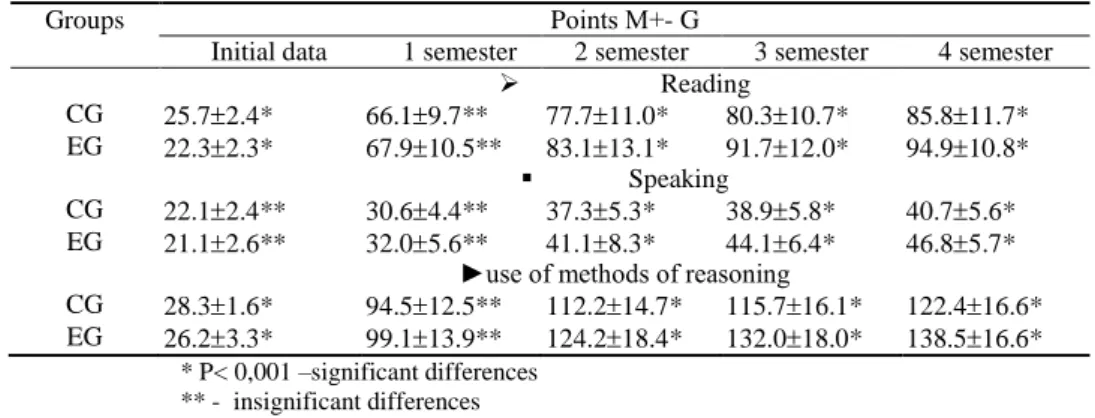
The results of the 3-year experimental work on the POLC formation in the control group (95 students) and the experimental group (101 students) are shown in Table 1.
Comparison of the dynamic changes of the quantitative data was done with the use of the Wilcoxon signed rank test for the two related samples. The significance of the difference in the qualitative data in the observed groups was evaluated with the nonparametric Pearson's χ2 test with the correction for continuity. With the frequency of the variable equaling 5 and less Fisher's exact test was used. All the differences were qualified as statistically significant with р<0.05.
3.RESULTS
assessment at the end of the fourth semester it was established that the members of the control group reached the threshold level B1 (85.8+- 11.7), and the members of the experimental group reached the vantage level B2 (94.9+- 10.8).
Evaluation of the speaking aspect of the POLC showed that the participants from both experimental and control groups initially were at the breakthrough level A1. In the first semester both groups had the way stage level of A2. The control group subjects had stayed at the way stage level of A2 during the second and third semesters and only by the fourth semester reached B1. The respondents from the experimental group reached B1 level in the second and third semesters and in the fourth one they were at B2 (Vantage).
Such an aspect of the POLC as the use of the methods of reasoning had the following results: the initial level in both experimental and control groups was breakthrough (A1). In the first semester both groups demonstrated A2 level (way stage), then in the second and third semesters B1 level was registered in both groups. In the fourth semester the subjects from the control group stayed at B1 level, whereas the respondents from the experimental group reached the vantage level of B2.
Table 1 Comparative table of the points assessment of the formed aspects of the POLC (Reading, Speaking, Use of Methods of Reasoning)
Groups Points М+- G
Initial data 1 semester 2 semester 3 semester 4 semester
Reading
CG 25.72.4* 66.19.7** 77.711.0* 80.310.7* 85.811.7* EG 22.32.3* 67.910.5** 83.113.1* 91.712.0* 94.910.8*
Speaking
CG 22.12.4** 30.64.4** 37.35.3* 38.95.8* 40.75.6* EG 21.12.6** 32.05.6** 41.18.3* 44.16.4* 46.85.7*
►use of methods of reasoning
CG 28.31.6* 94.512.5** 112.214.7* 115.716.1* 122.416.6* EG 26.23.3* 99.113.9** 124.218.4* 132.018.0* 138.516.6*
* P< 0,001 –significant differences ** - insignificant differences
Reading – А1 -<30, A2-65-75, B1-75-90, B2->90 ▪ Speaking - А1 -<30, A2-30-40, B1-40-45, B2->45
► Methods of Reasoning - А1 -<30, A2-85-110, B1-110-135, B2->135
Taking into account that the distribution of the majority of the variables was deviating from the norm, Spearman’s rank correlation coefficient was used to assess the strength and direction of the correlation between the studied variables. The correlation strength between the variables was calculated using the r coefficient and was significant with р<0.05. The data are presented in Table 2.
Table 2 Correlation between the use of the experimental method and the formation level of the POLC aspects
Studied variables (POLC aspects)
4.DISCUSSION
The acquired results allow us to state that the level of the professionally oriented language competence of the students from the experimental group is higher than that of the participants from the control group. This is attributed to the organization of the practice-oriented communication. Organization of such activity is a systemic, focused, and motivating process, which results in the improvement of the quality of the students’ cognitive, communicative, and professionally oriented activity.
Organization of the practice-oriented communication with the use of the interactive methods of teaching helps to develop students’ abilities to independently acquire the material not only in FL learning but also in other disciplines during the course of studies. Consequently, it contributes to a student’s personal and professional growth and enhances the motivation to study a FL, enriches the student’s knowledge of a FL in the professional context, and encourages continuing education during the entire course of studies. Moreover, the use of POC in the classroom allows the teacher to implement an interactive model of teaching (a possibility for the feedback in the ―teacher – student – teacher‖ communication model), use some information technology and the Internet resources, and improve the quality of the different forms of assessment (self-assessment). [3,5]. Finally, it improves the students’ skills to communicate in the professional context, which in their turn form the professionally oriented language competence.
5.CONCLUSION
Practice oriented activities in teaching a foreign language, which include the verbal-dialectical, terminological-conceptual, and interactive methods, imply taking the organization of communication to the level of complex cooperation. This contributes to the students’ transition from reporting knowledge to drawing conclusions; from simple to extended rendering of the information. Moreover, the opportunity given to the students to self-assess their work allows them to cultivate self-control, self-development, and self-education as well as form the professionally oriented competence.
The methods described in the present article are not limited to only teaching medical English. They may be applied in teaching English for specific purposes in other areas of professional education and training.
Further research may focus on investigating other ways of organizing professionally oriented training to form students’ professionally oriented competence.
REFERENCES
Adolf V.A., Zhuravleva O.P. ―Razvitie lichnostnogo potentsiala studenta v processe professional'noi podgotovki‖ [Development of a student’s personality potential in the course of professional training] Sibirskiy pedagogicheskiy zhurnal. – (2012). - №2. - p.21-27 // Сибирский педагогический журнал. - 2012. - №2. - С.21-27.
Antic, Zorica. ―Forward in Teaching English for Medical Purposes.‖ Facta Universitatis, Series: Medicine and Biology, 14, no.3 (2007): 141-147
Hull, Melodie. ―Changing the Paradigm for Medical English Language Teaching.‖ Paper presented at the 2004 International Symposium of English for Medical Purposes, Xi’an, China, October 16-19, 2004.
Keen, K. ―Competence: What is it and how can it be developed?‖ In Instructional Design: Implementation Issues, edited by J. Lowyck, P. de Potter, and J. Elen, 111-122. Brussels: IBM Education Center, 1992. Leontiev А. А. Yazyk, rech', rechevaya deatel'nost'. [Language, speech, communicative activity] / A.A.
Leontiev – Moscow: Komkniga, 2007. А. А. Леонтьев - М.: Комкнига, 2007. – 216 с. Moirand, Sophie. nseigner ommuni uer en angue trang re Paris: Hachette, 1990
Yurchuk G. V. ―Razvitie yazykovoi kompetentnosti pri izuchenii angliyskogo yazyka studentami meditsinskogo vuza‖. [Medical students' development of a language competence while studying English] // Vestnik KGPU im. V.P. Astafiev. 2011. - № 3 (17). - С.218-221. Вестник КГПУ им. В.П. Астафьева. – 2011. - № 3 (17). - С.218-221.