Target selection and prioritization are common goals for academic and commercial drug research organizations.
While motivations differ, in all cases, the target selection task is fundamentally one of resource allocation in the face of incomplete information. Consequently, target selection strategies (and metric-based approaches to assess their success) remain complex1 and are hindered by multiple bottlenecks. Some bottlenecks pertain to the data themselves, such as disjointed, disparate data and metadata standards, data recording errors and accessi-bility issues; overcoming these issues will require human and computational efforts and coordination across mul-tiple communities. Another set of bottlenecks pertains to the scientists involved. These include a tendency to focus on a small subset of well-known genes2 and the tendency to avoid riskier research paths, driven by poor research funding climates3.
For the purposes of this article, we define knowledge as the consensus of information aggregated from dif-ferent sources and information as structured data, with a contextual layer that supports a broad range of data analytics. Data have quantity, quality and dimensionality (for example, genomic knowledge is defined in relation to associations with distinct entities such as molecular probes and disease concepts). Data, like facts, may also have an expiration date (Supplementary Box S1), and thus knowledge is subject to change. Yet, within a given time frame, knowledge provides context for interpre-tation and integration of emergent data, information and models.
Data-driven drug discovery strategies rely on the integration of proprietary and internal data with third-party resources — both public databases, such as PubMed, PubChem4, ChEMBL5 and The Cancer *e-mail:
doi:10.1038/nrd.2018.14
Published online 23 Feb 2018; corrected online 23 Mar 2018 Drug
Externally administered, possibly endogenous but mostly xenobiotic, substances that are administered to patients in order to influence the outcome of a disease, syndrome or condition.
Unexplored therapeutic opportunities
in the human genome
Tudor I. Oprea
1,2,3,4*, Cristian G. Bologa
1, Søren Brunak
4, Allen Campbell
5,
Gregory N. Gan
2, Anna Gaulton
6, Shawn M. Gomez
7,8, Rajarshi Guha
9, Anne Hersey
6,
Jayme Holmes
1, Ajit Jadhav
9, Lars Juhl Jensen
4, Gary L. Johnson
8, Anneli Karlson
6,20,
Andrew R. Leach
6, Avi Ma’ayan
10, Anna Malovannaya
11, Subramani Mani
1,
Stephen L. Mathias
1, Michael T. McManus
12, Terrence F. Meehan
6, Christian von
Mering
13, Daniel Muthas
14, Dac-Trung Nguyen
9, John P. Overington
6,21,
George Papadatos
6,22, Jun Qin
11, Christian Reich
15, Bryan L. Roth
8,
Stephan C. Schürer
16, Anton Simeonov
9, Larry A. Sklar
2,17,18, Noel Southall
9,
Susumu Tomita
19, Ilinca Tudose
6,23, Oleg Ursu
1, Dušica Vidovic´
16, Anna Waller
17,
David Westergaard
4, Jeremy J. Yang
1and Gergely Zahoránszky-Köhalmi
1,24Drug targets
Molecular entities present in living systems that, upon interaction with therapeutic agents or their by-products, result in modified biological responses that lead to therapeutic outcomes. The interaction between a drug and its target leads, directly or indirectly, to observable clinical outcomes.
Druggable genome Originally defined by Hopkins and Groom as the set of genes that encode proteins that could be modulated by an orally administered small molecule, as estimated by Lipinski’s ‘rule of five’ guidelines.
Genome Atlas (TCGA6), and commercial databases, such as Integrity. This integration requires fusion and reconciliation of heterogeneous and sometimes con-flicting data sources and types. Although many of these resources are already partially interlinked, data heterogeneity, complexity and incompleteness, as well as contextual information and metadata capture, pose substantial barriers to reliable systematic analyses of all data required to address biomedical research questions, such as target prioritization in drug discovery1.
With the increasing scale and variety of data genera-tion, collection and curation in the biomedical sciences, there is an unmet need for in-depth, accurate and truth-ful integration of multiple scientific domains across disciplines. Once successful, these data and knowledge integration efforts enable us to ask both global and fundamental questions about genes, proteins and the processes they are involved in. Integrated resources also allow us to address aspects of reproducibility7 via con-cordance of similar data types from unrelated sources and deficits in our knowledge of biological systems and their function. More generally, data integration facilitates our ability to quantify knowledge using an evidence-based approach.
Illuminating the Druggable Genome. “The reluctance to work on the unknown” (REF. 2) is inherent to the scientific endeavour, partly due to our subconscious tendency to choose research subjects more likely to confirm what we already know or believe8. In a deliber-ate, strategic attempt to map the knowledge gaps around potential drug targets and to prompt exploration of
cur-rently understudied but potentially druggable proteins, the US National Institutes of Health (NIH) launched the
Illuminating the Druggable Genome (IDG) initiative in 2014. As part of this broad, multimillion-dollar initiative, the IDG Knowledge Management Center (KMC) aims to systematize general and specific biomedical knowl-edge by processing a wide array of genomic, proteomic, chemical and disease-related resources (BOX 1), with the explicit goal of supporting target hypothesis genera-tion and subsequent knowledge creagenera-tion, especially for genes and proteins that are not well studied.
In this article, we first define objective, evidence-based criteria for tracking target development levels (TDLs) for human proteins, using multiple sets of current knowl-edge. We discuss the data collected by the KMC on TDLs, which show the existence of a substantial knowl-edge deficit concerning a large portion of the human proteome (one out of three proteins). Reflecting the goal of illuminating the druggable genome, we then present
spotlights on the TDL categories, as well as on key target classes, including G protein-coupled receptors (GPCRs), protein kinases and ion channels.
Knowledge-based protein classification
Target development levels. Most current protein clas-sification schemes are based on structural and func-tional criteria. For any given protein, it is also possible to identify associated drugs and chemical or biologic modulators, and many types of experimental data can be associated with the protein, including publications, pat-ents, gene expression data and experimental or modelled 3D structures.
For target prioritization and therapeutic development, it is useful to understand the quantity and diversity of data that are available for a given protein and to assign a qualitative knowledge metric that characterizes the degree to which a target is comparatively well studied or unstudied. To address this, we developed the TDL clas-sification scheme, which categorizes proteins into four groups — Tclin, Tchem, Tbio and Tdark — with respect to the depth of investigation from a clinical, chemical and bio-logical standpoint (FIG. 1; TABLE 1). Except for Tclin, TDL assignments were performed without human curation. Formal definitions for the TDL categories are as follows.
• Tclin (clinic) proteins are drug targets linked to at least one approved drug (that is, an active pharmaceuti-cal ingredient) by mechanism of action (MoA) (this criterion supersedes any of the other parameters). Classification into this TDL category was achieved through exhaustive manual querying of primary lit-erature and drug labels for MoA assignments with respect to molecular (protein) targets9; drug targets annotated as MoA-related proteins are categorized as Tclin (see further discussion below).
Author addresses
1Department of Internal Medicine, University of New Mexico School of Medicine,
Albuquerque, NM, USA.
2UNM Comprehensive Cancer Center, Albuquerque, NM, USA.
3Department of Rheumatology and Inflammation Research, Institute of Medicine,
Sahlgrenska Academy at University of Gothenburg, Gothenburg, Sweden.
4Novo Nordisk Foundation Center for Protein Research, Faculty of Health and Medical
Sciences, University of Copenhagen, Copenhagen, Denmark.
5IQVIA, Plymouth Meeting, PA, USA.
6European Molecular Biology Laboratory, European Bioinformatics Institute (EMBL-EBI),
Wellcome Genome Campus, Hinxton, Cambridge, UK.
7Joint Department of Biomedical Engineering, University of North Carolina at Chapel
Hill and North Carolina State University, Chapel Hill, NC, USA.
8Department of Pharmacology, University of North Carolina School of Medicine,
Chapel Hill, NC, USA.
9National Center for Advancing Translational Sciences (NCATS), National Institutes of
Health (NIH), Rockville, MD, USA.
10Icahn School of Medicine at Mount Sinai, New York, NY, USA.
11Baylor College of Medicine, Houston, TX, USA.
12University of California, San Francisco, CA, USA.
13Institute of Molecular Life Sciences, University of Zurich, Zurich, Switzerland.
14Respiratory, Inflammation and Autoimmunity Diseases, Innovative Medicines and
Early Development Biotech Unit, AstraZeneca R&D Gothenburg, Mölndal, Sweden.
15IQVIA, Cambridge, MA, USA.
16Department of Molecular and Cellular Pharmacology, Miller School of Medicine,
University of Miami, Miami, FL, USA.
17Center for Molecular Discovery, University of New Mexico Cancer Center,
University of New Mexico, Albuquerque, NM, USA.
18Department of Pathology, University of New Mexico, Albuquerque, NM, USA.
19Yale School of Medicine, Yale University, New Haven, CT, USA.
Present addresses: 20SciBite Limited, BioData Innovation Centre, Wellcome Genome
Campus, Hinxton, Cambridge, UK.
21Medicines Discovery Catapult, Alderley Edge, UK.
22GlaxoSmithKline, Stevenage, UK.
23Google Germany GmbH, München, Germany.
• Tchem (chemistry) proteins lack MoA-based links to approved drugs but are known to bind to small mole-cules with high potency. The interactions between pro-teins and small molecules (and sometimes approved drugs) are usually studied in the context of a disease and often arise from medicinal chemistry efforts. For inclusion in the Tchem category, we required the bio-activity of at least one small molecule to be above a specific cut-off chosen to include about 90% of the bioactivity values of drugs with a confirmed MoA for a target from that protein family (Supplementary Figure S2). Currently chosen thresholds are ≤30 nM for kinases, ≤100 nM for GPCRs and nuclear recep-tors, ≤10 μM for ion channels and ≤1 μM for other target families. Bioactivity values were extracted from ChEMBL5 and DrugCentral10.
• Tbio (biology) refers to those proteins that have a con-firmed Mendelian disease phenotype in the Online Mendelian Inheritance in Man (OMIM) database11 (that is, at least two publications), have Gene Ontology (GO)12 leaf term annotations based on experimental evidence or meet two of the following three condi-tions: a fractional PubMed publications count13 above five; three or more National Center for Biotechnology Information (NCBI) Gene Reference Into Function (RIF) annotations; or 50 or more commercial anti-bodies, counted from data made available by the Antibodypedia database14. T
bio assignments imply that these proteins are not MoA-related drug targets (these are Tclin proteins). However, it does not follow that these proteins lack associations with bioactive molecules, including approved small-molecule drugs and biologics. It does, however, imply that given cur-rent levels of evidence, associated bioactivity values and clinical observations did not meet Tchem or Tclin criteria, respectively.
• Tdark (dark genome) refers to the remaining proteins that have been manually curated at the primary sequence level in UniProt15 yet do not meet any of the criteria for Tclin, Tchem or Tbio. Even for this cate-gory, evidence may be available concerning genome-wide association studies (GWAS), tissue location, dysregulation, inferred function via homology, etc. Many proteins in the Tdark category are not context-less sequences. However, these are proteins for which there is the least current knowledge and a low number of specific molecular probes available, and some rep-resent unexplored opportunities within the druggable human genome. While evidence that approved drugs interact with some Tdark proteins may be available, the above criteria were observed for all Tdark assignments (Supplementary Table S3).
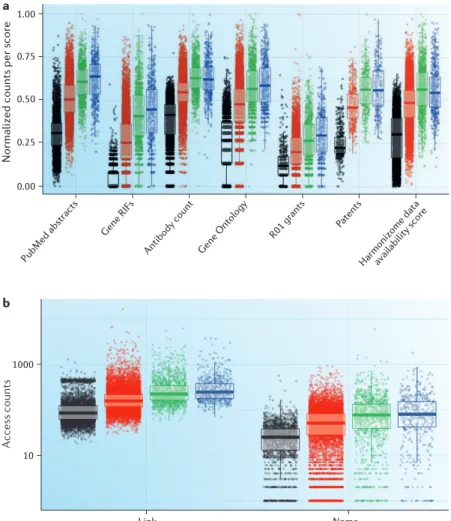
The knowledge deficit. FIGURE 2a summarizes the vary-ing degree of available data (represented usvary-ing a normal-ized count of occurrence) for seven different data types associated with individual targets and grouped by TDL. The first three groups illustrate category differences for three TDL defining criteria discussed above — namely, the fractional count of protein and/or gene mentions in PubMed abstracts, NCBI Gene RIF counts and antibody
counts per protein. ‘GO terms’ examines the distribution of GO12 annotation counts per protein using data from UniProt15. ‘R01 grants’ examines the distribution of text-mined R01 grant counts detected for each protein using NIH RePORTER data (see below for further discus-sion). ‘Patents’ examines the distribution of text-mined granted patents for each protein using SureChEMBL16 data. Finally, the data availability score summarizes experimental information density per protein obtained from Harmonizome17 data — a resource developed independently for the KMC that provides an abstract representation of the many types of data associated with all human genes and proteins (BOX 1).
Whereas the first three data types were used to assign the TDL category for proteins in the Tbio and Tdark catego-ries, the other four data types — derived from separate text corpora and repositories — provide independent valida-tion of our criteria for categorizavalida-tion overall. Distribuvalida-tion trends within TDL categories are consistently repro-duced across all data types in FIG. 2a and have statisti-cally significant differences (Supplementary Table S4). Tdark proteins have the least amount of data associated with them regardless of source.
Increasing amounts of data are observed for proteins when progressing through the categories from Tdark to Tbio, Tchem and Tclin. For example, Tdark proteins tend not to be the object of study for many funded NIH R01 grants and are significantly less discussed in patents compared with proteins in other TDLs. Statistical significance breaks down when comparing Tclin and Tchem, but because successful clinical trials are required for the Tchem-to-Tclin progression, this evidence may not be well captured by the four data types highlighted in Supplementary Table S4. However, this is less surprising from a knowledge man-agement perspective, since on average, the biochemis-try and pharmacology of a protein are likely to be well studied upon reaching the Tchem development stage. It is important to note that the Tchem stage can be completely bypassed for targets of therapeutic antibodies and other biologics.
In summary, all the data, information and knowl-edge aggregated and processed within the IDG KMC archive (partially illustrated in FIG. 2a) confirm the existence of a knowledge deficit about many proteins, some of which could have therapeutic relevance. The bias towards well-described proteins2 is confirmed not only with respect to publications but also with respect to patents, NIH funding patterns, GWAS and mouse phenotype data (data not shown), availability of molec-ular probes such as antibodies and small molecules, and even queries in the STRING18 database (see below and FIG. 2b). Because of this bias, one out of three human proteins (Tdark) have been largely unstudied. Although the NIH acknowledged that illumination should directly target understudied proteins, scientists engaged in target selection are likely to remain risk-averse and perhaps systematically less inclined to study Tdark proteins.
Mode of action
Referred to as ‘mechanism of action’ when the molecular interactions are well understood; describes the way in which drugs exert their intended therapeutic action, resulting in the intended therapeutic outcome.
proteins of potential therapeutic interest to migrate from Tdark to Tclin over time, and TDL monitors knowledge accumulation using multiple types of clinical, chem-ical and biologchem-ical evidence, while providing an easily interpretable ranking scheme. We argue that proteins in Tdark and Tbio are understudied and more in need of illu-mination, and we discuss approaches for achieving this later in the article, after first overviewing knowledge on proteins in the Tclin and Tchem categories.
Spotlight on Tclin and Tchem
Evaluating protein target druggability — the ability of a protein to be therapeutically modulated by medicines — can involve complex assessments of a range of protein characteristics. Structural biology and computational
and medicinal chemistry assessments of druggability largely focus on forecasting whether a target protein can bind to drug-like small molecules with high affinity and specificity19. However, druggability literature rarely men-tions biologics, antibodies and other protein therapeu-tics, radiotherapy (Supplementary Box S5), gene therapy or stem cells. In this section, we discuss Tclin and Tchem proteins in the context of small-molecule drug discovery.
Tclin proteins. Ideally, unequivocal Tclin assignment (that is, identification of molecular drug targets) would require several layers of evidence: a full matrix of in vitro bio-activity for all prodrugs, drugs and active metabolites (active ingredients) assayed against all relevant human and non-human (for example, bacterial and viral) targets
Box 1 | Overview of the Illuminating the Druggable Genome Knowledge Management Center Knowledge management implies the ability to structure data into
information88 while combining low-volume, high-quality data, such as
thorough analyses of experimental data (for example, high-resolution X-ray crystallographic structures) or evidence-based systematic reviews
(for example, the Cochrane Collaboration), with high-volume (and perhaps
lower quality) data such as genome-wide association studies (GWAS) or high-throughput screening data sets. As the overall scientific process requires the archiving, evaluation and re-interpretation of sometimes conflicting data, the Illuminating the Druggable Genome Knowledge Management Center (IDG KMC) faces similar challenges. Consensus emerges based on repeated independent experiments, robustness of the results (for example, modified reagents or conditions, or model organisms), increased domain expertise and qualitative judgement. To this end, the IDG KMC automates algorithmic processing of structured data by extracting and processing expression and functional data related to proteins and genes, molecular probes such as small molecules and antibodies, small-molecule bioactivities, GWAS, disease associations
and launched drug information (among other data types) into the Target
Central Resource Database (TCRD)89. TCRD content is presented via
Pharos, a multimodal web interface89 (see below).
TCRD–Pharos is not unique in providing integrated content:
ChEMBL, DrugBank90 and UniProt91 are excellent examples of drug
discovery integration systems, for example, for chemical structure and drug bioactivity data and protein and disease information, largely focused
on a specific knowledge domain. CiViC92 combines multiple resources with
a specific goal, for example, to enable clinical interpretation of gene variants. The only resource that parallels the scope of IDG KMC is
OpenTargets93, a consortium focused on disease-specific target validation
efforts. The KMC collates evidence about all human proteins from multiple domains, supporting research on understudied proteins and new biology, and includes the following resources.
Target Central Resource Database
TCRD is the central open-access data repository for the IDG KMC and is the
primary data source for the IDG KMC project-wide web portal Pharos89.
TCRD integrates 55 heterogeneous data sets, with over 85 million gene and/or protein attributes. Special emphasis is placed on four families that were of interest to the pilot phase of the IDG programme: G protein-coupled
receptors, ion channels, kinases and nuclear receptors (TABLE 1). The focus
on this fraction of the proteome is justified by historical evidence, which indicates that these four protein families are among the most consistently
successful druggable target classes (see also TABLE 2). TCRD is available
under the CC-BY-SA 4.0 licence. Programmatic access to TCRD is also available via a REST application programme interface (API).
Pharos
Access to TCRD content is via the web portal Pharos89, which is a Java
platform that supports efficient and intuitive search queries and
browsing of all TCRD data. Features include search filters to reduce lists of targets, query-saving capability for sharing, and dossier functionality to collate data during searching or browsing. Pharos provides an extensive REST API to support programmatic access and inclusion in pipelining tools.
Harmonizome
Given the wide variety of experimental data that is generated on individual proteins, it is useful to characterize the total availability of data
types around individual targets. This Harmonizome is a resource
developed for KMC17 that contains a collection of processed data sets
from 70 major online resources, abstracted and organized into ~72 million functional associations between genes and proteins and their attributes. Such attributes could be physical relationships with other biomolecules, expression in cell lines and tissues, genetic associations with knockout mouse or human phenotypes or changes in expression after drug treatment.
These associations are stored in a relational database along with rich metadata for genes and proteins, their attributes and the original sources. To report overall levels of knowledge for each target, the Harmonizome computes a cumulative probability of a protein occurring within a given data set. With appropriate normalization, this results in an association score for a protein–data source pair, with values ranging from 0 to 1. When a source has no data associated with a target, its score is set to 0. Currently, 110 individual data sources (including supplementary files from publications and public repositories of omics data) are made available through the Harmonizome, resulting in a 110-element vector representation for each target. From this vector, we compute the data availability score as the sum of the 110 association scores.
The Harmonizome is available through a web portal, a web service and a mobile app for querying, browsing and downloading all data. The Harmonizome visualizes gene–gene and attribute–attribute similarity networks for all processed data sets.
DrugCentral
This online compendium provides chemical, pharmacological and regulatory information for active pharmaceutical ingredients
and pharmaceutical products by linking chemical entities, multiple drug
identification codes, drug mode of action and pharmacological action at
the target level, and pharmaceutical formulation and product-specific information, as well as indications, contraindications and off-label
indications10. DrugCentral links 4,509 active ingredients to 93,084
pharmaceutical products and is available under the CC-BY-SA 4.0 licence.
Drug Target Ontology
This is an interactive framework to integrate, navigate and analyse drug discovery data, based on formalized and standardized classifications and
annotations of human proteins94, available under the CC-BY-SA 4.0
(such as the half-maximal inhibitory concentration (IC50), effector concentration for half-maximum response (EC50), inhibitory constant (Ki) and the dissociation constant (Kd)); on–off rate constants and other kinetic measure-ments performed at appropriately relevant concentra-tions in the tissue or tissues relevant for that particular disease context, preferably with matching in vivo data
in humanized animal models (although human data are preferable); and phenotypic confirmation supported by pharmacodynamic data. In animal disease models lacking the gene or genes responsible for the MoA of the drug, the drug should lack therapeutic effect. Meeting these criteria would be needed in order to attribute the desired clinical outcome to a specific drug target interaction mechanism.
Nature Reviews |Drug Discovery
Tdark
Tbio
T chem
T
clin
Transporter
Epigenetic Other Kinase
Transcription factor Enzyme
GPCR
Ion channel Nuclear receptor
55%
35%
7%
3% 60%
28%
71% 8%
3%
24%
7% 12%
7% 35%
16%
3%
21%
31%
4%
8%
14%
Per
centage of pr
oteins in family
100
70 80 90
60
50
40
30
20
10
0
Enzyme
Epigenetic pr
oteins GPCR
Ion channel Kinase
Nuclear r eceptor
Orphan GPCR
Transcription factorTranscription factor (epigenetic) Tr
ansporter Other a
b
Tbio Tchem Tclin
2%
Because the above criteria are difficult to implement by automation, a previous analysis carefully curated MoA data from approved drug labels as well as primary literature, based on a rigorous definition of a drug tar-get9. This ongoing process, performed in parallel by three teams, is anticipated to improve our ability to link drug responses to genetic variation and to help us understand the molecular basis of clinical efficacy, safety and adverse events. The interplay between target tissue expression under disease-specific conditions and the local concen-tration of the drug or its active metabolites at the rele-vant disease site is often difficult to ascertain, which is why we attributed a higher weight of evidence to data derived from multiple drugs belonging to the same ther-apeutic class. Indeed, we anticipate that efficacy target annotations will become more precise as our capability to colocalize target, disease and drug increases.
From this analysis, Tclin currently consists of ~600 protein targets9, which is at the lower end of the orig-inal estimate of between 600 and 1,500 targets for the intersection between proteins in the druggable genome and disease-modifying genes by Hopkins and Groom20 (note, however, that Tclin includes targets of biologic drugs as well as small molecules, while the estimate was for small-molecule drug targets only20). So far, proteins in the Tclin category thus represent only a small fraction (3%) of the human proteome (FIG. 1a). From a com-mercial perspective, it is also noteworthy that most of the global revenues of the pharmaceutical industry are derived from drugs that target a relatively small number of the proteins in the Tclin category (BOX 2; TABLE 2). The majority (259 or 79.7%) of these targets are single pro-teins, whereas 39 (12%) are complex multiprotein tar-gets. Only 25 targets (8.3%) are comprised of multiple proteins for non-selective drugs; these include the mus-carinic, α-adrenergic and oestrogen receptors, as well as cyclooxygenases and histone deacetylases.
Among the factors contributing to the small frac-tion of each major protein family in Tclin so far, one factor is that not all members of a protein family have drug- compatible or ligandable21 binding sites; for
example, some nuclear receptors lack an (endogenous) ligand-binding domain or do not appear to be amenable to small-molecule perturbation. Another factor is that not all proteins can (or will) alter the course of disease via therapeutic intervention, perhaps in some cases owing to our lack of understanding of the underlying pathology.
Kubinyi pointed out that single proteins combine in vivo in ways that could lead to many more drug target combinations across multiple pathways — that is, a ‘druggable proteome’ (REF. 22) — and there is now experimental evidence that alternative splicing, post- translational modification and heterogeneous oligomers produce functional isoforms with different interaction profiles, which may further result in increased diver-sity of the proteome23. It is also important to note that for many drugs, the precise MoA and contributing molecular targets remain cryptic, especially when poly-pharmacology (the simultaneous modulation of multiple targets by drugs) occurs. Shedding light on this would require data completeness24, namely, experiments across all proteins, in relevant physiological conditions, for all approved drugs. This remains a resource-intensive and costly task, which was partially accomplished25 by the NIH Molecular Libraries Initiative26.
Tchem proteins. Assignment to Tchem is based on com-pound activity thresholds originating from binding experiments for small molecules (Supplementary Figure S2). Selectivity, though important both in vivo and in vitro, could not be factored in for all Tchem targets (Supplementary Box S6 and Supplementary Table S7). Because, by definition, Tclin attribution requires support-ing evidence for the MoA, many proteins known to inter-act with approved drugs, even with high affinity, remain in the Tchem category. Additional bioactivity data from, for example, patent literature and papers currently not indexed in ChEMBL may progress more targets to Tchem.
Many compounds that have reported activity against Tchem targets are also candidate drugs undergoing clini-cal trials. Based on an in-depth analysis of cliniclini-cal trial data combined with data from ChEMBL, PubMed, the
Table 1 | Current distribution of TDL categories by protein family for the druggable genome
Target class All Tclin Tchem Tbio Tdark
GPCRs (non-olfactory) 406 96 113 145 52
Olfactory GPCRs 421 0 0 8 413
Kinases 634 50 390 163 31
Ion channels 355 126 44 150 35
Nuclear receptors 48 18 19 11 0
Transporters 473 26 46 287 114
Transcription factors 1,400 0 27 866 507
Epigenetic proteinsa 280 12 53 178 37
Enzymesb 4,146 186 493 2,607 860
Others 11,957 87 217 6,671 4,982
Total 20,120 601 1,402 11,086 7,031
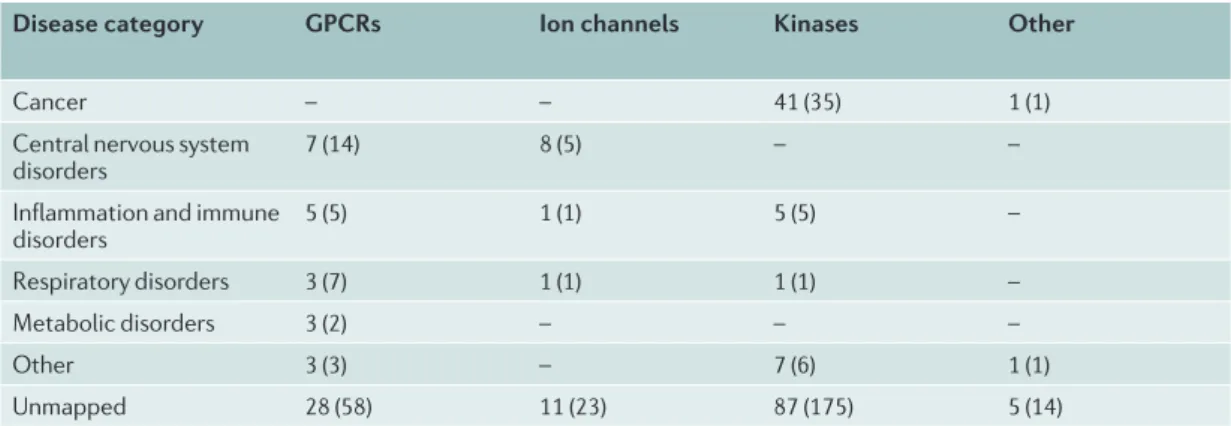
IUPHAR Guide to Pharmacology27 and ChemIDplus, we mapped 144 Tchem proteins to 356 clinical (phase I–III trial) candidates, for a total of 701 unique target–clinical candidate pairs. For 175 (25%) of these pairs, therapeutic indication data extracted from ChEMBL highlight the different distribution among protein families (TABLE 3). Most targeted proteins are kinases (93 unique enzymes), followed by GPCRs (31 unique receptors) and ion chan-nels (13), with seven targets from other families, which is similar to the prior observation that most clinical candidates target the most druggable target families28. Analysis of the target–clinical candidate subset in which anticipated therapeutic indications are available shows that most of the kinase-targeting clinical candidates are aimed at oncology applications, whereas GPCRs and ion channel-targeting clinical candidates are aimed at central nervous system disorders.
As noted above, target druggability is frequently esti-mated based on the ability to bind to small molecules20, and expectations of druggability typically diminish as the size of the binding pocket increases, with affinity and selectivity being major concerns. The challenge is even greater when the binding pocket is shallow and highly exposed to a solvent or when the therapeutic strategy involves disrupting the interaction between the targeted protein and other proteins. One approach to evaluating druggability is to focus on protein domains mined from the InterPro database29 and then to prior-itize proteins that contain domains known to interact with approved drugs20 or bioactive small molecules30. Others have explored target druggability by evaluating side-effect similarity for known drugs31 or by perform-ing combined chemical and target similarity queries32, followed by experimental confirmation of novel drug targets derived from clinical observation or computa-tion. It is possible that induced binding sites in proteins in which a druggable pocket is not initially found may enable them to be targeted with drug-like small mole-cules, but identifying these binding sites with structural approaches is likely to be challenging, and phenotypic screens may be more useful.
An emerging approach harnessing so-called PROTACs (proteolysis-targeting chimaeras) may help substantially in addressing the issue of undruggability33, at least for proteins that are capable of selectively binding a small- molecule ligand, although not necessarily at a typical binding site34. Essentially, this strategy harnesses the endo-genous ubiquitin– proteasome system to promote targeted degradation of desired proteins following binding of the PROTAC35; the mechanism for ternary ligase–PROTAC– target complex activation has been recently elucidated36. This technology may also be subcellular location-specific, which could be an additional advantage in some (but not other) cases. However, the oral bioavailability of PROTAC molecules may be constrained by their size.
Spotlight on Tbio and Tdark
A critical effort in addressing the knowledge deficit about Tbio and Tdark proteins is being undertaken by the Monarch
Initiative37, which relies on informatics methods to iden-tify phenotypically relevant disease models in research and diagnostic contexts based on integrated model organ-ism and clinical research data. One of the main sources for the Monarch Initiative is phenotype data from the
International Mouse Phenotype Consortium (IMPC), which was set up to generate and pheno typically char-acterize mouse knockout lines. Their recent analysis of 1,751 unique gene knockouts found that human disease genes are enriched for essential genes38.
The IDG KMC incorporates gene-centric mouse phe-notype data and maps these data to the respective human orthologues. IDG coordinated with IMPC production centres to prioritize production of knockout mouse strains for druggable genes. As of November 2017, 568 new knockout strains had been produced: 166 GPCRs, 141 ion channels, 238 kinases and 23 nuclear receptors (see Supplementary Table S8). When ignoring olfactory GPCRs, these represent a little more than one-third of
Nature Reviews |Drug Discovery a
b
Normalized counts per scor
e 1.00
0.75
0.50
0.25
0.00
1000
10 PubMed abstr
acts
Gene RIF s
Antibody count Gene Ontology R01 gr
ants
Patents
Harmonizome dataavailability scor e
Link
Access counts
Name
Box 2 | Financial spotlight on the human proteome
Analyses of drug sales focus on pharmaceutical products95 and the
companies authorized to market them96. Here, we ask a target-centric
question — what are the most financially valuable therapeutic targets —
by exploring IMS Health (now known as IQVIA) data from their MIDAS™
platform. We used IMS Health MIDAS drug sales data from 75 countries covering Europe, North America, Australia and Japan, aggregated for the 2011–2015 period. MIDAS tracks products from most therapeutic classes, estimating product volumes, trends and market share through retail and non-retail channels. We chose quinquennial aggregation over annual sales data as it diminishes the importance of factors less relevant to this analysis, such as fluctuations in currency exchange rates. Because active
ingredients lose patent coverage and become generic, annual sales figures can abruptly drop from one year to the next.
After excluding traditional medicines, including botanicals and animal products, the MIDAS set comprised 51,095 unique pharmaceutical products, including small molecules and biologics. As most anti-infective and antiparasitic drugs target non-human proteins (with the notable exception of maraviroc, which targets the host (human) CC-chemokine receptor type 5 (CCR5)), we removed these drugs because their targets are outside of the scope of this analysis. The remainder were mapped to 1,182
active pharmaceutical ingredients (APIs) from DrugCentral10, which were
first normalized by the number of APIs per pharmaceutical formulation, then by the number of manually curated mechanism of action (MoA)
targets9 per API. Thus, we used 581 T
clin proteins and 1,096 APIs, a subset of
the 893 human and pathogenic biomolecules through which 1,578
previously analysed approved drugs act9.
By linking global drug sales data to drug targets, we sought to assess a snapshot of their commercial value and to evaluate the market value of human MoA targets. The top 20 MoA
targets ranked by aggregated sales data, together with National Institutes of Health (NIH) R01 funding for
the same period, are shown in TABLE 2. The entire
set covers 325 drug targets, comprising
581 Tclin proteins, totalling over US$3,417
billion in global drug sales
(Supplementary Table S10). These data indicate that the cytokine tumour necrosis factor (TNF) is the most valuable target, and cytokines are the only target class comprised entirely of biologic drugs in this analysis for the 2011–2015 period. G protein-coupled receptors (GPCRs) are the most valuable class of druggable targets, with total aggregated sales nearing $917 billion over the 5‑year period. This spotlight covers 72 of the 108 druggable GPCRs
reviewed elsewhere97. Kinases
($263 billion, with 45 drugs acting on 43 targets) and cytokines ($242 billion, with 17 drugs acting on 12 targets) are the only two target classes with an extremely active ratio of ongoing versus completed projects, particularly for emerging mechanism–
indication pairs98. Finally, combining
financial data with targets organized by family and Anatomical, Therapeutic and Chemical (ATC) classification system level 2 codes shows that the top revenue categories are antineoplastics and immunomodulators, followed by nervous system targets (see box figure; a larger version is available as Supplementary Figure S11; see also Supplementary Table S10).
The commercial outcomes of target selection and product-led validation
can also be analysed with respect to research funding. NIH RePORTER data
(see the NIH ExPORTER website) were processed using the same
text-mining methods described earlier for FIG. 2. During the same period,
2011–2015, the NIH funded 42,924 R01 grant applications, at a total cost of $32 billion. These projects discuss up to 7,851 human proteins (see Supplementary Table S10). For example, R01 grants associated with oestrogen receptors were awarded $101 million, compared with $50 billion in sales earned by 18 drugs acting through oestrogen receptors during that
same period (TABLE 2). Some targets, having over 30 drugs each, are also
top-earning and well funded, for example, the μ-opioid (OPRM1) and the
glucocorticoid (NR3C1) receptors. Other top-earning targets with over
30 drugs each, such as the β2 adrenergic receptor and cyclooxygenase 1,
are not as well funded. We found no relationship between MIDAS global drug target sales and NIH R01 funding during the 2011–2015 period, even when factoring in the number of APIs per target. Overall, $4.2 billion was
awarded to study 496 Tclin proteins, representing 13% of the R01 budget and
6% of all R01-funded proteins. Another 615 proteins (485 Tbio and 67 Tdark)
had just one funded R01 project dedicated to their study during 2011–2015, and 8,857 proteins were not associated with any NIH funding for this
time frame. AT1 receptor, angiotensin II type 1 receptor; COX2,
cyclooxygenase 2; DPP4, dipeptidyl peptidase 4; HMG-CoA, 3-hydroxy-3-methylglutaryl-CoA. A B C D G H J L M N R S V
A01 A02 A03 A04
A05 A06 A07 A08 A10 A11 A16 B01 B02 B03 C01 C02 C03 C04 C05 C07 C08 C09 C10 D04 D05 D06 D07 D10 D11 G02 G03 G04 H01 H02 H03 H04 H05 J05 L01 L02 L03 L04 M01 M02 M03 M04 M05 N01 N02 N03 N04 N05 N06 N07 R01 R02R03 R05R06
S01 S02 S03 V03 Insulin receptor DPP4 Coagulation factor X Proton pump
β2 and muscarinic receptors Glucocorticoid receptor Monoamine transporters μ-Opioid receptor COX2 TNF Tyrosine kinases HMG-CoA reductase AT1 receptor Dopamine D2 receptor Voltage-gated calcium channels CD20 Progesterone receptor 10 50 100 150 200 250(US$ billions) Glucocorticoid receptor A - Alimentary tract and metabolism B - Blood and blood-forming organs C - Cardiovascular system D - Dermatologicals G - Genitourinary system H - Hormonal preparations J - Anti-infectives
L - Antineoplastics and immunomodulators M - Musculoskeletal system
N - Nervous system R - Respiratory system S - Sensory organs V - Various
GPCR Enzyme Nuclear receptor Cytokine Other Kinase Transporter Ion channel
Table 2 | Financial (sales and NIH funding) activity for the top 20 mechanism-of-action targets
Target Target
class Top two drugs Number of APIs MIDAS global sales, 2011–2015 per target (US$)
NIH R01 funding, 2011–2015 per target (US$)
Target
type Protein count
TNF Cytokine Adalimumab and
etanercept 5 163 billion 165 million Single 1 INSR Kinase Insulin glargine
and insulin aspart
7 144 billion 2 million Single 1
NR3C1 NHR Fluticasone
propionate and budesonide
36 143 billion 52 million Single 1
HMGCR Enzyme Rosuvastatin and
atorvastatin 8 123 billion 1 million Single 1 H+/K+-ATPase Transporter Esomeprazole
and omeprazole 10 118 billion 5 million Complex 2
AGTR1 GPCR Valsartan and
olmesartan medoxomil
9 100 billion 17 million Single 1
ADRB2 GPCR Salmeterol and
salbutamol 36 90 billion 8 million Single 1
OPRM1 GPCR Oxycodone and
fentanyl 34 88 billion 51 million Single 1 COX2 Enzyme Paracetamol and
diclofenac 40 84 billion 8 million Single 1 DRD2 GPCR Aripiprazole and
quetiapine 48 75 billion 17 million Single 1 Muscarinic
acetylcholine receptors
GPCR Tiotropium bromide and solifenacin
40 64 billion 65 million Multiple 5
SLC6A4 Transporter Duloxetine and
escitalopram 26 59 billion 46 million Single 1
HTR2A GPCR Aripiprazole and
quetiapine 27 58 billion 13 million Single 1 L-Type
calcium channels
Ion
channel Amlodipine and nifedipine 23 57 billion 21 million Complex 3
SLC6A2 Transporter Duloxetine and
methylphenidate 36 56 billion 5 million Single 1 VEGFA Cytokine Bevacizumab
and ranibizumab 4 55 billion 162 million Single 1 HRH1 GPCR Olopatadine and
cetirizine 56 54 billion 1 million Single 1 Interferon α–β
receptor Membrane receptor Interferon and interferon β-1a
β-1b
5 51 billion 7 million Multiple 2
Voltage-gated sodium channels
Ion
channel Lidocaine and lamotrigine 39 51 billion 40 million Multiple, complex 10
Oestrogen
receptors NHR Ethinyloestradiol and oestradiol 18 50 billion 101 million Multiple 2
Targets are ranked by aggregated API sales data. The number of drugs is the number of MoA-target-associated APIs used in
this data set. Target type: single, one protein; multiple, more than one target; complex, more than one protein per target.
Protein count, number of proteins associated with that target. ADRB2, β2-adrenoceptor; AGTR1, AT1 receptor; API, active
pharmaceutical ingredient; HMGCR, hydroxymethylglutaryl-CoA reductase; DRD2, dopamine D2 receptor; GPCR, G
protein-coupled receptor; HRH1, histamine H1 receptor; HTR2A, serotonin 5-HT2A receptor; INSR, insulin receptor; MoA,
mechanism of action; NHR, nuclear hormone receptor; NIH, National Institutes of Health; NR3C1, glucocorticoid receptor; OPRM1, μ-opioid receptor; COX2, cyclooxygenase 2; SLC6A2, sodium-dependent noradrenaline transporter; SLC6A4,
the druggable genes in these protein families. Phenotype data are available for 80% of these strains, with abnor-malities detected in numerous biological systems, including those related to development, immune func-tion, metabolism and behaviour. These IMPC strains provide evidence for biological systems that may be affected when a drug targets a gene with little-known function.
Of the 119 Tdark genes (51 GPCRs, 36 ion channels and 32 kinases) submitted by IDG to IMPC, 45 mouse lines were produced, with 41 phenotypes observed. For example, knockouts of the Tdark kinase gene Alpk3 have increased embryonic and perinatal lethality, with the surviving adults displaying severe heart defects (see Further information). Of 482 Tbio genes submitted by IDG (135 GPCRs, 133 ion channels, 200 kinases and 14 nuclear receptors), 184 mouse lines were produced, with 145 phenotypes observed. For example, knock-outs of the Tbio GPCR gene Adgrd1 display reproductive defects, such as female infertility, and skeleton pheno-type defects, such as decreased bone mineral density (see Further information).
Among 2,788 genes phenotyped in mice at the IMPC, 953 have at least one significant behavioural, neuro logical or other nervous system-related phenotype observation. Target Central Resource Database (TCRD) data from the GWAS Catalog39, OMIM11 and text-mined DISEASES13 databases confirmed human disease phenotypes for 191 (20%) of these 953 genes, ranging from neurological (for example, seizure disorders) to cognitive (for example, tauopathy) and psychotic affective disorders. Because only 9 of the 953 genes lack confirmed expression in any of the 34 neuro-related tissues tracked by IDG KMC (for example, GTEx40,41, HPA42 and HPM43), these data sug-gest that the remaining 80% of this set have the potential to be associated with human neurobehavioural pheno-types, paving the way for new research avenues in this direction (see Supplementary Table S8). Production of IMPC strains is set to continue for several more years, and so further knockout strains for druggable genes and their phenotype data are anticipated.
To further explore the characteristics of Tdark and Tbio proteins, we analysed their distribution in the L1000 gene set, as annotated in TCRD (Supplementary Table S3).
L1000 is a set of 978 landmark genes that have been selected for their ability to predict a large portion of the total variability seen in large sets of microarray exper-iments. The proportion of Tdark proteins in the L1000 set (79 of 978; 8%) is substantially smaller than would be anticipated based simply on the a priori distribution of Tdark proteins (which make up 35% of the proteome), whereas Tbio targets (671 of 978; 69%) are more common than expected, as these make up 53% of the proteome. The proportions of Tclin proteins (41 of 978; 4%) and Tchem proteins in the L1000 set (187 of 978; 19%) are also higher than expected, as these make up 3% and 7% of the proteome, respectively. The L1000 TDL distribution data support the existence of a knowledge deficit.
To some extent, the data on Tbio and Tdark suggest a causality dilemma: are Tdark proteins underfunded because there is no scientific interest in this category, or is the lack of knowledge perpetuated by lack of funding? Although our data do not allow us to establish a causal relationship, we suggest that the absence of high-quality, well-characterized molecular probes is a root cause for this situation. Lack of tools leads to lack of interest, and lack of interest diminishes the probability of such tools being developed. A bibliometric evaluation by Edwards and colleagues2 examined how many newly sequenced proteins from several protein families were the subject of new studies 10 years after the completion of the human genome sequencing project. This analysis concluded that the process of druggable target selection is con-servative and incremental and that limited progress has been observed with respect to understanding newly discovered proteins.
“If you don’t know very much to begin with, don’t expect to learn a lot quickly”(REF. 44).Anecdotal evi-dence (summarized in TABLE 4) suggests that it is pos-sible for proteins to migrate from Tdark to Tclin within 12–20 years. Data on the six protein targets highlighted indicate that proteins for which little information was available two decades ago (effectively Tdark) became attractive from a drug discovery perspective follow-ing key papers, namely, deorphanization and protein– disease association studies. Five of these six targets are modulated by at least one approved drug, which places them in the Tclin category.
Table 3 | Summary of clinical candidates (phase I–III) with activity against Tchem proteins
Disease category GPCRs Ion channels Kinases Other
Cancer – – 41 (35) 1 (1)
Central nervous system
disorders 7 (14) 8 (5) – –
Inflammation and immune
disorders 5 (5) 1 (1) 5 (5) –
Respiratory disorders 3 (7) 1 (1) 1 (1) –
Metabolic disorders 3 (2) – – –
Other 3 (3) – 7 (6) 1 (1)
Unmapped 28 (58) 11 (23) 87 (175) 5 (14)
Successful ‘promotions’ across classes, such as those in TABLE 4, are currently rare. We expect the rate of knowl-edge accumulation for Tdark proteins to be low, at least initially. Well-studied proteins require multiple layers of management for diverse, rich sets of data, with informa-tion and knowledge stemming from corpora such as bio-medical literature, patents and clinical trials. A paucity of data and lack of information for understudied proteins (Tbio and Tdark) affect both knowledge management and the decision-making process with respect to experimen-tal planning, what research questions need to be asked (and in what order) and which methods may be better suited for each task. For example, we examined access counts for human proteins in STRING18 during 2016 (FIG. 2b). ‘Counts by name’ represents users that access the STRING website and type in a gene symbol. ‘Counts by link’ represents users accessing the network for a gene in STRING by linking to it from another resource (for example, GeneCards45 or UniProt15). Whereas ‘Counts by link’ shows a more comprehensive method to access the entire proteome, it also suggests that Tdark proteins have a lower probability of being recognized (input) by gene name. These data show a pattern similar to that observed in FIG. 2a: Tdark proteins are less likely to be the subject of scientific curiosity, which is a reflection of funding patterns and an overall lack of information and molecular probes. Indeed, the paucity of antibodies and small molecules (criteria that help define Tbio and Tchem, respectively) that could be used to interrogate Tdark proteins diminishes our ability to subject Tdark proteins to scientific inquiry.
Genomic and proteomic responses following radia-tion therapy are also understudied. One in vitro study46 suggested that as many as one-third of the 10,174 genes examined in immortalized B cells following ionizing radiation are radioresponsive (GSE26835 column46 in
Supplementary Table S3). Of the 447 genes with signif-icant fold changes in the GSE26835 set, only 26 are Tclin and 61 are Tchem, whereas the majority (268 Tbio, 92 Tdark) are understudied (see also Supplementary Box S5).
As many as 3,644 proteins have significant disease (confirmed OMIM11 phenotype) associations. Given their TDL assignments (335 Tclin, 543 Tchem and 2,766 Tbio), we examined the distribution of the TDL in rela-tion to druggable protein family categories (FIG. 1b). It appears that Tbio–disease associations are quite rare for druggable families such as nuclear receptors, ion chan-nels and GPCRs, as these families are more likely to be in the Tclin or Tchem category. Instead, Tbio assignments are quite frequent for transcription factors, epigenetic targets, transporters and unassigned protein families. The exception among druggable families are olfactory GPCRs, which appear to attract less interest from drug discovery programmes, despite some of these GPCRs being linked to metabolism and ageing47.
Concerted efforts focused on an entire target class have sometimes led to new drugs. For example, GlaxoSmithKline (GSK) had a comprehensive pro-gramme aimed at finding new ligands and characteriz-ing the biology of nuclear receptors48. New insights into bile acid metabolism49 and xenobiotic transcription of cytochrome P450s50, mediated by nuclear receptors, were described. A bile acid receptor (FXR) agonist has reached the market since this programme started: obet-icholic acid (Ocaliva), which was discovered by GSK in collaboration with the University of Perugia51 and subsequently developed by Intercept Pharmaceuticals. Currently, several FXR agonists are in clinical develop-ment52. Choosing the appropriate proteins as drug targets remains a complex process, where scientific factors need to be balanced against commercial factors (such as com-pany investors and medical insurance companies) and societal factors (such as physicians and patients), as well as legal factors (such as the requirements of regulatory agencies)1.
Spotlight on G protein-coupled receptors
GPCRs are membrane-bound, cell-surface receptors that transduce signals via interactions with hetero trimeric G proteins, arrestins and other cellular transducers53,54. Table 4 | Examples of successful attempts of targeting the dark genome
Gene name Relevant
study (year) Study type and reference Citation counta API name Therapeutic indication Market approval (year)
LEPR 1995 Receptor
deorphanization99 4,100 Metreleptin Lipodystrophy 2014
SMO 1998 Protein–disease
association study100 1,195 Vismodegib Basal cell carcinoma 2012
S1PR1 1998 Receptor
deorphanization101 968 Fingolimod Multiple sclerosis 2010
HCRTR1 and
HCRTR2 1998 Receptor deorphanization102 4,608 Suvorexant Insomnia 2014
PCSK9 2003 Protein–disease
association study103 1,840 Evolocumab Hyper-cholesterolaemia 2015
GHSR 1999 Receptor
deorphanization104 8,248 Anamorelin
b Cachexia Successful phase III clinical trial105
API, active pharmaceutical ingredient; GHSR, ghrelin receptor; HCTR1, orexin receptor type 1; LEPR, leptin receptor; PCSK9, proprotein convertase subtilisin/kexin type 9; S1PR1, sphingosine 1-phosphate receptor 1; SMO, smoothened homologue.
Alterations in GPCR signalling are implicated in the pathogenesis and treatment of neuropsychiatric55, immunological56, gastrointestinal57,58, cardiac59, renal, hormonal, infectious60 and many other disorders53,54. GPCRs represent the largest family of druggable targets in the human genome9, with between 20% and 30% of approved drugs acting on them53,54.
The number of publications per GPCR and the num-ber of chemicals associated with that GPCR in ChEMBL were examined61 to determine which of the druggable, non-olfactory GPCRs are understudied: less than 100 citations and less than ten ChEMBL compounds define understudied, uninterrogated GPCRs. The number of publications, similar to the fractional PubMed publi-cations count13, does not take into account large-scale (many proteins per paper) analyses. Counting ChEMBL compounds, a quantitative criterion similar to Tchem assignments, does not consider bioactivity values. However, this independent analysis validates the more general TDL criteria with respect to GPCR biological functions and corresponding chemical matter.
Tclin and Tchem G protein-coupled receptors.Currently
827 GPCRs — including 421 olfactory GPCRs — are tracked by IDG KMC; of these, 96 are Tclin and 113 are Tchem (none of which are olfactory). Slightly more than half of the non-olfactory GPCRs have annotated drugs and small molecules targeting them53,54,61; see also TABLE 1. A recent analysis indicates, however, that a handful of GPCRs — mainly biogenic amine, muscarinic and opioid receptors — represent the most abundantly targeted receptors for FDA-approved medications53,54. GPCRs also represent important off-targets for kinase inhibitors62,63, ion channel modulators64, anti- infectives65 and other classes of drug-like molecules53,54. As with other druggable target classes, off-target actions within the GPCR class can be associated with severe and life- threatening side effects. For example, valvular heart disease is associated with anorectic agents, such as fen-fluramine, and antimigraine medications, such as ergot-amine, via serotonin 5-HT2B receptor agonism66. Recent successes in structure-guided and cheminformatics- driven drug discovery show promise for creating safer and more effective medications targeting GPCRs.
Tbio and Tdark G protein-coupled receptors. Although 52
non-olfactory GPCRs are categorized as Tdark, the avail-ability of new screening platforms to discover chemical matter for these GPCRs has begun the process of illumi-nation64,67,68. Of 62 GPCRs for which significant pheno-type calls have been reported by IMPC (Supplementary Table S8), 24 are Tbio and 7 are Tdark; of these, 15 are asso-ciated with neurological and behavioural phenotypes. Including olfactory GPCRs, 618 proteins are classified as Tdark or Tbio; of these, 126 non-olfactory GPCRs and 51 olfactory GPCRs have significant associations with human diseases via OMIM, GWAS and text mining. Whereas the majority of these associations (nearly 59%) stem from text mining69, 48 GPCRs have confirmed associations from at least two information channels. For example, Adgrb2-mutant mice (Tbio)showed significant
antidepressant- like behaviour compared with wild-type mice70, whereas the association71 between schizophrenia and Fzd3 mutants (Tbio) remains controversial72,73.
Spotlight on protein kinases
Tclin and Tchem kinases.The ~600-member human
kinome (Supplementary Table S3) is made up of pro-tein kinases, in addition to metabolic and lipid kinases, and is highly druggable using both competitive and allosteric small-molecule inhibitors. However, the func-tions of about one-third of the kinases in this family are poorly defined or unknown. The 634 human kinases were categorized as follows: Tclin, N = 50; Tchem, N = 390; Tbio, N = 163; and Tdark, N = 31 (TABLE 1). Tclin kinases are not exclusively protein kinases, and the number of FDA-approved small-molecule kinase inhibitors varies depending on inclusion criteria. Wu and colleagues74 found 38 small-molecule protein kinase inhibi-tors. Based on DrugCentral, we found 50 approved kinase inhibitors, including 40 small-molecule pro-tein kinase inhibitors, of which 32 are FDA-approved, one FDA-approved protein kinase activator (ingenol mebutate) and the phosphoinositide 3-kinase subunit-δ (PIK3CD) small-molecule inhibitor idelalisib, which is also FDA-approved. An additional seven FDA-approved antibodies target the receptor tyrosine kinases human epidermal growth factor receptor 2 (HER2; also known as ERBB2), epidermal growth factor receptor (EGFR), vas-cular endothelial growth factor receptor 2 (VEGFR2) and platelet- derived growth factor receptor-α (PDGFRα), and there is also an FDA-approved HER2-targeting antibody–drug conjugate, trastuzumab emtansine (see
Supplementary Table S9).
Tbio and Tdark kinases. A number of Tbio and Tdark kinases are known to interact with FDA-approved multikinase inhibitors. According to data in DrugCentral, sorafenib inhibits 114 kinases, of which only 9 are associated MoA-related targets, whereas sunitinib inhibits 263 kinases, of which 9 are MoA-related targets. Given the current state of kinase inhibitor chemistry, it is very likely that Tbio and Tdark kinases can be effectively therapeutically targeted with highly selective small- molecule inhibitors. Some of the characteristics shared by understudied Tbio and Tdark kinases include poorly defined integration of the kinase in signalling networks, poorly defined function and reg-ulation, lack of activation-loop phospho-antibodies or immunohistochemistry-grade antibodies, and lack of selective chemical tools for functional characterization. Primary tools for knockout and/or altered expression are RNA interference (RNAi) and CRISPR–Cas9, and cDNAs for overexpression; kinase knockout or altered expression rarely provides readily assayable phenotypes (for example, growth, migration, apoptosis or in vivo function in mouse organ physiology). Currently, the IMPC has targeted 238 kinases with 114 knockouts hav-ing a significant phenotype; of the latter, 22 are of current interest for phase 2 of the IDG programme.
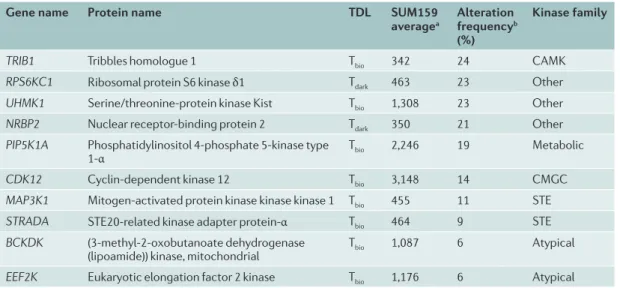
database, together with their RNA expression in tri-ple-negative breast cancer (TNBC) cells. These under-studied kinases are frequently altered in breast cancer. The potential increased expression of many kinases in primary human tumours suggests these understudied kinases have important functions for the tumour cell phenotype that have not been characterized to date. These represent unexplored kinases with possible therapeutic utility.
The potential therapeutic importance of Tbio and Tdark kinases in the kinome is highlighted by a recent clinical study that assessed the response to trametinib, a MEK1 and MEK2 inhibitor, in TNBC patients75. Pretreatment needle biopsies and surgical tumour resections follow-ing 7-day trametinib treatment were used for RNA sequencing (RNA-seq) to analyse tumour transcriptomic changes in response to the drug. Pretreatment biopsies matched to post-treatment surgical specimens showed overall concordance of the transcriptional kinase response to trametinib, with FRK (Tchem) exhibiting the highest mean increase and cytoplasmic BMX (also Tchem) exhibiting the highest mean decrease among patients in response to a 7-day drug treatment. Among the kinases transcriptionally altered in the TNBC tumours were several understudied kinases, including MRCK-γ (also known as CDC42BPG), PRKACB, STK32B and leukocyte tyrosine kinase receptor (LTK). These find-ings demonstrate that in TNBC tumours in patients, members of the understudied Tbio and Tdark kinome are co-regulated transcriptionally with kinases from the Tclin and Tchem category, in a dynamic adaptive response to targeted inhibition.
Spotlight on ion channels
Ion channels mediate signalling within cells, between cells, and between cells and their environment. Defects in ion channels underlie many major disorders in humans, also known as channelopathies, including neuronal disorders76, diabetes77 and heart failure78. This makes
ion channels an attractive target class for drug develop-ment. Ion channels are mostly heteromeric complexes that require optimal interactions with ligands at specific locations. Currently, 355 ion channel pore-forming and auxiliary subunits are tracked by IDG KMC (TABLE 1;
Supplementary Table S3). About 100 ion channel modula-tors, including auxiliary subunits, are reported, but to our knowledge, a systematic list of cell type-specific auxiliary subunits for all ion channels is not available.
Tclin and Tchem ion channels.Many drugs are known to
bind to ion channels. There are 217 drugs annotated in DrugCentral10 as acting through 125 (T
clin) ion channels for the MoA9. The number of drugs increases to 497 when querying how many drugs are known to interact with ion channels outside of the MoA-related constraint. Some of these interactions are likely to be responsible for side effects such as cardiac toxicity. An accurate under-standing of MoA and side-effect assignment at the target (molecular) level is required if we are to improve upon available drugs. For example, the anaesthetic ketamine, which has been postulated to act as a noncompetitive N-methyl-d-aspartate (NMDA) antagonist79, has been used off-label as an antidepressant80. However, in-depth analysis of the antidepressant effects of ketamine found that its active metabolite (2R,6R)-hydroxynorketamine (HNK) does not block the NMDA receptor. Instead, HNK displays sustained activation of α-amino-3- hydroxy-5-methyl-4-isoxazole propionic acid (AMPA) receptors and lacks ketamine-related side effects81. This may pave the way for the development of novel, rapid-acting antidepressants. It is therefore conceivable that some ion channels currently categorized as Tclin or Tchem are in need of further illumination with respect to MoA and drug specificity. Indeed, the low bioactivity cut-off criterion for ion channels (≤10 μM) in Tchem (see also Supplementary Figure S2) may need revision, given that older drugs continue to reveal unexpected modes of action.
Table 5 | Understudied kinases that are frequently altered in breast cancer
Gene name Protein name TDL SUM159
averagea Alteration frequencyb
(%)
Kinase family
TRIB1 Tribbles homologue 1 Tbio 342 24 CAMK
RPS6KC1 Ribosomal protein S6 kinase δ1 Tdark 463 23 Other
UHMK1 Serine/threonine-protein kinase Kist Tbio 1,308 23 Other
NRBP2 Nuclear receptor-binding protein 2 Tdark 350 21 Other
PIP5K1A Phosphatidylinositol 4-phosphate 5-kinase type
1-α Tbio 2,246 19 Metabolic
CDK12 Cyclin-dependent kinase 12 Tbio 3,148 14 CMGC
MAP3K1 Mitogen-activated protein kinase kinase kinase 1 Tbio 455 11 STE
STRADA STE20-related kinase adapter protein-α Tbio 464 9 STE
BCKDK (3-methyl-2-oxobutanoate dehydrogenase
(lipoamide)) kinase, mitochondrial Tbio 1,087 6 Atypical