Preventing Avoidable Deaths:
Essentials and Recommendations
On Opioid Overdose
2014
EUROHRN II PROJECT
Supporting Innovative Measures to Address
the Reduction of Drug Related Harm in Europe
Authors
APDES, Portugal, Chapters 2 and 4
Soraia Teles, MD Helena Moura, PhD Marta Pinto, PhD Maria João Oliveira, PhD Cláudia Rodrigues, MD
Akzept, Germany, Chapters 1 and 3 Christiane Bernard, PhD Heino Stöver, PhD Proofreading
Francisco Azevedo, APDES, Portugal
Design
Inês Santos, APDES, Portugal
Donors
Financial support for this publication was provided by the Drug Prevention and Information Program of the European Commission. The views expressed herein are those of the authors and in no way reflect the opinions/policies of the donor.
Contributors -‐ European group of experts in drug-‐related deaths
Dagmar Hedrich -‐ European Monitoring Centre for Drugs and Drug Addiction (EMCDDA), Lisbon, Portugal.
John Strang -‐ Addictions Department at King’s College, London, UK. José Queiroz – Agência Piaget Para o Desenvolvimento, Porto, Portugal. Kerstin Dettmer -‐ Fixpunkt, Berlin, Germany.
Mika Mikonen -‐ A-‐Clinic Foundation, Helsink, Finland; and his colleagues James Boyd and Margareeta Häkkinen
Pier Paolo Panni -‐ Social and Health Services, Health District 8, Cagliari, Italy.
Rui Rangel -‐ Forensic Toxicology Service from the National Institute of Legal Medicine and Forensic Sciences, Porto, Portugal.
Xavier Majó -‐ Public Health Agency of Catalonia (ASPCAT), Catalonia, Spain.
Suggested citation
© APDES & Akzept, 2014. Citing the source is necessary when using parts of this publication. Please contact APDES and Akzept for permission if you wish to use the entire publication.
Forewords
This report offers a comprehensive analysis of drug-‐related deaths, and suggestions of how to overcome these risks for drug users. On the one hand it is looking at the individual level of risk taking behaviour and skills to avoid these risks. On the other hand it is analysing the structural level of living conditions (e.g. poverty and education), discriminating laws (prohibition), insufficient services (ban on state-‐of-‐the-‐art treatments), and marginalizing attitudes producing stigma and fear.
It is only the look at both levels that is promising to identify and implement successful strategies in order to increase the general and individual awareness of OD risks and the individual and institutional knowledge and practical skills.
Overdose deaths e.g. from opioids is not an inevitable occurrence, for many drugs it can be tackled successfully by various means consisting of individual training and for instance the provision of medications (e.g. naloxone) to partners, family members, friends. However, for some drugs it is not that easy as there are no quickly effective antidotes available yet. This points on the one hand to the need of more research and to the other hand to a more comprehensive understanding of the overdose situation and concrete circumstances as well as knowledge, awareness of drug users and friends.
This report points out the evidences for this intervention and for many others. One of the biggest obstacles are the juridical and political constraints and thus being located on a structural societal level. We already know the evidences for far more interventions than we have implemented so far. We are identifying a substantial implementation gap. Serious obstacles for successful OD prevention have been identified on the structural level, meaning that effective and efficient therapies and provision of tools cannot be introduced simply because they are not accepted. Opioid Substitution Treatment for instance should be offered on a continuous basis, no matter where the drug user is living. Yet, in many prisons in Europe, OST is being interrupted once people get into police custody or are imprisoned. Especially when leaving prison the re-‐take-‐up of OST is in many countries extremely difficult, so the risk of
relapse into opioid consumption is very high. The numbers of overdose deaths shortly after release are confirming this sad phenomenon.
Changes on the structural level are not that easy to achieve. It takes a long time to change opium laws and even longer to change attitudes of politicians and the general population. Thus it is of utmost importance and highest priority to collect evidences of effectiveness of certain strategies in order to make the healthier choice the easier choice – for all involved!
Heino Stöver, Project Partner, Akzept, Germany
Abbreviations and Acronyms
ACMD Advisory Council on the Misuse of Drugs AIDS Acquired Immunodeficiency Syndrome ART Antiretroviral Treatment
SFAD Scottish Families Affected by Drugs
CINAHL Cumulative Index to Nursing and Allied Health Literature CPR Cardiopulmonary Resuscitation
CSFD Civil Society Forum on Drugs DCR Drug Consumption Rooms
ECDC European Centre for Disease Control and Prevention EHRN Eurasian Harm Reduction Network
EMCDDA European Monitoring Centre for Drugs and Drug Addiction EU European Union
EuroHRN European Harm Reduction Network EuroPUD European People Using Drugs
GRASP Grief Recovery After a Substance Passing
HAT Heroin-‐Assisted Treatment
HBV Hepatitis B Virus
HBsAg Hepatitis B Surface Antigen
HCV Hepatitis C Virus
HIV Human Immunodeficiency Virus
HOORAT Housing Opiate Overdose Risk Assessment Tool
ICT Information and Communication Technologies
IDU Injecting Drug User
MDMA 3,4-‐Methylenedioxymethamphetamine MDPV Methylenedioxypyrovalerone
MEDLINE Medical Literature Analysis and Retrieval System Online NPS New Psychoactive Substances
OD Overdose
OSF Open Society Foundation OST Opioid Substitution Treatment PND Peer Naloxone Distribution PUD People Who Use Drugs PWID People Who Inject Drugs
SAMSHA Substance Abuse and Mental Health Services Administration
THN Take Home Naloxone
UK United Kingdom
UKDPC United Kingdom Drug Policy Commission UN United Nations
UNAIDS Joint United Nations Programme on HIV/AIDS UNODC United Nations Office on Drugs and Crime WHO World Health Organization
WP Work Package
Contents
ForewordsAbbreviations and Acronyms
About this report: Scope and structure ... 9
What is the European Harm Reduction Network? ... 10
Euro HRN II Project ... 10
Report Structure ... 12
Chapter 1|
Drug-‐related deaths in Europe: Mapping the extent of the problem ... 14
About this chapter ... 15
Methodology and limitations ... 15
Drug use and Drug-‐related deaths in Europe ... 16
Deaths caused directly and indirectly by drug consumption ... 22
Overdose Deaths ... 22
Implicated substances ... 26
Risk factors for non-‐fatal and fatal overdoses ... 28
Deaths due to infectious diseases ... 34
HIV and AIDS ... 34
Viral Hepatitis: HCV and HBV ... 38
Other infectious diseases ... 41
Other causes of drug-‐related Deaths ... 42
Non-‐infectious diseases ... 42
Suicide ... 42
Trauma ... 42
Summary and conclusions ... 44
Chapter 2| Drug-‐induced deaths: a comprehensive review of existing knowledge on overdose prevention ... 46
About this chapter ... 47
Methodology ... 48
Establishing a framework for overdose prevention ... 49
Socioeconomic determinants on Problematic drug use and ODs ... 52
The role of Drug Policy Models in Drug-‐induced deaths ... 56
Preventing Overdose occurrence ... 62
Information and communication for overdose prevention ... 62
Drug treatment ... 68
Drug consumption rooms (DCR) ... 73
Information on heroin purity and composition ... 77
Preventing Overdose deaths ... 80
Naloxone provision ... 80
Professionals managing overdoses: Training and intervention ... 84
Overdose prevention, recognition and response: Training PUD, families/social network and other bystanders ... 88
After surviving: non-‐fatal Overdose ... 92
Following fatal Overdose ... 96
Victims’ family and social network: Intervention recipients and providers ... 96
Drug-‐related and drug-‐induced deaths registry systems ... 98
Chapter 3| Mapping the HR measures to reduce Drug-‐related deaths ... 102
Chapter 4| Recommendations on good policies and practices to prevent Drug-‐induced deaths ... 126
Recommendations for Practice, Research and Policies on overdose prevention ... 127
Environmental Prevention ... 130
Drug Policy Models contributing to prevention ... 131
Preventing Overdose occurrence ... 133
Preventing Overdose deaths ... 149
Preventing overdose re-‐occurrence after non-‐fatal episode(s) ... 153
Actions following fatal overdose ... 157
References ... 161
About This Report:
Scope and Structure
What is the European Harm Reduction Network?
The European Harm Reduction Network (EuroHRN) works to reduce the health and social harms related to drugs and drug policies by promoting the human rights and health of people who use psychoactive substances through collective advocacy, research and information exchange. Its overall objective is to expand the knowledge base of harm reduction in Europe, raise awareness of drug-‐related harms and promote and support public health and human rights based responses to drug use across Europe. More specifically it aims to:
• Facilitate networking at European, sub-‐regional and national level;
• Advocate for harm reduction in the European region;
• Map the state of harm reduction and good practice (especially related to the
prevention of drug related deaths) in Europe;
• Advocate for evidence-‐based harm reduction models;
• Establish and promote models of innovative practice and meaningful participation of
people who use drugs and their associations.
Formed in 2009 by ten organisations with a shared interest in advocating for and sharing knowledge on harm reduction within Europe, EuroHRN is comprised of three sub-‐regional networks covering North, South and Eastern Europe. The sub-‐regional networks seek to establish a body of local experts and contacts, engage in local advocacy opportunities, disseminate harm reduction news and information, and mobilise resources to support activities and ensure the sustainability of the network. EuroHRN is managed by a coordinator based at Harm Reduction International (formerly known as the International Harm Reduction Association; IHRA).
EuroHRN II Project
This project aims to support some of the activities of the European Harm Reduction Network (EuroHRN) – the only harm reduction network and advocacy alliance that covers the entire European Union. EuroHRN works to reduce the health and social harms related to drug use
and the drug policy environment, by promoting the human rights and health of people who use drugs through collective advocacy, research and information exchange. The specific objectives of this project will be to:
• Facilitate networking at the European, sub-‐regional and national;
• Map good practices and develop recommendations on harm reduction measures to
prevent drug related deaths, most particularly drug-‐induced deaths;
• Establish an expert group on drug related deaths in Europe;
• Advocate for evidence-‐based opioid overdose management models and establish
models of meaningful engagement for people who use drugs and their associations around the prevention of overdose;
• Promote innovative practices for the prevention of drug related deaths and the
improvement of health for people who use drugs;
• Support harm reduction stakeholders from across Europe in sharing practices related
to working with local stakeholders ;
• Gather and disseminate the project’s findings and outputs, allowing partners, key
stakeholders and network members to publicize results, share information and engage in transnational learning through an event organized in 2014.
This report is a product from the WP1 included in Euro HRN II project: Overdose prevention in Europe – Collating lifesaving practices. This work stream was designed to fulfil four main objectives:
Work Stream Objectives
A. Map good practices in harm reduction to reduce drug-‐related deaths in Europe;
B. Develop recommendations on good policies and practices to prevent drug-‐related deaths, with a focus on drug-‐induced deaths by opioids
C. Create a European group of experts to reduce drug-‐related deaths; and
D. Promote European focal points between organizations established in countries of the
Cyprus to strengthen the Southern SRN network and pan-‐European nature of this project.
Report Structure
This report was designed to present a comprehensive analysis of the drug-‐related deaths -‐ more specifically the drug-‐induced deaths issue -‐ as well as of the existing and necessary measures to mitigate it. The first chapter is related to the mapping (according to existing data) of the extent of the issue of drug-‐related mortality in the 28 European member states, Switzerland and Norway. The information presented covers the epidemiological situation of drug-‐related mortality (e.g. number of deaths caused directly by drug use – overdoses; number of deaths caused indirectly by drug use -‐ infectious diseases, other chronic health problems, accidents, violence etc.; characteristics of the deceased; mortality among problem drug users), as well as the types of substances implicated in drug-‐induced deaths (including poly-‐drug use and the so called ‘New Psychoactive Substances’). By summarizing the existing information and characterising the situation in different European countries this report intends to identify the extent of drug-‐related mortality.
The second chapter focuses on a comprehensive perspective about the state of the art on the prevention of drug-‐related mortality. It concerns both the scientific production and actions developed in the field by European countries (28 European member states, Switzerland and Norway). The analysis tapers on the topic of drug-‐induced deaths by opioids. It was elected to receive major attention on this report since it continues to be the first cause of deaths among drug users. There’s also an urgent need to develop a significant amount of work in this field, particularly in regard to the extent of this problem. Interventions designed to prevent overdose occurrences and deaths are analysed based on evidence and the best European and international practices are highlighted. The contents explored display a multi-‐level overdose prevention framework created to approach measures that cover both the individual and broader environment. It’s fundamental to clarify that the term ‘prevention’, when used isolatedly, is conceptualized as a broad term that defines actions at three levels:
• Minimizing the harms of overdose experiences (e.g. by individually assessing personal
risk; by providing health education on high-‐risk consumption practices);
• Educating about overdose symptoms’ recognition; and
• Mitigating overdose deaths when an episode takes place.
The third chapter works as a conclusion for the previous one, by mapping harm reduction measures (overall protective or specifically designed) capable of contributing for the reduction of drug-‐related deaths, and particularly of drug-‐induced deaths. It covers the 28 European member states, Switzerland and Norway.
Finally, the fourth chapter delineates a set of recommendations that are presented in the previous material (i.e. literature review and mapping) as well as in the inputs of the European group of experts coming from Portugal, Germany, Spain, Italy, UK and Finland. Recommendations on good policies and practices are different in nature (although complementary) and organized according to this 3 principles A) Practice, B) Research and C) Policies.
Chapter 1
Drug-Related Deaths in Europe:
Mapping The Extent of The Problem
About This Chapter
The following chapter provides an overview on deaths caused directly and indirectly by drug consumption in 30 European countries. Section 1 explores the epidemiology of drug-‐induced deaths (overdose deaths), including a mapping of the current situation, trends in overdose deaths, characteristics of those dying from overdose and substances involved in drug-‐induced deaths, as well as individual and social risk factors for non-‐fatal and fatal overdoses. Section 2 presents information on drug-‐related deaths due to infectious diseases, in particular due to HIV/AIDS and viral hepatitis. It includes data on the prevalence of HIV/AIDS, hepatitis C and B among drug users, especially among those who inject, as well as trend data and information on special groups of drug users (e.g. injecting drug users in prisons).
Section 3 explores other causes of drug-‐related mortality such as deaths due to non-‐infectious diseases, suicide, violence or accidents. Section 4 concludes with a summary and discussion of the results presented.
Methodology and Limitations
The information of this chapter was drawn from existing data sources, including statistics and reports provided by the European Monitoring Centre for Drugs and Drug Addiction (EMCDDA), Harm Reduction International, the European Centre for Disease Control and Prevention (ECDC), the Joint United Nations Programme on HIV/AIDS (UNAIDS), other multilateral and national agencies, harm reduction networks, the international scientific literature as well as experts working in the harm reduction field. The information provided seeks to reflect the most recent available data on the epidemiology of drug-‐related mortality for each of the 30 surveyed countries at time of data collection (November and December 2013). Sources are provided for all of the estimates reported. Discrepancies in data are noted in footnotes within the tables or in the text. Countries selected for this mapping are the 28 Member States of the European Union, which are at the same time, members of European Harm Reduction Network. Norway and Switzerland, two additional network members, are included as well.
In the absence of a common definition of drug-‐related mortality, the methods used across Europe to collect information vary, which limits the comparability of the data. Thus, direct
comparisons between countries (e.g. regarding the numbers or rates of drug-‐related deaths and the coverage of harm reduction services) should be made with caution. The statistics presented here are mainly based on data collected in 2010/2011. However, earlier studies where more recent data were unavailable have been included. The report focuses on the mortality related to illicit substances. It does not cover deaths related to alcohol and tobacco use or deaths related to the use of prescription drugs (except the ones used in OST). Furthermore, specific data are not always available for each of the 30 countries.
Drug Use and Drug-Related Deaths in Europe
Deaths both directly and indirectly related to drug use account for a considerable proportion of mortality among young adults in Europe. Recent data show that almost 4% of all deaths among 15 to 39 year olds are attributed to illicit drug overdose (drug-‐induced deaths), with men being far more likely to die from an overdose than women (EMCDDA, 2013a). After a sharp increase in the number of drug-‐induced deaths during the 1980s and early 1990s, paralleling the rise in heroin and injection drug use, more than six up to more than eight thousand overdose deaths have been reported in Europe each year since the mid-‐1990s (EMCDDA, 2012). Although the annual number of reported deaths peaked around the turn of the millennium, drug overdose still accounted for more than 70,000 deaths in Europe in the following decade. Most often, these deaths are associated with injecting drug use, especially with injecting opioid use (EMCDDA, 2013b).
Yet, overdose deaths only constitute part of the mortality attributable to drug use. In addition to mortality directly related to the use of drugs a significant number of drug deaths are caused by indirect effects. These include infectious diseases (e.g. HIV/AIDS, HCV) transmitted through certain patterns of use, particularly through sharing drug equipment, other chronic or long term health problems related to repeated drug use (e.g. cardiovascular and lung diseases), violence (e.g. due to criminal and violent structures associated with street drug scenes and public drug markets), as well as accidents and suicides due to effects on the physical or mental state of drug users (EMCDDA, 2012). Cohort studies show annual mortality rates of 1-‐2% among problem drug users, revealing an excess mortality for this group 10 to 20 times greater than for the general population. According to an analysis conducted by the EMCDDA, between 10,000 and 20,000 opioid users die in Europe each year (EMCDDA, 2011a). Thus, in order to
estimate the magnitude of drug related mortality, both direct and indirect causes have to be taken into account.
Definition of Drug Related Mortality
The epidemiological indicator ‘drug induced deaths and mortality among drug users’ as it has been defined by the EMCDDA in collaboration with national experts, comprises two complementary components: 1) deaths caused directly by and within a short time of the consumption of at least one illicit substance (referred to as drug-‐induced deaths or overdose1) and 2) mortality among problem drug users. The first and core component of the indicator (drug-‐induced deaths) is based on national statistics on deaths directly linked to illicit drug use which are collected annually by the majority of European countries. The aim is to provide valid, reliable and comparable information on the number, rates, characteristics and circumstances of people dying from drug overdose. The second component, which incorporates both overall and cause-‐specific mortality among problem drug users, is mainly based on longitudinal mortality cohort studies. It provides additional information on deaths that may be indirectly related to drug use such as infectious diseases, injuries and violence, suicides, and other causes of death. While the number and characteristics of overdose deaths can be understood as a reflection of the current patterns of drug use in Europe, overall mortality may be influenced by other concurrent aspects, such as the prevalence of HIV, access to health care, harm reduction services and drug treatment, violence related to drug markets or the magnitude of social exclusion of drug users. Taken together, these two components aim to fulfil several public health objectives: they serve as an indicator of the overall health impact of drug use and the different factors involved, and can help to identify particularly risky patterns of use and potential new risks. Thus, the indicator seeks to improve understanding of the health impact of different forms of drug use and its correlates and determinants, with the aim to inform the development and evaluation of policies and interventions aimed at reducing health problems, in particular mortality, related to drug use (EMCDDA, 2009a).
It is estimated that at least 85 million Europeans aged 15-‐64 – about a quarter of the adult population in Europe – have used an illicit drug at least once in their lifetime. Cannabis is by far the most commonly used illicit drug (with 77 million Europeans reporting lifetime use), followed by cocaine (14.5 million), amphetamines (12.7 million) and ecstasy (11.4 million) (EMCDDA, 2013C). However, only a minority of those who have used an illicit drug at some point in their lives continue to use drugs on a regular basis and an even smaller percentage goes on to develop problem drug use (EMCDDA, 2012). For Cannabis it is estimated that about 23 million Europeans (6.8% of the adult population; one in three lifetime users) have used the substance during the last year and that 12 million (3.6%; nearly half with last year use) have done so in the last month, indicating a more regular use. The percentage of daily or almost daily cannabis users is estimated at 1%. Last year’s prevalence for cocaine is 1.2% (about 4
million Europeans; one in four lifetime users), the last month use 0.5% (about 1.5 million). Approximately 0.6% of European adults (about 2 million; one in six lifetime users) have used amphetamines or ecstasy during the last year (EMCDDA, 2012).
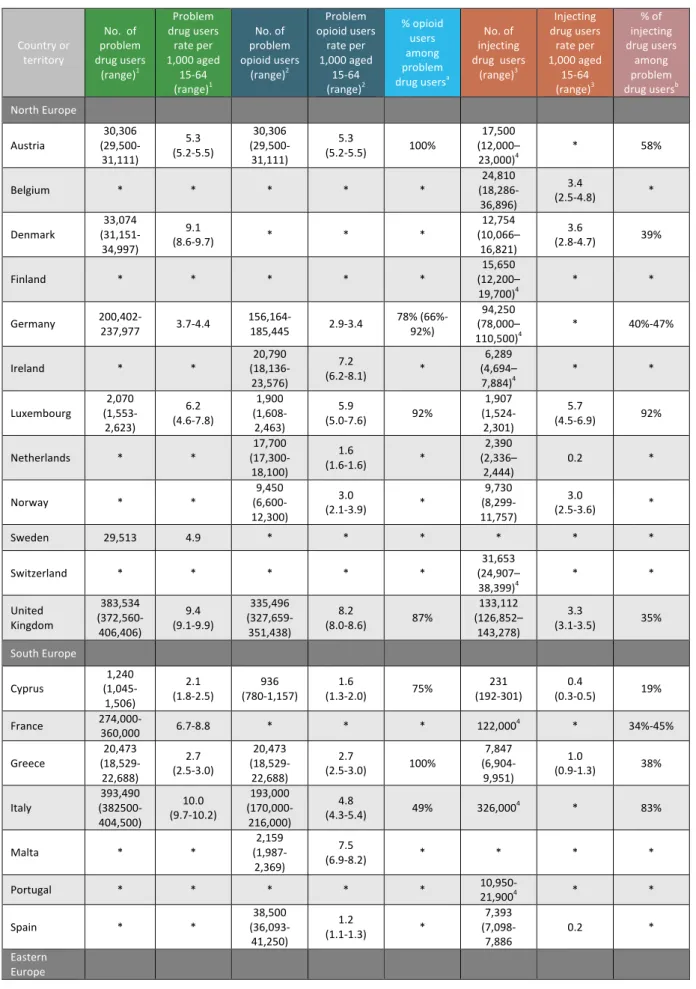
Estimates on the number and rates of problem drug users are available for 16 EU Member states, amounting to a total of about 1,6 million problem drug users in these countries (with numbers ranging from close to 1,5 million up to almost 1,8 million). The highest rates of more than nine problem drug users per 1,000 aged 15-‐64 are found in Italy, Latvia, the UK and Denmark. The lowest rates (less than three problem drug users/1,000 ages 15-‐64) are reported for Cyprus, Greece, Slovakia and Poland (see table 1) (EMCDDA, 2013a).
In Europe, the use of opioids – especially heroin, but other opioids such as methadone, buprenorphine and fentanyl as well – remains to be a major factor when it comes to drug related morbidity and mortality. Opioid users are often polydrug users and are more likely to be socially marginalised (e.g. unemployed, homeless) than non-‐Opioid users (EMCDDA, 2013c). The number of problem opioid users in Europe is estimated at 1,4 million, with an average prevalence of 0.41% in the adult population (15-‐64 years). Recent data suggest a downward trend in heroin use especially in western European countries: the number of new heroin users has decreased, as has the number of new heroin clients entering treatment. Overall, those in treatment appear to be an aging population. Furthermore, a long-‐term decline in heroin injection can be observed (EMCDDA, 2013c). Among those countries providing recent data, the approximate rate varies between less than one (Hungary) and more than eight problem opioid users (Latvia, UK, Ireland, and Malta) per 1,000 aged 15-‐64 (average: 3.7 problem opioid users/ 1,000 ages 15-‐64). In the 11 countries that provided data on both the number of problem drug users and the number of problem opioid users on average about 70% of problem drug users are thought to be problem opioid users. In this regard, the lowest proportions are found in the Czech Republic (23%), Slovakia (46%) and Italy (49%), whereas in Austria, Greece, Croatia and Luxembourg problem opioid users make up more than 90% of problem drug users (see table 1). It has to be noted, that recent estimates for problem methamphetamine use reveal relative high numbers for the Czech Republic (0.42% in the adult population aged 15-‐64) and for Slovakia (0.21%)(EMCDDA, 2013c).
Table 1: Estimated numbers and rates (per 1,000 population aged 15-‐64) of problem drug users, problem opioid users and injecting drug users, percentage of opioid users and injecting drug users among problem drug users Country or territory No. of problem drug users (range)1 Problem drug users rate per 1,000 aged 15-‐64 (range)1 No. of problem opioid users (range)2 Problem opioid users rate per 1,000 aged 15-‐64 (range)2 % opioid users among problem drug usersa No. of injecting drug users (range)3 Injecting drug users rate per 1,000 aged 15-‐64 (range)3 % of injecting drug users among problem drug usersb North Europe Austria (29,500-‐30,306 31,111) 5.3 (5.2-‐5.5) 30,306 (29,500-‐ 31,111) 5.3 (5.2-‐5.5) 100% 17,500 (12,000– 23,000)4 * 58% Belgium * * * * * (18,286-‐24,810 36,896) 3.4 (2.5-‐4.8) * Denmark (31,151-‐33,074 34,997) 9.1 (8.6-‐9.7) * * * 12,754 (10,066– 16,821) 3.6 (2.8-‐4.7) 39% Finland * * * * * (12,200–15,650 19,700)4 * * Germany 200,402-‐237,977 3.7-‐4.4 156,164-‐185,445 2.9-‐3.4 78% (66%-‐92%) (78,000–94,250 110,500)4 * 40%-‐47% Ireland * * (18,136-‐20,790 23,576) 7.2 (6.2-‐8.1) * 6,289 (4,694– 7,884)4 * * Luxembourg (1,553-‐2,070 2,623) 6.2 (4.6-‐7.8) 1,900 (1,608-‐ 2,463) 5.9 (5.0-‐7.6) 92% 1,907 (1,524-‐ 2,301) 5.7 (4.5-‐6.9) 92% Netherlands * * (17,300-‐17,700 18,100) 1.6 (1.6-‐1.6) * 2,390 (2,336– 2,444) 0.2 * Norway * * (6,600-‐9,450 12,300) 3.0 (2.1-‐3.9) * 9,730 (8,299-‐ 11,757) 3.0 (2.5-‐3.6) * Sweden 29,513 4.9 * * * * * * Switzerland * * * * * (24,907–31,653 38,399)4 * * United Kingdom 383,534 (372,560-‐ 406,406) 9.4 (9.1-‐9.9) 335,496 (327,659-‐ 351,438) 8.2 (8.0-‐8.6) 87% 133,112 (126,852– 143,278) 3.3 (3.1-‐3.5) 35% South Europe Cyprus (1,045-‐1,240 1,506) 2.1 (1.8-‐2.5) (780-‐1,157) 936 (1.3-‐2.0) 1.6 75% (192-‐301) 231 (0.3-‐0.5) 0.4 19% France 274,000-‐360,000 6.7-‐8.8 * * * 122,0004 * 34%-‐45% Greece (18,529-‐20,473 22,688) 2.7 (2.5-‐3.0) 20,473 (18,529-‐ 22,688) 2.7 (2.5-‐3.0) 100% 7,847 (6,904-‐ 9,951) 1.0 (0.9-‐1.3) 38% Italy (382500-‐393,490 404,500) 10.0 (9.7-‐10.2) 193,000 (170,000-‐ 216,000) 4.8 (4.3-‐5.4) 49% 326,0004 * 83% Malta * * (1,987-‐2,159 2,369) 7.5 (6.9-‐8.2) * * * * Portugal * * * * * 10,950-‐21,9004 * * Spain * * (36,093-‐38,500 41,250) 1.2 (1.1-‐1.3) * 7,393 (7,098-‐ 7,886 0.2 * Eastern Europe
Country or territory No. of problem drug users (range)1 Problem drug users rate per 1,000 aged 15-‐64 (range)1 No. of problem opioid users (range)2 Problem opioid users rate per 1,000 aged 15-‐64 (range)2 % opioid users among problem drug usersa No. of injecting drug users (range)3 Injecting drug users rate per 1,000 aged 15-‐64 (range)3 % of injecting drug users among problem drug usersb Bulgaria (23,050-‐31,316 42,920) 6.0 (4.4-‐8.2) * * * 20,250 (16,200-‐ 24,300)4 * 65% Croatia (8,104-‐9,795 12,553) 3.3 (2.7-‐4.2) 10,726 (9,598-‐ 11,853) 3.6 (3.2-‐4.0) 94%c 1,431 (1,184-‐ 1,833) 0.5 (0.4-‐0.6) 15% Czech Republic 40,200 (32,700-‐ 47,700) 5.5 (4.5-‐6.5) 9,300 (8,800-‐ 9,750) 1.3 (1.2-‐1.3) 23% 38,600 (37,300-‐ 39,850) 5.3 (5.1-‐5.5) 96% Estonia * * * * * (8,178-‐13,801 34,732)4 * * Hungary * * (2,780-‐3,130 3,480) 0.5 (0.4-‐0.5) * 5,699 0.8 * Latvia (10,849-‐13,141 16,811) 9.5 (7.8-‐12.1) 10,169 (7,662-‐ 15,177) 6.6 (5.0-‐9.9) 77% * * * Lithuania * * (5,314-‐5,458 5,605) 2.4 (2.3-‐2.4) * 5,4584,d * * Poland (56,000-‐79,500 103,000) 2.9 (2.1-‐3.8) * * * * * * Romania * * * * * 17,000 * * Slovakia (8,182-‐10,519 33,489) 2.7 (2.1-‐8.5) 4,888 (3,966-‐ 9,782) 1.3 (1.0-‐2.5) 46% 18,841 (13,732-‐ 34,343) 4.9 (3.5-‐8.9) >100%e Slovenia * * * * * 7,3104 * *
NB: * data/information not available
a. calculation based on the estimated number of problem drug users and estimated number of problem opioid users as shown in the table.
b. calculation based on the estimated number of problem drug users and estimated number of IDUs as shown in the table.
c. the percentage is based on the highest estimates of problem drug and problem opioid users
d. number of problem opioid users is identical with the number of IDUs indicated in the Harm Reduction International’s report
e. estimated number of IDUs is from 2006, the estimated number of problem drug users from 2008.
References: 1. EMCDDA, 2013a. 2. EMCDDA, 2013a. 3. EMCDDA, 2013a.
4. Harm Reduction International, 2012.
People who inject drugs are at high risk of experiencing health problems due to their drug use, with the risk of contracting HIV, HCV or other blood-‐borne viruses or of suffering from non-‐ fatal or fatal overdose being among the most serious ones. It is estimated that more than one million people in Europe are injecting drug users (Harm Reduction International, 2012). The highest number of injecting drug users is found in Italy, the UK and France. Among the 13 countries with recent estimates on the prevalence of injecting drug use a range between less
than one (the Netherlands, Spain, Cyprus, and Croatia) and more than five (Luxembourg, Czech Republic) injecting drug users per 1,000 adults aged 15-‐64 are found. On average, there are 2.5 injecting drug users per 1,000 in this age group. Among the 12 countries where estimates of both the number of problem drug users and the number of injecting drug users are available, on average about half of problem users are injectors. At a national level, the respective proportions range from less than 20% in Croatia and Cyprus to more than 90% in the Czech Republic and Luxembourg. Sufficient trend data on injecting drug use available for eight countries indicate a decreasing trend in the UK and a relatively stable situation in Greece, Cyprus, Hungary, Slovakia, Croatia and Norway. The Czech Republic, in contrast, has experienced an upward trend in injection drug use. Although injection is most commonly associated with opioid (and especially heroin) use, some countries report a fairly high number of people who inject amphetamines (including methamphetamine), cocaine or other stimulant drugs. In the Czech Republic for example, the increase in the number of injectors seems to be largely attributable to injecting methamphetamine use. There, but also in Latvia, Finland, Sweden and Norway, the majority (63%-‐80%) of (meth-‐) amphetamine clients entering treatment report to mainly inject the substances (EMCDDA, 2012). The injection of new psychoactive substances, mainly cathinones such as mephedrone and MDPV, has been reported for a few countries (Hungary, Austria, Romania and the UK) that have seen a heroin shortage in recent years. Here, cathinones seem to function as an opioid replacement for injecting drug users. The underlying motives for switching from injecting heroin to cathinones, two substances with very opposite effects, are not fully understood yet, but may be partly linked to the easy availability and the perceived high quality of NPS (EMCDDA, 2013c).
New Psychoactive Substances
During the past few years, a large number of new psychoactive substances (NPS) or so called “legal highs” have emerged on the European market. These substances mimic the effects of known illicit drugs but are not (yet) controlled by the international drug control conventions. Between 2005 and 2012 the early-‐warning system set up by EMCDDA in 1997 identified more than 230 new substances with the highest number of 73 new substances in 2012 (2011: 49). Reference: EMCDDA, 2013c.
Deaths Caused Directly and Indirectly by Drug Consumption
Overdoses, diseases (in particular HIV, HBV and HCV), suicide and trauma (referring to deaths due to injuries from accidents and violence, including assaults and homicide) have been identified as the major causes of drug-‐related deaths and the following sections are structured around these four categories. It is roughly estimated that overdoses account for between one third and half of deaths among drug users, while one to two fifths are attributable to suicide and trauma and less than a tenth to HIV/AIDS. A considerable proportion of drug-‐related deaths are due to other causes, mostly somatic and chronic conditions including liver diseases due to viral hepatitis, cardiovascular and lung diseases, cancer and other infections. However, causes of death may not be clear-‐cut, since other factors such as social marginalization, difficulties to access services and treatment, abuse of licit drugs or psychological comorbidities may also affect mortality rates among drug users. Problems linked to drug-‐related deaths are most often found among long-‐term users of opioids, users who inject and to a lesser degree among people who use some form of stimulants (EMCDDA, 2011a).
Overdose Deaths
Overdose is a leading cause of death among illicit drug users, particularly among injecting opioid users. Since 1995, between approximately 6,500 and 8,500 overdose deaths have been recorded in the EU Member states, Norway and Switzerland each year, adding up to more than 125,000 deaths (Bundesamt für Polizei, 2009; EMCDDA, 2013a).2 It has to be noted, though, that these numbers are likely to be conservative as national data may be affected by under-‐ reporting or under ascertainment of drug-‐induced deaths. As figure 1 indicates, drug-‐induced deaths continuously increased between 1997 and 2000, but dropped until 2003. This decline was again followed by an increase until 2008. The most recent data available for the EU Member States, Switzerland and Norway suggest the number of drug-‐induced deaths to be more than 6,800. This number includes the reported drug deaths in Belgium and Switzerland, where the latest data are available for 2008. The most recent estimates provided by the other 28 countries suggest that there were around 6,500 drug-‐induced deaths in 20113, showing a continuing decrease since 2008, when more than 8,000 people died from an overdose (EMCDDA, 2013a).
2 In Switzerland, between 361 and 143 overdose deaths per year were reported from 1995 to 2008. 3 The estimate is based on 2011 data for 22 EU member states, and 2010 data for five others and Norway.
Figure 1: Trends in drug-‐induced deaths in the 28 EU Member States, Norway and Switzerland
NB: Belgium and Switzerland are excluded after 2008, as no data are available. The 2011 estimate is based on 2011 data for 22 EU Member States and 2010 data for five others and Norway.
References: EU Member States and Norway: European Monitoring Centre for Drugs and Drug Addiction (EMCDDA) (2013): Statistical Bulletin. Table DRD-‐2: Number of drug-‐induced deaths recorded in EU according to national definitions. Part (i): Total drug-‐induced deaths, 1995–2011, EMCDDA: Lisbon; Switzerland: Bundesamt für Polizei (2009): Polizeiliche Kriminalstatistik PKS, Schweizerische Betäubungsmittelstatistik. Bundesamt für Polizei: Bern (from 1995 to 2008 between 361 and 143 overdose deaths were recorded in Switzerland each year).
Nevertheless, the situation varies between different countries. A stable decrease in the number of reported deaths since 2008 can be seen in Germany, Spain, Italy, Portugal, Slovenia, Slovakia, and the United Kingdom, whereas an increase can be observed in Estonia, Austria, France, Poland and Finland (EMCDDA, 2013a). The United Kingdom and Germany, the two nations with the highest number of drug-‐induced deaths, account for half of all overdose cases reported in 2011. However, regarding the death rate per million population, the UK remains among the five countries with the highest rate, whereas Germany ranks in the upper mid-‐ range. The average EU rate is estimated at 13 overdose deaths per million population, with higher rates among younger cohorts: among 15-‐64 year olds the estimated rate is 18.3 deaths per million, among 15-‐39 year olds 22.2 deaths per million population. There are considerable differences between countries: on the one hand, six countries report rates of less than 5 deaths per million for both the entire population and 15-‐64 year olds, on the other hand, eight countries report more than 20 death per million for the entire population and more than 35 deaths per million population aged for 15-‐64. Rates of close to or more than 50 deaths per million in this age cohort are found in six countries. The by far highest rates of drug-‐induced deaths are found in Estonia and Norway (EMCDDA, 2013a). As the following Figure 2 shows, most countries with a mortality rate above the European average are located in North Europe, whereas all South European countries show below-‐average mortality rates.
0 3 000 6 000 9 000
Figure 2: Drug-‐induced mortality rates (cases per million population) in the entire population and among 15-‐64 year olds – countries with rates above (top) and below (bottom) the EU average
NB: No data available for Switzerland (entire population) and Greece (15-‐64 year olds). The estimated rates are based on 2011 data for 22 EU Member States, 2010 data for five others and Norway and 2008 data for Belgium and Switzerland.
References: EU Member States and Norway: EMCDDA, 2013a; Switzerland: UNODC, 2012.
0,0 20,0 40,0 60,0 80,0 100,0 120,0 140,0 Estonia Norway Denmark Finland United Kingdom Ireland Sweden Switzerland Austria Lithuania Croaya Belgium
15-‐64 year olds enyre populayon
0,0 2,0 4,0 6,0 8,0 10,0 12,0 14,0 16,0 18,0 Germany Malta Luxembourg Slovenia Cyprus Greece Spain Poland Netherlands France Italy Latvia Bulgaria Slovakia Czech Republic Portugal Hungary Romania
In Estonia more than a fifth (21.2%) of all deaths among 15 to 39 year olds are attributed to drug overdose, while for Norway the respective percentage is 13.5%. In two other countries – Ireland (11.6%) and Finland (10.7%) – drug-‐induced deaths account for more than a tenth of all deaths in this age group, whereas in six countries (Bulgaria, Czech Republic, Slovakia, Hungary, Portugal, and Romania) less than one per cent of all deaths among young adults are attributed to overdose. According to recent data, 3.6% of 15-‐39 year old Europeans died from a drug overdose (EMCDDA, 2013a).
Those dying from an overdose are on average is their mid-‐thirties, with a wide range of the mean age among the various countries: from as low as 30 years in Romania, Estonia and Latvia to as high as 44 and 45 years in France and Denmark (EMCDDA, 2013a). Less than 14% of people dying from an overdose are under 25 years: the highest proportions of young people among the deceased are found in Austria (30.3%), Hungary (28.6%) and Malta (25%), but in Ireland, Romania and Bulgaria this age group still accounts for a fifth of overdose victims. The lowest proportions of under 25 year olds are reported for Slovakia (0%), Spain, Croatia and Portugal (about 5%); five additional countries (the Netherlands, Denmark, Germany, the UK, and France) report proportions of less than 10%. In Denmark, Spain and the Netherlands more than 70% of people dying from overdose are 35 years or older (EMCDDA, 2013a). Drug users aged 40 or more accounted for more than two fifths of all reported overdose deaths in Europe. At a national level, proportions of more than 50% of at least 40 year olds are reported for Denmark, the Netherlands and Sweden, percentage rates of less than 10% are found in Malta, Estonia and Latvia. In general, the data indicate that especially countries in Eastern Europe respectively countries that joined the European Union after 2003 report comparatively low proportions of older drug users among the deceased (see figure 3). This might be partially explained by longer-‐standing heroin problems in countries that joined the European Union before 2004 (EMCDDA, 2011a).
Men are far more likely to suffer from fatal drug overdoses than women. Overall, men account for 80% of overdose deaths in Europe. The highest proportions of males among the deceased are reported for Cyprus, Malta (100% respectively) and Hungary (93%), the lowest rates are found in Luxembourg (50%), Poland (61%) and Sweden (69%)(EMCDDA, 2013a).
Figure 3: Percentage of people aged 40+ among the deceased in drug-‐induced deaths in 27 EU Member States and Norway
References: EMCDDA, 2013a.
Implicated Substances
The use of opioids, in particular the use of heroin, accounts for the vast majority of overdose deaths in Europe. In the 23 countries providing data for 2010 or 2011, opioids were on average present in 74% of the cases. Nine countries report proportions of more than 80%, among the five countries with proportions of more than 90%. A comparatively low prevalence of opioids of less than 50% is found in Latvia, Slovenia and France. In the Czech Republic, the nation with the by far lowest proportion of overdose deaths due to opioids, these substances only account for about one in five overdose deaths (see figure 4).
Where more detailed information on the type of opioids is available, the percentage of overdose deaths involving heroin (with or without additional drugs) varies between as low as 24% in Denmark to as high as 91% in Greece (Norway: 38%, UK: 46%, Italy: 48%, Germany: 58%). Opioid substitution medications are also reported in a number of cases, with methadone alone or in combination with other drugs accounting for 5% or less of overdose deaths in Spain, Italy, Lithuania and the Czech Republic and more than half in Denmark, Romania and Croatia (Portugal: 6%, Norway and Austria: 15%, Germany: 20%, Hungary: 29%, Slovenia: 33%, Ireland: 37%). Increasing numbers of deaths due to methadone have been reported for Portugal and Croatia (in the latter case methadone accounted for three quarter of drug-‐
0% 10% 20% 30% 40% 50% 60% 70%