Consider “8” before
you integrate
An evaluation of “free” versus “for fee” ESBs
Executive summary
Today, many organizations are looking for integration
solutions to help connect existing disparate IT assets so
they can become more agile to meet changing business
needs. They are also looking for integration solutions
when trying to power mobile and cloud initiatives. When
adopting such a solution, they are sometimes lured into
“free” versus “for fee” Enterprise Service Bus (ESB)
offerings, the former often associated with Open Source
Software (OSS). But as any open-source vendor will tell
you, open source is free as in “free choice” but not free
as in “free drinks”!
Since open-source ESB is perceived as being free—
there are no upfront costs for license fees—and
some companies are attracted to the ability to modify
code to suit their requirements, it is considered a viable
alternative to a commercial ESB solution. However, much
of the excitement around an open-source ESB is isolated
to specifi c user scenarios, and there are many factors to
consider before investing in such a solution.
TABLE OF CONTENTS
1 Executive Summary
3 Eight points to consider before you integrate with an open-source
6 The Software AG webMethods ESB
7 Conclusion and next steps
8 References
BUSINESS WHITE PAPER
Small vendors, and most open-source ESB vendors are small, are an easy target for acquisitions. This can have two potential negative effects. First, the road map and the control of the OSS changes when ownership changes. This can have a major impact on your organization if your IT team depends on this software for critical projects. Second, in an acquisition scenario, there is no guarantee that the acquiring company will continue to support the OSS. The company could very easily shelve the solution for business and strategic reasons.
For instance, in April 2012, Progress Software Corporation announced plans to divest its non-core product lines, including open-source provider FuseSource®.1 Following this, Red Hat® agreed
to acquire FuseSource as well. The decision may have left many customers wondering if they should continue to adopt FuseSource. The road map of FuseSource will remain unclear for quite some time. The future of the solution will also be muddied considering that Red Hat has its own competing solutions as well.
Even MuleSoft™, an open-source provider of integration platforms, chose to offer its customers a commercial messaging application rather than Apache Active MQ™ due to its scalability and reliability concerns from end-users.2
Choosing an integration solution for your business is a costly, time-consuming and strategically critical decision. Although an open-source ESB may appear attractive at fi rst glance, there are often hidden costs, business risks and unpredictable outcomes when your integration solution is not factored into the overall business strategy.
While open-source ESB may be perceived as free, the benefi ts of free license fees are quickly overshadowed by the costs to hire specialists to implement and support the software. In addition, because acquiring open-source software is easy at the developer level, leadership is not always included in the decision. As a result, such short-term solutions don’t always support the organization’s strategic expansion plans. On top of that, open-source ESB solutions are mostly a loose set of components that are not completely integrated out-of-the-box. The software also lacks support across other integration areas, particularly messaging, B2B and Service-Oriented Architecture (SOA) governance requirements. Finally, open-source ESB solutions lag the market overall in support of mobile and cloud applications.
The promise of free license fees, open code that can be altered to meet specifi c needs and freedom from vendor lock-in makes OSS ESBs attractive to some companies. However, for every perceived benefi t, there are many inherent drawbacks. To determine which solution is best for your organization, consider both the benefi ts and drawbacks of each solution.
Get There Faster
Eight points to consider before you integrate
with an open-source
Keep these eight points in mind when choosing between open-source ESBs and commercial ESBs for integration.
1. Open is not free
While cost is the most-frequently cited reason for implementing OSS ESBs, most IT decision-makers concur that OSS ESBs are not truly free. Open-source solutions offer “free choice” rather than free licensing. But the free choice to do whatever the organization wants comes at a cost. The benefi ts of free license fees are quickly overshadowed by the costs to hire specialists— whether in-house or consultants—to get the software up and running and for ongoing administrative and support costs. In addition, open-source integration software is diffi cult to confi gure and customize. Developers have to manipulate large XML fi les and write complex code to support relatively straightforward business requirements. Because of this, OSS ESB customers have to hire experienced developers who are comfortable working in open-source environments. Although the situation varies from application to application, determining the true cost of implementing and administering OSS ESB also depends on:
• An available pool of resources that have been trained on the system • Tools that enable administrators to manage multiple systems • The number of upgrades and patches issued by the OSS ESB vendor
In the end, open-source ESB has a signifi cant Total Cost of Ownership (TCO) and its ROI is generally not higher than that of commercial ESBs. In fact, if not carefully managed, open-source ESB projects can quickly stretch any IT budget.
2. Plan for long-term growth
Investing in an integration solution can be costly and time-consuming. Companies must be certain their solution supports long-term expansion plans for at least the next decade, providing a sound infrastructure for B2B, SOA governance, Business Process Management (BPM) and Business Activity Monitoring (BAM). Organizations also must be certain that both the technical and business demands of the effort are managed properly.
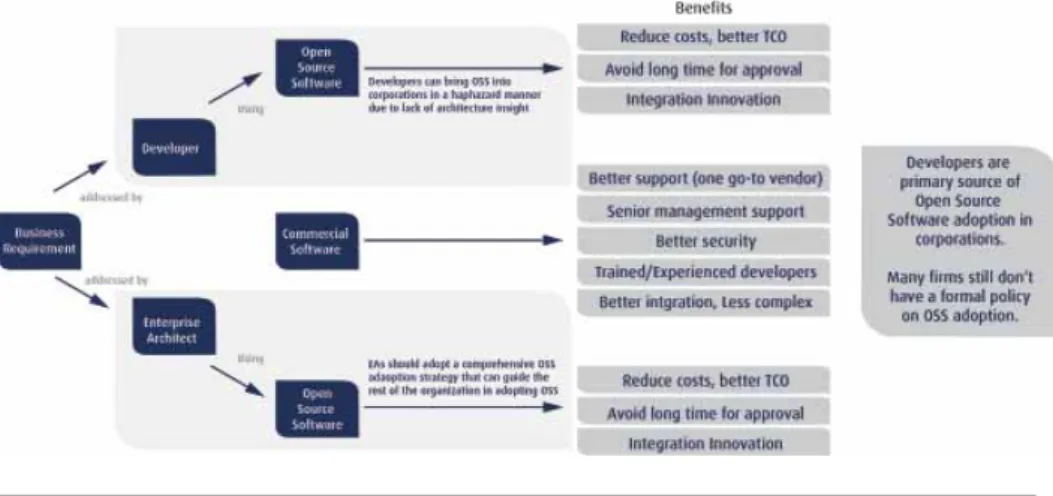
As shown in Figure 1, because open-source software (in general) is very easy to acquire, developers are often the primary decision-makers when it comes to choosing OSS, and many fi rms still do not have formal policies regarding OSS implementation. However, developers and leadership alike must be on-board to ensure that the OSS ESB solution is integrated into the overall business strategy and can support important long-term initiatives. Open-source ESBs may be convenient from an adoption standpoint. But customers have too much at stake to trust their key infrastructure to a solution that has signifi cant risks and threats.
Investing in an integration
solution can be costly and
time-consuming. Companies
must be certain their
solution supports long-term
expansion plans for at least
the next decade.
Figure 1: The OSS adoption decision-making process
Large corporations also often question an OSS ESB’s ability to pass their stringent security and privacy requirements and scale to necessary requirements. It is widely known that OSS ESBs simply cannot match the scale and number of integration implementations of a commercial ESB solution. So, OSS ESBs usually target small companies or small projects (developer-based) at larger companies. In addition, companies must consider vendor viability. In a constantly changing industry, OSS ESB vendors may be acquired, merged or may fall to fi nancial pressures, leaving customers with no continuity.
3. Out-of-the-box vs. extensive integration
Open-source integration software is typically a set of loose components—components that are not well integrated out-of-the-box and require extensive integration during the actual implementation. In addition, an OSS ESB provides limited options for scaling into BPM, BAM, B2B and SOA governance.
Another area to focus on strongly, in this regard, is to consider the depth of adapter offerings. Many OSS ESB vendors offer very limited adapters for packaged applications.3 This impacts
developer productivity as the developer will have to write lots of custom code to leverage ERP functionality.
Unlike commercial solutions, in which the product components across these areas are pre-integrated, to get an OSS ESB implementation up and running, you’ll need in-house experts or consultants to complete the installation and implement complex integrations.
Open-source integration
software is typically a set
of loose components—
components that are not
well integrated
out-of-the-box and require extensive
integration during the
actual implementation.
Get There Faster
4. Make support a priority
Most IT staff is already stretched thin. When it comes to OSS ESB, there are no proprietary software vendors maintaining code for companies who must install updates and upload new modules themselves. As a result, OSS integration customers are forced to harness the necessary support skills internally or via a support contract with a specifi c open-source ESB provider. With confl icting demands pulling staff in different directions, this doesn’t always take priority. Without a support contract, companies run the risk of rapidly deteriorating software quality, patches that may not get installed, bugs that maybe left unfi xed and, ultimately, an increase in overall TCO.
5. Factor in your B2B requirements
Integration needs are not always limited to internal applications and IT systems. Such needs can extend to entities, such as customers, suppliers and vendors, that are outside the company. In such a scenario, integration needs arise beyond the internal enterprise and, as a result, a B2B solution should be put in place that can work closely with their integration solution.
According to a major third-party industry analyst, open-source products lag the overall market in providing comprehensive support for a wide range of B2B standards. Most of the OSS vendors are narrowly focused on providing a limited services-based integration internally. But, as a growing enterprise, you will need the ability to bring external data seamlessly into your internal applications. This is only possibly when your integration solution can easily support B2B standards and requirements as well.
6. Consider your messaging requirements
With the introduction of new delivery channels such as real-time Web, mobile and cloud, there is a need to provide messaging to deliver business data across a wide variety of delivery channels in a standards-based and reliable way. Businesses are looking to set up a low-latency messaging infrastructure that can support high-volume and high-speed requirements of modern supply chain, logistics and e-commerce applications. This has resulted in the emergence of universal messaging providers that support various messaging topologies (publish/subscribe, peer-to-peer, brokered, distributed) and platforms/protocols like MQTT and Web messaging in addition to Java® Message Service ( JMS).
Open-source ESB providers don’t provide best-of-breed “universal” messaging support across the various delivery channels and implementation topologies. OSS messaging software cannot support the high-speed and high-volume requirements posed by modern-day applications. As a matter of fact, MuleSoft, an open-source integration provider, used Software AG’s webMethods Universal Messaging as the underlying messaging layer for Mule MQ.
Customers should consider their messaging requirements carefully before implementing messaging solutions with an open-source ESB.
OSS messaging software
can-not support the high-speed
and high-volume
require-ments posed by modern-day
applications.
7. Control the road map
Open-source integration software is built by a community of developers. As a result, individual OSS vendors have no control over the road map of the project. Since the open-source community does not necessarily have the same requirements and needs as the customer, the future of the product may or may not be not be in line with the customer’s user requirements. Specifi cally, if the customer has key initiatives that need to be executed by a specifi c timeline, the unclear road map can be a major hindrance to IT delivery and performance.
8. Look to the cloud
Cloud-based models are becoming increasingly prevalent with the increase in adoption of Software as a Service (SaaS) in almost every company. Combine that fact with the increase in adoption of virtualized or private cloud-based models of integration solutions, there is a strong need for the ESB solution to run in scalable and high-performance mode in such environments. With the advent of such hosted cloud models, the cost differential between OSS ESB and commercial ESB applications will be further reduced. Because open-source ESB providers are smaller in size and do not support all integration categories, they will be forced to invest more heavily in supporting a cloud based model. As a result, they may end up passing on those investment costs directly to customers, further closing the gap in the cost differential between “free” open source ESB software and commercial ESB applications.
The Software AG webMethods ESB
Unlike open-source ESB solutions, Software AG has a robust enterprise application solution, based on the highly rated webMethods ESB, that also offers extensive road map planning and comprehensive support across all integration areas. Through our Prime methodology, Software AG provides out-of-the-box assets, including best practices, design and project deliverables that assist with identifying a strategy and accelerating implementation. With more than 40 years of experience and dedication to a core suite of integration and BPM products, Software AG offers its customers applications that support long-term expansion plans. The solution offers additional benefi ts, including:
• Easy integration with any IT assets to streamline information exchange with any technology from any vendor, including ERP systems, databases, mainframes and legacy applications, SaaS platforms, Web services, JMS messaging systems and packaged apps
• Interoperability with any vendor, whether open source or commercial, enabling customers to safely tailor solutions to their strategic business needs
• Building-block-style architecture that is unparalleled in the industry, pre-integrating products across application integration, B2B, SOA governance and BPM
• Graphical development environment and pre-built adapters that result in high cost savings and faster time to market
• Global consulting support to facilitate implementation • 24/7 basic and premium global support
Unlike open-source ESB
solutions, Software AG
has a robust enterprise
application solution,
based on the highly rated
webMethods ESB.
Get There Faster
Conclusion and next steps
Choosing the right integration solution for your business can have a signifi cant positive impact on your success. And, because success in today’s market is closely tied to how quickly companies respond to change, your integration solution is the one that enables your IT team to quickly connect disparate IT systems and assure interoperability between cloud-based solutions and on-premise applications.
While open-source ESB solutions appear attractive at fi rst glance, the long-term viability of providers is vital to the life of a solution. Today, even open-source vendors are reconsidering their strategies and partnering with commercial application providers to ensure reliability for their customers. In a constantly changing industry, open-source providers can be acquired; they can merge or dissolve due to fi nancial pressures, leaving customers with no continuity. In addition, there are many unexpected costs and potential risks associated with an open-source integration solution. And, although the solution may be easy to obtain, it may not fi t into your long-term business strategy.
When it comes to selecting a mission-critical solution that will impact virtually your entire business, it’s important to consider the benefi ts and drawbacks of your options. Keep the eight considerations outlined in this white paper in mind when choosing between open-source and commercial integration solutions.
To learn more about Software AG and our commercial ESB, talk to your Software AG representative or visit www.SoftwareAG.com.
LEVERAGE THE FOUR FORCES
Cloud
Treat cloud-based applications as fi rst-class citizens by providing a standard mechanism to sync information and govern the interactions between cloud-based applications and on-premise systems. Mobile
Selectively expose their unique assets to power mobile apps via Web APIs while ensuring proper governance and security.
Big Data
Connect diverse data sources, load large volumes of data at once and process it in-memory.
Social
Integrate diverse third-party social platforms and internal system events with rest of the IT landscape to allow teams to take timely action.
Get There Faster
Find out how to power up your Digital Enterprise at www.SoftwareAG.com
ABOUT SOFTWARE AG
Software AG helps organizations achieve their business objectives faster. The company’s big data, integration and business process technologies enable customers to drive operational effi ciency, modernize their systems and optimize processes for smarter decisions and better service. Building on over 40 years of customer-centric innovation, the company is ranked as a “leader” in 14 market categories, fueled by core product families Adabas-Natural, Alfabet, Apama, ARIS, Terracotta and webMethods. Learn more at www.SoftwareAG.com.
© 2014 Software AG. All rights reserved. Software AG and all Software AG products are either trademarks or registered trademarks of Software AG. Other product and company names mentioned herein may be the trademarks of their respective owners. SAG_Consider8_WP_Feb14
References
1 Progress Announces Strategic Plan to Increase Growth, Profi tability and Shareholder Value,
http://www.progress.com/en/inthenews/progress-announces-s-58698.html
2 Worthington, David. ( January 20, 2010). MuleSoft releases proprietary JMS server.
http://www.sdtimes.com/p/34068
3 Gartner report: “Assess Open-Source ESB Vendors”, 1 Oct 2012
About the authors
Dinesh Chandrasekhar is a senior manager of the global product marketing team at Software AG. He is responsible for the messaging, positioning and market growth of the application & cloud Integration products in the company. With 19+ years of experience in integration, cloud & application architecture, Dinesh has extensive knowledge of large-scale implementations of customers across multiple industry verticals. Dinesh has a master’s degree in business administration from Santa Clara University. He tweets at @AppInt4All. Sachin Gadre is a director of product management at Software AG. He is responsible for managing the road map and guiding the development of the integration products within the Software AG suite. Prior to joining Software AG, Sachin worked with Accenture where he worked on many IT strategy engagements in the high-technology sector. Prior to Accenture, Sachin worked as a solutions architect at BearingPoint. He tweets at @sachin_gadre.