Reenix: Implementing a Unix-Like Operating System in
Rust
Alex Light (
alexander [email protected]
)
Advisor: Tom Doeppner
Reader: Shriram Krishnamurthi
Brown University, Department of Computer Science
April 2015
Abstract
This paper describes the experience, problems and successes found in implementing aunix-like operating system kernel inrust. Using the basic design and much of the lowest-level support code from theWeenix operating system written forCS167/9I was able to create a basic kernel supporting multiple kernel processes scheduled cooperatively, drivers for the basic devices and the beginnings of a virtual file system. I made note of where therustprogramming language, and its safety and type systems, helped and hindered my work and made some, tentative, performance comparisons between therustandCimplementations of this kernel. I also include a short introduction to therustprogramming language and theweenixproject.
Contents
1 Introduction 1
1.1 The Weenix OS . . . 2
1.2 TheRustlanguage . . . 2
2 Reenix 7 2.1 Organization . . . 7
2.2 Booting . . . 8
2.3 Memory & Initialization . . . 8
2.4 Processes . . . 9
2.5 Drivers . . . 11
2.6 KShell . . . 13
2.7 Virtual File System . . . 13
2.8 Other Challenges . . . 15
2.9 Future Work . . . 17
3 Rust Evaluation 18 3.1 Benefits of Rust . . . 18
3.2 Challenges of Rust . . . 20
3.3 Critical Problem: Allocation . . . 21
3.4 Performance . . . 24
4 Conclusions 25
1
Introduction
Ever since it was first created in 1971 theUNIX operat-ing system has been a fixture of software engineeroperat-ing. One of its largest contributions to the world of OS engineering, and software engineering in general, was the C programming language created to write it. In the 4 decades that have passed since being released,C has changed relatively little but the state-of-the-art in programming language design and checking, has ad-vanced tremendously. Thanks to the success of unix almost all operating system kernels have been written largely inCor similar languages likeC++. This means that these advances in language design have largely passed by one of the fields that could most benefit from the more expressive, more verifiable languages that have come after C.
The goal of this project is to try to create aunix -like operating system kernel using therust program-ming language. As far as I know, this is a project that has never really been attempted seriously, nor had anyone made much progress on before now1. By doing so I will be able to explore the feasibility and convience of creating a kernel with a higher-level
1 All otherrustoperating systems I was able to find were
little more than toys capable of running basicrustcode. Few had any notion of threads of execution and even fewwer had any form of process control beyond starting new threads. None had any form of drivers beyond painting the screen and maybe echoing key presses without processing them.
language such asrust, as well as find where the lan-guage could be improved to better suit this purpose. Furthermore, it will allow us to evaluate how well the basic design ofunixholds up when examined through a language other thanC. Finally, we will see how the much more sophisticated type and safety system of
rusthandle the complicated task of verifying a ker-nel.
In order to allow me to begin working on the more high-level parts of the kernel faster, I based my ef-fort off of the weenix operating system that is im-plemented in CS169. This allowed me to not worry about implementing many of the lowest level pieces of the kernel, such as the memory allocators, which are not specific to operating system development.
1.1
The Weenix OS
The Weenix operating system is a small x86 based teaching OS created in 1998 for use with Brown’s
CS167 course on operating systems[12]. Today, stu-dents in the optional lab course CS169 attached to
CS167 implement much of the higher level pieces of a unix-like OS with weenix. Students doing this project start out with the code necessary to get the OS booted and running C code, with memory-management, a debug-printing system, and a basic
libcimplementation. Using this as their base,CS169 students then proceed to implement a fairly complete
unixOS. The project, and its support code, are writ-ten almost entirely inC, with some of the initial boot code beingx86 assembly, and some python and shell scripts for running and testing the OS.
This project is split into multiple parts, commonly referred to as,PROCS, DRIVERS, VFS, S5FS, & VM. For
PROCS, they implement a unix-style process model, with parent-child relationships among processes and ainitprocess, as well as a simple scheduler and syn-chronization primitives. DuringDRIVERS, they imple-ment large parts of aTTY driver, allowing user input and interaction, as well as a (very bare-bones) ATA driver allowing use of a hard-disk. ForVFS, they im-plement a virtual file system type abstraction, using a provided ram-backed file system called RamFS for testing. InS5FS, a version of thesysv-fsfile system, called theS5file system, is implemented to allow real non-volatile storage. Finally forVMa virtual memory and user-space is implemented. There are also many provided user-space utilities that allow one to test the final OS.
1.2
The
Rust
language
Therust2programming language is a relatively new systems programming language being made by the Mozilla foundation. It is designed to be usable as a replacement forCin the low-level and embedded pro-gramming environments that are common for small and high-performance software. The Mozilla Founda-tion is currently usingrustin a few official projects, including the rust compiler (rustc), and an exper-imental web-browser called Servo. It also plans to begin using rust code in its popular Firefox web-browser in the near future[4]. Rustis currently being developed and hosted on Github3. The project is very popular and open, with thousands of contribu-tors, most of whom are not associated with Mozilla.
Rust itself is a procedural programming language with C-like syntax. It uses its very comprehensive type system, a data ‘lifetime’ system, and an ex-tremely small runtime to ensure memory and thread safety during compile time. Specifically, rust uses its ownership and lifetime tracking system to ensure that data is not unexpectedly modified when it is still being used by another object. Furthermore, it uses the lifetime tracking system to ensure that there are no dangling pointers possible in the language. The runtime of rust is made up of several pieces, many of which are separable. Its only required (and most ba-sic) function is to simply recover from out-of-memory or other fatal errors. In most cases, including most of reenix, it also provides an interface for allocation of heap memory. All other functions of the runtime are essentially just to provide a consistent interface to the underlying operating system it is running on, al-lowing disk-io, inter-process communications and the creation of threads, among other things.
1.2.1 Syntax & Semantics
The syntax of rust is similar to, but slightly differ-ent from most other C-like programming languages. Figure 1 contains a basic quicksort implementation in
rustthat I will use to illustrate some of the languages features. A full description of therustsyntax and se-mantics can be found online at doc.rust-lang.org4.
The most notable difference is that rust has a somewhat different divide between expressions and statements. In rust an expression is any piece of code that yields a value. A statement, on the other
2http://www.rust-lang.org(April 2015)
3https://github.com/rust-lang/rust(April 2015) 4http://doc.rust-lang.org/reference.html(April 2015)
1 //! A basic quick -sort implementation 2
3 /// A type generic quick -sort. ‘T‘ is the type we are sorting , it must have a total ordering
4 /// ( implement the ‘Ord ‘ trait ). It takes a list by value and returns a sorted list containing the 5 /// same elements sorted . We say that this passed in list is mutable so we can modify it.
6 pub fn quicksort <T: Ord >(mut lst: Vec <T >) -> Vec <T> {
7 // Get the first element as our pivot , Pop will return None (and go to the else branch ) if this 8 // list is empty , otherwise it will remove the first element from the list and return it. 9 if let Some( pivot ) = lst.pop () {
10 // Split list around the pivot . We iterate through the list ( into_iter function ) and 11 // partition it into two lists . The partition function turns an iterator into a pair of 12 // lists where the first is a list of all elements where the condition given is true and 13 // the other is false .
14 let (less , more ): (Vec <_>, Vec <_ >) = lst. into_iter (). partition (|x| x < & pivot );
15 // Recursively sort the half of the list less then the pivot . This will be the start of our 16 // returned list.
17 let mut res = quicksort (less );
18 // Push the pivot element onto the end of the sorted lower half of the list . This appends 19 // the pivot onto the ‘res ‘ list.
20 res. push ( pivot );
21 // Sort the larger half of the list and append it to the sorted lower half and pivot . 22 // extend will append the entire given list onto the ‘res ‘ list.
23 res. extend ( quicksort ( more ));
24 // Return the now sorted list . Note the return statement is not required here . Simply 25 // making this line ’res ’ ( note the lack of a ’;’) would be equivalent since the function 26 // will return the value of the last expression ( this if - else) which takes the value of the 27 // last expression in its branches (Vec <T >).
28 return res; 29 } else {
30 // Since lst.pop () returned None the list passed in must be empty so we will return an 31 // empty list here. Note that return is not needed because this is the last expression in a 32 // block and this block is the last expression in the function . vec! is a standard macro 33 // that creates a Vec <T >.
34 vec ![]
35 } 36 } 37
38 fn main () {
39 // Create a list to sort . vec! is a macro and will create a vec containing the elements listed . 40 let lst = vec ![3 ,1 ,5 ,9 ,2 ,8 ,4 ,2 ,0 ,3 ,12 ,4 ,9 ,0 ,11];
41 println !(" unsorted : {:?} ", lst );
42 // Call quicksort . This relinquishes ownership of lst. 43 println !(" sorted : {:?} ", quicksort (lst ));
44 }
1 /// A trait . Structs and enums can implement this. 2 pub trait Id {
3 /// A required function . All implementers must provide a definition for this function or else 4 /// type - checking will fail . The ’static means the returned string must be statically
5 /// allocated .
6 fn username (&self) -> &’ static str;
7 /// A function with a default implementation . The returned string must be usable at least as 8 /// long as the Id exists . The ’a means that the returned str must be usable at least as long 9 /// as ’self ’ is. The type checker will ensure this is true.
10 fn screenname <’a >(& ’a self, _board : &str) -> &’a str { self. username () } 11 }
12
13 /// A structure . The derive provides default implementations for the given traits . Only certain 14 /// traits may be implemented in this way.
15 #[ derive (Debug , Eq , PartialEq )]
16 pub struct Account { name : &’ static str, msgs: Vec <u64>, } 17
18 // Implementing the Id trait . Note we do not need to provide a ’screenname ’ implementation since 19 // there is a default version .
20 impl Id for Account {
21 fn username (&self) -> &’ static str { self. name } 22 }
23
24 // Functions associated with Account directly . 25 impl Account {
26 pub fn get_messages (&self) -> &[u64] { &self. msgs [..] } 27 }
28
29 #[ derive (Debug , Eq , PartialEq )] 30 pub enum Commenter {
31 /// An enum variant with data 32 User ( Account ),
33 /// An enum variant without data
34 Anon ,
35 } 36
37 /// Implement the Id trait . 38 impl Id for Commenter {
39 fn username (&self) -> &’ static str {
40 // We take different actions depending on the variant . 41 match *self {
42 Commenter :: User (ref a) => a. username (), 43 Commenter :: Anon => " Anon ",
44 }
45 } 46 }
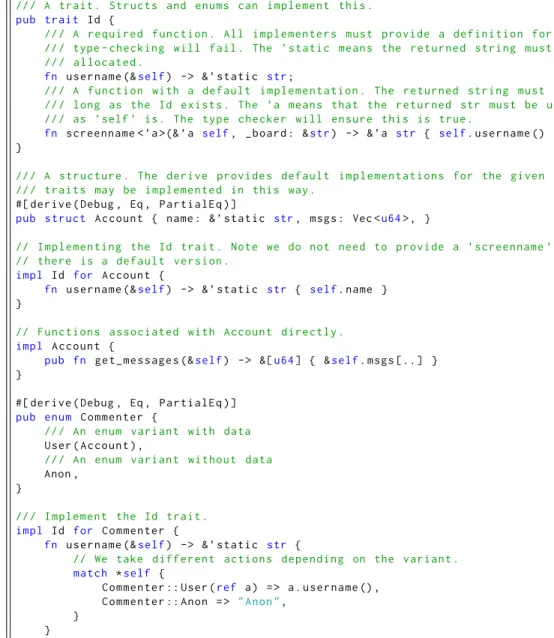
hand does not create a value. Within functions ev-erything is generally an expression except for (1)let variable bindings, such as on lines 14, 17, and 40 of Figure 1, (2) looping constructs, and (3) any expres-sion or statement with a semicolon (;) placed after it. Note that blocks, delimited by curly-braces ({}) are also expressions, using the value of the last expres-sion they contain as their value. In the same vein both if-elseand matchblocks are also expressions. In Figure 1 theif-else block beginning on line 9 is an expression of typeVec<T>, for example. Rusttakes this idea of the final expression of a block being its value even further, placing an implicitreturnbefore the final top-level expression in a function (in Fig-ure 1 this is theif-elsestarting on line 9); one may still use ‘return <value>;’ to return earlier, however. This can be seen on lines 41-44 of Figure 2, where the result of the match is what is returned by the func-tion. Furthermore, this means that we could change line 28 of Figure 1 to simply be ‘res’ and the meaning of the program would remain the same.
Another notable difference from C is that rust is fully immutable by default. In order to use an object mutably one must declare it mut, as is done in line 17 of Figure 1. One must do this even for function arguments, which is why there is a mut before the argumentlst on line 6 of Figure 1. This immutable default extends to pointers, which must be declared
&mutto be used mutably.
Rusthas a syntax for declaring structures and enu-merations that is very similar to C. One of the main differences is that enumerations can have data asso-ciated with them. In Figure 2 on line 30 we see the definition of an enumeration where one of its vari-ants (User) has data of the type Accountassociated with it. This data can be used inmatchexpressions, such as on line 42 of Figure 2. In rust there are alsotraits, which are similar to Javainterfaces and may have default function definitions associated with them. Usingtraits it is much easier to create generic functions than it is in C. For example, the quicksort implementation in Figure 1 only requires that the objects being sorted implement theOrd trait, mean-ing they have a total ordermean-ing. We can see the Id trait be defined on lines 2-11 of Figure 2, it is imple-mented for the Account type on line 20 and for the
Commenter type on line 38. Both enumerations and structures can have methods implemented on them directly or throughtraits. TheCommenter trait has aget messagesfunction implemented on it on line 26 of Figure 2. Rustwill transparently redirect function
calls through virtual method tables (vtables)5 when appropriate to allow handling objects astrait point-ers. This also makes it much easier to write generic code, as well as to hide implementation details in a much more straightforward way than is possible inC.
Rustalso supports declaring anonymous functions. Anonymous functions are declared by having a list of arguments surrounded by pipes (|) followed by a sin-gle expression. Type annotations similar to those on normal functions are allowed, but optional. The re-turn and argument types will be inferred if they are absent. An anonymous function is used on line 14 of Figure 1. On this line it is used to distinguish be-tween items less then the pivot so that thepartition function can split the items in the list into two lists. Figure 1 also makes use of therustmacro system. Inrustmacros are pieces of code that transform the abstract syntax tree (AST)6 at compile time, rather than just the raw text of the source code asCmacros do. Macros may be implemented using a special macro Domain Specific Language (DSL)7or by writ-ing a compiler-plugin for rustc[5]. Both systems allow the creation of hygienic macros, where there can be no name collision and the meaning is (mostly) independent of the context it is used in. The macro DSL does not allow any compile-time computation beyond pattern matching and has no explicit quasi-quote operator8, however compiler plugins may do both these things. Macros are identified by the exclamation-mark (!) that ends their name. They may expand to be either statements or expressions and may (generally) be nested. In Figure 1 I make use of the vec![...] macro, which creates aVec<T> filled with the arguments given to the macro, on lines 34 and 40.
Rust also has fairly robust support for pattern
5VTables are structures containing function-pointers used
to allow types to specify different implementations of standard functions for their use. They are similar to interfaces inJava.
6 An AST is a representation of a program as a tree, with
the nodes and edges representing the syntactic elements of the language. The tree as a whole represents the parse of the gram being examined. It is used as the representation of a pro-gram during compilation, optimization, and macro-expansion.
7 A DSL is a programming language created for some
spe-cific purpose. It is usually quite well suited for use in this domain but is less powerful or more difficult to use than more general languages. Some commonly used DSLs are the regular-expression syntax used by perl, the Hyper-text Markup Lan-guage (HTML) commonly used for creating web-pages, and the typesetting language LATEX.
8 A quasi-quote is an operator that turns a given piece of
text into an AST for the text. Using a related operation called “unquote” one is allowed to embed other ASTs as it does so.
matching. In ‘let’ statements one can ‘de-structure’ objects and tuples into their constituent parts, Fig-ure 1 does this on lines 9 and 14. On line 14 we de-structure the two-tuple returned by partition into the two lists that make it up. On that line we also need to specify that we wantVec< >s to tell the com-piler which variant of partition to use. It is also possible to do this with enums, although there one must either use an if-let, as Figure 1 does on line 9, or use amatchstatement to cover all possible vari-ants, as is done in the implementing of usernamein Figure 2 in lines 41-44.
1.2.2 Ownership
Another major feature of rust is its ownership sys-tem. In general, every object in rusthas some, spe-cific owner. The owner of an object is the one that is responsible for destroying the object when it goes out of scope. Ownership can be transfered by ei-ther passing the object ‘by value’ (without using a pointer) to another function or by returning an ob-ject from a function. When ownership is transfered in this way the object is said to be ‘moved’ to its new owner (although actual memory might or might not be moved). Once ownership has been transfered, the original owner of an object may no longer di-rectly use the moved object, it must obtain a pointer from the new owner if it is to do anything. A trans-fer of ownership can be seen in Figure 1 on line 43 where ownership of the variablelstis passed into the
quicksortfunction. If one attempted to make use of
lst after this line the compiler would prevent it by saying that the lst variable has been moved out of scope. In thequicksortfunction itself the ownership of the variable res is transfered up the call stack by returning it on line 28. The fields of an object are said to be owned by the object that contains them. This forms a tree of ownership, the root of which is either in some stack frame of the current thread or in a statically allocated object.
There are, of course, some exceptions to this sys-tem, such as reference counted pointers, weak ref-erences9 and mutexes. These types are all im-plemented using unsafe behavior, which allows one
9Reference counted pointers are special pointers that allow
objects to have multiple, concurrent, owners. The object ref-erenced will only be destroyed when all references to it are de-stroyed. Weak pointers are related to reference counted point-ers. Weak pointers allow one to have a reference to an object contained in a reference counted pointer without contributing to the reference count of said object. Theruststandard library implements these types asRc<T>andWeak<T>respectively.
to ignore the rust type checking and safety system. This makes sharing data between threads difficult, as there is no obvious owner for shared data. Further, when sharing data like this, one needs to ensure that all references stay valid as long as they are in use. I discuss some of the ways I dealt with this problem in subsection 2.4.
1.2.3 Type & Borrow checker
Therusttype checker is a fairly standard statically-typed language checker with type-inference. One in-teresting feature of the rust type checker is that it does type inference in multiple directions. It will choose which variant of a function to use based on both the types of its arguments and the (declared) type of its return value. For example in Figure 1 I need to specify that less and moreare both Vec or else the type checker would not be able to determine which version of partition to use. It is possible to use the underscore ( ) to mark places where the type-inference system should supply the types, as is done in Figure 1 on line 14. This is done by default when-ever one has a let statement where the type is not supplied, such as line 17 in Figure 1.
The other major feature of the rustchecking sys-tem is that it takes into account the lifetimes of data. Inrustwhenever one creates an object the checking system automatically gives it a lifetime. An objects lifetime is from when it is created until when it is de-stroyed. The lifetime of an object can change when it is moved by value but is otherwise constant. Life-times may be given names like any other generic, or one may use the special ’static lifetime, as shown in Figure 2. The name of a lifetime is always marked with an unmatched single quote (’). The borrow checker of rust makes sure that the lifetimes of all objects in a rust program are consistent. It works by whenever a pointer is created to an object that pointer retains the same lifetime as the pointed to object. Rustwill then ensure that no pointers outlive the lifetime of the object they point to and that the pointed to object cannot be moved (have its own-ership transfered) as long as there is pointers of it still (potentially) alive. For example, in Figure 2 on line 10 we specify that the lifetime of the returned string is the same as the lifetime of the object whose
screenname function is being called. The compiler will prevent one from using the string returned by this function anytime after the object that created it is destroyed. Lifetimes can also be incorporated as part of a type, allowing one to hold these pointers
inside of structs and enums. All of these checks are done purely at compile time, incurring no additional runtime overhead.
Rust does allow one to get around these checks if necessary. To do so one uses theunsafeenvironment. While in anunsafeenvironment one may do several things normally forbidden by the rust type and safety system. These include dereferencing raw memory and doing unchecked type casts.
2
Reenix
Reenix is the name of my project to reimplement as much of theweenixOS in rustas possible. I choose to split this work up in much the same way the orig-inal weenix project is split up. Of the five sections of weenix(see subsection 1.1), I was able to fully im-plement the first two, PROCS & DRIVERS. I was also able to finish a non-trivial part of the VFS project and made some of the auxiliary support code that is needed to complete S5FS & VM. In doing this I also had to convert and rewrite many large pieces of the
weenix support code into rust. The results of my project, including all code and patches to the origi-nalweenixproject, can be found on Github10.
2.1
Organization
In building reenix I used the rust language’s con-cept of crates. Rust crates are packages of related code that can be compiled into libraries, or (in some cases) binaries. They are generally identified by find-ing a folder with a ‘lib.rs’ file in it, which is the standard (though not obligatory) name for a crate-root. ForreenixI ended up dividing the project into nine crates that are entirely new. There are also three compiler plugins that I used in this project, two of which I created. Finally, I make use of several stan-dard library crates and even created a version of the standard library11that only uses crates available for
reenix. Overall reenix makes use of 18 crates, of which 12 of them are entirely custom.
Many of the crates in reenixmirror the organiza-tion of theweenixproject. The memory-management architecture is contained in the mm12 crate, the pro-cesses related code is in the procs 13 crate, and so on. There are, however, several crates which have no real analog inweenixthat are present inreenix.
The first and most basic of these is thebasecrate. This crate holds a large and rather diverse collection of types and traits. This is partly to make it possible for crates to know about some of the types of other crates further down the dependency tree. By
declar-10https://github.com/scialex/reenix(April 2015)
11Theruststandard library is made up of a large number of
separate crates which are all joined together in a single crate calledstd. This is commonly called the standard library facade by therustcommunity. Thestdcrate is treated specially by the compiler which automatically includes some modules from it in every file, allowing one to use the standard rust types without explicitly importing them.
12See subsection 2.3 13See subsection 2.4
ing certain traits in this crate we can allow them to be used in all crates, even ones which are dependencies of where the trait is implemented. Another function of this crate is to hold the definitions for many of the basic data types used inreenix, such aserrnos. I also placed the ‘dbg!’ macro14 in this crate so it could be used everywhere without difficulty.
Another new crate is the (somewhat badly named)
startupcrate. This crate mostly contains stubs toC code that implements functions related toACPI,PCI, andGDT15, used mostly during boot, hence its name. These are all very tightly related to the actual hard-ware and managing them requires the ability to per-form complicated bit-twidling and memory manipu-lation, something rust could be better at. It also includes an implementation of thread-specific data functions. These were mainly put here, and indeed created at all, due to the fact that implementing the
rust stack overflow detection16 for reenix threads made them fairly trivial.
The last totally new crate is theumem crate. This crate is not fully finished and currently holds some of the mechanisms needed to implement user-space virtual memory and page-frame caching. In weenix these are part of the mm hierarchy, however to do that withrust would require that we only have one crate and would make using theruststandard library much more difficult.
2.2
Booting
One of the first challenges I had while writingreenix was getting the system to boot at all. Weenix(at the time I started) made use of a custom 16-bit assembly code boot-loader. This boot-loader, unfortunately, did not support loading any kernel images larger than 4 megabytes. This turned into a problem very quickly as it turns out that rustc is far less adept thangcc at creating succinct output. In fact, I was hitting this problem so early I was barely able to make a “Hello
World” before having to stop working on rustcode. Fixing this problem required rewriting most of the early boot code, all of which was x86 assembly. It also required rewriting parts of the build system
14‘dbg!’ is the debug printing macro. It prints out text to
the standard output of the host computer, aiding debugging.
15ACPIis the Advanced Configuration and Power Interface,
it controls basic power-management functions. PCIis the Pe-ripheral Component Interface, it controls the use of pePe-ripherals such as video cards, keyboards and mice.GDTis the Global De-scriptor Table, it affects how we address memory.
16See subsection 2.8
to create boot disks that used GRUB17, a common
Linuxboot-loader, and changing the boot sequence to support the multiboot specification18. This, in and of itself, was not terribly difficult, though the fact that this was absolutely critical to making any sort of at-tempt to do this project does show that some of the simple hacks that are possible withCcannot be done withrust. WithCit is perfectly feasible to keep even a moderately complicated kernel like weenix’s down under 4 megabytes, and in fact almost nobody has ever run into this limit during CS169’s history. With
rust, however, this limit was blown through almost immediately. While it is most likely that this is more to do with therustcompiler’s optimizations (or lack thereof) than the language itself, the fact is that op-timizations matter to any software developer. Rust’s relative lack of them when compared to more estab-lished languages must be considered.
2.3
Memory & Initialization
Another early challenge I faced was getting mem-ory allocation working. For many reasons, includ-ing feelinclud-ing it was rather outside the scope of this project, I choose to make no attempt to implement a memory allocator in rust and instead use the ex-istingweenixallocators. This led to a small problem since theweenixallocators areslaballocators, which allocate fixed-size data structures from contiguous slabs of memory. These types of allocators are ac-tually extremely useful for kernel tasks and are used in many real-world kernels, such as FreeBSD[11] and
Linux[3]. They are also commonly combined with ob-ject caching schemes[1, 6], although weenixdoes not use such a scheme. Since there are generally only a few structures with known sizes that need to be allo-cated at any one time this works quite well for most OSs.
The only problem is that rustwas built with the idea that it will be used with amallocstyle memory allocator. This kind of allocator is rather hard to im-plement using slab allocators since malloc must be able to allocate buffers of any size. One needs to cre-ate some system where the mallocfunction will find a suitable allocator from the many different sizes of
slab allocators. There has been some debate about adding support for custom allocators to rust, which could allow one to use slab allocators easily, but this has been postponed until afterrust1.0 comes out at
17https://www.gnu.org/software/grub/(April 2015) 18https://www.gnu.org/software/grub/manual/multiboot/
least[7]. Further, the language and the compiler are also built with the idea that allocation is, in some sense, infallible. In an operating system kernel, this is an impossible standard to keep. This is, unfortu-nately a rather deep problem as well since the rust compiler has these assumptions built into it. I discuss this problem in more detail in subsection 3.3 bellow. In order to support this I ended up needing to write a rather complicated shim around theweenix alloca-tors so as to support the rust allocator model. I ended up making code that would search through all known allocators whenever memory was allocated and select the best one available to supply the mem-ory. This though created problems as it would be useful to still have allocators perfectly sized for com-mon types, to ensure good space utilization. To do this however we need to get a full list of all allocators that we will commonly be using. This required me to create a somewhat strange multi-stage initialization scheme for boot. I needed to have a first stage of initialization where allocation is not yet set up. Dur-ing this phase each piece can request allocators be reserved for them, or do other startup related tasks that do not require allocation, including most initial-ization of the C parts of the project. This is added onto the other two phases of the initialization tap-dance from weenix. Once this is done we do all the other initialization that is possible before we are run-ning in a real thread context, then we do the final initialization once we have entered the idle-process.
2.4
Processes
In this section I will talk about how processes are cre-ated, controlled and stopped, covering the two most basic functions of a process system. Next, I will talk about how inter-thread synchronization is performed and maintained. Finally, I will examine the reenix scheduler and explain how it is made and behaves.
The first major part of reenix that is also im-plemented in theCS169 weenix project isPROCS, en-compassing process-control, scheduling and synchro-nization. I chose to follow the basic weenix design for my process structure. There is a separation be-tween a process and a thread, where there is a hier-archy of processes each of which has threads of exe-cution. Threads and processes are represented sep-arately; each process has at least one thread. As in standard unix, we keep track of the parent-child re-lationships among processes and will move orphaned processes to theinitprocesses. Processes hold infor-mation about the child processes and memory map;
1 pub struct KProc { 2 /// our Process ID
3 pid : ProcId ,
4 /// Process name
5 command : String ,
6 /// Our threads
7 threads : HashMap <u64, Box <KThread >>, 8 /// Our children
9 children : HashMap <ProcId ,
10 Rc < ProcRefCell <KProc >>>, 11 /// Our exit status
12 status : ProcStatus ,
13 /// running / sleeping /etc.
14 state : ProcState ,
15 /// Our Parent
16 parent : Option <Weak < ProcRefCell <KProc >>>, 17 /// Page directory
18 pagedir : PageDir ,
19
20 /// wait - queue for waitpid 21 wait : WQueue ,
22 }
Figure 3: The process structure in reenix is very
similar to how it is in weenix, though it make use of
HashMaps to store the children and threads instead of the interned lists of weenix
a slightly annotated definition of the process struc-ture can be seen in Figure 3. If I had gotten farther on implementing it, processes would also hold infor-mation on open files and the current directory which is shared by all threads. Threads hold information about what the process is currently doing, are what the scheduler works with, may block and has a stack.
2.4.1 Control & Creation
Reenixhas a very simple process control model. One may create a process at any time by calling the
KProc::new function and giving it a function to be invoked by its first thread. This function returns the new process’s unique id number, or a value identifying the error if something went wrong. Once this func-tion has been called, the created process will continue running until either all threads finish or it explicitly stops itself. Currentlyreenixdoes not support mul-tithreaded processes. A thread can therefore only be created by creating a process. This restriction is cur-rently there for convenience. The design of processes and threads is made to allow one to switch to hav-ing multi-threaded processes rather easily. There is no facility analogous to kill(2) in reenix, one may
cancel a thread or process, which might wake up a thread if it is sleeping and prevent it from sleeping
again, but there is no way to force a thread to exit, threads exit only under their own volition. Finally any process can wait for its children to exit, through the use of awaitpid(2)like function. Processes may wait either for any child process to exit, or for a spe-cific one. Waiting for a process that has already ex-ited to finish occurs without sleeping.
A major challenge in implementing all of this was simply the question of ownership of the process struc-tures. The most obvious answer is that each process should own the process structures of all of its chil-dren. This mirrors the process tree we are creating with waitpid and is rather simple to implement. If we do this we need to deal with the fact that each process must keep track of its parent, to allow one to notify a parent sleeping inwaitpid. Furthermore, it is important for usability that we not need to pass the current thread variable around all the time, therefore we need to have some way to turn an arbitrary pro-cess id into a propro-cess structure that we can cancel or query. In order to allow all of these uses we handle process structures mostly through reference counted
Rc<KProc> pointers, with all non-owning references being Weak<KProc> weak references19. This lets us leave the owner of a process structure as its parent while still letting us access it safety since rust will not allow one to access a Weak<T> without checking that it is still present and getting a full reference to it.
A benefit of using rusthere was that scope-based destructors allowed me to simplify the code some-what. These destructors allowed me to define cleanup code that is run whenever an object goes out of scope, simplifying error cleanup. For example, I could gen-erally just return an error code if creating a new pro-cess failed for some reason, knowing that all the tem-porary values, including the new process structure, would be destroyed. This meant I did not need to re-peat cleanup actions in multiple places or use a ‘goto
error’ based cleanup system.
2.4.2 Synchronization
Sincereenixis a strictly single-core operating system we can have a rather simple synchronization scheme. All synchronization in reenix is based around wait queues. A wait queue is a simple synchronization primitive similar to a condition variable. Anything may choose towaiton a wait queue and they will go to sleep until some other thread signals the queue.
19See subsubsection 1.2.2
These functions take care of masking off interrupts when they are being used, preventing interrupts from occurring while a thread is going to sleep or being wo-ken up. Wait queues are implemented with a struc-ture called aKQueue. In my implementation one may only wake-up the entire queue at once, furthermore one may optionally go into a sleep such that being canceled will cause the thread to wake up. Using this it is fairly straightforward to create all the other synchronization constructs one could desire, such as
Mutexs, or condition variables. In order to make these structures more generic I also created a pair of traits which encapsulated this behavior.
Like with process control above, implementing this form of synchronization led to some tricky questions of ownership. This is because, in the end, a wait queue is simply a list of threads that are currently paused. The wait queues clearly should not be the owners of the threads in any sense and should simply have temporary references to them. Unfortunately the rustlifetime system gets in our way since there is no clear lifetime we could give to the references that is consistent across all threads. This is because lifetimes in rust are always related to the call stack of the current thread of execution. Rust assumes that everything that any given thread can see is either (a) going to be around forever or (b) was created in some particular function call in the current call-stack and will be destroyed when we move through said frame. This makes working with references which, in some sense, live on entirely separate stacks very tricky. Since each thread has a totally separate life-time from all of the others there is no way forrustto prove that the references are safe to use20and there-fore it will not allow us to write the queue in this way. One possible solution would be to use weak references as we did with processes in the previous section, and, if I were to do this project again, I would likely do just that. Instead, I chose to exploit another one of the nice features of rustwhich is the ability to explicitly ignore some of rust’s safety checks. I therefore held the queued threads as simple pointers, casting them back to threads when they are removed. This solu-tion is funcsolu-tionally equivalent to the naive method discussed above and is just as safe. It also conve-niently avoids the extremely heavyweight nature of the weak-reference solution, by avoiding the need to keep around a reference counted pointer simply so we can get sleeping working.
2.4.3 Scheduling
The reenixOS employs a simple, First-in-First-out scheduler. It maintains a simple list of running threads. Each thread keeps track of its state in a specialContextstructure that holds the values of its instruction pointer and other registers, as well as the thread-local-storage data.
This naturally runs into many of the same issues that the wait queues do in terms of ownership and it solves them in the same way. One other, somewhat strange, issue I had was with the compiler optimiz-ing away many of the checks in the loop the scheduler performs when there is no thread to run immediately. It would believe that since it had the only mutable reference to the list there was no way anything else could modify it. Unfortunately, this list is often mod-ified by interrupt contexts and must be checked each time. While such an error could (and, with optimiza-tions turned on, does) happen in C it is much more difficult to fix in rust. In C, one must simply mark the variable being used asvolatileand the compiler will stop attempting to optimize its access. To do the same inrust, one must be sure that all reads of the variable are done through a special marker function to read the variable.
2.5
Drivers
The next major part of reenix is to add basic de-vice drivers. I chose to follow theweenixproject and have an (emulated) ATA hard disk driver and a ba-sic TTY21 driver stack. This allows one to have a (small) amount of interactivity with the OS, eas-ing testeas-ing and analysis and also allow one to have persistent storage at some point in the future. Fur-thermore, both these drivers are rather simple, well understood, and well documented, easing the process of making them from scratch.
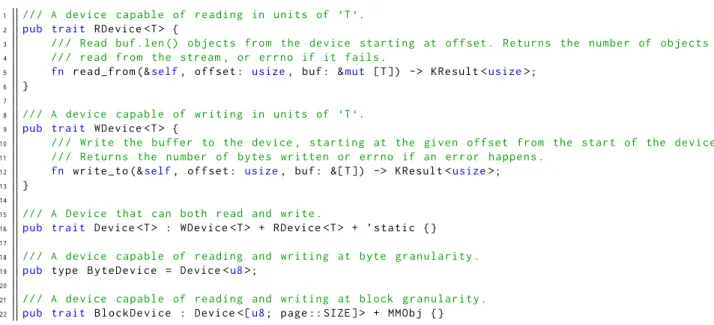
In order to make the use of drivers easier in other parts of the kernel I created a basic trait to en-capsulate their basic functions. They can be seen in Figure 4. They nicely abstract the way one uses in-put/output devices inside the kernel. Furthermore, they illustrate a nice feature of rust in that one can reimplement the various Device traits multiple times with different type arguments. This is
ex-21 TTY (sometimes called tele-typewriters or text
termi-nals) are a common interface forunix-like operating systems. They provide users with an area where they type commands and other data as text and the programs may write text in response.[6]
tremely useful with things like memory-devices such as /dev/zero, which one might want to either read whole blocks of memory from or read character by character.
This section will explore the implementation of each of the drivers I created for reenix. It will also examine any of the problems I faced while creating them.
2.5.1 TTY Stack
The TTY subsystem inreenixis split into five sepa-rate parts. At the lowest level is the keyboard driver, which allows one to receive input from the outside world, and a simple display driver, letting one print characters for the outside world. The display driver is a simple VGA mode 3 text video interface, avoid-ing the trouble of creatavoid-ing a real video driver that needs to draw everything to the screen. The key-board driver is implemented as a standardPS/2 key-board and supports all of the standard keys and some of the meta-keys. Both of these are implemented fully in rustbut are rather simple ports of the Cversions included withweenix.
Using the screen driver I created a simple vir-tual terminal driver. A virvir-tual terminal is a com-monunixabstraction that represents a virtual screen with a keyboard. These virtual terminals implement scrolling and a cursor that keeps track of the next place to write to. This is another mostly straight port from Ctorust.
Finally, above virtual terminal and keyboard driver I created the TTY driver and line-discipline. These are the actual drivers used in running a TTY. The TTY driver receives interrupts from the keyboard, passes them to the line discipline, which might pro-cess and record them, then echoes them out to the screen. When the tty is written to it uses the line discipline to translate the characters so they can be displayed and then passes them to the virtual termi-nal. When the tty is read from the next full line is returned, or the current thread goes to sleep until a full line is typed.
There were no major challenges that needed to be dealt with regarding the reenix design during this part. About the only somewhat difficult challenge was that I was unable to find any clean way to switch between different virtual terminals. I ended up hav-ing to just update a pointer so that the interrupt subsystem could know which TTY to send input to. Though this is also a problem in the C version, the fact that this was the best way to solve this
prob-1 /// A device capable of reading in units of ‘T ‘. 2 pub trait RDevice <T> {
3 /// Read buf.len () objects from the device starting at offset . Returns the number of objects 4 /// read from the stream , or errno if it fails .
5 fn read_from (&self, offset : usize, buf: &mut [T]) -> KResult <usize>; 6 }
7
8 /// A device capable of writing in units of ‘T ‘. 9 pub trait WDevice <T> {
10 /// Write the buffer to the device , starting at the given offset from the start of the device . 11 /// Returns the number of bytes written or errno if an error happens .
12 fn write_to (&self, offset : usize, buf: &[T]) -> KResult <usize>; 13 }
14
15 /// A Device that can both read and write .
16 pub trait Device <T> : WDevice <T> + RDevice <T> + ’static {} 17
18 /// A device capable of reading and writing at byte granularity . 19 pub type ByteDevice = Device <u8>;
20
21 /// A device capable of reading and writing at block granularity . 22 pub trait BlockDevice : Device <[u8; page :: SIZE]> + MMObj {}
Figure 4: TheDevicetraits encapsulates a hardware device capable of reading and writing fixed size data
lem I could come up with is disappointing, since it is very much something that rust discourages. Ac-tually switching the interrupt handler would be an-other possible solution but doing so seemed incredibly heavyweight, especially since the different functions would be almost identical. Furthermore, I am ac-tually unsure what the implications of changing out interrupt handlers while handling an interrupt would be, and, as far as I am aware, no operating system changes out interrupt handlers as often as this would have to.
2.5.2 ATA Disk
TheATAdisk driver inreenixis a fairly simple block-device driver. It is capable of reading and writ-ing specified blocks to the disk, includwrit-ing performwrit-ing multiple consecutive reads and writes at once. To do this the driver makes use of direct memory access (DMA). When using DMA the driver writes to spe-cific memory locations which the memory bus uses to send instructions to the disk[6]. The disk then per-forms the specified operation, loads the result into a (user specified) memory location, and triggers an interrupt on the CPU.
As this whole process is fairly straightforward there are few differences between myrustversion and the
Cversion that one creates inCS169. The main differ-ences being thatrustallowed me to move away from somewhat arcane macros in controlling the DMA
de-vice.
Other than figuring out what theCcode was doing in order to replicate it, the main difficulty I had was
rust’s relative lack of alignment primitives. To use DMA one needs to deal with a data-structure called the Physical Region Descriptor Table (PRD). This table tells the PCI bus where the memory that the DMA is going to be using is. Because this table is so inextricably linked to the hardware it has very strict alignment requirements; it must be aligned on a 32 byte boundary. In C this is not a very large prob-lem; one can simply statically allocate the table with an attribute about its alignment, or just dynamically allocate a buffer using an aligned allocator or just enough space to guarantee one can get the alignment. Inrust this is a much more challenging problem for several reasons. First, there is no good way to force alignment of data inrust, the current recommenda-tion is to put a zero-length array of a SIMD type to emulate it[13]. Second, thereenixallocators can-not guarantee alignment in any meaningful sense so it is a moot point since I could not get good align-ment anyway. I could allocate these statically but I have been trying to avoid doing this asrustdoes not make doing so simple. Furthermore, since the CPU I am compiling for lacks support for SIMD types I am unsure if even the recommended approach would work. In the end I chose to over-allocate and man-ually align the data whenever I use the PRD table,
which is rather cumbersome, error-prone, and com-plicated.
2.6
KShell
Once I had the TTY driver finished one of the first things I worked on was a simple command shell, which I called theKShell. This allows one to interact with the operating system in a way that was previ-ously impossible, dynamically selecting tasks using the keyboard. With the KShell it became so much easier to test and examine the operating system. It is difficult to overstate how useful this is for testing, suddenly it was possible to simply experiment with different sequences of commands without recompil-ing. Furthermore, without theKShellit would have been much more difficult to test the TTY driver. Fi-nally, since I have not yet implemented any form of userspace, a kernel-space shell is the only possible way we could interactively control the system.
Like most command shells, theKShellis based on a simple read-evaluate-print loop. There are a number of commands that theKShellis able to use, including aparallelcommand to run other commands in their own threads. Each of the commands is written as a
rust function which runs the command and returns a value indicating whether it succeeded.
One of the most interesting things about the
KShell is how similar it is to a generic REPL shell written in rust. In many ways it is implemented in almost exactly the same way one would in normal
rust; the types are the same, the loops are the same, etc. This is rather interesting since it shows just how much of theruststandard library can be used with-out modification in reenix. For most higher-level languages, the lack of a real runtime when running in kernel mode would severely constrain the sort of code one could write here.
Furthermore, while writing theKShellit struck me how much easier writing it inrustseemed to be than doing the same thing inC. By writing it inrustI was able to take advantage of features such as easy-to-use list and mapping types and being able to make use of
rust’s high level string routines. These removed some of the more annoying aspects of creating a working command shell that would have been present inC.
2.7
Virtual File System
Once I had finished working on getting drivers work-ing I next started to work on creatwork-ing a virtual file system for reenix. A virtual file system (VFS) is a
common abstraction in unix-like operating systems first created and popularized by Sun in the mid-1980s[8]. It is designed to smooth over the differ-ences between various on-disk and network file sys-tems. The VFS defines common interfaces for all the major file system manipulation and interaction rou-tines, such as searching a directory, creating a file or directory, or opening, reading, and writing to files. It also commonly defines a data block cache to al-low the caching of reads to underlying block devices by the file systems underneath it.22 Bothweenixand all majorunix-like operating systems today make use of a VFS-like interface in order to ease the use and creation of file systems.
Unfortunately, due to time constraints, I was un-able to get very far in implementing a VFS forreenix. In order to allow incremental testing of components I decided to follow the example of weenixand imple-ment a rather simple, in memory, file system, called
RamFS, to test some of the VFS specific features before moving on to implement the much more complicated
S5 file system. I was, however, able to implement parts of the block-device and caching layer thatS5FS would have used to access the disk, and create a rea-sonably completeRamFS.
This section will examine each of the three parts of
VFSthat I was able to at least get a start on complet-ing. We will first look at the design of theVNodetrait and the decisions that went into it. Next, we shall look at theRamFStest file system, which I was able to mostly complete. Finally, we will examine the page-frame, memory object, and their attendant caching system which I was only able to get a small start on.
2.7.1 VNodes
The major data type in the virtual file system is the
VNode. A VNode is the VFS representation of what a file or other file system object is and what it can do. It consists mainly of a large number of functions that will do the main file system operations on theVNode. Since it is mostly defined by the functions it imple-ments, inreenixI made theVNodebe a trait. VNode’s generally have multiple, concurrent, owners who all make use of the underlying file data. Inweenixthis is implemented by performing manual reference count-ing on the VNodes, which is one of the most difficult and error-prone parts of the assignment.
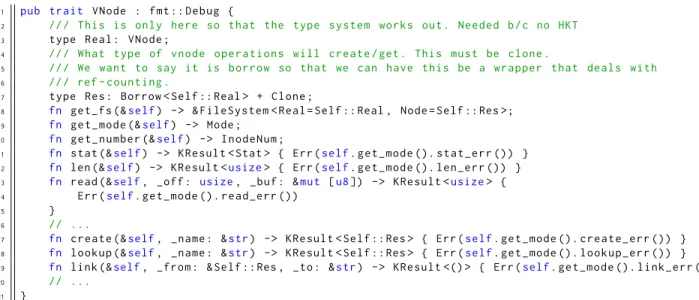
A part of the reenix VNode trait can be seen in Figure 5. One thing to note about this is that I make
22Inweenixthis cache is actually implemented by students
1 pub trait VNode : fmt :: Debug {
2 /// This is only here so that the type system works out. Needed b/c no HKT 3 type Real: VNode ;
4 /// What type of vnode operations will create /get. This must be clone .
5 /// We want to say it is borrow so that we can have this be a wrapper that deals with 6 /// ref - counting .
7 type Res: Borrow <Self :: Real > + Clone ;
8 fn get_fs (&self) -> & FileSystem <Real =Self :: Real , Node =Self ::Res >; 9 fn get_mode (&self) -> Mode;
10 fn get_number (&self) -> InodeNum ;
11 fn stat (&self) -> KResult <Stat > { Err(self. get_mode (). stat_err ()) } 12 fn len (&self) -> KResult <usize> { Err(self. get_mode (). len_err ()) } 13 fn read (&self, _off: usize, _buf: &mut [u8]) -> KResult <usize> { 14 Err(self. get_mode (). read_err ())
15 } 16 // ...
17 fn create (&self, _name : &str) -> KResult <Self ::Res > { Err(self. get_mode (). create_err ()) } 18 fn lookup (&self, _name : &str) -> KResult <Self ::Res > { Err(self. get_mode (). lookup_err ()) } 19 fn link (&self, _from : &Self ::Res , _to: &str) -> KResult <() > { Err(self. get_mode (). link_err ()) } 20 // ...
21 }
Figure 5: TheVNode trait
use of rust’s type system to represent the fact that we will often not be dealing withVNodes directly but instead with wrappers that handle reference counting for us. We say that the result type of functions like
createmust be usable as some type of VNode. This allows us to have each separate type of file system object23 implementVNode and yet return a standard
enum that might be any of these file system objects. By requiring that this result type is copyable (the
Clone trait), we hide how the backing file data is shared betweenVNodes which reference the same ob-ject, allowing the reference counting to take place be-hind the scenes. We can simply return a type that is wrapped by some reference counter that makes sure we remove theVNodewhen it is no longer referenced. For example inRamFS the result type is Rc<RVNode>. This prevents a whole class of errors that is one of the trickiest parts of VFS inweenix, by removing the need for manual reference counting.
2.7.2 RamFS
RamFS is the name of a testing-focused, in memory, file system used to test ones VFS implementation in
weenix and reenix. This “file system” implements all the calls needed to be used by VFS without actu-ally being backed by a disk. Inweenixthis system is provided as support code to enable one to test VFS without having to be concurrently working on
creat-23For example, directory, file, device, etc.
ing theS5file system.
I actually made several attempts to implement
RamFS before coming up with its final design. My initial design was to do a straight port from
C to rust. I could not simply use a stubbed version that called directly into the already finished C code because it relied on a lot of the otherweenixsupport code, such as the VNoderepresentation. This turned out to be much more difficult than I had thought it would be.
The C RamFSis mostly implemented just as a nor-mal file system is, but with a massively simplified system for keeping track of allocated file nodes and no system for allocating blocks of memory (all files and directories get exactly one block). This means that, for example, directories are implemented as an array of bytes which is cast to an array of directory entries. While this does mean that it is very similar to real file systems in this way, it is a problem since
rustdoes not make working with raw, untyped, stor-age as simple as C does. InC one would simply cast the array and work with it as the array of (possi-bly uninitialized) directory entries that it is, doing so in rust is rather cumbersome. While this prob-lem would need to be handled eventually with S5FS (probably through the use of a binary-serialization li-brary) I decided that, in the interests of time, I would take a simpler route.
My second design for RamFS was to create as sim-ple of a mock file system as I could. I abandoned
any notion of creating something similar to a real file system in implementation. Each type of file system object is a different type, each directory is simply a map from file-names to nodes, reference counting is done through the standard-libraryRc<T>type and so on. This did make the implementation far simpler, allowing me to quickly finish most of it in a short time. Unfortunately by the time I had gotten this done there was little time to work on the rest of VFS beyond what I had already done. It was during this that I made the final design decisions surrounding howVNodeswork.
2.7.3 PFrames & MMObjs
When I began working on VFS I had initially not planned to create theRamFSfile system and had there-fore started by creating much of the support code that is needed by S5FS. This support code contains the structures necessary to implement the block-cache needed by most file-systems, which RamFS does use. These systems are often considered a part of the vir-tual file system subsystem by operating system ker-nel projects, although in weenix they are not im-plemented until the S5FS project. This system is made up of two major components, MMObjs, which are an abstraction of a data source that can pro-vide (cacheable) pages of data, and PFrames which are pages of data from anMMObjwhich can be cached and updated. A PFrame is conceptually owned by its sourceMMObj and is, in some sense, simply a cur-rent view into that MMObj. In fact though, PFrames are cached separately from MMObjs, and the MMObjis mostly responsible for simply filling in thePFrameand writing the data back when thePFrameis destroyed. In reenix these pieces are not fully completed, al-though the interfaces they expose are fully written.
The basic MMObj trait can be found in Figure 6. One interesting thing to note about this design is that none of these functions is ever called directly by file system driver code other than thePFrame sys-tem. When a file system needs a page of memory from an MMObj the basic call structure would be to request a PFrame of the given page number on the
MMObj. This will first search the globalPFramecache to see if it is already there, returning it if so. Other-wise it will create a newPFrameand fill it with data using the MMObj. The caller may then make use of thePFramehowever it wants since they are reference-counted preventing them from being removed while in scope. When a PFrame goes out of scope it will check to see if it is reachable from anywhere, either
as a reference or from its MMObj. If it is not (or if there is little memory left) it will check to see if it has been modified and if so have the MMObj write it back.
The most important challenge I faced while creat-ing this was convinccreat-ing myself that the call structure is actually what I want. For the first time many calls are moving through traits that hide implementation, making it difficult to determine what is going to be happening. Another challenge I have been having is that this system is very difficult to test in isolation.
2.8
Other Challenges
As I was working on reenix there were many chal-lenges and decisions that I needed to make that were not part of any single piece of the project. These chal-lenges included implementingruststack-overflow de-tection, implementing thread-local-storage and sim-ply getting the project building at all. The difficul-ties I had in doing these, and the need to do them at all, are mostly due to the differences between C and
rust.
2.8.1 Stack Overflow Detection
One of the nice features that rust has over many other (commonly) compiled languages such as C is it supports built-in stack overflow detection. This means it is able to detect stack overflow even if there is no hardware memory protection available. Rust uses theLLVM24provided method of doing this by hav-ing all subroutine calls check a thread-local variable that holds the address of the end of the stack. On each subroutine call the function use this to check if there is enough space on the stack to hold all of its local variables. Specifically, it will check the value at offset0x30within the%gssegment25onx86systems. Since this feature makes use of (implicit) thread-local variables, it requires specific runtime support and setup to work.
24LLVMis a compiler project and toolchain that provides a
standard intermediate representation which may be targeted by other compilers[9]. This is then turned into binary code for several different machine architectures. It is used by therust compiler to create the final binary code for arustprogram.
25Memory segmentation is a method of addressing onx86
and related processors. It was originally developed to allow 16 bit processors address up to 24 bits of memory. It works by having segments that start at a particular address and extend for a specified number of bytes. All memory accesses are per-formed relative some segment, either specified in the assembly code or a default one. The segment definitions are held in the global descriptor table.
1 pub trait MMObj : fmt :: Debug {
2 /// Return an MMObjId for this object . 3 fn get_id (&self) -> MMObjId ;
4
5 /// Fill the given page frame with the data that should be in it. 6 fn fill_page (&self, pf: &mut pframe :: PFrame ) -> KResult <() >; 7
8 /// A hook; called when a request is made to dirty a non - dirty page. 9 /// Perform any necessary actions that must take place in order for it 10 /// to be possible to dirty ( write to) the provided page. This may block . 11 fn dirty_page (&self, pf: & pframe :: PFrame ) -> KResult <() >;
12
13 /// Write the contents of the page frame starting at address 14 /// pf.page to the page identified by pf. pagenum .
15 /// This may block .
16 fn clean_page (&self, pf: & pframe :: PFrame ) -> KResult <() >; 17 }
Figure 6: TheMMObjtrait
1 c0048f10 <kproc :: KProc :: waitpid >: 2 # Compare used stack with end of stack 3 c0048f10 : lea -0x10c (%esp),%ecx 4 c0048f17 : cmp %gs:0x30 ,%ecx
5 # Continue if we have enough stack space 6 c0048f1e : ja c0048f30
7 <kproc :: KProc :: waitpid +0x20 > 8 # Save meta - data about stack
9 c0048f20 : push $0xc 10 c0048f25 : push $0x10c
11 # __morestack will abort the current process . 12 # The name is a remnant from when rust supported 13 # segmented stacks .
14 c0048f2a : call c000975c <__morestack > 15 c0048f2f : ret
16 # Standard x86 function prelude 17 c0048f30 : push %ebp
18 c0048f31 : mov %esp,%ebp 19 c0048f33 : push %ebx 20 c0048f34 : push %edi 21 c0048f35 : push %esi 22 c0048f36 : sub $0xfc ,%esp
Figure 7: The disassembled function prelude from
KProc::waitpid.
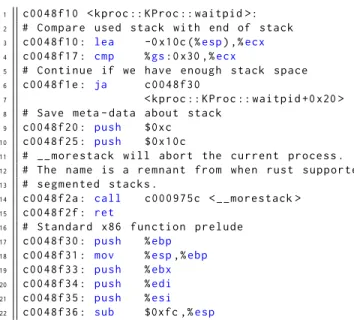
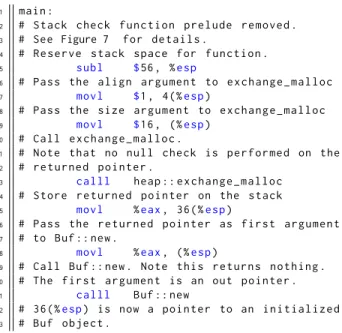
A copy of the standardrust x86function prelude can be seen in Figure 7. There we can see that the function will first calculate the farthest point on the stack it will use on line 3. Then it loads the end of the stack from the %gs segment and compares it to the required stack space on line 4. Finally, on line 6 it either jumps to the actual function or calls the
morestackfunction to abort the thread.
Unfortunately,weenixhas no support for this type of stack checking so I needed to implement it myself
if I wanted to use it. Initially, I had thought I could just disable this functionality, sinceweenixworks per-fectly fine without it. Unfortunately, however, at the time that I started this project there was no way to re-move this stack checking code from functions globally. This meant that in order for my code to run, I had to support the stack checking method used by LLVM. Doing this was actually somewhat less difficult than I feared it might be. Using the Global Descriptor Ta-ble (GDT) manipulation routines provided byweenix, I was able to write a data-structure that would store the stack endpoint at the appropriate offset. This data structure can be seen in Figure 8.
From there I still had some small amount of work to do. I next needed to make sure that there was no call with stack-checking enabled until we had success-fully set up the%gs GDTsegment, which was actually somewhat tricky. Next I needed to ensure that dur-ing process switchdur-ing we would correctly change the value of the %gsdescriptor and, again, make no calls with stack-checking enabled until we had successfully switched processes. Once this was accomplished all that was left was to wire up the error-reporting func-tions, which was mostly made difficult by the relative lack of documentation. Ironically, less then a week after I had finally finished getting all of this stuff to work, the rustdevelopers added a switch to the
rustc compiler that let one disable the stack check-ing completely. Still, the experience of implementcheck-ing this was very informative and helped me implement the thread-local storage described below. It also did legitimately help with doing the rest of the project as it helped me find several accidental infinite recursions
1 #[ cfg( target_arch ="x86")] 2 #[ repr(C, packed )] 3 pub struct TSDInfo { 4 vlow : [u8; 0x30],
5 stack_high : u32, // At offset 0x30 6 /// The other thread specific data. 7 data : VecMap <Box <Any >>,
8 }
Figure 8: The TLS data structure
in my code.
2.8.2 Thread-Local Storage
Once I had finished getting the stack-overflow detec-tion inrust working I realized that I had most of a thread-local storage system. Since there was so little of it left to do I decided to implement the rest of it. There is no comparable system in standard weenix. To do this I simply added aVecMap onto the end of the structure holding the stack data.
I chose to use this thread-local storage to hold some information that is held in static variables inweenix, specifically the current process and thread. By stor-ing this data in this manner it also removes one of the obstacles to makingreenixusable on multi-processor machines, although there are still a number of other issues with doing this. The thread-local data storage structure is shown in Figure 8. Note that it holds the thread-local data in a VecMap<Box<Any>>. The
Box<Any>type is a special type that uses limited run-time type information to perform checked, dynamic casts. This lets me store arbitrary thread-local data in this map without having to know exactly what it is, while the users of said data may still check and make sure that the data they receive is the correct type. For example, the currently running process is stored using in this structure. This can occur despite the fact that the TLD structure has no notion of what a process structure is. When the current process is retrieved the user must manually check, using theAny
trait, that the returned value is, in fact, a process.
2.8.3 Build System
One last unexpected challenge that I had while writ-ingreenixwas getting it to be built at all. The stan-dard way to buildrustcode is to use its custom build tool, cargo. This tool is perfectly sufficient for most normalrustprojects, it even includes fairly good sup-port for linking to external libraries or invoking other
build tools. Unfortunately, the tool is very difficult to use if one needs to perform more complicated link-ing or build operations. Therefore I had to figure out how to create a makefile that would work withrust. This turned out to be somewhat difficult because I needed to make sure that rustconly uses the ver-sions of the standard library and other libraries that I built. In addition the dependencies between crates are much more complicated than normal C depen-dencies, depending on the libraries created by other crates. Furthermore there are two slightly inconsis-tent naming conventions in use inreenix, theweenix naming conventions and the rust standard library naming conventions. All this ended up meaning that I had to create a rather complicated set of makefile macros that creates the rather large rules dynami-cally, using therustcdiagnostic functions to get the names correct.
2.9
Future Work
There is still much work to be done beforereenixis at a point that could be called complete. The most obvious first step is to complete the remaining three parts of theweenixproject;VFS,S5FSandVM. Doing this will require solving several design questions for
reenix. Some major open questions are how reenix should keep track of open files, how we should interact with the serialized binary data-structures that make up theS5file system, and how we should keep track of memory mappings.
Furthermore, there are still large parts of the
weenixsupport code that must be rewritten inrust. Major components that must be ported include the file system test suite, the actualsyscallhandler rou-tines, the ELF file loader and a time slice system. Each of these are important, though ultimately rather simple, pieces of an operating system kernel and are very specific to the architecture of the kernel as a whole, preventing one from simply using the weenix versions of these components.
Finally, a more permanent solution should be found with respect to the problem of rustmemory alloca-tion failure. This problem is discussed in depth in subsection 3.3 below. Without this, getting the sys-tem to be truly stable and usable would be difficult at best and impossible at worst. Once these have been accomplished it should be possible to continue to experiment onreenixin even more interesting di-rections, such as possibly adding networking, SMP, or 64-bit support.