Harvesting One Hundredfold: Key Concepts and Case Studies in Environmental Education (1989).
The Global Citizen (1991). with Dennis Meadows:
Toward Global Equilibrium (1973). with Dennis Meadows and Jørgen Randers:
Beyond the Limits (1992).
Limits to Growth: The 30-Year Update (2004).
with Dennis Meadows, Jørgen Randers, and William W. Behrens III:
The Limits to Growth (1972). with Dennis Meadows, et al.:
The Dynamics of Growth in a Finite World (1974). with J. Richardson and G. Bruckmann:
Groping in the Dark: The First Decade of Global Modeling (1982). with J. Robinson:
LONDON • STERLING, VA
Thinking in Systems
—— A Primer ——
Donella H. Meadows
Edited by Diana Wright,
Sustainability Institute
All rights reserved
ISBN: 978-1-84407-726-7 (pb) ISBN: 978-1-84407-725-0 (hb)
Typeset by Peter Holm, Sterling Hill Productions Cover design by Dan Bramall
For a full list of publications please contact: Earthscan
Dunstan House 14a St Cross St London, EC1N 8XA, UK Tel: +44 (0)20 7841 1930 Fax: +44 (0)20 7242 1474 Email: [email protected] Web: www.earthscan.co.uk
22883 Quicksilver Drive, Sterling, VA 20166-2012, USA
Earthscan publishes in association with the International Institute for Environment and Development
A catalogue record for this book is available from the British Library Library of Congress Cataloging-in-Publication Data has been applied for.
At Earthscan we strive to minimize our environmental impacts and carbon footprint through reducing waste, recycling and offsetting our CO2 emissions, including those created through publication of this book. For more details of our environmental policy, see www.earthscan.co.uk.
This book was printed in the UK by TJ International Ltd, an ISO 14001 accredited company. The paper used is FSC certifi ed.
Part of this work has been adapted from an article originally published under the title “Whole Earth Models and Systems” in Coevolution Quarterly (Summer 1982). An early version of Chapter 6 appeared as “Places to Intervene in a System” in Whole Earth Review (Winter 1997) and later as an expanded paper published by the Sustainability Institute. Chapter 7, “Living in a World of Systems,” was originally published as “Dancing with Systems” in Whole Earth Review (Winter 2001).
F O R DA NA (1941–2001)
CONTENTS
A Note from the Author | ix A Note from the Editor | xi
Introduction: The Systems Lens | 1
Part One: System Structures and Behavior
ONE. The Basics | 11
TWO. A Brief Visit to the Systems Zoo | 35
Part Two: Systems and Us
THREE. Why Systems Work So Well | 75
FOUR. Why Systems Surprise Us | 86
FIVE. System Traps . . . and Opportunities | 111
Part Three: Creating Change—in Systems and in Our Philosophy
SIX. Leverage Points—Places to Intervene in a System | 145
SEVEN. Living in a World of Systems | 166
Appendix
System Defi nitions: A Glossary | 187 Summary of Systems Principles | 188 Springing the System Traps | 191 Places to Intervene in a System | 194
Guidelines for Living in a World of Systems | 194 Model Equations | 195
Notes | 204
Bibliography of Systems Resources | 208 Editor’s Acknowledgments | 211
About the Author | 213 Index | 215
A NOTE FROM THE AUTHOR
This book has been distilled out of the wisdom of thirty years of systems modeling and teaching carried out by dozens of creative people, most of them originally based at or infl uenced by the MIT System Dynamics group. Foremost among them is Jay Forrester, the founder of the group. My particular teachers (and students who have become my teachers) have been, in addition to Jay: Ed Roberts, Jack Pugh, Dennis Meadows, Hartmut Bossel, Barry Richmond, Peter Senge, John Sterman, and Peter Allen, but I have drawn here from the language, ideas, examples, quotes, books, and lore of a large intellectual community. I express my admiration and grati-tude to all its members.
I also have drawn from thinkers in a variety of disciplines, who, as far as I know, never used a computer to simulate a system, but who are natu-ral systems thinkers. They include Gregory Bateson, Kenneth Boulding, Herman Daly, Albert Einstein, Garrett Hardin, Václav Havel, Lewis Mumford, Gunnar Myrdal, E.F. Schumacher, a number of modern corpo-rate executives, and many anonymous sources of ancient wisdom, from Native Americans to the Sufi s of the Middle East. Strange bedfellows, but systems thinking transcends disciplines and cultures and, when it is done right, it overarches history as well.
Having spoken of transcendence, I need to acknowledge factionalism as well. Systems analysts use overarching concepts, but they have entirely human personalities, which means that they have formed many fractious schools of systems thought. I have used the language and symbols of system dynamics here, the school in which I was taught. And I present only the core of systems theory here, not the leading edge. I don’t deal with the most abstract theories and am interested in analysis only when I can see how it helps solve real prob-lems. When the abstract end of systems theory does that, which I believe it will some day, another book will have to be written.
Therefore, you should be warned that this book, like all books, is biased and incomplete. There is much, much more to systems thinking than is
presented here, for you to discover if you are interested. One of my purposes is to make you interested. Another of my purposes, the main one, is to give you a basic ability to understand and to deal with complex systems, even if your formal systems training begins and ends with this book.
A NOTE FROM THE EDITOR
In 1993, Donella (Dana) Meadows completed a draft of the book you now hold. The manuscript was not published at the time, but circulated informally for years. Dana died quite unexpectedly in 2001—before she completed this book. In the years since her death, it became clear that her writings have continued to be useful to a wide range of readers. Dana was a scientist and writer, and one of the best communicators in the world of systems modeling.
In 1972, Dana was lead author of The Limits to Growth—a best-selling and widely translated book. The cautions she and her fellow authors issued then are recognized today as the most accurate warnings of how unsus-tainable patterns could, if unchecked, wreak havoc across the globe. That book made headlines around the world for its observations that continual growth in population and consumption could severely damage the ecosys-tems and social sysecosys-tems that support life on earth, and that a drive for limit-less economic growth could eventually disrupt many local, regional, and global systems. The fi ndings in that book and its updates are, once again, making front-page news as we reach peak oil, face the realities of climate change, and watch a world of 6.6 billion people deal with the devastating consequences of physical growth.
In short, Dana helped usher in the notion that we have to make a major shift in the way we view the world and its systems in order to correct our course. Today, it is widely accepted that systems thinking is a critical tool in addressing the many environmental, political, social, and economic challenges we face around the world. Systems, big or small, can behave in similar ways, and understanding those ways is perhaps our best hope for making lasting change on many levels. Dana was writing this book to bring that concept to a wider audience, and that is why I and my colleagues at the Sustainability Institute decided it was time to publish her manuscript posthumously.
so. Perhaps you are working in a company (or own a company) and are struggling to see how your business or organization can be part of a shift toward a better world. Or maybe you’re a policy maker who is seeing others “push back” against your good ideas and good intentions. Perhaps you’re a manager who has worked hard to fi x some important problems in your company or community, only to see other challenges erupt in their wake. As one who advocates for changes in how a society (or a family) functions, what it values and protects, you may see years of progress easily undone in a few swift reactions. As a citizen of an increasingly global society, perhaps you are just plain frustrated with how hard it is to make a positive and last-ing difference.
If so, I think that this book can help. Although one can fi nd dozens of titles on “systems modeling” and “systems thinking,” there remains a clear need for an approachable and inspiring book about systems and us—why we fi nd them at times so baffl ing and how we can better learn to manage and redesign them.
At the time that Dana was writing Thinking in Systems, she had recently completed the twenty-year update to Limits to Growth, titled Beyond the Limits. She was a Pew Scholar in Conservation and the Environment, was serving on the Committee on Research and Exploration for the National Geographic Society, and she was teaching about systems, environment, and ethics at Dartmouth College. In all aspects of her work, she was immersed in the events of the day. She understood those events to be the outward behavior of often complex systems.
Although Dana’s original manuscript has been edited and restruc-tured, many of the examples you will fi nd in this book are from her fi rst draft in 1993. They may seem a bit dated to you, but in editing her work I chose to keep them because their teachings are as relevant now as they were then. The early 1990s were the time of the dissolution of the Soviet Union and great shifts in other socialist countries. The North American Free Trade Agreement was newly signed. Iraq’s army invaded Kuwait and then retreated, burning oil fi elds on the way out. Nelson Mandela was freed from prison, and South Africa’s apartheid laws were repealed. Labor leader Lech Walesa was elected president of Poland, and poet Václav Havel was elected president of Czechoslovakia. The International Panel on Climate Change issued its fi rst assessment report, concluding that “emissions from human activities are substantially increasing the atmospheric
concentra-A NOTE FROM THE EDITOR XIII
tions of greenhouse gases and that this will enhance the greenhouse effect and result in an additional warming of the Earth’s surface.” The UN held a conference in Rio de Janeiro on environment and development.
While traveling to meetings and conferences during this time, Dana read the International Herald Tribune and during a single week found many examples of systems in need of better management or complete redesign. She found them in the newspaper because they are all around us every day. Once you start to see the events of the day as parts of trends, and those trends as symptoms of underlying system structure, you will be able to consider new ways to manage and new ways to live in a world of complex systems. In publishing Dana’s manuscript, I hope to increase the ability of readers to understand and talk about the systems around them and to act for positive change.
I hope this small approachable introduction to systems and how we think about them will be a useful tool in a world that rapidly needs to shift behaviors arising from very complex systems. This is a simple book for and about a complex world. It is a book for those who want to shape a better future.
If a factory is torn down but the rationality which produced it is left standing, then that rationality will simply produce another factory. If a revolution destroys a government, but the systematic patterns of thought that produced that government are left intact, then those patterns will repeat themselves. . . . There’s so much talk about the system. And so little understanding.
Introduction: The System Lens
Managers are not confronted with problems that are independent of each other, but with dynamic situations that consist of complex systems of changing problems that interact with each other. I call such situations messes. . . . Managers do not solve problems, they manage messes.—Russell Ackoff,1 operations theorist
Early on in teaching about systems, I often bring out a Slinky. In case you grew up without one, a Slinky is a toy—a long, loose spring that can be made to bounce up and down, or pour back and forth from hand to hand, or walk itself downstairs.
I perch the Slinky on one upturned palm. With the fi ngers of the other hand, I grasp it from the top, partway down its coils. Then I pull the bottom hand away. The lower end of the Slinky drops, bounces back up again, yo-yos up and down, suspended from my fi ngers above.
“What made the Slinky bounce up and down like that?” I ask students. “Your hand. You took away your hand,” they say.
So I pick up the box the Slinky came in and hold it the same way, poised on a fl attened palm, held from above by the fi ngers of the other hand. With as much dramatic fl ourish as I can muster, I pull the lower hand away.
Nothing happens. The box just hangs there, of course.
“Now once again. What made the Slinky bounce up and down?” The answer clearly lies within the Slinky itself. The hands that manipu-late it suppress or release some behavior that is manipu-latent within the structure of the spring.
That is a central insight of systems theory.
Once we see the relationship between structure and behavior, we can begin to understand how systems work, what makes them produce poor results, and how to shift them into better behavior patterns. As our world
continues to change rapidly and become more complex, systems think-ing will help us manage, adapt, and see the wide range of choices we have before us. It is a way of thinking that gives us the freedom to identify root causes of problems and see new opportunities.
So, what is a system? A system is a set of things—people, cells, molecules, or whatever—interconnected in such a way that they produce their own pattern of behavior over time. The system may be buffeted, constricted, triggered, or driven by outside forces. But the system’s response to these forces is characteristic of itself, and that response is seldom simple in the real world.
When it comes to Slinkies, this idea is easy enough to understand. When it comes to individuals, companies, cities, or economies, it can be heretical. The system, to a large extent, causes its own behavior! An outside event may unleash that behavior, but the same outside event applied to a differ-ent system is likely to produce a differdiffer-ent result.
Think for a moment about the implications of that idea:
• Political leaders don’t cause recessions or economic booms. Ups and downs are inherent in the structure of the market economy.
• Competitors rarely cause a company to lose market share. They may be there to scoop up the advantage, but the losing company creates its losses at least in part through its own business policies.
• The exporting nations are not solely responsible for oil-price rises. Their actions alone could not trigger global oil-price rises and economic chaos if the oil consumption, pricing, and investment policies of the oil-importing nations had not built economies that are vulnerable to supply interruptions. • The fl u virus does not attack you; you set up the conditions
for it to fl ourish within you.
• Drug addiction is not the failing of an individual and no one person, no matter how tough, no matter how loving, can cure a drug addict—not even the addict. It is only through under-standing addiction as part of a larger set of infl uences and societal issues that one can begin to address it.
THE SYSTEM LENS 3
Something about statements like these is deeply unsettling. Something else is purest common sense. I submit that those two somethings—a resis-tance to and a recognition of systems principles—come from two kinds of human experience, both of which are familiar to everyone.
On the one hand, we have been taught to analyze, to use our rational ability, to trace direct paths from cause to effect, to look at things in small and understandable pieces, to solve problems by acting on or controlling the world around us. That training, the source of much personal and soci-etal power, leads us to see presidents and competitors, OPEC and the fl u and drugs as the causes of our problems.
On the other hand, long before we were educated in rational analysis, we all dealt with complex systems. We are complex systems—our own bodies are magnifi cent examples of integrated, interconnected, self-maintaining complexity. Every person we encounter, every organization, every animal, garden, tree, and forest is a complex system. We have built up intuitively, without analysis, often without words, a practical understanding of how these systems work, and how to work with them.
Modern systems theory, bound up with computers and equations, hides the fact that it traffi cs in truths known at some level by everyone. It is often possible, therefore, to make a direct translation from systems jargon to traditional wisdom.
Because of feedback delays within complex systems, by the time a problem becomes apparent it may be unnecessarily diffi cult to solve.
— A stitch in time saves nine.
According to the competitive exclusion principle, if a reinforc-ing feedback loop rewards the winner of a competition with the means to win further competitions, the result will be the elimination of all but a few competitors.
— For he that hath, to him shall be given; and he that hath not, from him shall be taken even that which he hath (Mark 4:25)
or
—The rich get richer and the poor get poorer.
more stable and less vulnerable to external shock than a uniform system with little diversity.
— Don’t put all your eggs in one basket.
Ever since the Industrial Revolution, Western society has benefi ted from science, logic, and reductionism over intuition and holism. Psychologically and politically we would much rather assume that the cause of a problem is “out there,” rather than “in here.” It’s almost irresistible to blame some-thing or someone else, to shift responsibility away from ourselves, and to look for the control knob, the product, the pill, the technical fi x that will make a problem go away.
Serious problems have been solved by focusing on external agents— preventing smallpox, increasing food production, moving large weights and many people rapidly over long distances. Because they are embedded in larger systems, however, some of our “solutions” have created further problems. And some problems, those most rooted in the internal structure of complex systems, the real messes, have refused to go away.
Hunger, poverty, environmental degradation, economic instability, unem-ployment, chronic disease, drug addiction, and war, for example, persist in spite of the analytical ability and technical brilliance that have been directed toward eradicating them. No one deliberately creates those problems, no one wants them to persist, but they persist nonetheless. That is because they are intrinsically systems problems—undesirable behaviors characteristic of the system structures that produce them. They will yield only as we reclaim our intuition, stop casting blame, see the system as the source of its own problems, and fi nd the courage and wisdom to restructure it.
Obvious. Yet subversive. An old way of seeing. Yet somehow new. Comforting, in that the solutions are in our hands. Disturbing, because we must do things, or at least see things and think about things, in a different way.
This book is about that different way of seeing and thinking. It is intended for people who may be wary of the word “systems” and the fi eld of systems analysis, even though they may have been doing systems thinking all their lives. I have kept the discussion nontechnical because I want to show what a long way you can go toward understanding systems without turning to mathematics or computers.
THE SYSTEM LENS 5
because there is a problem in discussing systems only with words. Words and sentences must, by necessity, come only one at a time in linear, logi-cal order. Systems happen all at once. They are connected not just in one direction, but in many directions simultaneously. To discuss them prop-erly, it is necessary somehow to use a language that shares some of the same properties as the phenomena under discussion.
Pictures work for this language better than words, because you can see all the parts of a picture at once. I will build up systems pictures gradually, starting with very simple ones. I think you’ll fi nd that you can understand this graphical language easily.
I start with the basics: the defi nition of a system and a dissection of its parts (in a reductionist, unholistic way). Then I put the parts back together to show how they interconnect to make the basic operating unit of a system: the feedback loop.
Next I will introduce you to a systems zoo—a collection of some common and interesting types of systems. You’ll see how a few of these creatures behave and why and where they can be found. You’ll recognize them; they’re all around you and even within you.
With a few of the zoo “animals”—a set of specifi c examples—as a foun-dation, I’ll step back and talk about how and why systems work so beau-tifully and the reasons why they so often surprise and confound us. I’ll talk about why everyone or everything in a system can act dutifully and rationally, yet all these well-meaning actions too often add up to a perfectly terrible result. And why things so often happen much faster or slower than everyone thinks they will. And why you can be doing something that has always worked and suddenly discover, to your great disappointment, that your action no longer works. And why a system might suddenly, and with-out warning, jump into a kind of behavior you’ve never seen before.
That discussion will lead to us to look at the common problems that the systems-thinking community has stumbled upon over and over again through working in corporations and governments, economies and ecosystems, physi-ology and psychphysi-ology. “There’s another case of the tragedy of the commons,” we fi nd ourselves saying as we look at an allocation system for sharing water resource among communities or fi nancial resources among schools. Or we identify “eroding goals” as we study the business rules and incentives that help or hinder the development of new technologies. Or we see “policy resistance” as we examine decision-making power and the nature of relationships in a
family, a community, or a nation. Or we witness “addiction”—which can be caused by many more agents than caffeine, alcohol, nicotine, and narcotics.
Systems thinkers call these common structures that produce character-istic behaviors “archetypes.” When I fi rst planned this book, I called them “system traps.” Then I added the words “and opportunities,” because these archetypes, which are responsible for some of the most intransigent and potentially dangerous problems, also can be transformed, with a little systems understanding, to produce much more desirable behaviors.
From this understanding I move into what you and I can do about restructuring the systems we live within. We can learn how to look for leverage points for change.
I conclude with the largest lessons of all, the ones derived from the wisdom shared by most systems thinkers I know. For those who want to explore systems thinking further, the Appendix provides ways to dig deeper into the subject with a glossary, a bibliography of systems think-ing resources, a summary list of systems principles, and equations for the models described in Part One.
When our small research group moved from MIT to Dartmouth College years ago, one of the Dartmouth engineering professors watched us in semi-nars for a while, and then dropped by our offi ces. “You people are differ-ent,” he said. “You ask different kinds of questions. You see things I don’t see. Somehow you come at the world in a different way. How? Why?”
That’s what I hope to get across throughout this book, but especially in its conclusion. I don’t think the systems way of seeing is better than the reductionist way of thinking. I think it’s complementary, and there-fore revealing. You can see some things through the lens of the human eye, other things through the lens of a microscope, others through the lens of a telescope, and still others through the lens of systems theory. Everything seen through each kind of lens is actually there. Each way of seeing allows our knowledge of the wondrous world in which we live to become a little more complete.
At a time when the world is more messy, more crowded, more intercon-nected, more interdependent, and more rapidly changing than ever before, the more ways of seeing, the better. The systems-thinking lens allows us to reclaim our intuition about whole systems and
THE SYSTEM LENS 7
• see interconnections,
• ask “what-if ” questions about possible future behaviors, and • be creative and courageous about system redesign.
Then we can use our insights to make a difference in ourselves and our world.
INTERLUDE
• The Blind Men and the Matter of the ElephantBeyond Ghor, there was a city. All its inhabitants were blind. A king with his entourage arrived nearby; he brought his army and camped in the desert. He had a mighty elephant, which he used to increase the people’s awe.
The populace became anxious to see the elephant, and some sightless from among this blind community ran like fools to fi nd it.
As they did not even know the form or shape of the elephant, they groped sightlessly, gathering information by touching some part of it.
Each thought that he knew something, because he could feel a part. . . . The man whose hand had reached an ear . . . said: “It is a large, rough thing, wide and broad, like a rug.”
And the one who had felt the trunk said: “I have the real facts about it. It is like a straight and hollow pipe, awful and destructive.”
The one who had felt its feet and legs said: “It is mighty and fi rm, like a pillar.”
Each had felt one part out of many. Each had perceived it wrongly. . . .2 This ancient Sufi story was told to teach a simple lesson but one that we often ignore: The behavior of a system cannot be known just by knowing the elements of which the system is made.
PART ONE
— ONE —
The Basics
I have yet to see any problem, however complicated, which, when looked at in the right way, did not become still more complicated.
—Poul Anderson1
More Than the Sum of Its Parts
A system isn’t just any old collection of things. A system* is an
intercon-nected set of elements that is coherently organized in a way that achieves something. If you look at that defi nition closely for a minute, you can see that a system must consist of three kinds of things: elements, interconnec-tions, and a function or purpose.
For example, the elements of your digestive system include teeth, enzymes, stomach, and intestines. They are interrelated through the physi-cal fl ow of food, and through an elegant set of regulating chemiphysi-cal signals. The function of this system is to break down food into its basic nutrients and to transfer those nutrients into the bloodstream (another system), while discarding unusable wastes.
A football team is a system with elements such as players, coach, fi eld, and ball. Its interconnections are the rules of the game, the coach’s strat-egy, the players’ communications, and the laws of physics that govern the motions of ball and players. The purpose of the team is to win games, or have fun, or get exercise, or make millions of dollars, or all of the above.
A school is a system. So is a city, and a factory, and a corporation, and a national economy. An animal is a system. A tree is a system, and a forest is a larger system that encompasses subsystems of trees and animals. The earth
is a system. So is the solar system; so is a galaxy. Systems can be embedded in systems, which are embedded in yet other systems.
Is there anything that is not a system? Yes—a conglomeration without any particular interconnections or function. Sand scattered on a road by happenstance is not, itself, a system. You can add sand or take away sand and you still have just sand on the road. Arbitrarily add or take away foot-ball players, or pieces of your digestive system, and you quickly no longer have the same system.
When a living creature dies, it loses its “system-ness.” The multiple interrelations that held it together no longer function, and it dissipates, although its material remains part of a larger food-web system. Some people say that an old city neighborhood where people know each other and communicate regularly is a social system, and that a new apartment block full of strangers is not—not until new relationships arise and a system forms.
You can see from these examples that there is an integrity or wholeness about a system and an active set of mechanisms to maintain that integrity. Systems can change, adapt, respond to events, seek goals, mend injuries, and attend to their own survival in lifelike ways, although they may contain or consist of nonliving things. Systems can be self-organizing, and often are self-repairing over at least some range of disruptions. They are resilient, and many of them are evolutionary. Out of one system other completely new, never-before-imagined systems can arise.
Look Beyond the Players to the Rules of the Game
You think that because you understand “one” that you must there-fore understand “two” because one and one make two. But you forget that you must also understand “and.”
—Sufi teaching story
The elements of a system are often the easiest parts to notice, because many of them are visible, tangible things. The elements that make up a tree are roots, trunk, branches, and leaves. If you look more closely, you A system is more than the
sum of its parts. It may exhibit adaptive, dynamic, goal-seeking, self-preserv-ing, and sometimes evolu-tionary behavior.
CHAPTER ONE: THE BASICS 13
see specialized cells: vessels carrying fl uids up and down, chloroplasts, and so on. The system called a university is made up of buildings, students, professors, administrators, libraries, books, computers—and I could go on and say what all those things are made up of. Elements do not have to be physical things. Intangibles are also elements of a system. In a university, school pride and academic prowess are two intangibles that can be very important elements of the system. Once you start listing the elements of a system, there is almost no end to the process. You can divide elements into sub-elements and then sub-sub-elements. Pretty soon you lose sight of the system. As the saying goes, you can’t see the forest for the trees.
Before going too far in that direction, it’s a good idea to stop dissecting out elements and to start looking for the interconnections, the relationships that hold the elements together.
The interconnections in the tree system are the physical fl ows and chemical reactions that govern the tree’s metabolic processes—the signals that allow one part to respond to what is happening in another part. For example, as the leaves lose water on a sunny day, a drop in pressure in the water-carrying vessels allows the roots to take in more water. Conversely, if the roots experience dry soil, the loss of water pressure signals the leaves to close their pores, so as not to lose even more precious water.
As the days get shorter in the temperate zones, a deciduous tree puts forth chemical messages that cause nutrients to migrate out of the leaves into the trunk and roots and that weaken the stems, allowing the leaves to
THINK ABOUT THIS
How to know whether you are looking at a system or just a bunch of stuff :
A) Can you identify parts? . . . and
B) Do the parts aff ect each other? . . . and
C) Do the parts together produce an eff ect that is diff er-ent from the eff ect of each part on its own? . . . and perhaps
D) Does the eff ect, the behavior over time, persist in a variety of circumstances?
fall. There even seem to be messages that cause some trees to make repel-lent chemicals or harder cell walls if just one part of the plant is attacked by insects. No one understands all the relationships that allow a tree to do what it does. That lack of knowledge is not surprising. It’s easier to learn about a system’s elements than about its interconnections.
In the university system, interconnections include the standards for admission, the requirements for degrees, the examinations and grades, the budgets and money fl ows, the gossip, and most important, the communi-cation of knowledge that is, presumably, the purpose of the whole system. Some interconnections in systems are actual physi-cal fl ows, such as the water in the tree’s trunk or the students progressing through a university. Many inter-connections are fl ows of information—signals that go to decision points or action points within a system. These kinds of interconnections are often harder to see, but the system reveals them to those who look. Students may use informal information about the probability of getting a good grade to decide what courses to take. A consumer decides what to buy using information about his or her income, savings, credit rating, stock of goods at home, prices, and avail-ability of goods for purchase. Governments need information about kinds and quantities of water pollution before they can create sensible regulations to reduce that pollution. (Note that information about the existence of a prob-lem may be necessary but not suffi cient to trigger action—information about resources, incentives, and consequences is necessary too.)
If information-based relationships are hard to see, functions or purposes
are even harder. A system’s function or purpose is not necessarily spoken, written, or expressed explicitly, except through the operation of the system. The best way to deduce the system’s purpose is to watch for a while to see how the system behaves.
If a frog turns right and catches a fl y, and then turns left and catches a fl y, and then turns around backward and catches a fl y, the purpose of the frog has to do not with turning left or right or backward but with catching fl ies. If a government proclaims its interest in protecting the environment but allocates little money or effort toward that goal, environmental protec-tion is not, in fact, the government’s purpose. Purposes are deduced from behavior, not from rhetoric or stated goals.
Many of the interconnec-tions in systems operate through the fl ow of infor-mation. Information holds systems together and plays a great role in determining how they operate.
CHAPTER ONE: THE BASICS 15
The function of a thermostat-furnace system is to keep a building at a given temperature. One function of a plant is to bear seeds and create more plants. One purpose of a national economy is, judging from its behavior, to keep growing larger. An important function of almost every system is to ensure its own perpetuation.
System purposes need not be human purposes and are not necessar-ily those intended by any single actor within the system. In fact, one of the most frustrating aspects of systems is that the purposes of subunits may add up to an overall behavior that no one wants. No one intends to produce a society with rampant drug addiction and crime, but consider the combined purposes and consequent actions of the actors involved:
• desperate people who want quick relief from psychological pain
• farmers, dealers, and bankers who want to earn money • pushers who are less bound by civil law than are the police
who oppose them
• governments that make harmful substances illegal and use police power to interdict them
• wealthy people living in close proximity to poor people • nonaddicts who are more interested in protecting themselves
than in encouraging recovery of addicts
Altogether, these make up a system from which it is extremely diffi cult to eradicate drug addiction and crime.
Systems can be nested within systems. Therefore, there can be purposes within purposes. The purpose of a university is to discover and preserve knowledge and pass it on to new generations. Within the university, the purpose of a student may be to get good grades, the purpose of a professor
A NOTE ON LANGUAGE
The word function is generally used for a nonhuman system, the
word purpose for a human one, but the distinction is not abso-lute, since so many systems have both human and nonhuman elements.
may be to get tenure, the purpose of an administrator may be to balance the budget. Any of those sub-purposes could come into confl ict with the overall purpose—the student could cheat, the professor could ignore the students in order to publish papers, the administrator could balance the budget by fi ring professors. Keeping sub-purposes and overall system purposes in harmony is an essential function of successful systems. I’ll get back to this point later when we come to hierarchies.
You can understand the relative importance of a system’s elements, interconnections, and purposes by imagining them changed one by one. Changing elements usually has the least effect on the system. If you change all the players on a football team, it is still recognizably a football team. (It may play much better or much worse—particular elements in a system can indeed be important.) A tree changes its cells constantly, its leaves every year or so, but it is still essentially the same tree. Your body replaces most of its cells every few weeks, but it goes on being your body. The univer-sity has a constant fl ow of students and a slower fl ow of professors and administrators, but it is still a university. In fact it is still the same univer-sity, distinct in subtle ways from others, just as General Motors and the U.S. Congress somehow maintain their identities even though all their members change. A system generally goes on being itself, changing only slowly if at all, even with complete substitutions of its elements—as long as its interconnections and purposes remain intact.
If the interconnections change, the system may be greatly altered. It may even become unrecognizable, even though the same players are on the team. Change the rules from those of football to those of basketball, and you’ve got, as they say, a whole new ball game. If you change the interconnections in the tree—say that instead of taking in carbon dioxide and emitting oxygen, it does the reverse—it would no longer be a tree. (It would be an animal.) If in a university the students graded the professors, or if arguments were won by force instead of reason, the place would need a different name. It might be an interesting organization, but it would not be a university. Changing intercon-nections in a system can change it dramatically.
Changes in function or purpose also can be drastic. What if you keep the players and the rules but change the purpose—from winning to losing, for example? What if the function of a tree were not to survive and repro-The least obvious part of
the system, its function or purpose, is often the most crucial determinant of the system’s behavior.
CHAPTER ONE: THE BASICS 17
duce but to capture all the nutrients in the soil and grow to unlimited size? People have imagined many purposes for a university besides disseminat-ing knowledge—makdisseminat-ing money, indoctrinatdisseminat-ing people, winndisseminat-ing football games. A change in purpose changes a system profoundly, even if every element and interconnection remains the same.
To ask whether elements, interconnections, or purposes are most impor-tant in a system is to ask an unsystemic question. All are essential. All inter-act. All have their roles. But the least obvious part of the system, its function or purpose, is often the most crucial determinant of the system’s behav-ior. Interconnections are also critically important. Changing relationships usually changes system behavior. The elements, the parts of systems we are most likely to notice, are often (not always) least important in defi ning the unique characteristics of the system—unless changing an element also results in changing relationships or purpose.
Changing just one leader at the top—from a Brezhnev to a Gorbachev, or from a Carter to a Reagan—may or may not turn an entire nation in a new direction, though its land, factories, and hundreds of millions of people remain exactly the same. A leader can make that land and those factories and people play a different game with new rules, or can direct the play toward a new purpose.
And conversely, because land, factories, and people are long-lived, slowly changing, physical elements of the system, there is a limit to the rate at which any leader can turn the direction of a nation.
Bathtubs 101—Understanding System Behavior over Time
Information contained in nature . . . allows us a partial reconstruc-tion of the past. . . . The development of the meanders in a river, the increasing complexity of the earth’s crust . . . are information-stor-ing devices in the same manner that genetic systems are. . . . Storinformation-stor-ing information means increasing the complexity of the mechanism.
—Ramon Margalef 2
A stock is the foundation of any system. Stocks are the elements of the system that you can see, feel, count, or measure at any given time. A system stock is just what it sounds like: a store, a quantity, an accumulation of
material or information that has built up over time. It may be the water in a bathtub, a population, the books in a bookstore, the wood in a tree, the money in a bank, your own self-confi dence. A stock does not have to be physical. Your reserve of good will toward others or your supply of hope that the world can be better are both stocks.
Stocks change over time through the actions of a fl ow.Flows are fi lling and draining, births and deaths, purchases and sales, growth and decay, deposits and withdrawals, successes and failures. A stock, then, is the present memory of the history of changing fl ows within the system.
For example, an underground mineral deposit is a stock, out of which comes a fl ow of ore through mining. The infl ow of ore into a mineral deposit is minute in any time period less than eons. So I have chosen to draw (Figure 2) a simplifi ed picture of the system without any infl ow. All
system diagrams and descriptions are simplifi ed versions of the real world.
Water in a reservoir behind a dam is a stock, into which fl ow rain and river water, and out of which fl ows evaporation from the reservoir’s surface as well as the water discharged through the dam.
A stock is the memory of the history of changing fl ows within the system.
Figure 1. How to read stock-and-fl ow diagrams. In this book, stocks are shown as boxes, and fl ows as arrow-headed “pipes” leading into or out of the stocks. The small T on each fl ow signi-fi es a “faucet;” it can be turned higher or lower, on or off . The “clouds” stand for wherever the fl ows come from and go to—the sources and sinks that are being ignored for the purposes of the present discussion.
outflow inflow
stock
mining mineral
deposit
CHAPTER ONE: THE BASICS 19
The volume of wood in the living trees in a forest is a stock. Its infl ow is the growth of the trees. Its outfl ows are the natural deaths of trees and the harvest by loggers. The logging harvest fl ows into another stock, perhaps an inventory of lumber at a mill. Wood fl ows out of the inventory stock as lumber sold to customers.
If you understand the dynamics of stocks and fl ows—their behavior over time—you understand a good deal about the behavior of complex systems. And if you have had much experience with a bathtub, you understand the dynamics of stocks and fl ows.
Imagine a bathtub fi lled with water, with its drain plugged up and its faucets turned off—an unchanging, undynamic, boring system. Now
river inflow discharge
rain evaporation
water in reservoir
Figure 3. A stock of water in a reservoir with multiple infl ows and outfl ows.
tree
growth lumbersales
lumber inventory wood
in living trees
logging
tree deaths
Figure 4. A stock of lumber linked to a stock of trees in a forest.
outflow inflow
water in tub
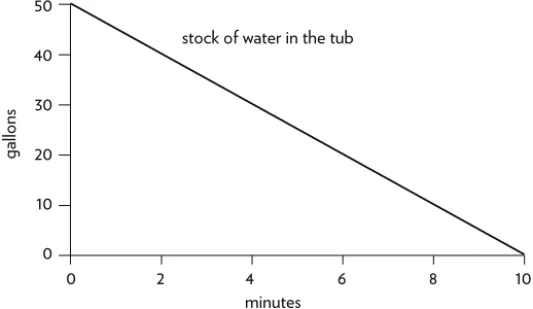
mentally pull the plug. The water runs out, of course. The level of water in the tub goes down until the tub is empty.
Now imagine starting again with a full tub, and again open the drain, but this time, when the tub is about half empty, turn on the infl ow faucet so the rate of water fl owing in is just equal to that fl owing out. What happens?
50 40 30 20 10 0
stock of water in the tub
0 2 4 6 8 10
gallons
minutes
Figure 6. Water level in a tub when the plug is pulled.
A NOTE ON READING GRAPHS OF BEHAVIOR OVER TIME
Systems thinkers use graphs of system behavior to understand trends over time, rather than focusing attention on individual events. We also use behavior-over-time graphs to learn whether the system is approaching a goal or a limit, and if so, how quickly.
The variable on the graph may be a stock or a fl ow. The pattern—the shape of the variable line—is important, as are the points at which that line changes shape or direction. The precise numbers on the axes are often less important.
The horizontal axis of time allows you to ask questions about what came before, and what might happen next. It can help you focus on the time horizon appropriate to the question or problem you are investigating.
CHAPTER ONE: THE BASICS 21
The amount of water in the tub stays constant at whatever level it had reached when the infl ow became equal to the outfl ow. It is in a state of
dynamic equilibrium—its level does not change, although water is contin-uously fl owing through it.
Imagine turning the infl ow on somewhat harder while keeping the outfl ow constant. The level of water in the tub slowly rises. If you then turn the infl ow
outflow 10
8
6
4
2
0
0 2 4 6 8 10
gallons/minute
minutes inflow
stock of water in the tub 50
40
30
20
10
0
0 2 4 6 8 10
gallons
minutes
Figure 7. Constant outfl ow, infl ow turned on after 5 minutes, and the resulting changes in the stock of water in the tub.
faucet down again to match the outfl ow exactly, the water in the tub will stop rising. Turn it down some more, and the water level will fall slowly.
This model of a bathtub is a very simple system with just one stock, one infl ow, and one outfl ow. Over the time period of interest (minutes), I have assumed that evaporation from the tub is insignifi cant, so I have not included that outfl ow. All models, whether mental models or mathemati-cal models, are simplifi cations of the real world. You know all the dynamic possibilities of this bathtub. From it you can deduce several important principles that extend to more complicated systems:
• As long as the sum of all infl ows exceeds the sum of all outfl ows, the level of the stock will rise.
• As long as the sum of all outfl ows exceeds the sum of all infl ows, the level of the stock will fall.
• If the sum of all outfl ows equals the sum of all infl ows, the stock level will not change; it will be held in dynamic equilib-rium at whatever level it happened to be when the two sets of fl ows became equal.
The human mind seems to focus more easily on stocks than on fl ows. On top of that, when we do focus on fl ows, we tend to focus on infl ows more easily than on outfl ows. Therefore, we sometimes miss seeing that we can fi ll a bathtub not only by increasing the infl ow rate, but also by decreasing the outfl ow rate. Everyone understands that you can prolong the life of an oil-based economy by discovering new oil deposits. It seems to be harder to understand that the same result can be achieved by burning less oil. A break-through in energy effi ciency is equivalent, in its effect on the stock of available oil, to the discovery of a new oil fi eld—although different people profi t from it.
Similarly, a company can build up a larger workforce by more hiring, or it can do the same thing by reducing the rates of quitting and fi ring. These two strategies may have very different costs. The wealth of a nation can be boosted by investment to build up a larger stock of factories and machines. It also can be boosted, often more cheaply, by decreasing the rate at which factories and machines wear out, break down, or are discarded.
A stock can be increased by decreasing its outfl ow rate as well as by increas-ing its infl ow rate. There’s more than one way to fi ll a bathtub!
CHAPTER ONE: THE BASICS 23
You can adjust the drain or faucet of a bathtub—the fl ows—abruptly, but it is much more diffi cult to change the level of water—the stock— quickly. Water can’t run out the drain instantly, even if you open the drain all the way. The tub can’t fi ll up immediately, even with the infl ow faucet on full blast. A stock takes time to change, because fl ows take time to fl ow. That’s a vital point, a key to understanding why systems behave as they do. Stocks usually change slowly. They can act as delays, lags, buffers, ballast, and sources of momentum in a system. Stocks,
espe-cially large ones, respond to change, even sudden change, only by gradual fi lling or emptying.
People often underestimate the inherent momentum of a stock. It takes a long time for populations to grow or stop growing, for wood to accumulate in a forest, for a reservoir to fi ll up, for a mine to be depleted. An economy cannot
build up a large stock of functioning factories and highways and electric plants overnight, even if a lot of money is available. Once an economy has a lot of oil-burning furnaces and automobile engines, it cannot change quickly to furnaces and engines that burn a different fuel, even if the price of oil suddenly changes. It has taken decades to accumulate the strato-spheric pollutants that destroy the earth’s ozone layer; it will take decades for those pollutants to be removed.
Changes in stocks set the pace of the dynamics of systems. Industrialization cannot proceed faster than the rate at which factories and machines can be constructed and the rate at which human beings can be educated to run and maintain them. Forests can’t grow overnight. Once contaminants have accumulated in groundwater, they can be washed out only at the rate of groundwater turnover, which may take decades or even centuries.
The time lags that come from slowly changing stocks can cause problems in systems, but they also can be sources of stability. Soil that has accumulated over centuries rarely erodes all at once. A population that has learned many skills doesn’t forget them immediately. You can pump groundwater faster than the rate it recharges for a long time before the aquifer is drawn down far enough to be damaged. The time lags imposed by stocks allow room to maneuver, to experiment, and to revise policies that aren’t working.
If you have a sense of the rates of change of stocks, you don’t expect things to happen faster than they can happen. You don’t give up too soon.
Stocks generally change slowly, even when the fl ows into or out of them change suddenly. Therefore, stocks act as delays or buff ers or shock absorbers in systems.
You can use the opportunities presented by a system’s momentum to guide it toward a good outcome—much as a judo expert uses the momentum of an opponent to achieve his or her own goals.
There is one more important principle about the role of stocks in systems, a principle that will lead us directly to the concept of feedback. The pres-ence of stocks allows infl ows and outfl ows to be independent of each other and temporarily out of balance with each other.
It would be hard to run an oil company if gaso-line had to be produced at the refi nery at exactly the rate the cars were burning it. It isn’t feasible to harvest a forest at the precise rate at which the trees are growing. Gasoline in storage tanks and wood in the forest are both stocks that permit life to proceed with some certainty, continuity, and predictability, even though fl ows vary in the short term.
Human beings have invented hundreds of stock-maintaining mecha-nisms to make infl ows and outfl ows independent and stable. Reservoirs enable residents and farmers downriver to live without constantly adjust-ing their lives and work to a river’s varyadjust-ing fl ow, especially its droughts and fl oods. Banks enable you temporarily to earn money at a rate different from how you spend. Inventories of products along a chain from distributors to wholesalers to retailers allow production to proceed smoothly although customer demand varies, and allow customer demand to be fi lled even though production rates vary.
Most individual and institutional decisions are designed to regulate the levels in stocks. If inventories rise too high, then prices are cut or advertis-ing budgets are increased, so that sales will go up and inventories will fall. If the stock of food in your kitchen gets low, you go to the store. As the stock of growing grain rises or fails to rise in the fi elds, farmers decide whether to apply water or pesticide, grain companies decide how many barges to book for the harvest, speculators bid on future values of the harvest, cattle growers build up or cut down their herds. Water levels in reservoirs cause all sorts of corrective actions if they rise too high or fall too low. The same can be said for the stock of money in your wallet, the oil reserves owned by an oil company, the pile of woodchips feeding a paper mill, and the concentration of pollutants in a lake.
People monitor stocks constantly and make decisions and take actions Stocks allow infl ows and
outfl ows to be decoupled and to be independent
and temporarily out of balance with each other.
CHAPTER ONE: THE BASICS 25
designed to raise or lower stocks or to keep them within acceptable ranges. Those decisions add up to the ebbs and fl ows, successes and problems, of all sorts of systems. Systems thinkers see the world as a collection of stocks along with the mechanisms for regulating the levels in the stocks by manipulating fl ows.
That means system thinkers see the world as a collection of “feedback processes.”
How the System Runs Itself—Feedback
Systems of information-feedback control are fundamental to all life and human endeavor, from the slow pace of biological evolu-tion to the launching of the latest space satellite. . . . Everything we do as individuals, as an industry, or as a society is done in the context of an information-feedback system.
—Jay W. Forrester3
When a stock grows by leaps and bounds or declines swiftly or is held within a certain range no matter what else is going on around it, it is likely that there is a control mechanism at work. In other words, if you see a behavior that persists over time, there is likely a mechanism creating that consistent behavior. That mechanism operates through a feedback loop. It is the consistent behavior pattern over a long period of time that is the fi rst hint of the existence of a feedback loop.
A feedback loop is formed when changes in a stock affect the fl ows into or out of that same stock. A feedback loop can be quite simple and direct. Think of an interest-bearing savings account in a bank. The total amount of money in the account (the stock) affects how much money comes into the account as interest. That is because the bank has a rule that the account earns a certain percent interest each year. The total dollars of interest paid into the account each year (the fl ow in) is not a fi xed amount, but varies with the size of the total in the account.
You experience another fairly direct kind of feedback loop when you get your bank statement for your checking account each month. As your level of available cash in the checking account (a stock) goes down, you may decide to work more hours and earn more money. The money entering
your bank account is a fl ow that you can adjust in order to increase your stock of cash to a more desirable level. If your bank account then grows very large, you may feel free to work less (decreasing the infl ow). This kind of feedback loop is keeping your level of cash available within a range that is acceptable to you. You can see that adjusting your earnings is not the only feedback loop that works on your stock of cash. You also may be able to adjust the outfl ow of money from your account, for example. You can imagine an outfl ow-adjusting feedback loop for spending.
Feedback loops can cause stocks to maintain their level within a range or grow or decline. In any case, the fl ows into or out of the stock are adjusted because of changes in the size of the stock itself. Whoever or whatever is monitoring the stock’s level begins a corrective process, adjusting rates of infl ow or outfl ow (or both) and so changing the stock’s level. The stock level feeds back through a chain of signals and actions to control itself.
outflow inflow
stock
stock
Figure 8. How to read a stock-and-fl ow diagram with feedback loops. Each diagram distin-guishes the stock, the fl ow that changes the stock, and the information link (shown as a thin, curved arrow) that directs the action. It emphasizes that action or change always proceeds through adjusting fl ows.
CHAPTER ONE: THE BASICS 27
Not all systems have feedback loops. Some systems are relatively simple open-ended chains of stocks and fl ows. The chain may be affected by outside factors, but the levels of the chain’s stocks don’t affect its fl ows. However, those systems that contain feedback loops are common and may be quite elegant or rather surprising, as we shall see.
Stabilizing Loops—Balancing Feedback
One common kind of feedback loop stabilizes the stock level, as in the checking-account example. The stock level may not remain completely fi xed, but it does stay within an acceptable range. What follows are some more stabilizing feedback loops that may be familiar to you. These exam-ples start to detail some of the steps within a feedback loop.
If you’re a coffee drinker, when you feel your energy level run low, you may grab a cup of hot black stuff to perk you up again. You, as the coffee drinker, hold in your mind a desired stock level (energy for work). The purpose of this caffeine-delivery system is to keep your actual stock level near or at your desired level. (You may have other purposes for drinking coffee as well: enjoying the fl avor or engaging in a social activity.) It is the
A feedback loop is a closed chain of causal connections from a stock, through a set of decisions or rules or physical laws or actions that are depen-dent on the level of the stock, and back again through a fl ow to change the stock.
discrepancy
energy expenditure energy
available for work stored energy
in body
B coffee intake
metabolic mobilization
of energy
desired energy level
gap, the discrepancy, between your actual and desired levels of energy for work that drives your decisions to adjust your daily caffeine intake.
Notice that the labels in Figure 9, like all the diagram labels in this book, are direction-free. The label says “stored energy in body” not “low energy level,” “coffee intake” not “more coffee.” That’s because feedback loops often can operate in two directions. In this case, the feedback loop can correct an oversupply as well as an undersupply. If you drink too much coffee and fi nd yourself bouncing around with extra energy, you’ll lay off the caffeine for a while. High energy creates a discrepancy that says “too much,” which then causes you to reduce your coffee intake until your energy level settles down. The diagram is intended to show that the loop works to drive the stock of energy in either direction.
I could have shown the infl ow of energy coming from a cloud, but instead I made the system diagram slightly more complicated. Remember—all system diagrams are simplifi cations of the real world. We each choose how much complexity to look at. In this example, I drew another stock—the stored energy in the body that can be activated by the caffeine. I did that to indicate that there is more to the system than one simple loop. As every coffee drinker knows, caffeine is only a short-term stimulant. It lets you run your motor faster, but it doesn’t refi ll your personal fuel tank. Eventually the caffeine high wears off, leaving the body more energy-defi cient than it was before. That drop could reactivate the feedback loop and gener-ate another trip to the coffee pot. (See the discussion of addiction lgener-ater in this book.) Or it could activate some longer-term and healthier feedback responses: Eat some food, take a walk, get some sleep.
This kind of stabilizing, goal-seeking, regulating loop is called a balanc-ing feedback loop, so I put a B inside the loop in the diagram. Balancing feedback loops are goal-seeking or stability-seeking. Each tries to keep a stock at a given value or within a range of values. A balancing feedback loop opposes whatever direction of change is imposed on the system. If you push a stock too far up, a balancing loop will try to pull it back down. If you shove it too far down, a balancing loop will try to bring it back up.
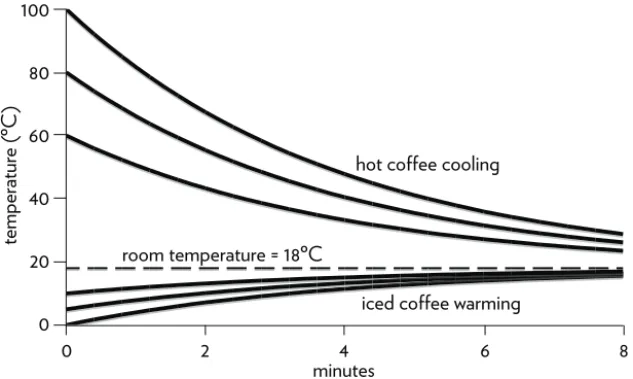
Here’s another balancing feedback loop that involves coffee, but one that works through physical law rather than human decision. A hot cup of coffee will gradually cool down to room temperature. Its rate of cooling depends on the difference between the temperature of the coffee and the temperature of the room. The greater the difference, the faster the coffee
CHAPTER ONE: THE BASICS 29
will cool. The loop works the other way too—if you make iced coffee on a hot day, it will warm up until it has the same temperature as the room. The function of this system is to bring the discrepancy between coffee’s temperature and room’s temperature to zero, no matter what the direction of the discrepancy.
Starting with coffee at different temperatures, from just below boiling to just above freezing, the graphs in Figure 11 show what will happen to the temperature over time (if you don’t drink the coffee). You can see here the “homing” behavior of a balancing feedback loop. Whatever the initial value of the system stock (coffee temperature in this case), whether it is above or below the “goal” (room temperature), the feedback loop brings it toward
discrepancy coffee
temperature
B cooling
room temperature
discrepancy
room temperature coffee
temperature
B heating
Figure 10. A cup of coff ee cooling (left) or warming (right).
iced coffee warming 100
80 60 40 20 0
0 2 4 6 8
temper
atur
e (ºC
)
minutes room temperature = 18ºC
hot coffee cooling
the goal. The change is faster at fi rst, and then slower, as the discrepancy between the stock and the goal decreases.
This behavior pattern—gradual approach to a system-defi ned goal— also can be seen when a radioactive element decays, when a missile fi nds its target, when an asset depreciates, when a reservoir is brought up or down to its desired level, when your body adjusts its blood-sugar concentration, when you pull your car to a stop at a stoplight. You can think of many more examples. The world is full of goal-seeking feedback loops.
The presence of a feedback mechanism doesn’t necessarily mean that the mechanism works well. The feedback mechanism may not be strong enough to bring the stock to the desired level. Feedbacks—the interconnections, the information part of the system—can fail for many reasons. Information can arrive too late or at the wrong place. It can be unclear or incomplete or hard to interpret. The action it triggers may be too weak or delayed or resource-constrained or simply ineffective. The goal of the feedback loop may never be reached by the actual stock. But in the simple example of a cup of coffee, the drink eventually will reach room temperature.
Runaway Loops—Reinforcing Feedback
I’d need rest to refresh my brain, and to get rest it’s necessary to travel, and to travel one must have money, and in order to get money you have to work. . . . I am in a vicious circle . . . from which it is impossible to escape.
—Honoré Balzac,4 19th century novelist and playwright
Here we meet a very important feature. It would seem as if this were circular reasoning; profi ts fell because investment fell, and investment fell because profi ts fell.
—Jan Tinbergen,5 economist
The second kind of feedback loop is amplifying, reinforcing, self-multiply-ing, snowballing—a vicious or virtuous circle that can cause healthy growth Balancing feedback loops are
equilibrating or goal-seeking structures in systems and are both sources of stability and sources of resistance to change.
CHAPTER ONE: THE BASICS 31
or runaway destruction. It is called a reinforcing feedback loop, and will be noted with an R in the diagrams. It generates more input to a stock the more that is already there (and less input the less that is already there). A reinforc-ing feedback loop enhances whatever direction of change is imposed on it.
For example:
• When we were kids, the more my brother pushed me, the more I pushed him back, so the more he pushed me back, so the more I pushed him back.
• The more prices go up, the more wages have to go up if people are to maintain their standards of living. The more wages go up, the more prices have to go up to maintain profi ts. This means that wages have to go up again, so prices go up again. • The more rabbits there are, the more rabbit parents there are to
make baby rabbits. The more baby rabbits there are, the more grow up to become rabbit parents, to have even more baby rabbits.
• The more soil is eroded from the land, the less plants are able to grow, so the fewer roots there are to hold the soil, so the more soil is eroded, so less plants can grow.
• The more I practice piano, the more pleasure I get from the sound, and so the more I play the piano, which gives me more practice.
Reinforcing loops are found wherever a system element has the abil-ity to reproduce itself or to grow as a constant fraction of itself. Those elements include populations and economies. Remember the example of
money in bank account
R interest rate
interest added
the interest-bearing bank account? The more money you have in the bank, the more interest you earn, which is added to the money already in the bank, where it earns even more interest.
Figure 13 shows how this reinforcing loop multiplies money, starting with $100 in the bank, and assuming no deposits and no withdrawals over a period of twelve years. The fi ve lines show fi ve different interest rates, from 2 percent to 10 percent per year.
This is not simple linear growth. It is not constant over time. The growth of the bank account at lower interest rates may look linear in the fi rst few years. But, in fact, growth goes faster and faster. The more is there, the more is added. This kind of growth is called “exponential.” It’s either good news or bad news, depending on what is growing—money in the bank, people with HIV/AIDS, pests in a cornfi eld, a national economy, or weapons in an arms race.
In Figure 14, the more machines and factories (collectively called “capital”) you have, the more goods and services (“output”) you can produce. The more output you can produce, the more you can invest in new machines and factories. The more you make, the more capacity you have to make even more. This reinforcing feedback loop is the central engine of growth in an economy. 350 300 250 200 150 100 50 0
0 3 6 9 12
dollars years $313.84 8% interest 10% interest $126.82 $160.10 $201.22 $251.82 6% interest 4% interest 2% interest
Figure 13. Growth in savings with various interest rates.
Reinforcing feedback loops are self-enhancing, leading to exponential growth or to runaway collapses over time. They are found when-ever a stock has the capac-ity to reinforce or reproduce itself.
CHAPTER ONE: THE BASICS 33
By now you may be seeing how basic balancing and reinforcing feedback loops are to systems. Sometimes I challenge my students to try to think of any human decision that occurs without a feedback loop—that is, a deci-sion that is made without regard to any information about the level of the stock it infl uences. Try thinking about that yourself. The more you do, the more you’ll begin to see feedback loops everywhere.
The most common “non-feedback” decisions students suggest are falling in love and committing suicide. I’ll leave it to you to decide whether you think these are actually decisions made with no feedback involved.
Watch out! If you see feedback loops everywhere, you’re already in danger of becoming a systems thinker! Instead of seeing only how A causes B, you’ll begin to wonder how B may also infl uence A—and how A might reinforce or reverse itself. When you hear in the nightly news that the Federal Reserve
capital
R fraction of
output invested
output investment
Figure 14. Reinvestment in capital.
HINT ON REINFORCING LOOPS AND DOUBLING TIME
Because we bump into reinforcing loops so often, it is handy to know this shortcut: The time it takes for an exponentially growing stock to double in size, the “doubling time,” equals approximately 70 divided by the growth rate (expressed as a percentage).
Example: If you put $100 in the bank at 7% interest per year, you will double your money in 10 years (70 ÷ 7 = 10). If you get only 5% interest, your money will take 14 years to double.