Deprivation, psychological distress, and
consultation length in general practice
A Mark Stirling, Phil Wilson and Alex McConnachie
Introduction
U
P to 40% of patients presenting to general practitioners (GPs) are psychologically distressed as measured by screening tools, such as the General Health Questionnaire (GHQ).1-3 Of these distressed patients, doctors correctly identify approximately half.1-3Up to half of depressive illness in the community is missed by GPs.4Of the patients whose depression goes unrecognised, most present with, and are treated for, physical symptoms.5General practice is the point of first contact with health ser-vices for most people who are psychologically distressed.6 Poor mental health (chronic anxiety, depression, and emo-tional maladjustment) is a major predictor of future poor physical health.7Failure to diagnose and treat appropriately may promote chronicity and the inappropriate and unneces-sary referral and medical treatment characteristic of somatic fixation.8Correct identification of the patient’s psychological problem may reduce somatisation.9
Studies have shown factors associated with increased psychological morbidity. There is a middle-aged peak in prevalence.2 Associations have been shown between socioeconomic deprivation and increased psychological morbidity.10,11There is a strong social gradient of increasing anxiety and depression scores by deprivation category (per-sonal communication: Morrison C, Glasgow Monica Project, 1997).
Consultation lengths in the United Kingdom (UK) (mean = 8.4 minutes12) remain short by international standards (com-pare with 15 minutes in Canada and 21 minutes in Sweden13,14) Although the GP may be aware of issues involved in the detection of psychological distress, time available and the doctor’s state of mind may make them choose not to confront it.15Longer booking intervals are of psychological advantage to the GP.16Recent research has also shown that patient enablement by the doctor is most closely correlated with increasing duration of the consulta-tion.21Although some studies have suggested that, given longer consultations, doctors will make more diagnoses of psychological problems,17 it has not been established whether this actually represents improved detection of psy-chological distress.
This study aimed to examine factors associated with pre-sentation and recognition of psychological distress in GPs’ surgeries and the interaction of these factors with consulta-tion length.
Method
A cross-sectional study was carried out involving 21 full-time GPs in the West of Scotland, between November 1997 and May 1998, using methods that have already been described.1-3,18Two or three doctors participated from each of nine practices. All of the practices were accredited for the A M Stirling, MRCGP, higher professional training fellow; P Wilson,
DPhil, MRCP, FRCGP, senior research fellow; and A McConnachie, BSc,
statistician, Department of General Practice, University of Glasgow. Address for correspondence
Dr Phil Wilson, Department of General Practice, University of Glasgow, 4 Lancaster Crescent, Glasgow G12 0RR.
Email: [email protected]
Submitted: 3 August 1999; Editor’s response: 19 January 2000; final acceptance: 23 March 2001.
© British Journal of General Practice, 2001, 51,456-460.
SUMMARY
Background: Recent research has shown the benefits of longer consultations in general practice. Approximately 40% of patients presenting to general practitioners (GPs) are psychologically dis-tressed. Studies have shown that psychological morbidity increases with increasing socioeconomic deprivation. The com-bined effects of psychological morbidity and socioeconomic depri-vation on consultation length are unknown. In addition, though it is known that doctors correctly identify half their distressed patients as such, the effect of consultation length on identifica-tion is unknown.
Aim: To examine factors associated with presentation and recog-nition of psychological distress in GPs’ surgeries and the interac-tion of these factors with consultainterac-tion length.
Design of study: A cross-sectional study.
Setting: Nine general practices in the West of Scotland, involv-ing 1075 consultations of 21 full-time GPs.
Method: The main outcome measures were patient psychological distress (measured by General Health Questionniare-12), doc-tors’ identification of psychological distress, consultation length, and Carstairs deprivation category scores.
Results: The mean consultation length was 8.71 minutes (SD = 4.40) and the prevalence of positive GHQ scores was 44.7%. Increasing GHQ (greater psychological distress) and lower depri-vation category scores (greater affluence) were associated with longer consultations. Positive GHQ scoring increased with greater socioeconomic deprivation and also peaked in the 30 to 39 years age group. Recognition of psychological distress was greater in longer consultations (50% increase in consultation length asso-ciated with 32% increase in recognition).
Conclusion: Increasing socioeconomic deprivation is associated with higher prevalence of psychological distress and shorter con-sultations. This provides further evidence to support Tudor Hart’s ‘inverse care law’ and has implications for the resourcing of pri-mary care in deprived areas.
Keywords: psychological morbidity; socioeconomic deprivation; inverse care law; consultation length.
teaching of undergraduate students or for postgraduate training. The practices covered both affluent and deprived areas. Data were collected in routine, booked surgeries from a series of at least 50 consecutive consultations with adult patients (aged 16 years or over) for each doctor. The GHQ-12 (along with a consent form and a short questionnaire to gather sociodemographic data) was administered to each patient of each doctor. This was done after the consultation to avoid influencing the patient’s normal consulting behav-iour. After each consultation, the doctor completed a six-point scale to estimate the patient’s degree of psychological distress (Box 1). Each consultation was timed by a research assistant observing patients from the waiting room.
Postal codes were collected from each patient and used to generate a Carstairs deprivation category score (from 1 = most affluent, to 7 = most deprived).19
Statistical methods
Data were entered using Access for Windows 95 (v7.0) and were analysed using S-Plus for Windows (v4.5) and SPSS for Windows 95.
For those patients who were actually distressed (GHQ score of four or more), the doctors’ assessment of patient distress (cut-off score 2/3 — Box 1) was modelled by logis-tic regression. The cut-off scores were similar to those used in previous studies.1-3The regression model included a term for each doctor as a categorical variable to allow for variation in identification rates between the GPs.
Patient age, sex, and deprivation category,19 as well as consultation length, were examined for their effects on iden-tification. Age and consultation length were treated as con-tinuous variables, while sex and deprivation category were modelled as categorical variables.
Consultation length was log transformed, since the assumption of normally distributed random errors was not satisfied when the raw times were used, and this transfor-mation resulted in a better model fit.
For all patients, ordinary least squares regression was used to model consultation length. Log transformation again resulted in a better fitting model, with more normally distrib-uted residuals. As with identification, the statistical model allowed for a different average consultation length for each
doctor. Patient age, sex, and deprivation category, as well as their GHQ score and the doctors’ own rating of the patient’s level of distress were examined for any associations with consultation length.
Finally, logistic regression was used to determine which of patient age, sex, and deprivation category were significantly associated with positive GHQ scores.
Results
A total of 21 full-time GPs from the West of Scotland partici-pated in this project. All were in group practices. Six (28.6%) were female. Data were collected from a total of 1075 con-sultations. The prevalence of psychological distress (GHQ score of four or more), identification rates, mean deprivation category scores, and patient characteristics for each of the GPs are shown in Table 1. Numbers of patients in each deprivation category are shown in Table 2.
The mean consultation length for the whole sample was 8.71 minutes (SD = 4.40, range = 1–45 minutes). The range of individual doctors’ mean consultation lengths was 6.63–10.51 minutes.
Consultation length was seen to be associated with the age of the patient and their level of distress, as determined by the GHQ score and the score assigned by the GP (doc-tor score).
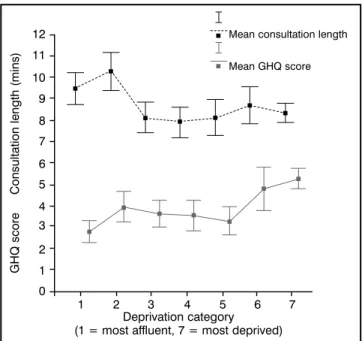
A 10-year increase in patient age was associated with a 2.69% increase in consultation length (95% CI = 1.00–4.41%). The doctors’ rating of distress showed a strong association with consultation length. An increase of one point on the doctor scale was associated with a 5.89% increase in consultation length (95% CI = 2.96–8.89%) (Figure 1). A one-point increase in the GHQ score was asso-ciated with a 1.62% increase in consultation length (95% CI = 0.77–2.48%) (Figure 2). Consultation length was also found to be strongly associated with deprivation category scores. Consultation length decreased with increasing deprivation scores (Figure 3). A one-point increase on the deprivation scale was associated with a 3.37% decrease in consultation length (95% CI = 1.96–4.77%).
The overall prevalence of a positive GHQ score was 44.7%. Positive GHQ scores were associated with patient age and deprivation category. The age effect on GHQ was not linear; mean scores rose from 3.8 in the under 20-year-olds, to a peak of 5.1 in the 30 to 39 year age group, with a HOW THIS FITS IN
What do we know?
About 40% of patients attending their general practitioners are psychologically distressed. The distress of only about half of these patients is recognised by their doctors in
routine consultations. Improved recognition may improve patient outcomes. Longer consultations are known to be associated with an increasing tendency for doctors to make psychological diagnoses.
What does this paper add?
Accurate recognition of psychological distress increased with greater consultation length. Increasing socioeconomic depri-vation is associated with both a higher prevalence of psycho-logical distress and shorter consultations. This study provides further support for Tudor Hart's 'inverse care law'.
Please indicate, by circling one number, your assessment of the psychological distress of the patient you have just seen.
1. Normal/stable person with or without physical illness. 2. Person with subclinical emotional disturbance. 3. Person with mild psychological disturbance. 4. Person with moderate psychological disturbance. 5. Person with severe psychological disturbance. 6. Psychological disturbance warrants admission.
Did you issue an acute prescription? Y/N (if yes, what is the name of the drug?)
Did you arrange a repeat appointment for the patient? Y/N Did you carry out a physical examination of the patients? Y/N Did you arrange any investigations Y/N (If yes, please specify.) Did you refer the patient? Y/N
Box 1. Questionnaire to estimate the patient’s degree of psycho-logical distress.
gradual decline to a mean of 2.0 in the over 90-year-olds. As Figure 3 shows, GHQ score rises with increasing deprivation category, although it appears to flatten out between depri-vation categories 3 and 5.
A total of 59.0% of the patients with positive GHQ scores were rated as distressed by the doctors, while 80.4% of the patients with negative GHQ scores were rated as not dis-tressed by the doctors.
Identification of distress was seen to be associated with
the length of the consultation and the age of the patient. A 50% increase in consultation length was associated with a 32% increase in identification (95% CI = 10.7–57.3%). This tendency for identification to increase with longer consulta-tions was greatest in the shorter consultaconsulta-tions (up to six min-utes) (Figure 4). Patient sex and deprivation category were not found to be important factors in identification of distress.
Though there was a slight decrease in identification of dis-tress in the youngest patients (15 to 25 years) and a slight increase in the oldest patients (over 70 years), the bulk of those seen were between these ages, and the data support-ed a linear decreasing trend in identification with the age of the patient. A 10-year increase in patient age was associat-ed with a 13.3% decrease in identification (95% CI = 2.1–23.3%).
The association of deprivation category, GHQ score, and mean consultation length is illustrated in Figure 3.
Discussion
Because recruitment was by invitation, this group of doctors is not representative. All of the practices used were in some way involved in teaching and were therefore potentially more motivated than average. It is also likely that these doc-tors have an interest in psychological medicine and they may therefore be better at detecting psychological distress than colleagues without such an interest. This is borne out in the results with 59% of distressed patients correctly iden-tified as such by the doctor. Some bias may also have result-ed from participating GPs knowing that their ‘performance’ was being observed. However, the main findings of this Table 1. Summary data for each doctor arranged in order of increasing mean deprivation score.
Patients
Mean Prevalence Mean scored as Female Mean Mean Cases Normals GP patient positive GHQ GHQ distressed patients patient consultation identified identified Number deprivation score (%) score by GP (%) (%) age length (%) (%)
1 1.34 44 3.12 44 70 49.08 10.31 72.7 78.6 2 1.47 37.3 2.76 19.6 66.7 51.37 10.18 47.4 96.9 9 1.68 34 2.62 12 48 55.84 9.24 23.5 93.9 10 1.89 55.1 4.04 28.6 51 51.49 9.29 48.1 95.5 20 2.14 36 2.48 16 42 53.7 8.78 33.3 93.8 21 2.55 49 4.69 54.9 31.2 49.57 10.51 84 73.1 14 2.69 44 3.52 22 62 53.86 9.36 45.5 96.4 13 2.92 44.2 3 15.4 42.3 49.83 8.08 17.4 86.2 15 3.85 45.3 3.57 32.1 56.6 47.94 7.08 29.2 65.5 17 4.05 54 3.52 52 84 44.38 10.22 63 60.9 16 4.08 60 4.48 24 46 41.5 7.7 33.3 90 19 4.21 54.7 4.26 60.4 64.2 52.57 7.15 75.9 58.3 3 4.56 55.1 4.1 49 40.8 45.29 9.29 70.4 77.3 4 4.67 51 3.47 30.6 67.3 45.46 6.88 48 87.5 18 4.68 50 4.02 24.1 53.7 45.83 8.63 40.7 92.6 6 6.27 64.7 4.88 37.3 64.7 44.92 9.86 48.5 83.3 5 6.57 66.7 5.39 49 74.5 41.98 8.2 55.9 64.7 12 6.65 68 5.5 60 58 42.78 8.86 73.5 68.8 8 6.65 58 4.66 60 48 46.12 8.54 79.3 66.7 11 6.66 79.6 6.33 49 70.8 42.18 6.63 56.4 80 7 6.82 58.3 4.42 41.7 58.3 42.18 8.37 51.4 72
Table 2. Numbers of patients in each deprivation category.
Deprivation category 1 2 3 4 5 6 7
Number of patients 180 121 142 121 106 77 270
Consultation length (mins) +/-95% CI
Doctor rating of level of patient psychological distress 1 7 8 9 10 11 12 13 2 3 4 5
Figure 1. Mean consultation length (with 95% confidence intervals) against doctor rating of patient psychological distress.
study are based upon comparisons of consultation lengths at different levels of deprivation, psychological distress, and identification of psychological distress. As such, they do not depend upon the absolute level of doctor performance.
The overall prevalence of positive scoring on the General Health Questionnaire is close to that found in previous stud-ies.1-3This study confirmed previous findings of a middle-aged peak in cases of distress measured by the GHQ.1,2 There is also confirmation of the socioeconomic gradient in psychological distress, with the highest prevalence being in deprivation category 7 (high deprivation). Consultation length also decreases as socioeconomic deprivation increases, as shown previously.20Figure 3 illustrates one of the problems facing GPs working in areas of high socioeco-nomic deprivation. Mean consultation length falls as the prevalence of positive GHQ scores rises across the
depriva-tion categories. Doctors in deprived areas thus have shorter consultations and see more patients with psychological morbidity. This mismatch of high consultation rates with higher workload of potentially difficult consultations has obvious implications for the provision of general medical services in deprived areas. It appears from these data that psychologically distressed patients in affluent areas are get-ting more time with their doctors than similarly distressed patients elsewhere.
Doctors’ identification of psychological distress tended to decrease with increased patient age. This raises questions about the consulting behaviour of younger versus older patients and whether there could be differences in the way that older patients who are psychologically distressed for-mulate and present their distress to doctors. This finding is at odds with Kessler’s recent study22 which found that recog-nition of depression and anxiety was lowest in those patients who had a normalising style of symptom attribution — i.e. those who did not attribute their symptoms to pathology, either psychological or physical. It was found that patients who normalised their symptoms were younger. A more qual-itative research approach may shed light on this area.
This study also showed that identification of psychological distress in GPs’ consultations is associated with longer con-sultations. This finding had not been demonstrated before. It is not possible to say from these data whether or not this relationship is causal; a randomised controlled trial would be required (we have just completed the pilot phase of such a trial). It could be argued that this finding simply represents doctors choosing to consult longer when they identify psy-chologically distressed patients. This is borne out by Figure 1, which illustrates that the more distressed the doctor thinks the patient is (regardless of actual GHQ score), the longer are the consultations. However, this raises the question of where the doctor gets the extra time for these consultations. Clearly, doctors in deprived areas faced with high preva-lence of psychologically distressed patients, and shorter than average consultation lengths, will have the greatest
Consultation length (min) +/-95% CI
GHQ score 0 1 2 3 4 5 6 7 8 9 10 11 12 6 8 7 9 10 11 12 13
Figure 2. Mean consultation length (with 95% confidence intervals) against GHQ score.
GHQ score Consultation length (mins)
Deprivation category (1 = most affluent, 7 = most deprived)
Mean GHQ score Mean consultation length
1 2 3 4 5 6 7 0 2 3 1 4 5 7 6 8 12 11 10 9
Figure 3. Consultation length and GHQ score against deprivation category.
Mean percentage true cases recognition
Time in minutes 2.00 4.00 3.00 5.006.007.008.009.0010.0011.0012.0013.0014.0015.00 20 30 40 50 60 90 80 70
Figure 4. Proportion of true cases identified against consultation length in minutes (consultation times are rounded to the nearest minute).
time pressure in their surgeries. The fact that average con-sultation length is shorter in deprived areas than in affluent areas, despite the higher prevalence of longer consultations with psychologically distressed patients, suggests that in deprived areas, consultations that do not involve distressed patients are very short. These data provide further evidence to support Tudor Hart’s ‘inverse care law’ — the availability of good quality medical care is inversely proportional to its need.23 In this case, those in the most deprived areas, who have the greatest need, have the least time with their doctor. In addition, patients in deprived areas who are not dis-tressed are getting considerably less time with the doctor than those in affluent areas.
These findings have implications which are in harmony with the general move in recent years toward longer book-ing intervals in GPs’ surgeries. There is a growbook-ing body of evidence that longer consultations appear to be better for patients and doctors. From this study, a strong case can be made that allocation of resources to allow doctors to spend more time with patients should be directed particularly toward general practice in areas of high deprivation.
Conclusion
This study demonstrates that GPs working in areas of high socioeconomic deprivation are faced with a higher preva-lence of psychologically distressed patients. They also have shorter average consultation lengths than doctors in affluent areas. Consultations involving distressed patients were longer than those where there was no distress. This mis-match of a greater prevalence of high demand consultations and shorter consultation lengths dramatically illustrates the continuing relevance of Tudor Hart’s ‘inverse care law’.23
References
1. Marks JN, Goldberg DP, Hillier VF. Determinants of the ability of general practitioners to detect psychiatric illness. Psychol Med
1979; 9:337-353.
2. Boardman AP. The general health questionnaire and the detection of emotional disorder by GPs: a replicated study. Br J Psychiatry
1987; 151:373-387.
3. Howe A. Detecting psychological distress: can general practition-ers improve their own performance? Br J Gen Pract1996; 46:
407-410.
4. Freeling P, Rao BM, Paykel ES, et al. Unrecognised depression in general practice. BMJ1985; 290:1880-1883.
5. Goldberg DP, Bridges K. Somatic presentation of psychiatric ill-ness in primary care. J Psychosom Res1988; 32:137-144. 6. Corney RH. A survey of professional help sought by patients for
psychosocial problems. Br J Gen Pract1990; 40:365-368. 7. Vaillant GE. Natural history of male psychological health; effects of
mental health on physical health. N Engl J Med1979; 301: 1249-1254.
8. Wilkinson G, Smeeton N, Skuse D, Fry J. Consultations for physi-cal illness among diagnosed and treated patients with psychologi-cal disorder: a twenty-year follow-up. BMJ1988; 297:776-778. 9. Grol R (ed). To heal or to harm — the prevention of somatic
fixa-tion in general practice. London: Royal College of General Practitioners, 1981.
10. Eachus J, Williams M, Chan P, et al. Deprivation and cause-specific morbidity: evidence from the Somerset and Avon survey of health.
BMJ1996; 312:287-292.
11. Gunnell DJ, Peters TJ, Kammerling RM, Brooks J. Relation between parasuicide, suicide, psychiatric admissions, and socioe-conomic deprivation. BMJ1995; 311:226-230.
12. Doctors’ and Dentists’ Review Body. General medical practition-ers’ workload survey 1992/93. London: Final Analysis, 1994. 13. Wilson A. Consultation length in general practice: a review. Br J
Gen Pract1991; 41:119-122.
14. Andersson SO, Mattson B. Length of consultations in general
practice in Sweden: views of doctors and patients. Fam Pract
1989; 6:130-134.
15. Howe A. ‘I know what to do, but it’s not possible to do it’ — gen-eral practitioners’ perceptions of their ability to detect psychologi-cal distress. Fam Pract1996; 13:127-132.
16. Wilson A, McDonald P, Hayes L, Cooney J. Longer booking inter-vals in general practice: effects on doctors’ stress and arousal. Br J Gen Pract1991; 41:184-187.
17. Howie JGR, Porter AMD, Heaney DJ, Hopton JL. Long-to-short consultation ratio: a proxy measure of quality of care for general practice. Br J Gen Pract1991; 41:48-54.
18. Johnstone A, Goldberg D. Psychiatric screening in general prac-tice. A controlled trial. Lancet1976; 261:605-608.
19. Carstairs V, Morris R. Deprivation and health in Scotland. Health Bulletin1990; 48/4:162-175.
20. Wyke S, Campbell G, MacIver S. Provision of, and patient satis-faction with, primary care services in a relatively affluent area and a relatively deprived area of Glasgow. Br J Gen Pract1992; 42:
271-275.
21. Howie JG, Heaney DJ, Maxwell M, et al. Quality of general prac-tice consultations: cross-sectional survey. BMJ1999; 319: 738-743.
22. Kessler D, Lloyd K, Lewis G, Gray DP. Cross-sectional study of symptom attribution and recognition of depression and anxiety in primary care. BMJ1999; 318:436-439.
23. Hart JT. The inverse care law. Lancet. 1971; 1(7696):405-412.
Acknowledgements
We would like to thank Professor G Watt, Dr A J Pelosi, and Dr S Ross for their helpful comments and suggestions. This research was funded by the Scottish Chief Scientist Office and was carried out as part of Dr Stirling’s Higher Professional Training Fellowship in General Practice.