Emerging university student experiences of learning technologies across
the Asia Paci
fi
c
B.F.D. Barrett
a, C. Higa
b, R.A. Ellis
c,*aUnited Nations University Media Centre, 53-70 Jingumae 5-chome, Shibuya-ku, Tokyo 150-8925, Japan bUniversity of Hawaii, PEACESAT, 2424 Maile Way, Saunders Hall 713, Honolulu, HI 96822, USA
cUniversity of Sydney, Institute of Teaching and Learning, Level 3, Carslaw F07, Broadway, Sydney 2006, Australia
a r t i c l e i n f o
Article history: Received 18 June 2011 Received in revised form 17 November 2011 Accepted 19 November 2011 Keywords: Experiences of learning Distance education Evaluation methodologies Learning technologies
a b s t r a c t
Three hundred students across eight countries and eleven higher education institutions in the Asia Pacific Region participated in two courses on climate change and disaster management that were sup-ported by learning technologies: a satellite-enabled video-conferencing system and a learning management system. Evaluation of the student experience across the region proved a significant chal-lenge, particularly the way the students conceived of the links between the technologies and their studies, and the way they approached the use of the technologies in connected and sometimes disconnected ways. This study examines the results of a quantitative investigation into the student experience and identifies key aspects of the structure of the variables used to evaluate the experience as well as identifying groups of students in the sample population who reported qualitatively different experiences. Significant outcomes reveal that cohesive conceptions of the learning technologies tend to be related to more effective ways of using both the video-conferencing and learning management systems, and that both at the level of variables, and at the level of groups of students, these experiences tend to be related to relatively higher outcomes. The results have important implications for both the design and teaching of technology-mediated courses and offer ideas for courses that combine systems such as learning management and video-conferencing.
Ó2011 Elsevier Ltd. All rights reserved.
1. Introduction
Technologies are shaping student learning experiences and also the work of course development teams across the higher education sector. This is particularly true of students studying at a distance whose learning experience is mediated by technology. Despite this emphasis on technology supported learning, little is known about how students approach learning in this type of environment, how they use technologies, why they use the technologies and why sometimes they do not, and what they think about them or whether the use of technologies influences the extent of interaction. Investigating the way learning technologies are related to the students’perspective and their strategies is essential if we are to understand the constitutional structure of qualitatively better experiences to inform both the design and teaching of courses reliant on technologies.
Sustained research into learning in higher education over the lastfive decades has identified key aspects of the student experience such as conceptions of learning, approaches to learning and perceptions of the learning context (Biggs, 1987; Biggs & Tang, 2007; Entwistle & Ramsden, 1983; Marton, 1970; Marton & Booth, 1997; Marton & Säljö, 1976; Prosser & Trigwell, 1999; Ramsden, 2002). More recently, these associations have been investigated for their associations with technology in the student experience (Ellis & Calvo, 2006; Ellis & Goodyear, 2010; Ellis, Goodyear, Calvo, & Prosser, 2008). Key outcomes from these studies include how students’understanding of the purpose of technologies in courses is closely related to their use of technologies and the academic outcomes they achieve. The research described here adds to the previous studies by looking at associations amongst the key aspects of the student experience of learning in relation to their use of two categories of learning technologies.
*Corresponding author. Tel.:þ61 2 9351 3781; fax:þ61 2 9351 1444. E-mail address:[email protected](R.A. Ellis).
Contents lists available atSciVerse ScienceDirect
Computers & Education
j o u r n a l h o m e p a g e : w w w . e l s e v i e r . c o m / l o c a t e / c o m p e d u
0360-1315/$–see front matterÓ2011 Elsevier Ltd. All rights reserved. doi:10.1016/j.compedu.2011.11.017
This study investigates students’learning experience on two courses inquiring into current environmental issues, disaster management and climate change. The student experience in both courses was reliant on video-conferencing and a learning management system. The learning model for these two courses has been developed by faculty at eleven institutions in the Asia Pacific. Over a 15 week semester running from September to January, a series of lectures and group discussions takes place via video-conferencing connecting the classrooms at each university. Dispersed in between are a range of assignments enabled by a learning management system (Moodle.org). The objective of the learning and teaching model is to enhance student learning through expert lectures, listening and reflecting on the key issues with the specialist lecturers, interrogating these ideas through discussion across the video-conferencing system in the second half of each session, and then following up on key issues and questions through the learning management system which also points the way to relevant online research activities.
The survey and analysis reported in this paper is part of a larger programme of research looking at student experiences of learning through inquiry. In this study, the key aspect focused on is how students strategized about and experienced the learning technologies, what they thought their purpose or role was and how this experience of the technologies was related to key aspects of their learning context. 2. View of the student experience of learning and prior research
Seminal research (Biggs, 1987; Biggs & Tang, 2007; Entwistle & Ramsden, 1983; Marton & Booth, 1997; Marton & Säljö, 1976; Prosser & Trigwell, 1999; Ramsden, 2002) has identified key aspects of the student learning experience. These include characteristics of the student, their perceptions of the learning context, how students approach their learning (including both the strategies they adopt and their intent), and how these are related to outcomes of their experience, including the concepts that they hold about learning.
In prior studies, students have reported qualitatively different approaches to learning. In engineering (Laurillard, 1979; Meyer, Parsons, & Dunne, 1990), science (Prosser & Millar, 1989) and in geography (Gibbs, 1993) qualitatively different groups in the student population have been identified; those whose approach is consistent with a deep approach to learning and those whose approach is consistent with a surface approach to learning. The former group employ strategies and reveal an intention which seeks meaning and comprehension. They are aware of evidence and the varying strength in arguments and seek evidence to create and formulate their own ideas. The latter group tend to rely more heavily on strategies such as memorisation, rote learning and repetition, with the intent of reproducing ideas without any real commitment to understanding.
Variation in the way students conceive of learning in their university experiences has been another key aspect in prior studies. Key differences include concepts of learning which make links between key ideas, joining them up to become aware of more holistic ideas within a course, and making links with personal and professional experiences outside of the course. These are typically referred to as cohesive conceptions of learning (Crawford, Gordon, Nicholas, & Prosser, 1994; Dahlgren, 1984). In contrast, these and other studies have found that some students report concepts which seem to separate key ideas in their studies, retaining unrelated concepts which are more like a list of things rather than a cohesive set of ideas. These have been typically referred to as multi-structural or fragmented conceptions (Crawford, Gordon, Nicholas, & Prosser, 1998; Ellis & Calvo, 2006; Ellis et al., 2008).
Another key aspect of student learning experiences identified in this body of research are the perceptions students hold about the context in which they are studying. After foundational studies (Entwistle & Ramsden, 1983; Ramsden, 1991), research on student perceptions of the learning context have identified both positive and negative perceptions which contribute to qualitatively different experiences of learning. In appropriate assessment tasks and workload, perceptions of good teaching, clear goals and outcomes and generic skills have been some of the variables which have proved to be significant for students (Prosser, Hazel, Trigwell, & Lyons, 1996; Trigwell & Prosser, 1991).
The study in this paper contributes to the above researchfindings by a key dimension of the student experience, when learning tech-nologies play a crucial role in enabling the experience.
3. Learning context
The student experience of learning investigated in this study occurred within a region-wide initiative known as The Asia Pacific Initiative (API), launched in 2002 at the World Summit on Sustainable Development. The goal of the API is to share knowledge amongst the members across the Asia Pacific Region, through course sharing arrangements and through the choice of topics of mutual interest; disaster management and humanitarian assistance (hereafter referred to as disaster management); and climate change, energy and food security (hereafter, climate change). Over the last eight years the members and roles have grown to the point where during the Fall Semester of 2009/ 2010, educators at eleven universities and research institutes1in Japan, the USA, Samoa, Thailand, India and Indonesia had oversight of two commonly shared and co-organized courses provided to the three hundred students across their institutions.
The partners in the initiative collaborated in the development of the educational model. At each of the country locations, a technical and content coordinator works with the local course instructor to support the student experience. The courses were taught through two key systems; the video-conferencing system was supported by the Pan-Pacific Education and Communication Experiments by Satellite or
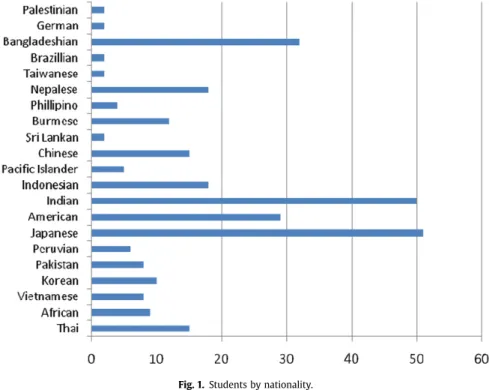
“PEACESAT”network; and the learning management system (Moodle.org) was administered by a staff at the University of Hawaii. The scheduling of the courses was a particular challenge. It required the integration of lectures, materials and activities across four time zones, a dozen institutions and the experience of students comprising more than twenty nationalities shown inFig. 1.
The development team responsible for the overall course design put it together with the intent that the students would experience the technologies in educationally useful ways; promoting ideas for critical thinking, engagement with knowledge, motivated research and interaction amongst participants were the principles behind the design. The teaching and learning model used was the same in both courses, with video-conferencing used for the presentation of lectures and follow-up of interactive discussions on each of the key topics, and
1 Keio University, Waseda University, Okayama University, University of the Ryukyus, Foundation for Advanced Studies on International Development (FASID), University of Hawaii, National University of Samoa, Asian Institute of Technology, Gadjah Mada University, TERI University and the United Nations University.
the use of the learning management system as a way of extending, elaborating and integrating the ideas across the duration of the course with activities interspersed in between the lectures.
A key goal of the course design and evaluation process was to establish the beginnings of an understanding of common aspects of the student experience across the region. Earlier work (Ellis, Barrett, Higa, & Bliuc, 2011) had confirmed the existence of qualitative variables of description of the student experience of the learning technologies. The outcomes of that study suggested that variation in how students reported approaching a use of the technologies was related to other key aspects of the experience such as academic achievement and concepts of learning. The purpose of this study is to empirically investigate similar relationships at the level of variables (through correlation analysis) and at the level of groups of students in the population sample (through cluster analysis). By doing so, it will provide an emerging understanding of how students report conceiving of, and approaching a use of, learning technologies in experiences of learning which are predominately mediated by technology.
4. Research questions
For the reasons described above, this study looks at the student experience of the learning technologies to investigate why some students experienced them in ways which were closer to the intentions of the course design team, and why some did not. To do this, the following research questions shape the study;
To what extent are there qualitatively different concepts of learning technologies amongst the students?
How might qualitatively different concepts of learning technologies be related to qualitatively different approaches to learning technologies?
How are student perceptions of key aspects of learning context related to qualitative variation in their ways of using learning technologies?
What are the implications of the student experience of learning technologies for the design and approaches to teaching of future iterations of the course?
5. Method
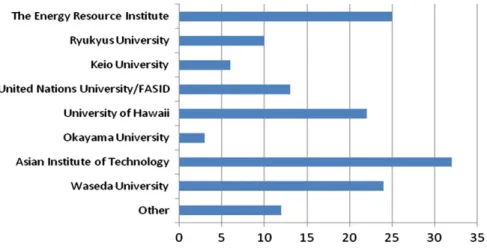
All the students were invited to complete the questionnaires through an online system. From a total of 300 students enrolled, (148 in Disaster management and 152 in Climate Change), 147 students participated in the survey. Fifty four percent were females with an average age of the total population of 26.05 years (standard deviation¼5.02). The dispersed nature of the cohort and the inability of those closest to the study to meet face-to-face with the students being surveyed may have contributed to the total proportion of students completing all questionnaires for the analysis. Future study designs may more proactively involved local tutors in the recruitment of volunteers to improve the response rate.Fig. 2shows the breakdown of the student sample by institution of study.
The students’experience of learning was interrogated using a set of items in the‘Conceptions of learning technologies’, and‘Approaches to learning technologies’questionnaire and in a perceptions of the learning context subscale. The Conceptions and Approaches questions benefitted from the design of questionnaires looking at the student experience of learning (Biggs, 1987; Crawford et al., 1998) and the
perceptions subscale was informed by the Course Experience Questionnaire (Ramsden, 1991). A qualitative study into student experiences of learning technologies across eight higher education institutions (Ellis et al., 2011) helped to inform item construction.
The ‘Conceptions of learning technologies’ questions comprises two subscales interrogating cohesive conceptions and fragmented conceptions of learning technologies. The former is orientated towards conceptions which view them as a way of interacting with knowledge, enabling the development of new ways of thinking, creating stimulating and research-rich opportunities to develop under-standing. It comprised nine items and Cronbach’s alpha was 0.91 in this study. The latter subscale is orientated towards a conception of learning technologies which does not view them as helpful for learning, requiring no real interaction with knowledge to develop ideas and does not value communication with other course participants. It comprised four items and Cronbach’s alpha was 0.75.
The‘Approaches to learning technologies’questionnaire comprises two subscales interrogating adeep approachand asurface approachto learning technologies. The former is orientated towards an approach which uses the technologies to test ideas against reliable sources and other course participants, to stimulate further research on course topics to enable critical thinking and to connect key ideas in the course to real contexts. It comprisedfive items and Cronbach’s alpha was 0.80 in this study. The latter is orientated towards an approach which uses technologies simply to fulfil course requirements, restricting their use to minimise work and to avoid developing an online presence. It comprisedfive items and Cronbach’s alpha was 0.72.
The perceptions subscale interrogated positive and negative student responses to key aspects of their learning context. These included perceptions of course quality, teaching quality, teacher interaction, clear goals and standards. It comprisedfive items and Cronbach’s alpha was 0.75 in this study. The Cronbach alphas fell within an acceptable range compared with similar previous studies representing a satis-factory measure of internal consistency of the variables (Ellis & Calvo, 2006; Ellis et al., 2008).Table 1ashows representative items of the questionnaires andTable 1bshows related statistics.
To administer the items, the questionnaires were designed as afive-point Likert-based ratings where items were rated between strongly agree and strongly disagree. The questionnaires were accessible via a web-based system. Students were invited to complete the ques-tionnaire over a three-week period at the end of their semester. From the population sample who volunteered to take part, all question-naires were completed in sufficient detail to enable the following analyses.
6. Results
A number of analyses were conducted on the students’responses to the questionnaires. In addition to the Cronbach alpha’s described above, Pearson correlation analysis was used to investigate if there was a sufficiently strong linear dependence between variables to indicate pair wise associations. When assessing the strength of the associations, 0.1 and 0.3 was considered a small correlation, between 0.3 and 0.5 a medium correlation and between 0.5 and 1 a large correlation (Cohen, 1977). To investigate if there were groups of students in the
Fig. 2.Population sample by institution of study.
Table 1a
Representative items from the learning technologies questionnaires.
Conceptions Item no. Item
Cohesive 9 items 4 The learning technologies in this course help me to gain a deeper knowledge of the topics.
11 The learning technologies enable me to experience different perspectives that increase my understanding. Fragmented 4 items 16 The learning technologies in this course do not require me to interact with the knowledge.
20 The learning technologies in this course do not help me to engage in critical thinking.
Approaches Item
Deep 5 items 7 I try to use the learning technologies in this course to communicate with other participants to test my ideas. 15 I spend time using the learning technologies in this course to connect key ideas to real contexts.
Surface 5 items 1 I restrict my use of learning technologies in this course to as little as possible. 6 I use learning technologies in this course mainly to downloadfiles. Perceptions
5 items 2 The tutor at my local institution was helpful.
population sample who rated similar experiences of the learning technologies, a hierarchical cluster analysis was conducted using Ward’s minimum variance method. The methodologies used followed similar processes in closely related research (Crawford et al., 1998; Ellis & Calvo, 2006).
Table 2presents the results of the correlation analysis.
Table 2shows that a high score on the cohesive conceptions variable shows a medium negative association with the fragmented conceptions variable (r¼ 0.47,p<0.00), a large positive association with the deep approach variable (r¼0.74,p<0.00), a medium negative association with the surface approach variable (r¼ 0.41,p<0.00) and a large positive association with the perceptions of learning context variable (r¼0.69,p<0.00). A high score on the deep approach to learning technologies variable shows a medium negative association with the surface approach variable (r¼ 0.36,p<0.00) and a positive large association with the perceptions of learning context variable (r¼0.61,p<0.00).
Table 2also shows a high score on the fragmented conceptions variable is associated with a medium negative association with the deep approach variable (r¼ 0.32,p<0.01), a large positive association with the surface approach variable (r¼0.51,p<0.00), and a negative medium association with the perceptions of learning context variable (r¼ 0.39,p<0.00). A high score on the surface approach to learning technologies variable shows a medium negative association with the perceptions of learning context variable (r¼ 0.31,p<0.00).
Table 3presents the results of the cluster analysis.
The cluster analysis revealed two groups of students using Ward’s technique of the increasing value of the Squared Euclidean Distance between the clusters (Prosser, Ramsden, Trigwell, & Martin, 2003).
Thefirst group of students experienced the learning technologies as a way of understanding judged by a positive score on the cohesive conception variable, the deep approach variable, the perceptions of learning context variable and negative scores on the fragmented conceptions variable and the surface approach variable. A second group of students experienced the learning technologies in a way closer to reproduction as judged by negative scores on the cohesive conception variables, the deep approach variable and the perceptions of learning context variable, and positive scores on the fragmented conceptions variable, and the surface approach variable.
Table 3shows a cluster of 44 students with a large positive score on the cohesive conception variable (0.87,p<0.00), the deep approach variable (0.66,p<0.00), and the perceptions of learning context variable (0.70,p<0.00). It also shows a large negative score on the fragmented conception variable (0.83,p<0.00), and the surface approach variable (0.97,p<0.00).
Table 3shows a second cluster of 103 students with a medium negative score on the cohesive conception variable (0.38,p<0.00), the deep approach variable (0.28,p<0.00), and the perceptions of learning context variable (0.30,p<0.01). It also shows a medium positive score on the fragmented conception variable (0.35,p<0.00), and a large positive score on the surface approach variable (0.41,
p<0.00).
The cluster analysis indicates that the population sample had qualitatively different experiences of learning technologies. One group (n¼44) had a relatively better experience of the learning technologies consistent with the ideas of being actively engaged with the knowledge and engaging in research as a way of developing critical thinking. This group tended to have a more positive perception of key aspects of the learning context such as the helpfulness of the teacher and the usefulness of interaction in the course. A second group of students (n¼103) had a relatively poorer experience of learning technologies, not seeing their value for developing understanding, interacting with knowledge or engaging in critical thinking. This group tended to have more negative perceptions of the learning context.
The outcomes of the correlation analysis and the cluster analysis are the majorfindings of this study. They have important implications for how the course teams engage in the design of the courses being taught across the Asia Pacific region, and the strategies which teachers may adopt when approaching their teaching across the two key technologies.
Table 1b
Cronbach alpha and descriptive statistics.
N Minimum Maximum Mean Std. deviation Cronbacha
Cohesive conception 2.11 5.00 3.92 0.64 0.91 Fragmented conception 1.00 5.00 2.13 0.75 0.75 Deep approach 1.40 5.00 3.54 0.72 0.80 Surface approach 1.00 4.20 2.39 0.73 0.72 Perceptions of context 1.20 5.00 3.96 0.65 0.75 n¼147. Table 2
Correlations amongst the student experience of learning technologies and perceptions of learning context.
Variables Variables
2 fc 3 da 4 sa 5 plc
Conceptions
1 Cohesive conceptions learning technologies (cc) 0.47 ** 0.74 ** 0.41 ** 0.69 **
2 Fragmented conceptions (fc) 0.32 ** 0.51 ** 0.39 **
Approaches
3 Deep approach learning technologies (da) 0.36 ** 0.61 **
4 Surface approach learning technologies (sa) 0.31 **
Perceptions
5 Learning Context (plc)
7. Discussion
This study reports on the student experience of learning in two university courses provided to students across eight countries. The teaching and learning model involved the use of a video-conferencing system for guest lectures and a learning management system for related inquiry-based activities into the key topics being considered. The researchers hypothesised that the use of the same teaching and learning model across the two courses enabled an investigation which examined qualitatively different conceptions and approaches experienced by the students of the learning technologies, and how these related to aspects of the learning context.
Broadly speaking, the results show qualitatively different experiences of learning amongst the student population. Students in thefirst group of the cluster analysis positively rated cohesive conceptions of learning technologies, conceptions that are about using the technologies to develop understanding, interact with knowledge and develop lines of inquiry to promote critical thinking. This group tended to also positively rate approaches to the use of the technologies which were relatively more aligned to the course team’s intentions, such as notions about testing the strength of their ideas through interaction and applying their understanding to new contexts. Significantly, cohesive conceptions of learning technologies and deep approaches to their use, tended to be positively related to key aspects of the learning context such as perceptions of the quality of teaching and interaction. In contrast, students in group two positively rated conceptions of learning technologies that are not related to interacting with knowledge and critical thinking. They also positively rated surface approaches to using the technologies which are more instrumental in their intent, such as downloadingfiles and limiting the extent to which they used them. Fragmented conceptions and surface approaches to learning technologies tended to be negatively related to perceptions of the learning context.
Of particular interest to the researchers was the students’perceptions of interaction in the learning context. The course team had a goal of enhancing interaction in the students’learning experience. It was the motivation behind the second half of each of the video-conferencing sessions being devoted to a question/answer/reflection model. For the purposes of exploratory analysis, the interaction item was extracted from the perceptions subscale and correlated with the scores on the learning technology variables. There were medium-sized, positive correlations with the cohesive conceptions variable (r¼0.48,p<0.00) and the deep approach variable (r¼ 0.48,p<0.00). The strength of these associations suggest to the researchers that in further studies, the structure of a new subscale on interaction in this type of context would be very valuable. It could look at dimensions of interaction with lecturers, tutors, students and resources and will provide one pathway for the design of future studies.
7.1. Implications for course design, teaching and future research
The student experience described in this study made combined use of video-conferencing and a learning management system. Significantly, a qualitatively better experience amongst the student population rated a deeper use of both technologies as a key aspect of their learning, and linked it to more cohesive conceptions of learning and positive perceptions of their learning context. Taking account of these aspects of the student experience provides an evidence-base for course design decisions likely to improve the student experience. Teachers and course designers should emphasise what constitutes a meaningful use of the technologies; in the video-conferenced lectures, this includes making most of the interactive stage of the lecture when students are able to have their questions answered, rather than sitting back and being more passive; in between the video-conference lectures, using the learning management system to inquire deeply into the subject matter of disaster management and climate change by testing ideas through communication with others and seeing ideas from different perspectives in order to engage more critically with them. These changes can be realised both in the design of the course materials, and the way that the local and online tutors interact with the students during their course.
The combination of technologies in the student experience investigated in this study is a result of different technology-mediated learning needs demanded by the context. As more technologies become available enabling different types of technology-mediated learning, understanding their combined contribution to student outcomes becomes increasingly important. The design of future research projects related to this one should consider both variation in the technologies being used by students, for example how social technologies may or may not be related to the students’learning experiences (Ellis & Goodyear, 2010), as well as consideration of the variables used to investigate the structure of those associations.
Acknowledgements
This study is part of a larger project into the student experience of inquiry, funded by the Australian Research Council (Grant DP0988334, awarded to Goodyear, Ellis, & Prosser).
Table 3
Cluster analysis of the Student experience of learning technologies and academic achievement.
Variable Cluster Stat sig ifp<0.05
1,n¼44 Understanding 2,n¼103 Reproducing Mean Std D Mean Std D Conceptions Cohesive conception 0.87 0.62 0.38 0.89 0.00 Fragmented conception 0.83 0.51 0.35 0.95 0.00 Approaches Deep approach 0.66 0.85 0.28 0.93 0.00 Surface approach 0.97 0.54 0.41 0.85 0.00 Perceptions Learning Context 0.70 0.54 0.30 1.00 0.00 N¼147.
References
Biggs, J. B. (1987).Student approaches to learning and studying. Hawthorne, Victoria: Australian Council for Educational Research. Biggs, J., & Tang, C. (2007).Teaching for quality learning at university: What the student does(3rd ed.). Buckingham: Open University Press. Cohen, J. (1977).Statistical power analysis for the behavioural sciences. New York: Academic Press.
Crawford, K., Gordon, S., Nicholas, J., & Prosser, M. (1994). Conceptions of mathematics and how it is learned: the perspectives of students entering university.Learning and Instruction, 4, 331–345.
Crawford, K., Gordon, S., Nicholas, J., & Prosser, M. (1998). University mathematics students conception of mathematics.Studies in Higher Education, 23, 87–94.
Dahlgren, L. O. (1984). Outcomes of learning. In F. Marton, D. Hounsell & L. O. Dahlgren (Eds.) (1988),‘Enduring and short term effects of higher education’.Paper presented at the 14th international congress of psychology, Sydney.
Ellis, R. A., Barrett, B., Higa, C., & Bliuc, A. (2011). Students’experiences of learning technologies across the Asia Pacific.Asia Pacific Education Reviewer, 20(1), 103–117. Ellis, R. A., & Calvo, R. A. (2006). Discontinuities in university student experiences of learning through discussions.British Journal of Educational Technology, 37(1), 55–68. Ellis, R. A., & Goodyear, P. (2010).Student experiences of e-learning in higher education: The ecology of sustainable innovation. London: Routledge.
Ellis, R. A., Goodyear, P., Calvo, R., & Prosser, M. (2008). Engineering students’experiences of learning through discussions in face-to-face and on-line contexts.Learning and Instruction, 18, 267–282.
Entwistle, N. J., & Ramsden, P. (1983).Understanding student learning. London: Croom Helm.
Gibbs, G. (1993). The CNAA improving student learning project.Research and Development in Higher Education, 14, 8–19. Laurillard, D. (1979). The processes of student learning.Higher Education, 8, 395–409.
Marton, F. (1970).Structural dynamics of learning. Stockholm: Almquist & Wisdell.
Marton, F., & Booth, S. (1997).Learning and awareness. Mahwah New Jersey: Lawrence Erlbaum Associates.
Marton, F., & Säljö, R. (1976). On qualitative differences in learning. I. Outcome and process.British Journal of Educational Psychology, 46, 4–11.
Meyer, J. H. F., Parsons, P., & Dunne, T. T. (1990). Individual study orchestrations and their association with learning outcome.Higher Education, 20, 67–89.
Prosser, M., Hazel, E., Trigwell, K., & Lyons, F. (1996). Qualitative and quantitative indicators of students’understanding of physics concepts.Research and Development in Higher Education, 19, 670–675.
Prosser, M., & Millar, R. (1989). The‘how’and‘what’of learning physics.European Journal of Psychology of Education, 4, 513–528.
Prosser, M., & Trigwell, K. (1999).Understanding learning and teaching: The experience in higher education. Buckingham: SRHE/Open University Press.
Prosser, M., Ramsden, P., Trigwell, K., & Martin, E. (2003). Dissonance in experience of teaching and its relation to the quality of student learning.Studies in Higher Education, 28, 37–48.
Ramsden, P. (1991). A performance indicator of teaching quality in higher education: the Course Experience Questionnaire.Studies in Higher Education, 16, 129–150. Ramsden, P. (2002).Learning to teach in higher education(2nd ed.). London: Routledge.