EUROCONTROL
This document is issued as an EATCHIP Guideline. The contents are not mandatory. They provide information and explanation or may indicate best practice.
Guidelines for Developing
and Implementing Team
Resource Management
DOCUMENT DESCRIPTION Document Title
Guidelines for Developing and Implementing Team Resource Management
EWP DELIVERABLE REFERENCE NUMBER HUM.ET1.ST10.DEL-01
PROGRAMME REFERENCE INDEX EDITION : 1.0
HUM.ET1.ST10.1000-GUI-01 EDITION DATE : 15.03.96 Abstract
These guidelines reflect the work of the Team Resource Management (TRM) Task Force of the EATCHIP Human Resources Domain and provide management and operational staff with relevant information when considering the development and implementation of TRM. An example of an outlined syllabus for TRM training which can be used by training designers as a basis for developing courses is also provided.
Keywords
Situational awareness Decision-making Communication Teamwork Leadership Stress management
CONTACT PERSON : M. Barbarino TEL : 3951 DIVISION : DED5
DOCUMENT STATUS AND TYPE
STATUS CATEGORY CLASSIFICATION
Working Draft o Executive Task o General Public o Draft o Specialist Task o EATCHIP þ Proposed Issue o Lower Layer Task þ Restricted o Released Issue þ
ELECTRONIC BACKUP
INTERNAL REFERENCE NAME : TRM_REL1.DOC
HOST SYSTEM MEDIA SOFTWARE(S)
Microsoft Windows Type : Floppy disk MS Word Media Identification : Version 6.0
DOCUMENT APPROVAL
The present edition of this document has been approved by the following management authorities.
AUTHORITY NAME AND SIGNATURE DATE
Chairman TRM Task Force M. BARBARINO 08.02.1996 Chairman Human Resources Team C. P. CLARK 01.03.1996 SDOE W. PHILLIP 15.03.1996
DOCUMENT CHANGE RECORD
EDITION DATE REASON FOR CHANGE
SECTIONS / PAGES AFFECTED
0.1 12.07.1995 Original version All
0.2 04.09.1995 Working Draft reviewed by the TRM Task Force All
0.3 20.10.1995 Working Draft reviewed by the TRM Task Force All
0.4 08.01.1996 Working Draft reviewed by the TRM Task Force All
0.5 01.02.1996 Working Draft reviewed by the TRM Task Force
and a technical author All
1.0 08.02.1996 Draft finally reviewed by the TRM Task Force
and accepted as Proposed Issue by HRT All
TABLE OF CONTENTS
DOCUMENT IDENTIFICATION SHEET ... ii
DOCUMENT APPROVAL ... iii
DOCUMENT CHANGE RECORD ... iv
TABLE OF CONTENTS ... v
eXECUTIVE SUMMARY ... 1
1. INTRODUCTION... 3
1.1 Scope... 3
1.2 Purpose ... 4
1.3 Task Force Activities ... 4
2. GUIDELINES FOR TRM DEVELOPMENT ... 7
2.1 Concept ... 7
2.2 Strategy ... 13
2.3 Training Course ... 16
2.4 Evolution ... 25
3. GUIDELINES FOR TRM IMPLEMENTATION ... 29
3.1 TRM Introduction ... 29
3.2 Testing and Evaluation... 33
3.3 Convergence and Implementation ... 35
4. OUTLINED SYLLABUS OF TRM TRAINING COURSES... 39
4.1 Sequence, Duration and Participants ... 39
4.2 Content and Methods... 40
REFERENCES ... 49
DEFINITIONS... 53
ABBREVIATIONS AND ACRONYMS ... 57
EXECUTIVE SUMMARY
In aviation, teamwork is one of the most important human factors in maintaining and enhancing safety and efficiency. The world’s airlines have successfully implemented the concept of Crew Resource Management (CRM) in the last 20 years. Several investigations and studies have indicated a similar need for enhanced teamwork practices amongst Air Traffic Management (ATM) staff. In this context ATM is understood to include Air Traffic Services, Airspace Management and Flow Control Management.
This document reflects the work of the Team Resource Management (TRM) Task Force of the EATCHIP Human Resources Domain and provides management and operational staff with relevant information to consider when developing and implementing TRM.
Chapter 1 introduces the background, scope and purpose of TRM and describes the Task Force activities, principles and work model used.
Chapter 2 describes the guidelines that form the basis for TRM development covering its concept, strategy, training course and evolution.
Chapter 3 covers issues relevant to the implementation of TRM giving recommendations and guidelines for its introduction, testing and evaluation, and convergence.
Chapter 4 provides an example of an outline syllabus for TRM training which can be used as a basis by training designers.
Chapter 5 summarises the guidelines for developing and implementing TRM.
1. INTRODUCTION
Over the last 20 years, airlines have been very successful in promoting the ideas of enhanced team working practices. Nearly every airline around the world applies the principles of Crew Resource Management (CRM) for pilots and other operational airline staff.
This raised the question of whether a comparable concept for operational staff would benefit the ATS/ATM system (see also Eissfeldt, 1994; Haertel & Haertel, 1995; Helmreich; 1993; Henderson, 1988; Herschler, 1991; Hopkin, 1994; Mudge & Gidde, 1993; Ruitenberg, 1995; Tenney, 1993).
Human Resources Business Plan Task HUM.ET1.ST10 entitled “Develop an ATS Crew Resource Management (CRM) Programme” was presented to ECAC representatives at the first EATCHIP Human Resources Team (HRT) meeting in March 1994.
Following from this, in July 1994, a Study Group reporting to the HRT through the Short Term Benefits Task Force was created, to investigate the possible benefits of and requirements for a Team Resources Management (TRM) programme. Within its scope the TRM Study Group carried out the following activities:
• a literature survey concerning relevant CRM/TRM publications (Eissfeldt, 1994);
• a teamwork-related ATC incident survey;
• a questionnaire survey to determine the attitude of controllers to teamwork in ATC;
• a TRM training survey to identify current team training activities in the ECAC States.
The results of these studies clearly indicated that failures in teamwork function contribute to incidents and often have a negative effect on the performance of controllers. This pointed to a definite need for a TRM training programme. In February 1995 the Study Group produced an Interim Report (EATCHIP HRT, 1994) which was presented to the third Human Resources Team (HRT) meeting in March 1995. The HRT agreed on this basis to establish a Team Resource Management Task Force (TRMTF) for a twelve-month period under its mandate. The Task Force was to report directly to the HRT and base its
principles should be taken into account in the future European Air Traffic Management System (EATMS).
For these purposes TRM is defined as: Strategies for the best use of all available resources - information, equipment and people - to optimise the safety and efficiency of Air Traffic Services, based on the following principles:
• developed by operational staff and human factors experts,
• linked to human factors incident and accident investigations,
• based on best practice from airline Crew Resource Management (CRM).
1.2 Purpose
The principal purpose of the TRM Task Force was to produce guidelines for the development and implementation of Team Resource Management. A secondary purpose was that the TF hoped to foster an awareness of the benefits of TRM, to integrate TRM into the global training plan, and to give an example of an outline syllabus on which TRM training courses could be modelled.
1.3
Task Force Activities
The TRM Task Force, established in Summer 1995, includes ECAC State representatives from France, Germany, Switzerland, the United Kingdom, Eurocontrol Headquarters and the Institute for Air Navigation together with a mixed team of active controllers, trainers and human factors experts.
1.3.1 Work Method
The Task Force adopted the Project Teamwork (PTW) method with which to address the question: “Which aspects should we consider for TRM?”. The Project Teamwork method enables work on complex problems to be undertaken using visual and interactive techniques. It is a structured work technique which provides an orderly mechanism for obtaining qualitative data and information from groups familiar with a particular problem area. A facilitator guides the process by which a team arrives at consensus and commitment to decisions and actions. Each member of a team is required to present his or her experience and concepts of the “real” situation. The wisdom and experience of team members are key elements in developing purposeful concepts and solutions.
PTW normally consists of six phases. Working through these phases is not seen as a one-off exercise but rather as a cyclic and iterative process which provides the flexibility required when addressing new developments and requirements.
The Task Force identified the following four phases as being sufficient for their purposes:
1. Leading question: At the start the facilitator guides the team to find the appropriate question in order to gather ideas on the subject.
2. Brainwriting: All team members supply as many answers to the question as possible in written form. All ideas are allowed and criticism at this stage is forbidden.
3. Idea explanation: The facilitator asks the team members to explain and discuss the ideas in a structured way in order to improve common understanding and to find common agreed definitions.
4. Clustering: The team identifies ideas of similar content to find a structure for the subject.
1.3.2 Model of Team Resource Management
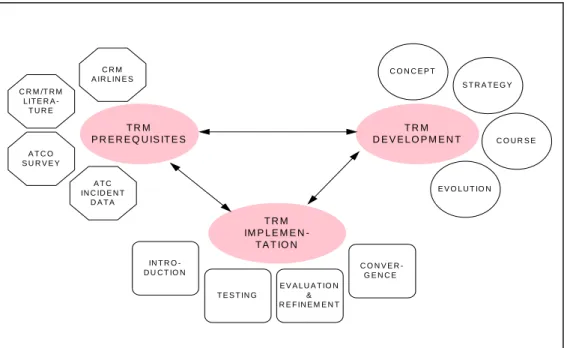
On completion of the Project Teamwork the Task Force put together a process model of TRM-related aspects (Figure 1).
T R M P R E R E Q U IS IT E S T R M D E V E L O P M E N T T R M IM P L E M E N -T A -T IO N A T C O S U R V E Y A T C IN C ID E N T D A T A C R M A IR L IN E S C R M /T R M L IT E R A -T U R E IN T R O -D U C T IO N T E S T IN G C O U R S E E V O L U T IO N C O N C E P T S T R A T E G Y C O N V E R -G E N C E E V A L U A T IO N & R E F IN E M E N T
TRM Prerequisites
TRM prerequisites seek to answer the basic question of whether there is a need for CRM training for operational staff in ATM. As mentioned earlier this work has already been done by the TRM Study Group and is described in an unpublished report (EATCHIP Human Resources Team, 1994).
Guidelines for developing and implementing TRM within national ATM organisations are now considered under the following headings:
TRM Development − Concept − Strategy − Training courses − Evolution TRM Implementation − Introduction − Testing − Evaluation − Convergence
The following chapters provide guidelines for the development and implementation of TRM and for each of the above-listed topics gives:
• a brief introduction and explanation of the topic,
• its relevance to existing knowledge and experience,
2.
GUIDELINES FOR TRM DEVELOPMENT
2.1 Concept
The sub-chapters below deal with the following TRM issues:
• why TRM?,
• TRM objectives,
• teamwork in ATM,
• teamwork and system changes.
2.1.1 Why TRM?
Crew Resource Management (CRM) on the flight deck gained much of its impetus from the fact that there had been a number of serious incidents and accidents in which poor communication, crew performance and inadequate behaviour were seen as significant contributory, if not causal, factors. There is a growing body of evidence which illustrates similar problems within ATM. This points to the need to complement the improvements made in the air, via CRM, with better team functioning within ATM. The point has been made elsewhere that "It is somewhat surprising that ‘Controller Resource Management’ did not develop in conjunction with Cockpit Resource Management" (Helmreich et al., 1993). Although a great deal of effort and expertise is devoted to training individuals in the technical skills necessary for the ATM task, little, if anything, has been done to train these individuals to function as team members. Incidents and accidents in which inadequate teamwork has been shown to be a factor indicate that much more attention needs to be focused on this vital area and the adoption of the title "Team Resource Management" is intended to reflect the importance of the team in the safe and efficient conduct of Air Traffic Management. "Now is the time to apply the same emphasis and standards to teamwork skills that we currently apply primarily to technical skills" (Biegalski, 1995).
2.1.1.1 TRM Benefits
Despite the evidence, it would be overly optimistic to assume that an innovation such as TRM training would be universally adopted without a convincing argument as to its worth to the organisation as a whole.
2.1.1.2 Management
While the development of CRM was brought about mainly by the recognition that ineffective behaviour can jeopardise safety, improvements in team performance also lead to a concomitant enhancement of efficiency. An examination of some of the CRM elements identified by Lauber (1987) shows that many of them have implications, not only for safety, but also for the efficiency of the operation. These elements include such aspects as communication and leadership, the delegation of tasks and appropriate workload distribution, the establishment of priorities, monitoring and cross checking, information use, the management of distraction and the avoidance of preoccupation. Other commentators in the field have proposed other dimensions including the use of available resources both human and in terms of equipment, Standard Operational Procedures (SOPs), manuals etc. Enhancements in the dimensions identified would clearly lead to greater task efficiency and improved use of staff resources.
While safety remains of paramount importance, management has also to take account of the relative benefits and costs of any innovation. As with many safety-related issues, it is difficult to place a monetary value on the benefits to be gained from the implementation of enhanced team training except perhaps to compare it with the potential cost, in human and monetary terms, of an incident or accident brought about by poor teamwork.
It is important that TRM is not viewed as a cosmetic and expensive "add-on" to existing training, but rather as an integral part of the training structure and culture within the organisation. A number of practical and relatively inexpensive methods have been suggested (Biegalski, 1995) by which CRM can be integrated into a company. Similar methods could be applied to the integration of TRM. These include underlining the importance of good teamwork at every meeting; using existing members of staff and training them as "coaches" and advocates of team training - in the context of ATC, supervisors and those responsible for coaching trainees would seem to be likely candidates; utilising and adapting existing programmes to address problems where teamwork skills have been shown to be inadequate; and, essentially, being prepared to deal with instances of poor team performance with the same level of concern as would be shown for any other examples of sub-optimum performance likely to affect safety and efficiency.
The role of management support in the success of team training initiatives like CRM cannot be overestimated. Helmreich and Foushee (1993), for example, discovered that "several organisations in which flight operations management made a concerted effort to communicate the nature of CRM training and the organisation’s dedication have noted significant improvement in cockpit management attitudes even before formal training was instituted".
2.1.1.3 Operational Staff
In addition to making management aware of the benefits of good team working, it is essential to convince the operational staff themselves that TRM has something to offer them in their daily work. Controllers for example realise the importance of good communication in a task which essentially depends for its safe execution on the quality and accuracy of the information which is transferred and the manner in which the various team members can communicate. However, the need to be able to accept suggestions from colleagues, to give and receive constructive criticism and to view the whole task as an exercise in team performance as well as individual skill, is perhaps less well understood. Much of the success of the process depends on the manner in which TRM information and concepts are conveyed. The credibility of any course will hinge on the relevance of the information provided to the participants everyday working lives. However, in the effort to explain to operational staff what TRM is, it is also important to make clear to them what it is not. TRM is not, for example, a substitute for inadequate training, nor is it intended to substitute for poor procedures and documentation nor for inefficient management structures or loosely and inadequately defined organisational roles. TRM is not intended as a replacement for technical training but should complement it. It is important that TRM is shown to be a means of increasing skill and professionalism. The increased awareness of doing a more efficient job, coupled with an enhanced sense of working as a part of a larger and efficient team, will also lead to improved job satisfaction which, in itself, is likely further to improve professionalism and efficiency. This is of benefit to the staff themselves and the organisations in which they work.
2.1.1.4 Guideline
TRM Development Guideline 1
The practical benefits of enhanced team performance for both management and operational staff should be communicated as early as possible. This will develop the necessary commitment to develop and reinforce TRM throughout the organisation.
2.1.2 TRM Objectives
In order to reduce or minimise the impact of teamwork-related errors within ATM teams a course should be introduced to train operational staff in behavioural strategies. TRM training seeks to ensure the effective functioning
operational staff are assessed to ascertain whether they have the aptitudes and attitudes required for the job concerned.
TRM will use these aptitudes and attitudes to help operational staff understand and be aware of the following:
• teamwork and how it affects team function;
• how behaviour and attitudes can have an influence in accidents and incidents.
After operational staff have developed the required attitudes and behavioural skills they should then have the opportunity to practise them in a further training programme in an operational environment.
2.1.2.1 Aims of TRM
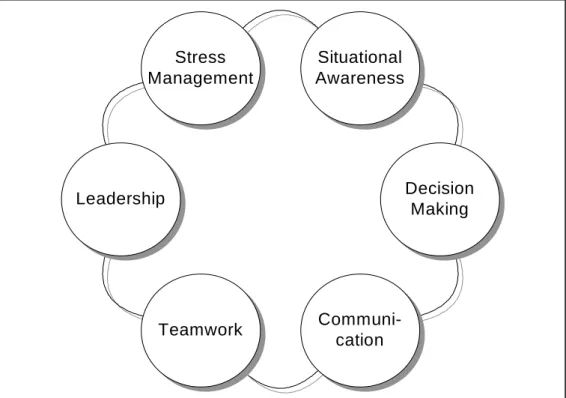
To enable operational staff to develop an effective ATM team concept TRM should deal with the following subjects:
Situational Awareness
• Symptoms of loss of situational awareness and factors that can have a positive or negative influence on awareness.
Decision-making
• Basic principles of individual and group decision-making processes. Communication
• Improve communication within teams and their effect on safety. Teamwork
• Effects of shared mental models and strategies to develop common understanding of typical situations that may influence efficient teamwork.
Leadership
• Leadership, authority and assertiveness and their positive or negative effects on teamwork depending on how it is used or misused.
Stress Management
• Effects of stress within ATM and the skills to cope with stress-related problems within teams.
2.1.2.2 Guideline
TRM Development Guideline 2
The main objective of TRM for operational staff should be the development of attitudes and behaviour which will contribute to enhanced teamwork skills and performance in order to reduce teamwork failures as a contributory factor in ATM-related incidents and accidents.
2.1.3 Teamwork in ATM
In the early days of Cockpit Resource Management (CRM) the definition of a crew and their work in a team was relatively easy (Lauber, 1984). The crew was defined as the pilot and co-pilot. In further developments of CRM the idea of crew work was extended to the cabin crew. Cockpit Resource Management was therefore renamed Crew Resource Management.
In ATM it is not so easy to define “team” and “teamwork”, however it is obvious that operational staff work in team structures (Hopkin, 1987, 1995, Ruitenberg, 1995). It is often difficult to define how many people constitute a team, who is seen as a member of a team and what kind of “co-operative and joint work” is regarded as teamwork.
2.1.3.1 Teams and Teamwork in ATM
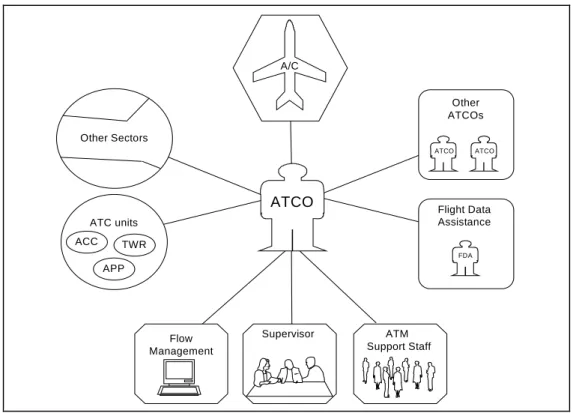
The TRM study group defined a team in ATM as “a group of two or more persons who interact dynamically and interdependently within assigned specific roles, functions and responsibilities. They have to adapt continuously to each other to ensure the establishment of a safe, orderly and expeditious flow of air traffic”. Figure 2 illustrates an example of possible teamwork relations which a single operational controller might identify from his individual point of view.
Flow Management Other ATCOs A/C ATC units ACC TWR APP Other Sectors Supervisor ATM Support Staff Flight Data Assistance ATCO ATCO ATCO FDA
Figure 2: Teamwork relations in ATM
First of all one can identify teamwork between controllers and pilots. Amongst controllers the smallest “teamwork” cell in ATM could be described as the controllers and flight data assistants working within the same operational area. There is also teamwork between controllers of different operational areas and finally there is teamwork between controllers of different ATC units (ACC, APP, TWR). Teamwork relations can also be seen between controllers and any other operational staff (flow management, supervisors, ATM support staff etc.).
Several authors (e.g. Johnston, 1993; Kabbani, 1995; Merrit, 1993) have stressed the consideration of cross-cultural aspects in CRM. ATM teamwork obviously has to deal with cross-cultural aspects. This includes not only cultural aspects amongst ATM units of different countries and nationalities, but also amongst different units and teams within one nation. TRM could in this respect be an aid to understanding and dealing with the cross-cultural aspects in an international ATM environment.
2.1.3.2 Guideline
TRM Development Guideline 3
The initial phase of TRM should concentrate on teamwork amongst air traffic controllers. At a later stage TRM should be extended to teamwork amongst other operational staff.
2.1.4 Teamwork and System Changes
In future ATM systems consideration will have to be given to the impact of systems innovations on teamwork and conversely, development in TRM will need to take account of system changes. Although it is impossible to anticipate all system changes, provision should be made to ensure the continuity and stability of teamwork which enables teams to cope with system changes in the work environment.
2.1.4.1 System Changes
New procedures and technology will certainly change the roles and functions of controller tasks and teamwork. Changes might be expected in advanced air and ground-based equipment, for example radiotelephony will be partly replaced by automatic datalink. Plans for some future ATM system concentrate primarily on support and computer assistance tools for the tasks of individual controllers but not for teams (Hopkin, 1994). The work of the controller might be less observable as far as collective consultation and decision-making processes are concerned. Flexible rostering arrangements may change the present fixed team structures into more fluid ones. Therefore the need for training in teamwork skills will increase to maintain efficient task performance in ATM.
2.1.4.2 Guideline
TRM Development Guideline 4
The development of the future ATM system should consider TRM principles in order to ensure continuity and teamwork stability.
2.2 Strategy
The sub-chapters below deal with the following issues of the TRM strategy:
• TRM training plan,
• TRM regulations.
2.2.1 TRM Training Plan
This chapter provides details on how TRM training should be structured and its relevance to other types of training.
2.2.1.1 Training Phases
It is considered that there are three distinct elements to TRM training:
• an introduction or awareness phase;
• a practice session using practical exercises to highlight concepts taught in the awareness phase;
• a refresher training phase.
This strategy is similar to that used by airlines and is in accordance with guidance issued by the FAA (1989).
The introduction or awareness phase would involve classroom type instruction and group exercises to explain the basic concepts of TRM. In general terms this instruction would be related to such items as situational awareness, decision-making, communication, teamwork, leadership and stress management.
Ideally, Team-Oriented ATC Simulator Training (TOAST) would follow on immediately from the theoretical aspects and may involve radar or other simulated operational environments. This aspect might be similar to the Line Orientated Flight Training (LOFT) provided by airlines (Butler, 1993), and involves specially designed exercises that highlight and demonstrate some of the theoretical aspects covered in the classroom sessions.
Finally, at periods during the operational career of participants, refresher or reinforcement training should be provided. This should be at intervals of not more than five years and include recent teamwork-related incidents and positive experiences.
Although this strategy is related to specific TRM training, it is essential that TRM issues are incorporated into all training where appropriate. For example, those courses that teach controllers instructional techniques must contain some elements of TRM input. It is also desirable that ab initio training considers the basic concepts of TRM in the same way it is done in the common core content. Finally, any emergency response or continuation training of any kind should contain TRM aspects/scenarios. TRM training may be successfully combined with other training.
2.2.1.2 Guideline
TRM Development
Guideline 5
TRM training should comprise three phases, an introductory/awareness phase, a practical phase and a refresher/reinforcement phase. Related training for operational staff should contain elements of TRM.
2.2.2 TRM Regulations
The ability to work efficiently as a team member should be recognised as essential for operational staff. The whole process of human resource management should therefore ensure that operational staff have the best support to help them attain this objective.
2.2.2.1 Link with Selection, Global Training Plan and Licensing
The selection process should assess personality traits most appropriate for work in a team environment. These general aptitudes should be considered of the utmost importance to facilitate the later acquisition of the appropriate attitudes and behaviour in teams.
Appropriate attitudes cannot be acquired with a single training action. It is essential to ensure the insertion of TRM training in the general training plan. Two different populations have to be considered:
• experienced operational staff,
• ab initio trainees.
For the first population a training plan has to be designed to ensure that all will benefit.
For ab initio trainees human factors issues should be part of basic and advanced training and TRM should therefore be integrated in the global training plan. This is taken into account in the harmonised common core content of training for air traffic controllers.
Wherever applicable TRM training should be a mandatory part of licensing.
2.3 Training
Course
The sub-chapters below deal with the following issues of the TRM training course: • objectives, • participants, • instructors, • scenario, • content,
• tools and methods.
2.3.1 Course Content and Training Objectives
As stated previously it is recommended that the following subjects (Figure 3) form the training content of a TRM course. For all subjects the objectives will be stated and explained and literature references dealing with the subject given. Leadership Teamwork Communi-cation Decision Making Situational Awareness Stress Management
2.3.1.1 Situational Awareness
The main objectives are that course participants will be able to:
• understand situational awareness;
• identify symptoms of loss of situational awareness;
• identify factors that may have a positive or negative influence on situational awareness;
Example: Describe the effect of high and low workload on situational awareness and develop appropriate strategies on how to prevent loss of awareness in such situations (see also Robertson & Endsley, 1995).
• identify hazardous attitudes and develop behavioural skills to avoid them.
Example: Identify your own personal motivations and attitudes towards job situations and analyse the reasons for these attitudes. Counter measures for actions and decisions based on hazardous attitudes should be developed. There are basically five typical kinds of hazardous attitudes (Eissfeldt et al, 1994) that are useful to analyse within TRM, these are:
• anti-authority: "Don’t tell me what to do!"
• impulsiveness: "I must act now, there is no time."
• invulnerability: "It won’t happen to me."
• macho: "I’ll show you - I can do it!"
• resignation: "What’s the use?" 2.3.1.2 Decision-making
The main objectives are that course participants will be able to:
• understand factors which contribute to effective team decision-making;
Example: Describe the importance of situation and risk assessment skills, meta-cognition, shared problem models and resource management skills in the process of team decision-making (see also Orasanu, 1993).
• understand an example of a structured process of decision-making in special situations.
2.3.1.3 Communication
The main objectives are that course participants will be able to:
• identify the functions of communication and analyse how communication is being performed within teams and how it can affect safety;
Example: Understand the main functions of communication: provide information, establish interpersonal relationships, establish predictable behaviour patterns and maintain attention to tasks and monitoring. (see also Kanki & Palmer, 1993; Seamster et al., 1992). The effect of using Standard Operational Procedures (SOPs) to communicate information and the risk of not adhering to SOPs should be made clear in this context.
• develop strategies on how to communicate effectively, how to intervene efficiently in typical ATM-related situations and how to give and receive feedback and constructive criticism.
Example: Analyse how misunderstandings can be avoided, suggestions communicated constructively and what effects criticism can have. Barriers to communication and ways of eliminating them should be specified. Effective communication skills should be taught to improve interpersonal diplomacy, appropriate assertiveness and team-oriented decision-making in order to generate positive reinforcement and respect within a team. The nature of information and how it is transferred should be analysed. The aim is to make participants aware of the danger of bad or confusing communication by presenting relevant examples that help them to develop more efficient and safer communication strategies.
2.3.1.4 Teamwork
The main objectives are that course participants should be able to:
• determine typical characteristics of ATM-related teamwork;
Example: Define the relevant positions and status of team members within an ATM team and determine the different roles, duties, responsibilities and the effect of their position in a team.
• identify behaviour that has a negative impact on teamwork and consequently develop and practise behavioural strategies that help to improve effective teamwork;
Example: Identify typical attitudes and behaviours of team members that may have positive and negative effects on teamwork (e.g. high and low power distance, uncertainty avoidance and individualism). Their strengths and weaknesses should be discussed and determined. Participants should be made aware of intra- and inter-cultural differences between teams (their own or other units and sectors). Once the skills are determined and identified, operational staff should have the opportunity to analyse, develop
and practise them to improve their individual teamwork style and their attitude towards colleagues.
• identify the importance of recognising different character types within teams and their influence on teamwork;
Example: Demonstrate how dominant and subordinate personalities can be identified and how various kinds of behavioural methods can help achieve consistency to maximise efficient team operation. Point out how dominant behaviour can have a negative impact on other team member’s performance (i.e. the dominant controller forcing the weaker colleague to accept more traffic than he or she is able to handle).
• understand the meaning and differences between team identity and corporate identity;
Example: Determine the “official rules”, “unofficial rules” and “unwritten rules” within an ATM environment and their effect on individual behaviour within a team.
• understand the effect of shared mental models and develop strategies that allow the development of common understanding of typical situations that may influence efficient teamwork.
Example: Make participants aware of the fact that each individual can interpret complex traffic situations differently (mental model), develop strategies and show examples by which mental models can be shared. Analyse the positive and negative effects on teamwork in order to facilitate the change from an individualistic to a co-operative and effective team-related approach. (see also Cannon-Bowers & Converse, 1993; Hackman, 1993).
2.3.1.5 Leadership
The main objectives are that course participants will be able to:
• describe authority and assertiveness;
Example: Describe formal and informal hierarchical structures in an ATM environment. Discuss the role of team supervisors or other team leaders and identify specific characteristics which influence leadership within teams. Determine the participant’s attitude towards authority, how they define their own authority and what it means to them if they feel mistreated
2.3.1.6 Stress Management
The main objectives are that course participants will be able to:
• define job-related stress situations, explain what stress is and its effect on teamwork;
• develop skills to prevent stress;
• develop skills to recognise and cope with stress situations in teams.
Example: Discuss stress coping strategies in a team environment. The general principles of the assimilation of shocking and stressful events should be described together with the principles of stress management (e.g. relaxation techniques). Discuss and practise team-related exercises dealing with stress detection and methods to help team members overcome the problem. Determine work factors that can have an influence on safe and efficient control decisions for themselves and team members. Learn how to avoid stress through better planning, priority setting and workload delegation (see also Eissfeldt, 1994: Hopkin, 1995).
2.3.1.7 Guideline
TRM Development Guideline 7
Situational awareness, decision-making, communication, teamwork, leadership and stress management should form the mandatory subjects of a TRM training course.
2.3.2 Course Participants
In the airline industry, the original cockpit resource management (CRM) training was designed for and provided to pilots. As the airline industry has gained experience with this type of training the advantages of increasing its scope to include non-flight crew have been realised.
As a first step, cabin staff have been included in some of the training programmes. It is understood that the scope of CRM will increase further, possibly to include other operational staff associated with aircraft operation such as flight dispatchers, etc. This chapter considers who within Air Traffic Management operation should be included in the TRM training.
2.3.2.1 Participants
It is a fact that a significant number of operational staff from differing disciplines within ATM have the potential to impact in some way on the safe and efficient operation of the system.
While it is likely that these operational staff may all benefit from TRM, it must be recognised that the training should be given first to those who can have a
major influence on the ATM system. This phased introduction would allow experience to be gained with TRM training and for the courses themselves to evolve.
2.3.2.2 Guideline
TRM Development Guideline 8
The first phase of TRM training should be provided both to operational controllers and supervisors and should later be extended to other operational staff in ATM.
2.3.3 Course Instructors
A crucial factor in the acceptance of TRM as a concept is the selection of the right instructors. Although human factors experts may be involved in the design of a specific course, airline experience has shown that there is a high acceptance level when the instruction given has an operational emphasis.
2.3.3.1 Instructors
Based upon airline experience, where the use of operational aircrew as instructors has helped CRM training achieve a high acceptance level, it is proposed that ATM operational staff should similarly be involved in training. CRM training involving operational staff has proven to give a high degree of credibility and acceptance.
In addition, it is important that instructors are selected with care. An instructor should be someone with good presentation skills who is both persuasive and aware of the problems experienced in the operational environment. An instructor should also be open to new concepts and be convinced of the importance and relevance of TRM training.
Having selected suitable instructors it will be necessary to provide them with training in TRM concepts. This training, which should include input from human factors experts, will explain TRM concepts and methods in detail, and demonstrate the importance of this type of training. It is recommended that a sufficient number of instructors be trained. Ideally, an instruction team should consist of an operational staff members and a human factors experts.
2.3.4 Course Scenario
If TRM is to be accepted by the target group it is essential that TRM principles are seen as relevant to the everyday working life of that group. If participants in TRM courses cannot relate what is taught to their own experience, there is little possibility that their attitudes, and subsequently their behaviour, will change in the desired manner and any hoped for improvement will not be forthcoming.
There are a number of ways in which the content of TRM courses can be tailored to make what is taught more relevant and effective. These are discussed below.
2.3.4.1 Realistic Training Examples
One of the major difficulties in designing training courses can be in the construction of appropriate examples and scenarios to illustrate training points and issues. If course participants perceive the examples provided as improbable or irrelevant, the effectiveness of the training as a whole is likely to be significantly reduced. The use of genuine examples, suitably disidentified, is therefore essential. The majority of units will have experienced ATM-related incidents, or at least have access to information about incidents which illustrate the importance of good teamwork. Ideally, a library of suitable incidents should be built up from which course designers can select appropriate examples that illustrate good and bad teamwork.
2.3.4.2 Updating of Examples
While it is important to use genuine scenarios to illustrate training points, it is also vital to keep courses updated with new examples. This is particularly true in the design and composition of refresher training courses which could lose a good deal of their impact if only familiar examples were included. One manner in which new material can be gathered is to encourage course participants to provide examples from their own experience. This presupposes that the course is run in an environment in which the participants feel sufficiently confident to reveal information on incidents in which they themselves have been involved. However, if the courses are conducted in an open, non-threatening, manner it should be possible to generate this level of confidence.
2.3.4.3 Realistic Training Solutions
The main aim of the course is to teach participants how to utilise good principles and practice in order to improve their own team functioning. When TRM principles are being taught it is important for the instructor to recognise the less than ideal situations in which same operational staff may operate. Part of the process of rendering courses realistic and relevant will be by taking account of problems which arise in day to day work. Some course participants may work as part of a large team, others in small groups or as individuals. TRM training should therefore be designed with sufficient flexibility to be able
to adapt to the different needs of course participants and to recognise and reflect the reality of the conditions under which they work.
2.3.4.4 Training Environment
Effective training requires good training materials but also depends on a suitable environment in which course participants can practise what they have learned. TRM involves learning and using practical skills and such skills are best learned and maintained through their use in a realistic setting. The adoption of Line-Oriented Flight Training (LOFT) (Butler, 1993) by the airlines recognises this fact. A similar training environment must be envisaged for operational staff. Training scenarios can be set up either in the simulator (TOAST), or as part of role play, to allow course participants to practise and develop TRM skills. These scenarios can involve both normal operation and unusual or emergency situations where effective team functioning is vitally important.
2.3.4.5 Guideline
TRM Development Guideline 10
Scenarios for training purposes should be realistic, relevant to course participants and regularly updated. The provision of a simulation environment should be considered such that participants can practise and reinforce TRM skills in both normal and emergency situations.
2.3.5 Course Tools and Methods
The following text describes the basic tools and methods recommended for the conduct of TRM training. Course subjects should be based on the experience and knowledge of the participants in order to allow an efficient transfer of the course contents to their operational environment and to play an active role in TRM. This requires that all exercises and examples should have a realistic link to the operational environment of the participants.
2.3.5.1 Tools and Methods
At the beginning of a course it should be made clear to participants that TRM training is aimed at developing teamwork-related attitudes and behaviour and is not trying to influence the participant’s personality. In addition it is recommended that participation in certain exercises (e.g. role-plays) be on a voluntary basis.
The following methods are recommended to meet the objectives of the various TRM-subjects (see also Eissfeldt et al., 1994):
Transfer of information and relevant facts, using:
• documents and classroom teaching.
Analysis of existing behaviour and attitudes, using:
• feedback by video,
• self-assessment and assessment by others through role-plays. Model-Learning, using:
• videos on relevant incidents or accidents caused by team-related errors,
• videos showing the positive results of effective teamwork,
• voice recordings (communication). Problem oriented learning, using:
• exercises and training in the use of new behavioural strategies,
• role-plays and groupwork,
• simulations.
Best results can be expected within the subject of communication and teamwork by presenting video reconstructions or recordings of incidents accidents and in combination with simulator exercises to practise and learn new behavioural strategies.
Teamwork exercises will also improve teamwork abilities by:
Developing tools to establish new behavioural practices:
• checklists,
• behavioural rules.
Instructors should ensure that subjects are presented in an easily understood way and made relevant to the participants.
2.3.5.2 Guideline
TRM Development Guideline 11
TRM training tools and methods should include lectures, examples,
discussions, role-plays, videos on team-related errors, handouts, checklists and simulator exercises.
2.4 Evolution
The following sub-chapters deal with the issues of TRM evolution:
• application,
• evaluation,
• extension.
2.4.1 TRM Application
Application and reinforcement of Team Resource Management should foster enhanced teamwork performance in several respects: more positive team culture, improved interpersonal communication and effectiveness, commitment, improved job satisfaction and enhanced motivation of team members. Creating and reinforcing a team-oriented workforce is a challenge for the whole organisation. Application of TRM principles therefore needs support from everyone involved.
2.4.1.1 Role of Management
Management plays an important role in the creation and maintenance of such a team culture. Commitment and active support from formal and informal leaders is crucial for successful application of TRM. Team and individual (de)briefings, constructive feedback mechanisms, adequate leadership, appropriate and timely interpersonal communication, and mutual respect, all contribute to the professionalism of a team.
2.4.1.2 Work Environment
TRM should be supported by reinforcement of its principles in the operational environment. Information and reminders like posters, flyers and booklets should be available in every operational environment.
2.4.1.3 Incident Investigation
Incident investigation usually tries to identify technical, procedural and human contributions. The tendency here is to focus on human limitations rather than strengths and capabilities. Investigation data are often perceived by operational staff as criticism rather than an opportunity to change attitudes and behaviour. Incident investigations should therefore take TRM principles into account and report and publish outcomes where worse was avoided
2.4.1.4 Guideline
TRM Development Guideline 12
The reinforcement of TRM in the operational environment should be ensured by management backup and support, team and individual (de)briefings, visual reminders and feedback from incident investigations.
2.4.2 TRM Evaluation
Two different modes can be differentiated for the evaluation of a TRM programme: the evaluation of the training course itself and the evaluation of changes in attitude and behaviour of operational staff.
2.4.2.1 Evaluation of Training Courses
The overall quality of training can be measured as a function of four factors and their interdependence, the training content, the training methods, the instructional performance and awareness (see also Gregorich & Wilhelm, 1993; Schiewe, 1995). These factors can be seen as the immediate reactions of the participants and should contain the following elements:
Training content:
• curriculum, sequence, duration. Training methods:
• lectures, case studies, scenarios, examples. Instructional performance:
• management, delivery, facilitation and evaluation. Awareness:
• teamwork attitudes before and after training. 2.4.2.2 Evaluation of Attitudes and Behaviour
The evaluation of attitudes and behaviour regarding teamwork in the longer term is far more complex than the evaluation of training courses. In ATM no set of evaluation measures is yet agreed with which to assess these aspects (Hopkin, 1995). A carefully selected mix of subjective and objective measures seems to be an appropriate approach to assessing these changes.
Objective methods could consist of recording and analysing team functions -which could include formal and informal communication within the team, co-operative work between team members, relevant movement within the workplace and precedence of team functions over individual ones. Such
methods are rather time consuming and cost intensive and bear the risk of misinterpretation as a means of measuring task performance.
Subjective methods mainly include the use of questionnaires and interviews to assess changes in attitudes and behaviour towards teamwork aspects. They can be economically applied and might find a higher level of acceptance by operational staff.
With the airlines the ultimate success of CRM remains evident. Many participants in CRM programmes rate the program highly and feel their effectiveness is enhanced. And although there are no agreed measures to evaluate the benefits, “no airline having set up a CRM program would now consider killing it!” (Paries & Amalberti, 1995)
2.4.2.3 Guideline
TRM Development Guideline 13
The benefits of TRM should be maintained by continuously evaluating training courses and the changes in attitudes and behaviour of operational staff in the work environment.
2.4.3 TRM Extension
The evolution of TRM will proceed in two directions. After initial implementation the target population for application of TRM will be extended. In parallel, a refinement of the content in the light of system changes will be necessary as a result of developments in technologies and procedures.
2.4.3.1 Extension and Refinement
After starting with supervisors and controllers TRM will be extended to other groups. Participant feedback will be used to improve the TRM concepts and training. Extending the target population to include information exchange between TRM trained ATM staff and CRM trained flight crews will contribute to this evolution.
Technology developments will complement and contribute to the evolution of TRM concepts and training. This will facilitate the acceptance of future changes in the ATM system and ensure the continuity and stability of teamwork.
3.
GUIDELINES FOR TRM IMPLEMENTATION
3.1 TRM
Introduction
The sub-chapters below deal with the following issues of TRM introduction:
• Awareness Phase,
• Preparation Phase,
• Development Phase.
3.1.1 TRM Working Groups
It is strongly recommended that each State involved in the introduction of TRM should develop its own TRM Working Group. These groups would then liaise with the TRM Task Force and be responsible for promoting TRM within their respective States and undertaking the "ground work" necessary to ensure the successful adoption of TRM principles and practice. The existence of such groups will also help to promote a stronger feeling of TRM ownership among the States themselves and help prevent any perception of TRM as having been devised and developed in isolation.
3.1.2 Awareness Phase
During the awareness phase it is important that TRM is publicised to as wide an audience as possible within the ATM community. However, it is important that information presented and the manner in which it is conveyed are given appropriate thought and careful development.
3.1.2.1 Target Population
One of the foremost aspects of the awareness phase is the selection of target populations for the dissemination of information. The overall target population, in this case, is ATM operational staff and management. The selection of a smaller, more specific, target population for testing and evaluating the TRM prototype course will be discussed later in this report.
3.1.2.2 Information Production
must be taken to ensure that there is no breakdown in communication during this important awareness phase. Information must be presented in a readily understandable format which facilitates "getting the message across" to the target audience. With ease of communication in mind, TRM information designed for this initial phase, should utilise words and phrases which can be clearly and concisely translated into other languages to minimise the risk of misunderstanding during the translation process.
In addition to the production of a video trailer, there are other, more traditional, methods of disseminating information. These include articles in journals, newsletters and other publications which would reach management, staff and industrial organisations such as unions or guilds. Publication of articles should also be supported by more face to face dissemination of information by means of presentations and "roadshows" which should also include question and answer sessions. Once again it is important that any presentational materials used should be of a high quality.
3.1.2.3 Wider Publicity of the TRM Concept
Although the major target group will be ATM operational staff and management, it is strongly recommended that TRM and human factors concepts be disseminated among those responsible for conducting incident and accident investigation with the aim of promoting deeper consideration of the human factors aspects of these investigations. This would serve a dual purpose. First and foremost, it would broaden the scope of the investigations themselves by providing information on the human-oriented issues as well as the technical factors and, second, it would be a useful source of information on TRM-related problems and successes in the field which would constitute valuable input for the future development of TRM.
3.1.2.4 Guideline
TRM Implementation Guideline 1
The awareness phase should be used to inform management, operational staff and incident investigators by using professional and understandable TRM information material.
3.1.3 Preparation Phase
The preparation phase should run in conjunction with the awareness phase. This would prevent the possibility of a time interval occurring between making the target population aware of TRM and the first TRM training. If the TRM awareness raising exercise is successful in stimulating interest, then this interest must not be allowed to decline because of failure to produce an immediate follow up in the form of a TRM training course.
3.1.3.1 Specific Target Population
Although the broad target population will already have been selected during the awareness phase, the preparation phase will involve the selection of a more specific group who will act as participants in the prototype training course. It is recommended that this initial target group should be defined at an early stage. The subsequent development of the course and the material and examples will depend to a fairly large extent on the nature of the target group. It is recommended that operational air traffic controllers should constitute this initial target group. Also at this stage, decisions have to be made regarding the precise mix of course participants. It could be argued, for example, that an amalgamation of ACC and aerodrome staff would provide a good starting point since bringing together controllers from different operational spheres would help to reinforce the concept that the team in TRM is broader than the group of immediate colleagues. Training could later be extended to other members of ATM operational staff.
3.1.3.2 Training Course Designers
During the preparation phase it is also necessary to select suitably qualified and experienced course designers. It is envisaged that one of the tasks of the national TRM Working Groups would be to organise the process.
In addition to selecting course designers, support should also be sought from human factors experts and interested operational staff to assist in the development process.
3.1.3.3 Preparation of Course Materials
A vitally important part of this phase is the gathering and preparation of relevant course materials. This will include:
• incident scenarios
The selection of incident /accident scenarios for training purposes needs to be done with some care to ensure the relevance of the scenarios to the target participant group. These data can be obtained from participating States which will ensure that these are examples of genuine incidents to which the participants can relate.
To facilitate the development and refinement of future training courses it is recommended that a database of appropriate incidents be established which would provide the basis for expanding the training and ensuring that
• evaluation material
In addition to the course material, this phase will also include the development of suitable evaluation material. It is important that the same evaluation materials are used by each state conducting TRM training in order that comparisons can be made across the various courses and that data can be combined to provide a clearer picture of the opinions of course participants regarding the success of the training. This is discussed in more detail in the description of the testing and evaluation phase later in this report.
3.1.3.4 Instructors
The preparatory phase is also the time to select appropriate instructors who will be involved in delivering subsequent courses. It is important that instructors are selected with care since the success of the training will depend on their ability to convey the appropriate message in a suitable manner. Advice can be sought from the course designers and/or human factors experts on the selection of suitable instructors since it is likely that they would be able to advise on the necessary skills and characteristics which future instructors should possess. Consideration should also be given at this stage to using a team of instructors for each course rather than a single instructor. Not only is this likely to render the training more interesting for course participants but it can also provide a valuable opportunity to illustrate teamwork in action.
3.1.3.5 Project Plan
The preparation phase will also involve the construction of a TRM project plan. This can be considered in parallel with the other activities of this phase. The project plan would consider such aspects as required manpower, the suitable size of group to be trained, the appropriate venue for the training and also provide a breakdown of the costs associated with achieving the desired training aim.
3.1.3.6 Guideline
TRM Implementation Guideline 2
The preparation phase should run in conjunction with the awareness phase and should cover the selection of target population, course designers, material and instructors, and the design of a TRM project plan.
3.1.4 Development Phase
The prototype training course will be developed based on the recommendations of the TRM guidelines. The objectives, content and training methods for each section of the course will need to be defined. In this phase, valuable input can be gained from the experience of the airlines in the
development and conduct of CRM courses and examples of best practice from the airlines should be incorporated. Valuable input could also be gained from relevant ATM courses dealing with teamwork-related matters.
3.1.4.1 Training Methods and Material
Consideration should be given during this phase to the duration of the course, the training methods by which the training is to be presented and material to be used. Possibilities include the use of video and/or computer based materials, coupled with a variety of training methods such as role-play and the use of the discovery method of teaching whereby the material is presented in such a way that course participants come to realise for themselves the significance of what is being taught. This can be contrasted with more "direct" methods in which the information is presented in a "pre-digested" form to the participants thereby reducing the scope of their involvement. It is recommended that a 3 day course should be designed utilising a variety of training methods appropriate to the particular topics being taught (see also paragraph 4: outlined syllabus).
3.1.4.2 Guideline
TRM Implementation Guideline 3
In the development phase objectives, details, content and methods for the prototype training course should be defined and agreed, and the training material should be developed.
3.2
Testing and Evaluation
The sub-chapters below deal with the following issues of the TRM testing and evaluation phase:
• volunteers and test design,
• evaluation and refinement.
3.2.1 Volunteers and Test Design
After a prototype course has been developed a testing phase must be conducted. This phase should assess whether the course fulfils its objectives and also that its content, methods and instructional performance were appropriate and that participants have begun to change their attitudes. This
3.2.1.1 Volunteering States
It is recommended that a minimum of 3-4 ECAC States be involved in the testing phase in order to obtain feedback from the different organisations and cultures within the European ATM system. An EATCHIP working group should develop and co-ordinate the appropriate schedule and distribute and gather the evaluation material in order to guarantee a comparable approach in the various States.
3.2.1.2 Testing Design
In order to collect sufficient data for analysis and evaluation each volunteering State should run 2-4 courses with 8-12 participants.
The evaluation material should consist of questionnaires to assess:
• content (curriculum, sequence, duration),
• methods (lectures, case studies, scenarios, examples),
• instruction (management, delivery, facilitation, evaluation),
• teamwork attitudes (before and after training). 3.2.1.3 Guideline
TRM Implementation Guideline 4
In the testing phase 3-4 ECAC States will be required to volunteer to conduct prototype courses in order to gather evaluation data.
3.2.2 Evaluation of Testing Phase
Information and experience gathered during the TRM testing phase will be collected and analysed to assist in the preparation of detailed specifications for the TRM training course.
3.2.2.1 Evaluation of Prototype Course
The objective of the pilot scheme is to evaluate the content, methods, instruction and teamwork attitudes of this initial TRM course and provide data for the refinement of the final TRM training product. This data and feedback information should be analysed by an EATCHIP working group.
Other aspects would also need to be considered during this phase. For example, the course may have been acceptable to an Area Control Centre but may have been less successful with staff from large or small airfields. The techniques used for selecting and training TRM instructors should also be examined to determine if any improvements are possible. It will also be important to evaluate the subjective benefits of the TRM training - for example, participants would be asked to state what they felt the benefits of TRM training had been - what did they feel they had got from the course.
Equally, it will be important to ask participants if anything may prevent them applying these principles back at their units.
This phase would also allow the study and analysis of cross-cultural aspects of TRM. States could try to find out why certain examples, methods and instructions may be positively assessed in one organisation but less positively in another.
3.2.2.2 Guideline
TRM Implementation Guideline 5
Experience and feedback data collected during the testing phase should be analysed and documented in order to modify and improve the TRM training courses.
3.3
Convergence and Implementation
The sub-chapters below deal with the following issues of the TRM testing and evaluation phase:
• convergence,
• implementation.
3.3.1 Convergence
After the analysis and evaluation of the prototype course the results should be made available to all States in order to begin the implementation of TRM throughout ECAC.
3.3.1.1 Detailed TRM Specifications
Once the evaluation data have been collected and analysed the refined, detailed specifications of the TRM course should be separately documented. This document should contain a detailed syllabus describing the mandatory, recommended and supplementary course content and material and could then be used by each State in order to set up its own national implementation scheme.
3.3.1.3 Guideline
TRM Implementation Guideline 6
In the convergence phase the results of the testing and evaluation phase should be documented. This document should contribute to a detailed course syllabus describing the mandatory, recommended and supplementary course content and material.
3.3.2 Implementation
In the implementation phase each State is required to set up its own national implementation scheme in accordance with the CIP Objective of TRM. The scheme should be based on the detailed TRM specifications and the experience and results of the development and testing phase.
3.3.2.1 Familiarisation Phase
The familiarisation phase should be based on the principles of the awareness phase (see paragraph 3.1.2) in order to explain the concept of TRM to all operational staff in each country and foster its importance. In this phase it is equally important to use well designed information material (e.g. articles, video, roadshows).
3.3.2.2 Integration of TRM
After having provided TRM training courses to appropriate operational staff in the first phase it should then be integrated into the national training plan and taught in all phases of training. At that stage it is also important to integrate TRM principles in the selection and licensing procedures (see also paragraph 2.2.1 and 2.2.2).
3.3.2.3 Long-term Evaluation
In addition to the training evaluation after the course an analysis should be made of the longer-term effects of TRM training courses. For example, while the training may result in a change in attitude, it is important that a corresponding change in behaviour take place when participants return to their units. If this is not the case then the reasons why TRM principles are not put into practice must be determined. Equally, it is important that any TRM-related changes are sustained and that participants do not revert to previous behavioural habits after a period of time. It may also be possible to determine if the number of TRM-related incidents has reduced during the analysis period.
3.3.2.4 Guideline
TRM Implementation Guideline 7
The implementation phase in the ECAC States should be based on detailed TRM specifications and the results of the testing phase. Individual States should integrate TRM into their national training plan and selection and licensing procedures.
4.
OUTLINED SYLLABUS OF TRM TRAINING COURSES
The following example of an outlined syllabus for TRM should be the model upon which training designers develop training courses. Details of course subjects can be found in chapter 2.3.1.
The sub-chapters below deal with the following issues of an outlined syllabus:
• sequence, duration and participants,
• content and methods,
• course outline.
4.1
Sequence, Duration and Participants
Sequence
Based on the airlines experience in ATS/ATM and Crew Resource Management training, TRM training subjects should be introduced in the following sequence: 1. Introduction 2. Situational Awareness 3. Decision-making 4. Communication 5. Teamwork 6. Leadership 7. Stress Management 8. Conclusion
This order might vary following feedback at the testing phase.
Duration
The ideal course length is considered to be three days. An exact timetable, however, should be based on the evaluation results of TRM pilot courses in the testing phase.
Participants
4.2
Content and Methods
This sub-chapter describes the TRM course content and teaching methods.
4.2.1 Course Introduction
4.2.1.1 Content
• describe what TRM is • explain why TRM is needed • state the importance of the course in relation to safety and efficiency • state the course objectives • inform participants about instructors (operational staff and human factors expert) • inform participants about course content and timetable.
4.2.1.2 Method
• ask participants for their expectations, i.e. how they expect to benefit from the course • ask participants to introduce their neighbour to the class • use a video to introduce TRM • show a video of incident(s) or accidents where lack of teamwork is a contributory factor.
4.2.2 Situational Awareness
4.2.2.1 Content
• explain what situational awareness is • explain the effects of high and low workload on situational awareness • define causes and effects of loss of situational awareness • identify symptoms of loss of situational awareness for yourself and your team members • describe actions to mitigate loss of situational awareness.
4.2.2.2 Method
• use lectures and presentations • use examples • use discussions.
4.2.3 Decision-making
4.2.3.1 Content
• explain what decision-making is • describe behaviour which can lead to effective and ineffective decisions • analyse a typical controller’s decision-making process • ask participants to develop a structured decision-making process.