Using Cloud Business Intelligence in competency assessment of IT
professionals
Elena Alexandra TOADER
Bucharest University of Economic Studies [email protected]
During the last years, the organizations and individuals have adopted Cloud Business Intelligence applications in order to provide access to BI related data such a dashboards, KPIs, analytics. Enterprises have increasingly implementing cloud computing models, improving their availability and reducing costs. The Cloud computing models and the Bi Cloud architecture were outlined, highlighting the advantages and disadvantages of adopting this solutions. The paper outlines the applicability of using the Oracle Business Intelligence Publisher reports in analyzing the results obtained from the competency assessment process of the IT professionals that are working in Romanian Software Organizations.
Keywords: cloud computing, business intelligence, cloud business intelligence, competency
assessment model, Bi Publisher
Introduction
Nowadays, the organizations are generating large volumes of data as a result of business processes. Cloud Business Intelligence solutions are gradually gaining popularity among the companies, as many businesses are realizing the benefits of data analytics. In this changing business environment, there is a need for a more scalable and flexible information technology architecture that can show and process accurate data [1]. Cloud computing provide a competitive advantage to IT organizations by adding flexibility to the way IT resources are consumed and by enabling the users to pay only for services or resources used. Organizations are using Clouds in order to reduce the IT capital and to provide needed resources to run applications and services [2].
The evolution of cloud computing has revolutionized how the computing is abstracted and utilized on remote third party infrastructure. Cloud computing is attractive to companies and organizations as it eliminates the requirement for them to plan ahead for provisioning, and allows them to start with small resources. The most important benefit provided by Clouds are the resources offered in a pay-as-you-go manner, improving the
availability and cost reduction. Clouds can help the organizations in saving money on the IT infrastructure [3].
This paper presents a practical solution implemented into a Business Intelligence product called BI Publisher and underlines the applicability of the BI solution in a competency assessment process of the IT professionals that are working in Romanian Software Organizations.
2. Cloud Computing
Cloud computing is a model for enabling convenient, on-demand network access to a shared pool of configurable computing resources (servers, storage, applications, and services) that can be rapidly provisioned and released with minimal management effort or service provider interaction [4]. Cloud computing represents a new paradigm model that allows the users to access any IT resource (hardware and software) over the Internet. This allows to the companies to increase the performance and reduce the costs [5].
2.1 Cloud Computing Deployment Models Cloud deployment models indicate how the cloud services are made available to users. There are four deployment models associated with cloud computing [5]:
• Public cloud. This model supports all users that want to use a hardware resource (OS, memory, storage) or a software resource (application server, database) on a subscription basis. The most common public clouds are used for application development and testing, as well non-mission-critical tasks, such as file-sharing and email service
• Private cloud. This model represents a typically infrastructure used by a single organization. The infrastructure can be used by the organization to support many user groups or can be managed by a service provider. Private clouds are more expensive than public clouds due to the costs involved in acquiring and maintaining it.
• Hybrid clouds. In this model, organizations are using private clouds interconnected with public clouds. This infrastructure is used by many organizations in order to scale up his resources rapidly. Hybrid clouds are used into during the holiday’s season, when the need for more computing resources is greater and can be helpful to access a private cloud to scale up the infrastructure.
• Community clouds are supported by multiple organizations that are sharing the computing resources. This infrastructure is used by the universities that are cooperating in different areas of research, police departments within a state or country, different organizations with the same domain of activity. The access into a community cloud is restricted to the members of the community.
2.2 Cloud Computing Service Models Depending on the customer’s needs, the cloud computing can provide different service models. Based on this models, it
can be implemented different types of could solutions that are efficient and reliable. There are three types of cloud computing models [6]:
• Cloud Software as a Service (SaaS) – in this model, the consumer is using the provider’s applications running on a cloud infrastructure. The applications are available through a web-based interface. The consumer has limited application configuration settings and does not has the possibility to administer or to control the cloud infrastructure (networks, servers, operating systems)
• Cloud Platform as a Service (PaaS) – in this model the consumer can deploy applications into the cloud infrastructure. The applications can be developed in different programming languages and tools. The consumer cannot manage or control the cloud infrastructure (network, servers, operating systems), but can manage the deployment of the applications and their configurations.
• Cloud Infrastructure as a Service (IaaS) – the consumer can manage the storage, network, operating systems, can deploy different software applications. Even though the consumer cannot manage the cloud infrastructure, he has limited control for selecting network components (such as host firewall) and for managing the operating system, storage and deployed applications. 2.3 The advantages and disadvantages of using Cloud Computing
Different studies has been conducted in order to outline the key advantages and disadvantages that cloud computing can offer to an organization [7][8][9]. In Table 1 are described the main advantages and disadvantages that cloud computing can offers to an enterprise.
Table 1. The main advantages and disadvantages of Cloud Computing
Advantages Disadvantages
Lower costs of entry for smaller firms Security at all levels (network, host, application and data level) and the privacy of users’ information.
Lower IT barriers to innovation and can be helpful in many start-ups
Connectivity and open access given by the high speed of access for all users.
More easier for enterprises to scale up or down their services dynamically through software APIs and with minimal service provider interaction
Reliability of the applications that must be available to support every hour some failures or outages.
New classes of applications and delivers services can be used by an important number of users
Interoperability and portability between private clouds and public clouds. This leads to highly integrated connections between instances in order to produce reliable information
Rapid access to hardware resources without capital investments for users
Changes in IT organization: trainings must be provided and the changing of IT role within the organization
3. Business Intelligence integration into Cloud Computing
3.1 Business Intelligence definition Business Intelligence (BI) represents a set of methodologies, processes, architectures and technologies that transform a raw data into meaningful and useful information used to enable more effective strategic, tactical and decision-making. [10]
BI is employed for monitoring the performance of the business processes through the analysis of multidimensional data taken from distributed transaction processing systems across the enterprise [11]. BI offers information analysis and information discovery technologies as Data Warehouse, On-line Analytical Processing (OLAP), and Data Mining. BI is integrated with different system types as enterprise resource planning (ERP), customer relationship management (CRM), supply chain, marketing and other databases. BI involves intelligent reporting on top of existing data exported from the systems described above, which helps in business decision making [12].
A BI system has four components: a data warehouse (data source), business analytics (collection of tools for data mining and analysing the data from the warehouse), business performance management (for monitoring the performance) and a user interface (a web-browser interface) [13]. Operational BI is providing more functions in the organization with role-specific dashboards and scorecard and is related to the performance management and the business process management. The BI data resulted must be consistent and reliable [14]. BI involves intelligent reporting on top of existing data which helps in decision making process. BI has evolved over time, but the main key components still exists: the factual data needs to be aggregate from various data sources in order to involve the required transformation.
BI systems help the organization in obtaining useful, correct and in-time information taken from different data sources. The BI systems close the gap between the report analyses and the huge amount of data available for the decision factor. In this way, BI systems support the decision making process [15].
There are a few factors considered necessary when an organization has adopted a BI
system: the BI solution should be business-oriented, rather than technology-oriented, act towards reaching the goals of the organization; a truthful partnership between management and informatics within the organization should be realized and the entire organization should be evaluated as a whole [15].
3.2 Cloud Business Intelligence
Cloud BI is a concept of delivering business intelligence capabilities “as a service” using clouded computing architecture [10]. It represents ways for reporting and analysis solutions in order to be developed installed and consumed more easily due to its lower cost and easier deployment. Cloud BI represents a new way to do Business Intelligence: the BI software is running in the Cloud instead of implementing complex and expensive software on-site [16].
A Cloud BI platform uses an infrastructure-as-a-service (IaaS), complements and extends a platform-as-a-service (PaaS), utilizes and on-demand, virtualized, software and hardware environment and delivers functionalities as software-as-a-service (SaaS) [16]. The BI system should be easily deployed and migrated to the cloud by providing Web-based flexibility that is specific to the new platform architecture.
The basic BI Architecture is containing three layers: hardware layer (the cloud infrastructure-as-a-service – IasS), the software layer (the cloud platform-as-a-service – Paas), the data layer (cloud software-as-a-service – Saas), the web client [10].
The software and hardware layers are containing the elements given by the cloud computer provider. Hardware layer is referring to storage, processing and networks. Software layer is referring to the operating systems and drivers that handle the hardware.
The data layer refers to the tools necessary to perform all the data processes. The data layer is composed by:
data integration, database, data warehousing tools, BI tools. It is important to have a relational or a multidimensional database that administer all the data within the organization. The data warehousing tools are a set of applications that allow creation and maintenance of the data warehouse.
The top of the application architecture is the web client, since all the elements will be accessed over the Internet. There is no need for the clients to have installed any application because all the content and configuration is reached through the internet browsers.
The BI Cloud architecture is described in Figure 1.
Fig 1. Bi Cloud Architecture (Source [10]) Some of benefits of Cloud Computing for BI were outlined by [5]:
- Lower costs. Under the cloud, the organization does not need to invest money in acquiring hardware, software, licenses.
- Multiple redundant sites. Most of cloud computing providers have sites geographically dispersed, so the possibility to have multiple sites can be redundant.
- Scalable provision of resources. With the cloud computing, the resources are scaled out and scaled in. This depends on the workload during the day.
- On-demand performance
improvements. Under a cloud computing, the expanding of the data is made transparently for the users.
PaaS
Hardware Data Integration; Database; Data Warehousing; BI Tools
Software Web client
IaaS SaaS
- Usage billing. The organizations are paying for a service monthly or yearly, depending on its business needs.
- Fast deployment. The platforms are up and running in few minutes for installing and deploying new features.
- Easy maintenance. The cloud computing provider makes the maintenance for hardware and software.
Since the traditional technologies were not fast enough to accomplish the business needs, and the situations in which the data warehouses and the application servers are reached their limits, the Cloud BI technological approach was needed to be achieved. Cloud computing is transforming the economics of BI and opens up the opportunity for enterprises to compete using the insight that BI provides.
3.3 BI Publisher and Enterprise Manager Cloud Control 12c
Oracle Business Intelligence (BI) Publisher is an Oracle primary reporting tool for authoring, managing, and delivering reports and documents in a faster manner than traditional reporting tools. With BI Publisher it can be viewed thousands of documents per hour with minimal impact to transactional systems. BI Publisher ships standard with Enterprise Manager Cloud Control 12c. Oracle Enterprise Manager is an Oracle integrated enterprise IT management product line, which provides a complete, integrated and business-driven enterprise cloud management solution. In addition, it can be used to patch, monitor, and scale up/down resources in the cloud [17].
Oracle BI Publisher (formerly known as XML Publisher) is based on a very versatile open source language: XML. It can access relational, OLAP, and other data sources and enables the creation, management, and delivery of all kinds of operational reports, financial reports, and any other customer-facing documents.
The architecture of BI Publisher tool is described in Figure 2.
The Oracle BI Publisher Repository can be: Data Warehouses, Exadata, and OLAP, different applications: EBusiness Suite, SAP, XML file. The layout templates can be developed in Word, XSL, Excel, Flash, and Acrobat. The layout tools are: Word, JDeveloper, Excel, Flex and Acrobat. The report output format consisting of high fidelity and highly formatted documents is delivered in a wide diversity of formats such as: pdf, html, excel, power point. The results can be viewed online, saved for further processing, can be e-mailed, can be sent over FTP or scheduled for a delivery by, and for, a wide range of users and destinations. The benefits of using BI Publisher tool are: optimize data extraction and document generation process, better report maintenance, easy to understand and debug the reports, advantages in using large reports.
The cloud feature of BI Publisher is enabling the users to create reports and dashboard layouts over the Internet, to deliver the right information to the right people at the right time, to make in a useful manner reports by dragging business indicators into blank sheets [19].
Fig 2. BI Publisher architecture (Adapted after [18])
4. Methodology Report output Oracle BI Publisher Layout Templates Layout Tools BI Publisher Repository XML
4.1 Research Methodology
Using a BI Cloud tool called BI Publisher integrated into Enterprise Management Cloud Control 12c, there can be outlined the competencies assessment results of the IT professionals that are working within a Romanian software organization.
According to [20], the best approach for assessing the competencies of IT professionals is an online assessment tool which tries to value each competency from the competency model developed by [21]. The online assessment tool contains 15 questions, each of them being linked to a competency. Each question is considered to be an assessment item. The IT professional must answer to 15 questions related to each competency from the competency model. The response on each question is having a score, and a final assessment score is
computed at the end of the assessment process.
Six IT professionals that are working within a Romanian software organization have assess their competencies using the competency assessment tool. The results were exported into an XML data model that has been imported into the BI Publisher tool. The idea to the current research was to develop some reports using the BI Publisher tool and the XML data model exported from the online assessment tool. The appraisal results highlights in an easy and attractive manner the performance level of the IT professionals.
4.2 Results and Discussion
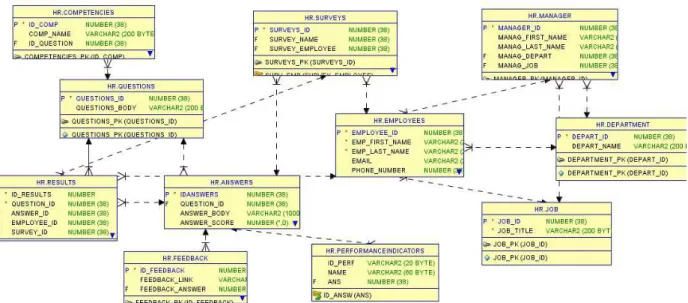
The database schema of the online assessment tool is described in Figure 3.
Fig 3. Database schema of the competency assessment tool The competencies table contains all the 15
PM competencies from the competency model defined by [21]. The Questions table contains the text of the questions, each of them being linked to a competency from the Competencies table. Each question is considered to be an assessment item and has 4 possible responses that are stored in the Answers table. Each answer contains a performance indicator taken from the Performance Indicator table and a feedback
containing a web resource (taken from the Feedback table). The Results table stores all the answers given by the employees to all assessment items as well the final assessment score and the Employees table stores information related to the employees: first name, second name, hire date, email, phone, manager, department and position. The Manager Table stores information related to the employee hierarchical manager, the Job table stores information
related to the position and the Department table stores information related to the departments within the organization.
The xml data model that is exported from the database is containing information related to the employee: employee id, the first name, last name, the department, manager and the job position, as well information related to the score of each competency item assessed, as well the final assessment score computed. The xml associated with an employee assessment score is described in source code below:
<?xml version="1.0" encoding="UTF-8"?> <DATA><CompetencyElements> <Person_ID>5633</Person_ID> <Person_FirstName>Elena</Person_FirstNam e> <Person_LastName>Zicu</Person_LastName> <Department>Solution Development</Department> <Manager>Danila Cristian</Manager> <Job>Developer</Job> <Competency_Assessment> <Q1_Assessment_Score>0.3</Q1_Assessment_ Score> <Q2_Assessment_Score>0.2</Q2_Assessment_ Score> <Q3_Assessment_Score>0.3</Q3_Assessment_ Score> <Q4_Assessment_Score>0.2</Q4_Assessment_ Score> <Q5_Assessment_Score>0.1</Q5_Assessment_ Score> <Q6_Assessment_Score>0.3</Q6_Assessment_ Score> <Q7_Assessment_Score>0.1</Q7_Assessment_ Score> <Q8_Assessment_Score>0.2</Q8_Assessment_ Score> <Q9_Assessment_Score>0.4</Q9_Assessment_ Score> <Q10_Assessment_Score>0.1</Q10_Assessmen t_Score> <Q11_Assessment_Score>0.3</Q11_Assessmen t_Score> <Q12_Assessment_Score>0.2</Q12_Assessmen t_Score> <Q13_Assessment_Score>0.2</Q13_Assessmen t_Score> <Q14_Assessment_Score>0.4</Q14_Assessmen t_Score> <Q15_Assessment_Score>0.3</Q15_Assessmen t_Score> <Assessment_finalScore>65</Assessment_fi nalScore> </Competency_Assessment> </CompetencyElements> </DATA>
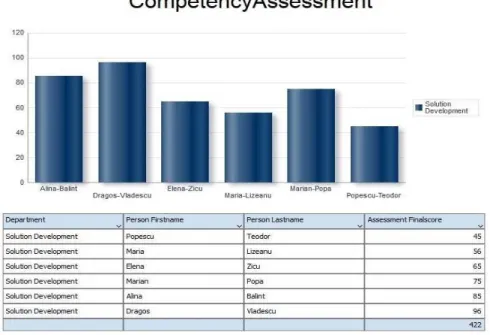
In Figure 4 it can be observed the assessment final score showed in a bar chart and a table containing the information related to the first name, the last name, the department and the assessment final for each employee.
Fig 4. Final scores associated with each IT professional
As it can be seen, Dragos Vladescu has the highest finale assessment score (96%), followed by Alina Balint (85%). The lowest
scores have been achieved by Popescu Teodor (45%) and Maria Lizeanu (56). The
table showing the final scores is very helpful in data analysing.
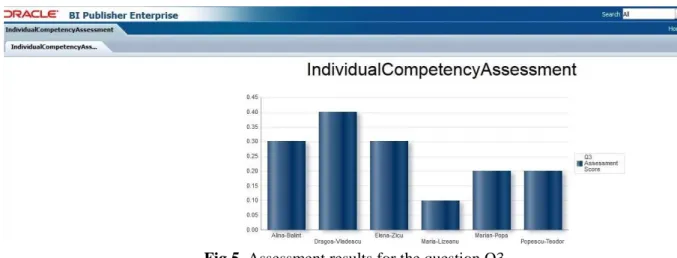
The results for the assessment of question number three, related to the assessment of
the competency item: the automation and optimization of work processes are showed in Figure 5.
Fig 5. Assessment results for the question Q3 As it can be observed, the highest
assessment score related to the evaluation of the question number three is achieved by Dragos Vladescu, followed by Alina Balint and Elena Zicu. The lowest assessment score is obtained by Maria Lizeanu which is having one of the lowest assessment final scores as we can see from the Figure 11. The two reports presented in Figure 10 and Figure 11 are useful for the managers of the department in order to see which employee is performant and how the employees can improve their actual degree of the competency. As well there are useful for the employees which can compare their assessment results with the colleagues’ results in order to raise the competitiveness between the employees from the same department.
The results of the individual assessment for the employee: Elena Zicu is showed in Figure 6.
As it can be seen, the highest score were achieved on the assessment of the competencies efficiency (question number 9) and health, security, safety and environment (question number 14). The lower assessment scores are related to the competency implementation of the maintenance technique (question 5), motivation (question 7) and creativity (question 10). This report is useful as well for the manager that can analyse the individual assessment score in order to improve the current performance level and as well it is useful for the employee who made the assessment in order to be aware of the individual competency level that possesses.
Fig 6. Individual results of the competency assessment
5. Conclusions
The aim of the study was to underline the applicability of the BI Cloud solution BI Publisher applicability of using the BI Publisher reports in analysing the results obtained from the competency assessment process of the IT professionals that are working in Romanian Software Organizations. First, Cloud computing concepts were presented revealing the cloud computing deployment models, the cloud computing service models as well a short analysis presenting the advantages and disadvantages of using Cloud Computing. The traditional Business Intelligence solutions has been presented and their integrations into BI Cloud solutions have been highlighted. At the end, the BI Publisher tool integrated into Enterprise Manager Cloud Control 12c has been showed, as well its architecture and the advantages of developing reports. There has been developed some reports that point out the assessment results of the six IT professionals. The reports are useful for the manager and as well for the professionals in order to improve the performance level achieved.
Acknowledgment
„This paper was co-financed from the European Social Fund, through the Sectorial Operational Programme Human Resources Development 2007-2013, project number
POSDRU/159/1.5/S/138907 "Excellence in scientific interdisciplinary research, doctoral and postdoctoral, in the economic, social and medical fields -EXCELIS", coordinator The Bucharest University of Economic Studies”.
References
[1] Bharat Chandra and Meena Iyer, BI in the Cloud – Defining the Architecture for Quick Wins. Available:
http://www.infosys.com/infosys- labs/publications/Documents/BI-in-a-cloud.pdf
[2] M. Armbrust, A. Fox, R. Griffith, A.D. Joseph, R.H. Katz, A. Konwinski, G. Lee, D.A. Patterson, A. Rabkin, I. Stoica, M. Zaharia, Above the Clouds: A Berkeley View of Cloud Computing, Technical report UCB/EECS-2009-28, Electrical Engineering and Computer Sciences, University of California at Berkeley, Berkeley, USA (February 2009).
[3] Farrukh Shahzad, State-of-the-art Survey on Cloud Computing Security Challenges,
Approaches and Solutions, Procedia Computer Science 37 (2014) 357 – 362 [4] National Institute of Standards and
Technology. NIST Definition of Cloud Computing v15. October, 2009
[5] Eumir P. Reyes (2010), A Systems Thinking Approach to Business
Intelligence Solutions Based on Cloud Computing, Massachusetts Institute of Technology
[6] Mell Peter, Grance Tim, The NIST Definition of Cloud Computing, National Institute of Standards and Technology, Information Technology Laboratory, available at:
[7] Marston S, Li Z, Bandyopadhyay S, Zhang J, Ghalsasi A. Cloud computing — The business perspective, Elseviewer, 2010
[8] Vaquero LM, Rodero-Merino L, Caceres J, Lindner M. A break in the clouds: Towards a cloud definition, SIGCOMM Computer Communications Review, 39:50 55, 2009.
[9] Avram M. G. (2013) Advantages and challenges of adopting cloud computing from an enterprise perspective, The 7th
International Conference
Interdisciplinarity in Engineering
(INTER-ENG 2013), Procedia
Technology, 12 (2014 ) 529 – 534
[10] Yuvraj Singh Gurjar, Vijay Singh Rathore, Cloud Business Intelligence – Is What Business Need Toda, International Journal of Recent Technology and Engineering (IJRTE) Vol 1(6), January 2013
[11] Marenakos L. (2005), Leveraging business intelligence, ABI/INFORM Glob. (2005), pp. 8–11
[12] W. H. Inmon, “Building the Data Warehouse,” John Wiley Sons, Inc., New York (NY, USA), 2005.
[13] A. Butuza, I. Hauer, C. Muntean, A. Popa, ”Increasing the Business
Performance using Business
Intelligence”, Analele Universităţii “Eftimie Murgu” Reşiţa, anul XVIII, nr.3, 2011, pp. 67-72, available
[14] Shimaa Ouf, Mona Nasr, Business Inteligence in the cloud, 2011 International Conference on Computer and Network Engineering (ICCNE 2011), vol 2(279)
[15] B. Ghilic-Micu, M. Mircea, M. Stoica, ”The Audit of Business Intelligence Solutions”, Informatica Economică vol.
14, no. 1/2010, available at http://revistaie.ase.ro/content/53/07%20 Ghilic,%20Mircea,%20Stoica.pdf
[16] J. Dibbern, T. Goles, R. Hirschheim, and B. Jayatilaka, “Information Systems Outsourcing. A Survey and Analysis of the Literature,” 2004.
[17] Leslie Grumbach Studdard (2013), Oracle Fusion Middleware Report Designer's Guide for Oracle Business Intelligence Publisher, 11g Release 1(11.1.1), Oracle, E22254-03, Available: http://docs.oracle.com/cd/E28280_01/bi. 1111/e22254.pdf
[18] Wiggins Ike (2009), Learn how this free utility can make running BI Publisher reporting components incredibly easy, Available: http://www.oracle.com/technetwork/artic les/wiggins-bipublisher-085427.html [19] Daniela Bozdoc (2011) Oracle BI
Publisher 11g: A Practical Guide to Enterprise Reporting. Available: https://www.packtpub.com/sites/default/f iles/3180EN-Chapter-3-Multiple-Data-Sources.pdf
[20] Bodea C. N, E-A. Toader, “Project management competency assessment methods for IT professionals”, 13th International Conference on Informatics in Economy (IE 2014), Education, Research and business Technologies, Bucharest, May 2014
[21] Bodea C. N., E-A. Toader, “Development of the PM competency model for IT professionals, base for HR management in software organizations”, 12th International Conference on Informatics in Economy (IE 2013), Education, Research and business Technologies, Bucharest, April 2013
Elena Alexandra TOADER has graduated the Faculty of Cybernetics, Statistics and Economic Informatics of the Bucharest Academy of Economic Studies in 2008. She has graduated the Professional Master’s Program in Economic Informatics at the Faculty of Cybernetics, Statistics and Economic Informatics of the Bucharest Academy of Economic Studies in 2010. She is a PHD Student at the Economic Informatics PHD School and the main field of interest is competency assessment methods.
![Fig 1. Bi Cloud Architecture (Source [10]) Some of benefits of Cloud Computing for BI were outlined by [5]:](https://thumb-us.123doks.com/thumbv2/123dok_us/9371203.2420359/4.892.428.770.475.764/fig-cloud-architecture-source-benefits-cloud-computing-outlined.webp)
![Fig 2. BI Publisher architecture (Adapted after [18]) 4. Methodology Report output Oracle BI Publisher Layout Templates Layout Tools BI Publisher Repository XML](https://thumb-us.123doks.com/thumbv2/123dok_us/9371203.2420359/5.892.132.753.952.1081/publisher-architecture-adapted-methodology-publisher-templates-publisher-repository.webp)