Table of Contents
Map 3
Dedication 4
Acknowledgements 5
Chapter One: Introduction 7
Chapter Two: A Brief History of Rwanda 11 Chapter Three: Research Question and Theory 22 Chapter Four: Research Design and Quantitative Analysis 37
Chapter Five: A Qualitative Perspective 54
Chapter Six: Conclusion 68
Bibliography 73
Dedication
Acknowledgements
Technically my thesis began in the fall of 2016, but the idea for this project originated with an early interest in human rights. I have worked with many people over the years that have helped cultivate this passion and contribute to this project. First and foremost I would like to thank the kindness of the survivors I have met over the years. In Poland, Bosnia, Rwanda, and Germany I have been welcomed with open arms. These experiences began in my hometown of Boston with the Lost Boys and Holocaust survivors that I encountered. I am grateful for their ability to humanize these conflicts and their patience while I learned their history.
I would like to thank the educators who have contributed to this project. From Concord Academy, to University of Colorado Boulder, to Science Politique, to The Danish Institute of Study Abroad, and finally the University of North Carolina. At each of these places I learned new ways of approaching this intellectual process. A particular thanks to Brendan Shepard, Jacques Sémelin, Torben Jorgenson, Nicolai Christofferson, Ulrik Graff, Patricia Sullivan, and Mark Crescenzi for teaching me to have a critical and patient approach. I would also like to thank the unparalleled support of the Peace, War, and Defense
Department and the Odum Institute.
In addition, I would like to thank the mentors I have had. I owe my continuous thanks to Emory Aronson, Gloria White-Hammond, as well as the entire teams at the Robin Hood Foundation, Northern Uganda Medical Mission, and Summer Search Boston. You taught me to approach the world with curiosity and kindness.
Chapter One:
Introduction
Pancrace would rise in the morning, eat a breakfast of brochettes, meet his friends, and walk to work. During the 1994 Rwandan genocide, this routine remained relatively normal. Instead of a traditional job, Pancrace worked as a civilian genocidaire (perpetrator of genocide). His day consisted of a series of attacks where he was expected to machete Tutsi-Rwandans. “Rule number one was to kill. There was no rule number two,” he remembers.1
To most people living in peaceful societies, his behavior seems insane. He killed people he knew. He murdered his neighbors. Surely he is monstrous. Pancrace, like many civilian participants in genocide, is not evil. He is a human being who was persuaded to believe certain versions of truth, and whose innate morality was corrupted with propaganda. This is one of the major misconceptions of genocide: everyone who kills must be “bad.” History and this research show otherwise. Pancrace is not an anomaly of human nature; rather his fate is a possibility for every person who feels an emotional connection to their designated identity.
Pancrace was not an outlier. He participated in killings that were orchestrated by his local government and the Interhamwe.2 The civilians were armed with machetes and ordered
to begin killing. The organizers were purposefully vague with their assignments and did everything in their power to dehumanize the victims. Civilians did not see themselves as murderers, but as civil servants carrying out a duty to their nation. When some of the men in Pancrace’s group pressed for more details, one of the leaders told them, “The only
worthwhile plan is to start straight ahead into the bush.”3 And so they did. The men, with
little or no experience of violence, began killing. Most of them do not remember their first $$$$$$$$$$$$$$$$$$$$$$$$$$$$$$$$$$$$$$$$$$$$$$$$$$$$$$$$
1 Hatzfeld, Machete Season.
kill. Instead Pancrace remembers the first person that he made eye contact with. To him, “the eyes of someone you kill are immortal...they have a terrible black color.”4 These moments
aside, the killings blended together.
Pancrace and the other genocidaires developed ways to cope with the violence. Their violent acts were not only fatal but also brutal and at times exhibitionist. One common practice, was killing females by taking a six-foot sharpened pole and driving it through the woman’s genitals until it went through her brain.5 Some embraced this process of death and
dehumanization while others attempted to distance themselves from the more grotesque parts of the work. Killing was tiring and men psychologically simplified the process by
transitioning their guilt. Killers would internally rationalize why they were not responsible for their actions. Pancrace explains “if you have been properly prepared, if you feel yourself pushed and pulled, if you see that the killing will be total and without disastrous
consequences for yourself, you feel soothed and reassured.”6 An individual’s ability to justify
their behaviors helps them remain human in their own minds. This research asserts that it is important to keep people like Pancrace in mind while studying genocide, not to sympathize with them, but instead to humanize them. Through this process we can better understand their decision-making and how they ended up with a machete in their hands.
The rationale of civilian perpetrators is too large of an undertaking for one project, but social science is best equipped to understand the process by focusing on specific area of influence. Therefore, this research seeks to understand how social homogeneity and hate speech impact civilian decision-making during genocide, specifically the case of Rwanda.
$$$$$$$$$$$$$$$$$$$$$$$$$$$$$$$$$$$$$$$$$$$$$$$$$$$$$$$$
4 Ibid.
Social homogeneity (or the qualities of sameness that a group possesses) and hate speech are both factors that motivate violence but each operate in different ways. Social homogeneity is a condition under which the group exists, where as hate speech is a mechanism distributed by the elites. By understanding this relationship, we can better understand Pancrace’s
motivation. In genocide studies, the majority of research is devoted to those who orchestrate the violence, but it is equally important to understand the individuals who comply with and execute it. Focusing on social homogeneity and hate speech helps to explain the societal influence which would subconsciously affect a civilian’s decision. As Raul Hilberg, a genocide survivor and scholar observed “At crucial junctures, every individual makes decisions, and… every decision is individual.”7 Genocide is not handed down from above,
but accepted and even embraced by the masses. Within the civilian decision-making process there are many variables at play. Here I focus on a single and crucial component: the
relationship between social homogeneity and hate speech.
This research is concentrated on civilian behavior at the community or village level, and the way that social interactions influence a person’s decision in crisis. There is a wide range of opinions, even controversy, on the role that social homogeneity plays in conflict. Many of these causal mechanisms vary at the level of conflict operationalization whether it be international, the state, counties, or villages. At the state level, socially homogeneous societies are successful, since homogeneity and conformity limit conflict. There is research at the community level suggesting that social diversity encourages individuals to question
$$$$$$$$$$$$$$$$$$$$$$$$$$$$$$$$$$$$$$$$$$$$$$$$$$$$$$$$
authority.8 The research discussed here will only address social homogeneity at the sector or
village level, which averages a population of 5,000.
The study of hate speech and propaganda is far less controversial. There is general consensus that propaganda impacts decision-making; the question is to what degree.9 This
research argues that hate speech is a key step in creating a strong national narrative to garner civilian support for genocidal violence. I hypothesize that high levels of social homogeneity and hate speech will lead to high levels of civilian participation in violence. This is tested through a quantitative and qualitative exploration of the relationship between the social homogeneity and hate speech. The discovered relationship is statistically significant, and reinforces the original hypothesis. This research discovers an interesting relationship between the two independent variables that calls for further extensive research.
$$$$$$$$$$$$$$$$$$$$$$$$$$$$$$$$$$$$$$$$$$$$$$$$$$$$$$$$
Chapter Two:
A Brief History of Rwanda
In 1994 the Hutu extremist population of Rwanda persecuted the Tutsis in what many consider the most efficient genocide in human history. However the roots of the genocide began decades prior to 1994, when colonialists cast Hutus as inferior to Tutsis. The geopolitical history of Rwanda shaped the conflict, which developed following the establishment of independence from the Belgians. This conflict was entrenched in an
ideology constructed by the different regimes and a stream of propaganda intended to create a chasm between Hutus and Tutsis. This environment built a perceived threat to the basic human needs of Hutu Rwandans who were then able to dehumanize their Tutsi counterparts for what the ideology allowed them to define as altruistic purposes, making it morally feasible to carry out genocidal violence. The specific structure of Rwandan history outlined in this chapter helps to frame the theory, the research, and the genocide itself.
The Birth of a Violent Ideology
The modern territory of Rwanda has been inhabited for nearly two thousand years. In the beginning, the society operated under a single culture, language, and religion with a common history. Prior to colonization, Hutu and Tutsi were permeable social structures meant to delineate material worth. Cattle were the primary monetary system of exchange, so the size of one’s herd directly translated to wealth. Tutsis were those who were rich in cattle, whereas Hutu were their subordinate laymen.10 People married within their social class,
which provided each group with a phenotypic identity over a series of generations. To
$$$$$$$$$$$$$$$$$$$$$$$$$$$$$$$$$$$$$$$$$$$$$$$$$$$$$$$$
10 Forges, Leave None to Tell the Story; Totten, Parsons, and Charny, Century of Genocide; Mamdani, When
clarify, the origin of the Hutu and Tutsi identity groups have no base in genetics, race, or ethnicity. (Therefore the complex separation of the two groups will be referred to as a “social division” and not as an issue of ethnicity.) In the years leading up the colonization rates of inter-marriage fluctuated and the groups lived harmoniously.11 Rwandans had a complex
tribal structure of government that the colonizers could not comprehend.
In 1884, at the Berlin Conference, the territory of Rwanda was allocated to Germany. The Germans maintained the existing political structure and gave Rwandans nearly
autonomous political control. Then, during WWI, the Belgians took control of Rwanda and changed local power structures. The Belgians struggled to understand the traditional modes of governance and instead exacerbated the social divisions to create an oppressive social hierarchy. The Belgians reorganized and simplified the state into chiefdoms and sub-chiefdoms, removing the “competing hierarchies” which acted as a system of checks and balances.12 Colonizers decided to focus on the Hutu/Tutsi social dynamic, which they
perceived as ethnic.
Tutsis were put into positions of power, even though Hutus were the majority. Beginning in the 1920s, only Tutsis could participate in government. Belgium’s political favoritism was not meant to create a divide-and-rule system. Instead they believed that one “ethnic” group was fundamentally superior to the other. The Tutsis in power exploited this perception and created a version of history to support the Belgian narrative. This historical representation showed Tutsis as the naturally superior leaders in a feudal structure of power. The Tutsis promoted the theory that lighter-skinned Africans were the main force civilizing
$$$$$$$$$$$$$$$$$$$$$$$$$$$$$$$$$$$$$$$$$$$$$$$$$$$$$$$$
Africa.13 “Ethnic” categories were solidified in the 1930s when all Rwandans were forced to
register their category. From that point the separation was concrete and a person’s ethnicity was assigned at birth. This bureaucratic decision would prove to be catastrophic.
Rwanda gained independence from Belgium in 1962 and the path to post-colonial power created further social divisions between groups. The two groups vied for power over the emerging state. The Tutsis were initially guaranteed power, since they were politically and socially dominant. Historically, the emperors of Rwanda were Tutsi, so the colonists believed there was precedence for leadership. In 1961, at the height of the colonial transition, Kigeli V Ndahindurwa, the last emperor of Rwanda, died. Simultaneously there were
incidents of Tutsi violence against Hutu. These two events created a window for the Hutu majority to seize power from Tutsis, claiming they were no longer fit for leadership.14 Half
of the Tutsis in the political system were replaced with Hutus. Hutus effortlessly won the first free election. The rhetoric of freedom and independence was deeply entrenched in the social divisions. The false feudal history that the Tutsis used to justify their social dominance was now used against them. The new government was characterized by Hutu power and anti-Tutsi attitudes. Hutu sought to “reclaim” power, territory, and wealth from their anti-Tutsi “overlords.”15 In the months following the first free election Tutsis were removed from their
land and property and over 10,000 were exiled from the country. Tutsis living in exile started to organize against the sitting government, which reinforced Hutus’ negative perceptions of Tutsis.16
$$$$$$$$$$$$$$$$$$$$$$$$$$$$$$$$$$$$$$$$$$$$$$$$$$$$$$$$
13 Ibid.; Morrock, The Psychology of Genocide and Violent Oppression. 14 Forges, Leave None to Tell the Story.
The postcolonial period saw the creation of a socially divisive and violent national ideology. The Tutsis in exile started organizing attacks against Rwandan nationals and the sitting government. This rebel activity encouraged the idea that Tutsis were not only dangerous, but that the Hutu majority had the right to rule over Tutsis. Vilifying Tutsis had financial benefits, since the government could claim the exiled person’s land and goods. In the late 1960s the state carried out a series of attacks against the Tutsis civilians hoping to suppress the exiled rebel movement. An estimated 20,000 were killed and 300,000 were forced into exile. Once again the falsified history of Rwanda, helped to reinforce an anti-Tutsi ideology.17 Classification measures, such as identity cards, were created so social
differences could easily be identified and institutionalized. These policies of discrimination and violence persisted into the 1990s. By 1991, due to both exiles and killings, the Tutsi population was down to 8.4% of the country’s total population, but this was just the beginning.18
In the 1990s the conflict between the ethnic groups intensified. Juvénal Habyarimana, of the MRND (National Republican Movement for Democracy and Development –
conservative party), was the president and authoritarian leader. The government was on the defensive, as Tutsi exiles militarized in neighboring countries. The Rwandan Patriotic Front (RPF) was the Tutsi political organization that opposed the sitting regime in Rwanda. They also had a militarized wing, the Rwandan Patriotic Army (RPA), which was led by Paul Kagame.19 In October of 1990, the RPA invaded Rwanda and captured territory within 45
miles of Kigali. Then on October 4th the RPF allegedly shelled Kigali causing Habyarimana
$$$$$$$$$$$$$$$$$$$$$$$$$$$$$$$$$$$$$$$$$$$$$$$$$$$$$$$$
to arrest over 13,000 Tutsis who were perceived to be a threat to the state.20 They were
tortured held under inhumane conditions. It was revealed after the genocide that
Habyarimana staged the shelling as an excuse to make arrests, gain popular support, and create a climate of fear. The RPF was forced back into surrounding countries such as Uganda and Burundi. The escalation of violence also increased the presence of NGOs and
government-watch agencies. They forced Habyarimana to change the constitution and create a government, which included both social groups.21
Following the constitutional changes, the first coalition government came to power in 1992, and Habyarimana remained president. The MRD (Republican Democratic Party) gained a significant amount of power and elected Agathe Uwilingiyimana as Prime Minister, under Habyarimana.22 The MRD was the moderate Hutu opposition party who favored
Hutu/Tutsi integration. Early in her term, Uwilingiyimana announced new policies such as a quota-free education system that gained her public support. Simultaneously the MRD started an intense propaganda campaign to increase their popular support. Habyarimana’s power was threatened both internally by the coalition government and externally by the rebels. He feared that the Tutsis could take control because power in the capital was fractured. Habyarimana slowed the growing power of the opposition through both soft and hard power techniques. Multiple political parties in Rwanda organized militarized youth groups. At the same time the Interhamwe23 emerged. They were the paramilitary arm of Habyarimana’s regime. The
MRND, MRD, and the Tutsi minority violently battled for power. The rule of law was absent as Habyarimana and the MRND tried to usurp power from the MRD. Citizens did not know $$$$$$$$$$$$$$$$$$$$$$$$$$$$$$$$$$$$$$$$$$$$$$$$$$$$$$$$
20 Fujii, Killing Neighbors; Forges, Leave None to Tell the Story. 21 Fujii, Killing Neighbors; Forges, Leave None to Tell the Story.
whom to trust, but it was clear that they were in danger when the government began indiscriminate attacks against the population.24
Less than a year later, in August of 1992, the Habyarimana regime and the domestic Hutu opposition signed the Arusha accords, which provided short-term peace.25 Neither side
wanted to demobilize and less than a month later Habyarimana privately rejected the accords and redefined the new enemy. The focus was no longer Hutu opposition, but the threat of Tutsi control. The enemy was separated into two categories: the principal and the partisan. The principal was:
The Tutsi inside or outside the country, extremist and nostalgic for power, who NEVER recognized and will NEVER recognize the realities of the 1959 social revolution and who wish to re-conquer power by all means necessary including arms.26
The partisan was anyone who supported the principal. In these defining documents, ‘Tutsi’ was used interchangeably with the word ‘enemy,’ and Hutus could also be members of the enemy. The MRND deftly combined two different enemies, Tutsi and Hutu opposition, into one abstract force that jeopardized the security of the Rwandan state and its people. From decades of violence and misinformation, a singular
ideology was born, which defined the threat and gave the people something to fight for.
Broadcasting the Perception of Threat
$$$$$$$$$$$$$$$$$$$$$$$$$$$$$$$$$$$$$$$$$$$$$$$$$$$$$$$$
24 Straus, The Order of Genocide; Straus, Making and Unmaking Nations. 25 Forges, Leave None to Tell the Story; Fujii, Killing Neighbors.
The core ideology for the Rwandan genocide was delivered through national radio programs. Beginning in 1992, the government created “free press,” which was a guise for anti-Tutsi propaganda. The government manipulated the social divisions to their advantage. The regime employed common stereotypes of Tutsis to dehumanize them in the eyes of the average Hutu citizen. Once they were perceived as sub-human it was easier to justify
violence against them. The state could paint this violence as altruistic or noble, since civilians were being violent towards non-humans to protect the safety of their nation and families. The dehumanization process was carried out through statewide propaganda and hate speech. The national radio stations of RTLM and Radio Rwanda were the main modes of delivery.
Blatant anti-Tutsi media hit the airwaves in 1991 and intensified in the following years. Propaganda, like social divisions, was not the absolute cause of the genocide, but it was a catalyst. Broadcast from RTLM and Radio Rwanda, the two government-controlled stations, focused on creating broad differences instead of focusing on one specific political, racial, or ethnic quality. The vague messages allowed civilians to interpret the message of discrimination and dehumanization to fit anyone who was different in their community. Pre-genocide Rwanda had low rates of literacy and multilingualism so radio was the primary way to distribute news and information. In the early 1990s, RTLM was only distributed in the Kigali area whereas Radio Rwanda was distributed through the country. Habyarimana aided this process by distributing radios to all regions of the country.
broadcasts and their influence.27 This research highlights that the genocide was not a conflict
between two social groups, which had complex roots that were deeply intertwined with the country’s colonial and feudal history.28 Elizabeth Baisley, a political scientist at Princeton
University, elaborates that “rebelling against wealthy people” was a key element in the MRND’s hate-speech messaging. Her analysis of hate speech focuses on status and
occupational differences between the two groups. “It was said that Tutsi could not farm, they were often accused of stealing food produced by Hutu or living off the work of Hutu
cultivators.”29 Propaganda mechanisms created the imagery that Tutsis were a scourge on
society, with no right to be superior since they relied on Hutus for food production and other key resource systems.30
The radio stations started to refer to Tutsis as Indiririzi or Inyenzi, which translate to “parasite” and “cockroach,” respectively. The classification as insects rendered Tutsis as sub-human: dehumanization. They were parasites on society who had to be eliminated for the greater good: altruism. Killing Tutsis was a service to the greater good of the nation and those who participated in the violence could compartmentalize their actions with less guilt, since their victims were not human.
Political Organization
$$$$$$$$$$$$$$$$$$$$$$$$$$$$$$$$$$$$$$$$$$$$$$$$$$$$$$$$
27 Roozen and Shulman, “Tuning in to the RTLM Tracking the Evolution of Language Alongside the Rwandan
Genocide Using Social Identity Theory”; Baisley, “Genocide and Constructions of Hutu and Tutsi in Radio Propaganda.”
28 Baisley, “Genocide and Constructions of Hutu and Tutsi in Radio Propaganda”; Roozen and Shulman,
“Tuning in to the RTLM Tracking the Evolution of Language Alongside the Rwandan Genocide Using Social Identity Theory.”
The propaganda descended from the elites and was predominantly distributed through the government-supplied radios, but civilians were organized and encouraged by the local government. At the local level, the Rwandan government operated a system called
Burgomasters. The Rwandan state was divided into ten prefectures and the prefectures were subdivided into communes, which averaged around 50,000 people, controlled by
Burgomasters. Communes were separated into sectors, each of which averaged 5,000 people and were controlled by a councilor. Then the sectors were partitioned into cells that
contained 1,000 people and were controlled by a group of five leaders. There was a person in power at each level, but the Burgomasters had the most influence.31 This system harkened
back to the pre-colonial Rwandan governmental structure, except that Tutsis were now excluded from the political system.32 Habyarimana selected the Burgomasters. This structure
allowed the state to permeate all aspects of life. Citizens were forced to participate in Umuganda (days of community service) and animation sessions (propaganda meetings for the MRND). The church network reinforced political messaging from the pulpit, since the archbishops were Hutu.33
The Burgomasters held power and authority in the communities. They were
considered a high court, so if problems could not be resolved at the cell or sector they would go to the commune. The key public duty of the Burgomaster was to hold “court once or twice a week to receive citizens and explain the latest news from the capital;” they also
“determined land use, mediated property conflict, settled family disputes, placed children in
$$$$$$$$$$$$$$$$$$$$$$$$$$$$$$$$$$$$$$$$$$$$$$$$$$$$$$$$
secondary schools, and decided which cases ought to go to higher court.”34 The
Burgomasters were imperfect since their allegiances and judgments could be bought.35
Nonetheless, Burgomasters held positions of moral absolutism in society and their words were essentially commands. When the genocide began, the orders came from the
Burgomasters, which the church and the media reinforced. This made it easy for civilians to rationalize their violent decisions.
Executing the Violence
The genocide began in full on April 6th 1994. That day President Habyarimana’s
plane was shot down and he was killed, along with most of his MRND cabinet. Tutsis and the RPF were blamed for his death and this was used an excuse to begin the killings. By the next morning all Tutsis had been removed from power and the government was replaced with Hutu extremists (those who favored the most the violent solutions to the social divisions).36
The Hutu civilian population was quickly organized to implement the violence and in the following 100 days between 500,000 and 1,000,000 Tutsis were killed, which was 75% of the country’s Tutsi population.37 Motivated by the murder of the president and the perceived
threat of quickly approaching RPF forces, the violence was intense and incredibly efficient.38
Habyarimana’s assassination reinforced the idea that Hutus were innocent victims of Tutsi violence. The MRND tried to disseminate this message world-wide, telling the international
$$$$$$$$$$$$$$$$$$$$$$$$$$$$$$$$$$$$$$$$$$$$$$$$$$$$$$$$
34 Morrock, The Psychology of Genocide and Violent Oppression. 67. 35 Mamdani, When Victims Become Killers.
community that the Tutsis were preparing to commit genocide.39 All the pieces of the
government’s genocidal ideology came together and Burgomasters, churches, as propaganda enlisted civilians into violence.
On the morning of April 7th, the MRND and General Bagosora began assassinating political dissidents. The moderate Prime Minister Agathe Uwilingiyimana, a Hutu who supported integration, was among the first killed. General Bagosora, a core member of the Hutu extremists, oversaw the killings. The network of Hutu extremists advocating for violence was integrated across the political, military, and civilian sectors. In 1993 Bagosora had imported a large number of machetes to Rwanda, some hypothesize as a planning step in the killings.40 A skilled military leader, he published military press releases which ordered
political stabilization, while simultaneously sending internal memos that encouraged the Interahamwe to violence. Under his command, the violence intensified.
Many of the massacres annihilated entire villages, so that the names and identities of the victims could not be recovered. This fact alone makes it one of the most effective
genocides in history. Some scholars suggest that over one million people, including military personnel, participated in some form of violence during the genocide. The death tolls are widely debated and they do not include the hundreds of thousands of Hutu deaths at the hand of the RPF. The genocide tells a one-sided story of struggle, since the Tutsi RPF forcibly took office after the genocide and wrote the history of the conflict. In the twenty-two years since the conflict, the country has splintered and struggled to recover from a legacy of
violence and distrust. The trajectory of this country, the conflict, and the aftermath influence the way in which research is conducted.
$$$$$$$$$$$$$$$$$$$$$$$$$$$$$$$$$$$$$$$$$$$$$$$$$$$$$$$$
Chapter Three:
Research Question and Theory
This work began with the research question: why do civilians participate in violence during genocide? There are innumerable factors, psychological and societal, that impact an individual’s decisions. Genocide research examines many different factors that motivate civilian violence from economics, to geopolitics, class, coercion, social context, external threats, and a myriad of other issues. This research focuses on the relationship between two factors: a) social homogeneity and hate speech; and b) civilian violence. These two
components have been investigated independently but not in combination. The relationship between these elements cannot absolutely answer the question of why civilians kill, but it is an important part of the puzzle.
When civilians live in socially homogeneous communities, I hypothesize they are more susceptible to hate speech, since they do not have a significant volume of personal relationships with the out-group. Individual interactions with members of the out-group have the potential to dispel stereotypes and misconceptions propagated through hate speech. The relationship between diversity and hate speech is a crucial area to focus on, because of its immediate policy and research implications.
Studying genocide collectively helps to illuminate the universal behaviors of
is a tendency in genocide studies to focus on the elites since they hold the power, but low-level civilian actors make up the social majority. They play an important role both as collaborators and active bystanders. So why do civilians accept genocidal ideology
disseminated by elites? Through conditions and mechanisms, this research builds a picture of a genocidal environment.
Social homogeneity measures the quality of sameness in a society or how many individuals are alike based on certain measures of identity.41 In the case of Rwanda, the
social homogeneity refers to a quality of sameness between the social groups of Hutu and Tutsi, but in other genocidal societies social homogeneity could be a quality of religion, race, or nationality. This term is meant to delineate between the dominant in-group and the
persecuted out-group. Therefore understanding the demography of communities prior to genocide is important. Demography directly influences who will become victims and how much of a community will be killed.42 In addition, hate speech colors the way these divided
populations understand one another. Both variables can be easily manipulated by elites, but they still have a direct impact on genocidaires.
In socially homogenous communities, members of the in-group provide emotional and physical support to one another as they attack the out-group.43The group mentality
towards the out-group is also affected by the status of the out-group in society. One must examine how much the propaganda or anti-out-group rhetoric has permeated society and how the in-group civilians become complacent with the idea that the victimized out-group is a threat to society. The different perceptions of the out-group are directly related to the
$$$$$$$$$$$$$$$$$$$$$$$$$$$$$$$$$$$$$$$$$$$$$$$$$$$$$$$$
41 Friedkin, “Structural Cohesion and Equivalence Explanations of Social Homogeneity.” 42 Straus, The Order of Genocide.
presence of propaganda. In order to be effective, propaganda must have strong messaging and wide distribution. These mechanisms explain the relationship between social
homogeneity and hate speech.
Civilian participation in violence does not exist in a vacuum and it is important to understand what other conditions are at play. While designing this research, I considered other measurable factors that could influence a civilian in a village in Rwanda. Mapping this research question helps to hone the understanding of the conditions under which violence is perpetrated. The two independent variables (social homogeneity and hate speech) easily develop and branch into other areas of study, suggesting further questions to be answered. To better understand the dynamics of the variables, we must also look at the target audience, the content of the propaganda, the dynamics of the inter-group relationship, the modes of
oppression, and the legacy of colonialism in the communities.
Examining the relationship between a condition of violence (social homogeneity) and a mechanism of genocidal violence (hate speech) has the potential for direct impact on policy and civil society. Research on the effects of social homogeneity could influence national policies towards diversity and inclusion. Governments can take preventative measures to avoid creating or encouraging dangerous intergroup dynamics, which have a high tendency towards discrimination. This research could also inform the need to monitor socially homogenous populations earlier, if in fact, they are more susceptible to out-group propaganda and consequently violence. Hate speech research helps militaries,
understand which communities are at the highest risk of violence for genocidal or identity-based conflict.
In a broader sense, the field of genocide research is essential for both academic and political progress. Genocide is not the most common form of violence against civilians, but it does have a unique impact on society. There is no merit to comparative suffering, so this is not to say that the violence of genocide is worse or more intense than another conflict. But the intentionality of genocide is unique. It aims to eliminate a whole group and their
respective culture from society. Genocide deprives both the in-group and the out-group of the development that is born out of interaction. There is both an empirical and a moral argument that diversity improves the development and achievements of society. Genocide seeks to exterminate civilians over inalienable and non-elective aspects of their identity. Those killed in genocide do not choose to be born Tutsis Yazidis, Jews, disabled, or Buddhists, nor can they disavow these associations. The perpetrators assign negative value to these groups and we must try to understand why.
Theoretical Approach
Defining Genocide
The definition of words is crucial not only for academic research, but also for the political and social interpretations of international events. Raphael Lemkin invented the word genocide in 1945 in reaction to the events of World War II. The multicultural etymology derives from the Greek root “genos,” which means people, and the Latin root “cide” which means murder. The word “genocide” literally translates to the murder of a people.44
Lemkin’s original definition was broad and inclusive, arguing that the intentional destruction of any social or cultural group should constitute genocide.45 “Genocide” was intended to
describe the intentional annihilation of a group as perceived and defined by theperpetrators so that mass identity-based violence could be prosecuted.
When the United Nations legally adopted the word in 1948, they edited the definition substantially. The “Convention on the Prevention and Punishment of the Crime of
Genocide,” defines genocide as
Any of the following acts committed with intent to destroy in whole or in part a national, ethnical, racial, or religious group, as such
a. Killing members of the group
b. Causing serious bodily or mental harm to members of the group c. Deliberately inflicting on the group conditions of life calculated to
bring about its physical destruction in whole or in part
d. Imposing measures intended to prevent births within the group e. Forcibly transferring children of the group to another group46
This is the legally accepted definition of genocide, and it limits the protected groups to only race, ethnicity, nationality, and religion. The legal and academic communities struggle to $$$$$$$$$$$$$$$$$$$$$$$$$$$$$$$$$$$$$$$$$$$$$$$$$$$$$$$$
44 Irvin-Erickson, “Genocide, the ‘Family of Mind’ and the Romantic Signature of Raphael Lemkin.” 45 Ibid.
agree which international incidents qualify under these terms. In the sixty-seven years since the convention was ratified, only two genocides have been legally recognized.47 The most
challenging aspect to prove in a court of law is the intent to commit genocide, which is where many cases fall apart. This is not the main issue for the academic community; instead they struggle to agree about the protected groups.
The definition for the legal framework is widely debated in the field of social sciences.48 This research maintains the legal definition of genocide, except for the list of
protected identity groups.49 The term ‘genocide,’ and the penalties associated with it, should
not be limited to acts against the conventionally defined ethnic, racial, national, or religious groups. In the dynamic of mass violence, the perpetrators have the decision-making power, whereas the victim has none. The perpetrators have the ability to define the parameters of out-group. They also have the capability to create perceived social groups regardless of their victims’ qualities of birth.50 For example, a group in power could decide to kill all blue-eyed
member of a population; while this would not qualify as genocide in the legal classification, it would conform to the more reasonable standard of the intentional eradication of a group based on their characteristics. Therefore I contend that genocide should be defined as the attempted destruction of a social group as determined by the perpetrators. The definition of genocide for this paper is the intentional destruction in whole or in part of a group as perceived and determined by the perpetrators.
$$$$$$$$$$$$$$$$$$$$$$$$$$$$$$$$$$$$$$$$$$$$$$$$$$$$$$$$
47 This measurement depends on which United Nations body has recognized the genocide. The UN Security
Council has only recognized the Holocaust and the Rwandan Genocide. Others feel as though the organization and oversight of the International Criminal Tribunal for the Former Yugoslavia, counts as a form of recognition. The Secretary General of the United Nations has also called for a trial of genocide crimes in Cambodia, which does not necessarily constitute recognition.
48 Jensen, “Evaluating Genocidal Intent.”
The Terminology of Conflict
To establish a theoretical argument, one must first establish and define the terms associated with research. This section addresses theories of social homogeneity, hate speech, the Asch paradigm, social identification theory, intergroup categories, othering, groupism, and civilians.
The two independent variables in this research look at the ways in which society is structured and influenced. Social homogeneity is a quality of sameness between members of a community, as they relate to their various social categories, whether it be class, race, religion, or ethnicity etc.51Hate speech is a contested term, but the American Bar association
defines it as “speech that offends, threatens, or insults groups, based on race, color, religion, national origin, sexual orientation, disability, or other traits.”52 This can be executed through
a number of different means such as personal interactions, propaganda, and elite
manipulation. Both these variables have the capability to impact civilian decision making. Decision-making is often thought of as an individual process, but psychological studies show that it can be easily influenced. The Asch Paradigm tests decision making in diverse populations. In a seminal study, social psychologist Solomon Asch found that individuals are highly likely to support an opinion they know is incorrect if the majority of the group has already supported it. Asch’s work provides evidence for in-group decision conformity.
$$$$$$$$$$$$$$$$$$$$$$$$$$$$$$$$$$$$$$$$$$$$$$$$$$$$$$$$
Social identification theory (SIT) maintains that group membership influences relationships and self-esteem, as well as conflict in extreme situations.53 Similarly
psychology suggests that group association is driven by a desire to fulfill certain human needs.54 In this school of thought, social interests between two (racially, nationally,
ethnically etc.) different groups emerge and people will tend to focus on the needs of their membership group and simultaneously “ignore or even disparage out-group members.”55
This differentiates from personality theory, which focuses on how the psychology of individuals, instead of the group, influences decision-making.56 Differences can lead to
privileges and group perception of superiority or entitlement. As a result the in-group can “[classify] the out-group as possessing a set of dangerous and morally bankrupt
characteristics.”57 In turn, the in-group members receive certain benefits or positive character
traits assigned to their person, even if they are not merited. The belief and participation in these representations of group dynamics permeate the culture and become engrained into societal modes of operation – often through media.
The terms intergroup categories, othering, and groupism refer to relationships between the in and out-groups. Intergroup categories are the characteristics or traits that individuals assign to themselves and other social groups. This can also be understood as the tendency towards “us vs. them” categorizations. Intergroup perceptions develop into
$$$$$$$$$$$$$$$$$$$$$$$$$$$$$$$$$$$$$$$$$$$$$$$$$$$$$$$$
53 Roozen and Shulman, “Tuning in to the RTLM Tracking the Evolution of Language Alongside the Rwandan
Genocide Using Social Identity Theory”; Reynolds et al., “The Role of Personality and Group Factors in Explaining Prejudice.”
54 Staub, The Psychology of Good and Evil.53
55 Roozen and Shulman, “Tuning in to the RTLM Tracking the Evolution of Language Alongside the Rwandan
Genocide Using Social Identity Theory.” 166
56 Reynolds et al., “The Role of Personality and Group Factors in Explaining Prejudice.”
57 Roozen and Shulman, “Tuning in to the RTLM Tracking the Evolution of Language Alongside the Rwandan
stereotypes and subconscious assumptions.58Othering is a sociological term which refers to
an individual’s tendency to distance or separate those perceived as ‘other,’ specifically the process of mental separation or distancing from the out-group. Groupism is a term invented by Raphael Lemkin at the same time that he developed the word genocide. It is the idea that people belonging to a certain race, ethnicity, nationality or social group is attributed with associated principles and morals resulting in a synthesized (and prosecutable) collection of individuals.59
We must also define the actors in conflict. According to the customary International Humanitarian Law established by the Geneva Convention, “Civilians are persons who are not members of the armed forces.”60 Therefore civilian genocidaires are those who have no
military affiliation or background. Instead they operate separate from the structure and rank of the military. Civilians can be perpetrators (those who contribute to or commit the
violence), bystanders (people who make the active choice to be passive in the face of conflict), or resistors (people who take actions contradictory to the violence to protect the persecuted population). The three categories of civilians in conflict are both malleable and permeable, in that civilians have the agency to transition between these different categories. With the terminology defined we can discuss the theories of participation in violence.
Theoretical Explanations of Violence
Independently, social homogeneity and hate speech have known impacts on
individual decision making at the village level. In socially homogeneous populations, people
$$$$$$$$$$$$$$$$$$$$$$$$$$$$$$$$$$$$$$$$$$$$$$$$$$$$$$$$
58 Baumeister and Vohs, Encyclopedia of Social Psychology.
59 Donald Bloxham and A. Dirk Moses, The Oxford Handbook of Genocide Studies, (Oxford: Oxford
University Press, 2010), 22.
feel as though they have control over the power dynamic. Through this they find the strength and confidence to participate in violence. Members of socially homogenous populations feel safe with one another and have a tendency to easily come to consensus, even if an opinion is incorrect, as highlighted by the Asch paradigm.61 This is often referred to as the mob
mentality. A recent study found that living in conditions of ethnic diversity causes
individuals to make more accurate decisions during educational exercises, which illustrates the positive potential of social heterogeneity.62 Diversity can cause societal friction, but it
also leads to individualized cognitive processes, instead of a reliance on messages from the in-group.
Civilians who feel as though they have control or dominance also gain a sense of safety from their intergroup category. When they feel dominant in the power dynamic, they can perform the violence instead of deferring to the military. In socially heterogeneous communities it is unclear who would prevail in a conflict, therefore it is in the in-group’s best interest to wait for the military to carry out the violence. When the in-group has safety in numbers, they can be assured that the out-group will not dominate. Intergroup violence in socially homogenous situations is low risk/high reward. There is a low likelihood that there will be violence of retaliation and civilians are rewarded with the material and property goods of the victimized group.63 Studies show that in Rwanda the government and
Burgomasters motivated civilians to violence, as they were promised ownership of the land and material possessions of the Tutsis they attacked.64 Social homogeneity has the capacity
$$$$$$$$$$$$$$$$$$$$$$$$$$$$$$$$$$$$$$$$$$$$$$$$$$$$$$$$
61 Levy, “Considerations on the Connections between Race, Politics, Economics, and Genocide”; Levine et al.,
“Ethnic Diversity Deflates Price Bubbles.”
62 Levine et al. 2014
to strengthen in-group membership and exclusion as highlighted by the Robbers Cave Experiment.
The Robbers Cave Summer Camp Experiment, shows how easily social homogeneity and ideology can foster an environment of persecution. During the experiment a group of social psychologists studied the intergroup relations between young children. In the experiment, twenty-two boys were brought to a remote campsite.65 The children were
unfamiliar with one another and were members of similar descriptive categories. The boys were separated into two arbitrary groups and then pitted against one another in a series of competitions. Teams that won competitions were rewarded and the rivalry between the two factions intensified to the point where they engaged in physical aggression and defaced one another’s property.66
The researchers created intense feelings of groupism between the two factions, even though they were based on random differences. The psychologists then tried to diffuse the tension and remedy the relationships, but this proved extremely challenging. The Robbers Cave Experiment shows the intensity of intergroup dynamics, their durability, and how expectations of social homogeneity can be built from any category regardless of basis, such as the social division of Hutu and Tutsi.67 The boys at Robbers Cave Summer camp did not
exist in a perpetual state of conflict, like those living in a genocidal society. Social homogeneity and conflict are not based in ethnicity, but arbitrary social divisions that are exploited.
$$$$$$$$$$$$$$$$$$$$$$$$$$$$$$$$$$$$$$$$$$$$$$$$$$$$$$$$
65 Baumeister and Vohs, Encyclopedia of Social Psychology. 66 Sherif, The Robbers Cave Experiment.
The decision to engage in violence is not a binary; it is more effectively explored and understood as a spectrum. Civilians in violence do not operate exclusively as victims,
perpetrators, or bystanders. These categories are flexible and individuals will transition between the categories during periods of conflict. A person who kills does not tend to exist exclusively as a killer, but rather vacillates between different types of behavior. Figure 1 shows the spectrum of civilian responses to genocidal violence
Fig. 1.68
Civilians can fluidly move through these categories in a way that militants cannot, so the question persists – what motivates a person to go to, and stay at, the far end of the violence spectrum? When conceptualizing the behavior, brutality, and humanity of the perpetrator it is important to retain this spectrum, the capacity to move through this scale, and to understand that these civilians did not exist exclusively in a space of violence. Movement between these categories helps a perpetrator to justify their actions as well as separate themselves from the identity of a killer. This research assumes that civilians are not predicated into a specific category of genocidal violence, and instead they can be motivated by outside forces to behave in certain ways.
I hypothesize that social homogeneity creates an environment for the spectrum of violence, but it requires an additional spark to ignite conflict. In the case of the Robbers Cave, the competition between the boys was the escalating factor of violence. In more
$$$$$$$$$$$$$$$$$$$$$$$$$$$$$$$$$$$$$$$$$$$$$$$$$$$$$$$$
68 Fujii, Killing Neighbors. 30
Killing$$ Denouncing$$
Pillaging$$ Evading$$
Witnessing$$ Resisting$
complex situations, such as genocide, there are multiple stimuli. Propaganda or hate speech has the capacity to be a powerful instigator of conflict, but it must be carefully planned and executed.
Hate speech desensitizes civilians to the out-group and intensifies the belief that the out-group are a threat to society that must be eliminated. In many genocidal or violent societies, the distribution of information is controlled to maintain the image and ideology of the dominant social group. Propaganda describes the out-group as a threat or dehumanizes them so that civilians can justify their killings. Many civilians are able to convince
themselves that their participation in violence not only protects their family and their basic human needs, but also has an altruistic nature.69 Through violence and self-sacrifice, civilians
can protect the integrity of their nation. Effective propaganda is founded in a strong narrative. Scott Straus, a professor of political science at the University of Wisconsin, studied both positive and negative cases of mass violence against civilians. He examined how national ideologies and elite leadership affected the progression of conflict in already hostile nations. Straus found that nations with thorough and convincing ideologies against the out-group had a higher propensity for violence.70 Nations with weak hate ideologies or national narratives
of heterogeneity were less likely to participate in mass violence. Hate speech centered around a negative national narrative promotes unrestrained behavior towards the out-group.
Hate speech cannot be randomly executed; instead it must be planned through covert and overt means. For political elites to implement successful propaganda they must make the conscious decision to use it; therefore it is intentional and they believe it will be effective in motivating conflict. In the years leading up to a conflict, when the in-group is building their $$$$$$$$$$$$$$$$$$$$$$$$$$$$$$$$$$$$$$$$$$$$$$$$$$$$$$$$
narrative, more subversive tactics are effective. This includes changing national monuments, historical records, school curriculums, academic research, and muted comments by political leaders. Once violence and public hatred begins in earnest, regimes can transition to overt hate speech. This is done through media platforms, such as newspapers, television, radio broadcasts, and visual campaigns. Overt hate speech publicly reinforces ideas that were distributed through the subversive propaganda. For the propaganda to be successful, the out-group cannot challenge this ideology or hate speech. Ideology builds a message which constructs an environment where genocide is possible. According to the psychologists Staub and Charny, “an ideology is a conception of social arrangements in a society or in the world that for the creators of the ideology are the desirable, ideal forms of life.”71 For civilians,
killing is easier to rationalize when the political narrative has established one group as superior and dehumanized the other.72 These ideologies are disseminated from the founding
elites through education and propaganda so that the sense of other is an ingrained idea instead of something that must be forced. Under a strong ideological construction, perpetrators sincerely believe that they are behaving with good intentions.
By the time the overt hate speech begins, the out-group must be removed from
politics and positions of power. For example, in Nazi Germany subversive hate speech began with academic studies of racial inadequacies. Then Jews and other out-groups were removed from schools and they were scapegoated for German social issues. The chosen method of dehumanization for Jews was an image of money-grubbing, horned, tailed, devil-like
creatures stealing the success of hardworking Germans. This was coupled with the systematic legalization of discrimination through the Nuremburg laws. By the time the Nazis were $$$$$$$$$$$$$$$$$$$$$$$$$$$$$$$$$$$$$$$$$$$$$$$$$$$$$$$$
directly violent towards Jews, they had convinced the public that, as a people, Jews were a stain on society. This kind of messaging is only possible through propaganda. In Nazi Germany and Rwanda alike, the radio was one of the most effective distributions of
propaganda. As the Nazi propaganda minister Joseph Goebbels observed, radio is “the most important instrument of mass influence that exists anywhere.”73 Civilians, regardless of
literacy, education, or economic status, could listen to the radio for information about the conflict at hand. The radio was both an informant and a distraction from violence. It is also an easy method to deliver mobilization orders to civilians.
This research theorizes that social homogeneity and hate speech work in tandem to create an environment where civilians can commit violence against the out-group. In socially homogeneous populations, not only have the out-group been removed from public life, but they have also been removed from personal life. Civilians have no individual anecdotes or personal interactions to challenge the ideology of the hate speech, especially in homogeneous communities. Civilians in villages in Rwanda heard over the radio that the cockroach Tutsis were coming to take their freedom and their country. If they had no close Tutsi
acquaintances, then it was hard to refute a message coming from the government. Paul Slovic, a researcher at the University of Oregon, studies how compassion impacts individual decision-making in conflict. He finds that civilians need a singular strong relationship to empathize or relate to an individual. In high-conflict situations where a civilian’s basic needs are threatened, it is much harder to find evidence to support the out-group’s humanity than it is to find justifications for violence against them.74
$$$$$$$$$$$$$$$$$$$$$$$$$$$$$$$$$$$$$$$$$$$$$$$$$$$$$$$$
73 Welch, The Third Reich. 184.
In my research, I looked at micro-data of violent civilians in Rwanda to explore if the relationship between social homogeneity and hate speech impacted their decisions. I
Chapter Four:
Research Design and Data Analysis
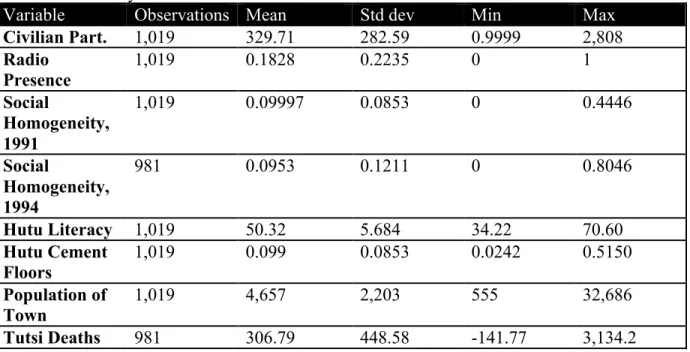
This research examines civilian participation in genocide in 1,019 of the 1,506 sectors across Rwanda. The data focuses on the count of prosecuted civilian killers in each sector (dependent variable), the percentage of Tutsis in 1994 and the availability of radio broadcasts (independent variables). Additional features such as the wealth, education, and literacy of the sectors are included. One of the inherent problems with studying genocide is the reliability of data. The current Rwandan regime is governed by the RPF, one of the warring parties from the conflict, therefore the information released by the state is both limited and biased. It is difficult to access accurate data from the genocide, but it should not be a deterrent.
Understanding local level decisions in genocide is an important and under-researched aspect of political science. As a result, there are flaws in this research, which must be
acknowledged. This chapter discusses the data used for this research, its faults, and how they can be overcome.
Research Design
average age and gender of the participants, as well as the literacy rates of the communities. I predict that high rates of social homogeneity and hate speech will produce higher rates of individual violence. The data set is supported by qualitative research based on interviews with perpetrators of violence and the style of information being disseminated through the broadcasts. The four possible predictions of my hypothesis are outlined in Table 1.
Table 1:
Low homogeneity High homogeneity
Low hate speech a) b)
High hate speech c) d)
Table 1 shows the expected relationship between the two variables. Proposition d) represents the primary hypothesis and would produce the highest rates of civilian violence. Proposition b) and c) would produce potentially similar rates of violence, but markedly lower than proposition d). The relationship between proposition b) and c) would additionally help to show which of the two variables is more influential. Finally proposition a) would have the lowest individual participation rate. Falsification of this hypothesis would show varying and uncorrelated rates of violence across the variables. In addition it could show the rate of influence operates in a different direction. There is a logical connection between these two factors, but that does not mean it will be represented in the data. Falsification would still provide important information, since it would further explain the relationship between propaganda and diversity.
independent variables: hate speech and social homogeneity. The data is available on the prefecture, commune, and then sector level. This research focuses on behavior at the sector or the smallest and most focused possible level. The data encompasses the entire state. It is worth noting that the northern provinces were close to the capital and exposed to the direct violence between the RPF and the government. These factors would have an unquantifiable effect on a civilian’s behavior in conflict.
The social homogeneity data comes from the 1991 census. Social homogeneity is described the percent of Tutsis in the community. Some of the social homogeneity data is negative, since there was underreporting of Tutsis residents in 1991 and very thorough information on the Tutsi deaths following the genocide. As a result, some Tutsi populations have a negative value. The information on hate speech is drawn from the location of radio towers in Rwanda, and the subsequent availability of RTLM broadcasts. Availability is categorized by radio coverage in village, village altitude, and distance to transmitter.
The research is reliant on the dependent variable – civilian violence. This is from prosecutions from the Gacaca courts, a semi-traditional communal justice process that was established following the genocide. In addition the data set notes different demographic pieces of information. This helps to create a profile of the individuals who participated in the violence. The data offers information about the gender, population density, age, literacy, housing, distance from major city, number of deaths in the community, household size, and percent killers in the home. This additional information isolates the conditions under which social homogeneity and hate speech influence civilian violence.
after the genocide.
1. Sealed Records
Following the conflict, Paul Kagame and the RPF took power. They created stable peace and widespread development, but they also created systematic political oppression.75
The internal narrative of the conflict foists all responsibility on the Hutus. National
memorials, museums, and sites of remembrance do not acknowledge Tutsi participation in violence. Recent research estimates that the death toll from RPF retaliation violence may rival that of the Hutu extremist regime during the genocide.76 The government classified and
obscured much of the information from the genocide as a way to build peace and avoid further social tensions.
2. Interference & Climate of Fear
The Tutsi government in Rwanda has a heavy hand in limiting what information leaves the country, which restricts the capabilities of free and honest academic research. This has created a climate of fear surrounding information-sharing. The first area this affects is social homogeneity data. The Habyarimana regime took a population census in 1991, which some hypothesize was a map for planning genocidal violence, following the genocide access to the census was privatized. The government believed that the information was
inflammatory. A few researchers have gained access to copies of the census but they have
$$$$$$$$$$$$$$$$$$$$$$$$$$$$$$$$$$$$$$$$$$$$$$$$$$$$$$$$
chosen to keep their sources anonymous.77 These copies of the census have been critiqued
for potential inaccuracies, seeing as the government or the sources may have altered the data, but it is the only available information on social homogeneity. The second issue is related to hate speech. The content of the RTLM broadcasts and the radio reach/availability is
available, but no information about listenership is available nor the number of radios distributed by the Habyarimana regime.
3. Inaccurate Data
The third and most complex issue with this data is the list of convicted civilians, the validity of the convicted civilian data which has deep implications for measurement, since the prosecuted civilians may not accurately reflect the number of perpetrators. In Rwanda there were three main forms of reconciliation: the International Criminal Tribunal for Rwanda (ICTR), Gacaca courts, and Ingandos. In the beginning the state attempted to
prosecute per the local judiciary, but when prosecutions began in 1996 judges could not keep up with the high number of cases. Prisons were overcrowded, 20% of cases were given the death penalty, and there were deep strains of corruption, which lead to widespread
international concern. As a result in 2002, the state instituted Gacaca courts, which were based on traditional justice systems that focused on forgiveness and shorter sentences for those who spoke honestly.78 Many victims were forced to participate in the Gacaca courts,
and participants were put in danger.79
Gacacas suffered from serious structural issues that impeded the reconciliation or $$$$$$$$$$$$$$$$$$$$$$$$$$$$$$$$$$$$$$$$$$$$$$$$$$$$$$$$
77 McDoom, “Predicting Violence within Genocide”; Straus, The Order of Genocide; Verpoorten, “Leave None
to Claim the Land A Malthusian Catastrophe in Rwanda?”
78 Sarkin, “The Tension Between Justice and Reconciliation in Rwanda: Politics, Human Rights, Due Process
and the Role of the Gacaca Courts in Dealing with the Genocide.”
justice process. During the proceedings a victim would tell their story before a panel of nine community judges and a minimum audience of one hundred people. Then the perpetrator would share their experience and ask for forgiveness. In the end a verdict would be decided upon. Due to the autonomy of the courts, there were no guaranteed rights of prosecution. Gacacas were “essentially political rather than judicial proceedings… The result in any one community will be determined by the local balance of power.”80 The verdicts were at the
mercy of an individual’s popularity, instead of a standard of law. The only prosecutions and convictions of civilian perpetrators came from the Gacacas. The data uses Gacaca verdicts as the measurement for civilian participation. It is important to recognize the political nature of the Gacaca and therefore the political nature of the convictions, which results in data that does not completely reflect civilian participation.
The issues in this data should not discourage the research nor jeopardize the legitimacy. The Rwandan genocide is often described as one-sided, with the in-group attempting to annihilate the out-group, a paradigm that leaves no room for the discussion of revenge or intergroup violence. History does not tell the stories of violence against Nazis sympathizers in Poland, or against Serbs in Bosnia. Following genocide, the group that takes political control is either part of the out-group or embarrassed by the actions during the genocidal period. This causes new regimes to obscure evidence from the conflict, deny discretions by minority groups, or refuse to address the internal history. Finding quality data and honest information from genocidal periods is challenging.
The current flaws in data from the Rwanda genocide exist because of the intentional withholding of information, not from flaws in the research. The issues with data from $$$$$$$$$$$$$$$$$$$$$$$$$$$$$$$$$$$$$$$$$$$$$$$$$$$$$$$$
80 Sarkin, “The Tension Between Justice and Reconciliation in Rwanda: Politics, Human Rights, Due Process
Rwanda create a bias towards Tutsi victims and the narrative of the RPF military force. This is problematic, but it does not favor my argument. This research is based on social
homogeneity, hate speech, and civilian participation in the Hutu extremist violence towards the Tutsi minority. The current government in Rwanda is trying to limit the international understanding of their violence towards Hutus, which does not show a direct impact or sympathy towards this research.
Data from Rwanda only tells half the story. The Rwandan national perspective does not address RPF violence towards Hutus, but the information about Hutu violence towards Tutsis is legitimate. Continuing this research is imperative while living memory of
participants’ permits. The data available helps us understand the behaviors of Hutu civilians and all understanding advances the cause. This thesis acknowledges and accepts the limiting conditions of available data, but simultaneously recognizes the importance of understanding the information that is available.
beyond the reach and limitations of the Rwandan regime’s censorship.
The limitations of the hate speech data are supported by two studies of the vocabulary in Rwandan hate broadcasts. Elizabeth Baisley analyzed eighty-four broadcasts from Radio Rwanda and RTLM, all of those that are available in English, to better understand the role of ethnicity in the dialogue. She looked for speech patterns and the frequency with which positive and negative vocabulary appeared. Her research on the content of the broadcasts shows the complexities of the conflict and what kind of hate speech was actually being disseminated. The data illustrates what sort of hate was being distributed and what civilians were being encouraged to do. Similarly Roozen and Shulman look at word frequency to understand how positive and negative messages were used in the social identity framework. Though there is a lack of data on listenership, this investigation of broadcast content
establishes how civilians could be targeted and manipulated through the medium of radio.81
To overcome some of the methodological hurdles that complicate my investigation, the topic will be addressed quantitatively and qualitatively. The qualitative portion focuses on balancing shortcomings in the data and explaining the behaviors of civilians. The
intention of the following study is to dissect the connection between social homogeneity and hate speech. I hypothesize that social homogeneity combined and distribution of propaganda will lead to higher rates of civilian participation in violence.
Data Analysis:
Variables:
The study was comprised of two independent variables and one dependent variable. The dependent variable, civilian participation, comes from David Yanagizawa-Drott’s data
$$$$$$$$$$$$$$$$$$$$$$$$$$$$$$$$$$$$$$$$$$$$$$$$$$$$$$$$