Abstract ... 2
Introduction ... 2
Literature Review ... 8
History of Childbirth Trends in the 20th Century ... 8
Feminism and Empowerment ... 9
Hospital Births Today: Does medicalization improve birth outcomes? ... 10
Augmentation of Labor and Routine Interventions ... 11
Position and Movement ... 14
Continuous Labor Support ... 15
Separate Trends in Childbirth ... 16
Materials and Methods ... 19
Design ... 19
Sample: ... 20
Methods ... 21
Procedure ... 21
Analysis ... 22
Results ... 22
Perceptions of Birth ... 24
Factors Influencing Desired Birth ... 25
Opinions on Various Birth Options ... 27
Birth Influences ... 33
Pressure from Outside Sources ... 33
Listening to Other Women’s Birth Stories ... 34
Media Depictions ... 36
Expectations vs. Reality ... 37
Birth Outcome ... 40
Perceptions of Control ... 46
Analysis ... 52
Perception of Issues Surrounding Birth ... 53
Navigating Choices and Women’s Expectations ... 57
A “Better Birth?” ... 61
Abstract
American women are increasingly choosing alternatives to a traditional physician-assisted hospital delivery to give birth. According to the U.S. Centers for Disease Control and Prevention (CDC), midwives assisted 8.1% of total births and 12.1% of vaginal births in 2009, the highest it’s been since the movement of
childbirth from the home into hospitals in the first half of the 20th century (Rochman 2012). In the US, the percentage of out-of-hospital births grew from 1.26% in 2011 to 2.36% in 2012, continuing a trend that has become increasingly popular since 2004 (MacDorman et. al 2014). Compare that to a whopping 2.4% of homebirths that occurred in Buncombe County, the heart of the mountains of Western North Carolina, in 2011 (Ball 2013).
This thesis surveys mothers in Western North Carolina from two generations to discover how women’s perceptions of options have changed over time and how they make their decisions or acquire expectations regarding birth. Women with a variety of childbirth experiences, including traditional hospital birth, birth assisted by a midwife, and an accidental homebirth, were interviewed allowing for the
analysis of variation in perception of a positive experience amongst women who had different types of birth experiences.
Introduction
Those from Asheville proudly wear T-shirts and display bumper stickers
proclaiming the come-to-be well-known phrase, “Keep Asheville Weird.” When it comes to new childbirth trends, this liberal mountain city at the heart of Western North Carolina has kept an open-mind. A quick Google search for “Birth in Asheville” will illustrate the growing popularity of natural birth alternatives, including
midwives, birthing centers, doulas, and even homebirths. There are two groups that offer certified nurse-midwife services in Asheville, the Mountain Area Health
Education Center (MAHEC) and New Dawn Midwifery, of which only the latter still provides 24/7 midwifery care and offers homebirth services. In 2010, MAHEC’s nurse-midwives were honored by the American College of Nurse-Midwives for their high rates of successful vaginal births after C-section (VBAC), a practice which most obstetrician-gynecologists condemn (Byrd 2011).
The new trend of laboring at home, a practice which has not been common in the United States since the move of birth to hospitals at the beginning of the 20th century, has not been met without controversy. The headline “Police: Asheville woman killed unborn child,” in the Asheville Citizen-Times described the arrest of an un-licensed lay midwife who practiced homebirth, which resulted in the death of an unborn child after three days of labor (Dixson and Morrison 2013). In North Carolina, only certified nurse-midwives, who are registered nurses with a master’s or doctoral degrees in midwifery, can legally practice midwifery. Certified
practice in the state as well. These midwives are typically the center of any
controversy involving midwifery and largely influence public opinion of the practice (Foley 2011).
Similarly, much controversy exists in the area regarding the rising rates of C-sections. Another article in the Asheville Citizen-Times, titled “Groups call for safe reduction of C-sections,” explains how major medical societies in Asheville are calling for doctors to “have more patience during labor.” The rising rates of C-sections, they believe, are due to risk of malpractice and state limits on compensation to patients from lawsuits (Szabo 2014).
The natural-birth mentality and the medical-model mentality, both highly represented in the area, represent two extremes. New mothers who are caught in the overlap of these ideas can sometimes be left feeling the need to justify their childbirth decisions to their friends and family. One woman in this study who wanted a homebirth faced conflicting attitudes from her friends when a fetal
breech-position resulted in her having to undergo a C-section. Her “crunchy” friends suggested that she could have done more to achieve her goal of vaginal delivery, and they cited videos of midwives delivering breech-babies naturally. Meanwhile, her “mainstream” friends failed to understand her disappointment, as the end result was a healthy baby. Similarly, changing trends and increasingly polarized attitudes about birth have mothers across the nation facing difficulty justifying their own experiences.
sections, women have more choices now than ever before. Although many
interventions are typically reserved for emergency situations, they are increasingly being elected by low-risk mothers (Declerq et. al 2013). What results is a complex range of options for mothers to navigate before and during birth with strong opinions found on all sides.
The most controversial trend is the rapid increase of Cesarean sections in US hospitals. According to a study by the American College of Obstetrics and
Gynecology (ACOG), the rate of Cesarean sections rose from 5.5% in 1970 to 31.3% in 2007 (Warner 2013). In Buncombe country, the most populous county in
Western North Carolina and the site of this study, the rate of Cesarean section has jumped 60.1% to an estimated 30.9% in the past fifteen years alone (Evans 2012)i.
While some mothers adhere to the natural birth movement in response to the negative aspects of the hospital environment, other women seem to have moved in the opposite direction and are allowing for increased medical intervention in their births. Many are choosing elective inductions for non-medical reasons such as convenience, or a desire to give birth on a day when their favorite doctor is on call (Simkin 2008). And although it hasn’t been seen to be a large trend amongst the general public, many celebrity and wealthy mothers are electing to have cesarean sections instead of vaginal births, in a trend known as “Too posh to push”
(Bourgeault et. al 2001).
The previously listed options represent two extremes, however there is a wide array of options that fill the spectrum. For women who want to try natural birth but believe homebirths are too risky, there has been an increase in birthing centers, which generally focus on natural childbirth and employ midwives with at least one standing physician. To appeal to these mothers, many hospitals are now employing midwives as well. For women who still prefer to be assisted by a
interventions in their childbirths. The decision to administer pitocin for induction, the decision to utilize continuous or intermittent electronic fetal monitoring (EFM), the choice of position, the choice to have an episiotomy, and the choice to use forceps or vacuum extraction are factors that women having hospital births must consider. However, some physicians may not provide mothers with a choice.
In this study, 14 women who gave birth in Western North Carolina were interviewed about their birthing experiences. They were asked a series of questions to determine whether they looked back on their experiences as positive or negative experiences, whether they felt a sense of agency, and what factors most shaped their experiences. Women with all different types of birthing experiences were
interviewed and divided into two separate groups: women who gave birth about twenty years ago and women who gave birth within the last ten years. Two time periods were evaluated to determine how women’s perceptions have changed over time and how the experiences of the older group may have influenced the decisions and changing trends witnessed in the younger group. The main goal of this study is to determine, in light of all the controversy surrounding different types of childbirth, how women perceive the issues regarding childbirth in the United States, as
described by well-known anthropologists such as Robyn Davis-Floyd, Brigitte Jordan, and Emily Martin, in relation to their own childbirth experiences. How do women navigate their choices and garner their expectations? And do women who have had a certain type of experience really benefit psychologically from that experience?
Literature Review
History of Childbirth Trends in the 20th Century
Understanding the history of childbirth can shed light on modern childbirth practices and changing trends in childbirth today. By the opening of the 20th century, midwives were still the primary care support for most laboring women. In 1915, the first maternity hospital in the US to offer the famed “Twilight Sleep” was opened. Twilight sleep was a “package” of medications used for childbirth that combined morphine, for pain relief, and scopolamine, which prevented women from
remembering their birthing experience. Initially a privilege afforded only to upper-class women, efforts by women’s rights activists made the option widely available, so that by the 1930’s, the majority of women were flocking to hospitals to have a “pain-free” childbirth (Mitford 1992). However, as outlined in Jessica Mitford’s The American Way of Birth (1992), many reports suggest that although mothers who had Twilight sleep could not remember the pains of childbirth, they remained conscious to some degree throughout the experience. Although the practice of Twilight Sleep mostly vanished after World War II due to the dangers it posed to mother and child due to the heavy use of anesthetics, many routine procedures for labor and delivery were implemented at that time that are still used today, such as delivery in the lithotomy position, or with the mother lying on her back.
20th centuryii. Thus, giving birth in a hospital attended by a physician is the norm in the United States today. Hospitals, as opposed to homebirths, provide the benefits of pain relief and safety due to the availability of interventionsiii. However, women who have homebirths do still have the option to undergo certain types of interventions, such as certain pain medications, as well as the possibility of using Pitocin for induction.
However, despite improvements brought about by the medicalization of childbirth, many criticized the overuse of drugs and invasive procedures in obstetrics. In response, the first natural childbirth movement began in 1933 with the growing popularity of the English Obstetrician Dr. Grantly Dick-Read, who emphasized that the pains of childbirth could be amplified by fear-induced tension. However, it wasn’t until the 1950’s with the pain-coping breathing techniques of French physician Dr. Fernand Lamaze and the 1960s with the advocacy for increased father-participation in the delivery room by American physician Dr. Robert Bradley, that women’s rights activists began to support the natural childbirth movement and reject previous intervention-rich childbirth models (Mitford 1992).
Feminism and Empowerment
change in power over childbirth that moved from the hands of mothers to the hands of obstetricians when normal birth was moved to hospitals, women’s rights activists began to see natural pain-relieving techniques, such as relaxation and patterned breathing, as a way for them to take back their births.
Birthing practices have always been evaluated as a feminist issue because they influence a woman’s ability to exercise control over her own body and her own reproductive capacity (Michaelson 1988). Now that American women are afforded the opportunity to experience pain-free childbirth with an epidural, the feminist movement is concerned that decreased mobility during labor leads to a decrease in agency, resulting in a more passive maternal role. As a result, women are
increasingly advocating for a more participatory role in childbirth and increasingly expecting to be the decision-makers (Morse and Park 1988; and Lally 2008).
Hospital Births Today: Does medicalization improve birth outcomes?
and de-humanize the process. The main issue with the medical model of childbirth, which is characterized by medical routines in the hospital, is that the same
interventions are often used in high-risk births as they are with low-risk births, although many interventions may not be appropriate for the latter (Jordan 1993).
Even medical professionals are raising questions about the appropriateness of some of the interventions that are routinely used in the hospitals today. In
Romano and Lothian’s Promoting, Protecting, and Supporting a Normal Birth: A Look at the Evidence (2008), six evidence-based care practices that promote physiological birth are examined. The first four, proposed by the World Health Organization are 1) allowing labor to begin on its own, 2) allowing freedom of movement throughout labor, 3) providing continuous labor support and 4) avoiding routine interventions. The remaining two were added by Lamaze International and include 5) spontaneous pushing in non-supine positions and 6) no separation of mother and baby. For the purposes of this report, they will be combined and discussed in three categories: augmentation of labor and routine interventions, position and movement, and continuous labor support.
Augmentation of Labor and Routine Interventions
The most common intervention is the use of pain medication, with 67% of American women electing to have the epidural according to most recent date (Declerq et al. 2013). Since becoming the pain medication of choice in the 1970’s, the epidural has proven to be the most efficient drug, providing pain relief with much smaller doses than previous drugs and having the least negative impact to mother and baby. The epidural causes the mother to experience partial to complete numbness, decreased control over the lower-half of the body, and an inability to urinate, which reduces the mother’s mobility and increases the need for further interventions. Additionally, the epidural can have adverse affects including a
prolonged labor, reduced ability to push, possible maternal fever, and a decrease in maternal blood pressure, which reduces the amount of oxygen that goes to the fetus. The baby can also experience a change in heart rate or a delay in reflexes upon birth. However, if the labor is prolonged or particularly complicated, the benefits of the epidural outweigh the potential risks; for instance, introducing the epidural to a woman experiencing prolonged labor can allow her to relax and result in a more rapid dilation of the cervix. For these reasons, some medical professionals and new mothers are questioning the routine use of the epidural for uncomplicated labors (Simkin 2008).
2013). The American College of Obstetrics and Gynecology (ACOG) defines post-term as beyond 42 weeks of gestation, yet 73% of ACOG Fellows and Junior Fellows admit to routinely inducing low-risk patients at 41 weeks (Cleary-Goldman, et al. 2006). According to Declerq et al. (2013), induction of labor is commonly practiced for “medical” reasons that are not supported by evidence and has significantly
contributed to the growth of the overall induction rate. These restrictions lead to the overuse of high-risk interventions with known side affects such as amniotomy, or the artificial rupture of membranes, and the administration of oxytocin (Enkin, et al. 2000). Early amniotomies are associated with increased risk or pressure injury and infection and is associated with greater rates of Cesarean section (Fraser et al. 1993 and Turcot 1997). The increased risk of infection then necessitates the use of pitocin, or synthetic oxytocin, to help the labor progress, which makes contractions more painful by preventing the release of the women’s endogenous endorphins that help manage pain (Romano and Lothian 2008). In addition, the greater amount of pain experienced by women with Pitocin usually requires an epidural, which in turn slows down labor and can lead to fetal distress, necessitating a c-section (Davis-Floyd 1988).
In comparison to spontaneous labor, inductions result in the increased likelihood for pain medications to be used and for cesarean sections to be
elective inductions to be “perhaps the greatest risk to the normal physiological birth.”
Furthermore, the rate of Cesarean section in the United States has been steadily increasing and now sits at 31%. In comparison, the World Health Organization stated in 1985, “There is no justification for any region to have Cesarean section rates higher than 10-15%.” Of the women in the study who had Cesarean sections, 66% spent some time in labor before having a cesarean. Approximately 16% had a Cesarean because baby was in wrong position, 11% because the fetal monitor showed a problem, 10% because the mother’s health was failing, 10% because the baby was having trouble fitting through, 9% baby was too big, and 8% attempted medical induction that didn’t work (Declerq et. al, 2013). Some of these issues, like fetal malposition and the inability of the baby to pass through the birth canal, can be reduced by maternal position and movement, as described by Romano and Lothian (2008).
Position and Movement
(Simkin and O’Hara 2002). Other studies have found that pushing in upright positions compared to the lithotomy position shortens the second stage of labor, decreases the incidence of severe maternal pain and abnormal fetal heart rate, and is associated with a small reduction in assisted deliveries and fewer episiotomies (Enkin et al. 2000; Gupta and Nickoderm, 2000; Gupta, Hofmeyr, and Smyth 2004). However, the lithotomy position remains the norm as epidurals and electronic fetal monitoring severely limit movement. Modern-day women who choose the epidural have to weigh the pros and cons, although many women are not fully aware of the benefits of being able to move about during labor.
Continuous Labor Support
A study of 412 nulliparous women in a US hospital found that having
continuous labor support, in this case provided by a professional known as a doula, greatly improved birth outcomes. The women in the study who had additional emotional support exhibited lower rates of Cesarean section and decreased use of forceps, as well as a decrease in use of epidural anesthesia, a shortening of labor, less prolonged infant hospitalization and lower rates of maternal fever (Kennel et al. 1991). For these reasons, many women in the United States are electing to have midwives as their care provider rather than physicians, as midwives are generally known to spend more time with the mother during labor. Benefits of continuous labor support are thought to be derived from a reduction in maternal anxiety and a related decrease in stress hormones (Romano and Lothian 2008). Increased
blood flow, which can pose a potential harm to the fetus and slow labor progress (Coad and Dunstall 2011; Romano and Lothian 2008). A study involving more than 13,000 women showed that when compared with routine care, continuous labor support resulted in a higher likelihood of spontaneous vaginal birth, lower likelihood of cesarean surgery, lower likelihood of vaginal instrumental delivery, fewer requests for intrapartum analgesia, and fewer reports of dissatisfaction of the childbirth experience (Hodnett et. al 2007). Although most laboring women in the United States are only provided with intermittent labor support, the practice of hiring a doula, or a birthing assistant who provides mostly emotional support, is becoming increasingly common. Some hospitals, such as the University of North Carolina hospitals, are implementing their own volunteer doula programs to provide labor support for women in need.
Separate Trends in Childbirth
Women today are increasingly discussing the issues surrounding the
hospitalization of childbirth, such as those described in previous passages, and as a response, separate trends in childbirth are emerging. The reliance on medicine and technology has increasingly become a characteristic of US society and is responsible for the rising rates of interventions and cesarean sections in US hospitals.
in a hospital. While some women have come to question common medical practices, others are placing greater trust in the medical model to which they are accustomed.
Changing trends in childbirth may also be due to the idea of “patient-choice” that many Americans have come to expect due to growing consumerism (Bourgeault et al. 2001). In addition to greater trust in the medical model, the wide range of interventions being utilized in US hospitals, along with a trend toward elective inductions and cesareans, may be the result of the market economy. Many women like the conveniences afforded to them by choosing a due date, or prefer cesareans for cosmetic reasons, and thus, providing these options is just meeting a need. Likewise, the ability to move about during labor, to choose a pushing position, and to labor in a comfortable environment are needs that are being met for natural birth mothers.
Perhaps the most surprising trend in light of increasing access to advanced medical technology in the US is homebirths. Some women have turned to
homebirths to avoid the possibility of intervention in hospitals and to benefit from the comforts of home. What may seem at first glance as an unnecessary risk, in fact doesn’t seem to show a much greater risk than that of hospital births. In a study of 5,418 women who planned homebirths, it was found that intrapartum and neonatal mortality rates were similar to that of hospital births in North America, but medical intervention rates were substantially lower (Johnson and Davis 2005). This can be attributed to the fact that most women who have homebirths were low-risk.
homebirth means forgoing the possibility of using available technology and is unethical (Chervenak, et al. 2013). Although risks are shown to be minimal, Chervenak et al. argue that there are certain situations that, due to the increased distance from the hospital, could be dire should they arise in a home birth. In the event of cardiopulmonary arrest, shoulder dystocia (the inability of the fetus to pass through the birth canal), or maternal exsanguination (severe maternal blood loss), maternal and fetal health would deteriorate too quickly to prevent severe harm or death in a home environment (Chervenak et al 2013). Although ACOG, The Royal College of Midwives (RCM), and the Royal College of Obstetricians and Gynecologists (RCOG) all assert that homebirths pose no significant risk to women at low risk for complications, ACOG still accepts the finding of Wax et al (2010) that there is a 2-fold to 3-2-fold risk of neonatal death from homebirths as opposed to hospital births.
Another trend in is the increasing number of births assisted by midwives, who can be employed by hospitals as well as birthing centers and often are the care providers in homebirths. In 2012, 10% of all births in the United States were
Despite positive reports from women who have been assisted by midwives, media depictions of midwives tend to cast them in a negative light. Many Americans think of midwives as lay midwives, or midwives who have had no formal training, but certified nurse midwives (CNM) as well as certified professional midwives (CPM) who advanced degrees are largely not distinguished in common vernacular. A study by Dahlen and Homer (2012) illustrated that midwifery tends to be more affected by negative media depictions because of the dominant medical voice in healthcare. Common words and phrases describing midwives in the media are “unscientific”, “irresponsible” and “incapable of handling emergency situations.” Reports of litigation involving midwives tend to be dramatized while reports of litigations involving obstetricians tend to be objective and factual. According to Dahlen and Homer (2012), midwives are gaining acceptance but lack recognition, while physicians have both.
Materials and Methods
Design
Group 2, which consisted of women who have given birth within the last ten years. The interviews were analyzed to compare women’s perceptions of their own childbirth experiences over time and across a diverse array of experiences. The study was designed to cultivate an in-depth understanding of individual women’s experiences and not to make overarching claims about childbirth attitudes within a particular group.
Sample:
Participants were identified through convenience sampling and past
Methods
An interview guide was developed to elicit information from women about their childbirth in an open-ended fashion to discern their pre-existing attitudes towards childbirth and their perceptions of their own role in their birth story. Semi-structured interviews were performed. Questions from the interview guide include:
How do you feel about midwives? Homebirths? C-sections? Elective inductions?
What factors influenced your decision to have the type of childbirth
experience that you had?
Did you feel in control of your birthing experience?
What did you expect labor to be like before giving birth and how did reality compare to your expectations?
The interviews ranged from approximately 20-45 minutes and were conducted either in person in a neutral location, by Skype, or by phone. All interviews were recorded.
Procedure
participants were suggested to the researcher by the initial participants.
Participants were recruited by e-mail or through personal Facebook messages using a recruitment script that highlighted important information about the study.
Women who were interested in the study either signed a written consent form or were read the consent form and asked to affirm their consent verbally in the case of a phone or Skype interview.
Analysis
Interviews were transcribed by the researcher and saved on a password-protected computer. Each subject was assigned a number to preserve their anonymity. After transcription each interview was summarized, important quotations were highlighted and tables were constructed that compared the participant’s responses to the Interview Guide questions. In addition, themes were identified and relevant quotations were separated by groups. Then, noteworthy quotes were pulled from those responses and highlighted in the results section.
Results
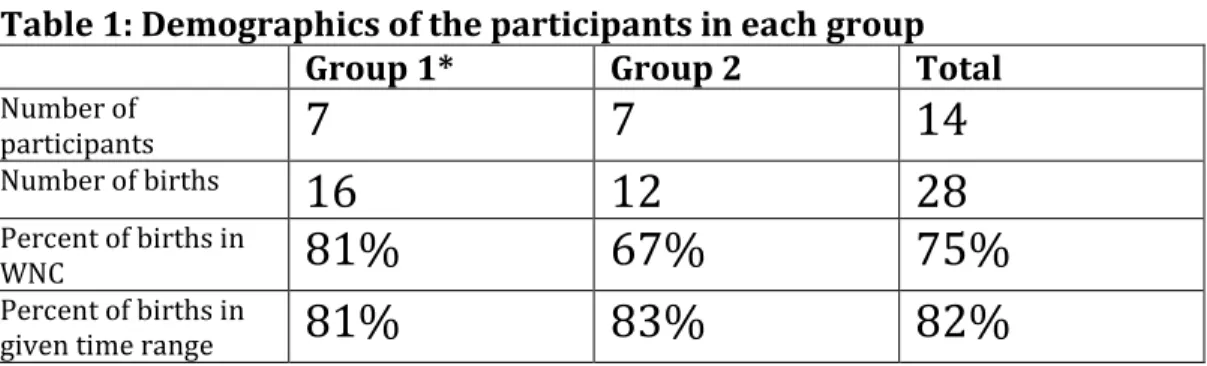
between 1980-1997. Of these births, 13 were within the given time range and 13 took place in WNC. The women in Group 2 gave birth to a total of 12 children between the years 1998-2013. Of these births, 10 were within the given time range and 8 took place in WNC.
Table 1: Demographics of the participants in each group
Group 1* Group 2 Total
Number of
participants
7
7
14
Number of births
16
12
28
Percent of births in
WNC
81%
67%
75%
Percent of births in
given time range
81%
83%
82%
*Group 1 had births between the years 1980-1997, while group 2 had births between the years 1998-2013.
The participants had a diverse array of desired births and actual birth experiences. This is true between participants as well as between the different births of an individual participant. The “type” of birthing experience that each woman had for each of her births is summarized below in Table 1. The majority of the women’s experiences deviated from their desired birth, with Group 2 achieving their desired birth more frequently than Group 1. Many of the women who had multiple births chose to have a birth similar to their first birthing experience, regardless of whether their first birthing experience was what they originally desired.
Table 2: A summary of the participants’ birth experiences
Group*
Informant Number Desired BirthActual Birth
1
1.1 No epiduralUnscheduled induction, but no
epidural Accidental homebirth N/A
1.2 Traditional** Natural Birth Traditional ---
1.3 Traditional Natural Birth Natural Birth ---
1.4
Natural birth at hospital with the
possibility of an
epidural Unscheduled induction Traditional Induction
1.5
Natural birth at hospital w/ LaBoya
bath Unscheduled induction Scheduled induction ---
1.6 Traditional Traditional Traditional ---
1.7 Traditional Natural Birth Traditional Traditional
2
2.1 Traditional Traditional --- ---2.2 Traditional Unscheduled induction Scheduled induction Scheduled induction
2.3 Traditional Traditional ---
---2.4 Traditional
Induction followed by emergency
C-section Scheduled C-section Scheduled C-section
2.5 midwife at hospital Natural birth with
Natural birth with midwife at
hospital
Natural birth with midwife
at hospital
---2.6
Homebirth or natural birth with midwife at
birthing center Emergency C-section
---
---2.7 midwife at hospital Natural birth with
Natural birth with midwife at
hospital ---
---*Group 1 had births between the years 1980-1997, while group 2 had births between the years 1998-2013.
** The term “traditional” is used here to mean a vaginal birth at a hospital with a physician and an epidural
Factors Influencing Desired Birth
The reasons for choosing a type of childbirth were varied; they include a fear of pain, a desire to make the experience more enjoyable for the mother, and a desire to find the “best way” to bring a baby into the world. As most women in the study planned on giving birth in a hospital rather than having a homebirth, women most commonly discussed the factors influencing their decision to have pain medication during childbirth. The most common responses are summarized in Table 3.
Table 3: Factors influencing the decision to have pain medication
Medicated Unmedicated
Group 1* Group 2 Group 1 Group 2
It’s “just the way things were”
Fear of pain
Fear of pain
To be able to sleep
To enjoy the experience without pain
Fear of Needles
A “Better Way” to bring a child into the world
Shouldn’t “mess with nature”
A “Better Way” to bring a child into the world
For the experience
Epidural heightens your risk of a C-section *Group 1 had births between the years 1980-1997, while group 2 had births between the years 1998-2013.
the benefits afforded to them through the absence of pain, like the benefit of being able to sleep and, most notably, the benefit of being able to enjoy the experience with your loved ones without having to cope with the pain.
Of the women who desired natural childbirth, the most common reasoning among all participants is the notion that an unmedicated birth is “a better way to bring a child into the world.” Group 2 added the idea that having an epidural would be “messing with nature,” which, as described below, was an idea expressed
frequently by Group 1 in regard to elective inductions and non-emergency
cesareans, but was not extended to epidurals. Group 2 seemed to be more aware of potential negative affects to the fetus and also reported wanting to be able to experience the feeling of labor. This sentiment was also reported by mothers who wanted the epidural, many of whom wanted to “see what it felt like,” or “see if they could do it,” before deciding to get the epidural.
Comparing the reasons for choosing a medicated versus unmedicated birth, we see that the mother’s own experience is an important factor in deciding whether to have the epidural and can be used to justify both. Women who wanted the
epidural thought that eliminating their pain would heighten the experience.
“I wanted to be present when my child was born and not be in so much – because I had heard stories of women being in so much pain—when it was coming out, like that burning or whatever… that they could just not enjoy their child. Because they were in so much pain. But then so many women say it was nothing. So I can’t be definitive. But I wanted to not be exhausted, one, and I wanted to not be in so much pain that I couldn’t enjoy meeting my child for the first time.”
“Well I didn’t really like the idea of having drugs for myself and not being able to really experience what it felt like… …I didn’t like—for me, personally—the idea of being numb pretty much from the waist down.”
The emphasis on the importance of the mother’s experience seems to show up only in Group 2. This could represent a change in attitude about childbirth in the past two decades, with a greater appreciation for the mother’s experience today. In addition, women in Group 2 were able to cite more reasons as to why they chose their desired birth, which may reflect a deeper contemplation on the issue by the younger mothers. This interpretation is consistent with the common response by the older mothers that, “that’s just the way things were.”
Opinions on Various Birth Options
To reveal the informant’s attitudes toward childbirth and to explore how that may have influenced their desired birth, each was asked to describe their opinions on midwives, homebirths, elective inductions and cesarean sections. The results are summarized in the following tables 4-7. The numbers in each column represent the number of participants who agreed with each statement.
Table 4: Opinions of midwives
Group 1* Group 2 Total
They are unable to
handle an emergency
3
1
4
They sound good in theory, but wouldn’t choose to have one
4
3
7
Unsure of what they do
1
1
2
Would consider hiring
Actually hired one
0
3
3
* There are 7 informants in each group (14 total). Not all participants answered this question and some may be counted in more than one category.
*Group 1 had births between the years 1980-1997, while group 2 had births between the years 1998-2013.
When asked about their opinion on midwives, the most common response is that having a midwife sounds like a good option for some women, but the informant herself would not choose to have one. Some would also add that they did not believe that a midwife would be capable of handling an emergency situation. Most women did not distinguish between lay midwives, certified nurse midwives, and certified professional midwives, many of them having never heard of the latter two. Many of these women seemed to associate midwives with homebirths and when asked if they would be more willing to be assisted by a midwife in a hospital setting, they viewed the idea more favorably. Two women admitted that they did not really know what the role of the midwife was. One such woman in Group 1 explained:
“You know…umm… I really had never thought about having a midwife and I don’t really know their entire purpose… umm… or their… uhh… exactly what they’d be doing other than what the doctor would be doing. So, I don’t—I prefer to have the experienced individual—not that they aren’t experienced—obviously, the ‘hard-knock’s’ experience is really good, as far as the umm… the medical knowledge, I think for me is more important as well. I think the combination of the medical knowledge with the experience is… for me I think… is more. So I don’t know if I would really opt for a midwife in a hospital.”
“unsafe,” or “incapable of handling an emergency situation.” Group 2 was less likely to report this sentiment and seemed to be more versed on the benefits and
drawbacks of a midwife versus a physician. One woman in Group 2 who decided not have a midwife stated:
“Ok, so I decided prematurely that I did not want to do natural childbirth. I had a lot of friends who do, but I just really felt like… also, for my personality type… like, I come from a medical background, like a medical family background. My parents are physicians and I felt like I wanted to have the baby in the hospital… I feel like midwives are amazing. And I have a lot of friends who’ve had natural childbirths at their house, but it made me too nervous… … umm… but I think midwives are very capable. I think that they do a really great job… I haven’t really read a lot of stories about complications with what they do. I mean, I’ve only heard good things, which is great. But I do think there is something to be said for if there’s a major complication. Just, like, not having those resources at hand to sort of deal with that.”
Midwives were the care-provider of choice for three of the seven informants in Group 2, but the investigator was unable to find an individual who had a midwife and met the criteria for Group 1. This may reflect the growing options afforded to women in the younger category.
Table 5: Opinions of homebirths
Group 1* Group 2 Total
It’s an unnecessary risk
2
2
4
All for it in theory, but
wouldn’t do it
1
2
3
Would consider it
0
1
1
Actually wanted one
0
1
1
* There are 7 informants in each group (14 total). Not all participants answered this question and some may be counted in more than one category.
the idea of laboring in a comfortable, home environment, few saw the benefits as being worth the risk. Additionally, homebirth is difficult to legally perform in North Carolina, as few certified nurse midwives are up to the task. One woman who
adheres strongly to the natural family perspective, or “an approach to parenting and family life that blends practices of voluntary simplicity and attachment parenting with elements of cultural feminism,” explains:
“The hospital birth is so normalized now that that’s where I felt more comfortable. I’d rather—you know, I labored at home but I wanted to be at the hospital just in case anything happens… … I would consider [a homebirth]. I think if I have another child I’ll probably go middle ground and go to a birthing center.”
One informant in Group 2 who wanted a homebirth explained her reasoning as: “Well I mean… I just… umm… I don’t like hospitals. And I don’t, like—all the kind of like interventions and stuff—that umm… I felt like were likely to be used, having some peer pressure or whatever… …And I wanted to be able to labor like in an environment where I felt supported and where I could eat if I wanted to (laughs). And like, walking around… …just the whole thing about how I think our bodies are able to do it. And I thought it would be better to not—if it’s less interfered with.”
Contrarily, many informants said that they would not be comfortable laboring in a home environment because of the lack of medical equipment and personnel that would be needed in case of an emergency. The informant in Group 1 who had an unexpected homebirth describes her experience as:
“Umm… the natural childbirth was just really fast. Umm… that was the main difference, and… umm… it was a little scary. I felt more secure in the hospital, because, you know, I had a support staff around and umm… so I’m glad it wasn’t reversed, because I would have been really terrified if I’d have had the homebirth for my first childbirth experience rather than the second.”
Group 1* Group 2 Total
It’s an unnecessary risk
2
2
4
It’s an OK option
1
2
3
* There are 7 informants in each group (14 total). Not all participants answered this question and some may be counted in more than one category.
Five informants had inductions, which comprised approximately a third of the total births in this study, and three of the five who had an unscheduled, or emergency, induction for their first birth decided to schedule an induction for their later births. This desire to have a scheduled induction for subsequent children after having an emergency induction likely accounts for the fact that there was not much of a consensus in opinion about elective inductions. There was little difference in the number of informants who thought that elective inductions were an unnecessary risk versus those who thought that it was an acceptable option for women. There was not a significant difference in opinion between Groups 1 and 2. Women who had not had an induction were more likely to think of elective inductions as being an unnecessary risk, while women who had at least one induction reported that
elective inductions could be more “relaxing.”
“Oh yeah. I think that [my second and third birth] were even, you know, even more comfortable because I had set the date. So I knew going into it—I already knew this was the day I was going in. So, I had already planned it. So, for me, being able to like plan when it was going to happen was like really helpful. So, umm… I could get prepared for it. I had everything packed for it. I got everything organized at home for it. So it was just—that was really, that was really relaxing. So we went in, and like ok, we’re going to the hospital and we’re going to have a baby today. And we knew that. You know, we knew going into the day that that was going to happen, so…”
Another woman who had an elective induction explains:
something I wouldn’t have had otherwise… …I think, realistically, if dating a pregnancy has gotten so much more accurate than it used to be, induction is much safer. And umm… a lot of people’s lives are complicated and I think you need to take some factors into consideration. If you consider like many of us have moved away from our families and we have to have childcare if we have other children at home. I think there can be valuable reasons for induction.”
Alternatively, many women think the birthing process should be “baby-led.” “Well, I don’t—I don’t support it. I definitely don’t think—I know the whole public health message of um… ‘Babies are worth the wait. Don’t—Definitely no inductions before 39 weeks, which can actually be really harmful for the baby… I think it’s—It’s unnecessary. Like the baby, usually, has… like a (inaudible) way of knowing when they’re ready to be born. I think there’s something special in that process and it’s umm… good to let the baby lead that. So that’s how I feel about it. And my whole parenting philosophy basically is like ‘baby-led,’ like putting… all of that… so... I know a lot of other people want to put more of like the philosophy of fitting the baby into their lives and what’s more convenient for me and… yeah. And that doesn’t necessarily make them bad parents. It’s just different.”
Table 7: Opinions of cesareans
Group 1* Group 2 Total
Good for emergencies, but shouldn’t be a choice
4
2
6
Is “afraid” of cesareans
1
2
3
Is “glad” she didn’t have
to have one
2
0
2
OK for women to
choose
1
2
3
* There are 7 informants in each group (14 total). Not all participants answered this question and some may be counted in more than one category.
These results seem to counter popular belief that elective cesareans are becoming increasingly accepted among today’s mothers.
“I was scared to death I was going to have one. That was my biggest fear. And thank God I didn’t. I would hate to have a c-section.”
Comparing the responses of Group 1 and 2 for each of the four birth options (midwives, homebirths, elective inductions, and cesareans), it appears that there is not much difference in opinion between groups when it comes to the increased medicalization (elective inductions and cesareans) of childbirth. There was,
however, a more accepting attitude towards the natural birth movement, as well as the homebirth movement, amongst the younger mothers. This suggests that the increasing medicalization of birth is no more accepted now than it was by mothers two decades ago, but that the increased move toward natural childbirth, or the avoidance of interventions due to recent knowledge about their harmful effects, has caused opinions on birthing practices to appear increasingly polarized.
Birth Influences
Pressure from Outside Sources
Table 8:Pressure from Outside Sources
Group 1 Group 2 Total
Felt pressured by
hospital staff
2
1
3
Did not feel pressured;
it was her own decision
2
3
5
Felt pressured by
family
0
1
1
* There are 7 informants in each group (14 total). Not all participants answered this question and some may be counted in more than one category.
A majority of the informants asked this question reported that they did not feel pressure from outside sources. The decision-making power was her own. When asked if she felt any pressure from outside sources, one woman who had a natural childbirth explained:
“No, if anything it was the opposite. I felt like I was defying the media and what a lot of my friends and family members thought—which was that it’s impossible, people didn’t believe—people honestly didn’t really think that that was still possible. I think a lot of people doubted me too, that they would just sort of be like, ‘Oh, ok, well we know that in the throes of childbirth you will be begging for an epidural, so, you know, whatever. You can say what you want now.’ Umm… so yeah, if anything it was the opposite. I felt a little bit of inspiration to, to like show them that it was still possible to do it like that, and how good the outcome would be.”
However, many women did feel pressure to have a birth other than what was desired, and the largest source of pressure came from the hospital staff. This seemed to be true regardless of the type of birth that the mother desired. One woman who desired a natural childbirth explained:
“I felt scared because they were scaring me and it was unknown. I felt like what they were saying was “You don’t know what you’re getting into yet.” So, I took that medicine to… yeah… to appease them.”
Some evidence suggests that women in the younger group were more influenced by other women’s birth stories than women in the older group were. Of the women interviewed, only 1 out of 7 women in the older group mentioned that talking to other women affected their birthing experience, as opposed to 6 out of 7 women in the younger group. However, it is important to note that this difference could be due to a difference in recollection rather than a lack of birth stories being told.
Five of the total women interviewed reported that stories they heard from other women affected their desired birth or decisions they made during their birth. One woman explains that interacting with women who had homebirths convinced her to try one.
“I don’t know. I just listened to a lot of their experiences and their opinions. So by the time I got pregnant with [my baby] I was like, yeah, let’s not go to the hospital… There’s one woman on the forum that’s really really cool, and she had like a
homebirth montage that she posted, and it was so beautiful. I’m such a feeler, like I know that I can find all the logical reasons and everything, but I saw the montage and I’m like ‘Ooh… she’s got some food in the crock-pot. Her family’s all there. There’s the baby.’ I don’t know. It was such a contrast from the way birth is usually presented. (inaudible) where everyone’s freaking out.”
Another woman describes how hearing “horror stories” about birth altered her perceptions about safety and influence her decision to have her child induced.
Talking to other women about childbirth also influenced women’s
expectations. The women in this study were quick to point out what “people don’t tell you” about childbirth. One woman explains that she was not warned about the possibility of back labor, the phenomenon where laboring women sometimes feel pain in their lower back:
“You know, and they had always told me, ‘It’s gonna feel like cramps.’ Like really bad cramps. But with the back labor, it was kind of unexpected. And that was really intense. So that, umm… wasn’t I guess what I really expected, because I didn’t expect -it’s really hard with your first child to imagine what to expect to be in back labor, you know. “
Another woman explains that she was not warned about the difficulties of labor recovery, such as prolonged bleeding and a painful healing process:
“Yeah, and really I was surprised to find that they felt like menstrual cramps. Times a hundred. But that’s, oddly enough, that’s what labor pains felt like. But that’s the only reality I faced during labor. But what people don’t tell you about is after labor. You know, what you go through afterwards”
Media Depictions
Similarly, many women reported that media depictions of birth influenced their perceptions and expectations. One woman in Group 1 explains that media depictions did not prepare her for the pain of childbirth:
“I just think I… you know… you as a kid you watch TV where a woman’s having a baby and you just think… that’s what it is, it’s just a bunch of breathing. And nothing comes out. And then it becomes… that… it’s not just… it hurts and you have to manage pain, and that was a little scary. You know, and they talk about the tennis ball, you know and the Lamaze, all the stuff that they want you to do, and I did none of that. I just did “uhhhh (crazy noise)” and had the baby (laughs).”
One woman from Group 2 explains that the media portrayed birth as more frantic than what she experienced:
movies] they’re sweating and screaming. [Mine] was way more calm. I mean, I think so… I mean, it’s really painful. But I was never screaming and I was never profusely sweating. I was thirsty. I remember being really thirsty and hungry because they don’t let you eat or drink and so I really wanted something to eat and so they brought chips.”
Expectations vs. Reality
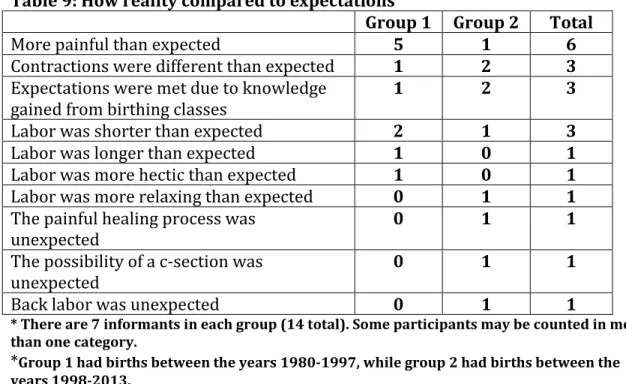
Table 9: How reality compared to expectations
Group 1 Group 2 Total
More painful than expected 5 1 6
Contractions were different than expected 1 2 3 Expectations were met due to knowledge
gained from birthing classes
1 2 3
Labor was shorter than expected 2 1 3
Labor was longer than expected 1 0 1
Labor was more hectic than expected 1 0 1
Labor was more relaxing than expected 0 1 1
The painful healing process was
unexpected 0 1 1
The possibility of a c-section was
unexpected 0 1 1
Back labor was unexpected 0 1 1
* There are 7 informants in each group (14 total). Some participants may be counted in more than one category.
*Group 1 had births between the years 1980-1997, while group 2 had births between the years 1998-2013.
* There are 7 informants in each group (14 total). Some participants may be counted in more than one category.
**The fractions are meant to show the number of women who reported experiencing more pain out of the total number of women in a particular category
***Group 1 had births between the years 1980-1997, while group 2 had births between the years 1998-2013.
Figure 1: Comparison of women who reported experiencing “more pain than expected” by birth type
Expanding upon the results highlighted in Table 9, Figure 1 shows the
number of women who reported experiencing “more pain than expected” by type of
0 10 20 30 40 50 60 70 80 90 100
Traditional Induction Natural with
physician Natural withmidwife C-section Homebirth
Group 1 Group 2
4/4
0/2
2/3 2/3
0/1 0/1
1/2
birthing experience. Although at least one participant cited “more painful than expected” in almost all of the categories, it is interesting to note that all four participants from Group 1 who had a “traditional” birth reported experiencing greater pain than expected. Of the two women in Group 1 who did not report experiencing “more pain than expected” (Table 9), neither gave birth with an epidural. No conclusions can be made regarding which type of birthing experience results in the perception of more pain, as at least half of the participants reported “more pain than expected” in all the categories besides c-section and homebirth, which were rare.
Birth Outcome
To evaluate birth outcome, the women were asked whether they considered their birthing experience to be generally positive or generally negative, and what factors contributed that conclusion. The participants’ experience with the hospital staff was the number one factor leading to both a positive and a negative experience.
Table 10: Factors Contributing to a Positive Experience
Group 1 Group 2 Total
Emotional Support
from Staff
5
6
11
Special Moments with
Friends and Family
2
4
6
Having the Epidural/Pain Medication
3
2
5
Feeling of
Accomplishment
2
2
4
Bonding Time with
Comfortable
Environment
0
2
2
Alternative Pain Coping
Mechanisms
0
2
2
* There are 7 informants in each group (14 total). Not all participants answered this question and some may be counted in more than one category.
*Group 1 had births between the years 1980-1997, while group 2 had births between the years 1998-2013.
Receiving some kind of emotional support from a member of the hospital staff was the most commonly cited factor that contributed to a positive experience, and was mentioned by the majority of participants. Presented below are some of the discussions about how staff members influenced a positive experience. Each quote illustrates how different members of the hospital staff, be it a nurse, a doctor or a midwife, can contribute to an overall perception of a positive experience:
“You know, I think the staff. Yeah, the nursing staff in particular. Because, you know, they’re the ones that greeted me and got me settled. And made me feel comfortable and, you know, made me feel like everything was going to be alright no matter what.”
“Yeah, I was scared. It was painful. Another factor as well was that I had a very excellent gynecologist and he took very good care of me. He was kind of a rare doctor. He had not only an excellent bedside manner but he genuinely seemed to care about not just me but his other patients as well. And, umm.. he’s the best. I definitely wanted him present. Having the same doctor is more important than I even realized while I was pregnant. I didn’t realize how important it was until it was time and he was there.”
“I was surrounded by amazing hospital staff. I had the best nurse in the world who was cheering me on and just giving me great positive support and coaching me with pushing. For when to push and when to breathe and when to rest and all that. And I had my midwife, who was there, and also she was working with a midwife-in-training. So I had both of them and they were there the entire time… umm… in the room. I wasn’t sure what to expect but my mom, later had mentioned how
impressive that was because she thought an OB would probably just be coming in and out. They were there the whole time.”
make her own birthing decisions, regardless of how unpopular they were. Some women explains:
“[The OB], I really really appreaciated her, because she came and sat down with me, and she actually reminded me of one of my really really good friends, and umm… I don’t know, that was helpful… … she explained everything to me in a way that didn’t really involve any pressure. She was ready to respect what my decision was.
Whatever it was. Even if she thought it was stupid, she wasn’t letting me know (laughs).”
The second most important factor contributing to a positive experience was the ability to have special moments with family and friends, and appears to be a slightly more important factor for Group 2 than Group 1. Presented below are some examples:
“We also had a very like lighthearted… like we were talking about Disney World… just the conversations between my mom, my female doctor, the nurse, the
photographer and me and my husband… like we were really lighthearted and had good conversations until… you know… between contractions. But during
contractions, of course, you know, we were concentrating. But it was really
lighthearted and I—I think that’s also another thing that I liked about the epidural was that I wasn’t in so much pain that I couldn’t enjoy conversation.”
“Oh yeah, I was very glad to see them. My friend, Anna, came in. She braided my hair back for me so it wouldn’t be in my face when I had to push. My mom came in and looked at me. (laughs) She didn’t really do anything. She stayed though. She invited herself to stay and watch me give birth. I was very relieved to see my doctor. And Forest Gump was on TV. I was very happy to see Forest Gump.”
For those that had pain medication, the epidural contributed greatly to their perception of a positive experience.
So I had them begin to taper the medication as the baby was crowning and all of that.”
“I’m really happy with how everything went. It was a beautiful experience for us. And not everyone can say that. Hands down the most beautiful experience of my life. And I just—and I loved it. And [my husband] did too. And I think—I think, had we tried to push through the contractions it just would… we would be really tired and exhausted and I just didn’t want to be that way. I was tired enough. I was tired enough. “
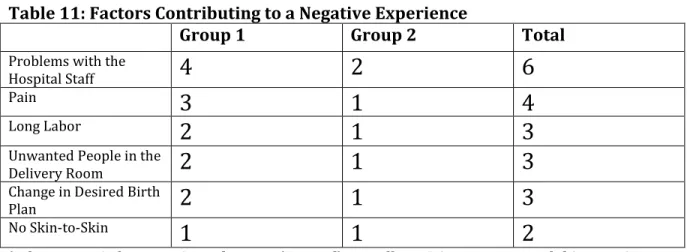
Table 11: Factors Contributing to a Negative Experience
Group 1 Group 2 Total
Problems with the
Hospital Staff
4
2
6
Pain
3
1
4
Long Labor
2
1
3
Unwanted People in the
Delivery Room
2
1
3
Change in Desired Birth
Plan
2
1
3
No Skin-to-Skin
1
1
2
* There are 7 informants in each group (14 total). Not all participants answered this question and some may be counted in more than one category.
*Group 1 had births between the years 1980-1997, while group 2 had births between the years 1998-2013.
Problems with the hospital staff was the main predictor of a negative
experience. Women in Group 1 reported more problems with the hospital staff than women in Group 2. Various issues with the hospital staff include: not feeling listened to, feeling pressured into an unwanted decision, and the inability of the staff to properly administer medication. One woman describes her interaction with the nurses:
“You don’t know what you’re getting into, yet.” So, I took that medicine to… yeah… to appease them.”
Another woman describes how the faulty administration of pitocin affected her experience:
“They had me on the pitocin to where I was having like one continual contraction. So when that, that 3:00 nurse, that next nurse came in and was like, ‘Well honey, no wonder you’re crying.’ I was like just crying really hard and she said, ‘No wonder. They’ve got you on one continual contraction!’ And so, once they gave me the epidural it seemed like it really relaxed me. Because I wasn’t in such pain. I think—I think I was in such pain that I was just tensing up.”
To determine whether one type of birth experience was seen as more
positive by the women who had them, the investigator tallied the number of “factors contributing to a positive experience” and “factors contributing to a negative
experience” that each woman cited to come up with a net value that can be used to rank their experiences, with each item having equal weight. The value will
*Group 1 had births between the years 1980-1997, while group 2 had births between the years 1998-2013.
Figure 2: Number of individuals with each positivity score by group
By examining Figure 2, it can be inferred that Group 2, the younger group, viewed their birthing experiences in a more positive light, on average than Group 1. Only one individual in Group 2 had an overall net negative outlook on their
experience, compared to three individuals in Group 1 that reported an even greater degree of negativity. Group 2 had greater extremes in the positive direction, which could indicate their perception of a much more positive experience. However, these women may also be recalling their birthing experience more fondly because it was more recent. Table 12 illustrates how average positivity scores varied by birth type.
Table 12: Degree of positivity amongst different types of birthing experiences
Mean Range
Homebirth -2.0 N/A
0 1 2 3 4
-2 -1 0 1 2 3 4 5 6
N
u
mber
of
Pa
rt
icip
ant
s
Posivity Values
C-section -0.5 -1 to 0
Induction 0 -2 to +6
Traditional +0.3 -2 to +3
Natural w/ physician +1.3 0 to +3
Natural w/ midwife +2.5 0 to +5
From this table it can be seen that women who had natural childbirth, on average, spoke about their experience more positively than those who did not experience natural childbirth. The experience was considered even more positive if the mother was assisted by a midwife rather than by a physician. However, it is important to note that the participant with the highest positivity score, a participant from Group 2, had scheduled inductions. The intermediate positivity score given to inductions is due to low positivity scores reported by all three women in Group 1 who experienced an induction. A high score for a natural birth with a midwife may also be attributed to the fact that the woman with the second highest positivity score experienced this type of childbirth, and only two participants had this experience. Low positivity scores for homebirths and c-sections were expected, as none of the women who experienced these birth types had planned to do so beforehand.
Perceptions of Control
Another aim of this study was to determine whether the participants felt in control over their birthing experience, and how important control was to them. The results are summarized in Table 13.
Table 13: Responses to the question, “Did you feel in control over your birthing experience?”
Absolutely, yes
1
4
5
Yes, but
3
0
3
You can’t really be
1
0
1
No, but
2
2
4
Definitely not
0
0
0
* There are 7 informants in each group (14 total). Not all participants answered this question.
*Group 1 had births between the years 1980-1997, while group 2 had births between the years 1998-2013.
Group 2 reported that they “absolutely” felt in control over their birthing experience much more frequently than Group 1, yet both groups illustrated a wide spectrum of feelings about control. Group 1 was more likely to qualify their
response as to whether they felt in control and revealed a greater degree of uncertainty. For example, one woman from Group 1 responded:
“I didn’t feel like I was in control but I certainly didn’t feel like I was out of control. Like, I knew what was going on. I was agreeable to the plan all along.”
Alternatively, a woman in Group 2 who had a midwife had no doubt that she was in control of her birthing experience:
“I did. Because, you know, with my midwife there… she was constantly, you know, wanting to know what I was doing: ‘How can we help make you feel more
comfortable?’; ‘What position do you need to be in?’; or, ‘Let’s try this.’ Umm… and so, and with me, you know, it was ‘Yes. No.” I mean, I certainly felt in control of umm… ‘Is this helping you?’ ‘No, that’s not making me feel any better.’ Or, ‘Yes, I do want to labor in the tub.’ Or, ‘Can you help me get up to go to the restroom?’ Or, you know, I mean I felt—I felt you know, that everybody was there, very supportive of me. You know—I did feel like—you know this is kind of all about me and whatever I needed to make my experience… umm… to go as planned, I guess, so to speak.”
When asked if she felt in control of her birthing experience, one woman from Group 2 explained:
“No, but I wasn’t such a “prego-zilla” that I wanted all kinds of control. For me, I just wanted it to go well. I didn’t want to die and I didn’t want my kid to die. And as long as we made it through alive…”
Similarly, many women downplayed their own experience as long as the end result was a healthy baby. One woman from Group 1 explains:
“Yeah one of the most important things was finding—you know, like I said, It’s about that baby. And the hardest decision I had to make in the whole bit -- was finding a pediatrician. So I don’t know if that tells you anything, but that’s kind of where I was. That pediatrician was going to matter more than that whole experience. And I think that was kind of the mindset of everybody at the time. All my friends, you know… we were all going through this. And we all just knew uhh—except for that one who knew she wasn’t going to do the epidural—you know, we all did pretty much what we had to do.”
The participants in this study also varied in terms of their perceptions of options and their perceptions of who had the decision-making power during labor. To evaluate the participants’ perception of options, their options will be discussed in two different categories: their options in choosing a birth type and their options as labor progressed.
The women in both groups seemed to agree that women generally do have options to choose their type of birth, although some objected that certain women do not have options based on their income level, or their lack of information about options. One woman from Group 2 explains how she navigated her options in choosing a birth type:
pre-decided that I wanted to have an epidural and I think I kind of had to because they were using pitocin and that tends to kind of exacerbate contractions anyway. And they were stronger that way. So, doing the epidural for me was really good.”
One woman from Group 1 discussed the options available today:
“Well I think that people want to look at the options. And you know, they want to look at the choice. They want to make their own decision.” (Investigator: Is that a good thing?) Well, yeah. I think it’s a good thing. I think it ought to be that way. But I don’t think truly it is that way. Politically, you know. What’s happening. And
insurance dictating… you know. It’s not truly an option.I think maybe a certain sector of people don’t have the options. Maybe.I think choice is great if you can… but realistically, it’s probably not an option for everybody to make a choice.”
This woman, like many in Group 1, acknowledged that pregnant women today perceive a greater amount of options, however, Group 1 in general did not seem to think of their own birthing experience in terms of having options. They described a more passive role both in choosing a birth type as well as in the labor and delivery room. One woman in Group 1 exemplifies this sentiment:
“You know, I keep saying how I didn’t know—I didn’t know. I was naïve, or whatever the word is, you know, unprepared. Maybe it was a choice? Subconsciously that way. I’m not real sure, I’m not clear on that.”