Sharif University of Technology
Scientia IranicaTransactions A: Civil Engineering http://scientiairanica.sharif.edu
Water reducing agent eects on the engineering
performance of cement stabilized aggregates
L. Hu
a;, Zh. Liu
a, and A. Sha
a;ba. School of Highway, Chang'an University, Xi'an 710064, P.R. China.
b. Key Laboratory of Special Area Highway Engineering of the Ministry of Education, Xi'an 710064, P.R. China. Received 18 February 2016; received in revised form 7 January 2017; accepted 24 April 2017
KEYWORDS Cement Stabilized Aggregates (CSAs); Water Reducing Agents (WRAs); Mechanical behavior; Vibration compaction method.
Abstract. Water Reducing Agents (WRAs) are usually utilized in cement concrete to reduce the water-cement ratio, increase mechanical strength, and improve the durability of concrete structures. As a kind of widely used construction materials in pavement structures, i.e., base or subbase courses, Cement Stabilized Aggregates (CSAs) have their own shortcomings, e.g., drying shrinkage at early ages. To evaluate the feasibility of water reducing agent in cement stabilized aggregates, and its eects on engineering performance, six groups of cement stabilized aggregates were prepared (water reducing content = 0, 0.5, 1.0, 1.5, 2.0, and 2.5 wt.%). Engineering performances including density-water relationship, Unconned Compressive Strength (UCS), Tensile Splitting Strength (TSS), Compressive Resilience Modulus (CRM), and Drying Shrinkage Strain (DSS) were measured. The results indicate that water reducing agents used in this study can signicantly benet the engineering performances of cement stabilized aggregates. The function of water reducing agent in cement stabilized aggregates is summarized in this paper, which would be benecial to guide the water reducing agent utilization in cement stabilized aggregates.
© 2018 Sharif University of Technology. All rights reserved.
1. Introduction
Admixtures have been reported as the signicant fth component in cement concrete [1,2], which play a very important role in cement-based composites. Among them, Water Reducing Agents (WRAs) may be the mostly used admixture in civil engineering, because WRAs can eectively reduce water usage in concrete, improving its engineering performance. Generally, to achieve a good workability of concrete, sucient water is added to concrete mixtures, but excess water does
*. Corresponding author. Tel.: +86 135 7189 8817 E-mail addresses: [email protected] (L. Hu); [email protected] (Zh. Liu); [email protected] (A. Sha)
doi: 10.24200/sci.2017.4213
harm to the engineering performance of concrete or structures due to the water evaporation paths [3]. Thus, the function of WRAs in improving the engi-neering performance of concretes, e.g., High-Strength Concrete (HSC), Engineered Cementitious Composite (ECC), Green High Durable Concrete (GHDC), etc., has been reported in many publications [2,4,5].
Cement Stabilized Aggregates (CSAs) are special composites bonded to the cementitious material. Due to its high mechanical performance and low cost [6], CSA has been widely used in course base all over the world [7-10]. Based on the current design methods of CSAs, the functions of water, whose content is deter-mined by compaction capacity, are believed to be as:
i) Reactive component with cement during hydration;
ii) Solution in mixtures to ensure the compaction capacity during construction.
In general, the usage of cement and water in CSA mixtures is about 45 wt.% and 56 wt.%, respectively. From the viewpoint of cementitious materials, the water-cement ratio in CSAs might be 80%150%, which is much higher than that in cement concrete. Actually, the real reacted water in Portland cement paste is only about 42% (w=c = 0:42). Indeed, caused by much lower cement usage (45%), much higher water-cement ratio (80150%), and dierent compaction technique (rolling), CSAs have to face many problems, the main one of which is drying shrinkage brought by sucient water evaporation at early ages. Therefore, drying shrinkage in semi-rigid base course brings great risk of bottom-up cracking to asphalt pavement surface. Hence, the strategy of using WRAs to mitigate the drying shrinkage in CSAs at early ages seems feasible [11], and the roles of WRAs in cement stabilized aggregates are worth being studied.
This paper aims to reveal the functions of Water Reducing Agents (WRAs) in Cement Stabilized Aggre-gates (CSAs) based on evaluation of the engineering performance. Thus, six groups of CSA mixtures were prepared and then, Unconned Compressive Strength (UCS), Tensile Splitting Strength (TSS), Compressive Resilience Modulus (CRM), and Drying Shrinkage Strain (DSS) were measured in laboratory. This study highlights the role of WRAs in CSAs. The conclusion and ndings obtained would be helpful to improve the engineering performance of semi-rigid base course of asphalt pavements.
2. Experimental program 2.1. Raw materials
The aggregate used in this study was crushed limestone with a crushing value index of 25 %, produced by Stone Material Plant in Jingyang County, Shaanxi Province. Common Portland cement was supplied by Qingling Cement Company, Shaanxi Province. The cement was classied as PO42.5 according to the China's national standard of \Common Portland Cement" (GB 175-2007), with characteristics of neness (>80 m) = 7.2%, initial setting time = 2.54 h, nal setting time = 3.30 h, compressive strength (3d) = 26.8 MPa, and exural strength = 5.30 MPa. A commercial WRA (poly-carboxylic acid) was supplied by Main-horn Tech. with solid content = 33.3%, pH value = 6.2, and specic gravity = 1.14%, according to the producer.
2.2. Cement stabilized aggregate mixtures and proportioning
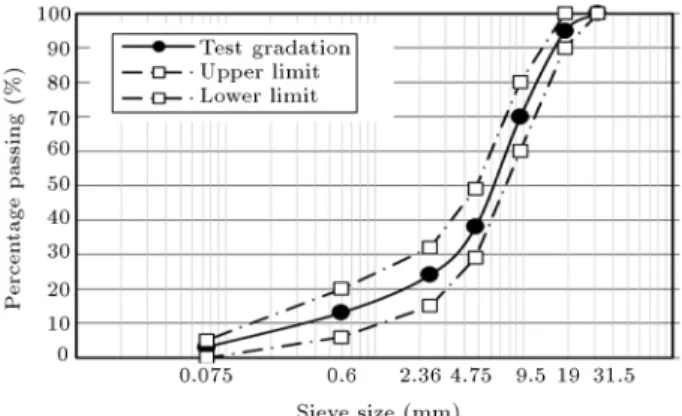
The gradation of Cement Stabilized Aggregates (CSAs) mixture used in this study is detailed in Figure 1. It is one of the most ordinary types of CSAs for application in China. The aggregate mixtures were well designed according to China's national specication of \JTG
Figure 1. Gradation of the cement stabilized aggregate mixtures.
D50-2006" [12], in which the upper limit and lower limit were required, and the used gradation was in the mid-specication range. The cement content in CSAs was given as 4.5% of the total weight of mixtures. To evaluate the function of the Water Reducing Agent (WRA) in CSAs, several contents of WRA (0, 0.5, 1.0, 1.5, 2.0, and 2.5% of cement binder weight) were added to mixtures, and the Optimum Water Content (OWC) of each in CSAs was determined based on maximum density method [13,14]. More details of determination of OWCs will be provided in Section 3.
2.3. Test methods
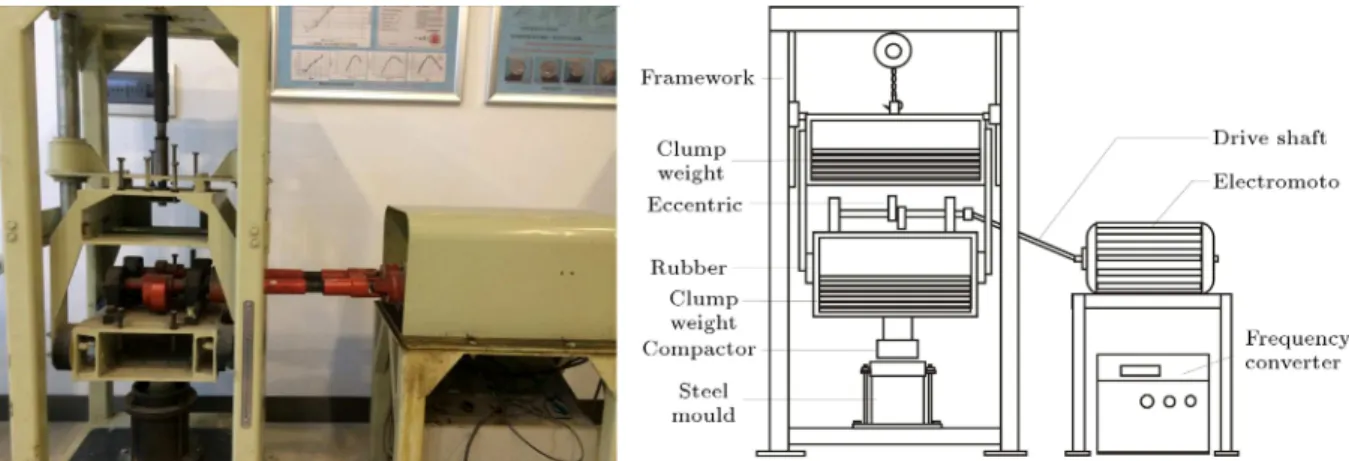
To simulate the eld construction technique, vertical vibration strategy was utilized in laboratory. The compacting machine and schematic diagram are shown in Figure 2. The static pressure of the vibration compactor was 104 kPa, vibration frequency was 28 Hz, and vibrating force was set to 6.86.9 KN.
Cement stabilized aggregate mixtures were mixed and, then, moved into steel molds. Here, the mixtures should be compacted within 1 hour after mixing due to the cement hydration. The relative compaction of test specimens was given as 98%.
Based on the OWCs, CSA samples were pre-pared for engineering performance measurements. All specimens used in this paper were sealed in plastic bags and stored in a curing chamber with a tem-perature of 20 0:5C and relative humidity above
95%. Before the measurement, specimens were soaked in room-temperature water for 24 h. Engineering performances, i.e., Tensile Splitting Strength (TSS), Unconned Compressive Strength (UCS), Compressive Resilience Modulus (CRM), and Drying Shrinkage Strain (DSS), were mainly measured complying with JTG E51-2009 [15]. In UCS test, cylindrical samples ( = 150 mm, h = 150 mm) were measured. Then, the unconned compressive strength was calculated according to Eqs. (1) and (2).
Figure 2. The vibratory compactor and diagram of Vibration Compaction Method (VCM) in laboratory.
A = 0:25D2; (2)
where UCS is the unconned compressive strength (MPa), Pu is the maximum pressure value (N), A is
the sectional area of measured sample (mm2), and D
is the diameter of cylinder.
Also, the samples were measured by tensile splitting test (T0806-1994); Tensile Splitting Strength (TSS) could be achieved by Eq. (3).
TSS = Dh2Pt0 sin 2 Da; (3) where TSS is the tensile splitting strength (MPa), a is the width of the depression bar (mm), is the central angle of half depression bar (), Pt is the maximum
pressure value in tensile splitting test (N), and h0 is
the height of sample after being immersed in water. Additionally, the Compressive Resilience Modulus (CRM) was detected with T0808-1994 method. In CRM test, cylindrical samples ( = 150 mm, h = 150 mm) were used and the compressive resilience modulus was calculated with Eq. (4).
E = p h=l; (4)
where E is the compressive resilience modulus (MPa), p is the unit pressure during CRM test (N), h is the height of sample, and l is the rebound deformation of cylinder (mm).
During measurements, in order to reduce the experimental errors, 9 samples were produced for each group and the average value was adopted, whose error was less than 10%. To observe the performance evolution of cement stabilized aggregates, specimens were measured at 7, 28, 90, and 180 d.
Specimens (100100400 mm under OWCs con-ditions) for Drying Shrinkage Strain (DSS) measure-ment were cured in the chamber at 40C to accelerate
cement hydration. Before measurement, CSA surface had to be polished for the strain gages setting. Here,
the operation process was based on the standards of T0854-2009 in JTG E51-2009 [15]. In this study, the shrinkage strain was calculated as follows:
" =14; (5)
where " is the drying shrinkage strain, 14 is the
length change of the specimen at 14 days, and is the original length of the specimen.
3. Experimental result of engineering performances
3.1. Relationship of moisture and mixtures' dry densities
The relation of drying density and water content in CSAs was measured according to T0804-1994 in JTG E51-2009 [15]. The results are plotted in Figure 3, in which parabolas are also shown with their quadratic polynomials. Based on maximum density method, the peak plots on the curves are the maximum density point and optimum water content in construction. The OWC and MDD of CSAs with increase in WRA are detailed in Table 1.
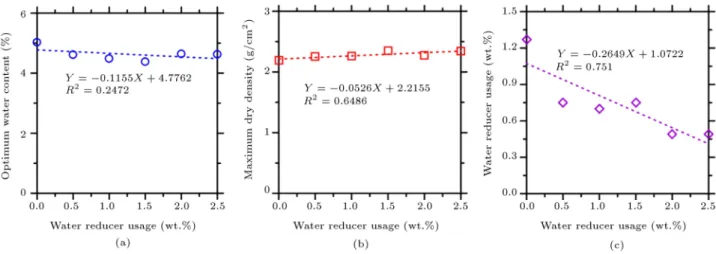
Figure 4(a) presents the OWCs of the six groups of mixtures. It is obvious that the OWCs slightly decreased with increase in WRA content, e.g., the slope of the line in Figure 4(a) is 0:1155. This result means that water content in application would be signicantly reduced, e.g., the initial water-cement ratio of control mixture was 1.12, which then decreased to 1.03 (8.1% reduction by 0.5% WRA), 0.99 (10.7%
Table 1. Water Reducer Agent (WRA) eect on Optimum Water Content (OWC) and Maximum Dry Density (MDD) of cement stabilized aggregates.
WRA content (%) 0 0.5 1.0 1.5 2.0 2.5 OWC (%) 5.03 4.62 4.49 4.39 4.65 4.62 MDD (g/cm3) 2.19 2.26 2.26 2.36 2.28 2.35
Figure 3. Moisture-density relationships of cement stabilized aggregate mixtures, while the water reducing agent utilized from (a) to (f) is 0%, 0.5%, 1.0%, 1.5%, 2.0%, and 2.5% of cement binder weight.
Figure 4. Water reducing agent eects on optimum water content and mixture density in application: (a) Optimum water content, (b) corresponding density, and (c) moisture sensitivity of mixtures in construction.
reduction by 1.0% WRA), and 0.97 (12.7% reduction by 1.5% WRA). Even the OWCs of the mixtures with 2.0 and 2.5% WRAs were still lower than that of the control mixture. As believed [7], less drying shrinkage would be caused by low water content in CSAs, which will be discussed below.
The addition of water reducing agent also brings
another advantage: enhancement of the maximum dry-ing density of CSAs, as demonstrated in Figure 4(b). Generally, increase in dry density in this case brings at least two benets:
i) Good integrality and homogeneity of semi-rigid material blocks. As courses or base
courses, cement stabilized aggregates have to bear vehicle loadings, mainly. Integrality and homo-geneity are signicantly linked with the loading bearing capacity, i.e., compressive strength and exural strength;
ii) Better compaction capacity in applications. All samples in this study were compacted in the same condition, namely, with the same compaction energy. This means that the CSA with a higher dry density could be compacted more easily than the control. In this case (with higher density), the particles of aggregate, cement, and some clay are in closer contact with each other. Thus, during the real application, especially during the vibratory rolling procedure, the CSAs with higher densities could be compacted much more densely; as a result, their mechanical properties would be better.
The data in Figure 3 also provide another charac-teristic of mixtures. The sensitivity of density to water content was reduced by the addition of water reducing agent, as plotted in Figure 4(c). As known, there are great dierences between laboratory compaction and eld compaction of CSAs, because it is dicult, in eld, to achieve the same quality (i.e., integrality and homogeneity) of CSAs blocks as in laboratory. Thus, the real water content in micro-regions could not be the same as designed (i.e., optimum water content). Water content sensitivity is dened as the delta value between maximum density and minimum density, as shown in Figure 3, where low index (delta density) means that better integrative and homogeneous semi-rigid block would be achieved concerning the real water content changing in micro-regions. Hence, Figure 4(c)
shows that water reducer also benets the construction quality control in applications.
3.2. Mechanical behaviors
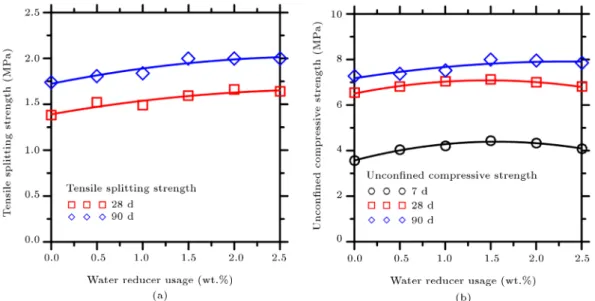
Tensile Splitting Strength (TSS) and Unconned Com-pressive Strength (UCS) are plotted in Figure 5. The mechanical behaviors (TSS and UCS) of CSAs show an increasing trend over WRAs addition. However, it is hard to say, based on the current data in this study, that the increase in mechanical behaviors, no matter TSS or UCS, is directly caused by the addition of water reducing agent, because the mechanical behavior of CSAs is tightly related to the mixture density [16]. Also, Figure 4(b) reveals the improvement of CSAs dry density by WRAs. Thus, two factors may contribute to the mechanical enhancement:
i) Water-cement ratio was reduced by WRAs. As a result, defects in hydrated cement paste caused by evaporation of free water were reduced. There was very little cement (4.5%) in mixtures; thus, little changes in binder might bring great improvement in whole blocks;
ii) Density of CSAs was improved by WRAs. As stated above, better density will ensure the in-tegrality and homogeneity of semi-rigid materials, while interlocking of aggregate particles with skele-ton structures mainly provides embedded squeeze forces.
The latter factor seems more reasonable, because little changes in cement binder in CSAs may not bring great variation due to its rare amount. However, the dry density of CSAs is believed to have more inuences on mechanical behaviors than water-cement ratio has [11].
Figure 5. Relationships of mechanical behaviors and water reducing agent usage in cement stabilized aggregate base course mixtures: (a) Tensile splitting strength and (b) unconned compressive strength.
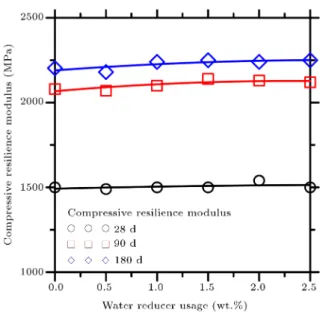
Figure 6. Water reducing agent eects on the compressive resilience modulus of cement stabilized aggregate mixtures.
3.3. Compressive resilience modulus
CRM is signicantly linked with the shrinkage stress and higher CRMs will produce higher stress under the same shrinking level in hydration. The Compressive Resilience Modulus (CRM) of CSAs at 28, 90, and 180 d is detailed in Figure 6. It seems that WRA has little eect on the CRM beyond 28 days, but makes a slight increase in CRM at 90 and 180 days. The low CRM at early ages (28 d) can bring other benets to CSAs, because shrinkage mainly occurs at early ages. Thus, based on the above data, this result suggests that WRAs will enhance mixture density, reduce water usage, and have a slight inuence on compressive resilience modulus, even at early ages; meanwhile, the slight inuence might be contributed by the densica-tion funcdensica-tion. Compared with the compressive strength and exural strength, the inuence of WRAs on CRMs is low.
3.4. Drying shrinkage strain
As mentioned in Sections 3.1 and 3.3, the main goal of this study is to prevent the drying shrinkage of CSAs, thus to reduce the risk of bottom-up cracks of asphalt pavement surface. Therefore, the strains during drying shrinkage were measured as detailed in Section 2.3. The drying shrinkage strain is plotted in Figure 7 versus water reducing agent usage. As desired, the drying shrinkage strain decreased with increase in water reducer usage in CSAs mixtures.
Based on Hooke's law, briey, the shrinkage stress is equal to modulus times shrinkage strain. Thus, the conclusion, based on the results observed in Figure 7, can be that the stress produced by drying shrinkage will be potentially reduced when the mechanical behavior of matrix is improved. As a result, as stated in
Figure 7. Drying shrinkage strain in cement stabilized aggregate mixtures aected by water reducing agent.
Figure 5, the capacity to prevent cracking in cement stabilized aggregates base course will be signicantly increased leading to the risk reduction of bottom-up cracking of asphalt pavement surface. As well, the strains measurement shows that a great amount (>2.0%) of WRAs may not work well to reduce the drying shrinkage in CSAs.
3.5. Linking of unconned compressive strength to tensile splitting strength and compressive resilience modulus
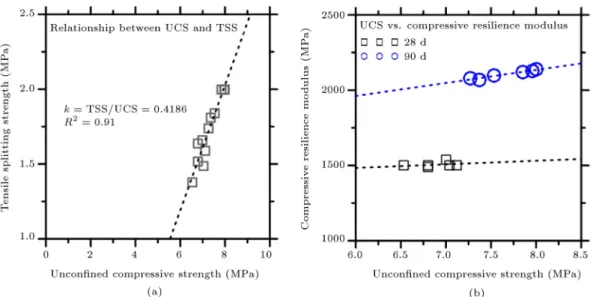
The relationship between unconned compressive strength and tensile splitting strength, whose slope is dened as exural compression ratio that can be used to evaluate the anti-cracking performance, is presented in Figure 8(a). The trend provides two pieces of important information:
i) Tensile splitting strength of CSAs increases with the improvement of unconned com-pressive strength. This trend can be conrmed in most of the cement-based composites. Thus, unconned compressive strength can be measured to estimate the tensile splitting strength in the same special condition. In addition, improvement of the UCS can be an ecient solution to improve the tensile splitting strength;
ii) TSS-UCS ratio of CSAs is stable (k = 0:4186) in this case. However, it should be noted that this trend does not mean the exural compres-sion ratios of all types of CSAs are stable. It works only under the limitation of this study, that is, with the same mixture gradation for incorporating Water Reducing Agents (WRAs). Flexural com-pression ratio of cement-based material indicates
Figure 8. Relationships between mechanical behaviors of cement stabilized aggregate mixtures: (a) Unconned compressive strength and tensile splitting strength and (b) unconned compressive strength and compressive resilience modulus.
the anti-cracking performance under loading stress. The stable exural compression ratio shows that the anti-cracking performance of CSAs will not be greatly changed incorporated in WRAs.
Figure 8(b) shows the relationship between UCS and CRM in CSAs. It is clear that there is a good linear relationship between unconned compressive strength and compressive resilience modulus at not only 28 days, but also 90 days. The CRMs were kept stable beyond 28 days after the addition of water reducing agent, but there was a slight improvement beyond 90 days. This two results are in good agreement with the observation in Figure 6.
4. Roles of water reducing agent in cement stabilized aggregate base course
The roles of Water Reducing Agents (WRAs) in Cement Stabilized Aggregates (CSAs) are absolutely similar to those in cement concrete. Figure 9 presents the working mechanism of WRAs in CSAs. CSAs are usually used as the base or subbase course (named semi-rigid material) with little amount of cement
binders (nearly 45 wt.%) and sucient water content (56 wt.%) compared with the water needed for hydration (w=c = 0:42) [17]. Dierent from Portland cement concretes, CSAs have to face severe problems, specically the drying shrinkage at early ages, bringing cracks to CSAs blocks and, further, producing bottom-up cracking.
As shown in Figure 9, moisture evaporation in cement paste in CSAs will occur in hardening process, no matter what mixture structure it is [7]. Due to the eects of dispersion, electrostatic repulsion, and lubri-cation of the water reducing agent, the water wrapped in cement occulation structure was released [1,2], which led to more uniform distribution of water in the mixture. Thereby, the reduced friction-force was generated by aggregate particles during compacting, moving, and rotating. As a result, the aggregate particles could move smoothly and be compacted more easily (Figure 3). Also, the dry density increased (Fig-ure 4(b)). Finally, the mechanical behaviors improved (Figures 5 and 6) and the drying shrinkage (Figure 7) was reduced by the reduction in optimum water content (Figure 4(a)).
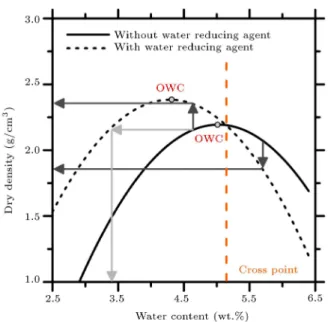
Figure 10. Schematic diagram of the function of water reducing agents in cement stabilized aggregate mixtures. The solid line is the control sample without water reducing agent and the dashed line is cement stabilized aggregate containing 1.5% water reducing agent (OWC: Optimum Water Content).
The signicances of this study could be summa-rized in the schematic diagram (Figure 10), presenting the density-water curve of CSAs incorporated in Water Reducing Agent (WRA). Based on the maximum density method, the deductions on dierent sides of the crossing point of curves are opposite. Take the left side, for instance; basically, the dashed line (containing water reducing agent) is above the solid line (control sample without water reducing agent). Some impor-tant conclusions are provided in the following. After addition of water reducing agents:
i) Mechanical behaviors of CSAs will be improved, due to the enhancement of dry density with the same mixture proportion;
ii) The (optimum) water content will be decreased to achieve the same mixture's dry density, leading to reduction in drying shrinkage strain and improve-ment of the sustainable properties;
iii) The compaction energy will be lowered, to achieve the same dry density with unchanged mixture proportion, which also improves the damage resis-tance caused by heterogeneous composites, bene-ting the quality control in application.
5. Conclusions
Desired functions or roles of water reducing agent utilized in cement stabilized aggregates were achieved for engineering performance in this study. Water re-ducing agent in cement stabilized aggregates decreased
the optimum water content, improved the maximum dry density, and beneted the sensitivity of water content during compaction. As a result, the unconned compressive strength and tensile splitting strength were improved, while slight eects on compressive resilience modulus were observed. In summary, water reducing agent in cement stabilized aggregates had at least three basic benets: improving the mechanical behaviors, reducing the optimum water content, and promoting the quality control.
Acknowledgement
The authors gratefully acknowledge the nancial sup-port of the National Science & Technology Pillar Program during the Twelfth Five-year Plan Period of China (No. 2014BAG05B04), and Fundamental Research Funds from the Central Universities (No. 2014G3213004).
References
1. Taylor, H.F., Cement Chemistry, 2nd Ed., Thomas Telford (1997).
2. Young, J.F., Mindess, S., and Darwin, D., Concrete, Prentice Hall (2002).
3. Bentz, D.P., Peltz, M.A., and Winpigler, J. \Early-age properties of cement-based materials. II: Inuence of water-to-cement ratio", J. Mater. Civ. Eng., 21, pp. 512-517 (2009).
4. Li, V.C., Wang, S., and Wu, C. \Tensile strain-hardening behavior of polyvinyl alcohol engineered cementitious composite (PVA-ECC)", ACI Mater. J.-Am. Concr. Inst., 98, pp. 483-492 (2001).
5. Mehta, P.K. and Monteiro, P.J., Concrete: Microstruc-ture, Properties, and Materials, 2rd Ed., McGraw-Hill, New York (2006).
6. Xuan, D.X., Houben, L.J.M., Molenaar, A.A.A., and Shui, Z.H. \Mechanical properties of cement-treated aggregate material-a review", Mater. Des., 33, pp. 496-502 (2012).
7. Sha, A. and Hu, L. \Structural characteristics of semi-rigid base course material", China J. Highw. Transp., 24, pp. 1-5 (2008).
8. Chakrabarti, S. and Kodikara, J. \Direct tensile failure of cementitiously stabilized crushed rock materials", Can. Geotech. J., 44, pp. 231-240 (2007).
9. Halsted, G.E., Luhr, D.R., and Adaska, W.S. \Guide to Cement-Treated Base (CTB)", Portland Cement Association, Skokie, USA (2006).
10. Jitsangiam, P. and Nikraz, H. \Mechanical be-haviour of hydrated cement treated crushed rock base (HCTCRB)", Aust. Geomech., 42, pp. 133-143 (2007).
11. Huang, Yubin, Lv, Weimin, Xu, Jianda and We, Ming \Eect of water reducing agent on the physical and mechanical properties of cement stabilized crushed rock", J. Build. Mater., 8, pp. 311-315(2005).
12. Ministry of Transportation, JTG D50-2006, Speci-cations for Design of Highway Asphalt Pavement, Ministry of Transportation, Beijing, China (2006).
13. ACI Committee 327, ACI 327R-14, Guide to Roller-Compacted Concrete Pavements, American Concrete Institute, Farmington Hills, MI (2015).
14. Mardani-Aghabaglou, A. and Ramyar, K. \Mechanical properties of high-volume y ash roller compacted con-crete designed by maximum density method", Constr. Build. Mater., 38, pp. 356-364 (2013).
15. Ministry of Transportation, JTG E51-2009, Test Meth-ods of Materials Stabilized with Inorganic Binders for Highway Engineering, Ministry of Transportation, Beijing, China (2009).
16. Luo, Jiaguo, Liang, Xiaoxia and Liu, Yanyan. \Anal-ysis of dierences in compactedness of cement stabi-lized gravel by formation methods", Technol. Highw. Transp., pp. 8-11 (2010) (in Chinese).
17. Powers, T.C. and Brownyard, T.L. \Studies of the physical properties of hardened Portland cement paste", ACI J. Proc., ACI (1946).
Biographies
Liqun Hu, PhD, is Professor and Director of the Institute of Highway Engineering, School of Highway, Chang'an University, Xi'an, PR China. He received
his MS and PhD degrees in Road and Railway Engi-neering from Chang'an University in 2000 and 2004, respectively. His research interests include road mate-rials, pavement structure, eco-friendly pavement, road construction quality control, and pavement detection techniques.
Zhuangzhuang Liu, PhD, is Asistant Professor in the School of Highway, Chang'an University. He received his BS, MS, and PhD degrees from Chang'an University in 2010, 2013, and 2016, respectively. His research interests are related to the structures-materials-functions problems of pavements in special regions. His current study includes building materials in cold climates, winter road maintenance, low-carbon footprint building materials, etc.
Aimin Sha, PhD, is Professor of Highway and Railway Engineering in the School of Highway, Vice-President of Chang'an University, and director of the Key Lab of Special Region Highway Engineering, MOE, PR China. He received his BS and MS degrees from Xi'an Highway University (Chang'an University), in 1985 and 1987, respectively, and PhD degree from Kharkov National Automobile and Highway University in 1996. His main research interests are focused on road material, pavement design theory, construction quality control, eco-friendly pavement, and \Green" transportation.