ABSTRACT
Andi Orben: Dipping Tobacco in New England Boarding Schools (Under the direction of Lori Evarts, MPH, and Kurt M. Ribisl, PhD)
Dipping tobacco usage among male New England (NE) boarding school students has been
prevalent since the mid-1980s. This paper attempts to understand the history and present culture
of dipping on NE boarding school campuses and to identify strategies for both preventative and
discipline response measures. In addition, specific action steps for boarding school faculty and
public health leaders are identified and presented. Due to the unique culture of NE boarding high
schools and the characteristics of faculty and staff who work on these campuses, this paper was
written using a colloquial tone to reach the audience that will have the greatest chance of
benefiting from the paper’s content, the faculty and staff in NE boarding schools.
Keywords: Dipping tobacco; smokeless tobacco; spitting tobacco; boarding school; adolescent
TABLE OF CONTENTS
Page
Abstract………... 1
List of Tables and Figures……….. 3
List of Abbreviations……… 4
Introduction……… 5
Methods……….. 9
Results……… 10
Discussion………... 13
Health Consequences of Dipping Tobacco………... 13
Communal Living Consequences of Dipping Tobacco……… 15
Education, Income and Unlikely Dip Relationship………. 16
Dip Usage in New England Boarding Schools……… 18
Reasons Cited for Usage………... 20
Addressing Dip Usage on our Campuses………... 23
Ten Recommendations for Addressing Dipping Tobacco Usage on Boarding School Campuses………... 36
Conclusion……….. 37
References………... 39
Appendix A – Survey Questions……… 42
Appendix B – IRB Approval……….. 43
Appendix C – Permission to use Independent School Health Check data………. 44
Appendix D – Early signs of oral cancer from the American Academy of Pediatrics……... 45
Appendix E – Qualitative phone survey results………. 46
LIST OF TABLES AND FIGURES
Page
TABLE 1. New England boarding school campus faculty and staff interviewed: Role of
respondent………... 10
TABLE 2. Perceived use of smokeless tobacco (dipping or chewing tobacco) by students at New England boarding school campuses based on interviews of campus faculty and
staff ………... 11
FIGURE 1. Do students on your campus use smokeless tobacco?...………... 10
FIGURE 2. Smokeless tobacco use by students at New England boarding school
campuses based on interviews of campus faculty and staff………...……… 12
FIGURE 3. Current actions taken by schools to address dipping tobacco usage………… 12
FIGURE 4. Protocol for a dipping violation ...………...……… 13
FIGURE 5. Perceived dipping tobacco use by sex ...………...……… 19
LIST OF ABBREVIATIONS
CDC Centers for Disease Control and Prevention
IOM Institute of Medicine
ISHC Independent School Health Check
NE New England
US United States
UST US Smokeless Tobacco Company
INTRODUCTION
While youth smoking rates in the United States (US) continue to decline, 1 smokeless
tobacco rates, marketing and products options are increasing. The 2010 Monitoring the Future
survey found a 39.3% increase in 12th graders using smokeless tobacco from 2006 (6.1%) to
2010 (8.5%). 1 And, the Centers for Disease Control and Prevention (CDC) 2011 Youth Risk
Behavior Surveillance System (YRBSS) indicates that 7.7% of high school students used
smokeless tobacco during the 30 days before the survey. 2 Research also shows an increase in the
marketing efforts of big tobacco conglomerates who produce and market smokeless tobacco. US
Smokeless Tobacco Company (UST), now a subsidiary of Altria, the parent company of Philip
Morris USA controls of more than half (55.3%) of the moist snuff tobacco market 3 (producer of
Skoal and Copenhagen) and American Snuff Company (formerly Conwood) owned by Reynolds
America, Inc. (producer of Grizzly and Kodiak) has more than a 25% share of the moist snuff
smokeless tobacco market. 4 While the Federal Trade Commission reports that the amount spent
on cigarette advertising and promotion by the largest cigarette companies in the US declined
from $12.49 billion in 2006 to $9.94 billion, in 2008, representing a 20% reduction; a separate
report on the major manufacturers of smokeless tobacco products in the US found that their
advertising spending and promotion rose from $354.1 million in 2006 to $547.9 million in 2008
(close to a 55% increase). 5 In addition, the portion of promotional efforts used for internet
marketing increased from $155,405 in 2000 to $2,538,000 in 2008, a more than sixteen-fold
increase. 5 The dollar value of sales in smokeless tobacco by these manufacturers rose from
$2.59 billion in 2006 to $2.76 billion in 2008. 5 This increase in sales during this two year period
represents a six percent increase and approximately $170 million. In addition to product
smokeless tobacco products such as e-cigarettes, lozenges, tablets, strips, sticks and snus. Snus, a
product growing in popularity in the US, 6 is a moist powder tobacco product packaged in small,
teabag-like pouches placed between the gum and lip that can be even less conspicuous than
dipping tobacco because spitting is not required.
The tobacco usage explored in this paper is that of moist snuff. As reported by CDC,
moist snuff is the most popular type of smokeless tobacco. Although there are two main types of
smokeless tobacco used in the United States, chewing tobacco and snuff, snuff can be dry, moist,
or packaged in sachets or pouches (snus) or loose in tins, 7 moist snuff occupies 75.3% of the
smokeless tobacco market. 8 The moist snuff loose in tins is the form of tobacco most often
found in the dorm rooms of NE male boarding students. The typical use of moist snuff from a
dipping tobacco tin involves taking a pinch between the thumb and pointer finger and placing the
pinch of tobacco between the cheek and/or lip and gums. Users, called “dippers” or “chewers” in
the boarding school environment, spat out (spit) the tobacco juices and the excess saliva (dip
spit) produced in the process. While students refer to the substance used as “dip or chew”, moist
snuff is not chewing tobacco. Chewing tobacco is a different product, which occupies a much
smaller percent of the smokeless tobacco market. 8
When one imagines an adolescent dip tobacco user the depiction usually includes a rural
setting, maybe a baseball stadium or the rodeo grounds and a dusty, boot jean clad teen with a
packed lip spitting brown juice onto arid ground. The typical image of a teenage dip tobacco user
generally does not involve a high achieving, wealthy or upper middle class preppy student on the
grounds of an immaculate, elite New England preparatory school. Yet, for nearly a decade, as a
health educator and the head of a residential student dormitory at a New England boarding
students. I often hear students talk about dip usage in the dorms and I have seen evidence of its
presence in the boys dorms, but my concern reached a new height when I reviewed the results of
an internal health survey conducted annually by the health education program director and
realized that our dipping tobacco rates for boarding boys (around 25% of 11th and 12th grade
boys have used chewing tobacco at least once during the last month, internal school survey,
During the past 30 days, on how many days did you use chewing tobacco, snuff or dip?) are
higher than national prevalence for male student smokeless tobacco users (15%) 1,9. While
researching dipping tobacco usage further, I learned that the highest rates of dipping tobacco
usage in the US are among white males (20.1%) 10 and I was surprised to see rates in my
Connecticut school on par with or even higher than rates in states with most-likely suspects like
Montana, Wyoming, and West Virginia. 10 Through speaking with peers at surrounding schools,
I learned that the problem was not confined to my campus.
Working with adolescents I have always been concerned about cigarette smoking and
actually quite relieved at the lack of smoking violations on my school’s campus. Our dean of student’s office has not given a cigarette smoking violation in the past four years. And, although
34% of our students admit to having ever tried smoking cigarettes (internal school survey, Have
you ever tried smoking cigarettes?) 93% of our students say they have not smoked a cigarette
during the past 30 days (internal school survey, During the past 30 days, on how many days did
you smoke cigarettes?). For the first few years I served as a health educator on my campus I was
focused on teaching students about the dangers of cigarette smoking, but I was missing the fact
dipping tobacco usage on my campus was much more of an issue, and that smokeless tobacco
rates were increasing in the US and tobacco companies and cigarette companies were producing
oversees the dormitory life of three-dozen teenagers, and as the head of my school’s health
education program (that attempts to educate and empower 560 students to make healthy choices),
I am troubled by the thought of adolescents developing a habit or addiction to tobacco and/or
nicotine under my watchful eye. Since my focus has shifted to from cigarettes to dipping tobacco
and other forms of smokeless tobacco, my attempts to address student usage have increased
awareness of potential bodily harm as well as awareness of the discipline response for those who
are found in violation the school’s tobacco free policy, yet I feel as if I have done little to shift
the pervasive cultural appeal of a group of male dorm residents sharing a late night dip.
I began this project by researching dipping tobacco usage in boarding schools but since
the topic involves behavior patterns at independent (private) schools, very little has been
published and/or is available. Using PUBMED with “smokeless tobacco” “adolescent” “United
States”, nearly 400 items are returned, but adding “New England” results in only two articles
with only one from 1994 focused on the higher smokeless tobacco rates in the US South seeming
to have relevance. Conducting an additional search in PUBMED using “smokeless tobacco”
“private school” yielded one article from 2009 about increases in tobacco (non cigarette) in
France. Through a series of conversations with a community education consultant I was able to
obtain findings from the Independent School Health Check (ISHC) National Database, that
contains data of over 15,500 independent schools boarding and day schools combined, on
cigarette smoking and the use of smokeless tobacco products. The data showed 12.3% of
boarding students saying they have used tobacco products in the last 30 days, of those 6.6% say
they do not smoke cigarettes. 11 But, the ISHC data is not specific to New England boarding
schools (due to confidentiality agreements, data specific to ISHC participating boarding schools
decided the best approach was to reach out through my network of peers, directly contacting
faculty and staff at NE boarding schools, to more deeply explore dipping tobacco usage in New
England boarding schools with an eye for the history and current cultural acceptance as well as
to give attention to best practices for addressing the issue.
METHODS
Using the research methodology of participant observer, common in anthropology
and sociology, 12I contacted 40 individuals and conducted 34 interviews with faculty and staff at
10 New England boarding schools. Faculty and staff in key positions were sought out to
participate in a ten-minute qualitative phone survey: head of school; school counselor;
residential life faculty; dean of students; the health center; and athletics. Survey questions asked
about the respondent’s perceptions of smokeless tobacco (specifically dipping tobacco) usage,
prevalence, culture, and discipline and preventative measures on the respondent’s campus (see
Appendix A). An IRB Exemption (Exemption Category: 2. Survey, interview, public
observation) from the Office of Human Research Ethics was received on 6/16/2012 (Study #:
12-1183) (see Appendix B). All interview notes were recorded and stored electronically in
Qualtrics, a secure University of North Carolina, Chapel Hill survey system. Descriptive
summaries of the quantitative measures were generated and the qualitative responses were
RESULTS
Eighty-five percent, 34 of the 40 individuals contacted agreed to complete the survey,
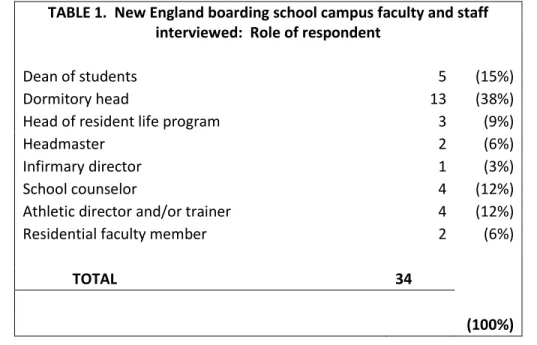
with the majority of respondents representing dormitory faculty and staff as shown in Table 1.
TABLE 1. New England boarding school campus faculty and staff interviewed: Role of respondent
Dean of students 5 (15%)
Dormitory head 13 (38%)
Head of resident life program 3 (9%)
Headmaster 2 (6%)
Infirmary director 1 (3%)
School counselor 4 (12%)
Athletic director and/or trainer 4 (12%)
Residential faculty member 2 (6%)
TOTAL 34
(100%)
Dipping tobacco usage among male students continues to present a public health issue on New
England boarding school campuses. This survey revealed that 91% of the respondents believe
Respondents from 70% of schools interviewed believe male students on their campus are using
dipping tobacco. Table 2 provides an overview of the respondents’ perceptions concerning the
type of students using smokeless tobacco.
TABLE 2. Perceived use of smokeless tobacco (dipping or chewing tobacco) by students at New England boarding school campuses
based on interviews of campus faculty and staff
Both (males & females) 16 (47%)
Males only 16 (47%)
Unsure 2 (6%)
Both (day-students and boarding students) 26 (76%)
Boarding students only 5 (15%)
Unsure 3 (9%)
Both 31 (91%)
Athletes only 1 (3%)
Unsure 1 (3%)
(no response) 1 (3%)
TOTAL 34 (100%)
Although few schools have exact prevalence usage numbers, many respondents (twelve, 38%)
perceived that between 25% and 50% of their male students use dip, as indicated by their
responses (see Appendix D for responses to question About how many or what percent of
students use it?). Seventy percent of respondents feel that there is a culture of dipping tobacco
usage on their campus and over half (56%) of interviewees did not feel their schools are doing
Current approaches for smokeless tobacco prevention like bringing in outside speakers,
displaying posters, and holding conversations in dorms and through athletics, vary greatly from
school to school and both discipline and health responses to dipping tobacco violations vary both
within and between schools. From this survey, some schools admit that discussions about
smokeless tobacco is not part of their health curriculum while other schools say they give the
parents, offer cessation programs and require health evaluations from a dentist and/or health care
provider.
Clearly, there is still much work to be done to increase awareness, ensure consistency of best
practices across campuses to the culture of smokeless tobacco usage within New England
boarding schools.
DISCUSSION
Health Consequences of Dipping Tobacco
Smokeless tobacco use can lead to oral cancer, oral health problems including gum
disease and nicotine addiction. 13,14 Smokeless tobacco exposes users to many harmful chemicals
such as Nitrosamines, cancer-causing chemicals from the curing process, and heightens a user’s
risk for many of the same health problems as smoking. The National Cancer Institute has
identified 28 known carcinogens in smokeless tobacco products produced in the US. 7 Smokeless
tobacco users have an 80% higher risk of developing oral cancer and a 60% higher risk of
developing pancreatic and esophageal cancer. 15 And, extended exposure to tobacco juice may
Dipping and spit tobacco, like the moist snuff boarding school students use, causes
leukoplakia, a disease of the mouth characterized by white patches and oral lesions (sores) on the
cheeks, gums and/or tongue. Leukoplakia, which occurs in more than half of all users in the first
three years of use, may lead to oral cancer. Studies have found that 60% to 78% of smokeless
tobacco users have oral lesions. 16 Cancer of the mouth (including the lip, tongue and cheek) and
throat most often occur at the spot in the mouth where the snuff tobacco is held. When surgical
removal of the cancer is required, parts of the face, tongue, cheek or lip must be removed. 17
Dipping tobacco also causes gums to decay and teeth to rot from sugar in the dip
decaying exposed tooth roots. A study by the National Institutes of Health and the Centers for
Disease Control and Prevention found chewing tobacco users were four times more likely than
non-users to have decayed dental root surfaces. 18 Additional research shows that heart problems
from the constant flow of nicotine into the body may include side effects such as increased heart
rate, increased blood pressure and irregular-heartbeats. 17
While evidence shows potential harm to the user, many people still perceive smokeless
tobacco including dip as a safe or safer alternative to smoking. 19 While smokeless tobacco does
not expose the user or those around to smoke, smokeless tobacco still delivers harmful and
addicting nicotine, tobacco, and other cancer causing substances to the users’ system. 20
Aside from the immediate and potential long-term damage to the body created by the use
of dip, the Surgeon General reports that teens are more sensitive to nicotine and may more easily
become addicted to nicotine. 14 In addition, some forms of smokeless tobacco contain and deliver
more nicotine than cigarettes, potentially making addiction more likely. Holding an average-size
dip in the mouth for 30 minutes gives as much nicotine as three cigarettes. 21 And, a tin-a-week
Because over 443,000 people die each year from tobacco related causes, half of
long-term smokers die prematurely from a tobacco-related disease, 22 and 1.8 million people
experience disease and disability from cigarettes and tobacco each year in the US, 10 it is clear to
see how forming any kind of tobacco habit or nicotine addiction is unhealthy, and a source of
anxiety for any adolescent health educator.
In addition to the health risks, it is fairly easy to see why many non-users perceive dip as
distasteful. Dip leads to bad breath, permanent teeth discoloration, which no amount of brushing
or flossing will make the stains go away, and the potential for cavities and loss of teeth. 17
Because dip contact with the teeth and gums is direct and repeated, the gums begin to recede and
may become diseased, leading to loose teeth. 18 Also, because many forms of smokeless tobacco
contain sugar, the sugar mixes with plaque to form acid that eats away at tooth enamel and
causes cavities and chronic painful sores. 17 From a purely aesthetic view, tobacco caught in the
teeth may be less forgivable than a piece of spinach from a summer salad or a piece of black
pepper wedged between the lateral incisors. Let us not forget to mention the gross factor
involved with the bi-product of dipping, the “dip spit”.
Communal Living Consequences of Dipping Tobacco
The spit bi-product is an important factor, especially in a boarding (communal living)
school environment. While seeing residual dip spit on the walls of the boys’ showers is one thing
or finding evidence in used soda bottles near the floor hall trashcan is another, when the spit is in
a student’s room where they study and sleep it becomes a whole other ball game. The unsavory
factor clearly shows through the infamous, yet true story an interviewee told about when the
spittoon of a dorm resident accidently toppled over.
travel down the wall until it ultimately contaminated the contents of the closet of the teenage resident one floor below. The spit juice finally settled in a pool below and within the loafers of the unassuming downstairs resident. Despite multiple carpet cleanings, the dippers room and the room one floor below continued, for years, to reek of bad breath and moldy tobacco.
In addition, countless stories are told of students expecting to take a swig of a friend’s
cold soda pop and instead experiencing warm, thick, mucus dip spit unexpectedly sliding down
their esophagus. The story is often recounted with a description of the instantaneous vomit
response from the throat of the unlucky victim. Students are also quick to mention the gross
factor when asked about how they might feel if they realized the person they were smooching
was hosting a pack, wad, or a dip. The usual response includes a gag and a sour face commenting
on the “grossness” of the thought of kissing a dipper. And, finally, while the dipper may
habituate to the smell of tobacco in their mouth, others around them are not as likely to adjust to
the scent. Yet, the health risks and the gross factor are not enough to detract many boarding
school adolescents from the appeal.
Education, Income and Unlikely Dip Relationship
Before delving deeper into dip into the current boarding school dip culture, it is worth
exploring why many NE boarding school students may have a hard time perceiving the dangers
of tobacco and nicotine use and addiction. We know that as education increases tobacco use
decreases. 23 Having spent the past decade in a traditional, elite New England prep school, I
would venture to say that very few of our students’ parents smoke. And, looking at our student
demographic I would be utterly surprised if their parents currently use dip. For the most part,
families that send their kids to elite boarding college preparatory schools value education and the
majority are well educated, hence lower rates of smoking and tobacco use. 23 Since a major
doing it, while student peers at boarding school may choose to engage with dip, it is unlikely that
when these students are home they are around adults using tobacco. For many students this
disparity may translate, possibly subconsciously, to a perception that they can use dip now, on
campus and during their time at boarding school and possibly into college if they desire, but that
they will have the ability to stop when they are ready since the adults in their lives do not use and
if they did in the past they have stopped. Students may not understand how powerfully addictive
the nicotine in the smokeless tobacco can be 22 and that many teens feel dependent on tobacco
after using it for only a short time. 22 This lack of potential awareness is concerning considering
that the Surgeon General reports that “the younger children are when they start using tobacco,
the more likely they are to become addicted to nicotine and the more heavily addicted they will
become.” 22 While at first glance the demographics of a typical boarding school student may
seem hopeful for avoiding tobacco addiction, the prevalence of dip in a high school boarding
environment for students ages 14-18-years old does not bode well for tobacco avoidance
predictions when the Surgeon General also reports that if a young person does not start using
tobacco by age 26, they almost certainly will never start. 22
Also, smoking rates decrease by income status for families above the poverty line. 10
Considering that only about 35% of the average secondary boarding school families receive
financial aid, 65% of families pay over $40,000 a year for their child to attend the school. 24
Meaning, the majority of families with children in NE boarding schools live well above lower
income levels and hence the adult members of the family are less likely to use tobacco.
Therefore, it is also likely that our students have less experience with immediate family
member’s struggling with tobacco addiction and/or the negative health implications of using
It is also important to note that the dip appeal on New England boarding school campuses
is not new. Faculty who have served on the campuses since the 1970s and mid 1980s talk about
the prevalence back “in the day” and their perceptions that dip may have first gained popularity
in the mid to late 1980s when many New England boarding schools closed their traditional
student smoking “butt” rooms and then created school rules against smoking in the late 1980s.
More seasoned faculty talk about time when athletes, especially baseball players, used
dip during afternoon practice, since smoking was no longer allowed. Some faculty members
think the start of dip on our campuses aligns with the mid 1980s smokeless tobacco marketing
push by big tobacco companies. 20 Many faculty members remember ads, such as those from
Skoal and Copenhagen, which focused on professional athletes like baseball player Carlton Fisk
and football player Earl Campbell touting the benefits and enjoyment of going smokeless. 25
Furthermore, interviewees having served on boarding school campuses from the 1980s until
now, see the dipping culture as something that has withstood the test of time.
So, if dip is dangerous and many adolescents view it off-putting, why has it been part of
NE boarding school culture for over 30 years? Who is using it and why does it also appear to
have such social cache among so many male boarding students?
Dip Usage in New England Boarding Schools
When asked about who is using dip, although both male and female students are
mentioned as potential users, respondents agree that boys on their campus are far more likely use
dip. “Chew is very common with boys. I would guess about 80% of my boys have tried it and
about 65% regularly use it.” “I would venture to say that about 50% of my upper school boys are
using dip.” Although girls were mentioned as potential users by nearly half of respondents, they
our girls have tried it, but I highly doubt any are
regular users.” “I would be open-mouth, drop-jaw if
girls were using it. I think it’s primarily a boy
phenomenon.” The main culprit seems to be older (11th
and 12th grade) boys and younger boys who want to
emulate the older boys. Thirty percent of the schools
surveyed (three schools) did not perceive dip as an
issue: one school is an all-girls school; one school was an all-girls school that went co-ed in the
mid-1990s; and one school has a much higher percent of day-students than most boarding
schools.
While faculty perceive that some day-students use dip, there is an overwhelming sense
that most dipping occurs late at night in the boys dorms. If day-students are involved it is
probably because they are friends with a dormitory dip user and on campus during the time of dipping. “If day-students are hanging out with boarders in their rooms, they may take a dip.” “It
seems to be more of a boarding thing.” “Day-students see their parents more so they can’t hide
the evidence as easily.” “If a day-student is using, it is probably in the dorms and with one of the
boarders who dips…students can only get away with it there (in the dorms).” “Most
day-students are home and not surrounded by their peers after 11pm on a weeknight, whereas in the boarding school environment, a peer is just steps away all hours of the night.”
While faculty members perceive both athletes and non-athletes are using dip (94% of
those surveyed), they feel that some groups of athletes (especially lacrosse players, often referred
to on NE boarding school campuses as Lax Bros, baseball, and ice hockey players) seem to be of
be involved. “It’s definitely part of the athletic culture here.” “I believe it is used more by
students who define themselves as serious athletes.” Most faculty members (nearly 97%) though
do not see the usage confined to athletes. “I think it’s a higher instance among athletes but not a
sole definer.” “I think the athletes are in the center of it all but there are still a lot of kids doing it
who are not athletic and/or ‘athletes’.”
Although very few schools had research to identify prevalence, interviewees gauged male
boarding regular (not just having tried it) usage on their campus between 5% and 70% with most
schools falling in the 25-40% range. Each school felt that there are more dippers especially
among 11th and 12th grade boys than the number of dipping tobacco infractions the dean’s office
sees in a year. In other words, faculty perceive that there are a lot more boys dipping than are
being caught.
Reasons Cited for Usage
Faculty cite a few main reasons for the prevalence of dip on boarding school campuses,
among the top, and not necessarily in the order of relevance or prevalence, are buzz, ease of use,
and social cache. Other
common reasons cited
include boredom,
curiosity, and the lure of
taking a risk, breaking a
rule, and/or defying dorm
faculty.
Nicotine is a
buzz; many students claim that they use dip for the additional energy, the high or the buzz.
Students, often ones in the midst of a dipping tobacco violation, claim that the buzz gives the
energy and focus to complete rigorous coursework requirements late at night when they begin to
feel a lag. Admittedly, boarding schools are demanding environments where students are
challenged, late hours prevail even though time is allotted each day for study hours and most
boarding schools do require students to turn off their lights and go to bed at a certain time, for
example, lights out for 11th and 12th grade students is midnight at my school. Late hours are often
hard for dorm faculty to police though. In the boarding school environment, with peers just a few
feet away, it is tempting for many students to seek out social interaction into the wee hours;
whereas for most students who live at home, aside from tapping into technology, there may be
limited activity options after 11pm.
Regulation, by dormitory faculty, of the late evening and early morning hours is
especially challenging considering that boarding school residential faculty are often what is referred to as a “triple threat”, they teach academic classes during the day, coach the schools’
sports teams in the afternoon and on weekends, and live and work in the dormitory. A typical night of “dorm duty” for a residential faculty member ends around midnight with a final,
exhausted walk through the dormitory. The tired triple threat faculty member may no longer
have the energy and/or motivation to stay awake for a post-midnight round to ensure residents
are not congregating for a dip.
In most boarding school environments, it is fairly easy to conceal a dip tin and even a dip
habit. As an article from one school newspaper in 1992 said, “chewing tobacco is the easiest way
for (students, school blinded) to get a “buzz”. Smoking leaves a strong smell, and alcohol is easy
dip away the back of their top desk drawer. They can also easily carry one back onto campus
from a weekend away and some students can even discretely hide a packed lip during
conversation with a faculty member. In addition to dipping in their rooms late at night when
faculty presence is reduced, it is not uncommon to hear about male students dipping in the
communal male student showers, a place where faculty members are unlikely to frequent. Unless
a faculty member sees the evidence either through catching a student in the act, a tin sighting, or
through finding a dip spit container, students may succeed at concealing the habit/addiction.
According to dorm faculty, “it’s tough to catch with no obvious scent and no real changes in
behavior when the student is using”. “It’s so hard to police because they can hide it so easily. It’s
much harder to spot than drinking or pot.” Faculty members see the evidence though. Although
the dipping infractions are fewer than many expect, the usage is obvious through in the pools of
dip spit at the bottom of clear plastic dorm hallway trash bags, empty tins in the trash, signs of
residual spit on the shower walls, and the occasional rebellious teen wiping dip spit on the door
of a faculty member, or spelling out words in the hallways with empty tins, or creating elaborate
dip-tin sculptures (like one anonymously created to replicate the Stanley Cup and presented to a
colleague at a peer school, or the dip-tin sculpture left outside the door of a dorm faculty member
at my school on graduation morning).
For the most part though, the dip “culture is wrapped around the bonding that takes place
late at night in the dorms.” The vast majority, 82% of respondents, mentioned social pressure as
a reason for usage. Users talk about the social cache of dipping with friends in the dormitories
and the conversations and bonding time they experience “sharing a lip”. “It’s a social thing more
than anything else. Guys get together like adults get together for a beer.” “Guys hanging out after
of who attended our schools as students in the 1970s and 80s prior to returning as teachers,
perceive the lure and peer pressure to participate arriving in both overt and covert terms. “I
would say the two biggest factors are the desire to experiment and exercise curiosity as well a peer pressure, both direct and indirect from other kids.” “I was not overtly pressured but that was
what was being done. I did it to fit in.” “Because it is cool, they want to do the cool thing. To
follow the herd.” “You are not cool if you are not doing it.” “To be cool. To fit in. To be one of
the guys.”
We would be kidding ourselves to deny that part of the dip culture on our school
campuses does not relate to the adolescent lure of trying something new, doing something risky
away from parents, exerting independence with body choices, and possibly displaying a bit of
rebellion and/or defiance along the way. “They are adolescents, it’s expected that they will want
to do something a bit naughty. Sometimes just to see if they can get away with it.” As educators
in the boarding school environment it is helpful to remind ourselves that adolescence is a time
when many kids take risks and try new things and it is also a time where friends are very
important so they are likely to not take the risks alone, hence the lure of sharing a dip together
late at night.
ADDRESSING DIP USAGE ON OUR CAMPUSES
One of the most interesting aspects of this project was listening to insightful ideas shared
by peers about ways to approach the dipping tobacco culture on our campuses. Boarding school
faculty resoundingly indicated though that one of our greatest challenges resides in finding the
It is important to note that not every interviewee felt motivated to address the dipping
tobacco issue. In fact, a few expressed clear reservations. One respondent commented that the
best approach for addressing dip usage is just to wait. He related dip usage rates to fashion as he
commented that the tides are sure to eventually shift and that dipping tobacco will not be as
appealing or as fashionable for boarding school students in the future. To illustrate his point, he used an analogy of the fashion trend shift for midriff tops. “A few years ago we were constantly
asking girls not to wear this kind-of top and telling them how inappropriate they looked. Really,
because of nothing we did differently, the trends changed and now we don’t have to say
anything. They just no longer wear midriffs. If we wait long enough the same will be true of
dipping.” A few other faculty members stated or implied that we would both be misusing our
time and misallocating resources to focus on tobacco while so many other pressing issues exist.
“We have kids here sexting, texting, bullying kids who are different, smoking marijuana and
doing a whole host of other things we need to pay attention to as well.” “Dip is only one of my
priorities, there are just so many things to address with this age group.” And, one respondent
suggested that although a 25% dipping rate for boarding males may seem high, compared to
national numbers, our percent only equal about 12% when looking at the entire student
population (males and females combined) and since our rates for cigarette smoking are so low, in
his opinion, 12% is not bad compared to national numbers for tobacco usage, so “maybe we
should focus on other initiatives?”
Considering that dip seems to have been an active part of our campus culture since the
early 1980s (over 30 years) and tobacco manufactures do not seem to be letting up on their
marketing agendas or new product development any time soon, I find it hard to believe that the
that there are many pressing issues on our campuses, I believe it is time we acknowledge that our
dip numbers are outliers for our student demographic, that dip is harmful to student health and
that we begin to take active measures for positive change.
Of the first steps necessary in addressing dipping usage on our campuses is to create and
spread awareness about the issue. While many faculty and staff on boarding school campuses
may have the perception that dipping tobacco usage is part of the male student culture, it is
helpful to have prevalence rates in order to create compelling conversations about usage on our
campuses. 19 While some schools engage in internal youth risk behavior surveys like the one
used on my campus, two of the school interviewed use the Independent School Health Check
(ISHC) 27 survey, still others lack a process for assessing dipping tobacco prevalence. Once a
school has data about usage prevalence and faculty and staff are informed, it is much more
challenging to ignore the need for action. “it is way harder to ignore this thing once we had the
data to support it.”
Once the community is informed about the issue, it is time to attempt to address the
student culture surrounding dip. There are steps we can take to create an environment that makes
it as easy as possible for our students to make the right choice about dip.
Sending clear, consistent messages to students, faculty and staff about our desire to have
a tobacco and nicotine free campus and to ensure that students are informed about the potential
harm associated with not only dip but also tobacco and nicotine. Having more of a presence in
the boys’ dormitories during the evening hours when students are likely to want to use dip and
having a discipline response that not only is a deterrent but also consistently used and includes a
medical and cessation component. And, including parents and/or school’s administration so the
The Guide to Community Prevention Services, What Works to Promote Health,
recommends two interventions for reducing tobacco use initiation, increasing the unit price of
tobacco products and mass media campaigns when combined with other interventions. 28 The
Surgeon General’s Report on Preventing Tobacco Usage Among Youth and Young Adults
recommends policies and programs that contain several parts working together to make tobacco
use more difficult and less accepted and mass media campaigns against tobacco use. 19 In
addition to making tobacco products less affordable and restricting tobacco marketing, the
Surgeon General recommends banning smoking in public places including workplaces and
schools. As boarding school faculty and staff we may not be able to influence the unit price of
tobacco products, and even if we could, this recommendation is likely to be less successful in our
environment where students are already choosing the more premium expensive brands such as
Copenhagen and Skoal over more affordable brands such as Grizzly and Kodiak, but we are able
to use on campus policies, programs, social influence and “mass media” to address dipping
tobacco usage.
If your school does not identify itself as a tobacco-free (nicotine-free campus) encourage
the senior administration to implement a tobacco-free policy. If you school does identify as
tobacco-free encourage the school to fully enforce tobacco-free policies for students, faculty,
staff and visitors. 22 “It makes it really hard for kids to live tobacco-free when a bunch of our
employees are smoking on the side of the main entrance to campus, when visitors leave tobacco
butts across campus, and when many members of our senior class light cigars up right after they
receive their diplomas.” Students may find it easier to decide not to start, reduce consumption or
to quit tobacco all together when they see less evidence of tobacco use on campus. 29 In addition,
hockey coach is out there spitting during practice it’s really hard to tell the boys in my dorm not
to do it.” Adhering to a tobacco-free policy by all on campus sends students a strong preventative
message.
Ideally, along with an enforced tobacco-free campus policy, we would also have a
powerful group of students taking a strong stance against dipping tobacco usage until the
behavior is deemed “uncool”. “When the kids that dip are marginalized by their peers only then
will it become uncool.” “The dip culture is not going to go away until the social status of being a
BMOC (big man on campus) with a dip in your lip is no longer something to aspire to.” An
Institute of Medicine (IOM) report titled Ending the Tobacco Problem, A Blueprint for the
Nation suggests using peer educators or peer leaders and facilitators are most effective. 30 But,
considering that many of our current male student leaders are likely culprits and the depth of the
cool factor on our campuses coupled with the marketing efforts of tobacco companies, we may
need to begin with policies and programs that lead up to peer support. Furthermore, the
dip-protesting students would likely need powerful younger siblings to continue to protect our
student population from finding the appeal again. Therefore, we need to support current
measures and take additional proactive measures to shift a deeply engrained cultural behavior.
One important component of any health education approach is focused, consistent
attention throughout the year. We cannot consider it enough to mention dip once during the start
of the year or to have a speaker, even one with the best of intentions, offer twenty minutes of
food for thought about tobacco and/or dipping and expect the message to resonate for the course
of the school year. Beginning with information and conversation about dipping tobacco as part of
new student orientation may arm students with knowledge before their first exposure to dip
understand a bit about addiction, and receive consistent, comprehensive communication efforts.
“This age (adolescents) is difficult (for teaching about addiction) because the benefits outweigh
the costs and consequences are not obvious…so a prevention emphasis (is important) and giving
them a sense about the fact that they can get stuck (addiction)… may be the first time ever in
their lives that they feel this feeling (stuck) or sense this lack of control. It is hard for them to
understand it if it happens to them”. Potential communication examples include hiring a
compelling speaker who has personal experience with the ill health effects of using dipping
tobacco (e.g. Gruen Von Beherns, Ken Miller, Tony Gwynn, Pat Sullivan), including
information about smokeless tobacco in the school’s health and biology curriculums, holding
evening dormitory discussions about the dangers of dip, presenting a school-wide announcement
at morning meeting or assembly, having coaches and athletic trainers discuss the potential harm
with athletes, putting up posters in the dormitory and health center and have brochures, and
making additional information including online resources available. Using other interested
community members, both adult and student, to help spread the message and to create a network
of allies leading the charge.
I must remind myself though that there is an art to communication, especially when it
involves talking with teens. While the tone and energy of the message must resonate with
adolescents, and it is important to ensure the message is sent, it is also important to identify the
communication sweet spot between talking about dip, or any other health issue, so much that
students tune out the message and not having enough bandwidth to send a clear message. As one
head of school so eloquently reminded me, “you want to make sure you are not the nagging
nanny” and instead provide enough information from various sources at regular points
message about the health and social risks of using dip without reaching the point of diminishing
returns in effort.
It is also essential that we find a way to be more present in our male student dormitories
after lights. As mentioned earlier though, it is very challenging for the triple threat to add more to
their daily commitments. “Dorm faculty do not pay enough attention to what is going on. But,
how much more can you ask of people at school? How much more can you ask of them in their
various roles?” “I catch more guys dipping than anyone else but that’s just because I actually do
my job, I enter their rooms and look around, even late at night.” In support of dorm faculty,
students need to know and feel as if an adult could walk in the room at any time. “More presence
may mean more kids getting caught but more kids getting caught means more kids seeing the
potential of getting caught and more kids having the out of saying ‘no’ because they are
concerned about getting caught.” One idea is to create a rotating schedule (of which the details
students are not aware) so that one faculty member enters all student rooms at least once a week
in an unpredictable, late evening rotation. For a faculty dormitory team of four members this
means one night a month, after midnight (maybe five times per team member per year after
considering school breaks) when the faculty member is expected to complete a late night “room
presence” rotation (midnight-1:30am). Although this request may be an additional commitment
for dormitory faculty, since it is not feasible to hire additional dormitory team member to
complete a post-midnight task or to bring someone in from the outside to cover dorm duty during
the wee hours. Furthermore, the effort must be a group effort so that the responsibility
(additional time and energy) does not fall on the shoulders of any one or two residential life
faculty members. It is also important that faculty members present a united charge in this effort
to do because (only) a few of us are involved in this type of activity (greater presence in the
dorm), because we are so involved they think it’s (identifying dip users) our initiative. I already
have 8 plates on sticks spinning, to keep them all up spinning takes a lot of energy.” In order to
ask dorm faculty to take on an additional night shift (even if it’s only once a month) may require
taking a closer look at the compensation both financial and/or additional responsibility for
dormitory faculty. A handful of schools mentioned that their dormitory team members already
feel as if they are unable to do all that is expected in their position and would benefit from a class
off (one less prep or class in their teaching schedule) or additional compensation (financial
compensation). Faculty may resist additional late night rotation requests without compensation.
In addition to an increased presence of faculty in dorm rooms between the hours of
midnight and 1:30am, consistent responses for violations must also be established and practiced
so that the residential team member who finds and “busts” a student dipping can expect the same
protocol for discipline and health measures is implemented for each student. Without consistent
implementation of policies or a well-defined, clearly communicated response, both students and
faculty may be more likely to question the protocol and possibly to search for ways to adjust the
response (either more or less severe) to meet their expectations and to sooth the discomfort
involved in enacting the protocol for a dipping violation. In other words, behavioral infractions
are often uncomfortable and challenging for both the student and the faculty involved. With clear
standards and policies, students may be less likely to try to attempt to “talk a faculty member
out” of responding with the standard protocol. As a result faculty may feel more confident and
comfortable moving forward with the established discipline protocol.
We must also ensure that the discipline response is not only used consistently but is also
for a dipping violation is “too soft to actually serve as a deterrent”. Responses for smokeless
tobacco range from a few hours of organized work detail and letter home to required cessation
programs and restriction. Restriction often includes being confined to the dormitory after a
certain hour each night and on a number of weekends following the infraction. Some schools
talked about their work detail punishment as including “dog walking and/or babysitting for
sleeping (faculty members’) children” (both tasks that students tend to enjoy) and/or “grades”,
points given to students which eventually accumulate to place a student “on report” or in
jeopardy of not having their student contract renewed. While many interviewees feel that the
only way to eradicate dip from our campuses is through more severe punishment, “just ratchet
the discipline response so high that kids stop,” a number of respondents feel that too strict of a
penalty might work against the ability of faculty members to maintain the close relationships
between students and faculty that so many boarding school environments promote as a
foundation of their culture.
Many of our schools have much stricter policies for alcohol, marijuana and cigarettes
(discipline committee meetings, suspensions, expulsions). The stricter discipline response with
cigarettes is not necessarily linked to health concerns but rather to open flame (fire code
violation) and combustible material concerns associated with the additional risk of living in a
communal (dormitory) environment. One peer school enforces an immediate suspension if a
student is found with an open flame (lighter, birthday candle, incense). Policies for alcohol and
marijuana seem to be more focused on legality and short-term health effects. In the words of one
head of school, “I worry a lot less about dipping than I do about drinking (alcohol) because while
a student can sit down with a bottle of Bourbon and drink themselves to death in one evening, I
for alcohol poisoning, and marijuana is regarded in its illicit drug status, “dipping tobacco may
appear as the lesser of the risks and therefore impose less of danger by the sake of solely not
being something else.” It may be beneficial to review your school’s current response to gauge the
perceived effectiveness. One school shared their success with a restriction policy where students
that are caught dipping must check into the dorms at 8pm each evening and may not leave
campus for a number of weekends as a consequence of the violation. Whatever policy is created
though should not only be a deterrent but also be in line with school culture and also be clearly
communicated to and understood by faculty, students and their parents, as well as consistently
used for each dipping violation.
A health component (education and medical attention) should be included along with the
discipline response; after all, dipping tobacco is a health threat. One school policy requires
boarding students who receive a dipping tobacco violation meet with a medical professional on
campus and then visit with their home dentist. The school requests that the student’s dentist
complete and return a form to the school noting the dipping violation. This protocol not only
ensures that the dentist is aware of the student’s behavior but may increase the likelihood that a
conversation with the student about the health risks will follow as well as a careful examination
of the student’s mouth. Many schools either do not currently have a policy that includes a health
component or they were not convinced that the health piece was consistently part of the
response. “We say we provide education (one-on-one health discussion) but I am not really sure
that happens.” In addition to an understanding about nicotine and the potential for addiction, it is
important that dip tobacco users understand the early signs of oral cancer and that their chances
of being cured are higher if the cancer is found early. 31 Users should also understand the
they hold tobacco and they should see their doctor right away if they display any signs of oral
cancer (see Appendix C). 31
A dipping tobacco violation response should also include accessible, non-judgmental
cessation support for anyone who is interested in quitting. A few schools shared stories about
successful on-campus cessation programs. One school described a popular cessation program
where students would arrive, often with friends, before the start of an important athletic season.
A number of peer schools have both optional or required tobacco and nicotine cessation
programs for offenders. A couple of schools also talked about the benefits of having a support
person available to students to establish a cessation plan that includes a cognitive-behavioral
intervention with realistic goal setting, monitoring, development of coping skills and
self-efficacy, cognitive reframing, problem solving. This person should be an adult who can help the
students establish the language and skill set necessary to ask others (friends, family, teachers and
coaches) for support and encouragement, 32 as an evidence review panel for better practices for
youth tobacco cessation noted in 2003. 32 Although evidence beyond social cognitive-behavioral
interventions was insufficient to draw other conclusions, 32 access to smokeless tobacco quitting
resources such as websites like Kill the Can, 33 Chew Free, 34 a national toll-free telephone
resource such as 1-800-QUIT-NOW, 35 and the availability of a guide book such as the National
Institute of Dental Craniofacial Research Smokeless Tobacco: A Guide for Quitting, 21 may
prove to be helpful resources for students and NE boarding schools.
Another school shared the benefits of creating a non-disciplinary forum for students to
express concerns about a peer either though an established monthly or weekly meeting where
students have access to supportive adults with whom to share concerns about a peer and/or seek
students complete to alert caring adults to concerns about a friend, these preventative measures
and conversations may lead to proactive, non-disciplinary responses that help both student and
faculty offer support to those with whom they are concerned, before the concerns end up in the dean of student’s office or in the discipline response system. Forums like these at peer schools
are said to “turn threats and consequences into proactive responses”.
The athletic program should be used not only as a threat, but also as place to promote
healthy lifestyle choice and to educate student athletes about the impact their behavior choices
may have on their health, team, and individual team members. Currently, a handful of schools
suspend student athletes from teams after a dip violation. While this response may be a
compelling deterrent, it is equally important to tap into the positive pressure teams, coaches,
captains, as well as the school athletic director may have on student athletes. The positive social
influence of a well-regarded team captain or a respected coach can make a big difference in a
student’s interest in and ability to say no when confronted with a risk taking option. Whenever
possible, encourage and support coaches and captains efforts to talk with athletes about the
potential negative health and social consequences of dip and a dipping violation. One school
discussed the benefits of team “dip talks” offered at the start of each athletic season to remind
kids about the impact of their decisions on their health and on their team. And, one respondent
shared the benefits of a team-initiated code of conduct, which each player signed before the start
of the season. The athletic trainer’s room and locker rooms are also good places for posters and
conversation starters about dip. If “training rules” are used as a response to suspend or restrict
student athletes involved in dipping violations, these responses should be standardized. Putting
coaches and/or students in the position of having to decide the appropriate athletic response to an
undergo when five of his players are caught dipping together a week before the New England
playoffs and he is the one charged with making the decision about whether they lose one or all of
the following opportunities: training rights; game presence; their varsity letter for the season; or
they walk away with nothing more than a slap on the wrist from their coach and the standard
response from the dean of students office. The discipline and athletic response may be less of a
threat if the student and/or coach believe they or their players can be excused from the response.
I would not recommend an athletic response unless the school is willing to apply the policy
consistently across all levels of sports, all seasons, and unless a similar response is established
for non-athletes.
Use parents as a health resource. I would guess that much of our parent population is
unaware of the dip usage and culture on our campuses. A note home to parents informing them
about smokeless tobacco, to include the harms and school policy, and encouraging them to
discuss the issue with their children may be a way to initiate additional discussions about dip
through influential contacts in student’s lives.
And, finally, make time to get the senior administration on board with the effort to reduce
dipping tobacco usage in your school. The influence of the senior administration may strengthen
efforts as well as increase the likelihood of collaborative efforts. “Imagine the impact of the
administration and the faculty saying that reducing rates of tobacco usage on campus is
important, and that we are going to take on this challenge together”. If the administration
articulates a desire to reduce dipping tobacco usage as part of "the type of school we want to be
this year" the community is reminded that this is an important challenge for all and that
The following action steps are recommended as a straightforward, accessible tool for
boarding school faculty and staff in their role as public health leaders to wage a campaign to
reduce the use of smokeless tobacco.
Ten Recommendations for Addressing
Dipping Tobacco Usage on Boarding School Campuses
1. Know your numbers
Assess the current dipping environment in your school
It is easier to present a compelling pitch for change when armed with the facts about why addressing dipping tobacco is important and necessary on your campus
2. Tobacco-free campus
Ensure the entire campus is tobacco-free
Create signage that clearly communicates the school’s tobacco-free status to all students, faculty, staff and visitors, including parents and any community members who use campus facilities
Ensure school employees (faculty and staff) do not smoke on campus or on the side of the roads surrounding or leading to campus
Consider first impressions for arriving prospective students and families Promptly address any tobacco breaches observed including cigar smoking at graduation 3. Respectful, consistent (but not predictable) late evening faculty presence
All dorm faculty, not just one or two members of the dorm team, need to be present (entering student rooms) while on duty and after lights (on occasion)
A well-defined (but unavailable to students) late night rotation schedule may need to be established for dorm faculty so that the burden of a late night rotation does not rest on one or two willing faculty members
In addition, schools may need to weigh the commitments and compensation (financial and additional responsibilities) of dormitory faculty against the desire to address late night dipping tobacco usage
Students should expect that dorm faculty will occasionally check on them, including entering their room to peek around, after midnight
4. More than a pinch of trouble when caught dipping
The discipline response for a dipping infraction needs to be a deterrent
Two hours of work detail, if it involves walking a friendly dog or babysitting a sleeping child, is not enough of a deterrent
Sunday morning manual labor work detail (although it is unpleasant for the faculty member involved as well as the student serving) seems to be a fairly effective approach
Restriction, in terms of evening restriction to the dorm and/or restriction to campus for a designated time period, also seems to work well
5. Health education
Inform and educate the students early
Every student should be aware of the potential harms of tobacco and nicotine
Ten Recommendations for Addressing
Dipping Tobacco Usage on Boarding School Campuses
6. Peer to peer education
Whenever possible (credible, realistic) in the dormitory and on the athletic fields, have students talk to peers about the negative health and social implications of using dipping tobacco and set a good example for peers and younger students
There is nothing better than a well-respected senior boy telling a younger boy "I don't do that because it's gross, and it's bad for you."
7. Medical response for any violation (health evaluation and cessation)
Implement mouth and health checks with the school health resource (doctor or on-campus medical professional)
Require a response from the student’s home dentist (awareness and education)
Require a post-offense health follow up with the on-campus health resource two months after the offense
Help students kick the can
Teen-friendly, accessible, on-campus information about cessation for both students involved in a dipping infraction and/or for other students interested in quitting
8. Use athletics as an in
Many dippers on our campuses are either involved with athletics or look up to students who are involved with athletics
Coaches can serve as positive role models (no dipping at practice)
Encourage coaches to talk to teams about the health consequences and impact on the team dynamics if a player is found using
One school uses a code of conduct (including health information about dip) that each student signs before the season start
9. Ask the administration and parents for help
Administrative attention may secure additional support and energy
Many of our parents are not aware that dipping tobacco is an issue on our campuses
Send a note home encouraging parents to discuss dip with their children, prior to their child’s arrival on campus
10. Keep trying
Remember, dipping has been part of our school’s ethos for the past 30 years A consistent, combined effort may take time to show positive change
Start conversations about dipping tobacco usage and share best practices with other schools Don’t give up until we are dip free
CONCLUSION
Only through actively confronting and addressing the issue of smokeless tobacco on our
usage will we have the best chance of reducing smokeless tobacco prevalence and improve
student and community health. In addition, if our schools work together in a combined and
supported effort we may create additional opportunities to positively impact a cultural change
REFERENCES
1. Monitoring the Future. Overview 2010. http://monitoringthefuture.org/. Accessed 6/28, 2012.
2. CDC - fact sheet - smokeless tobacco facts - smoking & tobacco use.
http://www.cdc.gov/tobacco/data_statistics/fact_sheets/smokeless/smokeless_facts/index.htm. Accessed 6/28, 2012.
3. Altria. Altria reports 2010 fourth-quarter and full-year results,” January 27, 2011.
http://investor.altria.com/phoenix.zhtml?c=80855&p=irol-newsArticle&ID=1520681&highlight.). Accessed 6/28, 2012.
4. Reynolds American Inc. Form 10-Q, quarterly report, filed October 28, 2010 Reynolds American Inc.
http://www.reynoldsamerican.com/results.cfm?Quarter=&Year=2010. Accessed 6/28, 2012.
5. Federal Trade Commission. Washington. Smokeless tobacco report for 2007 and 2008. [Cigarette and smokeless]. 2011;0823050.
6. As cigarette sales dip, new products raise concerns - USATODAY.com.
http://www.usatoday.com/news/nation/2007-08-06-snus_N.htm. Accessed 7/23, 2012.
7. National Cancer Institute, Bethesda: U.S. Department of Health and Human Services, National Institutes of Health. Smokeless tobacco or health: An international perspective. . 1992:June 12, 2012.
8. Centers for Disease Control and Prevention. CDC - fact sheet - smokeless tobacco facts - smoking & tobacco use.
http://www.cdc.gov/tobacco/data_statistics/fact_sheets/smokeless/smokeless_facts/index.htm. Accessed 6/28, 2012.
9. Eaton DK, Kann L, Kinchen S, et al. Youth risk behavior surveillance - united states, 2011. MMWR Surveill Summ. 2012;61(4):1-162.
10. Centers for Disease Control and Prevention. Morbidity and mortality weekly report. vital signs: Current cigarette smoking among adults aged =18 years --- united states, 2005--2010.
http://www.cdc.gov/MMWR/preview/mmwrhtml/mm6035a5.htm. Accessed 6/28, 2012.
11. Baggish R, Wells P. Independent school health check, institute of living, Hartford Hospital. Hartford, ct. . ;Series of email correspondence from 6/26/2012-7/23/2012.
12. Sociology central. http://www.sociology.org.uk/. Accessed 7/30, 2012.
13. Centers for Disease Control and Prevention Office on Smoking and Health. A report of the surgeon general, preventing tobacco use among youth and adults. . 2012.
14. Centers for Disease Control and Prevention. CDC - 2012 surgeon general's report - smoking & tobacco use.
http://www.cdc.gov/tobacco/data_statistics/sgr/2012/. Accessed 6/28, 2012.
15. Boffetta P, Hecht S, Gray N, Gupta P, Straif K. Smokeless tobacco and cancer. Lancet Oncol. 2008;9(7):667-675. doi: 10.1016/S1470-2045(08)70173-6.