Does Sunscreen Use Decrease the Incidence of Primary
Cutaneous Melanoma in Caucasians: A Systematic Review
By
Rachel Blasiak
A Master’s Paper submitted to the faculty of
the University of North Carolina at Chapel Hill
in partial fulfillment of the requirements for
the degree of Master of Public Health in
the Public Health Leadership Program
Chapel Hill, NC
2012
[Signature]
Advisor
[Printed name]
Date
[Signature]
Second Reader
[Printed name]
Abstract:
Purpose: To update the recommendations made by the USPSTF in 2008, on the use of
sunscreen for primary melanoma prevention.
Background: Melanoma is a significant and increasing public health problem in the U.S. with
limited proven, effective preventive interventions.
Data Sources: MEDLINE, the Cochrane Library, and the U.S. Government Clinical Trials Website were searched for relevant articles from 11/01/2008 to 03/08/2012. Reference lists of key articles were hand searched.
Study Selection: Two reviewers independently screened 264 abstracts and 75 full-text articles using predetermined inclusion and exclusion criteria to identify controlled trials, systematic reviews, cohort studies, and case-control studies investigating the relationship between sunscreen use and melanoma. Articles were independently appraised, and only good to fair quality studies were included in the data synthesis.
Data Extraction: One reviewer abstracted data from the 4 included articles into a premade data extraction table; the information was verified by a second reviewer.
Data Synthesis and Quality Rating: The results of this review include one good quality
randomized, controlled trial and one fair quality case-control study. Both found a decreased risk of melanoma associated with regular sunscreen use. The RCT found a borderline significant HR of 0.50 (95% CI: 0.24 -1.02) for all melanoma and a HR of 0.27 (95% CI: 0.08 - 0.97) when considering only invasive melanoma. The case-control study found an adjusted OR for regular sunscreen use versus never sunscreen use of 0.44 (95% CI: 0.23 - 0.86). All other types of sunscreen use, including use during outdoor actives, thickness of application, amount of skin covered, and reapplication frequency were not associated with melanoma risk.
Limitations: There wereno data on harms associated with sunscreen use. Included articles
Conclusions: There is insufficient evidence to recommend for or against regular sunscreen use for melanoma prevention; therefore, we bestowed a grade I recommendation on sunscreen use for the prevention of melanoma. Evidence is also insufficient to recommend for or against other types of sunscreen use. The certainty and magnitude of the evidence is not substantial enough to recommend daily sunscreen use for all U.S. Caucasian adults. Patients at high risk of
Introduction:
Burden of Disease:
Melanoma will lead to an estimated 76,000 new cases and over 9,000 deaths in the United States (U.S.) in 2012.1 The incidence of melanoma is steadily increasing worldwide, making melanoma a significant public health problem.2 From 1992 to 2007, the incidence increased by 2.2% per year in the U.S.3 Overall melanoma mortality rates have not increased. From 2004 to 2008 mortality rates decreased by 2.9% in white women younger than age 50 and 2.3% in white men younger than age 50;4 conversely, mortality rates in white males over age 50 increased by 1.0%; rates were stable in white women over age 50.4
Possible explanations for the increase in incidence include increased exposure to ultraviolet (UV) radiation and increased screening by doctors. An ecological population based study found that the increasing incidence rate of melanoma over the past 20 years is correlated to an increase in skin biopsy rates over the same time period.5 The melanoma incidence rate and skin biopsy rate increased by 2.5 and 2.4 fold, respectively, from 1989 to 2001 in the U.S.5 This increase in incidence was limited to local disease with no increase in mortality, suggesting increased skin biopsy rates are possibly leading to over diagnosis.5
Localized disease is highly curable with wide local excision.10 Currently, we are likely over-diagnosing melanoma given the increase in incidence rate without a concurrent increase in morality. Therefore, some melanomas likely never present an overall health risk to the patient and do not need to be excised at all. Unfortunately, there are limited effective treatments for advanced disease.11 Therefore, prevention and early diagnosis are currently the best methods to decrease morbidity and mortality from melanoma.
Risk Factors:
Family history is considered an important risk factor for melanoma. A meta-analysis of 11 case-control studies with non-significant inter-study heterogeneity found a relative risk of 1.74 (95% CI: 1.41 - 2.14) for a history of one of more first degree family members with
melanoma.12 Even so, only a small number (less than 7%) of melanoma cases are attributed to family history.13 There are also familial genetic syndromes where multiple family members in several generations develop melanoma; the most common gene implicated in multiple familial melanoma is CDKN2A.14
A personal history of melanoma is a risk factor for a second primary melanoma.15 A population based study found a 5% risk for a second primary melanoma over twenty years for patients with cutaneous melanoma.15 A history of squamous cell carcinoma or basal cell carcinoma is also associated with an increased risk of melanoma, likely due to the influence of sun exposure in both types of cancer.16
Several case-control studies found that multiple normal and atypical nevi are associated with an increased risk of melanoma.17-19 Atypical or dysplastic nevi are likely associated with a higher risk of melanoma than normal nevi.19 The immune system also likely plays a role in the development of melanoma; transplant patients and other immunosuppressed individuals are at an increased risk of developing melanoma.20
skin type classification system is often used to standardize characterization of skin type in studies.21 The system uses skin color and propensity to burn or tan to classify individuals into six categories (see Appendix C). People with Fitzpatrick skin type I and II are at an increased risk for melanoma.12 A meta-analysis of 23 case-control studies found a relative risk of 2.09 (95% CI: 1.67 - 2.58) for skin type I compared to people who never burn and tan easily
(heterogeneity Chi-square p-value < 0.001).12 A high density of freckling versus no or minimal freckling was found to have a relative risk of 2.10 (95% CI: 1.80 - 2.45) for development of melanoma in the same meta-analyses using 32 case-control studies.12 There is some uncertainty about this estimate, because the pooled studies often characterized freckling differently.
UV radiation is the only known modifiable risk factor for the development of melanoma.22 The link between UV exposure and melanoma is less clear than for other types of skin cancer. The evidence is based on observational studies with limited external validity and consistency.23
Observational studies have found an increased risk of melanoma with intermittent severe sun exposure, especially during childhood, more so than chronic sun exposure.12,24 Three meta-analyses found an odds ratio (OR) of 1.6 - 1.7 (95% CI: 1.3 - 1.9) for intermittent sun exposure versus an OR of 0.7 - 0.9 (95% CI: 0.6 - 1.0) for chronic sun exposure.12,25,26 A history of sunburn, especially during childhood, is consistently associated with a risk of
melanoma. A meta-analysis found a relative risk of 2.2 (95% CI: 1.6 - 3.1) for sunburn and the development of melanoma.23 It also appears that the latitude at which people live plays a role in the risk for melanoma. Latitude affected the relative risk estimates for the effect of sunburn and freckling on melanoma risk and could be confounding these relationships.12,23
identified risk factors for melanoma have limited predictive value given ORs and RRs in the range 1-2. More research is needed to understand this heterogeneous disease and its complex interaction with UV radiation.
Screening:
Currently, the most common screening method for melanoma is whole body visual inspection of the skin by a physician or self-examination. The United States Preventive Services Task Force (USPSTF) does not recommend screening for melanoma. The American Cancer Society, Skin Cancer Foundation, and the American Academy of Dermatology do recommend monthly self-skin exams and regular physician skin checks for people over age 50.28 The evidence to support the use of visual skin inspection to reduce melanoma mortality is limited. A systematic review performed by the USPSTF in 2005 found insufficient evidence to assess the accuracy of screening or its effect on morbidity and mortality.29 There are no randomized, controlled trials of screening; the USPSFT statement is based on poor to fair quality
observational studies with limited ability to prove causation. Harms associated with screening, including over-diagnosis, over-treatment, and psychological harm, have not been well studied.
Dermatoscopy and digital dermatoscopy are new diagnostic tools used to assist in melanoma diagnosis. One meta-analysis of nine studies found dermatoscopy, compared to examination with the naked eye, can improve the sensitivity of melanoma diagnosis with an OR of 9.0 (95% CI: 1.5 - 54).30 There is also evidence from an observational study of 1865 excised lesions that digital dermatoscopy can decrease the number of excised pigmented lesions.31 Both of these tools have the potential to improve screening accuracy and decrease
over-treatment, but they have not been evaluated in screening populations. More research is needed to fully characterize their ability to improve screening and diagnosis.
Diagnosis:
mitotic rate (the number of cells undergoing mitosis) are evaluated. A research study evaluating the accuracy of melanoma diagnosis using visual microscopic evaluation found that among 8 expert pathologists, there was disagreement about the diagnosis in 38% of the 37 specimens.32 This suggests we need a stricter definition and diagnostic criteria for melanoma.
Current Prevention Practice:
Logically, the use of preventive methods that decrease exposure to UV radiation should protect against the development of melanoma, given that UV radiation is an identified risk factor. Controversy remains in the literature over which preventive methods, if any, are effective,
including protective gear, sunscreen, and reducing tanning bed use.24
Protective Clothing: The effect of protective clothing on melanoma prevention is not well researched. Observational studies have shown that children who wear a shirt all the time when outside or wear more clothing on vacations develop less nevi.33,34 The direct effect of protective clothing on melanoma is unknown.
Tanning Bed Use: A systematic review of 1 fair quality cohort study and 10 fair quality case-control studies found that regular tanning bed use many increase the risk of melanoma (OR ranging from 1.55 to 2.3).24 The certainty of the evidence is limited by observational study designs with un-validated and varying measures for tanning bed use.
Sunscreen: Daily sunscreen use for 4.5 years was found to protect against the
Sunscreen’s effect on melanoma is unknown and controversial. This effect is difficult to
study because the main determinates of sunscreen use, such as fair skin, a tendency to burn, sun exposure, and a family history of melanoma, are also risk factors for melanoma. Therefore, it is very important, and difficult, to control for these confounders.
The issue is further complicated because UV radiation is comprised of both UV A (UVA) radiation and UV B (UVB) radiation. UVA radiation (about 95% of the total incident UV light) is the main type of UV radiation implicated in the development of melanoma.24,37 Conversely, UVB radiation (about 5% of the total incident UV light) confers a possibly protective effect.2437 Until 1989, most sunscreens only protected against UVB radiation, with limited ability to absorb UVA.24 Also, while sunscreens have been formulated to be sweat or water-proof, the effectiveness of these new formulations is unknown. Studying the effect of sunscreen on melanoma is further complicated by varying Sun Protection Factors (see Appendix D), and incorrect application methods. Often times, sunscreen is not applied to the correct thickness and users do not reapply after water exposure, sweating, or prolonged sun exposure.38 These details make the timing of studies, the type of sunscreen used, and the application process a critical factor to study.
Several observational studies and randomized, controlled trials have evaluated the effect of sunscreen use on the development of nevi in children, with mixed results.39-42,43 A
randomized, controlled trial conducted in British Columbia found children in the sunscreen group developed a median of 24 nevi, versus 28 nevi (p = 0.048) in the control group, over 3 years.43 The development of nevi is an intermediate outcome and its effect on the future development of melanoma is unknown.
Past systematic reviews and studies evaluating the direct effect of sunscreen on
the current controversy over the effect of sunscreen on melanoma, we will evaluate the literature for new, high quality studies, in the hope of further clarifying the issue. Previous USPSTF Recommendations:
The USPSTF conducted an updated systematic review in 2008 and concluded that the evidence was insufficient to recommend for or against the use of sunscreen to prevent
cutaneous melanoma.24 The review evaluated one fair quality cohort study and four fair quality case-control studies. Case-control studies are not ideal for determining causation and often over-estimate the effect of an intervention. Two studies found no effect of sunscreen use on melanoma risk; one study found a protective effect for women using daily screen versus occasional or never use; and two studies found harmful effects, with an increased risk of melanoma for people who reported always or almost always using sunscreen.24 All of these studies had significant limitations from unadjusted confounders and fair external validity from homogenous populations.24
Purpose:
Methods:
Table 1: Key Question
Key Question Does sunscreen use compared to no
sunscreen use decrease the incidence of primary cutaneous melanoma in
Caucasians?
Inclusion and Exclusion Criteria:
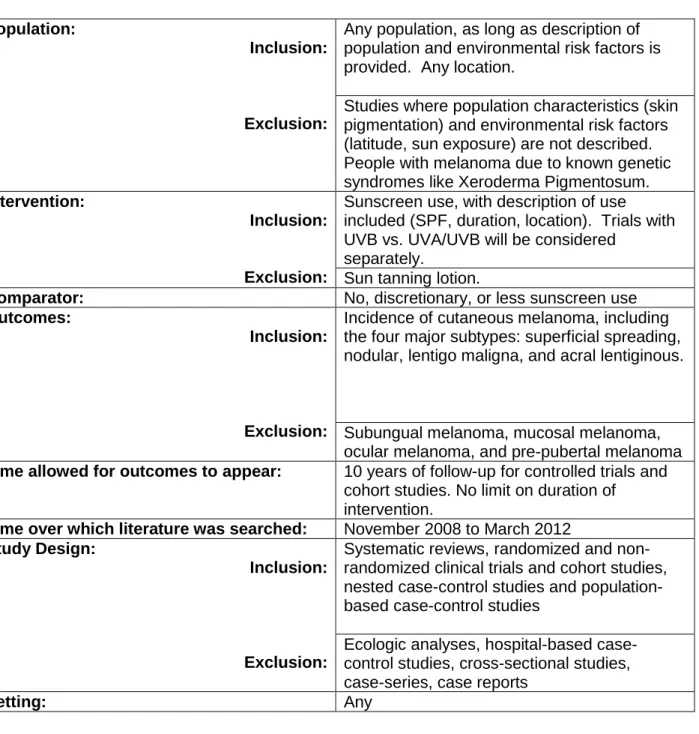
As this is an update to the USPTF review, the inclusion and exclusion criteria used for this study were the same as previously described (see Table 2). We included any population of patients or location, as long as a detailed description of environmental risk factors and
demographic information was included in the study. We excluded studies where the population and location were not described. This requirement was due to the fact that information about latitude, sun exposure, skin type, and family history are very important factors in our review to help understand the role of potential confounding. We considered trials of younger patients, age 12 - 50, separately from trials of older patients (50 and older), because the disease is likely different in these two age groups.6 We also excluded studies on patients with known genetic conditions, such as Xeroderma Pigmentosum, because the biological effect of sunscreen on the development of melanoma may be different in these patients compared to the general
UVA and UVB protection. We excluded studies that evaluated sun-tanning lotion, as these products offer very limited sun protection factor, if any.
Our comparison group was no, discretionary, or less sunscreen use. We did not limit our comparison to no sunscreen use because randomized, controlled trials cannot ethically use a placebo. Our outcome of interest was the incidence of melanoma. We also included studies evaluating morbidity and mortality due to melanoma. Ideally, we would have only included studies evaluating mortality, given this is the most clinically important outcome. However, given the natural history of melanoma, exposure often occurs years before onset of disease. We do not expect to find many studies that are long enough to evaluate mortality as an outcome. We will included the four major subtypes of cutaneous melanoma, because other types of
melanoma may have different pathogeneses and risk factors. No secondary outcomes were included, such as sunburn or nevi, as they are not clinically relevant and would require a different search strategy.
We chose a minimum of 10 years of follow-up for RCT and cohort studies. Ideally, the length of follow-up would have been longer, given the length of time from exposure to outcome in melanoma, but the current literature is not robust enough to support this limit. We did not set a limit of the duration of sunscreen use, but considered this factor when evaluating the studies.
Table 2: PICOTTSS Inclusion and Exclusion Criteria
Population:
Inclusion:
Exclusion:
Any population, as long as description of population and environmental risk factors is provided. Any location.
Studies where population characteristics (skin pigmentation) and environmental risk factors (latitude, sun exposure) are not described. People with melanoma due to known genetic syndromes like Xeroderma Pigmentosum.
Intervention:
Inclusion:
Exclusion:
Sunscreen use, with description of use included (SPF, duration, location). Trials with UVB vs. UVA/UVB will be considered
separately.
Sun tanning lotion.
Comparator: No, discretionary, or less sunscreen use
Outcomes:
Inclusion:
Exclusion:
Incidence of cutaneous melanoma, including the four major subtypes: superficial spreading, nodular, lentigo maligna, and acral lentiginous.
Subungual melanoma, mucosal melanoma, ocular melanoma, and pre-pubertal melanoma
Time allowed for outcomes to appear: 10 years of follow-up for controlled trials and cohort studies. No limit on duration of
intervention.
Time over which literature was searched: November 2008 to March 2012
Study Design:
Inclusion:
Exclusion:
Systematic reviews, randomized and non-randomized clinical trials and cohort studies, nested case-control studies and population-based case-control studies
Ecologic analyses, hospital-based case-control studies, cross-sectional studies, case-series, case reports
Setting: Any
Literature Search:
“melanoma”, “skin cancer,” and “sunscreen agents.” All of the search terms used are Medical
Subject Headings (MeSH) terms. A full explanation of the search strategy can be found in
Appendix E; these are the same search terms and databases as the 2008 USPSTF review. Articles were also obtained from the reference lists of key studies identified in the search. We consulted with a health science librarian about our search strategy and utilized her
recommendations. We did not limit the search to humans or articles published in English to capture articles recently added to MEDLINE that were not yet indexed. The last search was run on May 20, 2012 to look for articles published since the start of the review.
Article Review and Data Abstraction:
Two reviewers independently reviewed the title and abstracts identified in the search using the predetermined inclusion and exclusion criteria. The first author reviewed all of the articles; the second author reviewed only articles excluded by the first reviewer. All articles included by either reviewer were included in the full text review. Articles without an abstract were automatically included in the full text review.
One reviewer obtained copies of all included full text articles. Both reviewers
independently reviewed all of the articles included in the full text review using the predetermined inclusion and exclusion criteria. Reasons for exclusion were recorded and reported in Figure 1
and Appendix F. Disagreements between the reviewers during full text review were resolved by discussion and consensus; if a consensus could not be met, it was planned for a third reviewer to resolve the disagreement. One reviewer abstracted data into evidence tables for all studies included after full text review; a second reviewer verified the results for accuracy. A data
extraction table was developed based on the Cochrane Consumers and Communication Review Group’s data extraction template and tables used in the 2008 USPSTF review (see Appendix G
for a sample data extraction table). Information was extracted from each study for
sunscreen use), type of outcome measure (incidence of melanoma, morbidity and mortality, harms, and other outcomes measured).
Quality Assessment and Risk of Bias:
We rated the internal validity of all of the articles included in the study using the same process as the USPSTF systematic review: the USPSTF’s study-design specific quality criteria
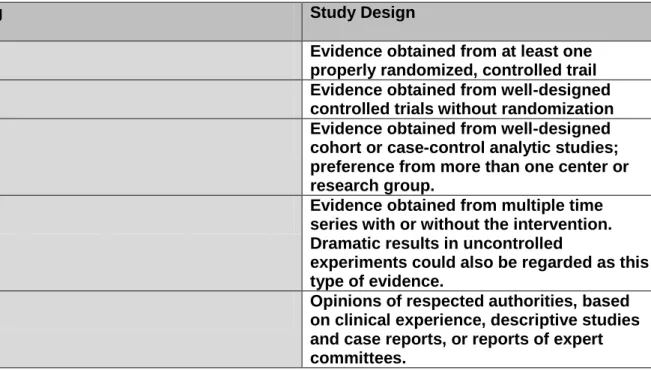
supplemented by the Newcastle-Ottawa Scale for assessing cohort and case-control studies and the National Institute for Health and Clinical Excellence (NICE) Methodology Checklists (see Table 3).24 The USPSTF study design-specific criteria were used as a guideline to rate the internal validity of 5 different study types: systematic reviews, case-control studies, randomized, controlled trials, cohort studies, and diagnostic accuracy studies.44 The overall internal validity of the study was then given a grade of good, fair, or poor (see Table 4). The USPSTF also gave the study a rating based on the study design (see Table 5).44
The Newcastle-Ottawa Scale was developed to assess the internal validity of non-randomized studies in meta-analyses. The scale evaluates case-control studies on three main areas: selection of cases and controls, comparability of cases and controls, and the
ascertainment of exposure.45 Each study is then given a star rating for each of the three categories. The content validity and inter-rater reliability of the scale was evaluated and approved by experts in the field. The criterion validity and construct validity are still being assessed.45
The NICE Methodology Checklists are used to evaluate the internal validity of studies in the development of NICE clinical guidelines.46 The checklists are study type-specific;
For this study, an overall internal validity rating was given to each individual study by combining the ratings from the three internal validity rating criteria. Studies were given an internal validity, external validity, and overall quality rating of good, fair, or poor based on the qualitative assessment (see Table 4).44 A good quality study was given a positive answer to all of the quality criteria. A fair study had one or more negative quality criteria, and a poor study had significant limitations that nullify the results. Poorly rated studies were not included in the overall strength of the evidence rating.
Table 3: Quality Rating Criteria 24
Design USPSTF Quality
Rating Criteria44
NICE Methodology Checklists46 Newcastle-Ottawa Quality Assessment Scales45 Systematic reviews and Meta-analyses
• Comprehensiveness of sources considered/search strategy used
• Standard appraisal of included studies • Validity of conclusions • Recency and relevance are especially important for systematic reviews
• Study addresses an appropriate and clearly focused question • Description of the
methodology used is included • Literature search is
sufficiently rigorous to identify all relevant studies
• Study quality is assessed and taken into account • There are enough similarities between the studies selected to make combining them reasonable
N/A
Case-control studies
• Accurate ascertainment of cases
• Nonbiased selection of cases/controls with exclusion criteria applied equally to both • Response rate is reported • Diagnostic testing
procedures applied equally to each group
• Measurement of exposure accurate and applied equally to each group
• Appropriate attention to potential confounding variables
• Study addresses an appropriate and clearly focused question • Cases and controls are taken from comparable populations
• Same exclusion criteria are used for both cases and controls
• Percentage of each group (cases and controls) that participated in the study is reported
• Comparison is made between participants and non-participants to establish similarities or differences • Cases are clearly defined and differentiated from controls
• It is clearly established that controls are non-cases • Measures have been taken to prevent knowledge of primary exposure influencing case ascertainment
• Exposure status is measured in a standard, valid, and
• Case definition is adequate • Cases are representative • Controls are from the same population as cases • If cases are first occurrence of outcome, then controls have no history of this outcome
• Cases and controls are matched, and/or confounders are adjusted for in the analysis • Same method of exposure ascertainment for cases and controls
reliable way
• Main potential confounders are identified and taken into account in the design and analysis
• Confidence intervals are provided
Randomized, controlled trials
• Initial assembly of comparable groups employs adequate randomization, including first concealment and whether potential confounders were distributed equally among groups • Maintenance of comparable groups (includes attrition, crossovers, adherence, contamination)
• Important differential loss to follow-up or overall high loss to follow-up
• Measurements are equal, reliable, and valid (includes masking of outcome assessment) • Clear definition of the interventions
• All important outcomes considered
• Study addresses an appropriate and clearly focused question • Assignment of subjects to treatment groups is randomized
• An adequate concealment method is used
• Subjects and investigators are kept blind about treatment allocation
• Treatment and control groups are similar at start of trial
• Only difference between groups is the treatment under investigation
• All relevant outcomes are measured in a standard, valid, and reliable way
• Percentage of individuals or clusters recruited into each treatment arm that dropped out before study completion is reported
• All subjects are analyzed in the groups to which they were randomly allocated (often referred to as intention-to-treat analysis)
• When the study is carried out at more than one site, results are comparable for all sites
N/A
Table 4: Definition of Quality Ratings44
Quality Rating: Definition:
Good Meets all applicable criteria. Low risk of
bias. Results are considered valid.
Fair Fails to meet one or two applicable criteria.
Some risk of bias.
Poor The study has a significant risk of bias that
Table 5: USPSTF Hierarchy of Research Design44
Rating Study Design
I Evidence obtained from at least one
properly randomized, controlled trail
II-1 Evidence obtained from well-designed
controlled trials without randomization
II-2 Evidence obtained from well-designed
cohort or case-control analytic studies; preference from more than one center or research group.
II-3 Evidence obtained from multiple time
series with or without the intervention. Dramatic results in uncontrolled
experiments could also be regarded as this type of evidence.
III Opinions of respected authorities, based
on clinical experience, descriptive studies and case reports, or reports of expert committees.
Data Synthesis:
When possible, we pooled data from randomized, controlled trials or cohort studies. We believed the ability to do a quantitative analysis was unlikely. We expected to find studies with varied study designs and populations. Meta-analyses performed in the past on this topic have had limited validity; they pooled data from several heterogeneous poor to fair quality case-control studies.47,48 When the original studies have intrinsic flaws pooling the results does not improve the quality of the evidence. Therefore, we only planned to perform a quantitative analysis if we determined there were several good quality studies of the same design, population, and sunscreen formulation.
Strength of Evidence:
Table 7 and Table 8). The magnitude of net benefit in the general population was estimated as substantial, moderate, small, or zero/negative (no benefit or harm). An outcomes table of potential benefits and harms of sunscreen use was used to help estimate the magnitude of net benefit. The ratings for certainty and magnitude of net benefit were combined to give an overall letter grade for the use of sunscreen to prevent melanoma (see Table 6).
Table 6: USPSTF Recommendation Grid49
Certainty of Net Benefit Magnitude of Net Benefit
Substantial Moderate Small Zero/Negative
High A B C D
Moderate B B C D
Low Insufficient
Table 7: Questions Considered by the USPSTF for Evaluating the Overall Certainty of the
Evidence of Net Benefit for the Preventive Service49
1. Do the studies have the appropriate research design to answer the key question(s)?
2. To what extent are the existing studies of high quality? (i.e., what is the internal validity?)
3. To what extent are the results of the studies generalizable to the general U.S. primary care population and situation? (i.e., what is the external validity?)
4. How many studies have been conducted that address the key question(s)? How large are the studies? (i.e., what is the precision of the evidence?)
5. How consistent are the results of the studies?
Table 8: USPSTF Levels of Certainty Regarding Net Benefit49
Level of Certainty Description
High The available evidence usually includes
consistent results from designed, well-conducted studies in representative primary care populations. These studies assess the effects of the preventive service on health outcomes. This conclusion is, therefore, unlikely to be strongly affected by the results of future studies.
Moderate The available evidence is sufficient to
determine the effects of the preventive service on health outcomes, but confidence in the estimate is constrained by such factors as: the number, size, or quality of individual studies, inconsistency of findings across individual studies, limited generalizability of findings to routine primary care practice, or lack of coherence in the chain of evidence. As more information becomes available, the magnitude or direction of the observed effect could change, and this change may be large enough to alter the conclusion.
Low The available evidence is insufficient to assess
effects on health outcomes. Evidence is insufficient because of: the limited number or size of studies, important flaws in study design or methods, inconsistency of findings across individual studies, gaps in the chain of
evidence, findings that are not generalizable to routine primary care practice, or a lack of information on important health outcomes. More information may allow an estimation of effects on health outcomes.
Results:
Study Selection:
in Appendix E. There were 3 disagreements between the reviewers during full text review that were decided by consensus; one of the articles was included. The other two articles were excluded; one evaluated sunscreen use in patients with a previous diagnosis of cutaneous melanoma and the other had an outcome of sunburn, not melanoma. A large majority of the articles (42 out of 71) were excluded due to the wrong study design or publication type. These included mostly news articles, opinion pieces, and non-systematic reviews. Of the other 71 excluded articles, 2 reported data in another article, 7 were not in English, 4 did not evaluate the intervention of sunscreen use, 11 had not evaluated melanoma as an outcome, and 4 evaluated the wrong population. The 2008 systematic review conducted by the USPSTF was excluded, because it is the study we are updating. Its findings are summarized in the Introduction.24 We were left with 4 studies for quantitative review: 1 randomized control trial, 1 systematic review, and 2 case-control studies. One of the case-control studies and the systematic review were judged as poor quality during the review and excluded.
Summary of Studies Excluded Due to Poor Quality Rating:
systematic review. Our quality rating details for the study using the USPSTF quality rating criteria and Nice Methodology Checklist can be found in Tables 9 and 12, respectively.
The case-control study was conducted in Prague, Czech Republic by J Varnova, M. Arenbergerova, P Arenberger, et al. The aim of the study was to determine risk factors associated with cutaneous melanoma and determine if behaviors associated with melanoma risk increased in young people versus older people, which could account for the increasing incidence of melanoma.51 The study used a one-time self-administered survey to collect sun exposure and sun protection information on cases, old controls, and young controls.
There were significant differences between the ages of each group, with cases averaging 53.6 years, old controls averaging 51.1 years, and young controls averaging 19.9 years. The goal of this study was to compare melanoma risk factors in different age groups, but age is a known risk factor for melanoma; therefore, it is an uncontrolled confounder in the relationship between sunscreen use and melanoma. They did not report information about those eligible to participate versus those that did participate in the survey. The two control groups were selected from different populations and the older control group was self-selected by they responding to a posted flyer. Additionally, the measure of exposure (sunscreen use) was obtained from an unvalidated self-survey. Participants were asked about sunscreen use at only two time points: childhood and adulthood. They were placed into 3 poorly defined groups: “never users, “occasional users,” and “regular users” (more than 5 times per sun tanning). They
Study Characteristics of Studies Included in the Final Review:
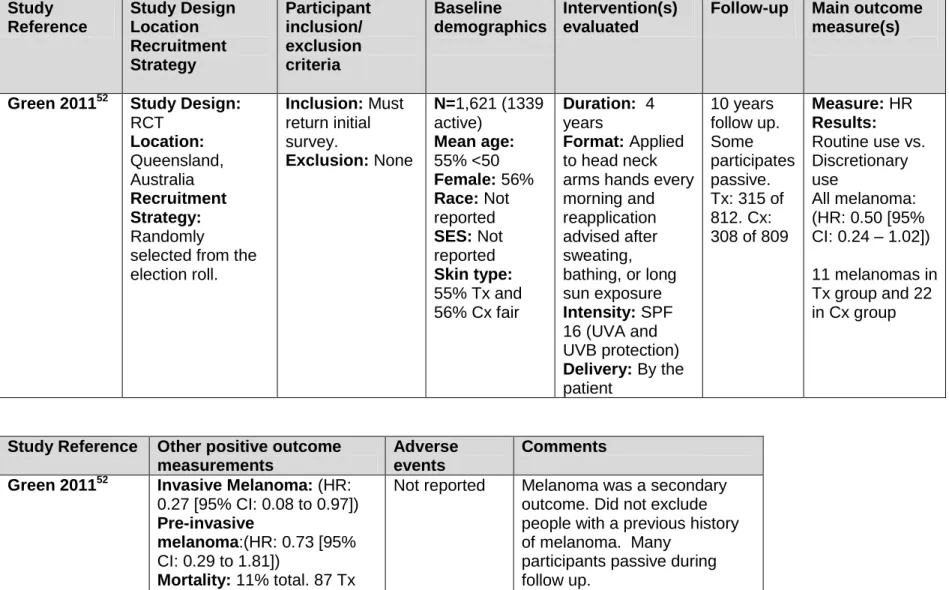
The two studies included in the final review and evidence synthesis were a RCT and a case-control study published in English. The randomized, controlled trial by Adele Green, Gail M. Williams, Valerie Logan, and Geoffrey M. Strutton was conducted in Queensland, Australia; the trial lasted 4 years, with 11 years of follow-up.52 The case-control study by DeAnn Lazovich, Rachel Isaksson Vogel, Marianne Berwick, et al. was a one-time telephone survey conducted in Minnesota that evaluated sun exposure and sunscreen use over each decade of life.53
The studies evaluated a total of 3889 participants: 1621 in the RCT and 2268 in the case-control study. The Green RCT participants were randomly selected 25 to 75 year olds, with no other specified inclusion or exclusion criteria. Participants with previous melanoma were not excluded from the study. The Lazovich participants were age 25 to 59, living in Minnesota, with no prior diagnosis of melanoma and no language barrier.
The intervention in the Green trial was daily use of SPF 16 sunscreen applied to the hands, neck, and arms every morning, with reapplication after sweating, water exposure, or long sun exposure for 4 years. Participants were given a free, unlimited supply of sunscreen.
Compliance was measured with sunscreen bottle weights and questionnaires asking about average frequency of use in a normal week. Controls were allowed discretionary sunscreen use, as the use of a placebo was deemed unethical. In the Lazovich study cases and controls were asked about sunscreen use of SPF 15 or greater in each decade of life during different outdoor actives and when not specifically doing an outdoor activity. Participants were asked about frequency, thickness, location, and reapplication after more than 2 hours of sun exposure. Lifetime sunscreen use was obtained by averaging a participant’s use within each decade and across all decade years. Users were also classified as “non-,” “inconsistent,” and “optimal users” based on the last two decades.
outcome. The study did report overall mortality or melanoma thickness. The Lazovich case-control study reported an odds ratio (OR) for different types of sunscreen use and melanoma risk. Due to inherent limits of the design, a case-control study cannot evaluate incidence. Neither study addressed harms or quality of life associated with sunscreen use. See Table 14
for study characteristics for the Green RCT and Table 13 for characteristics of the Lazovich case-control study.
Risk of Bias within Studies:
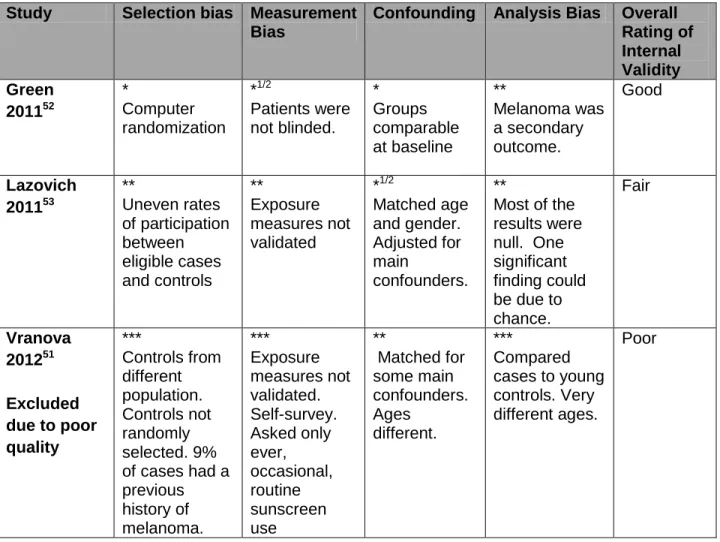
The potential for selection bias, measurement bias, confounding, and analysis bias was estimated for each study and can be found in Table 10. The Green RCT used adequate randomization and concealment allocation, through simple computer randomization, leaving minimal risk for selection bias. The groups were very similar at baseline in all measured
characteristics, including sex, age, skin phenotype, sun exposure, sunburns, nevi, and previous history of skin cancer. The dermatologist and dermatopathologists were masked, but the participants were not. Masking the participant in this type of trial is not an option, because the use of a placebo was deemed unethical. The nonmasking of participants introduced a risk for measurement bias if patients misreported sunscreen use based on knowledge of treatment allocation. To help control for this possibility, investigators conducted sunscreen bottle weights to improve measurement of compliance in the treatment group. Knowledge of treatment group could affect the measurement of exposure (sunscreen use), but should not have an effect on the measure of the outcome (melanoma). This is likely to bias the results towards the null, as participants in the control group might underreport sunscreen use if they know they are in the non-treatment group and participants might over-report use if they know they are in the treatment group.
passive participants during the follow-up period, introducing a risk for measurement bias of the exposure during follow-up. We are not given information on potential differences between active and passive participants. Melanoma outcome data was collected for all active and passive participants and cross checked with the national cancer registry, limiting the risk of measurement bias of the outcome. There is significant discrepancy in the diagnoses of melanoma among pathologists.32 This was addressed by having two expert
dermatopathologists, masked to sunscreen group allocation, review all melanoma diagnoses. There is minimal risk of confounding, as groups were similar at baseline due to
randomization. Melanoma was a secondary outcome for this trial, originally designed to assess squamous cell carcinoma and basal cell carcinoma. Overall, the main risk of bias comes from unmasked participants and melanoma being a secondary outcome. The study was given an internal validity quality rating of good; the results can be found in Tables 10 and 12.
In the case-control study by Lazovich, a higher number of cases than controls
participated in the survey and interview (84% of cases and 69% of controls). There may be a difference between those who chose to participate and those who did not, but we are not given any information on eligible participants that chose not to participate, introducing a risk of selection bias.
This study collected detailed information on sunscreen use and sun exposure in each decade of life. This is superior to many case-control studies on this topic, which only use one question about sunscreen use to categorize participants. However, the survey used in the study is not validated and there is risk of recall bias with self-reported sunscreen use. The study also did not prevent knowledge of primary exposure influencing case ascertainment. The controls were randomly selected from the state drivers license registry, which is not representative of the source population for the cases who were obtained from the state cancer registry. There is also a risk of bias in the measurement of the outcome, as melanoma was diagnosed by many
The cases and controls were matched based on age and gender. Income, education, skin phenotype, nevi number, family history, sunburns, indoor tanning, and sun exposure were controlled for during analysis. There is a risk for analysis bias in this study, as they evaluated a large number of outcomes and had only one significant finding. This could be due to chance, given the large number of analyses conducted. This study was given an internal validity quality rating of fair; see Tables 10, 11, and 12 for details. A summary of the quality rating for each study using the 3 quality rating scales and an overall quality rating can be found in Table 15. Results of Individual Studies:
The RCT by Green found a borderline significant HR of 0.50 (95% CI: 0.24 -1.02) for all melanoma and sunscreen use.52 When considering only invasive melanoma, the hazard ratio decreased to 0.27 (95% CI: 0.08 - 0.97). Thirty-six total primary melanomas occurred during the study: 11 participants in the sunscreen group and 22 participants in the control group. The average thickness of melanoma was 0.53 mm in the sunscreen group, versus 1.2 mm in the control group (p = 0.08). Eleven percent of the participants died during the study: 87 in the sunscreen group and 86 in the control group. There was only one death due to melanoma that was diagnosed in 1978. A summary of the main results can be found in Table 13.
The Lazovich case-control study also found a decreased risk of melanoma with regular sunscreen use, defined as sunscreen use when not specifically engaging in an outdoor activity. The adjusted OR for regular use versus never use was 0.44 (95% CI: 0.23 - 0.86).53 The study also found a significant adjusted OR for optimal use of other sun protection methods (wearing a hat, long-sleeved shirt, or staying in the shade) versus never or rare use (OR: 0.59 [95% CI: 0.44 -0.78]). There was a possible trend of decreased melanoma risk with increasing use of SPF 15 or higher (OR: 0.83 [95% CI 0.62-1.12], p = 0.03). All other variations of sunscreen use were not associated with melanoma risk, including use during outdoor actives (p = 0.59),
Synthesis of Results:
We were not able to perform a quantitative review given the different study designs and populations of the included studies. Both included studies found a decreased risk of melanoma with regular sunscreen use in adults. A summary of the main results can be found in Table 16. The Lazovich studies found no effect of other types of sunscreen use and the Green RCT trial was only designed to evaluate regular sunscreen use. Neither study evaluated the use of sunscreen to prevent morbidity and mortality from melanoma.
Neither study evaluated harms associated with sunscreen use, a significant limitation to fully quantifying the net benefit of sunscreen use. Potential harms associated with sunscreen use include allergic reactions, skin irritation, decreased vitamin D synthesis, and psychological harm.
Strength of Evidence:
We rated the overall strength of the evidence using the methods of the USPSTF.49 First we estimated the certainty of the evidence to be low based on the six key questions developed by the USPSTF. A prospective cohort study or a RCT with longer follow up would be ideal for evaluating the effect of sunscreen use on melanoma, given the long duration from exposure to development of disease, low incidence of melanoma, and difficulty of exposure measurement in retrospective studies. Case-control studies often over-estimate the effect of an intervention.
The Green RCT was only designed to evaluate daily sunscreen use and does not evaluate long-term use or use to prevent intermittent sun exposure. The Green RCT was given a good internal validity rating and the case-control study received a fair quality rating. The Green study had poor precision due to the wide confidence intervals and small numbers with only 36 diagnosed melanomas. Even so, the Green RCT received a higher quality rating than any study published on this topic in the past.
are only generalizable to adult populations. The studies did not limit participants based on skin phenotype, but a limited number of participants had an olive/brown skin type (only 6 - 7% in the Green RCT).52 Australia has a much higher incidence of melanoma than the U.S., which limits its generalizability to U.S. populations. Minnesota also has a higher incidence of melanoma than other parts of the U.S.54 Both studies only evaluated sunscreen with an SPF of 15 or greater. Therefore, we conclude that these studies are only generalizable to the U.S. Caucasian screening population age 25 to 60, who use sunscreen with and SPF 15 or higher and UVA/UVB protection.
The evidence is based on only two studies of 3889 participants. Given the low incidence of melanoma, this is not a very large sample size. There have been many studies published previously on this topic, but these studies were limited by uncontrolled confounding and conflicting results. Both included studies found a reduced risk of melanoma associated with daily sunscreen use. The HR was only significant in the Green RCT when considering invasive melanoma, but melanoma was a secondary outcome. The Green RCT also had wide
confidence intervals leading to low precision. The case-control study found evidence of a possible trend of decreased melanoma risk with increasing use of SPF 15 or higher. The case-control study found no effect of other types of sunscreen use and the RCT was not designed to evaluate other types of sunscreen use. Overall, we judged the certainty of the evidence as low for regular sunscreen use and other types of sunscreen use. The studies found consistent results for daily sunscreen use and were of good to fair quality, but the evidence was limited by the precision, number, and size of included studies and fair generalizability.
considered estimating a change in mortality from the incidence data using the percentage of patients with melanoma that die in the U.S. This estimation would be completely hypothetical and not based on study data, which limits its utility. The table does show a small reduction in melanoma incidence with daily sunscreen use. Logically, a decrease in melanoma incidence should lead to a decrease in mortality, but this is not proven. Possible but poorly studied harms include skin irritation, allergic reactions, low vitamin D, and psychological harm. Therefore, we gave daily sunscreen use a magnitude rating of insufficient. Overall, daily sunscreen use was given a grade of insufficient, and other types of sunscreen use were also given a grade of insufficient.
Table 9: Internal Validity of Systematic Reviews USPSTF criteria: (* to *** good to poor)
Table 10: Internal Validity of Included Studies using USPSTF Criteria (* to *** low risk of bias to high risk of bias)
Study Selection bias Measurement
Bias
Confounding Analysis Bias Overall Rating of Internal Validity Green 201152 * Computer randomization *1/2 Patients were not blinded. * Groups comparable at baseline ** Melanoma was a secondary outcome. Good Lazovich 201153 ** Uneven rates of participation between eligible cases and controls ** Exposure measures not validated *1/2 Matched age and gender. Adjusted for main confounders. **
Most of the results were null. One significant finding could be due to chance.
Fair
Vranova 201251
Excluded due to poor quality *** Controls from different population. Controls not randomly selected. 9% of cases had a previous history of melanoma. *** Exposure measures not validated. Self-survey. Asked only ever, occasional, routine sunscreen use ** Matched for some main confounders. Ages different. *** Compared cases to young controls. Very different ages.
Poor
Table 11: Newcastle-Ottawa Quality Assessment Scale Case Control Studies
Study Selection (****) Comparability (**) Exposure (***) Overall (9)
Lazovich 201153 ***
Not all eligible cases
participated. (only 84%)
**
Controlled for sun exposure and skin phenotype * Interview not blinded to case/control status. Response rate different in cases and controls. 6/9
Vranova 201251 *
No independent validation of
*
Controlled for sun exposure. Ages
*
Interview not blinded to
cases. Not all eligible cases participated. Did not exclude prior h/o melanoma.
very different. case/control status.
Response rate different in cases and controls.
Table 12: NICE Methodology Checklist
Case-Control Studies
Selection of Participants
Assessment Confounding
Factors
Statistical Analysis (have CI been
provided) Lazovich 201153 Adequately
addressed to well covered Poorly Addressed Adequately covered
Yes (only one significant result of many
analyzed)
Vranova 201251 Poorly Addressed Poorly Addressed Poorly Addressed (age) Yes Randomized, Controlled Trials
Selection Bias Performance Bias
Attrition Bias Detection Bias
Green 201152 Low risk of bias (positive answer to all criteria)
Low to medium risk of bias (1 negative answer)
Low to medium risk of bias (1 unclear answer)
Unclear/unknown risk of bias (2 unclear answers)
Systematic review and Meta-analysis
Internal Validity Overall Assessment
(++,+,-) how well was the study done to minimize bias?
Included Study types
How does this review help to answer your key question?
Kutting 201150 Poorly Addressed
__ Case-control and cohort studies
Table 13: Evidence Table Randomized, Controlled Trials24 Study Reference Study Design Location Recruitment Strategy Participant inclusion/ exclusion criteria Baseline demographics Intervention(s) evaluated
Follow-up Main outcome measure(s)
Green 201152 Study Design:
RCT Location: Queensland, Australia Recruitment Strategy: Randomly
selected from the election roll.
Inclusion: Must return initial survey.
Exclusion: None
N=1,621(1339 active)
Mean age:
55% <50
Female: 56%
Race: Not reported
SES: Not reported
Skin type:
55% Tx and 56% Cx fair
Duration: 4 years
Format: Applied to head neck arms hands every morning and reapplication advised after sweating, bathing, or long sun exposure
Intensity: SPF 16 (UVA and UVB protection)
Delivery: By the patient 10 years follow up. Some participates passive. Tx: 315 of 812. Cx: 308 of 809
Measure: HR
Results:
Routine use vs. Discretionary use
All melanoma: (HR: 0.50 [95% CI: 0.24 – 1.02])
11 melanomas in Tx group and 22 in Cx group
Study Reference Other positive outcome measurements
Adverse events
Comments
Green 201152 Invasive Melanoma: (HR:
0.27 [95% CI: 0.08 to 0.97])
Pre-invasive
melanoma:(HR: 0.73 [95% CI: 0.29 to 1.81])
Mortality: 11% total. 87 Tx and 86 Cx.1 from melanoma.
Not reported Melanoma was a secondary outcome. Did not exclude people with a previous history of melanoma. Many
Table 14: Evidence Table Case Control Studies24 Study Reference Study Design Location Population
Participant Inclusion/ Exclusion Baseline Demographics Measurement of
exposure (sunscreen use) Lazovich 201153 Study Design: Case-Control Location: Minnesota, U.S. Cases:
Selection: State Cancer Registry
Eligibility Criteria: Diagnosed between 2004 and 2007 with invasive cutaneous melanoma. Age 25-59.
Controls:
Selection: Randomly selected from state driver license list
Eligibility Criteria: Matched by age and gender. Live in MN, never diagnosed with melanoma
Cases:
n= 1167
Controls: n=1101
Age: Cx n= 447 age 50-59
Sex: Not reported
Skin type: Phenotypic risk index. Cases 53% high. Controls: 62% high.
Asked about sunscreen use and sun exposure in each decade of life by telephone interview.
(obtained information on 97% of cases and controls)
Vranova 201251
Excluded due to poor quality Study Design: Case-Control Location: Praque, Czech Republic. Cases:
Selection: Diagnosed with cutaneous melanoma at Kraloveske Vinohrady University
Eligibility Criteria: Not reported.
Controls: Young:
Selection: Randomly selected 1st year students at Charles University and faculty from Czech Technical University.
Eligibility Criteria: Excluded if they had active melanoma or were non-Caucasian.
Old:
Selection: Responded to notice at Charles Hospital in Prague.
Eligibility Criteria: Excluded if they had active melanoma or were non-Caucasian.
Cases: n= 216
Controls: n= 762 (460 young and 302 old)
Age:
Cases: 53.6 Young Cx: 19.9 Old Cx: 51.1 % Female: Cases: 43% Young Cx: 65% Old: 62%
Skin type:
Skin classified at always turns red, sometimes turns brown.
Cases: 62% Young Cx: 23% Old Cx: 32%
Study Reference
Confounders Considered
Measurement of Sun Exposure Measurement of Sunscreen use Measurement
of Sunburn Comments Lazovich 201153 Gender, age, income, education, skin phenotype, number of nevi, family history, sunburns, indoor tanning, sun exposure
Total sun exposure: High sun exposure Cases 41%, Controls 41%
Total recreational sun exposure: High outdoor activity Cases: 44% Controls: 44%
Total years in outdoor jobs: Not reported
Number of vacations: Not reported
Protective Clothing: Cases: Rarely/never 26% Frequent 19% Controls: Rarely/never 21% Frequent: 25%
Asked about sunscreen use during different outdoor activities (time spent at the beach or pool,
sunbathing, boating or waterskiing, fishing, playing or coaching outdoor team sports, walking, hiking or jogging, biking, roller skating or rollerblading, golfing, playing tennis, playing outside, gardening or performing outdoor chores, and winter sports.) Including frequency of use of SPF >15, thickness, amount of exposed skin covered, reapplication after > 2hrs, and frequency of sunscreen use when not specifically doing a sun related activity. Averaged use within each decade and across all decades.
Reported they collected this information but it is not
reported.
Only included sunscreen SPF >15. Type of UV protection unknown. Vranova 201251 Excluded due to poor quality Skin phenotype, history of skin cancer, number of nevi,
immunosuppressi on, sunburns, sun exposure
Total sun exposure: Reported all day sun exposure
Cases: 67%
Young Cx: 70% Old Cx: 32%
Total recreational sun exposure: Active Sunbathing or sports Cases: 69% Young Cx: 93% Old Cx: 84%
Total years in outdoor jobs: Not reported
Number of vacations: Seaside Vacations never: Cases: 5.6% Young Cx 5.2 Old Cx: 8.0%. Mountains Vacations Never: Cases: 10.2% Young Cx: 4.8% Old Cx: 17.2%
Asked about sunscreen use in childhood and adulthood. Never, occasionally, or regularly.
(Regularly defined as more than 5 times per sun tanning). SPF, thickness, and location applied not specified.
Reported No sunburns in childhood: Cases 8.3% Young Cx: 63% Old Cx: 33%
Table 15 Overall Internal Validity of Included Studies
Study USPSTF NICE
Newcastle-Ottawa
Overall Internal Validity
External Validity
Green 201152 Good (I) Low/medium
risk of bias
NA Good Fair
Kutting 201050
Poor (III) __ NA Poor NA
Lazovich 201153
Fair (II-2) Adequate 6/9 Fair Fair
Vranova 201251
Poor (II-2) Poor 3/9 Poor NA
Table 16: Summary Characteristics of Included Studies
Study Design Population Routine use
(HR or OR[95%CI])
Adjustments reported
Green 201152
Randomized control trial
Queensland, Australia. Tx: 812, Cx: 809 56% female, 55% <50
vs. Discretionary use
(HR: 0.50 [95% CI: 0.24 – 1.02])
None. Groups comparable at baseline
Kutting 201050 Excluded due to poor quality
Systematic review
Outdoor workers NA NA
Lazovich 201153
Case-control Minnesota, US Case: 1167 Cx: 1101.
Vs. Never use (OR: 0.44 [95% CI: 0.23- 0.86])
Gender, age, income, education, skin phenotype, number of nevi, family history, sunburns, indoor tanning, sun exposure
Vranova 201251 Excluded due to poor quality
Case-control Praque, Czech Republic. Case: 216 Control: 762
Vs.
Occasionally use (OR: 0.21 [95% CI: 0.058-0.74])
Table 17: Outcomes Table for Daily Sunscreen Use Over 15 years in the general U.S.
Caucasian population age 25 to 60
Daily Sunscreen Use (SPF 15 or higher)
Discretionary Sunscreen Use
Incidence of Melanoma 158/100,000 315/100,000
Mortality from Melanoma ?? ??
Harms ??
Not assessed
??
Error! Reference source not found.
Discussion
Summary of the Evidence
The USPSTF review conducted in 2008 found insufficient evidence to recommend for or against the use of sunscreen to prevent melanoma. This recommendation was based on 5 fair quality observational studies with significant uncontrolled confounding.24 The results of this review found insufficient evidence on the effect of daily sunscreen use on risk of melanoma, resulting in a I recommendation. The review also found insufficient evidence to recommend for or against other types of sunscreen use. A summary of the findings are available in Table 18.
We found one fair quality case-control study and one good quality RCT evaluating the relationship between sunscreen use and melanoma. The Green RCT is a landmark study, the first RCT published on this topic, which found decreased melanoma risk with daily sunscreen use. It is the first study published on this topic with adequate design to control for important confounders like sun exposure and skin phenotype. The Green RCT was designed to evaluate the ability of sunscreen to prevent chronic sun exposure, as participants applied sunscreen daily. This finding is surprising as chronic sun exposure is not associated with melanoma risk in
observational studies.23 The study does not address the ability of sunscreen to prevent intermittent, severe sun exposure, which is more highly associated with melanoma risk.23 The study did not have long enough follow-up to evaluate the effect of sunscreen use on morbidity and mortality from melanoma. The case-control study evaluated several different types of sunscreen use, including sunscreen use when not engaging in a sun related activity (regular use), use during outdoor activities, thickness of application, location of skin covered,
possible trend of decreased melanoma risk with increasing use of SPF 15 or higher. All other types of sunscreen use were not associated with melanoma risk.
Therefore, we concluded there is moderate evidence for a small effect of daily sunscreen use on melanoma risk, based on one good quality RCT and one fair quality case-control study. There is insufficient evidence for other types of sunscreen use, based on one fair quality case-control study.
Table 18: Summary of the Evidence
# of Studies
Design Limitations Consistency Applicability Overall
Grade
Summary of the Findings
2 1 RCT
1 Case- control
No
assessment of harms. Did not assess morbidity, mortality, or quality of life. Melanoma was a secondary outcome in RCT. Crude measure of sun exposure. Case-control studies subject to recall bias. High. Both found decreased melanoma risk with regular sunscreen use. No effect of other types of sunscreen use. Caucasian populations. Age 25 to 60 only. Proper daily
sunscreen use is time consuming and expensive. Routine sunscreen use: I Other types of sunscreen use: I Routine sunscreen use may protect against the development of melanoma in Caucasians age 25 to 60.
Limitations:
decision making on our part about how to combine the 3 rating systems to determine a final quality grade for each study. There is also a risk for publication bias. We searched the U.S. government clinical trials website to limit this bias, given the recency of our search timeline, but there is still significant risk for publication bias.
The literature on this topic has many significant limitations. No studies on this topic have evaluated the direct effect of sunscreen use on morbidity and mortality, the most clinically important outcome. The studies in this review did not assess harms associated with sunscreen use. We only found two studies of high enough quality to be included, limiting our sample size. Observational studies on this topic are limited by difficult to control confounding, as the main determinates of sunscreen use are also risk factors for melanoma. Sun exposure and sunscreen use are also very difficult exposures to measure; the included case-control study tried to improve this measure by determining sun exposure and sunscreen habits in each decade of life. Recall bias is also a significant problem in retrospective, observational studies. Melanoma was a secondary outcome in the RCT, and participants were not blinded to treatment group allocation, leaving a risk for measurement bias. The studies also considered all types of melanoma
together, even though there is emerging evidence that risk factors for melanoma are different based on subtype and anatomic location.55 The studies included in this review also had limited external validity, as they were single state studies, conducted in areas with a higher incidence of melanoma than the general U.S. population.
Future Research:
There are many potential avenues for future research on the relationship between sunscreen use and melanoma. The results of this review suggest an association between daily sunscreen use and melanoma, but there are significant gaps in our knowledge about other types of sunscreen use. A well-deigned RCT or prospective, cohort study is needed to understand the relationship between sunscreen use in childhood and adolescence and melanoma risk, as
chronic sun exposure.23 Ideally, an RCT of sunscreen use during childhood and adolescence with long term follow-up could help us to understand the relationship between sunscreen use and melanoma morbidity and mortality. For observational studies on this topic to be useful, we need improved, valid, reliable, and consistent measures of sunscreen use and sun exposure. Future research also needs to differentiate melanoma by subtype and anatomic location to fully
understand the complex relationship between sun exposure and melanoma.
There is also a large gap in the research on the harms associated with sunscreen use. More research is needed to determine if sunscreen use affects vitamin D levels and if the time and cost associated with daily sunscreen use is worthwhile. If it is determined with increased certainty that daily sunscreen use is beneficial, we must learn the best way to educate and motive people to apply sunscreen correctly. Uncertainties also exist in other areas of the
relationship between sun exposure prevention and melanoma, including protective gear to avoid sun exposure and indoor tanning beds.
Conclusions:
The results of this systematic review suggest that regular sunscreen use can decrease the risk of melanoma in adult Caucasians. There is only one good quality RCT and one fair quality case-control study to support this relationship, which was given a recommendation grade of I. This review also found insufficient evidence to recommend for or against other types of sunscreen use. Given the grade I recommendation, we do not believe the evidence is certain or substantial enough to recommend daily sunscreen use for all U.S. adult Caucasians. Patients at high risk of melanoma should be presented the evidence on sunscreen use and other preventive
Appendix A: Definitions of Key terms revised from the USPSTF 2008 review24
Melanoma: Cutaneous melanoma includes four major subtypes: superficial spreading, nodular, lentigo maligna, and acral lentiginous. For the purposes of this review, acral melanoma, as well as mucosal melanoma, ocular melanoma, and pre-pubertal melanoma (“childhood melanoma”), are excluded.
Nevi: Benign pigmented spot on the skin, such as a mole, that is a cluster of melanocytes and supportive tissue. In contrast, dysplastic nevi, or atypical moles, are melanocytic lesions that can be precursors to melanoma. Dysplastic nevi are distinguished by histology; however, they may also have certain clinical characteristics (e.g., increased diameter, lack of pigment uniformity).
Skin phenotype: Skin, hair, and eye color and skin type (i.e., ability to tan or burn that is genetically determined). A common measure of skin type is the Fitzpatrick Skin Type Scale.
Sun exposure: Intermittent, chronic, or total exposure to ultraviolet light. Intermittent patterns of exposure are most often related to recreational activities, versus chronic or continuous patterns of exposure, which are related to occupational exposure. For the purposes of this review, studies that included only crude measures of sun exposure (e.g., place of residence or type of
occupation) were excluded.
Sunburn: Inflammation of the skin in response to ultraviolet light, manifested by painful erythema with or without blistering.
Sunscreen or sunblock: Lotion with sun protection factor (SPF) 15 or higher that is used to protect against ultraviolet light, both UVA and UVB. Protection against UVA was added in 1989. SPF was introduced in 1978 and is reported when available. For the purposes of this review, sun tan lotions or oils were excluded.
Appendix B: Abbreviations used in the review RCT: Randomized Controlled Trial
HR: Hazard Ratio
RR: Relative Risk
OR: Odds Ratio
CI: Confidence interval
UVR: Ultra-Violet Radiation
NICE: National Institute for Health and Clinical Excellence
Appendix C: Fitzpatrick Skin Type21
Fitzpatrick Skin Type: Skin Color Reaction to sun exposure at
the beginning of the summer
Type I Extremely fair skin Always burns, never tans
Type II Fair Skin Always burns, sometimes
tans.
Type III Medium Skin Sometimes burns, always
tans.
Type IV Olive Skin Rarely burns, always tans.
Type V Moderately pigmented brown
skin
Never burns, always tans
Type VI Markedly pigmented black
skin