YUNARMIYA: A NEW WAVE OF RUSSIAN NATIONALISM
Faith C. Goldsmith
A thesis submitted to the faculty at the University of North Carolina at Chapel Hill in partial fulfillment of the requirements for the degree of Master of Arts in the Curriculum in Global
Studies (Russian, East European, and Eurasian Studies) in the College of Arts & Sciences.
Chapel Hill 2020
iii ABSTRACT
Faith C. Goldsmith: Yunarmiya: A New Wave of Russian Nationalism (Under the direction of Graeme Robertson)
iv
TABLE OF CONTENTS
LIST OF FIGURES……….………vi
INTRODUCTION: YUNARMIYA WHO?………1
CHAPTER 1: HISTORICAL BACKGROUND………...12
The Historical Role of Youth……….12
Previous Pro-Government Youth Movements………...18
CHAPTER 2: THEORETICAL DISCUSSIONS OF PROPAGANDA………...22
Understanding Yunarmiya’s Rhetoric and Imagery as Propaganda………...22
A Semiotic Understanding of Meaning………..25
The Role of Rhetorical Arguments……….28
How These Approaches can be Applied to Yunarmiya………..34
CHAPTER 3: YUNARMIYA’S BACKGROUND AND WEBSITE DOCUMENTS………….37
Website Documents: Yunarmiya’s Purposes and Desired Image………..41
v
CHAPTER 4: YUNARMIYA’S SOCIAL MEDIA PRESENCE………..54
Military Training………56
Media Training………...59
Memorials, Veterans, and Military Culture………63
Response to Current Events………70
CONCLUSION: IMPLICATIONS AND FURTHER STUDY……….76
vi
LIST OF FIGURES
Figure 1: Cover image for the Ministry of Defense's page on Yunarmiya………40
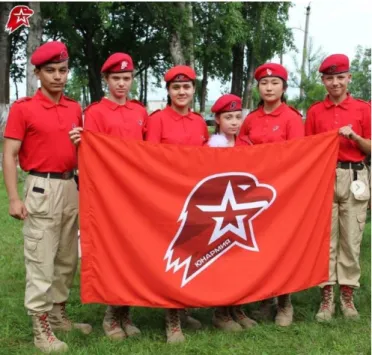
Figure 2: Yunarmiya's logo………55
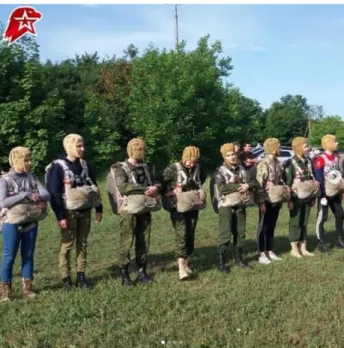
Figure 3: Cadets lined up for parachute training………...57
Figure 4: Yunarmiya cadets in Ingushetia……….65
Figure 5: Cadet with one of the "soldier's pouches"……….….68
Figure 6: Cadets compete in the Miss Yunarmiya pageant………...71
1
INTRODUCTION: YUNARMIYA WHO?
Involvement of young people in political groups has been popular in Russian society since the Soviet period and was reignited after Vladimir Putin was elected president in 2000. Since then, such organizations have taken shape depending on the government’s current social and political needs, but share a set of core principles and an allegiance either to the Russian president or government more broadly. These movements are often assembled to face threats to Moscow and there have been roughly four waves marketing themselves to different social groups of youth since Putin’s first term. While earlier groups such as Moving Together (Идущие
Вместе)and Nashi (Наши/Ours) focused on the ability to rally young people as counter protestors to a possible Color Revolution (such as happened in Ukraine and other surrounding nations), artistic groups have also stepped forth to popularize events such as the annexation of Crimea in 2014. Cresting the most recent wave is the militant “patriotic” youth group Yunarmiya (Юнармия or the Young Army Cadets National Movement), which was founded in 2015 and promotes values associated with military service and the continuation of traditions honoring Russians who served in past conflicts.1
2
Yunarmiya draws its roots from a turbulent period for Russians. In 2014, the involvement of Russian forces in covert operations in eastern Ukraine led to the Russian annexation of the Crimean Peninsula and a civil war in the Donbass region.2 Therefore, the Russian government managed to place itself in a much different position within the international community than it had previously occupied. Although Russian forces had conduced pre-Crimean military
interventions, the annexation attracted criticism and a harsh response from the United States and Europe. Sanctions negatively impacted the Russian economy and affected the well-being of many average Russians, but provided Moscow with the opportunity to capitalize on its situation.3
The Russian government could blame the West for undermining Russian success and attempt to turn its people against cooperation with foreign nations. “Traditional” Russian patriotism could be reconstructed and national identity could become more intertwined with the government. The aim of this study is to understand how Yunarmiya promotes values that assist the Russian government through its presence online and through social media accounts.
With the rising popularity and accessibility of social media among young people, and the complex effects its presence has on mass organization, the manner in which politically active groups reach their audience and produce a desired image within online communities has fundamentally changed. In decades prior, membership in political youth groups in the Soviet Union was widely encouraged as a method of making connections for future employment and social standing. Now, decades after the collapse of the Soviet Union, membership in groups supporting the government is usually voluntary. Therefore, it is imperative to effectively market
2“The Ukrainian Crisis Timeline.” Center for Strategic and International Studies. http://ukraine.csis.org/.
3
to young people and present pro-government (or pro-Putin) values in an attractive way.
Yunarmiya currently boasts 700,000 members across the Russian Federation, and although these numbers are difficult to verify, recruitment is a major concern.4In order to communicate with younger generations that have become accustomed to online platforms, government-sponsored groups must compete for attention against all other organizations in formats which encourage quick scrolling and skimming.
Because this is a study of online material, Yunarmiya’s true demographic breakdown and daily activities are difficult to determine. Images the group presents on its website and social media accounts depict both girls and boys taking part in a variety of activities. Although Yunarmiya claims to recruit children aged eight to eighteen, some look even younger.5 Social media posts discussed in later chapters mention programs and activities taking place in regions on the edges of the Russian Federation, and although it claims to have offices in eighty-five regions around the country (and provides contact information for each), there is not information on the number of members for which each office is responsible.6 Evidence has become available to suggest that the children of military officers are obligated to join, and backlash against
Yunarmiya’s presence in schools reveals that the group has made inroads in educational institutions, but many more questions about the group’s structure and members remain unanswered.7 Because of these demographic difficulties, the main focus of this study will be
4Юнармия. Last modified 2020. https://yunarmy.ru/.
5"О Движении «Юнармия»." Юнармия. Last modified 2020. https://yunarmy.ru/headquarters/about/. 6"Региональные штабы." Юнармия. Last modified 2020. https://yunarmy.ru/headquarters/branches/. 7Thomas Nilsen. "Children of officers are ‘forced’ to join Youth Army, says leaked document." The Barents Observer. Last modified February 25, 2019. https://thebarentsobserver.com/en/security/2019/02/children-officers-are-forced-join-youtharmy-says-leaked-document.
4
evaluating the image Yunarmiya wishes to convey about itself to young people and their parents on the internet.
Keeping this information in mind, the main questions I will address in this study are: How is the Russian youth group Yunarmiya promoting militaristic and nationalistic values through its website and social media presence? How does this group construct a specific version of Russian patriotism and how does it intend to persuade its audience that this understanding is the right one? What are the current and future implications of this group for youth in Russia?
Answers to these questions will provide a glimpse into the government’s needs from its youngest generations. An inclination toward government service stemming from direct
participation in the group’s activities, or observation of peers, can leave a lasting impression on children and teens. Stress on military training implies a need for more recruits and begs inquiry about the motivation for such a need. This may be an attempt to address the growing problem of compulsory military service in Russia. Putin has been discussing the possibility of abolishing such service and professionalizing the Russian military since 2001, but this plan has never come to fruition.8 It could also be interpreted as a strategy to continue riding the surge of the Russian government’s popularity with its citizens after the annexation of Crimea or a continuation of resistance to growing Western influence in the Russian periphery.
In order to analyze Yunarmiya’s method of communication, this study will approach the group as a creator of propaganda. While propaganda is perhaps an infamous term, its use here is not meant to alarm, but instead to facilitate understanding. According to a compilation of studies in online and visual propaganda, it can be understood as a “two-way transaction in which elite
5
propagandizing interacts with audiences who play an active role in the production of meaning.”9
When applied in a strategic context, however, the United States Department of Defense defines propaganda instead as “any form of adversary communication, especially of a biased or
misleading nature, designed to influence the opinions, emotions, attitudes, or behavior of any group in order to benefit the sponsor, either directly or indirectly.”10 There is different,
traditional Soviet understanding of propaganda that further “links education and agitation with organization [and] mobilization.”11 The first edition of the Great Soviet Encyclopedia reveals the
tie between using propaganda to reeducate people with higher levels of education and agitating and appealing to the emotions of masses of people when quick action was needed.12 All of these interpretations are relevant to the study of Yunarmiya’s online activities. Overall, this research will address Yunarmiya’s political and social culture and will likely raise many more questions about the Russian government’s aims for this large group with remarkably young members.
While there is plenty of literature on the role of youth in politics and how young people are perceived as political agents, it has become increasingly important to study the influence of political youth groups in contemporary Russia, which are affected by the historical perceptions of the role of youth within the region.13 Western scholarship often considers youth movements to
be quintessentially counterculture, anti-government, or anti-conservative, but a wealth of
9Cori Dauber and Carol Winkler, eds., Visual Propaganda and Extremism in the Online Environment, (Carlisle: Strategic Studies Institute and U.S. Army War College Press, 2014), 7.
10Dauber and Winkler, Visual Propaganda, 7.
11Jonathan Auerbach and Russ Castronovo, eds. The Oxford Handbook of Propaganda Studies. New York: Oxford University Press, 2014, 220.
12Ibid.
13Lonnie R. Sherrod, ed., “Eastern Europe, Youth and Citizenship In,” Youth Activism: An International
6
scholarship on subjects such as Nashi and Russian nationalism has emerged to examine the dynamics of different pro-government influences on youth. With the threat of Russian aggression hanging over many of its former Soviet satellite states, and in some cases the whole of Europe itself, the need to understand the political forces influencing young people in Russia is growing. The mindset of the youth in any country will affect that nation for decades to come.
Although Putin’s party, United Russia (Единая Россия), has enjoyed the majority of power in government since 2000, there is a range of political parties present in the Duma and regional governments which encourage youth participation. The People’s Freedom Party
(Партия народной свободы, ПАРНАС/PARNAS), a group opposing the corruption and limited freedoms faced in the Russian government, has experienced problems with government
recognition as a legitimate party.14 Due to periods of limited activity, its youth participation has
taken various paths, at one point united behind the leadership of party official Mikhail Kasyanov, but the movement dropped off in 2012 while the party underwent transformations in membership and structure.15 The Russian United Democratic Party “Yabloko” (Яблоко), an independent political party, appears to be among the best organized opposition parties in regard to youth involvement in recent years with its Yabloko Youth. The Yabloko Youth formerly enjoyed a more centralized core to their organization, but recently the more active groups have been regional branches in Moscow, St. Petersburg, and other large cities.16
14"ВС РФ отменил решение о ликвидации Республиканской партии России." Российское агентство правовой и судебной информации. Last modified January 23, 2012.
http://rapsinews.ru/judicial_news/20120123/259723488.html.
15Данила Гальперович. "Касьянов ведет РНДС к ПАРНАСУ." Радио Свобода. Last modified May 19, 2012.
https://www.svoboda.org/a/24586331.html.
16"Молодёжное Яблоко." ВКонтакте. Last modified 2020. https://m.vk.com/youthyabloko.
7
The St. Petersburg Yabloko Youth branch allows young people ages 14 to 30 to apply for membership through a form on its VKontakte page (ВКонтакте/InContact, a Russian version of Facebook), and sees itself as the party with the most potential to counter the “mafia state” it says has taken control of the Russian government.17 The movement states on this webpage that it stands against “aggressive foreign policy,” military conscription, Bolshevism, Stalinism, media censorship, “nationalism and religious fundamentalism in any form,” and more.18 Members of
this group campaign for the protection of people’s constitutional rights, the repeal of oppressive laws, a move away from authoritarianism, and the “separation of business from government.”19
While the Yabloko Youth is smaller and does not appear to have as many regional branches as Yunarmiya claims, its political stance flies in the face of the Russian government’s current policies and offers young people a chance to counter the influence of groups like Yunarmiya.
As the Russian government attempts to regain influence over its surrounding regions and opposes the expansion of NATO and the European Union, rekindled sentimentality for former Russian and Soviet greatness can cement support for such policies from Russian citizens. By extension, if this worldview takes hold in the youngest generations of the Russian population, the West may be combating such aggression for the foreseeable future. The sooner we can
understand the motivations behind movements such as Yunarmiya, the better equipped we will be to understand events in Eurasia and areas of Russian influence. If nothing else, the goals and
17"Молодёжное Яблоко | Санкт-Петербург." ВКонтакте.
"О «Молодежном Яблоке» в Петербурге." ВКонтакте. Last modified June 12, 2019. https://m.vk.com/@spb_molyabloko-o-molodezhnom-yabloke-v-peterburge.
8
very existence of groups such as Yunarmiya may be a symptom of greater social movements within Russia and Eastern Europe.
Much of the data in this study is translated text from Yunarmiya’s website and various social media posts, but background must be established for appropriate context. To do so, I will take into consideration studies of youth in political movements, previous Russian
pro-government youth groups (since 2000, pro-pro-government can in some cases be considered synonymous with pro-Putin), and the Russian government’s policies in both foreign and domestic spheres. To elaborate on Yunarmiya’s implications for politics and societal change in the future, it is necessary to construct a brief timeline of prior groups and the political change that took place during their lifespans. There have been a handful of studies on groups in Russia both supporting and opposing the policies of the Russian government that can provide insight into the motivations behind creating and joining the groups of the 2000s and 2010s.20 This research will contribute to the literature surrounding Russian pro-government youth groups and the timeline of Putin-supporting youth that these studies began.
For analysis of Yunarmiya’s social media presence, the primary accounts examined here are two of its most active: those on VKontakte and the group’s Russian-language page on Instagram. VKontakte appears to be the main outlet through which Yunarmiya advertises its other social media accounts along with events and pages it wishes to support. This study will
20These studies include:
Jeffery Long. Putin Youth?: The Moving Together Youth Movement in Post-Soviet Russia. Master’s thesis,
University of North Carolina at Chapel Hill, 2004.
Douglas Buchacek. NASHA Pravda, NASHE Delo: The Mobilization of the Nashi Generation in Contemporary Russia. Master’s thesis, University of North Carolina at Chapel Hill, 2006.
Laura Lyytikainen. Performing Political Opposition in Russia: The Case of the Youth Group Oborona. London: Routledge, 2016.
9
also incorporate theory about the significance of symbolism in propaganda and persuasive tactics along with analysis of symbolism that Yunarmiya employs.21 This is particularly important, as the group likely exerts some of its influence by relying on well-known semiotics in Russian and Eastern European culture.22
When discussing the social media content from Yunarmiya’s VKontakte and Instagram pages, temporal scope will be limited to June, July, and August 2019 because some of the largest protests in Russia since 2011 took place in late July and August over issues relating to upcoming Duma elections.23 Independent candidates were barred from participating in these elections with
authorities citing inconsistencies in the voter signatures that candidates had to gather to run.24 Some opposition leaders countered these accusations by stating that the signatures had been rendered invalid by the election officials themselves.25 Some United Russia candidates decided
to run as independents in this Moscow election and none of their candidacy applications were denied, leading to more speculation on the fairness of the system.26 This led to unapproved
21Kenneth Burke, The Rhetoric of Religion: Studies in Logology, (Berkeley: University of California Press, 1961).
Kenneth Burke, “The Rhetoric of Hitler’s ‘Battle.’” The Philosophy of Literary Form, (Berkeley: University of California Press, 1974), 191-220.
22Yuri Lotman, "On the Semiosphere," Signs Systems Studies 33, no. 1 (2005): 205-226.
23Елена Мухаметшина. "Политический кризис в Москве может усилиться." Ведомости. Last modified July 21, 2019. https://www.vedomosti.ru/politics/articles/2019/07/21/806931-politicheskii-krizis.
"Список задержанных на акции против недопуска кандидатов на выборы 27 июля 2019 года." ОВД-Инфо. Last modified July 27, 2019. https://ovdinfo.org/news/2019/07/27/spisok-zaderzhannyh-na-akcii-protiv-nedopuska-kandidatov-na-vybory-27-iyulya-2019.
24Jen Kirby. "The pro-democracy protests rocking Moscow, explained." Vox. Last modified August 13, 2019. https://www.vox.com/2019/8/13/20802093/moscow-protests-city-concil-opposition-putin.
10
demonstrations (most heavily in Moscow) that were considered part of a larger political crisis.27
Many events and competitions were already planned for Yunarmiya in the summer months and continued despite political action, including “Army-2019” and “Victory-2019.”28 Evaluating the
group’s online activity during this time provides insight into its leadership’s abilities to respond to politically charged situations while maintaining a positive image of the Russian government and pro-military activities.
Ultimately, examination of the symbolism, propaganda, and rhetorical breakdown of Yunarmiya’s online presence will reveal a group that is trying to create a generation of children who have respect for personal sacrifice and military service and all the necessary skills and training to participate in this way of life themselves. While examples of similar tactics can be found in political youth groups in numerous contexts, adaptation to the online environment and circumstances of contemporary Russian children are part of what makes this research important. Yunarmiya’s online presence contributes to a climate where service to the Russian state is lauded and members are indirectly made to feel as if they owe themselves to service of the Russian nation and community.
This study is divided into five parts. Chapter 1 briefly discusses these events in the
context of existing literature on youth movements as well as provide the timeline of groups in the Putin era. Chapter 2 explores relevant theoretical knowledge behind the construction of
propaganda and persuasive rhetoric. Chapter 3 provides necessary background on Yunarmiya and analysis of the documents it provides on its website in order to understand the involvement
27Леонид Гозман. "Накануне режима ЧП." Новая Газета. Last modified August 10, 2019.
https://novayagazeta.ru/articles/2019/08/10/81557-nakanune-rezhima-chp.
11
12
CHAPTER 1: HISTORICAL BACKGROUND
In order to understand the political and social context in which contemporary Russian youth are growing up, it is necessary to dispel preconceptions upon which scholars and journalists in the West often rely when considering youth agency and activism. Although it is impossible to remove all biases that come with participation in one’s native society, discussing Russia’s historical background and political situation as it is pertinent to youth groups will assist in the examination of Yunarmiya’s website documents and social media posts. This chapter aims to tackle this undertaking as well as present a brief timeline of the major post-Soviet
pro-government youth groups that preceded Yunarmiya. The Historical Role of Russian Youth
13
This is the conundrum present when studying the role of youth in contemporary Russian society. This region of the world has had a fundamentally different experience than the United States and Western Europe in the past century. Although Eastern Europe and Russia have had similar histories to, and in-depth interactions with, Western Europe throughout history, the impact of a combination of autocracy and Soviet-style communism has created stricter rules for young people’s lives even today. This is further complicated by the social change that occurred in the early 1990s with the fall of the Soviet Union. Both turmoil and deep tradition have affected the manner in which youth participate politically. Therefore, I will briefly examine differences between the Western view of youth roles in political action and the reality of the situation in Russia.
Beginning in the nineteenth century, youth in Europe became known as the demographic most heavily responsible for social change due to the establishment of new nations and various “nationalist independence, unification, and republican movements.”29 Transitioning into the early
twentieth century, aspects of youth that were considered “vital” included “‘beauty, health, purity, energy, idealism, creativity, boldness, vision’ as well as rebelliousness and openness to uncertainty and transformation.”30 Leading up to the First World War, the amount of
nationalistic youth organizations and emphasis on the importance of the youth in society were on the rise. The membership of these early groups may have been overexaggerated, but the romantic viewpoint mentioned above is a dominant narrative which is still ingrained in Western culture. 31 These youths came to be celebrated for their vitality, especially after the devastating losses of
29Mayssoun Sukareih and Stuart Tannock, Youth Rising?: The Politics of Youth in the Global Economy, (New York: Routledge, 2014), 87.
14
World War I, and were later celebrated in organizations such as the Hitler Youth and Komsomol both for “military prowess and sacrifice of youth on the battlefield” and becoming the
“‘vanguard’ of the socialist and proletarian revolution.”32
Youth therefore became tied to national identity, an emotional attachment to one’s nation that fosters allegiance to, and participation in, government and society.33 There are varying elements that bind each person to his or her nation, and feelings of belonging can take directions such as patriotism or nationalism (depending on the context).34 The former tends to be a more general love of country, while the latter is known for excluding some aspects of that country in the formation of what individuals may consider a “true” national identity.35 Impressionable
young people frequently form this identity through socialization in schools. Government-run school systems facilitate three essential aspects of national identity formation: teaching a
common language through which to communicate these ideals, espousing a particular curriculum (which includes the history of the nation in question), and including such activities as pledging allegiance to the flag every morning.36 The feeling of national inclusion and belonging that young people derive from this socialization can lead to activism in their communities, which is often equated with ideal citizenship both in youth and adulthood.37 This path employs the
“pro-32Sukareih and Tannock, Youth Rising?, 87. 33Sherrod et al., Youth Activism, 29. 34Ibid., 30.
35Ibid. 36Ibid, 30-31.
37Shawn Ginwright, Pedro Noguera, and Julio Cammarota, eds., Beyond Resistance!: Youth Activism and
15
social view,” which is the addition of a desire to help others to the accepted belief that citizens should be useful and patriotic in their society, a concept often grasped early in students’ lives.38
However, community involvement can take forms other than service to the “nation-state.”39 Activities that benefit the community are more likely to positively involve youth.40
Young people sometimes face stigma or are deprived of “adult” responsibilities or activities, but “education, school activities, and community service, for example, offer mainstream youth the promise of later meaningful adult activities.”41 Creating responsibilities, or delegating some to young people, can develop civic participation and combat the problem of political or social marginalization.42 Application of these ideals to Russian society reveals common ground with Western socialization tactics, but the presence of a different national mindset and traditional social responsibilities for young people.
Russian society experienced a markedly different twentieth century than either the United States or Western Europe. In centuries past, citizenship was strongly linked to the defense of the nation and preservation of society from invading and bordering threats.43 Then, the Soviet transition first in Russia and later in Eastern Europe magnified the emphasis on community
38Ginwright et al., Beyond Resistance!, 287. 39Ibid., 289.
40Ibid., 295. 41Ibid., 293. 42Ibid., 294.
16
responsibility. Young people were encouraged to take an “active life position” that included various forms of political and social engagement, as well as being steeped in Soviet culture.44
During this period, there was little autonomy to youth participation.45 In Soviet Eastern
Europe, there was either “strategic participation on the part of youth leaders, forced participation by the majority of young people, or voluntary escapism in informal youth subcultures.”46
Svetlana Stephenson and Charles Walker note in their work on social change in the Soviet bloc that “under socialism, practically every aspect of young people’s lives had been structured by some form of state organization or agency, from their moral upbringing by the Communist Youth Organization [or the Komsomol, which enjoyed 40 million members at its peak] to the assignment of mandatory work placements through the ‘distribution’ system.”47
Similar to Western society, school was considered the most important “agent of political socialization” in the Soviet Union.48 Through membership in such groups as the Komsomol and
Pioneers (for teenagers and young children respectively), students could be socialized in a way that ingrained a mindset of service to the nation and excluded from certain positions in society if they refused participation.49 During this time, the Soviets organized new “rituals” to celebrate
44Sherrod et al., Youth Activism, 542-543. 45Ibid., 222.
46Ibid.
47Svetlana Stephenson and Charles Walker, Youth and Social Change in Eastern Europe and the Former Soviet
Union, (New York: Routledge, 2012), 2.
"Komsomol." Encyclopaedia Britannica. Last modified February 14, 2016. https://www.britannica.com/topic/Komsomol.
48Friedrich Kuebart. "The Political Socialization of Schoolchildren," Soviet Youth Culture, edited by Jim Riordan, (Bloomington: Indiana University Press, 1989), 103.
49These widespread organizations were meant for the young people of the Soviet Union to participate in to learn the teachings of communism and prepare for Communist Party membership.
17
and define their national lifestyle and establish milestones for Soviet life.50 For example,
frequent meetings with veterans were intended to give students “the feeling of historical
continuity, to help them gain an idea of the sacrifices and suffering which have formed the older generation but cannot be directly relived.”51 Some groups put military influences upon young people, such as the Pioneers, a Communist party group for young children that wore military uniforms and often stood watch at significant monuments.52
With the social and political identity of Soviet youth tied so closely to the state, the collapse of the Soviet Union meant devastating changes. Because involvement in these arenas had previously been more forced, there may be an artificial feeling of youth participation in Russia itself. Since this is no longer the case after the Soviet disintegration, leaders have perceived a large drop in such involvement.53 Commenting on the state of Russian youth after the fall of the Soviet Union, Mikhail Chernysh writes that “bereft of any stable set of values, and embroiled in turmoil, Russia [was] facing a kind of society-wide discussion in which the state, political parties, and social movements construct[ed] their own programs of social action for society and then eagerly await[ed] the response of the population.”54 Youth were subsequently isolated from politics after the Soviet collapse and “victimized” by the Russian reform process.55
Russian young people were blamed for their lack of involvement in politics, as a dearth of
50Kuebart. "The Political Socialization of Schoolchildren," 110. 51Ibid., 106.
52Ibid., 111.
53Sherrod et al., Youth Activism, 543.
18
political participation or support for parties was considered to “reveal an ambivalence on the part of the young in assessing both the policies and actors” present in Russian politics at the time.56 Attempts by post-Soviet government officials to attract and indoctrinate young people have been met with understandable skepticism and mistrust.57
Having examined the traditional place for young people in the Soviet Union and Russia, there are clearly pieces of Western theory about youth in politics that are applicable to Russian youth, such as the idea that the model citizen is good for the nation and achieves this value through membership in volunteer organizations and community outreach. Soviet leadership tried to empower youth in a way that showed the Soviet path as the most upright way to live one’s life. By involving youth in groups such as the Pioneers and the Komsomol, they gave children and teens a form of the agency that Western theory claims is critical to the development of good, socially responsible, politically engaged adults. Youth in Russia today still feel Soviet influences passed down through family, school, and higher education.58 Familial and government figures who were raised on these principles may feel inclined to fall back on prior experiences. With the Russian government returning to an authoritarian mindset, similar policies may be implemented for incentivizing young people to regain a feeling of Russian greatness citizens may remember with nostalgia.
Previous Pro-Government Youth Movements
In early 2014, Russian aggression during the Euromaidan movement in Ukraine disturbed the geopolitical circumstances of former Soviet states. The annexation of Crimea and resulting
56Tomasi. Values and Post-Soviet Youth, 176. 57Sherrod et al., Youth Activism, 545.
19
war in the Donbass were blows to Ukraine unexpected in the West. After the unsuccessful “reset” in relations between Russian and the United States in 2009, these events contributed to the tension between Russia and many Western nations.59 Public attitudes toward one another have likewise been affected. The annexation provided an opportunity for political groups to seize upon divisions and increase support from their followers or to gain new adherents. These
stirrings were the beginnings for Yunarmiya’s story.
Since Putin was first elected, youth groups supporting either him, or his administration and party (United Russia), have taken shape to reflect desired responses to threats facing the government during the years they were active. Chronologically, these movements have been Moving Together, Nashi, smaller offshoots that came out of Nashi’s fall, and Yunarmiya. Each wave has incorporated the administration’s political agenda at its founding while adapting to the successes and failures of previous groups in order to understand how the Russian public receives ideology, events, and media presence.
Established in 2000, Moving Together supported Putin in his early stages of power, but lacked a cohesive set of values because of its preoccupation with supporting him alone. It also became too unpredictable and controversial in its protests for many members of government to support it.60 Soon after Moving Together became defunct, its founder Vasily Yakemenko established Nashi in 2005, which could be considered a better organized version of Moving
59Jeffrey Mankoff. "The Tricky U.S.-Russia ‘Reset’ Button." The Council on Foreign Relations. Last modified February 17, 2009. https://www.cfr.org/expert-brief/tricky-us-russia-reset-button.
Mikhail Zygar. "The Russian Reset That Never Was." Foreign Policy. Last modified December 9, 2016.
https://foreignpolicy.com/2016/12/09/the-russian-reset-that-never-was-putin-obama-medvedev-libya-mikhail-zygar-all-the-kremlin-men/.
60Jeffery Long. Putin Youth?, 41-42.
20
Together.61 Nashi constituted a populist movement that prized itself on its ability to quickly rally
large numbers of young people if protests resembling the Color Revolutions of other nations were to erupt.62 Moscow perceived the foreign revolutions as a threat and could not reassure itself that similar attempts would not be made against the Kremlin. Nashi enjoyed roughly seven years of popularity before succumbing to problems during the 2012 elections and scandals over bribing the media.63
A variety of smaller movements emerged from Nashi’s fall, ranging from the militant group Сталь (Stal’) and a traffic politeness group named StopKham to the hipster-luring film and artistic organization called Сеть (Network).64 In the wake of the annexation of Crimea, Network assisted in prolonging the event’s popularity within Russia and emphasizing its connection to Putin by attracting the support of educated young people via the promise of resources with which they could realize their patriotic creativity.65 These are the metaphorical
shoes that Yunarmiya must fill and hopes to surpass. The group appears to draw on some of these influences for ideology and strategy, as well as incorporating the image of Soviet youth groups.
61Douglas Buchacek. NASHA Pravda, NASHE Delo, 4. 62Ibid., 5-7.
63"Russia: The Fate of the Nashi Youth Movement." Stratfor Enterprises, LLC. Last modified April 10, 2012.
https://worldview.stratfor.com/article/russia-fate-nashi-youth-movement.
64Jonathan Earle. "Kremlin Backs Youth Politics with Reformed Nashi." The Moscow Times. Last modified February 11, 2013. https://www.themoscowtimes.com/2013/02/11/kremlin-backs-youth-politics-with-reformed-nashi-a21447.
Tom Balmforth. "On patrol with Russia's Kremlin-backed traffic vigilantes." The Guardian. Last modified February 23, 2015. https://www.theguardian.com/world/2015/feb/24/russia-traffic-vigilantes-stopkham-kremlin.
Tom Balmforth. "Network, Son of Nashi: New Youth Group Seeks to Woo Russia's Middle Class." Radio Free Europe/Radio Liberty. Last modified July 3, 2014. https://www.rferl.org/a/network-russian-youth-group-nashi-/25444358.html.
21
22
CHAPTER 2: THEORETICAL DISCUSSIONS OF PROPAGANDA
Although each movement must adapt to the time and context in which it has emerged, there are patterns of effective arguments and propaganda that date back hundreds of years. The ideology of an organization is supported by these arguments and then advertised using symbols and cultural references that the target audience will understand. In order to evaluate underpinning strategies that Yunarmiya is using to convey its desired messages, this chapter will delve into the discoveries of recent scholarship on propaganda tactics, the field of semiotics, and the use of religious logical arguments.
Understanding Yunarmiya’s Rhetoric and Imagery as Propaganda
Yunarmiya’s online presence should be understood as dissemination of propaganda. Association with this label does not mean the movement is malicious. By looking into the social media posts and website documents that Yunarmiya has posted, I will evaluate visual and textual propaganda aimed at Russia’s youngest generations. The convictions that Yunarmiya promotes are not those of adversarial wartime campaigns or insidious anti-government psychological warfare. They fall more heavily into the category of “directed or intentional attempts to ‘disseminate or promote particular ideas.’”66 Yunarmiya’s objective is to “confirm rather than
convert” by taking elements of society and history that are already present in Russian
23
culture and emphasizing their importance to further the goals that the Russian government has for its citizens.67
Turning first to the visual, audiences tend to “focus on visual information because they see images as credible records, allowing them to ‘witness’ news events even though they themselves were not physically present.”68 Images and videos also appeal to a wider
demographic range because they can be understood by young or illiterate audiences, or by anyone who might not understand the nuances of text in the same way.69 And while text might elicit strong emotions from some of the population, images can convey strong statements or sentiments much more efficiently.70 People are both more likely to recall visual messages alone and those that are “redundant across both visual and verbal channels.”71
The internet is a convenient medium for communicating visual propaganda to a large audience. Social media in particular makes networking and widespread communication relatively cheap and easy. Reliance on social media for publicity can help stretch a group’s resources, but can also serve to “reach sympathetic target audiences” and “intimidate opponents.”72 Yunarmiya
may not have much of the competition for influence that traditional extremist groups encounter online, but for the purposes of this study, we can consider opposition to the Russian government or independent groups as competing for attention in social media communities.
67Dauber and Winkler, Visual Propaganda, 8. 68Ibid., 10.
24
In addition to images, the expansion of YouTube since the mid-2000s has created another platform for self-publishing branded material that spreads and reinforces the messages expressed on their websites and other social media platforms.73 Although this study will not include an examination of the manner in which Yunarmiya’s YouTube videos facilitate the spread of its messages to young people, it is important to note the group’s involvement on the website, as younger generations (Millennials and Generation Z) are increasingly more attracted to websites such as YouTube and Instagram rather than Facebook and Twitter.74
Yunarmiya’s involvement in these spheres indicates that its leadership is aware of its young audience’s interests. Working to “engage the ‘hearts and minds’ of their audience,” the movement needs to capture the interest of both children and their guardians.75 To do so, Yunarmiya aims for its audience to understand its terms both emotionally and logically. Although the propaganda value of the activities and online presence organized by a state-sponsored youth group could be dismissed as unequal to more brazen political extremist movements, youth groups can have subtler long-term implications for political and social influence. Presumably, because Yunarmiya’s target audience is children aged eight to eighteen, values it promotes may stick in the minds of young Russians and influence their decisions later in life.76 Propaganda wields meaning through logical arguments, and the next section will discuss a cultural understanding of meaning.
73Dauber and Winkler, Visual Propaganda, 4-6.
74Jessica Baron. "The Key to Gen Z is Video Content." Forbes. Last modified July 3, 2019.
https://www.forbes.com/sites/jessicabaron/2019/07/03/the-key-to-gen-z-is-video-content/#39462a0a3484. 75Dauber and Winkler, Visual Propaganda, 6.
25 A Semiotic Understanding of Meaning
Members of a society tend to navigate relatively smoothly through its nuances. People understand that images and symbols hold meaning that is quickly conveyed when observing a picture or advertisement. Contributors to an issue of International Studies in Visual Sociology and Visual Anthropology note that “what we see in something…is profoundly affected by what is in our minds.”77 The study of this phenomenon is referred to as semiotics or structuralism.78
Objects that hold meaning or “can be used to stand for or substitute for something else” are referred to as signs.79 These signs are shorthand for concepts that are culturally defined and
understood contextually. Such principles form the foundation communication is built upon, and signs and symbols are the channels through which textual and visual mediums communicate complex messages in the context of the Russian semiosphere.
Semiotics exist in a system in which there are many semiospheres that overlap and each have their own cultural and symbolic systems. The “semiotic act” is defined as a “single
communicative act – an exchange of communication between addressee and addressor.” 80 Each unique culture can be understood as a “collection of codes” for understanding the signs that its members encounter.81 Code learning begins in youth and is shaped largely by the people in an
individual’s surroundings. The previous chapter discussed socialization in schools, but semiotic
77Arthur A. Berger, "What's in a Sign?: Decoding Magazine Advertising," International Studies in Visual Sociology
and Visual Anthropology 1 (1987): 12.
78Arthur A. Berger, "Introduction," International Studies in Visual Sociology and Visual Anthropology 1 (1987): 5. 79Berger, “What’s in a Sign?,” 7.
26
teaching comes from each person a child encounters.82 This produces an index of officially and
unofficially sanctioned signs in each person’s mind. For the purposes of this study, Yunarmiya is the addressor and its target audience of young Russians the addressee. Audience members from Yunarmiya’s target demographic each have a lifetime of learned signs to navigate which they bring to their encounters with the signs and symbolism that the group provides.
Yuri Lotman, associated with the second wave of semiotic scholars, notes that “any fragment of the semiotic structure or separate text preserves the mechanisms for reconstruction of the whole system.”83 We are analyzing “isolated signs” when evaluating the textual and visual
propaganda Yunarmiya presents in order to understand the “subsequent semiotic phenomena [that] are considered as a succession of signs” in the minds of Russian children when they see and interpret the organization’s online content.84 Yunarmiya strives to create a semiotic
environment through its website and social media pages that will be the same across the Russian Federation and has uniform militaristic and historically reverent values even along the peripheral zones of the greater Russian semiosphere.
Lotman discusses the development of a culture as viewed from inside and outside of its semiosphere, writing that through the “process of mutual acquaintance and inclusion into a specific general culture, a given culture begins to cultivate its own originality in a more acute fashion. In its turn, the other culture also considers it as ‘special,’ ‘unique.’ The isolated culture ‘to itself’ is always ‘natural’ and ‘usual.’”85 The development of Yunarmiya’s specific cultural
82Berger, “What’s in a Sign?,” 13. 83Lotman, “On the Semiosphere,” 214.
Ann Shukman, "Soviet Semiotics and Literary Criticism," New Literary History 9, no. 2 (1978): 189-97. 84Lotman, “On the Semiosphere,” 206.
27
context and practices is happening within a wider Russian semiosphere that we are interpreting from outside of that semiosphere. Elements of Yunarmiya’s public image that are striking to viewers who are not native to the Russian semiosphere may seem natural or less controversial to native Russians.
Semiotics are important to Yunarmiya’s analysis because this field of study can help critics to understand the spoken and unspoken messages throughout the group’s content. Semiospheres cannot function without a “complex memory system” that supports all the understanding of meaning and communication.86 This is essential for the political and social
memory within Russian society from which Yunarmiya extrapolates in order to create convincing messages. The behavior of citizens, the state, and groups functioning within this semiosphere is dictated by the norms that come from this collective memory.87
The presence of the semiosphere is what allows language to function and convey meaning, and this is the reason semiotics must be discussed before turning to rhetorical arguments, as they will not carry the same weight when they are not in their original
semiosphere.88 Not only is rhetoric intertwined with the semiosphere, but the arguments it can support are dependent on local semiotics, as each semiosphere has its own unique
“personality.”89 In 20th-century discussions of semiotics, borders between each semiosphere were more easily defined by physical territories, but now the semiospheres extend and blend online,
86Lotman, “On the Semiosphere,” 219. 87Ibid., 219.
28
which makes the study of Yunarmiya’s online propaganda intriguing for the purposes of cultural influence. Semiospheres blending could possibly spread Yunarmiya’s messages, or those of other groups, past the boundaries they would traditionally have. The signs and symbols that Yunarmiya presents form the basis of the messages that its audience receives by interacting with its website or social media accounts. Rhetorical theory that I discuss below will reveal the manner in which young Russians understand and are compelled by the signs and symbols Yunarmiya offers to its online audience.
The Role of Rhetorical Arguments
Many of the most convincing political and social arguments find their roots in patterns of religious thought. Governments, social institutions, and groups such as Yunarmiya need to provide compelling reasons for adherence to their causes and values for their potential followers and recruits, as well as prove their arguments are logical.90 To understand the methods by which this is done, I will consider the analyses of Kenneth Burke, a critic who viewed literature as a “symbolic action,” and who explains the relationship of religion and state power as well as delving into the more controversial case of propaganda created in Hitler‘s rhetoric.91 Burke called his critical technique dramatism, the “analysis of language and thought as basically modes of action rather than as means of conveying information.”92
90Burke, The Rhetoric of Religion, 189.
91“Kenneth Burke | American Critic,” Encyclopedia Britannica, 2020,
https://www.britannica.com/biography/Kenneth-Burke.
92"Dramatism." Encyclopedia Britannica. Last modified September 17, 1999.
29
Burke wishes to understand how institutions of power convince the individual to use his or her free will in accordance with accepted practices of governing authorities. He expresses the need to understand how a “vision of the natural order can become infused with the genius of the verbal and socio-political orders.”93 Burke notes that people approach people and things
differently, as people can be “‘reasoned with,’ petitioned, persuaded.”94 In his understanding of
communication as acting, he therefore seeks to tease out the motives behind actions and what factors influence an individual into acting the way he or she does. Because of this approach to understanding rhetoric, Burke sees the world as a stage where “an act is done by an agent in a scene.”95 Therefore, the motivations behind both persuasion and response, both sides of
communication examined here, can be determined by how the individual or group performs their roles. One can more easily understand propaganda through dramatism, as the expected roles for both authority and followers quickly become apparent.
Having established the paradigm through which to understand propaganda, it is possible to pick apart its motives. When an authority appeals to followers or citizens, individual freedom presents itself as an issue, and Burke terms it as a “faculty that makes possible the choice between the yea-saying of Humble Obedience or the nay-saying of Prideful Disobedience.”96
The powers that be need to establish a relationship with followers that encourages them to use their will in manners according to an established order and convince them that it is the side of reason. Burke illustrates this as harnessing the “imagination” of the people in order to make
93Burke, The Rhetoric of Religion, 185. 94Ibid., 41.
30
“reasonable things seem sensible, and thus inducing the Wills of persons weak in Reason to nonetheless freely choose, as it were reasonably, and thus to act on the side of Order, eschewing Temptation.” 97 This temptation would otherwise encourage an individual to act against power
and misbehave. For children, presenting a certain narrative as correct early in a person’s life will have consequences for his or her worldview later in life whether or not this is a conscious effort.
Burke observes that in this model “the idea of Reason…is obviously permeated with ideas of Dominion, owing to its identification with ideas of control,” which for this study is the Russian state and Motherland in the paradigm that Yunarmiya presents online.98 Keeping this in
mind, Yunarmiya offers practices similar to those of mortification, a method understood as “exercising oneself in ‘virtue’… a systematic way of saying no to Disorder, or obediently saying yes to Order.”99 Burke states that mortification “must come from within,” as the “mortified must,
with one aspect of himself, be saying no to another aspect of himself – hence the urgent incentive to be ‘purified’ by ‘projecting’ his conflict upon a scapegoat, by ‘passing the buck,’ by seeking a sacrificial vessel upon which he can vent as from without, a turmoil that is actually within.”100
When there is no exterior scapegoat, mortification becomes the method for punishing oneself for disobeying. If there is a possible scapegoat besides oneself, Burke’s logic tells us that this
scapegoat will be punished or expelled in order to make the guilty individual or group feel as though it has purified itself.
97Burke, The Rhetoric of Religion, 189. 98Ibid., 189.
31
Throughout Burke’s collected works, one can observe differing versions of the scapegoating process. In the case of Yunarmiya’s propaganda, factional scapegoating is the relevant variation, where an issue “divides individuals into camps” and then places blame on one of those camps to divert blame for the evils at hand.101 Writing on the use of scapegoating for the
Western Journal of Communication, Mark Moore states that Burke’s principles can be applied to
American politics in calls to destroy “what we believe to be the cause of disorder,” so that society continually revives “the role of the ancient and ever-present figure of the victim upon whose back we load our own evil in the belief that in sacrificing him we destroy our own
evil.”102 Yunarmiya has no explicitly stated scapegoat, but there is a guilty faction that is implied
throughout its website and social media accounts: the ambivalent, freeloading Russian.
To avoid being placed in this faction, one can become good and virtuous through wider participation in Russian society for Yunarmiya, which wants children to be patriotic, physically fit, and active in their communities.103 Being virtuous (in this secular way) requires an individual to sacrifice parts of life that he or she otherwise might enjoy. The “sacrificial principle” is
inherently linked to the “idea of dominion” in its ability to convince people to come together and give up the desire to disobey in exchange for the promise of a better future and condition of that
101Mark Moore. "To Execute Capital Punishment: The Mortificationand Scapegoating of Illinois Governor George Ryan." Western Journal of Communication 70, no. 4 (2006): 311-30. https://doi.org/10.1080/10570310600992129, 312.
102Ibid., 315.
32
community.104 With obedience, there is the promise of reward, and with disobedience the threat
of punishment, both administered by the institution of power.105
One of the most infamous examples of the application of this religious logic and scapegoating process to political and social rhetoric is Adolf Hitler’s manifesto Mein Kampf, which Burke analyzes in depth and considers a “bastardization of fundamentally religious patterns of thought” at its core.106 It was, however, politically persuasive in its time. Throughout
Burke’s analysis, he notes the manner in which Hitler preys upon people’s insecurities and offers a universal way to make their social situations better. To be convincing, one must have a
“unifying center” to which all paths lead, offer solutions to various woes and prevent people from seeing the strengths of competing ideologies.107 Burke argues that Hitler “was not offering people a rival world view; rather, he was offering a world view to people who had no other to pit against it,” and this bears significance for Yunarmiya, as these are children who may be
encountering an institutionalized belief system and worldview for the first time.108
“Heroism” and “sacrifice” were termed the keystones of Hitler’s argument for the superiority of Aryans over Jewish and other people.109 The dictator defined the Aryan by his strength and his unique “alone-ness,” which stemmed from factors such as “inborn dignity” and
104Burke, The Rhetoric of Religion, 196. 105Ibid., 191.
106Burke, “The Rhetoric of Hitler’s ‘Battle,’” 188. 107Ibid., 165, 166, 187.
33
a willingness to give of himself for general self-preservation, whereas Jewish people were considered as taking resources when pursuing the same goals.110 This facet of Hitler’s rhetoric stresses the “prosperity of poverty” argument, that religion uses to convert setbacks and hindrances into something better.111 The Russian people faced devastating conflict during the Soviet period and the turmoil of reforming their entire society in the late 1980s and 1990s. Struggles like this could be considered in a rhetorical sense to have purified some citizens through suffering while revealing “enemies” who might have embraced non-traditional or Western-leaning values and divided the image of a strong Russian nation.
Having established this rhetorical dichotomy, Mein Kampf takes more steps to bring its readers onto the same page, namely: sharing a “projection device,” creating a narrative of “symbolic rebirth,” and constructing economic uses for Hitler’s ideology.112 First, projecting the
battle outside of oneself brings the entire audience against a similar foe. Second, being reborn in any ideology can give the participant the impression of “moving forward, towards a goal” and heeding his or her “spiritual ancestors.”113 Third, economic problems are simultaneously brought
into focus and dismissed as secondary when discussing the manner in which the Aryan is “constructive” by nature, but cannot “derive dignity from economic stability” alone.114 These
principles create an image of society where people with troubled pasts can band together because
110Burke, “The Rhetoric of Hitler’s ‘Battle,’” 173-75, 180. 111Ibid., 166.
34
of their inherent virtue to oppose an enemy that is corrupting their nation. The generally faceless points of this argument allow for its application in a variety of contexts.
How These Approaches can be Applied to Yunarmiya
Yunarmiya is therefore a new framework for these arguments. Blending the explanations of the scholars above, one can see that Yunarmiya is an extension of the state in its own way, and disseminates its propaganda to young Russians and their parents through both rhetorical and visual media. The main message of such effort is expressed well by Burke, as he addresses the necessary “relation between leaders and followers, each group in its way fulfilling the same commonality of interests, as the soldiers and captains of an army share a common interest in victory.”115 Russian children are the soldiers in this metaphor, and the state the captains.
There is something to be said in regard to the specific “Russian-ness” that Yunarmiya wishes to present to its young audience (and their parents). To paint the movement’s ideal landscape: the Russian people, too, are moving toward some goal in a brighter future. There are sacrifices that have been made throughout the nation’s history, like those of Soviet ancestors who won the Great Patriotic War and should be revered by today’s young people.116 Russians
share an “inborn dignity” of their own; their nation and families are battle-born and bloodied from the twentieth century, and it now falls to future generations to steward the Motherland and foster her growth. Russian blood ties them together, but only those who actively help the
Motherland will be considered worthy to lead her forward. A myriad of Yunarmiya’s images and
115Burke, “The Rhetoric of Hitler’s ‘Battle,’” 176.
35
rhetoric mention the march to victory, and the organization is more than willing to show young people how to accomplish this.117 Once recruits complete their training and schooling, enlistment in the Russian armed forces is often glorified and publicized on Yunarmiya’s social media accounts. Both children and their guardians will already feel as though they owe the Russian state their service to do so, as the Russian Ministry of Defense has helped them learn skills and gain respect among their peers. Having been coached in the ways their ancestors bled for their community, Yunarmiya’s members may come to the conclusion that there is no path more noble.
While movements from previous years truly played on having their own “Rome” and “devil” (as Burke phrases it) by vilifying Western influence or lack of direction in the youth of the 1990s, Yunarmiya’s devil, as previously mentioned, is implied.118 The negative and
combative language other groups wielded does not tend to raise its head in Yunarmiya’s online content. Its devil, its scapegoat, is not so much the active choice to be disobedient and stray from Russian influence, but rather to be left behind in the march forward. To remain unpatriotic, inactive in one’s community, and without some level of expertise in military training (or any of the other skills Yunarmiya markets to its young audience) is the true fall from grace in this context. All of Yunarmiya’s marketing shows the extent to which the Russian state has provided for and educated young Russians. If one does not choose to participate militarily or patriotically, especially if they enjoyed the benefits of membership, they have become part of the undesirable, ungrateful faction. Yunarmiya may construct its persuasiveness from bandwagon and patriotic advertising techniques, but its propaganda structure rests firmly on a foundation of long-studied
36
37
CHAPTER 3: YUNARMIYA’S BACKGROUND AND WEBSITE DOCUMENTS
Yunarmiya has been closely affiliated with the Russian state since its founding and the Russian Ministry of Defense has been happy to take the movement under its wing.119 In October
2015, Putin signed the 536th Russian Presidential decree, which focuses on the creation of organizations that could shape the character of young Russians to match what the Russian government considered the country’s official values.120 Although there was hesitation in the past
to be closely tied to particular government officials after Moving Together’s mistakes, Yunarmiya has been quick to embrace supervision. Sergei Shoigu, the Russian Minister of Defense, has remained closely involved with Yunarmiya’s growth and is credited by some sources as its founder.121 He denied accusations about the organization’s role in attempts to militarize the Russian population, but did hint in 2016 that the movement carried a “long-term” and “important” significance for Russians.122
It is important to note that Yunarmiya’s website is not a trustworthy source for statistics on group membership or execution of the events that it advertises. The nature of this group
119"Всероссийское Военно-Патриотическое Общественное Движение «Юнармия»." Министерство обороны Российской Федерации.
120“Указ Президента Российской Федерации От 29 Октября 2015 Года № 536 "О Создании Общероссийской Общественно-Государственной Детско-Юношеской Организации ‘Российское Движение Школьников,’” Российская Газета, November 2, 2015, https://rg.ru/2015/10/31/deti-dok.html.
121Atle Staalesen. "Our Children will be Real Patriots." The Barents Observer. Last modified March 23, 2019.
https://thebarentsobserver.com/en/life-and-public/2019/03/our-children-will-be-real-patriots.
38
makes its propaganda one of its largest assets, and therefore the information examined here should be taken with a grain of salt. Yunarmiya can claim efficiency and a variety of successes, but because this study does not incorporate interviews or field work to engage this organization further, the reality of the situation remains murky. Regardless of reliability, however, the website is an apt source for evaluating the group’s desired reputation.
Russian young people involved in Moving Together exhibited a variety of motivations when joining, including boredom and desire to use the resources available with membership.123 When reading Yunarmiya’s texts or information from separate news outlets, it is necessary to keep in mind that voluntary youth groups such as this cannot control their members and likely are not as strict or efficient as they claim or appear in media coverage. Because the group may not be as large or have as broad a reach as it claims, this research is focused on the image and purposes Yunarmiya wishes to set forth for young Russians.
Yunarmiya claims to have been founded under the cooperation of Valery Vostrotin, Valentina Tereshkova, Svetlana Khorkina, Arthur Chilingarov, and the organizations of the All-Russian Public Organization of Veterans of the Armed Forces of the All-Russian Federation (OOOV AF RF) and the Volunteer Society for Cooperation with the Army, Aviation, and Navy
(DOSAAF).124 Each of these individuals bring their fame and proximity to the state to
Yunarmiya’s reputation. Tereshkova is a former cosmonaut, the first female in space, and hero of the Soviet Union affiliated with Putin’s political party, Vostrotin is a veteran and member of the
123Long, Putin Youth?, 31.
39
Duma, Khorkina is a renowned retired Olympic gymnast, and Chilingarov is a polar explorer and former member of the Duma recognized as a hero of the Russian Federation.125
Children can easily see these figures as role models who support the ideas that
Yunarmiya encourages such as a healthy lifestyle and involvement in sports, rather than solely the military training that otherwise pervades the group’s activities. Their successes stem from acts of service to the Soviet Union or Russian Federation, which may influence young admirers. The involvement of the OOOV AF RF and DOSAAF also plays heavily into Russian traditions. Connected to the Ministry of Defense, the OOOV AF RF stresses the duty to revere the
generation that defeated the Nazis in combat and to respect servicemen and women of all ages.126 The DOSAAF is a former Soviet sporting organization with militaristic focuses such as weapon training and aviation.127 It is over ninety years old, and the traditions that its involvement bring
are a further testament to the legitimacy the Russian government wishes to lend to Yunarmiya. The current chief of Yunarmiya’s main headquarters, Roman Romanenko, fits the model of these personalities perfectly. A former cosmonaut, Romanenko is also a deputy in the Russian
125"Valentina Tereshkova." In Encyclopaedia Britannica, 2019.
https://www.britannica.com/biography/Valentina-Tereshkova.
"Women in Space." National Aeronautics and Space Administration. Last modified July 21, 2017. https://history.nasa.gov/women.html.
"Valery Vostrotin." Wikidata. https://www.wikidata.org/wiki/Q661432.
"Svetlana Khorkina." Sports Reference, LLC. Last modified, 2016. https://www.sports-reference.com/olympics/athletes/kh/svetlana-khorkina-1.html.
"Чилингаров Артур Николаевич." Герои Страны. Last modified, 2019. 1.html.http://www.warheroes.ru/hero/hero.asp?Hero_id=8452.
126“Общероссийская общественная организация ветеранов Вооруженных Сил Российской Федерации (ОООВ ВС РФ)." Министерство обороны Российской Федерации. Last modified 2019.
http://veteran.mil.ru/for_veterans/department/organization.htm.
127"В России возродили ДОСААФ." Лента.Ру. Last modified December 7, 2009.