ISSN: 2147-611X
www.ijemst.com
Investigating
Elementary
Students’
Problem Solving and Teacher Scaffolding
in Solving an Ill-Structured Problem
Mi Kyung Cho, Min Kyeong Kim
Ewha Womans University, Seoul, South Korea
To cite this article:
Cho, M. K. & Kim, M. K. (2020). Investigating elementary students‟ problem solving and
teacher scaffolding in solving an ill-structured problem.
International Journal of Education
in Mathematics, Science and Technology (IJEMST), 8
(4), 274-289.
This article may be used for research, teaching, and private study purposes.
Any substantial or systematic reproduction, redistribution, reselling, loan, sub-licensing,
systematic supply, or distribution in any form to anyone is expressly forbidden.
Authors alone are responsible for the contents of their articles. The journal owns the
copyright of the articles.
Volume 8, Number 4, 2020
Investigating Elementary Students’ Problem Solving and Teacher
Scaffolding in Solving an Ill-Structured Problem
Mi Kyung Cho, Min Kyeong Kim
Article Info
Abstract
Article HistoryReceived: 21 February 2020
This study investigated the features of elementary students‟ problem solving skills, when teachers provide scaffolding in the process of solving an ill-structured problem in an elementary school mathematics classroom in Seoul, South Korea. In this study, participants solved the ill-structured problem following the phases of Analyze, Browse, Create, Decision-making, and Evaluate. When problem solving was completed without the phase of the Evaluate, to provide metacognitive scaffolding helped to analyze the information of the problem in more depth by returning to identifying related information, which was the sub-phase of Analyze and Browse. When there were difficulties in deepening their understanding of the information from the problem situation, to provide strategic scaffolding helped to access information in an organized way and facilitated solving an ill-structured problem. Based on these results, this study draws implications about scaffolding that can help in the process of solving ill-structured problems, and ultimately suggests the direction to advance to improve problem solving ability in mathematics education.
Accepted: 08 August 2020
Keywords
Ill-structured problem Problem solving Scaffolding
Mathematics education
Introduction
Mathematics education around the world has emphasized the mathematical processes that can help solve real-world problems encountered outside of school. From this point of view, the use of ill-structured problems can be suggested. The elements contained in the ill-structured problems are not specified, and their nature itself can be ambiguous (Chi & Glaser, 1985; Jonassen, 1997). Therefore, when solving the ill-structured problem, students need to be concerned about their understanding of the problem situation and be provided with appropriate help as needed (Bransford, Brown, & Cocking, 2000). Jonassen (1997) compared the solution of structured problems to that of ill-structured problems and the help needed at each stage of solving ill-structured problems. Since then, research into providing scaffolding has been ongoing for research on how to provide help in solving ill-structured problems (Chen & Bradshaw, 2007; Davis & Linn, 2000; Ge, Chen, & Davis, 2005; Ge & Land, 2003, 2004; Greene & Land, 2000; Jang, 2014; Kim, Park, & Lim, 2015; Lee, Chen, & Chang, 2014; Song & Shin, 2010). These studies are empirical studies that analyze the effectiveness of scaffolding as a treatment for solving the ill-structured problem and can be highly appreciated in terms of their contribution to establishing a theoretical basis for scaffolding in solving the ill-structured problem. However, since these studies are in a technology-based learning environment, the contents of scaffolding are pre-determined and presented unilaterally. There are limitations that do not show consistent results regarding the effectiveness or method of utilizing scaffolding.
One of the objectives of school mathematics in Korea is to develop the ability of problem solving and this is also stated and emphasized in other countries‟ curriculum (CCSSI, 2010; Ministry of Education, 2015). The goal is to help transfer the problem solving skills learned in textbooks into everyday life, and to do this, the use of ill-structured problems in mathematics classes will have an educational implication for this. However, the studies on solving ill-structured problems and providing scaffolding, as the previous studies did, have not been done in the classroom. Therefore, in this study, in order to help students develop their problem solving skills by utilizing ill-structured problems in mathematics classes, teachers provide scaffolding as needed.
How does teacher scaffolding help elementary school students solve an ill-structured problem? What difficulties do elementary school students experience in solving an ill-structured problem?
Solving an Ill-structured Problem in Mathematics Education
One of the “good problems” that are seen in the mathematics classrooms is a problem that can transfer knowledge and experience gained in problem solving to other problem situations (Lenchner, 1983). Non-routine ill-structured problems are the types of good problems to use for enhancing student learning, because the solving of these problems lead to various conclusions which were achieved through active inquiry by learners and enabled a continued higher-order thinking by the learners (Charles & Lester, 1982; Holmes, 1995; Jonassen, 1997). Because of the characteristic of ill-structured problems that the solution could be varied, Abdillah, Mastuti, & Rahman (2018) reported that students solved ill-structured mathematical problems in various ways and those experiences had a positive effect on the development of creativity.
It is noted, that the mathematical thinking required to solve ill-structured problems is different from that required in convergent problem solving skills of well-structured problems (Dunkle, Schraw, & Bendixen, 1995; Ge & Land, 2003; Jonassen, 1997; Lave, 1988). The process of solving well-structured and ill-structured problems is divided into the phases of representing, solving, and monitoring in common, but there are the phases of justifying and evaluating in solving ill-structured problems (Ge & Land, 2003; Jonassen, 1997). Kim, Heo, & Park (2014) analyzed the characteristics of the process of solving ill-structured problems (Ge & Land, 2004; Jonassen, 1997) and developed the ABCDE model for the process of cooperatively solving ill-structured mathematical problems. Ge (2002) proposed a framework consisting of problem representation (Define problems, Set the goals, Identify related information, Collect information), solution creation (Develop solutions), and justification and selection (Construct arguments), evaluation of solutions (Evaluate solutions and justification).
The characteristics of successfully solving ill-structured problems are similar to those commonly seen by people with high levels of problem solving skills (Qualification and Curriculum Authority, 2004; Rowland, 1992). In addition, in solving ill-structured problems, the results of problem solving can be different depending on how to understand the problem situation (Artzt & Yaloz-Femia, 1999; Kim, Heo, Cho, & Park., 2012; Kintsch & Greeno, 1985; Voss & Post, 1988). Prayitno, Subang, Susiswo, & Abdur (2020) analyzed the use of visual and symbolic representations in understanding problems to investigate how mathematical knowledge and experience affect the solution of ill-structured problems. As can be seen from the studies presented above, it is important to understand problems in the process of solving ill-structured problems, unlike well-structured problems.
Also, studies on solving an ill-structured problem in elementary mathematics classrooms have explored various aspects of mathematical thinking: the type of mathematical reasoning (Kim, Heo et al., 2012), the developmental stage of proportional reasoning (Kim & Park, 2013), and the process of mathematical abstraction (Hong & Kim, 2016). There are also studies that analyze the characteristics of decision-making (Kim, Lee et al., 2012), problem solving strategies and justification types (Joo & Kim, 2014). The motivational characteristics, mathematical attitudes, and solving ill-structured problems of elementary pre-service teachers were also analyzed. Also, Araiku, Parta, & Rahardjo (2019) said that having an experience of continually solving ill-structured problems can help formulate questions, construct solutions, or make reasonable decisions based on relevant information. Taken together, the aforementioned studies have identified features of ill-structured problem solving and emphasized the importance of such experiences in the mathematics classroom, which can be seen to ultimately lead to the development of mathematical thinking.
Scaffolding and Solving an Ill-structured Problem
and 'transfer of responsibility' in relation to the student‟s learning of these problem solving skills (Van de Pol, Volman, & Beishuizen, 2010). In addition, according to Model of Contingent Teaching (Van de Pol, Volman, Oort, & Beishuizen, 2014), teachers first need to grasp the level of how students currently understand and diagnose their condition by asking questions or looking at learner activities. After that, the scaffolding suitable for the condition should be provided.
Scaffolding needs to be distinguished from the general aids provided in the teaching and learning process (Belland, 2014). First, scaffolding helps to simplify the process in the complexity of the task, but general aids only involves simplifying the process. Also, scaffolding involves complex procedures and knowledge due to the complexity of the task, but general aids are primarily concerned with the simplification of processes. Second, scaffolding is used temporarily and contextually to solve the problem, but general aids can be used continuously and universally in any situation. Depending on the purpose of scaffolding, it can be divided into conceptual, strategic, metacognitive, and procedural types (Cagiltay, 2006; Ge & Land, 2004; Jackson, Krajcik, & Soloway, 1998). The use of conceptual scaffolding helps students understand what knowledge is necessary for problem solving, and the strategic scaffolding helps them analyze and approach problems. In this way, the use of metacognitive scaffolding helps learners monitor the current status of problem solving and reflect on its process of problem solving, and the use of procedural scaffolding helps them understand how to use the data and tools that are needed to solve a problem.
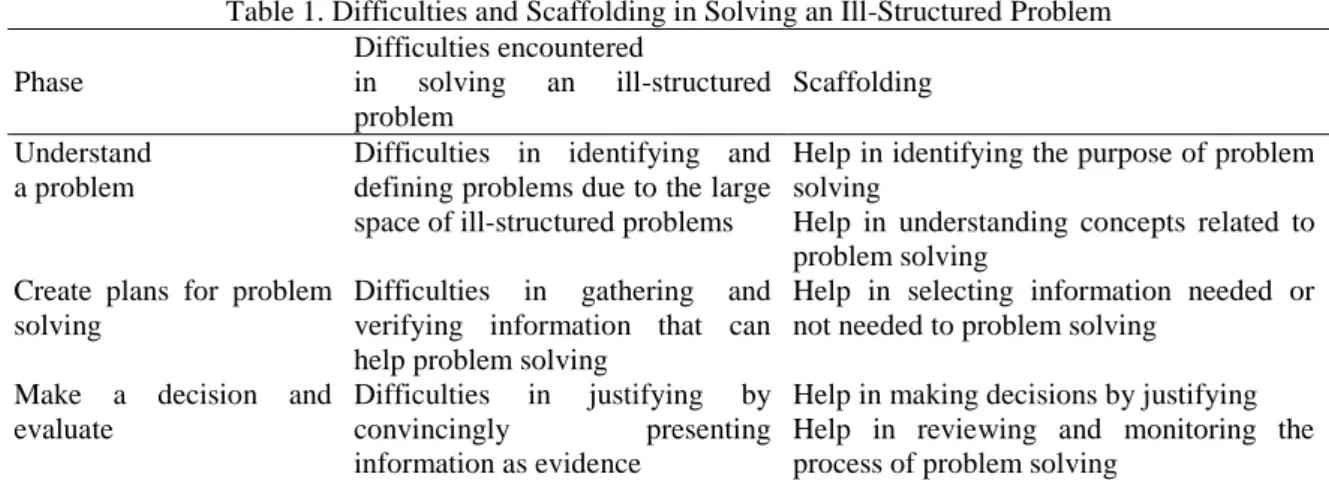
In general, questioning is considered as one of the most effective strategies to provide scaffolding (Van de Pol et al., 2010). It helps learners focus on their learning tasks and plays a leading role in their learning process. It can also help them monitor their learning paths as the students develop problem solving skills (Rosenshine, Meister, & Chapman, 1996). Questioning also elicits learners‟ responses, such as explaining or reasoning, to facilitate and develop higher-order thinking as they learn problem solving skills (Chi, Bassok, Lewis, Reimann, & Glaser, 1989; King, 1992; Lin, Hmelo, Kinzer, & Secules, 1999; Rosenshine et al., 1996). The earlier studies that provided scaffolding with questioning were mainly concerned with the process of problem solving (Davis & Linn, 2000; Ge & Land, 2003; Greene & Land, 2000), while subsequent studies were often concerned with the effectiveness of scaffolding or questioning about the content of the problem (Chen & Bradshaw, 2007; Jang, 2014; Kim et al., 2015; Lee et al., 2014). Since learners may face various difficulties in the course of solving ill-structured problems, studies have been continuously conducted on providing scaffolding to help solve those difficulties (Cho & Jonassen, 2002; Ge & Land, 2004; Jonassen, 2003; Song & Shin, 2010; Voss, Wolfe, Lawrence, & Engle, 1991). Araiku et al. (2019) also revealed that when the learner faced difficulties in solving ill-structured problems, the teacher's proper guidance also helped to improve understanding of the problem and develop a critical perspective on problem solving, and the importance of providing active scaffolding was emphasized. Based on the previous studies, the difficulties that learners may encounter in the process of solving ill-structured problems and the scaffolding that can be provided to help them overcome the difficulties were summarized in Table 1.
Table 1. Difficulties and Scaffolding in Solving an Ill-Structured Problem Phase
Difficulties encountered
in solving an ill-structured problem
Scaffolding Understand
a problem
Difficulties in identifying and defining problems due to the large space of ill-structured problems
Help in identifying the purpose of problem solving
Help in understanding concepts related to problem solving
Create plans for problem solving
Difficulties in gathering and verifying information that can help problem solving
Help in selecting information needed or not needed to problem solving
Make a decision and evaluate
Difficulties in justifying by convincingly presenting information as evidence
Help in making decisions by justifying Help in reviewing and monitoring the process of problem solving
Methods
Participants
Participants were selected by purposeful sampling (Creswell, 2012) to obtain the in-depth information on how providing scaffolding worked in solving an ill-structured problem in the elementary school mathematics classroom. First, 6th grade students were selected as participants for the following reason: in general, domain specific knowledge is needed to solve ill-structured problems (Jonassen, 1997; Voss et al., 1991), and the problem of ratio and proportion developed in this study belongs to the sixth grade curriculum in Korea. Second, there were four participants (two boys, Tom and Jack, and two girls, Emily and Jane) who were selected from an elementary school in Seoul. They voluntarily expressed their willingness to participate in this research and were recommended by their homeroom teachers based on their experiences actively participating in collaborative problem solving activities in school life. Also, this school operates a science curriculum based on Problem-Based Learning and conducts a large amount of educational activities based on collaborative activities among all students. For this reason, students in this school were selected because it was judged that verbal interaction would be actively conducted among students participating.
Research Setting
Solving an Ill-structured Problem
This study was conducted in the following order (see Figure 1). First, the individual activity (Phase 1), which lasted about 30 minutes, consisted of the allowance of time for analyzing and understanding problems, so that the individual would be prepared to work together in a small group. Then an individual interview (Phase 2) was conducted for about 10 minutes independently to identifying the individual‟s thoughts about how each participant understood and solved the problem. Afterwards, the group of four participants were asked to collaboratively solve the problem in the group activity. In the group activity (Phase 3), the participants shared what they had understood in the individual activity, and then worked together to solve the ill-structured problem. In a group interview (Phase 4), the researcher conducted a semi-structured interview on the group's collaborative problem solving process, and on the feelings of participation of the participants in solving the ill-structured problem.
Figure 1. The Procedures for Collaboratively Solving an Ill-structured Problem in This Study
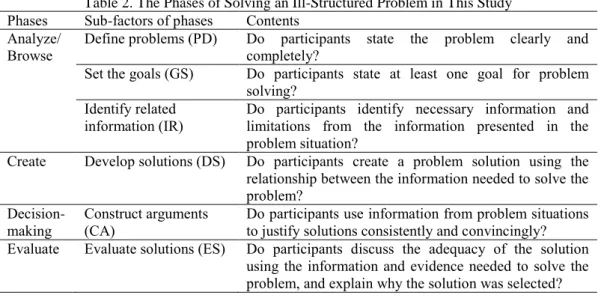
In this study, the process of solving an ill-structured problem was defined as follows (Ge, 2002; Kim et al., 2014) (see Table 2).
Table 2. The Phases of Solving an Ill-Structured Problem in This Study Phases Sub-factors of phases Contents
Analyze/
Browse Define problems (PD) Do participants state the problem clearly and completely? Set the goals (GS) Do participants state at least one goal for problem
solving? Identify related
information (IR) Do participants identify necessary information and limitations from the information presented in the problem situation?
Create Develop solutions (DS) Do participants create a problem solution using the relationship between the information needed to solve the problem?
Decision-making Construct arguments (CA) Do participants use information from problem situations to justify solutions consistently and convincingly? Evaluate Evaluate solutions (ES) Do participants discuss the adequacy of the solution using the information and evidence needed to solve the problem, and explain why the solution was selected? Phase 1
Individual activity
Phase 2
Individual interview
Phase 3
Group activity
Phase 4
Development of an Ill-structured Problem Focusing on ‘Ratio and Proportion’
An ill-structured problem was developed based on the mathematical concepts of ratio and proportion, which are topics that can often be experienced in real life, and are related to proportional thinking, as well as the basis for higher mathematical thinking (Lesh, Post, & Behr, 1988). However, although ratio and proportion are the integrated concepts that can be broadly addressed in connection with other subjects, these are not integrated with the themes of other subjects (similarity, speed, concentration, density, scaling, etc.) in Korean mathematics textbooks (Jeong, 2003). Based on these studies, this study has developed a problem situation in which mathematical communication and mathematical reasoning could occur, and the problem could be solved according to reasonable judgment and decision making (Park & Jeong, 2010).
The problem was developed to reflect the characteristics of ill-structured problems, such as reality, openness and complexity. For this reason, there is a lot of information presented in a problem situation, so it is necessary to select the information necessary for problem solving and organize them well. The overview of the problem is shown in Table 3. One mathematics educator and three elementary school teachers with expertise in elementary mathematics education had consulted and developed the ill-structured problem together. They had also corrected and reviewed the terms suitable for the problem situation.
Table 3. Overview of the Problem Developed in This Study
Problem situation
Select sub-costs to be included in the cumulative costs to compare annual cumulative costs (the criteria of car-selection), and solve the ill-structured problem by comparing the costs according to the time when the cumulative costs are compared Overview Construct and compare cumulative
costs using information about fuel costs, car supply prices, car taxes, and when to replace a car
Solve the problem by negotiating the cost of one year as a reference to find the cumulative cost and comparing the cumulative cost. Application of the
ratio and proportion
To compare various reference quantities such as fuel efficiency, annual fuel demand and annual fuel consumption
To generate information about annual fuel demand and annual fuel consumption using the information on mileage and fuel efficiency presented in the problem
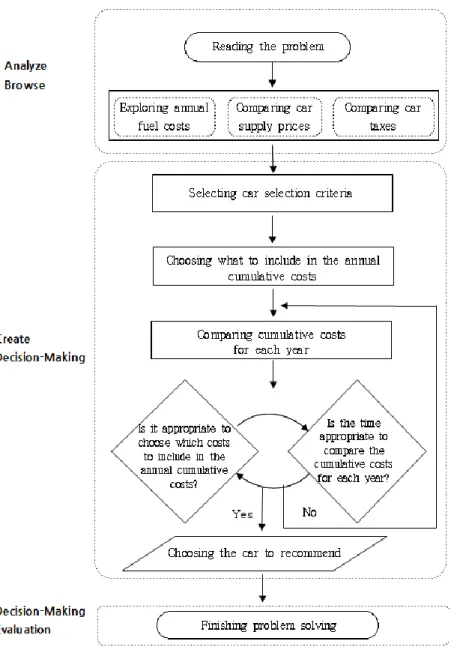
The expected process of problem solving is shown in a flowchart (see Figure 2).
Design of Scaffolding
Figure 2. The Expected Process of Ill-Structured Problem Solving Table 4. Plans of Scaffolding in This Study
Types of scaffolding
Purposes of providing
scaffolding Examples
Strategic scaffolding
Help in identifying the purpose of problem solving
What is the problem to solve?
Help in selecting information needed for problem solving
Which of the information suggested in the problem is necessary to solve the problem?
What information do you find most helpful in solving the problem? How is the information presented in the problem related to problem solving?
Is there anything else I need to know other than the information presented in the problem?
Help in making decisions by justifying
Let us explain in detail the evidence that supports your opinion. Conceptual
scaffolding
Help to understand concepts related to problem solving
What mathematical knowledge can you use to solve the problem? Have you experienced solving a similar problem or a situation similar to a problem situation?
Metacognitive scaffolding
Help to review and check the process of problem solving
Data Collection and Analysis
In this study, to collect discourse data, audio recording and video recording were performed every time with the consent of the research participants and the researchers participated in the field and recorded observations. The reason why audio recording and video recording was performed at the same time is to improve understanding of what the discourse explains, and gestures can help you understand verbal interactions properly. However, only the discourse data was taken for analysis, because the content of verbal interaction, not facial expressions or actions, represented the content of problem solving. The discourse data on video recording were collected, transcribed, and analyzed to investigate the characteristics of solving an ill-structured problem in a small group activity. In addition, interview data, individual activity sheets, and group activity sheets, which participants created during problem solving, were collected and analyzed.
In this study, in order to analyze the discourse of participants, the analysis unit was set to an episode according to the topic of the discourse. Episode analysis provides information on which topics are discussed in what ways (Choi, 2013; Hogan, Nastasi, & Pressley, 1999). Each episode begins when the topic of discourse begins to change and is composed of two or more consecutive turn-takings. The length of the episode varied depending on how long the participants' discourse continued on the topic of discourse.
Results
For this study, the results are divided into before and after providing scaffolding. In this study, the discourses data consisted of a total of 25 episodes, and the distribution of episodes was organized according to sub-factors of the phases of solving the ill-structured problem in Table 2 (see Table 5). It was shown that the episodes about IR were the highest (48%), followed by CA and ES.
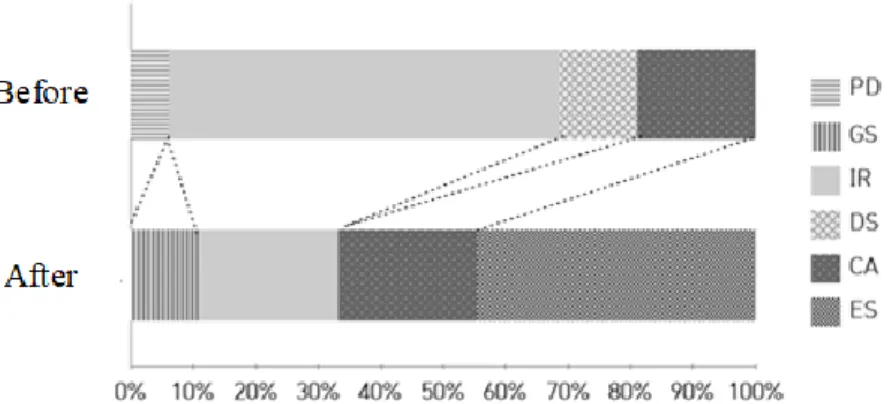
Table 5. Distribution of Episodes according to Subfactors of Phase in Solving an Ill-Structured Problem Sub-factors of phases in solving an ill-structured problem PD GS IR DS CA ES Total Frequency of episode (%) 1(4) 1(4) 12(48) 2(8) 5(20) 4(16) 25(100) Figure 3 shows the distribution of episodes before and after providing scaffolding and compares the proportion of episodes by sub-factors of phases in the ill-structured problem solving. The ratio of IR-related discourses was highest before and after scaffolding was provided, and CA-related discourses were also consistently high. On the other hand, after scaffolding was provided, GS-related and ES-related discourses have appeared.
Figure 3. Distribution of Episodes by Sub-factors of the Phases in Solving an Ill-Structured Problem according to Scaffoldings
Solving an Ill-structured Problem before Scaffolding is provided
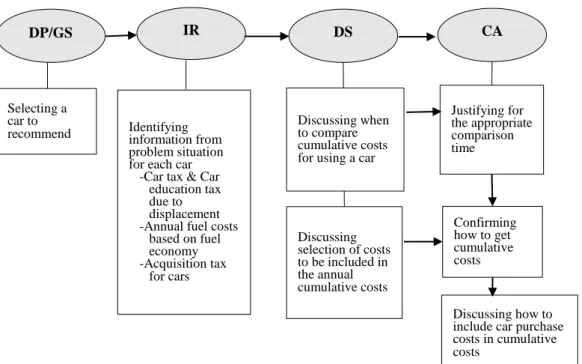
Figure 4. Solving an Ill-Structured Problem before Scaffolding is provided
Define Problems (PD)
Participants set the problem to be solved as comparing the cost of using a car to what to recommend to their fathers. They suggested how to find the total cost of buying and using a car for one year, or how to compare the cost of each part of the total cost.
Identify Related Information (IR)
The participants identified and collected information necessary for problem solving, and often used information necessary for the calculations. They gathered all the information presented in the problem situation and prepared for creating solutions. To this end, they compiled information for each car on taxes related to displacement, fuel costs, and taxes paid when buying a car.
Develop Solutions (DS)
Based on the information gathered above, the participants discussed and developed solutions in two aspects: the time to compare the cumulative costs of using a car and the cost to include in the cumulative cost. Instead, an analysis of the participant‟s discussions on these two aspects suggested that the phase of IR had proceeded prematurely to the phase of CA, without a clear distinction between the information necessary or unnecessary for problem solving.
Construct Arguments (CA)
The participants justified the two aspects discussed in the phase of DS. Additionally, they justified how to compare the cumulative costs of using a car, by the cost of one year and the cost of seven years. Some participants who argued that it was appropriate to compare the cumulative costs of using a car for seven years did not solve the problem systematically, and therefore did not give convincing arguments because they presented only the principle of how to compare those costs. Similarly, others who wanted to compare costs for one year didn't provide any concrete evidence of these calculations, because it was too complicated to calculate. Subsequently, they found that it was an error to include the car supply price several times when calculating the cumulative cost, they then recalculated the cumulative cost and finally solved the problem by selecting Car B.
Justifying for the appropriate comparison time
Confirming how to get cumulative costs
Discussing how to include car purchase costs in cumulative costs
DS CA
DP/GS IR
Discussing when to compare cumulative costs for using a car
Discussing selection of costs to be included in the annual cumulative costs Selecting a
car to
recommend Identifying information from problem situation for each car
-Car tax & Car education tax due to displacement -Annual fuel costs
based on fuel economy -Acquisition tax
Evaluate Solutions (ES)
There was no process for discussing the adequacy of the solution, nor to explain in detail why the solution was chosen.
Solving an Ill-structured Problem after Scaffolding is provided
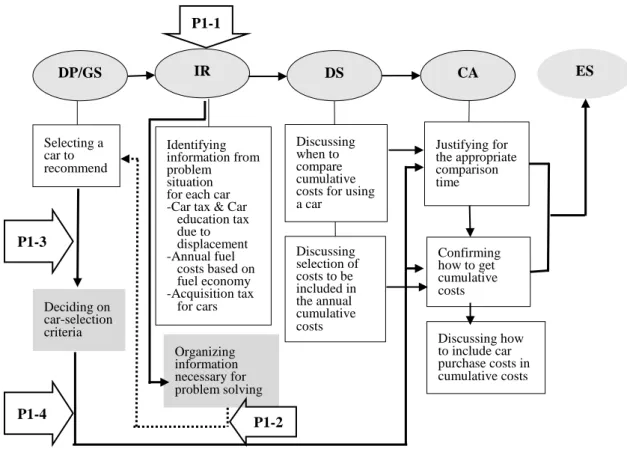
Figure 5 shows the changes in solving an ill-structured problem after scaffolding is provided.
Figure 5. Solving an Ill-Structured Problem after Scaffolding is provided
Returning to Identifying Related Information
As shown in Extract 1, the researchers asked questions to diagnose the current level of the learner‟s understanding in solving an ill-structured problem (underlined in Extract 1). This diagnosis serves as a basis for what scaffolding to provide. In the process of diagnosis, the participants were confused about the meaning of the terms „fuel efficiency‟ and „fuel cost,‟ which are presented in the problem situation and played an important role in solving the ill-structured problem. Researchers continued to question this confusion, and participants were able to properly understand the confused meaning by responding. Also, through this process, participants gained a better understanding of the information needed to solve the problem.
Extract 1:
Researcher: Do you know what you need to solve in this problem?
Tom: Yes.
Researcher: What should I solve?
Tom: Which car would you recommend
Researcher: We have to choose which car to recommend, if we recommend, what can we recommend?
Justifying for the appropriate comparison time
Confirming how to get cumulative costs
Discussing how to include car purchase costs in cumulative costs Discussing
when to compare cumulative costs for using a car
Discussing selection of costs to be included in the annual cumulative costs
DS CA
Selecting a car to recommend
Deciding on car-selection criteria
DP/GS IR
Identifying information from problem situation for each car -Car tax & Car
education tax due to displacement -Annual fuel
costs based on fuel economy -Acquisition tax
for cars
Organizing information necessary for problem solving
ES P1-1
P1-4
P1-2 P1-3
*thin solid line: Solving an ill-structured problem before scaffolding is provided *thick solid line: Solving an ill-structured problem after scaffolding is provided
Tom: Reason Emily: Evidence
Researcher: Yes, evidence. There must be criteria. Can you make recommendations based on criteria? What criteria do you have?
Jack: (Pointing to the problem situation activity sheet) It is written here, to consider fuel, cost, etc. Jane: But we did it at our price.
(omitted)
Researcher: But what you're getting confused about is the concept of fuel efficiency. Jack: Fuel economy is the distance you can go per liter
Researcher: Yes. There's a problem sheet in there. What is fuel efficiency? (omitted)
Researcher: I think that's what you call the fuel efficiency continuously. Jack: Fuel cost
Researcher Yes, the fuel cost is correct.
As shown in Extract 1, participants well defined the problem to be solved, so they needed to help them progress into a phase where they needed a deeper understanding of the information. They did not understand the limitations of the information in the process of developing and justifying problem solving solutions. This can be regarded as not convincingly constructing the argument for the solution. Therefore, it was necessary to provide strategic scaffolding (P1-1) to help in-depth understanding of information for problem solving (see Extract 2). Before scaffolding was provided, participants tried to use all the information presented in the problem. However, when strategic scaffolding (P1-1) was provided, the participants organized and classified information necessary or unnecessary for problem solving in the phase of IR (see Extract 2). By providing P1-1, information that is not necessary for problem solving is excluded, and information necessary for problem solving is organized. To organize with only the necessary information helped to access the solution more systematically. It was analyzed that this change presented by providing P1-1 facilitated ill-structured problem solving in this study.
Extract 2:
Researcher: So, aren't there any pieces of information that you need to solve your problem, and some that you don't need? (P1-1)
Researcher: Let's discuss it with our friends, and look back at the process we've solved so far and see if it seems to have solved it correctly or whether our approach seems right. I think we need to talk again.
(omitted) Jack: Car education tax
Researcher: Why do you think so? Jack: It's all the same
Researcher: I also think it's the same thing.
By the way, did you calculate car education tax or not? Jack: No, we didn‟t.
Jack: (At the same time with Jane) we did. Researcher: You didn‟t?
Jack: (Laughing) we did.
Researcher: You did. But should you have done it?
Jack: No.
Tom: No, we didn‟t.
Researcher: I think you can calculate it except that.
And do you have any other information you don't need? Tom: Displacement
Jack: Displacement is the same. Researcher: Yes, it‟s the same.
Returning to Setting the Goals
one of the participants (Jack) then asked about the concerns he had had on his own before providing scaffolding, and participants began discussing the car-selection criteria.
In this context, the participants presented a variety of opinions on what could be considered as car-selection criteria (see Extract 3). One participant suggested an opinion based on the information presented in the problem situation, whereas the others were based on common knowledge used in everyday life. At that time, they were confused about car-selection criteria. Likewise, this discussion led back to the phase of specifying the sub-goals of defining the problem. This was analyzed that P1-2 made the participants return to the phase of setting the goals necessary for problem solving, and provided an opportunity to consider various viewpoints when setting the goals. After providing P1-2, participants were confused setting sub-goals.
Extract 3:
Researcher: Then let's take a look at the process you just took and talk about whether there's something you need to fix or if you missed it. (P1-2)
Jack: I missed… No, not missed, but the odd thing is that Tom kept saying "performance, performance", but it's not listed here.
(omitted) Jack: But it's all written here (activity sheet). Emily: You have to look at the design. Jack: The design is the same.
Jane: By the way, there are three things to consider in the activity sheet, because there is no design or performance in it.
Jack: Performance is there. Hybrid. Electric energy utilization. Jane: It's all here (activity sheet).
Jack: It is written here (activity sheet). Convenience, comfort and dynamics…
To help clarify the sub-goals of problem solving, strategic scaffolding (P1-3) is provided. Providing P1-3 helped evaluate the adequacy of various opinions on the car-selection criteria presented so far. And since the information presented in the problem situation was all about cost, participants agreed that choosing the car based on the total cost was the most reasonable way (see Extract 4). It can be analyzed that providing P1-3 helped us to realize that to justify using the information presented in a problem situation is a convincing way for providing evidence, when making diverse opinions and making decisions,
Extract 4:
Researcher: What can be the criteria with the information given here? (P1-3) Tom: There's only price?
Emily: Price (in a small voice)
Jack: The price, it's written here (activity sheet), but the price and fuel efficiency… Emily: It is only price. Let's set the price.
Advancing to Creating Arguments and Evaluating Solutions
Meta-cognitive scaffolding (P1-4) was provided to help participants review and finalize the problem solving process when consensus was reached on creating sub-goals (see Extract 5).
Extract 5:
After the metacognitive scaffolding (P1-4) was provided, the participants examined the activity sheets they had recorded as they solved the problem. They tried to build a shared understanding among them by checking the calculation process and the costs to be included in comparing the overall cost, and when to compare the cumulative cost. Finally, the problem was solved by mathematically explaining the reason for choosing Car B. It is analyzed that what the participants discussed after providing P1-1, P1-2, and P1-3 helped to discuss the appropriateness of the solution and to have a shared understanding of the problem solving.
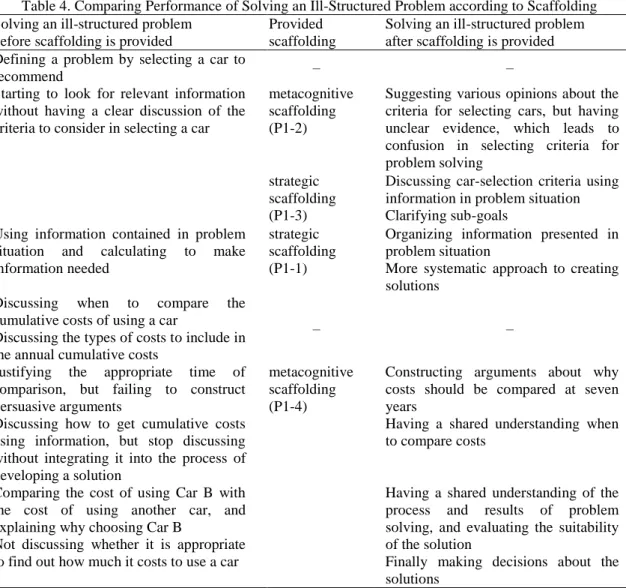
The changes in the process of ill-structured problem solving were examined by dividing them before and after providing scaffolding. Those are summarized in Table 6.
Table 4. Comparing Performance of Solving an Ill-Structured Problem according to Scaffolding Solving an ill-structured problem
before scaffolding is provided
Provided scaffolding
Solving an ill-structured problem after scaffolding is provided Defining a problem by selecting a car to
recommend – –
Starting to look for relevant information without having a clear discussion of the criteria to consider in selecting a car
metacognitive scaffolding (P1-2)
Suggesting various opinions about the criteria for selecting cars, but having unclear evidence, which leads to confusion in selecting criteria for problem solving
strategic scaffolding (P1-3)
Discussing car-selection criteria using information in problem situation Clarifying sub-goals
Using information contained in problem situation and calculating to make information needed
strategic scaffolding (P1-1)
Organizing information presented in problem situation
More systematic approach to creating solutions
Discussing when to compare the cumulative costs of using a car
Discussing the types of costs to include in the annual cumulative costs
– –
Justifying the appropriate time of comparison, but failing to construct persuasive arguments
Discussing how to get cumulative costs using information, but stop discussing without integrating it into the process of developing a solution
metacognitive scaffolding (P1-4)
Constructing arguments about why costs should be compared at seven years
Having a shared understanding when to compare costs
Comparing the cost of using Car B with the cost of using another car, and explaining why choosing Car B
Not discussing whether it is appropriate to find out how much it costs to use a car
Having a shared understanding of the process and results of problem solving, and evaluating the suitability of the solution
Finally making decisions about the solutions
All four scaffolding were provided in this study. Three scaffolding (P1-1, P1-3, P1-4) facilitated solving the ill-structured problem, whereas the other scaffolding (P1-2) caused confusion. This is analyzed because P1-2 did not fit the problem solving situation of the participants, but did not provide a convincing reason when presenting various opinions.
Difficulties Encountered in Solving an Ill-structured Problem
In this study, based on the diagnosis of the status of problem solving and the analysis of the process that provided scaffolding, participants had difficulties in two aspects in solving the ill-structured problem. First, the participants had experienced difficulties in identifying and organizing the information when developing solutions for the ill-structured problem. To help overcome this difficulty, the strategic scaffolding has been provided that leads to identifying and gathering the information necessary for solving the ill-structured problem, and understanding the relationships between the information. Generally speaking, it helped to organize the information and discuss in detail how to use it for problem solving. It also helped to find and fix errors that were made while solving the ill-structured problem. In summary, it worked to help deepen an understanding of the information elaborated and utilized in problem solving. This difficulty also appeared in responses in group interviews such as "I had a lot of things to consider," and "I had a lot to choose." In addition, as shown in the following excerpt, it was useful to help the participants understand the relationship and structure of the complex information, which were presented in the problem situation.
Researcher: If you have to solve this problem with your classmates in class, what do you think the teacher needs to do to help you?
Jane: Yes.
Jack: To structure the hints.
Second, although a process of monitoring or evaluating is necessary for the ill-structured problem solving, the participants did not voluntarily perform those process and couldn‟t elaborate the solution in this study. For this reason, in order to help overcome this difficulty, the researcher provided a metacognitive scaffolding to deliberately elicit the phases of monitoring and evaluating the solution. Ultimately, this led to a shared understanding among the participants.
Conclusion
Many of the studies on scaffolding in solving ill-structured problems were mostly about the effectiveness of scaffolding in a technology-based learning environment, and those studies played a major role in establishing the theoretical basis for scaffolding. However, there is little work on scaffolding for the ill-structured problem solving in elementary school mathematics classroom. This study aimed to investigate how teacher scaffolding helps elementary school students solve an ill-structured problem in mathematics classroom and what difficulties they experience in the process of solving an ill-structured problem.
First, in this study, there have been shown two major difficulties in solving an ill-structured problem: one about the difficulties in the phases of identifying and organizing the necessary information from problem situation, and the other about not monitoring or not evaluating the appropriateness of the final selected solution. The reason for these difficulties is due to the characteristics of the ill-structured problem itself: one or more of the problem elements are unknown or vaguely defined, and the problem space is large due to unclear objectives and conditions that do not appear directly in the problem situation (Jonassen, 1997; Kitchner, 1983; Spiro, Coulson, Feltovich, & Anderson, 1988; Wood, 1983). Considering the difficulties presented in this study in-depth understanding of the problem situation is important in solving the ill-structured problem, in connection with previous studies (Artzt & Yaloz-Femia, 1999; Kim et al., 2012; Kintsch & Greeno, 1985; Voss & Post, 1988) that revealed that solutions differ depending on how understanding of the problem situation is achieved, Second, before providing scaffolding, participants solved the ill-structured problem without any help. Although the purpose of providing each scaffolding was different, it was analyzed that the changes made by scaffolding generally facilitated the ill-structured problem solving after providing scaffolding. In this study, metacognitive scaffolding helped to reset the goals and develop solution for ill-structured problem solving, and strategic scaffolding helped organize information and make good use of it to discuss the suitability of the solution. This is consistent with the findings of Ge & Land (2003) and Jonassen (1997), who said that phases of monitoring and justifying are needed to solve ill-structured problems. As reported in prior studies (Araiku et al., 2019; Chen & Bradshaw, 2007; Davis & Linn, 2000; Kim et al., 2015; Ge & Land, 2003, 2004; Ge et al., 2005; Greene & Land, 2000; Jonassen, 1997; Lee et al., 2014), providing the scaffolding can be effective in the ill-structured problem solving and qualitatively improve that. Furthermore, the fact that facilitating the ill-structured problem solving with scaffolding means that the scaffolding provided in this study was contingent upon the state of the ill-structured problem solving. Here, the fact that scaffolding was provided according to the learner's state means that with the help of scaffolding the learner can do what he or she could not do alone. Subsequently, scaffolding will gradually decrease, and the scope of transfer of responsibility for learners themselves will expand.
Based on the results of this study, providing scaffolding helped to facilitate the ill-structured problem solving. Particularly, when scaffolding was provided while solving an ill-structured problem, participants began to explore the problem situation in more depth, which led to efforts to find the best solution. This is similar to the characteristics of expert problem solving (Rowland, 1992) and those of high level problem solving (QCA, 2004). This means that providing scaffolding in the process of solving an ill-structured problem can foster the quality of problem solving solution and help to achieve a higher level of problem solving, thereby improving your problem-solving ability like an expert.
increase in mathematical problem solving ability, and will enhance the learner‟s self-regulatory ability to solve the ill-structured problem on their own without teacher‟s scaffolding.
Notes
This study was based on parts of a dissertation titled, „A study on ill-structured mathematical problem-solving and peer interactions according to teacher‟s scaffolding,‟ by the first author.
References
Abdillah, A., Mastuti, A. G., & Rahman, M. A. (2018). Ill-structured mathematical problems to develop creative thinking students. Proceedings of the International Conference on Mathematics and Islam (ICMIs 2018)(pp. 28-33). http://dx.doi.org/10.5220/0008516700280033
Araiku, J., Parta, I. N., & Rahardjo, S. (2019). Analysis of students‟ mathematical problem solving ability as the effect of constant ill-structured problem‟s employment. Journal of Physics, 1166(1), 12-20. https://doi.org/10.1088/1742-6596/1166/1/012020
Artzt, A. F., & Yaloz-Femia, S. (1999). Mathematical reasoning during small group problem solving. In S. Lee, & R. C. Frances (Eds.), Developing mathematical reasoning in grades K-12, 1999 yearbook (pp. 115-126). Reston, VA: National Council of Teachers of Mathematics.
Belland, B. R. (2014). Scaffolding: Definition, current debates, and future directions. In J. M. Spector, M. D. Merrill, J. Elen, & M. J. Bishop (Eds.), Handbook of research on educational communications and technology (4th ed., pp. 505-518). New York, NY: Springer.
Bransford, J. D., Brown, A. L., & Cocking, R. R. (Eds.). (2000). How people learn: Brain, mind, experience, and school. Washington, DC: The National Academies Press.
Cagiltay, K. (2006). Scaffolding strategies in electronic performance support systems: Types and challenges.
Innovations in Education and Teaching International, 43(1), 93-103.
https://doi.org/10.1080/14703290500467673
Charles, R. L., & Lester, F. K. (1982). Teaching problem solving-what, why, and how. Palo Alto, CA: Dale Seymour Publications.
Chen, C., & Bradshaw, A. C. (2007). The effect of web-based question prompts on scaffolding knowledge integration and ill-structured problem solving. Journal of Research on Technology in Education, 39(4), 359-375. https://doi.org/10.1080/15391523.2007.10782487
Chi, M. T. H., Bassok, M., Lewis, M. W., Reimann, P., & Glaser, R. (1989). Self-explanations: How students study and use examples in learning to solve problems. Cognitive Science, 13(2), 145-182. https://doi.org/10.1207/s15516709cog1302_1
Chi, M. T. H., & Glaser, R. (1985). Problem solving ability. In R. J. Sternberg (Ed.), Human abilities: an information processing approach (pp. 227-250). New York, NY: W. H. Freeman.
Cho, K. L., & Jonassen, D. H. (2002). The effects of argumentation scaffolds on argumentation and problem solving. Educational Technology Research and Development, 50(3), 5-22. https://doi.org/10.1007/bf02505022
Choi, I. S. (2013). Analysis of verbal interactions that generate mathematical reasoning. Unpublished doctoral dissertation, Ewha Womans University, Seoul, Korea.
Common Core State Standards Initiative (2010). Common core state standards for mathematics. Retrieved from http://www.corestandards.org
Creswell, J. W. (2012). Qualitative inquiry and research design: Choosing among five approaches. SAGE Publications.
Davis, E. A., & Linn, M. (2000). Scaffolding students‟ knowledge integration: Prompts for reflection in KIE. International Journal of Science Education, 22(8), 819-837. https://doi.org/10.1080/095006900412293 Dunkle, M. E., Schraw, G., & Bendixen, L. D. (1995, April). Cognitive processes in well-defined and ill-defined
problem solving. Paper presented at the annual meeting of the American Educational Research Association, San Francisco, CA.
Ge, X. (2002). Scaffolding students’ problem-solving processes on an ill-structured task using question prompts and peer interactions. (Unpublished Doctoral Dissertation). The Pennsylvania State University.
Ge, X, & Land, S. M. (2003). Scaffolding students‟ problem-solving processes in an ill-structured task using question prompts and peer interactions. Educational Technology Research and Development, 51(1), 21-38. https://doi.org/10.1007/bf02504515
Ge, X, & Land, S. M. (2004). A conceptual framework for scaffolding ill-structured problem-solving processes using question prompts and peer interactions. Educational Technology Research and Development, 52(2), 5-22. https://doi.org/10.1007/bf02504836
Greene, B. A., & Land, S. M. (2000). A qualitative analysis of scaffolding use in a resource-based learning environment involving the world wide web. Journal of Educational Computing Research, 23(2), 151-179. https://doi.org/10.2190/1gub-8ue9-nw80-cqad
Hogan, K., Nastasi, B. K., & Pressley, M. (1999). Discourse patterns and collaborative scientific reasoning in peer and teacher-guided discussions. Cognition and Instruction, 17(4), 379-432. https://doi.org/10.1207/s1532690xci1704_2
Holmes, E. E. (1995). New directions in elementary school mathematics. Englewood Cliffs, NJ: Merrill, Prentice Hall.
Hong, J. Y., & Kim, M. K. (2016). Mathematical abstraction in the solving of ill-structured problems by elementary school students in Korea. Eurasia Journal of Mathematics, Science & Technology Education, 12(2), 267-281. https://doi.org/10.12973/eurasia.2016.1204a
Jackson, S. L., Krajcik, J., & Soloway, E. (1998, January). The design of guided learner-adaptable scaffolding in interactive learning environments. In Proceedings of the SIGCHI conference on Human factors in computing systems (pp. 187-194). ACM Press/Addison-Wesley Publishing Co.
Jang, S. (2014). The effects of scaffolding types on the problem-solving phases in an online learning environment. Journal of Educational Technology, 30(2), 193-220. https://doi.org/10.17232/kset.30.2.193 Jeong, E. S. (2003). An educational analysis on ratio concept. The Journal of Educational Research in
Mathematics, 13(3), 247-265.
Jonassen, D. H. (1997). Instructional design models for well-structured and ill-structured problem-solving learning outcomes. Educational Technology Research and Development, 45(1), 65-94. https://doi.org/10.1007/bf02299613
Jonassen, D. H. (2003). Using cognitive tools to represent problems. Journal of Research in Technology in Education, 35(3), 362-381. https://doi.org/10.1080/15391523.2003.10782391
Joo, H. J., & Kim, M. K. (2014). Problem solving strategy and justification for solving ill-structured mathematical problems based on the learning styles of elementary students. Journal of Learner-Centered Curriculum and Instruction, 14(7), 127-148.
Kim, J, Y., Park, H. S., & Lim, K. Y. (2015). The effects of scaffolding types on problem solving ability and achievement in problem solving learning with creative thinking method. Journal of Korean Association for Educational Information and Media, 21(1), 111-136.
Kim, M. K., Heo, J. Y., Cho, M. K., & Park, Y. M. (2012). An analysis on the 4th graders' ill-structured problem solving and reasoning. The Mathematical Education, 51(2), 95-114. https://doi.org/10.7468/MATHEDU.2012.51.2.095
Kim, M. K., Heo, J. Y., & Park, E. J. (2014). Design, application, and its educational implication of ill-structured problem solving in elementary mathematics education. Journal of Elementary Mathematics Education in Korea, 18(2) 189-209.
Kim, M. K., Lee, J. Y., Hong, J. Y., & Joo, H. J. (2012). Decision making from the 5th Grade's ill-structured problem of data analysis. Communications of Mathematical Education, 26(2), 221-249.
Kim, M. K., & Park, E. J. (2013). Children‟s proportional reasoning on problem type of proportion according to ill-structured degree. Journal of the Korean School Mathematics Society, 16(4), 719-743.
King, A. (1992). Facilitating elaborative learning through guided student-generated questioning. Educational Psychologist, 27(1), 111-126. https://doi.org/10.1207/s15326985ep2701_8
Kintsch, N., & Greeno, J. G. (1985). Understanding and solving word arithmetic problem. Psychological Review, 92(1), 109-129.
Kitchner, K. S. (1983). Cognition, metacognition, and epistemic cognition: A three-level model of cognitive processing. Human Development, 26(4), 222-232. https://doi.org/10.1159/000272885
Lave, J. (1988). Cognition in practice. Cambridge, UK: Cambridge University Press.
Lee, C., Chen, M., & Chang, W. (2014). Effects of the multiple solutions and question prompts on generalization and justification for non-routine mathematical problem solving in a computer game context. Eurasia Journal of Mathematics, Science, & Technology Education, 10(2), 89-99. https://doi.org/10.12973/eurasia.2014.1022a
Lenchner, G. (1983). Creative problem solving in school mathematics. Boston, MA: Houghton Mifflin Co. Lesh, R., Post, T., & Behr, M. (1988). Proportional reasoning. In M. Behr, & J. Hilbert (Eds.), Number concepts
Lin, X., Hmelo, C., Kinzer, C. K., & Secules, T. J. (1999). Designing technology to support reflection. Educational Technology Research and Development, 47(3), 43-62.
Ministry of Education (2015). Mathematics curriculum. Ministry of Education Notice 2015-74 [supplement 8]. Seoul, Kore: Author.
Park, H., & Jeong, E. (2010). A comparative analysis on units about ratio and rate between Korean mathematics textbook and MIC textbook. Journal of Elementary Mathematics Education in Korea, 14(3), 769-788. Prayitno, L. L., Subanji, S., Susiswo, S., & Abdur, A. A. (2020). Exploring student‟s representation process in
solving ill-structured problems geometry. Participatory Educational Research, 7(2), 183-202. https://doi.org/10.17275/per.20.28.7.2
Puntambekar, S., & Hubscher, R. (2005). Tools for scaffolding students in a complex learning environment: What have we gained and what have we missed? Educational Psychologist, 40(1), 1-12. https://doi.org/10.1207/s15326985ep4001_1
Qualification and Curriculum Authority (2004). The key skills qualifications standards and guidance: working with others, improving own learning and performance and problem solving. London, Qualification and Curriculum Authority.
Rosenshine, B., Meister, C., & Chapman S. (1996). Teaching students to generate questions: A review of the intervention studies. Review of Educational Research, 66(2), 181-221. https://doi.org/10.3102/00346543066002181
Rowland, G. (1992). What do instructional designers actually do? An initial investigation of expert practice. Performance Improvement Quarterly, 5(2), 65-86. https://doi.org/10.1111/j.1937-8327.1992.tb00546.x Song, H., & Shin, S. (2010). Instructional design principles for scaffolding problem-based learning in a
multimedia-based learning environment. The Journal of Yeolin Education, 18(3), 149-164.
Spiro, R. j., Coulson, R. L., Feltovich, P. J., & Anderson, D, K. (1988). Cognitive flexibility theory: Advanced knowledge acquisition in ill-structured domains. (Tech Report No. 441). Champaign, IL: University of Illinois, Center for the Study of Reading.
Tharp, R. G., & Gallimore, R. (1988). Rousing minds to life: Teaching, learning, and schooling in social context. Cambridge: Cambridge University Press.
Van de Pol, J., & Elbers, E. (2013). Scaffolding student learning: a micro-analysis of teacher-student interaction. Learning, Culture and Social Interaction, 2, 32-41. https://doi.org/10.1016/j.lcsi.2012.12.001
Van de Pol, J., Volman, M., & Beishuizen, J. (2010). Scaffolding in teacher–student interaction: A decade of research. Educational Psychology Review, 22(3), 271-296. https://doi.org/10.1007/s10648-010-9127-6 Van de Pol, J., Volman, M., Oort, F., & Beishuizen, J. (2014). Teacher scaffolding in small-group work: an
intervention study. Journal of the Learning Sciences, 23(4), 600-650. https://doi.org/10.1080/10508406.2013.805300
Voss, J. F., & Post, T. A. (1988). On the solving of ill-structured problems. In M. T. H. Chi, R. Glaser, & M. J. Farr (Eds.), The nature of expertise (pp. 261-285). Hillsdale, NJ: Erlbaum.
Voss, J. F., Wolfe, C. R., Lawrence, J. A., & Engle, R. A. (1991). From representation to decision: An analysis of problem solving in international relations. In R. J. Sternberg, & P. A. Frensh (Eds.), Complex problem solving (pp. 119-157). Hillsdale, NJ: Lawrence Erlbaum.
Wood, D., Bruner, J. S., & Ross, G. (1976). The role of tutoring in problem solving. Journal of Child Psychology and Psychiatry, 17(2), 89-100. https://doi.org/10.1111/j.1469-7610.1976.tb00381.x
Wood, P. K. (1983). Inquiring systems and problem structures: Implications for cognitive development. Human Development, 26, 249-265. https://doi.org/10.1159/000272887
Author Information
Mi Kyung Cho
Department of Elementary Education College of Education
Ewha Womans University Seoul
South Korea
Min Kyeong Kim
Department of Elementary Education College of Education
Ewha Womans University Seoul
South Korea