www.ijemst.com
Patterns of Physics Reasoning in
Face-to-Face and Online Forum Collaboration
Around a Digital Game
Grant Van Eaton1, Douglas B. Clark1, Blaine E. Smith2 1 Vanderbilt University
2 University of Miami
To cite this article:
Van Eaton, G., Clark, D.B., & Smith, B.E. (2015). Patterns of physics reasoning in
face-to-face and online forum collaboration around a digital game.
International Journal of
Education in Mathematics, Science and Technology, 3
(1), 1-13.
This article may be used for research, teaching, and private study purposes.
Any substantial or systematic reproduction, redistribution, reselling, loan, sub-licensing,
systematic supply, or distribution in any form to anyone is expressly forbidden.
Authors alone are responsible for the contents of their articles. The journal owns the
copyright of the articles.
Volume 3, Number 1, January 2015, Page 1-13
ISSN: 2147-611X
Patterns of Physics Reasoning in Face-to-Face and Online Forum
Collaboration Around a Digital Game
Grant Van Eaton1*, Douglas B. Clark1, and Blaine E. Smith2 1Vanderbilt University
2
University of Miami
Abstract
Students playing digital learning games in the classroom rarely play alone, even in digital games that are ostensibly “single-player” games. This study explores the patterns of physics reasoning that emerge in face-to-face and online forum collaboration while students play a physics-focused educational game in their classroom. We observed five increasing levels of explicit articulation of physics reasoning across interactions in the face-to-face and online forum interactions. Additionally, we found that students were much more likely to explicitly articulate formal physics reasoning in their online forum interactions than they were in their face-to-face interactions. We discuss multiple possible explanations for these patterns of articulation in terms of differences in timing of interactions, affordances of medium, classroom scripts, and social norms. The findings and discussion extend our understanding of the structuring and contributions of peer interactions to student learning in digital learning environments in the classroom.
Key words: Physics Reasoning, Online Forum, Digital Game.
Introduction
Students playing digital learning games in the classroom rarely play alone, even in digital games that are ostensibly “single-player” games. Rather, students engage “offline” continuously and informally with their nearby peers. Students might also simultaneously engage “online” with their peers throughout the classroom and beyond in online forums, chat, or message boards if they are available. In other words, there are no truly “single-player” digital game experiences for learning in a typical classroom. For example, a student playing a game on her laptop can interact with other students sitting next to her while also posing questions to the entire class within the virtual space of online forums connected to the game. Current research on digital learning environments, however, often focuses heavily on pre-post comparisons of learning (with the general tacit methodological assumption that the students represent independent participants and outcomes) rather than delving into students’ social interactions during gameplay in the classroom.
Some important foundational research on social interactions around gameplay has been conducted outside of classrooms in informal spaces. Steinkuehler and Duncan (2008), for example, analyzed informal game-based learning and have shown that players engage in social knowledge construction in online communities through message board discussions, co-producing productive scientific habits of mind. Within formal learning spaces, research on the use of simulations in classrooms has shown the impact of classroom cultures, peer dialogue, and power relationships on students’ appropriation of classroom resources to solve problems presented in gameplay (e.g., Squire, 2005, 2011). In order to further contribute to the research literature on the contributions of peer interactions to student learning while engaged in a digital learning environment, this study explores the patterns of physics reasoning that emerge in face-to-face and online forum collaboration while students play a physics-focused educational game in their classroom.
Theoretical Background
Developing students’ ability to align and express their intuitive understanding of physics within the framework and canonical language of Newtonian mechanics is fraught with challenges. Students frequently encounter substantial difficulty when they seek to reconcile their extensive experience as movers in the world with the
*
abstract, and seemingly counterintuitive, laws of force and motion (e.g., diSessa, 1988, 1993; Halhoun & Hestenes, 1985; White, 1984). Research suggests that conceptual change in such contexts involves a gradual development of coherence that typically involves altering structured priorities (diSessa, 1993) of relevant knowledge elements (i.e., altering the likelihood that particular pieces of knowledge will be activated upon recognition of specific contextual cues). In this view, misconceptions cannot easily be “removed and replaced” because they are productive pieces of knowledge that are valid in certain contexts. In order to develop coherent understanding from pieces of knowledge, these naïve conceptions must be reorganized and refined into more stable, expert-like knowledge structures (Clark, 2006; diSessa, 1993; diSessa, Gillespie, & Esterly, 2004). Over the past decade, digital games have been the object of substantial research and interest for approaching the difficult task of reorganizing students’ conceptual resources. In 2006, the Federation of American Scientists issued a widely publicized report stating that games as a medium offer powerful affordances for education (FAS, 2006). The report encouraged private and governmental support for expanded research into complex gaming environments for learning. A special issue of Science in 2009 echoed and expanded this call (Hines, Jasny, & Mervis, 2009). Studies demonstrate potential of digital games to support learning in terms of conceptual understanding (e.g., Barab et al., 2009; Klopfer, Scheintaub, Huang, Wendel, & Roque, 2009), process skills and practices (e.g., Kafai, Quintero, & Feldon, 2010; Steinkuehler & Duncan, 2008), epistemological understanding (e.g., Squire & Jan, 2007; Squire & Klopfer, 2007), and players’ attitudes, identity, and engagement (e.g., Barab et al., 2007; Dieterle, 2009; Ketelhut, 2007). Reports by the National Research Council (2009) and others (e.g., Honey & Hilton, 2010; Martinez-Garza, Clark, & Nelson, 2013; Young et al., 2012) acknowledge this potential, but also acknowledge the importance of better understanding how best to leverage and integrate games for learning into the classroom.
Conceptual Change through Online and Face-to-Face Collaboration
Collaborative interactions in and around game environments provide a window into students’ communities of practice (Gee, 2007) and conceptual understanding (Jan, San, & Tan, 2011; Steinkuehler, 2006). As opposed to traditional teacher-guided dialogue in the classroom, research suggests that peer-guided dialogue fosters more explorative and generative discussions (Hogan, Nastasi, & Pressley, 2000). Asking students to collaboratively grapple with a problem (e.g., advancing in a video game) challenges them to establish common frames of reference, resolve discrepancies in understanding, negotiate the distribution of labor, and arrive at a joint understanding (Barron, 2000; Ploetzner, Dillenbourg, Preier, & Traum; 1999). Rochelle (1992) explained that in order for conceptual change to occur, students must experience convergence, which includes iterative cycles of “displaying, confirming, and repairing situated actions” (p. 237). As a result, constructive collaboration around video games often leads to positive learning outcomes (Echeverrîa et al., 2012; Tuzun et al., 2009) and higher levels of abstract thinking through bridging multiple different perspective (Schwartz, 1995).
Research into students’ collaborations through online computer-mediated communication formats (e.g., discussion boards and speaking to other players in-game) also suggests benefits for student learning (Schwarz & Asterhan, 2011; Sins, Savelsbergh, van Joolingen, & van Hout-Wolters, 2011). The online medium offers increased time for students to compose and reflect upon their responses, as well as a disembodied space for interaction that is more democratic than a face-to-face classroom setting (Asterhan & Eisenmann, 2009, 2011). Asterhan and Eisenmann (2011) found that students who defined themselves as typically “silent” in the classroom reported a profound preference for communicating through discussion boards over participating in face-to-face discussions, for both social and academic reasons. Studies have also reported that students are more explicit (Kim, Anderson, Nguyen-Jahiel, & Archodidou, 2007) and provide deeper reasoning (Sins et al., 2011) when responding online.
understanding that are elucidated during collaboration, particularly in academic contexts. In addition, research in this field predominately focuses on either face-to-face or computer-mediated collaboration (although there are notable exceptions, e.g., Asterhan & Eisenmann, 2009, 2011; Sins et al., 2011). Further research is also needed that explores and compares the levels of articulated reasoning across both settings.
Research Questions
The current study explores these issues in the context of four classes of middle school students who played a digital physics game designed to support students in learning about Newtonian dynamics over the course of three class periods. More specifically, the current study investigates the following questions:
1. What patterns of physics reasoning emerge in face-to-face interactions while students play a physics-focused educational game in their classroom?
2. What patterns of physics reasoning emerge in the associated online forums that accompanied the game while the students played?
3. What are the relationships between the face-to-face and online interactions in terms of physics reasoning?
Method
We first describe the learning environment involved in the current study. We then describe the participants, data collection procedures, and coding and analysis procedures.
Learning Environment
This study focuses on a version of our physics games called SURGE Next, developed through grants from the U.S. National Science Foundation and the U.S. Department of Education†. SURGE Next is a single-player game that integrates disciplinary representations of Newtonian mechanics and explicit connections to its central concepts using popular commercial game mechanics. SURGE Next is a conceptually-integrated game for learning (Clark & Martinez-Garza, 2012), rather than a conceptually-embedded game, in the sense that the science to be learned is integrated directly into the mechanics of navigating through the game world, rather than being embedded as an activity to be visited at some location in the game environment. Core ideas from commercial game design conventions included (a) supporting engagement and approachable entry (Koster, 2004; Squire, 2011), (b) situating the player with a principled stance and perspective (McGonigal, 2011), (c) providing context and identification for the player with a role and narrative (Pelletier, 2008; Aarseth, 2007; Gee, 2007), (d) monitoring and providing actionable feedback for the player (Annetta et al., 2009; Garris, Ahlers, & Driskell, 2002; Kuo, 2007; Munz, Schumm, Wiesebrock, & Allgower, 2007), and (e) using pacing and gatekeeping to guide the player through cycles of performance (Squire, 2006).
In SURGE Next, missions are short puzzles that students must solve in order to advance in the game. Students attempt to navigate to an exit portal on each mission, and there are additional game incentives along the way (e.g., collecting diamonds and different levels of achievement in the mission) for certain possible trajectories (Figure 1). SURGE Next limits the total number of (force) commands available in a given mission (increasing the salience and impact of each) to encourage players to more carefully consider the outcomes and implications of each action.
Rather than employing a real-time interface (where pressing an “arrow key” results in the immediate application of a force, such as a brief impulse or an extended period of thrust, in the corresponding direction), SURGE Next requires the player to spatially place all of the force commands (which vary in direction, magnitude, and time over which they are applied) in advance by dragging from a pallet and placing the force vectors at appropriate points on the screen. If the Surge character’s trajectory crosses the point where the force vector was placed, Surge’s trajectory is modified by the application of that force.
† This study was conducted with an early beta version of SURGE Next. Further information and playable
Figure 1. Simple SURGE Next mission involving a “fuzzy” pick up.
Figure 2. More elaborate SURGE Next “Boss” mission
Data Collection and Coding
linked to each game mission (within which students could only see and respond to posts from other members of their own classroom). Data analysis involved qualitative coding procedures informed by Grounded Theory and the constant comparative method (Glaser & Strauss, 1967; Strauss & Corbin, 1990). Through emergent coding, categories for types of collaborations and conceptual level of physics discourse were developed and refined. In a second coding phase, all class videos and forum transcripts were examined for the codes developed in the first phase and illustrative examples were identified and transcribed. Throughout this iterative process, codes and emergent findings were reviewed in consultation with members of the research team (Charmaz, 2000).
Findings
Students exhibited five levels of physics reasoning (or lack of physics reasoning) in their face-to-face and online forum interactions. In this section, we provide an overview of each of the five levels of interactions that emerged from the observational data and provide examples of each. We present these five levels of interaction from least to most complex explicit articulation of physics reasoning below.
1. Non-verbal enacted interaction: student interactions focus on concrete solutions to missions during which the students do not speak about the solution with any specifics but instead one student “points out” concrete solutions with gestures or physically takes over the computer keyboard and trackpad to enact the solution for the other student.
2. Concrete specification: student interactions focus on discussing or verbally specifying solutions without providing any game-based or physics-based rationale.
3. Concrete reasoning: student interactions focus on discussing or providing solutions with rationale purely in terms of game elements and mechanics with no explicit reference to physics ideas or terminology.
4. Formal physics reasoning: student interactions focus on discussing or providing solutions with rationale utilizing formal physics ideas or terminology other than Newton's laws.
5. Formal physics reasoning with Newton’s laws: student interactions focus on discussing or providing solutions with rationale explicitly referencing Newton’s laws.
Non-verbal Enacted Interactions
Instances of non-verbal enacted interactions focus on concrete solutions to missions during which the students do not speak about the solution with any specifics but instead one student “points out” concrete solutions with gestures or physically take over the other student’s computer keyboard and trackpad to enact the solution. These interactions generally focus on providing technical assistance with game mechanics or solutions to game missions for a student. On some occasions, students offered help of this type to other students after seeing them struggle with a mission. In the following example, James offers his computer to Maria while asking for help in a non-verbal way. Maria takes the computer and begins to work on it.
James: [Pushes his computer to Maria] Maria: [Takes computer from James] [Laughs] James: I don’t have anything else [Indecipherable]
Maria: [Working on James’s computer] You put this right there, okay? No, no, no, no, no trashcan. James: [Laughs]
Maria: You put this right, hold on. Ah!
In instances of non-verbal enacted interaction, the motivation for students primarily focuses on completing the mission successfully rather than generating conceptual understanding around why the mechanics enacted by the partner resulted in the successful completion of the mission. In summary, we saw students request, offer, and receive help to complete a mission by letting another student input the necessary actions on their computer or by having the student point out and direct solutions and actions through primarily non-verbal enacted interaction.
Concrete Specification
instances of concrete specification. In the following example, Jose helps Dante learn how to advance to the next mission in the game.
Dante: How do you get to the next one?
Jose: You go to the sidebar and you click. [Dante turns computer around and Jose points to location on screen] Right there.
Dante: Oh, gotcha.
While concrete specification usually involved students learning gameplay mechanics, as with the interaction between Jose and Dante, other communication was direct and gave specific instruction on how to complete a mission or an objective.
Sarah: You have to put it straight down…
Thomas: Wouldn’t you have to…you see you have to more to the left. Sarah: Oh! You put this one up here.
In this example, Thomas receives a tip from Sarah about the direction in which he needs to apply a force in the current mission. Thomas reflects on and challenges Sarah’s advice. Sarah then amends her original suggestion. Neither Sarah nor Thomas, however, make any effort to warrant or explain their solutions in terms of physics ideas or game ideas. While Thomas does challenge Sarah’s advice on purely mechanical grounds of having to move “more to the left,” he does not challenge the conceptual grounds underpinning the “why” behind why Sean’s advice is valid from the standpoint of Newtonian relationships or game mechanics.
Concrete specification was also present on the strategy boards, typically instantiated when students wrote tips on where to place forces in particular missions in order to successfully complete the mission.
David: What you need to do is put an arrow going to the right on the red ball, then put an up arrow right next to it, not touching the wall, then u put a down arrow on the diamond and another down arrow right underneath it but a little to the right, if it doesn't work the first time try moving your second down arrow around!
This hint provides other students with instructions on how to complete the mission, including directional and specific instructions on where each impulse should be placed, but it does not include any physics-based or game mechanics warrants to help students understand conceptually why the impulses should be placed in the specified configuration. Pithy hints and tips were also characteristic of concrete specification in the online forums, such as “Use 2s 1N works like a charm!!” and “Put all of the arrows before the velocity gate so the ball will slow down.” Again, students in postings coded as concrete specification provided their peers with the “what” for the specific mission but did not explicitly articulate the “why.”
Concrete Reasoning
The next level of interaction observed was concrete reasoning, which comprised students discussing or providing solutions while giving rationale in terms of game elements and mechanics without referencing physics terminology or ideas beyond the simple inclusion of units with numbers (e.g., “7kg” or “5 Newtons”). Concrete reasoning could include students providing principles deduced through concrete reasoning to create gameplay heuristics that could apply in other missions. In the following example, Whitney moves beyond concrete specification and into concrete reasoning as she considers the angle of her spaceship, moving beyond a simple explanation of what she must do in order to successfully complete the mission, and instead considering generalized gameplay mechanics that will consistently predict how her spaceship must move in order to reach the target.
Whitney: Okay, so if I want it to go right here, oh no, it went the wrong way, it has to go at the same angle.
Whitney processes her mistake beyond the level of concrete specification by reasoning about where the impulse must be placed in relation to the angle at which she wants her ship to travel. This concrete reasoning heuristic about the effect of impulses on angles applies to future missions, as opposed to a concrete specification solution, which would have only been useful for the immediate mission she played.
this discussion, students generate two SURGE Next gameplay heuristics: (1) speed is important to collect every diamond and (2) budget considerations are central to completing a mission.
Nikki: You’re supposed to get all four [diamonds] Kyle: You can’t get all four
Nikki: Yeah you can
Rob: No you can’t it’s impossible Nikki: Says who?
Kyle: Because it’s not slow enough, see look it’s not going to be slow enough! … Woah, wait, watch Nikki: Wait, do both sixes on it, do a six and a four
Kyle: No, do all of them
Nikki: You can only do two, you’ve got a budget of two
Similar to instances of concrete reasoning in face-to-face collaboration, concrete reasoning on the online forums consisted of students providing advice generally applicable beyond the specific mission for which the advice was posted. Examples of such collaboration included tips like, “where you put the arrow really matters,” and “if you can make it hit a little before the diamonds it will hit the diamonds.” These tips are applicable across missions and thus were coded as concrete reasoning. In concrete reasoning, students are thus beginning to generalize gameplay mechanics across multiple missions. While students are starting to warrant their explanations with game play mechanics, however, these explanations are not yet utilizing formal physics ideas.
Formal Physics Reasoning
In instances of formal physics reasoning, students discussed or provided solutions that explicitly included rationale for their advice in terms of physics terminology or ideas. This level of physics reasoning encompasses communication between students that moves beyond the concrete. It includes not only heuristics for beating missions but elaboration of these in terms of physics ideas. Frequent examples of physics ideas included friction, force, acceleration, and the relationship between force and Newtons. Mere inclusion of units in answers is not sufficient to qualify as formal physics reasoning. In the following example, Jesse questions how to complete the mission at hand. Taja explains to Jesse that he must apply sufficient force in order to get his spaceship to follow the desired path.
Jesse: Do you know how to do this? Taja do you know how to do this? I don’t get it, I got the angle and everything
Taja: You just have to make sure that when this goes down it has enough force to keep it from going this way again and then you have to put two of those arrows... wait, maybe, I have an idea, never mind, it took me like five minutes to figure this out for myself [Emphasis added to highlight formal physics ideas]
Here, Jesse is frustrated that his spaceship is not traveling to the target in the way that he expected and requests help from Taja. Taja connects what is happening to the physics concept of force in order to help Jesse work through the mission.
In the next example, Kieran reasoned out loud about the connection between force and the unit of Newtons while playing SURGE Next.
Kieran: I guess when you’re adding more Newtons it’s like you’re adding more force [Emphasis added to highlight formal physics ideas]
This student, through self-talk, created general rules for herself, making a connection between representations of force using tiles labeled in Newtons in the game and the formal physics concept of force.
In this final example, two students reason about the presence of friction and its effect on their spaceship’s path: Brittany: Oh, I see.
Megan: [Pointing at Brittany’s computer] Now just reset it. Reset it. And then, remember so there’s friction, so you can’t put exactly that amount.
[Emphasis added to highlight formal physics ideas]
In the online forums, many comments and tips posted by students included physics concepts. On the strategy boards students frequently mentioned friction, mass, and speed. Some examples of tips posted included: “Friction slows you down”, “Remember that when you add mass to an object it slows down”, “Since there is friction in this new level you will need as much speed as possible!!” and “Remember that the fuzzy has the same mass as the surge.”
Formal Physics Reasoning with Newton’s Laws
The final level of physics reasoning that emerged from the data was formal physics reasoning with Newton’s laws. In these interactions, students discussed or provided solutions that included rationale explicitly connecting formal physics ideas in explanations to one of Newton’s three laws of force and motion. Formal physics reasoning with Newton’s laws was extremely rare and only occurred in the honors class. Additionally, in face-to-face interactions, this level of physics only occurred when mediated by a teacher prompting a student for further explanation while the student played the game.
In the following episode, the teacher prompts Marcel to connect game mechanics with Newton’s third law of motion.
Ms. Tabor: Do you understand what the Fuzzy launch is? Marcel: Yeah
Ms. Tabor: The Fuzzy launch is which law of motion? Marcel: It’s the third
Ms. Tabor: Good job! Marcel: Yeah!
In the online forums, students more frequently connected game mechanics to Newton’s laws of force and motion, leaving strategy notes for their peers that explicitly referenced Newtonian relationships without teacher prompting. In contrast to the reasoning observed in face-to-face interactions, formal physics reasoning with Newton’s laws was observed across all class periods in the online forums, not just from students in the honors class. Examples of strategies posted that reasoned with Newton’s laws include: “for every action there is a equal and opposite force” and “An object in motion will stay in motion till acted on by an unbalanced force, remember that 1st law and also remember the 3rd law.” Students also made comments merely referencing the Newtonian law applicable to a specific mission; for example, one student simply posted “1st
law of motion.”
Frequency of Collaborative Interactions and Tiers of Physics Reasoning
As we coded the data, a key relationship emerged when comparing the levels of physics reasoning students engaged in during face-to-face and online forum collaborations: Student interactions were more likely to employ formal physics reasoning in the online forums than in face-to-face collaboration. In this section we provide an overview of frequency patterns observed in both face-to-face and online forum interactions.
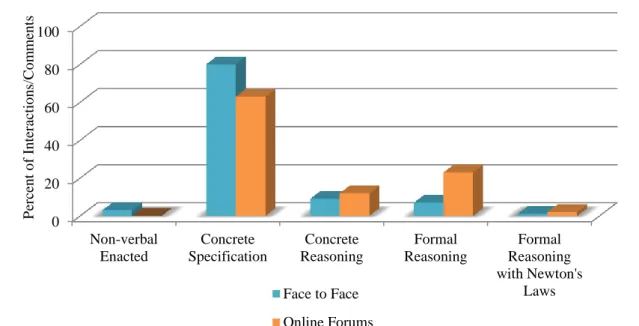
Students collaborated face-to-face constantly, but this collaboration generally took the form of requesting or specifying very concrete solutions to individual missions. Approximately 69% of the 251 face-to-face collaboration episodes involved concrete specification as the highest level of articulated reasoning in the episodes. Concrete reasoning, involving discussing or sharing reasoning for solving a mission without any explicit connection to physics ideas, was the highest level of articulated reasoning for 8% of the episodes. Formal reasoning that included some formal physics ideas or terminology accounted for 6% of the episodes. Formal reasoning that included some reference to Newton's laws accounted for only 1% of the episodes, and only occurred in interaction with the teacher.
Figure 3. Frequency of levels of physics reasoning in face-to-face and online forum collaboration Furthermore, 87% of the students posted at least one comment in the forums that articulated some level of concrete or physics-based reasoning, and the comments articulating higher levels of reasoning were distributed across students from each class period. This finding is in contrast to patterns observed on many public online forums on the internet, where only a very small percentage of participants account for the majority of the high level reasoning and the vast majority of participants are "lurkers" who do not post at all. Impressively, all of the comments articulating reasoning in terms of Newton's laws were posted by unique users with no user posting more than one (rather than all of the comments with Newton’s laws being posted by one “super user”).
Discussion
Student interactions in the online forums were three times more likely to employ formal physics reasoning than instances of face-to-face collaboration even though these interactions were coded more stringently (i.e., by individual post within a forum as opposed to simply the highest level of reasoning articulated within an entire episode of interaction). While this study is primarily exploratory in nature, we propose three possible explanations for the higher levels of physics reasoning observed in the online interactions relative to the face-to-face interactions.
First, the timing of the opportunity to post in the online forums immediately after a student successfully completes a mission creates and shapes the space available for reflection. Within the context of having successfully completed a mission, students are more apt to think about the strategies they used in order to beat the mission. Furthermore, since physics language is helpful in describing the solution to each mission in a written form (because pictures and screens are not available in the forums whereas they are available in the face-to-face interactions), the structure of the forums also shaped the nature of student postings. After completing a mission, the space of the online forums gives students an opportunity to generalize their gameplay strategies with the aim of communicating helpful advice to students who will play the mission in the future. These generalizations conformed to the abstract language of Newton’s laws, creating a direct path for students to communicate the principles governing the mission without having to go into depth about the specific strategies employed and paths charted to complete the mission. Thus both the timing (after completing a mission rather than during the process of seeking a solution) as well as the medium (text-only rather than affording deictic, verbal, and pictorial representations) incentivized students to engage in articulating higher levels of reasoning in their interactions online than face-to-face.
Building on this first explanation, a second proposed explanation is that the traditional classroom script (Gutierrez, Rymes, & Larson, 1995) constrains various forms of talk that, in contrast, are permitted by the scripts of the online forum space. Whereas it would be awkward to simply shout out about one of Newton’s laws when asked for help in face-to-face interactions, the online forums afford this mode of discourse. From a social perspective, students might also deem formal reasoning with Newton’s laws as less socially appropriate in the
0 20 40 60 80 100
Non-verbal Enacted
Concrete Specification
Concrete Reasoning
Formal Reasoning
Formal Reasoning with Newton's
Laws
P
er
ce
n
t o
f
In
ter
ac
tio
n
s/C
o
m
m
en
ts
face-to-face classroom space, whereas in the more removed space of the forum, in which students are positioned as mission experts after completing a mission, it is more acceptable to use formal reasoning to warrant advice. Constrained by the traditional classroom scripts, wherein speaking utilizing formal physics reasoning might be perceived as uncool, overly academic, or too risky if the language is used incorrectly, the space of the online forum better affords the use of formal language and gives students time to reflect on what they wrote before submitting it to the entire class. Similarly, the students may view the classroom script as inviting the question “How do I complete this task so I can move on to the next?” rather than “How does this work?” or “What is the pattern here that I can take forward?”
Finally, related to this second explanation, a third explanation focuses on the nature of the processes that students are engaged in at the time of the interactions (e.g., talking with their peers, physically completing missions for each other, or writing on the forums). Each of these processes or goals affords or constrains the level of physics reasoning that students engage in. As briefly mentioned, writing is a more reflective medium for generalizing advice with warrants after playing a mission, whereas talking with peers and gesture better afford procedural problem solving in the moment while playing a mission. Herein the goal of discourse changes. In face-to-face interactions the perceived goal may be to complete the mission as efficiently as possible, which frequently means doing it yourself for another person or telling the person exactly what to do without conceptual explanation. In the online forum, however, the goal of discourse is more easily framed and viewed as passing on knowledge that is useful independent of the presence of the person giving the advice. As a result, students must rely on a shared, formal language to point other students to the ideas embodied by the mission, rather than being able to troubleshoot the mission in the moment. Furthermore, students are repeatedly taught that one of the goals of writing is to persuade. As a result of the medium, students are pushed to provide additional warrants for their advice, providing rationale for their suggestions beyond procedural instructions, such as “Put this here because I’ve already beaten that mission and I’m telling you how I did it so you can move on.” Such assistance is sufficient in face-to-face interactions when the goal is construed as completing an activity rather than sense-making.
Helping students to explicitly articulate the key disciplinary relationships they are exploring in a digital game, or any activity in the classroom, is of great import. As Vygotsky (2012) clarified in Thought and Language, deep learning of formal concepts involves articulating and synthesizing abstract relationships across experiences. All three of these proposed explanations are interrelated and all may contribute to the higher levels of physics reasoning articulated in the online interactions relative to the face-to-face interactions. Furthermore, each proposed explanation provides an interesting lens for future research exploring the mechanisms underlying the relative affordances of each mode of interaction as students play digital games for learning.
Limitations
This is an exploratory study. The methods utilized to gather this dataset were not tailored to specifically prove or disprove any of the above explanations. In future studies, the following two related variables should be addressed and explored more deeply: (1) the shaping of discourse by goals, (2) the role of the teacher across diverse classroom configurations in fostering formal physics reasoning.
To better explore the affordances of face-to-face and online interactions, it would be instructive to conduct a comparison where the teacher or researcher could frame face-to-face interactions and online forum posting as having the same goal. Only in aligning the goals of both expression contexts can the affordances and limitations of the contexts be explored. The online forums were cast in the current study in a way that encouraged abstraction and reflection. Similar face-to-face activities, or hybrid activities, might prove even more effective if cast and structured in a manner encouraging abstraction and reflection as goals.
such a degree that the influences of the teacher – through curriculum, discourse norms, classroom culture and management – are present in the study to such a degree that their influence on student interaction is made visible. Only then can researchers undertake the difficult work of parsing the influences of teacher and the learning environments on student interactions.
Conclusions and Final Thoughts
Digital learning games show much promise for engaging students in rigorous content and shaping their ideas about the natural world. How students interact with digital learning games is more complex, however, than simple pre-post assessments can reveal. Further research must be undertaken to ascertain the effects of social interactions on formal reasoning while engaging with digital learning environments.
In this exploratory study, we observed five increasing levels of explicit articulation of physics reasoning across interactions in two distinct contexts – face-to-face collaboration and online forum postings. These levels of articulation ranged from basic forms of interaction, wherein students simply complete missions for one another, to levels of physics reasoning where students are connecting representations and actions in gameplay with the formal concepts and language in Newton’s laws of force and motion. We found that students were much more likely explicitly articulate formal physics reasoning in online forum interactions than they were in face-to-face collaborations. This insight is powerful in that in highlights the effects of different participation structures on the ways in which students reason while playing a digital game.
We then explored multiple possible explanations for these patterns of articulation in terms of differences in timing of interactions, affordances of medium, classroom scripts, and social norms. These exploratory conjectures, if confirmed by empirical study, have the potential to inform teacher practice and the design of participation structures as teachers seek to integrate digital games into their curricula. Research into the first two fields – issues of timing and medium – directly influences the design of participation structures in which both teachers and students engage around digital games in the classroom. These insights will provide teachers with clearer guidance around when and how to structure reflection and collaboration during gameplay in order to maximize learning opportunities for students. Research on the social structures and classroom scripts around digital games, as well as the creation of social norms that support inclusion of digital games in classrooms, will provide teachers with guidance for navigating and managing the social risks and affordances that students encounter and experience. Finally, continued research around digital games and classroom discourse structure will expand our knowledge of the ways in which teachers can capitalize on students’ pre-existing experience with games to build classroom communities focused on harnessing digital games for learning.
Acknowledgements
The research reported here was supported by the Institute of Education Sciences, U.S. Department of Education, through Grant R305A110782 to Vanderbilt University. The version of the learning environment used in the research was originally developed through support from the National Science Foundation through grant 1119290 to Vanderbilt University. The opinions expressed are those of the authors and do not represent views of the Institute, the U.S. Department of Education, or the National Science Foundation.
The authors would also like to acknowledge Stephanie Zuckerman, Sara C. Wilson, and Joy L. Sebikindu for help in coding and processing the data.
References
Aarseth, E. (2007). I fought the law: transgressive play and the implied player. proceedings of DiGRA 2005 Conference: Situated Play.
Annetta, L. A., Minogue, J., Holmes, S. Y., & Cheng, M. T. (2009). Investigating the impact of video games on high school students’ engagement and learning about genetics. Computers and Education, 53(1), 74-85. Asterhan, C. S. C. & Eisenmann, T. (2011). Introducing synchronous e-discussions in co-located classrooms: A
study on the experiences of 'active' and 'silent' secondary school students. Computers in Human Behavior, 27, 2169 - 2177.
Barab, S. A., Scott, B., Siyahhan, S., Goldstone, R., Ingram-Goble, A., Zuiker, S., & Warren, S. (2009). Transformational play as a curricular scaffold: Using videogames to support science education. Journal of Science Education and Technology, 18, 305-320. doi: 10.1007/s10956-009-9171-5.
Barab, S. A., Zuiker, S., Warren, S., Hickey, D., Ingram-Goble, A., Kwon, E-J., Kouper, I., & Herring, S. C. (2007). Situationally embodied curriculum: Relating formalisms and contexts. Science Education, 91, 750-782. doi: 10.1002/sce.20217.
Barron, B. (2000) Achieving Coordination in collaborative problem-solving groups. The Journal of the Learning Sciences, 9, 403-436.
Bluemink, J. & Järvelä, S. (2011). Elements of collaborative discussion and shared problem-solving in a voice-enhanced multiplayer game. Journal of Interactive Learning Research, 22(1), 23–50.
Bluemink, J., Hamalainen, R., Manninen, T., & Järvelä, S. (2010). Group-level analysis on multi- player-game collaboration: How do the individuals shape the group interaction? Journal of Interactive Learning Environments, 18, 365–383.
Charmaz, K. (2000). Grounded theory: Objectivist and constructivist methods. In N. Denzin & Y. Lincoln (Eds.), Handbook of qualitative research (2nd ed., pp. 509-535). Thousand Oaks, CA: Sage.
Clark, D. B. (2006). Longitudinal conceptual change in students’ understanding of thermal equilibrium: An examination of the process of conceptual restructuring. Cognition and Instruction, 24(4), 467–563. Clark, D.B., & Martinez-Garza, M. (2012). Prediction and explanation as design mechanics in conceptually
integrated digital games to help players articulate the tacit understandings they build through game play. In C. Steinkuehler, K. Squire, & S. Barab (Eds.), Games, learning, and society: Learning and meaning in the digital age (pp. 279-305). New York: NY: Cambridge University Press.
Dieterle, E. (2009). Neomillennial learning styles and River City. Children, Youth and Environments, 19(1), 245–278.
diSessa, A. A. (1988). Knowledge in pieces. In G. Forman & P. Pufall (Eds.), Constructivism in the computer age (pp. 49-70). Hillsdale, NJ: Lawrence Erlbaum Associates.
diSessa, A. A.(1993). Toward an Epistemology of Physics. Cognition and Instruction, 10(2&3), 105 - 225. diSessa, A., Gillespie, N. M., & Esterly, J. B. (2004). Coherence versus fragmentation in the development of the
concept of force. Cognitive science, 28(6), 843 - 900.
Echeverrîa, A., Améstica, M., Gil, F., Nussbaum, M., Barrios, E., & Leclerc, S. (2012). Exploring different technological platforms for supporting co-located collaborative games in the classroom. Computers in Human Behavior, 28, 1170-1177.
Federation of American Scientists. (2006). Report: Summit on Educational Games: Harnessing the Power of Video Games for Learning. Washington, D.C.
Garris, R., Ahlers, R., & Driskell, J. E. (2002). Games, Motivation, and Learning: A research and practice model. Simulation & Gaming, 33(4), 441 -467. doi:10.1177/1046878102238607.
Gee, J. P. (2007). What video games have to teach us about learning and literacy. Revised and Updated Edition (2nd ed.). Palgrave Macmillan.
Glaser, B., & Strauss, A. (1967). The discovery of grounded theory. Weidenfield & Nicolson, London.
Gutierrez, K., Rymes, B., & Larson, J. (1995). Script, counterscript, and underlife in the classroom: James Brown versus Brown v. Board of Education. Harvard Educational Review, 65(3), 445-472.
Hamalainen, R. (2011). Using a game environment to foster collaborative learning: a design based study. Technology, Pedagogy and Education, 20(1), 61-78.
Halhoun, I. A. & Hestenes, D. (1985). Common sense concept about motion. American Journal of Physics, 53, 1056-1065.
Hines, P. J., Jasny, B. R., & Merris, J. (2009). Adding a T to the three R’s. Science, 323, 53. doi: 10.1126/science.323.5910.53a.
Hogan, K., Nastasi, B. K., & Pressley, M. (2000). Discourse patterns and collaborative scientific reasoning in peer and teacher-guided discussions. Cognition and Instruction, 17, 379–432.
Honey, M. A., & Hilton, M. (Eds.). (2010). Learning science through computer games and simulations. National Research Council. Washington, DC: National Academy Press.
Jan, M., San, C.Y., and Tan, & E.M. (2011). Reconceptualizing science classroom discourse towards doing science through a game-based learning program. US-China Education Review B 6, 786-796.
Kafai, Y. B., Quintero, M., & Feldon, D. (2010). Investigating the “‘Why’”in Whypox: Casual and systematic explorations of a virtual epidemic. Games and Culture, 5, 116–135. doi: 10.1177/1555412009351265 Ketelhut, D. J. (2007). The impact of student self-efficacy on scientific inquiry skills: An exploratory
investigation in River City, a multi-user virtual environment. The Journal of Science Education and Technology, 16, 99–111. doi: 10.1007/s10956-006-9038-y.
Klopfer, E., Scheintaub, H., Huang, W., Wendal, D. & Roque, R. (2009). The Simulation Cycle: combining games, simulations, engineering and science using StarLogo TNG, E-Learning, 6, 71-96. doi: 10.2304/elea.2009.6.1.71.
Koster, R. (2004). A Theory of Fun for Game Design (1st ed.). Paraglyph Press.
Kuo, M. J. (2007). How does an online game based learning environment promote students’ intrinsic motivation for learning natural science and how does it affect their learning outcomes? Digital Game and Intelligent Toy Enhanced Learning (DIGETEL) 2007, (pp. 135-142). doi:10.1109/DIGITEL.2007.28. Martinez-Garza, M., Clark, D. B. & Nelson, B. (2013). Digital games and the US National Research Council’s
science proficiency goals. Studies in Science Education, 49, 170-208. doi: 10.1080/03057267.2013.839372
McGonigal, J. (2011). Reality is broken: Why games make us better and how they can change the world. New York, NY: Penguin Press.
Munz, U., Schumm, P., Wiesebrock, A., & Allgower, F. (2007). Motivation and learning progress through educational games. Industrial Electronics, IEEE Transactions on, 54(6), 3141-3144. doi:10.1109/TIE.2007.907030.
National Research Council. (2009). National research council workshop on games and simulations. October 6-7, 2009, Washington, D.C.
Pelletier, C. (2008). Gaming in Context: How Young People Construct Their Gendered Identities in Playing and Making Games. In Y. B. Kafai, C. Heeter, J. Denner, & J. Y. Sun (Eds.), Beyond Barbie and Mortal Kombat: new perspectives on gender and gaming. Cambridge, Mass: The MIT Press.
Ploetzner, R. Dillenbourg, P., Preier, M., & Traum, D. (1999). Learning by explaining to oneself and to others. In P.Dillenbourg (Ed.), Collaborative learning: Cognitive and computational approaches. (pp.103-121). Amsterdam: Pergamon Press.
Rochelle, J. (1992). Learning by collaboration: Convergent conceptual change. The Journal of the Learning Sciences, 2(3), 235-279.
Schwartz, D. (1995). The emergence of abstract representations in dyad problem solving. The Journal of the Learning Sciences, 4(3): 321–354.
Schwarz, B. B. & Asterhan, C. S. C. (2011). E-moderation of synchronous discussions in educational settings: A nascent practice. The Journal of the Learning Sciences, 20(3), 351-442.
Sins, P. H. M., Savelsbergh, E. R., van Joolingen, W. R., van Hout-Wolters, B. H. A. M. (2011). Effects of face-to-race versus chat communication on performance in a collaborative inquiry modeling task. Computers & Education, 56, 379-387.
Squire, K. (2005). Changing the game: What happens when video games enter the classroom. Innovate: journal of online education, 1(6), 25–49.
Squire, K. (2006). From content to context: Videogames as designed experience. Educational Researcher, 35(8), 19.
Squire, K. (2011). Video games and learning: Teaching and participating culture in the digital age. New York: Teachers College Press.
Squire, K. D. & Jan, M. (2007). Mad City Mystery: Developing scientific argumentation skills with a place-based augmented reality game on handheld computers. Journal of Science Education and Technology, 16, 5-29. doi: 10.1007/s10956-006-9037-z.
Squire, K.D. & Klopfer, E. (2007). Augmented reality simulations on handheld computers. Journal of the Learning Sciences, 16, 371-413. doi:10.1080/10508400701413435.
Steinkuehler, C. A. (2006). Massively multiplayer online video gaming as participation in a discourse. Mind, Culture, and Activity, 13(1), 38-52.
Steinkuehler, D. & Duncan, S. (2008). Scientific habits of mind in virtual worlds. Journal of Science Education and Technology, 17, 530-543. doi: 10.1007/s10956-008-9120-8.
Strauss, A. & Corbin, J. (1990). Basics of qualitative research. Grounded theory procedures and techniques. Newbury Park, CA: Sage.
Tuzun, H., Yilmaz-Soylu, M., Karakus, T., Inal, Y., & Kizilkaya, G. (2009) The effects of computer games on primary school students’ achievement and motivation in geography learning. Computers & Education, 52, 68-77.
Vygotsky, L. (2012). Thought and language (Revised and expanded edition). Cambridge, MA: MIT Press. White, B. (1984). Designing computera ctivitiest o help physics students understand Newton's laws of motion.
Cognition and Instruction, 1, 69-108.