RESEARCH ARTICLE
Cytokinin acts through the auxin influx carrier AUX1 to regulate cell
elongation in the root
Ian H. Street1, Dennis E. Mathews2, Maria V. Yamburkenko1, Ali Sorooshzadeh3, Roshen T. John1, Ranjan Swarup4, Malcolm J. Bennett4, Joseph J. Kieber5and G. Eric Schaller1,*
ABSTRACT
Hormonal interactions are crucial for plant development. In Arabidopsis, cytokinins inhibit root growth through effects on cell proliferation and cell elongation. Here, we define key mechanistic elements in a regulatory network by which cytokinin inhibits root cell elongation in concert with the hormones auxin and ethylene. The auxin importer AUX1 functions as a positive regulator of cytokinin responses in the root; mutation ofAUX1specifically affects the ability of cytokinin to inhibit cell elongation but not cell proliferation. AUX1 is required for cytokinin-dependent changes of auxin activity in the lateral root cap associated with the control of cell elongation. Cytokinin regulates root cell elongation through ethylene-dependent and -independent mechanisms, both hormonal signals converging on AUX1 as a regulatory hub. An autoregulatory circuit is identified involving the control ofARR10andAUX1expression by cytokinin and auxin, this circuit potentially functioning as an oscillator to integrate the effects of these two hormones. Taken together, our results uncover several regulatory circuits controlling interactions of cytokinin with auxin and ethylene, and support a model in which cytokinin regulates shootward auxin transport to control cell elongation and root growth.
KEY WORDS:Arabidopsis, Cytokinin, Ethylene, Auxin, Root Development, AUX1
INTRODUCTION
The root systems of plants are essential for survival, performing such functions as absorbing water and nutrients from the soil, storing food and nutrients, and providing anchorage (Giehl et al., 2014; Jones and Ljung, 2012). The architecture of the root system is developmentally plastic and responds to its environment by modifying such characteristics as primary root growth, lateral root density and lateral root growth, with root growth itself being dependent on both cell proliferation and cell elongation (Giehl et al., 2014; Jones and Ljung, 2012). Cell proliferation occurs at the root apical meristem (RAM), the stem cells of the RAM being organized around a mitotically inactive quiescent center (QC). The stem cells and their derived cells divide, each division shifting the cells further away from the QC (Perilli et al., 2012; Scheres et al., 2002). The
meristematic cells eventually cease dividing and begin to elongate and differentiate (Bennett and Scheres, 2010). Not surprisingly, multiple phytohormone signaling pathways interact to control root growth, including the hormone cytokinin, which inhibits both cell proliferation and elongation of root cells (Beemster and Baskin, 2000; Hwang et al., 2012; Moubayidin et al., 2009; Schaller et al., 2015; Vanstraelen and Benkova, 2012; Werner et al., 2003).
The cytokinin signaling pathway of plants is a phospho-relay similar to the two-component response systems of prokaryotes (Kieber and Schaller, 2014; Schaller et al., 2011; Werner and Schmülling, 2009). InArabidopsis, the cytokinin signaling pathway incorporates histidine kinase receptors (AHKs), histidine-containing phosphotransfer proteins (AHPs), and response regulators (ARRs), all encoded by multi-gene families. Signaling is initiated by cytokinin binding to and inducing autophosphorylation of the AHKs, which are predominantly localized to membranes of the endoplasmic reticulum. Phosphates are transferred from the receptors to cytosolic AHPs which, after movement into the nucleus, phosphorylate the type-B ARR transcription factors. Three type-B ARRs (ARR1, ARR10 and ARR12) play the predominant role in cytokinin signaling, with higher order mutants curtailing the ability of cytokinin to induce changes in gene expression and rendering the plant cytokinin insensitive (Argyros et al., 2008; Ishida et al., 2008; Mason et al., 2005) Among the transcriptional targets induced by the type-B ARRs are a second class of response regulators termed the type-A ARRs, which negatively regulate cytokinin signaling (Bhargava et al., 2013; To et al., 2004).
Cytokinin coordinates root development in concert with the phytohormones auxin and ethylene. Auxin, like cytokinin, regulates both cell proliferation and elongation of the root. Mutants affecting auxin biosynthesis, transport and signaling affect cytokinin responses (De Rybel et al., 2014; Dello Ioio et al., 2008; El-Showk et al., 2013; Schaller et al., 2015; Timpte et al., 1995; Zhou et al., 2011), indicative of the interaction between these two hormones in the control of root growth. The primary role explored for cytokinin-auxin cross-talk has been in the control of cell proliferation at the RAM, cytokinin inhibiting and auxin stimulating the anticlinal cell divisions that regulate RAM size (Dello Ioio et al., 2008; Schaller et al., 2014). Cytokinin-mediated control of cell proliferation appears to involve both transcriptional and post-transcriptional regulation of a subset of PIN auxin efflux carriers (Marhavý et al., 2011; Ruzicka et al., 2009; Zhang et al., 2011). Cytokinin and auxin also cross-talk to regulate cell division in the quiescent center of the root, with cytokinin repressing expression of LAX2, thus modulating auxin transport in the root tip (Zhang et al., 2013). Ethylene also plays a substantive role in root growth owing to its ability to inhibit cell proliferation and elongation, the inhibition of cell elongation being dependent on an ethylene-induced redistribution of auxin (Ruzicka et al., 2009; Swarup et al., 2007; Received 21 October 2015; Accepted 19 September 2016
1Department of Biological Sciences, Dartmouth College, Hanover, NH 03755, USA. 2Department of Molecular, Cellular, and Biomedical Sciences, University of New
Hampshire, Durham, NH 03824, USA.3Department of Agronomy, Tarbiat Modares
University, Tehran, Iran.4Centre for Plant Integrative Biology, School of
Biosciences, University of Nottingham, Nottingham LE12 5RD, UK.5Department of
Biology, University of North Carolina, Chapel Hill, NC 27599, USA. *Author for correspondence ([email protected])
I.H.S., 0002-1113-1415; J.J.K., 0002-5766-812X; G.E.S., 0000-0003-4032-2437
DEVEL
O
Thomann et al., 2009). Cytokinin stimulates ethylene biosynthesis, and the increased ethylene concentration is proposed to play a role in cytokinin-dependent inhibition of root cell elongation (Chae et al., 2003; Hansen et al., 2009; Vogel et al., 1998b). Substantial progress has been made in our understanding of how cytokinin, auxin and ethylene coordinate root growth and development but, given the complexity of this process, new mechanisms underlying their interactions continue to be discovered.
We performed a forward genetic screen to uncover key regulators that function in conjunction with cytokinin to control root growth. Through this screen, we identified the gene encoding the auxin influx-carrier AUX1 as a positive regulator of the root growth response to cytokinin. AUX1 is one of a four-memberArabidopsis family of auxin importers, and is a primary mediator for shootward auxin transport in the root (Bennett et al., 1996; Péret et al., 2012; Swarup et al., 2008). Through characterization of the role of AUX1 in cytokinin signaling, we determined that: (1) AUX1 mediates the ability of cytokinin to inhibit root cell elongation but not root cell proliferation; (2) AUX1 is required for cytokinin-dependent changes in auxin activity; and (3) cytokinin regulates root cell elongation through both ethylene-dependent and -independent mechanisms. Our results uncover several regulatory circuits that
control the interactions of cytokinin with auxin and ethylene, and support a model in which cytokinin regulates shootward auxin transport to control cell elongation and, ultimately, root growth.
RESULTS
A mutant screen identifiesAUX1as a positive regulator of cytokinin signaling in the root
ARR1,ARR10andARR12are the type-B ARRs that contribute most to cytokinin-dependent root development (Argyros et al., 2008; Ishida et al., 2008; Mason et al., 2005). Although single mutants have a minimal effect on cytokinin sensitivity, higher-order mutants show pronounced phenotypes consistent with overlapping function. For example, an arr1 arr12 double mutant has a longer root than thearr1orarr12single mutants when grown on cytokinin. To identify other genes that contribute to cytokinin regulation of root development, we generated ethyl-methanesulfonate (EMS)-mutagenized populations of arr12 and arr1 as sensitized backgrounds, and assayed for seedlings with long roots in the presence of exogenous cytokinin [0.1 µM 6-benzyl-aminopurine (BA); Fig. 1A]. We screened 20,000 M2 seeds of each genotype, using a pooling strategy, and confirmed six candidate mutations in the M3 generation. We named these mutantsenhancer of response
A
14
12
10
8
6
4
2
0
root length (mm)
WT err3-1 arr12 err3-1
arr12
arr1,12 err3-1
arr1,12
Mock 1 µM BA
a a
b b
c
e a,d
a,d f
d
d d
B
C
D
E
12
10
8
6
4
2
0
root length (mm)
WT lax1 lax2 lax3 aux1 aux1-121
(err3-1)
quad
a
Mock 1 µM BA
a a
a a
a a
b b b b
c
c c
WT arr12 arr1 arr12
err3-1 err3-1 arr12 err3-1 arr1 arr12
Gravity
5 mm
Fig. 1. A genetic screen identifiesAUX1as a positive regulator of cytokinin signaling in the primary root.(A) Design of the mutant screen to identify enhancer of response regulator(err) mutants; these enhance the cytokinin insensitivity, determined by the root growth response, of type-B ARR single mutants. (B) Root growth response to cytokinin of wild type (WT), single mutantserr3-1andarr12, double mutantserr3-1 arr12andarr1 arr12, and triple mutant err3-1 arr1 arr12. Seedlings were grown on vertical plates in the absence or presence of 1 µM BA (n≥20) for five days illuminated from above. (C) Agravitropic phenotypes of five-day-old light-grownerr3-1mutants. (D) A missense mutation inerr3-1results in a Pro371Leu change in AUX1. (E) Root growth response to 1 µM BA of WT compared with the AUX1/LAX auxin importer family single mutantslax1,lax2,lax3,aux1-21andaux1-121(err3-1), and the quadruple mutant lax1 lax2 lax3 aux1(quad) (n≥20). In B and E, groups marked by different letters are significantly different (P<0.05). Error bars represent s.e.m.
DEVEL
O
regulator (err) and describe in this paper results obtained from allelicerr3mutants.
Theerr3-1mutant was identified in thearr12enhancer screen. To examine the relative contribution of err3-1 to root growth responses, we introducederr3-1from theerr3-1 arr12background into wild-type andarr1 arr12backgrounds by crossing. Theerr3-1 mutant exhibited partial cytokinin insensitivity by itself in a root growth assay, but also significantly enhanced the cytokinin insensitivity exhibited by arr12 and arr1 arr12 (Fig. 1B). We also observed that the err3-1 mutant exhibited an agravitropic phenotype regardless of background (Fig. 1C), suggesting it might be allelic to AUX1(At2g38120), which encodes an auxin influx carrier and mutations in which also lead to an agravitropic phenotype (Bennett et al., 1996; Péret et al., 2012; Swarup et al., 2004). Indeed, we identified a Pro371Leu missense mutation in the coding sequence ofAUX1in theerr3-1line, suggesting thaterr3-1 is allelic toaux1(Fig. 1D). Similarly, we identified a second allele oferr3(err3-2) from thearr1enhancer screen and found it was the result of a Gly374Ser missense mutation inAUX1(Fig. S1A,B), confirming the significance of AUX1in mediating the cytokinin response. Botherr3-1anderr3-2alter amino-acid residues present in the extracellular loop between the ninth and tenth predicted transmembrane segments of AUX1 (Swarup et al., 2004). This region is highly conserved in the Arabidopsis amino acid/auxin permease superfamily that contains AUX1 (Swarup et al., 2004). A previously identified null allele ofAUX1(aux1-21) exhibited the same level of cytokinin insensitivity aserr3-1(Fig. 1E) (Bennett et al., 1996), consistent with err3-1 being a complete loss-of-function allele of aux1. Becauseerr3-1 and err3-2 are allelic to AUX1, we designated them asaux1-121andaux1-122, respectively
(Swarup et al., 2004), and use these designations for the remainder of the manuscript.
AUX1 is the founding member of the four-member AUX/LAX family of auxin-influx carriers inArabidopsis(Péret et al., 2012). We examined thelax1,lax2andlax3mutants to determine whether they also contributed to the cytokinin root growth response. The three singlelaxmutants were indistinguishable from wild type in their response to 1 µM cytokinin (Fig. 1E). Furthermore, the lax mutants did not enhance the aux1 mutant phenotype, as the cytokinin response ofaux1-21 lax1 lax2 lax3 quadruple mutant was not significantly different from that of theaux1single mutant (Fig. 1E) (Ugartechea-Chirino et al., 2010). These data are consistent with the hypothesis that AUX1 is a positive regulator of cytokinin-mediated root growth and that it performs a function that does not overlap with other family members in this regard. Our identification of AUX1mutant alleles through a forward genetic screen also corroborates an earlier finding that anaux1-7 loss-of-function allele exhibits reduced cytokinin sensitivity for root growth (Timpte et al., 1995).
The ability of cytokinin to inhibit cell elongation is dependent onAUX1
Cytokinins control root growth through effects on cell proliferation in the meristem as well as on cell expansion in the elongation zone (Beemster and Baskin, 2000; Dello Ioio et al., 2008; Marhavý et al., 2011; Ruzicka et al., 2009; Zhang et al., 2011), both of which decrease in wild type treated with exogenous cytokinin (Fig. 2). The single type-B mutants arr1, arr10 and arr12 all exhibit a small increase in meristem cell number (Hill et al., 2013; Dello Ioio et al., 2007), presumably owing to a reduction in endogenous cytokinin
B
0 20 40 60 80 100 120 140 160
a
a a
a a
a a a
a,c
b b
c
Elongation zone cell length (
µ
m)
WT arr12 arr1,12 aux1 aux1 arr12 arr1,12aux1
100 µm
5 10 15 20 30 35 40
25
0
Mock 1 µM BA
a a a a
b
b d
d
e e
c c
Root meristem size (cortex cell #) WT arr12 arr1,12 aux1 aux1
arr12 arr1,12aux1
A
BA
WT arr1,12 aux1
+ + +
-
-
-BA
WT arr1,12 aux1
+ + +
-
-
-Fig. 2. Cytokinin requiresAUX1to inhibit cell elongation but not cell proliferation at the root tip.Seedlings of wild type (WT), the single mutantsarr12and aux1-121, the double mutantsarr1 arr12andaux1-121 arr12, and the triple mutantaux1-121 arr1 arr12were grown in the absence or presence of 1 µM BA for 5 days. Representative images are stained with propidium iodide. (A) Effect on root meristem size. Meristem size was quantified by cortical layer cell counts (n≥10). Results of one representative experiment are shown. (B) Effect on root epidermal cell size. Cell lengths were quantified on the shootward side of the elongation zone at the region of root hair initiation (n≥20). Groups marked by different letters are significantly different (P<0.05). Error bars represent s.e.m.
Arrowheads indicate meristem size (A) and cell boundaries (B). Scale bars: 100 µm.
DEVEL
O
signaling. Thearr1 arr12double mutant, which shows pronounced cytokinin insensitivity (Mason et al., 2005), exhibits significant increases in both meristem cell number and cell length at the elongation zone (Fig. 2). Furthermore, the arr1 arr12 mutant is significantly resistant to the effects of exogenous cytokinin on both cell proliferation and elongation (Fig. 2).
AUX1 facilitates basipetal (shootward) auxin transport via the lateral root cap (LRC) and epidermal tissues as well as acropetal (rootward) transport via the phloem (Marchant et al., 2002; Swarup et al., 2001). Because AUX1expression spans the meristem and elongation zone, it could theoretically affect cytokinin’s control of cell proliferation and/or expansion. We therefore examined the effects ofaux1-121alone as well as in combination witharr12and arr1 arr12to determine the role of AUX1 in cytokinin-regulated cell proliferation and expansion (Fig. 2). We observed no effect of aux1-121on meristem size (Fig. 2A). For example, the meristem size of theaux1-121single mutant was indistinguishable from wild type in the absence or presence of cytokinin (Fig. 2A). Similarly, the aux1-121 mutant had no additive effect on the meristem phenotype in combination with arr12 and arr1 (Fig. 2A), suggesting that these type-B ARRs, but not AUX1, play a role in regulating cell proliferation in the root apical meristem (Fig. 2A). In contrast to what we observed for meristem size, the aux1-121 mutation had a substantial effect on the ability of cytokinin to regulate cell expansion in the elongation zone (Fig. 2B). Cell length of the aux1mutants aux1-121, aux1-121 arr12andaux1-121 arr1 arr12were indistinguishable from wild type in the absence of cytokinin, but were all insensitive to treatment with exogenous cytokinin. Like aux1-121, the independent aux1-21 allele affected the ability of cytokinin to inhibit cell expansion but not meristem size (Fig. S2C,D). Taken together, these data indicate that AUX1 plays a role in the ability of cytokinin to regulate cell elongation but not cell proliferation in the root. Consistent with this role for the shootward transport of auxin by AUX1 in mediating the cytokinin response, sensitivity foraux1 root growth to cytokinin was fully restored by expressingAUX1in the mutant LRC and epidermal tissues (Fig. S1C) using a GAL4-based transactivation system (Swarup et al., 2005).
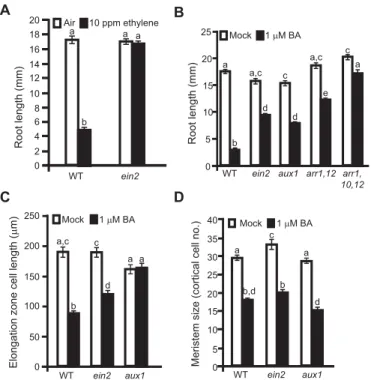
AUX1was previously found to mediate the inhibitory effect of ethylene on root cell elongation (Ru˚zicka et al., 2007; Stepanova et al., 2005; Strader et al., 2010; Swarup et al., 2007). As cytokinin increases ethylene biosynthesis (Cary et al., 1995; Chae et al., 2003; Hansen et al., 2009; Vogel et al., 1998a), we examined whether the inhibitory effect of cytokinin on cell elongation was ethylene dependent. To examine the role of ethylene, we used the ethylene-insensitive mutantein2-5(Fig. 3A) (Alonso, 1999). As shown in Fig. 3B, bothein2-5and aux1-7affect the ability of cytokinin to inhibit root growth. The effect ofein2-5on the cytokinin response is primarily due to the regulation of cell size, not cell proliferation (Fig. 3C,D), consistent with ethylene acting downstream of cytokinin to control cell elongation. However, whereas theaux1 mutant is completely insensitive to cytokinin, theein2-5mutant is only partially insensitive to cytokinin. These data indicate that cytokinin inhibits root cell elongation through ethylene-dependent as well as ethylene-independent mechanisms, with both mechanisms converging on AUX1 as a key mediator.
Expression of the type-B response regulatorARR10is dependent onAUX1and auxin
Because AUX1 genetically behaved as a positive regulator of cytokinin signaling, enhancing the type-Barrmutant phenotype, we hypothesized that theaux1mutant might affect expression of
type-B ARRs. We therefore examined expression of the seven subfamily-1 type-B ARRs in root tips by use of the NanoString nCounter system, a high-throughput, extremely sensitive and precise method of quantifying transcript abundance (Geiss et al., 2008; Malkov et al., 2009) and which is an effective means of following phytohormone responses (Bhargava et al., 2013; Tsai et al., 2012; Zhang et al., 2011). We performed NanoString analysis on wild type, aux1-21 and the arr1 arr12 cytokinin-insensitive mutant, with expression analyzed following 24-h growth on 1 µM BA or the DMSO vehicle control. We detected expression ofARR1, ARR2,ARR10andARR12(Fig. 4A; Fig. S2A), consistent with these being the most abundantly expressed type-B ARRs in the root tip (Hill et al., 2013). Two independent factors influenced expression of ARR10. First, expression of ARR10 was significantly reduced in aux1compared with wild type, being expressed at 64% of the wild-type level (Fig. 4A). Second, expression of ARR10 was also influenced by cytokinin, with cytokinin treatment resulting in a reduction inARR10expression to 59% of the wild-type level; this reduction in ARR10 expression was dependent on cytokinin signaling as no significant difference was observed in the arr1 arr12background (Fig. 4A). In theaux1background,ARR10was as responsive to cytokinin as in wild type, indicating that these factors independently influence expression ofARR10. We confirmed these effects on ARR10 expression by qRT-PCR using independently isolated root-tip mRNA and our aux1-121 allele (Fig. 4B). The cytokinin-dependent suppression of ARR10 expression required bothARR1andARR12, based on single mutant analysis (Fig. S2B). We did not observe inhibition ofARR10expression by cytokinin in
25
20
15
10
5
0
Root length (mm)
WT ein2 aux1 arr1,12 arr1, 10,12
Mock 1 µM BA
a a,c a
b d
d e c a,c
c
B A
250
200
150
100
50
0
Elongation zone cell length (
µ
m)
WT ein2 aux1
Mock 1 µM BA
a,c
a a
b d c
C
Meristem size (cortical cell no.)
35 40
30
25
20
5 10 15
0
WT ein2 aux1
Mock 1 µM BA
a
d a
b,d b c
D
20 18 16 14 12
10 8 6 4 2 0
Root length (mm)
WT ein2
Air 10 ppm ethylene a
b
a a
Fig. 3. The ethylene-insensitiveein2mutant confers partial insensitivity to cytokinin.(A) Root lengths of wild-type (WT) andein2-5seedlings grown in the absence or presence of 10 µl l−1ethylene (n≥20) for 7 days. (B) Root
lengths of WT as well asaux1-7,ein2-5,arr1 arr12andarr1 arr10-2 arr12 mutants grown in the absence or presence of 1 µM BA (n≥20) for 7 days. (C) Elongation zone cell lengths of roots from WT,ein2-5andaux1-7seedlings grown in the absence or presence of 1 µM BA (n≥20) for 7 days. (D) RAM cortex layer cell counts of WT,ein2-5andaux1-7seedlings grown in the absence or presence of 1 µM BA (n≥8) for 7 days. Groups marked by different letters are significantly different (P<0.05). Error bars represent s.e.m.
DEVEL
O
root tissue lacking the root tip (Fig. S2C). In contrast to theARR10 expression changes in the root tip, expression ofARR1,ARR2and ARR12 was not significantly affected by aux1 or by cytokinin (Fig. S2A).
The reduced expression ofARR10observed in theaux1mutant background suggests that mobilization of auxin is required for maintaining ARR10 expression. We therefore predicted that treatment of the aux1mutant with exogenous auxin could rescue ARR10expression back to its wild-type level. For this purpose, we treated seedlings with the natural auxin indole-3-acetic-acid (IAA) as well as with a membrane-permeable auxin naphthalene-acetic-acid (NAA) (Fig. 4C,D). We observed rescue ofARR10expression in the root tips ofaux1seedlings treated with NAA but not with IAA. These data are consistent with rescue of theaux1agravitropic phenotype by the membrane-permeable NAA (Marchant et al., 1999). Expression of the known auxin-regulated genesIAA19and SHY2was induced by IAA inaux1(Fig. S2D,E), demonstrating that the IAA treatment was effective and that expression of ARR10 differs from these genes in its requirement for AUX1-mediated transport. Furthermore, auxin induced expression ofARR10in the arr1 arr12background (Fig. 4C,D), consistent with auxin being a positive regulator of ARR10 expression and countering the suppression by cytokinin.
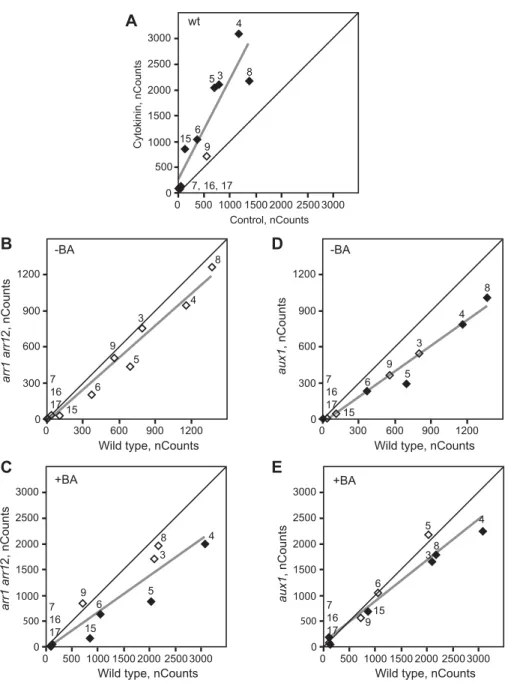
Based on the reduced expression ofARR10inaux1mutants, we predicted there could be effects on the induction of the type-A ARRs, which are cytokinin primary-response genes (To et al., 2004). We therefore examined expression of the ten type-A ARRs by NanoString analysis with the same RNA samples (wild type, aux1andarr1 arr12) used for Fig. 4A. Nine of the type-A ARRs were significantly induced by cytokinin in wild-type root tips (Fig. 5A; Fig. S2F). In the cytokinin-insensitivearr1 arr12mutant, the expression of multiple type-A ARRs was reduced compared with wild type, this effect being particularly apparent in the cytokinin-treated samples (Fig. 5B,C; Fig. S2F), consistent with
expression of type-A ARRs being dependent on transcriptional activity of type-B ARRs. In theaux1mutant, expression of multiple type-A ARRs was reduced compared with wild type, but here the effect was most pronounced on the basal expression level absent of exogenous cytokinin (Fig. 5D,E; Fig. S2F). Taken together, our results support the hypothesis that AUX1 and shootward auxin transport act to maintain ARR10 transcript levels in root apices, thereby influencing the expression of cytokinin primary-response genes. Furthermore, based on the role of ARR10 in mediating cytokinin signaling, control of ARR10expression represents one mechanism by which AUX1 might positively regulate cytokinin signaling in the root. As discussed later, the interaction of auxin and cytokinin in the regulation ofARR10could form an autoregulatory circuit controlling sensitivity to these two hormones.
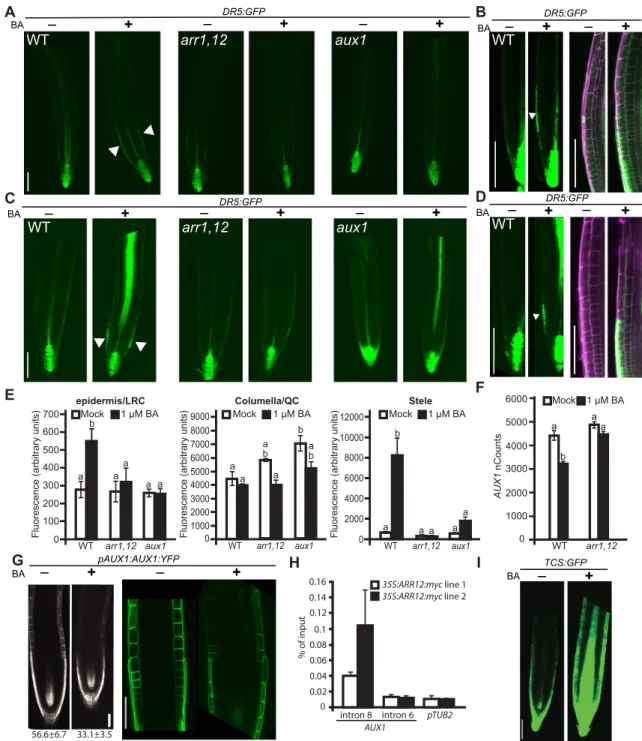
The type-B ARRs and AUX1 are similarly required for cytokinin-dependent regulation of auxin activity in the root To examine the role of cytokinin in regulation of the root auxin response, we crossed theDR5:GFPauxin reporter into various type-B ARR mutant backgrounds. Treatment with 1 µM type-BA significantly inducedDR5:GFPexpression in the outer cell layer of the wild-type LRC, the increased level of auxin activity being observed following 24-h or constant cytokinin treatment (Fig. 6A-E). The region of increasedDR5:GFPactivity in the LRC extends from a location approximately parallel to the QC up to the transition zone. We also observed significant induction of theDR5:GFPsignal in stele tissue but with longer-term kinetics of induction (Fig. 6A,C,E).
Induction of DR5:GFP in the outer cell layer and stele was eliminated in the cytokinin-insensitive arr1 arr12 mutant (Fig. 6A,C,E), consistent with it being dependent on the transcriptional activity of the type-B ARRs. Induction of DR5: GFP was also attenuated in the single type-B ARR mutants, indicating an overlapping function in the control of auxin activity (Fig. S3). Similar toarr1 arr12, induction ofDR5:GFPin response 0
200 400 600 800 1000 1200
ARR10
nCounts
WT arr1,12 aux1-21
a
a b
b
c
a
a b
a b
a b
b
c c
a a
a
c
c
b
b b
Mock 1 µM BA
0 0.2 0.4 0.6 0.8 1.0 1.2 1.4 1.6 1.8
Relative
ARR10
expression
WT arr1,12 aux1-121
Mock 0.1 µM IAA
A
C
D
B
Mock 0.1 µM NAA
0 0.2 0.4 0.6 0.8 1.0 1.2 1.4 1.6 1.8
Relative
ARR10
expression
WT arr1,12 aux1-121
0 0.2 0.4 0.6 0.8 1.0 1.2 1.4
Relative
ARR10
expression
Mock 1 µM BA
WT arr1,12 aux1-121
a
a
a
d
Fig. 4. Effects of auxin and cytokinin on expression of
ARR10.(A) Cytokinin inhibits expression ofARR10. NanoString analysis ofARR10levels in 7-day-old 1-mm primary root tips of wild type (WT),arr1 arr12andaux1-21treated in the absence or presence of 1 µM cytokinin for 24 h. Groups marked by different letters are significantly different (P<0.05). (B) qRT-PCR validation of the data shown in A in WT,arr1 arr12andaux1-121. (C) Auxin stimulates expression ofARR10in anaux1-dependent manner. Expression ofARR10in root tips of WT,arr1 arr12andaux1-121 of 7-day-old seedlings in the presence or absence of 100 nM IAA. (D) Expression ofARR10in root tips of WT,arr1 arr12and aux1-121of 7-day-old seedlings in the presence or absence of membrane-permeant 100 nM NAA. Relative levels ofARR10in B-D are normalized to the untreated wild-type control. Error bars represent s.e.m. based on three biological replicates (n=3), with each replicate containing 50-100 root tips.
DEVEL
O
to cytokinin in was also strongly attenuated in the aux1 mutant (Fig. 6A,C,E). We conclude that the cytokinin induction of auxin activity in the root outer cell layer is dependent on both the type-B ARRs and AUX1, consistent with both acting as positive regulators of cytokinin responses in the root.
To determine whether cytokinin regulates auxin activity by controlling expression of AUX1/LAX family genes, we performed NanoString analysis on its four members. Expression was analyzed in root tips in the presence or absence of 24-h treatment with 1 µM BA. Consistent with previous work (Zhang et al., 2013), LAX2 exhibited the most pronounced change, decreasing in response to exogenous cytokinin to 31% of the untreated control; AUX1 exhibited a more modest decrease to 73% of the untreated control (Fig. 6F; Fig. S4B). The decrease in message levels of AUX1is reflected at the protein level based on fluorescence analysis of a pAUX1:AUX1-YFP translational fusion (Swarup et al., 2004), which decreased to 58% of the untreated control in response to growth on 1 µM BA (Fig. 6G). The BA-induced decrease in pAUX1:AUX1-YFPoccurred similarly in both the LRC and in the epidermal cell layer just above it, although the LRC region
exhibited 20-fold higher AUX1-reporter expression than the epidermal cell region. We noted that the AUX1 gene was enriched for extended type-B ARR binding motifs in intron 8 (Fig. S4A) (Franco-Zorilla et al., 2014) and therefore hypothesized thatAUX1might be a direct target of the type-B ARRs. ChIP-qPCR with a CaMV35S:ARR12:MYC construct revealed binding of ARR12 to intron 8 but not to intron 6 ofAUX1, consistent with cytokinin suppressingAUX1expression through direct action of the type-B ARRs (Fig. 6H). Additionally, examination of cytokinin transcriptional activity using theTCS:GFPreporter (Zürcher et al., 2013) revealed that cytokinin activity overlaps the region ofAUX1 expression (Fig. 6G,I), consistent with cytokinin modulating auxin flux through action of AUX1. These data indicate that the expression level ofAUX1is regulated in part through cytokinin-dependent effects on gene expression, and these may thus contribute to changes in auxin activity.
Changes in auxin activity are likely to involve multiple regulators, and so we also examined the root tip for additional cytokinin-dependent changes in gene expression. NanoString analysis of the PIN family of auxin efflux carriers revealed that 0
1000 1500 3000
0 500 1500 2000 3000
wt
Control, nCounts
Cytokinin, nCounts
7, 16, 17 15
9 6
5 3 4
8 2500
2000
500
1000 2500
0 1000 1500 3000
0 500 1500 2000 3000
Wild type, nCounts
arr1 arr1
2, nCounts
7 16
17 15
9 6
5 3
4 8 2500
2000
500
1000 2500
+BA
0 600 1200
0 300 600 900
Wild type, nCounts
arr1 arr1
2, nCounts
7 16 17
15 9
6 5
3
4 8
900
300
1200
-BA
0 600 1200
0 300 600 900
Wild type, nCounts
aux1
, nCounts
7 16 17
15 9
6 5
3 4
8
900
300
1200
-BA
0 1000 1500 3000
0 500 1500 2000 3000
Wild type, nCounts
aux1
, nCounts
7 16 17
15 9
6 5
3
4
8 2500
2000
500
1000 2500
+BA
7 7
3 3
4
8
A
B
D
C
E
Fig. 5. Type-AARRexpression is attenuated in
aux1-21andarr1 arr12mutant backgrounds.
Seven-day-old seedlings were treated in the absence or presence of 1 µM BA for 24 h, and NanoString expression analysis of type-A ARRs performed on 1-mm primary root tips. (A) Type-A ARR induction by cytokinin in wild type. (B) Type-A ARR expression inarr1 arr12compared with wild type in the absence of cytokinin (−BA). (C) Type-A ARR expression inarr1 arr12compared with wild type in the presence of cytokinin (+BA). (D) Type-A ARR expression inaux1-21compared with wild type in the absence of cytokinin (−BA). (E) Type-A ARR expression inaux1-21compared with wild type in the presence of cytokinin (+BA). Points represent the mean of three biological replicates. Black lines at 45° angles in plots indicate position of equivalent expression level. Gray lines are best-fit lines to indicate overall skewing of type-A ARR expression. Numbers next to points label individual type-A ARR genes. Filled symbols indicate significant differences for type-A ARR expression between the conditions examined (P<0.05).
DEVEL
O
cytokinin induced a modest decrease inPIN2expression to 77% of the untreated control, and modest increases in PIN4 and PIN7 expression to 166% and 160% of the untreated control, respectively (Fig. S4B), consistent with previous reports (Ruzicka et al., 2009). The arr1 arr12 mutant eliminated or attenuated these effects of
cytokinin on gene expression. Expression analysis also indicated that cytokinin stimulated the expression ofABCG36, which encodes an indole-3-butyric acid (IBA) efflux carrier, and TAR2, which encodes a tryptophan aminotransferase for auxin biosynthesis (Fig. S4C) (Stepanova et al., 2008; Strader and Bartel, 2009). These
0 1000 2000 3000 4000 5000 6000
AUX1
nCounts
WT arr1,12
a aa
b
Mock 1 µM BA A
C D
B
E F
G H I
0 100 200 300 400 500 600 700
Fluorescence (arbitrary units)
WT arr1,12 aux1
Mock epidermis/LRC
1 µM BA
a b
a a
a a
0 2000 4000 6000 8000 10000 12000
Fluorescence (arbitrary units)
WT arr1,12 aux1 Stele Mock 1 µM BA
a a a a a b
0 1000 2000 3000 4000 5000 6000 7000 8000 9000
Fluorescence (arbitrary units)
WT arr1,12 aux1 Columella/QC Mock 1 µM BA
a a
a b
b
a a b
WT
–
+ arr1,12 aux1BA
DR5:GFP
–
+–
+56.6±6.7 33.1±3.5
BA
pAUX1:AUX1:YFP
–
+–
+WT
–
+ arr1,12 aux1BA
DR5:GFP
–
+–
+TCS:GFP
BA
–
+DR5:GFP
–
+–
+BA
intron 8 intron 6 pTUB2
0 0.02 0.04 0.06 0.08 0.1 0.12 0.14
0.16 35S:ARR12:myc line 1
35S:ARR12:myc line 2
% of input
AUX1
BA
DR5:GFP
–
+–
+WT WT WT
Fig. 6. Cytokinin induction of auxin activity in the root is dependent on type-B ARRs andAUX1.(A,B) Representative images ofDR5:GFPreporter activity in wild-type (WT),arr1 arr12andaux1-7backgrounds after 24 h in the absence or presence of 1 µM BA. Arrowheads indicate induction of DR5 reporter in the outer cell layers. (C,D) Representative images ofDR5:GFPreporter activity in WT,arr1 arr12andaux1-7backgrounds grown in the presence or absence of constant 1 µM BA. (B,D) Close-up images in WT showing cytokinin-induced DR5:GFP activity (green) in the LRC; propidium iodide was used as a cell wall stain ( purple). (E) Quantification of tissue-specificDR5:GFPsignal from experiment shown in C (n=5). Groups marked by different letters are significantly different by ANOVA applying Bonferroni correction post-test comparisons (P<0.05). (F) NanoString expression analysis ofAUX1transcript from 1-mm root tips of 7-day-old seedlings after 24 h in the absence or presence of 1 µM BA. (G) Representative images ofpAUX1:AUX1:YFPexpression after growth in the absence or presence of 1 µM BA. Numbers are relative quantification ofpAUX1:AUX1:YFPfluorescence (±s.e.m.;n=5;P<0.05). (H) ARR12 binds to intron 8 ofAUX1based on ChIP-qPCR analysis. ChIP analysis was performed on 3-week-old seedlings with two independent35S:ARR12:myclines treated with 5 µM BA for 30 min. Three biological replicates of each line were analyzed (error bars represent s.d.).TUB2and intron 6 ofAUX1are negative controls. (I) Representative images ofTCS: GFPreporter showing induction of cytokinin activity in 7-day-old root tips treated for 24 h with 1 µM BA or a vehicle control. Scale bars: 100 µm (A-D,I); 50 µm (G).
DEVEL
O
data indicate that cytokinin induces additional changes in gene expression that are predicted to affect both auxin transport and biosynthesis. Significantly, PIN2, tissue-specific expression of which overlaps with that ofAUX1, exhibits a similar reduction in expression in response to cytokinin.
DISCUSSION
Cytokinin regulates primary root growth through inhibitory effects on both cell proliferation and elongation (Beemster and Baskin, 2000; Hwang et al., 2012; Kieber and Schaller, 2014; Moubayidin et al., 2009; Schaller et al., 2014). Here, we define regulatory elements specific to the mechanism by which cytokinin inhibits root cell elongation, these involving modulation of both auxin and ethylene activity. Our results establish a genetic circuit whereby the auxin-influx carrier AUX1 operates downstream of cytokinin perception to regulate shootward auxin transport, this involving both ethylene-dependent and -independent mechanisms (Fig. 7A). Our results also provide insight into how cytokinin-dependent changes in transporter expression regulate auxin activity and, through a feedback circuit (Fig. 7B), have the capacity to establish oscillating patterns of gene expression. Our results complement the extensive literature on cytokinin-auxin interactions, and, more specifically, the significance of cytokinin control of auxin transport, which, within the root alone, regulates such diverse processes as vascular patterning, lateral root development and the control of meristem size (Bishopp et al., 2011; Schaller et al., 2015). Below, we discuss our results within the context of what is known about the interactions of cytokinin, auxin and ethylene in the control of root cell elongation and RAM size.
Our results define a genetic circuit whereby cytokinin inhibits cell elongation through AUX1-dependent changes in auxin activity at the root tip (Fig. 7A). A role for cytokinin in controlling shootward auxin transport is consistent with the distribution of cytokinin activity based on analysis of the Two-Component signaling Sensor (TCS) reporter and measurement of cytokinin levels in cells of the root apex (Antoniadi et al., 2015). Cytokinin-dependent stimulation of auxin activity in outer cells of the LRC was previously observed (Ruzicka et al., 2009), consistent with what we observe. Our results expand on this prior observation by directly linking the effect of cytokinin on auxin activity in this region to the control of cell elongation, not cell proliferation. Furthermore, we find that cytokinin insensitivity (type-B ARR mutants) or loss ofAUX1result in an inability to induce this zone of auxin activity, as well as an inability to inhibit cell elongation. Because a primary function for AUX1 in these tissues is to mediate shootward auxin transport (Band et al., 2014; Marchant et al., 1999; Swarup et al., 2005), our results support a model in which modulation of shootward auxin flux acts as a key mechanism by which cytokinin controls cell elongation.
We find that AUX1 mediates the inhibitory effects of cytokinin on cell elongation, but is not essential for the inhibition of cell proliferation by cytokinin in the RAM. These results indicate that the regulatory effects of cytokinin on cell expansion and proliferation in the root are separable, such regulatory independence probably being facilitated by the spatial separation of the RAM and elongation zone, with shootward auxin flux controlling cell expansion and rootward auxin flux controlling cell proliferation (Fig. 7A) (Dello Ioio et al., 2008). It has been recently proposed that a shootward auxin flux may mediate communication between the QC and the transition zone to control cell proliferation at the RAM (Moubayidin et al., 2013). However, a prediction of that proposal is that loss of the shootward flux, such as that which occurs in anaux1mutant, would result in an altered RAM size. We do not observe such anaux1-dependent effect on RAM size (i.e. the ability of cytokinin to inhibit cell proliferation of the RAM is unaffected by theaux1mutation), indicating that alternative mechanisms exist to coordinate RAM behavior between the QC and the transition zone. Ethylene also contributes to the inhibitory effects of cytokinin on root cell elongation based on genetic analysis (Fig. 7A). Ethylene-insensitive mutants were first demonstrated to be hyposensitive to cytokinin in regards to overall root growth over two decades ago (Su and Howell, 1992). Since then, a role for ethylene in mediating the effects of cytokinin specifically on root cell elongation has been proposed based on the ability of cytokinin to induce ethylene biosynthesis (Chae et al., 2003; Hansen et al., 2009; Vogel et al., 1998a) and the finding that ethylene inhibits root growth through effects on cell elongation (Bleecker et al., 1988; Kieber et al., 1993; Le et al., 2001). Furthermore, the effects of ethylene on root cell elongation, like cytokinin, require AUX1-dependent changes in auxin distribution (Ru˚zicka et al., 2007; Swarup et al., 2007). Our results confirm the proposed role for ethylene in the cytokinin response but also, in contrast to prior results, indicate that ethylene-independent mechanisms exist by which cytokinin controls auxin activity. Thus, cytokinin directly affects the AUX1-dependent auxin flux. An overestimation of the role played by ethylene in the cytokinin response may have arisen in part due to use of the ethylene biosynthesis inhibitor 2-aminoethoxyvinyl glycine (AVG) and signaling inhibitor silver ion (Ruzicka et al., 2009; Ru˚zicka et al., 2007), which both also affect auxin activity (Soeno et al., 2010; Strader et al., 2009), thereby confounding interpretation of some results. Additionally, ethylene inhibits cell proliferation at the RAM
Inhibition of cell proliferation Inhibition of
cell elongation
CK SHY2
C2H4 Auxin movement
CK AUX1
C2H4 ARR1 ARR12 ARR10
ARR1 ARR12 ARR10
CK
ARR1 ARR12 ARR10
AUX1
auxin A
B
Fig. 7. Model for cytokinin inhibition of root cell elongation and proliferation.(A) Genetic model for control of root cell elongation and proliferation by cytokinin (CK). The cytokinin signal is transmitted through a two-component signaling pathway involving AHKs, AHPs and type-B ARRs. The auxin influx carrier AUX1 functions downstream of the cytokinin signaling pathway to mediate shootward auxin transport, leading to localized increases in auxin activity, and inhibition of cell elongation. The auxin signaling repressor SHY2 functions downstream of the cytokinin signaling pathway to inhibit rootward auxin transport, resulting in reduced cell proliferation of the RAM. The regulation of auxin activity by cytokinin involves ethylene-dependent and -independent mechanisms. The model is based on results from this study, as well as those of Růzicka et al. (2007), Dello Ioio et al. (2008) and Street et al. (2015). (B) An autoregulatory circuit (oscillator) by which auxin and cytokinin
regulate expression ofARR10andAUX1.
DEVEL
O
and contributes to the cytokinin response here as well (Street et al., 2015) (Fig. 7A), which may also affect analysis of the role of cytokinin in regulating root growth.
Although AUX1-mediated transport of auxin is necessary for cytokinin-dependent control of cell elongation, we find that the expression ofAUX1is inhibited by cytokinin, a finding that might seem counterintuitive at first.AUX1is a direct target for cytokinin regulation based on type-B ARR12 binding to intron 8, the repression of gene expression by transcription factor binding to introns being well-documented and serving, for example, to repress the expression of AGAMOUS (Sieburth and Meyerowitz, 1997; Dinh et al., 2012). The expression ofPIN2, which encodes an auxin-efflux carrier involved in shootward auxin transport, is also reduced in response to cytokinin (Ruzicka et al., 2009). Cytokinin thus represses the expression of two key regulators that mediate the shootward auxin flux, this correlating with the increase in auxin activity in the LRC. We hypothesize that the transition zone is a
‘bottleneck’for auxin transport, based on the lower level of AUX1 in the epidermal cells of the transition zone compared with the LRC, such that a decrease in AUX1 levels will reduce auxin transport out of this region and result in increased auxin activity and an inhibition of cell elongation. Thus, AUX1 is needed for shootward auxin transport to its site of action at the transition zone, the observed expression changes serving to concentrate auxin in this region. Consistent with this hypothesis, cytokinin reduces the shootward transport of IAA (Zhou et al., 2011). Cytokinin also induced expression ofABCG36, which encodes an IBA efflux carrier, as well asTAR2, which encodes a tryptophan aminotransferase, further emphasizing the importance of auxin transport and biosynthesis in controlling the cytokinin response at the root tip (Stepanova et al., 2008; Strader and Bartel, 2009).
We uncovered a feedback circuit involving expression of the type-B response regulator ARR10and AUX1(Fig. 7B), and it is likely that this circuit also plays a role in integrating the effects of cytokinin and auxin on cell elongation and differentiation. AUX1-dependent increases in auxin activity positively regulate expression of ARR10, which would increase cytokinin activity. However, cytokinin acting through the type-B ARRs negatively regulates expression ofAUX1as well as of ARR10, which would decrease cytokinin activity. Regulation ofARR10expression, in comparison to other members of the type-B ARR family, may be of particular significance owing to its protein stability (Argyros et al., 2008; Hill et al., 2013; Kim et al., 2013, 2012) and enrichment in the epidermal layer where AUX1 is also most active (Argyros et al., 2008; Band et al., 2014), thereby placing ARR10 within a region particularly sensitive to changes in auxin flux. Such cytokinin-auxin antagonism is a common motif in hormonal regulation (Schaller et al., 2015) and here takes the form of a regulatory feedback circuit similar to that of circadian oscillators. Interestingly, the region bordering the RAM has been referred to as the‘oscillation zone’ owing to its role in establishing oscillating patterns of gene expression in a manner that is partially dependent on root cap-derived auxin (Moreno-Risueno et al., 2010; Xuan et al., 2015). This is also the region in which type-B ARRs are maximally expressed and mediate effects of cytokinin on cell differentiation. Therefore, the auxin-cytokinin feedback circuit described here could establish oscillating patterns of gene expression and of shootward auxin flux through AUX1 in the root. Non-transcriptional mechanisms might also play a role in short-term regulation of auxin transport, such as phosphorylation and/or subcellular trafficking of the transporters (Kleine-Vehn et al., 2006; Rashotte et al., 2001; Rigó et al., 2013; Robert and Offringa, 2008;
Titapiwatanakun and Murphy, 2009; Zourelidou et al., 2014), although cytokinin-dependent changes in membrane localization/ endocytosis have not yet been observed for AUX1 or PIN2 (Marhavý et al., 2011).
MATERIALS AND METHODS Plant material and growth conditions
Wild-type and mutant lines ofArabidopsis thalianaare Columbia ecotype. The type-B ARR, AUX/LAX and ein2-5mutants have been previously described (Argyros et al., 2008; Mason et al., 2005; Ugartechea-Chirino et al., 2010; Vogel et al., 1998a). We used thearr12-1andarr1-3mutant alleles for these studies and refer to these asarr12andarr1for convenience. TheAUX1:AUX1:YFP(Swarup et al., 2004) andDR5:GFP(Ulmasov et al., 1997) reporter constructs were introduced into mutant backgrounds by crossing; genotyping primers are given in Argyros et al. (2008) and Table S1. TheTCS:GFPreporter for cytokinin activity has been previously described (Zürcher et al., 2013). Seedlings for molecular and physiological assays were grown on medium containing 1× Murashige and Skoog (MS) salts with Gamborg’s vitamins and MES (Research Products International), 1% (w/v) sucrose and 0.9% (w/v) phytoagar (Research Products International) under continuous white light (100μE m−2s−1) at 22°C, as
previously described (Argyros et al., 2008). BA was included in the medium for exogenous cytokinin treatment, the control containing the DMSO vehicle.
Mutant screen
For mutagenesis, 5000 M0 generationarr12orarr1seeds were treated with 0.2% (v/v) EMS (Sigma), pooled (∼100 seeds per pool), and the M1 generation seeds harvested from the plants and selfed. We screened 20,000 M2 seeds of each genotype, using a pooling strategy with approximately 500 seeds per pool for the identification oferrmutants. The M2 seeds were sown on media containing 0.1 µM BA with wild-type and type-Barrmutant background controls. Five-day-old M2 seedlings with long roots relative to thearr12orarr1single mutants were selected. Cytokinin insensitivity was confirmed in the M3 generation for six of the candidateerrmutants.err
mutants were crossed into wild type and arr1 arr12 to assess the contribution of the type-B arr mutant background to theerr cytokinin sensitivity. The primers used for genotypingerrandarrmutant alleles are given in Table S1, with genotyping performed as previously described (Argyros et al., 2008). Mutant alleles used in this study are given in Table S2.
Root meristem size and cell length determination
Seedlings were cleared with chloral hydrate as described (Perilli and Sabatini, 2010). To determine the size of the root meristem, cells of the cortex layer were counted in a file extending from the QC to where the cell length exceeded its width using a Nikon Eclipse 90i optical microscope with Nomarski optics and the 20× objective as previously described (Perilli and Sabatini, 2010). Cell length was determined from images captured with a Cool Snap HQ2 digital camera (Photometrics) from trichoblast cells at the shootward end of the elongation zone, based on where root hair primordia emerge in wild-type plants (Le et al., 2001). Cell length was measured using ImageJ software (Abramoff et al., 2004).
RNA isolation and expression analysis
Seeds were plated on 20-μm nylon mesh (BioDesign). Fifty root tips (1 mm) from seven-day-old seedlings were harvested following 24-h treatment with 1 µM BA or a vehicle control. Root tips were placed immediately in RNAlater (Life Technologies); the RNAlater solution was removed within 24 h and the tissue frozen in liquid nitrogen. The tissue was ground using a Retsch Tissuelyzer and RNA extracted using an RNeasy Plant RNA Isolation Kit (Qiagen). Reverse transcription was performed using Bio-Rad iScript cDNA Synthesis Kit.
NanoString gene expression analysis was performed using a custom probe set (NanoString Technologies) targeted against type-A and type-B ARRs, AUX1/LAX family members and PIN family members (Table S3). Three biological replicates, with 400 ng of total RNA from 1 mm root tips,
DEVEL
O
were submitted for nCounter analysis. Geometric mean and background subtraction were performed using nSolver software v1.1 (Geiss et al., 2008; Malkov et al., 2009). Counts were normalized using NanoString internal positive controls as well as threeArabidopsiscontrol genes included in the probe set: At1g13320 (PROTEIN PHOSPHATASE 2A), At4g05320 (UBIQUITIN 10) and At5g44340 (BETA-TUBULIN 4). Normalized counts were averaged and analyzed by a two-way ANOVA.
qRT-PCR was performed using the Bio-Rad iTaq SYBR-green system, with three biological replicates and three technical replicates each per treatment. Relative expression was calculated using theΔΔCt values and normalized to the wild-type non-treated control. Primers are listed in Table S1.
To image and evaluate relative expression of fluorescent reporters, a Nikon A1 confocal microscope was used. At least five seedlings per line were imaged and ImageJ software was used to quantify fluorescence by the ‘corrected total cell fluorescence’method (Burgess et al., 2010). Cell walls were visualized by staining with 10 µg/ml propidium iodide.
ChIP analysis
ChIP-qPCR was performed in biological triplicate with two independent lines of35S:ARR12-Mycexpressed in wild-type background. TheARR12
construct was generated by cloning a genomic DNA fragment ofARR12
into the vector pEarleyGate 203 (Earley et al., 2006), using primers ATGACTGTTGAACAAAATTTAGAA and TATGCATGTTCTGAGT-GAACT for initial amplification of ARR12. Three-week-old seedlings were treated with 5 µM BA in liquid MS media for 30 min, and tissue cross-linking, chromatin isolation, and immunoprecipitation performed as described (Zhang et al., 2013). Immunoprecipitation was performed using anti-Myc (ab9132, Abcam; 5 µg/sample) antibodies and MagnaChIP protein A+G Magnetic beads (EMD Millipore). Input and ChIP DNA were examined by qRT-PCR using the primers listed in Table S1.
Statistical analyses
ANOVA tables were generated using http://www.physics.csbsju.edu/stats/ anova.html and multiple comparison tests performed using the QuickCalcs web tool (http://graphpad.com/quickcalcs/posttest1), which uses the Bonferroni correction for post-test comparisons.
Accession numbers
ARR1 (At3g16857), ARR10 (At4g31920), ARR12 (At2g25180), AUX1
(At2g38120),LAX1(At5g01240),LAX2(At2g21050),LAX3(At1g77690),
EIN2(At5g03280).
Acknowledgements
A.S. gratefully acknowledgesfinancial support from Tarbiat Modares University and
extends thanks to G.E.S. and his lab for their kindness while he performed research during his sabbatical leave.
Competing interests
The authors declare no competing or financial interests.
Author contributions
I.H.S., J.J.K. and G.E.S. designed the study. I.H.S., with contributions from M.V.Y., R.T.J. and A.S., performed the experiments and analyzed the data. D.E.M., R.S. and M.J.B. generated materials. I.H.S. and G.E.S. wrote the manuscript with input from all authors.
Funding
This work was supported by the National Science Foundation [IOS-1022053 and IOS-1238051 to G.E.S. and J.J.K., IOS-1456487 to G.E.S.]; a Biotechnology and Biological Sciences Research Council (BBSRC) Professorial Research Fellowship award to M.J.B.; and a BBSRC award to the Centre for Plant Integrative Biology (R.S. and M.J.B.). Deposited in PMC for release after 6 months.
Supplementary information
Supplementary information available online at
http://dev.biologists.org/lookup/doi/10.1242/dev.132035.supplemental
References
Abramoff, M. D., Magalhães, P. J. and Ram, S. J.(2004). Image processing with
imageJ.Biophoton. Int.11, 36-42.
Alonso, J. M. (1999). EIN2, a bifunctional transducer of ethylene and stress
responses in Arabidopsis.Science284, 2148-2152.
Antoniadi, I., Plačková, L., Simonovik, B., Doležal, K., Turnbull, C., Ljung, K. and Novák, O. (2015). Cell-type-specific cytokinin distribution within the
Arabidopsis primary root apex.Plant Cell27, 1955-1967.
Argyros, R. D., Mathews, D. E., Chiang, Y.-H., Palmer, C. M., Thibault, D. M., Etheridge, N., Argyros, D. A., Mason, M. G., Kieber, J. J. and Schaller, G. E. (2008). Type B response regulators of Arabidopsis play key roles in cytokinin
signaling and plant development.Plant Cell20, 2102-2116.
Band, L. R., Wells, D. M., Fozard, J. A., Ghetiu, T., French, A. P., Pound, M. P., Wilson, M. H., Yu, L., Li, W., Hijazi, H. I. et al.(2014). Systems analysis of auxin
transport in the Arabidopsis root apex.Plant Cell26, 862-875.
Beemster, G. T. S. and Baskin, T. I.(2000).Stunted plant 1mediates effects of cytokinin, but not of auxin, on cell division and expansion in the root of
Arabidopsis.Plant Physiol.124, 1718-1727.
Bennett, T. and Scheres, B.(2010). Root development–two meristems for the
price of one?Curr. Top. Dev. Biol.91, 67-102.
Bennett, M. J., Marchant, A., Green, H. G., May, S. T., Ward, S. P., Millner, P. A., Walker, A. R., Schulz, B. and Feldmann, K. A.(1996). ArabidopsisAUX1gene:
a permease-like regulator of root gravitropism.Science273, 948-950.
Bhargava, A., Clabaugh, I., To, J. P., Maxwell, B. B., Chiang, Y.-H., Schaller, G. E., Loraine, A. and Kieber, J. J.(2013). Identification of cytokinin-responsive
genes using microarray meta-analysis and RNA-seq in Arabidopsis. Plant
Physiol.162, 272-294.
Bishopp, A., Help, H., El-Showk, S., Weijers, D., Scheres, B., Friml, J., Benková, E., Mähönen, A. P. and Helariutta, Y.(2011). A mutually inhibitory interaction
between auxin and cytokinin specifies vascular pattern in roots.Curr. Biol.21,
917-926.
Bleecker, A. B., Estelle, M. A., Somerville, C. and Kende, H.(1988). Insensitivity
to ethylene conferred by a dominant mutation in Arabidopsis thaliana.Science
241, 1086-1089.
Burgess, A., Vigneron, S., Brioudes, E., Labbé, J.-C., Lorca, T. and Castro, A. (2010). Loss of human Greatwall results in G2 arrest and multiple mitotic defects
due to deregulation of the cyclin B-Cdc2/PP2A balance.Proc. Natl. Acad. Sci.
USA107, 12564-12569.
Cary, A. J., Liu, W. and Howell, S. H.(1995). Cytokinin action is coupled to ethylene in its effects on the inhibition of root and hypocotyl elongation in Arabidopsis
thaliana seedlings.Plant Physiol.107, 1075-1082.
Chae, H. S., Faure, F. and Kieber, J. J.(2003). Theeto1,eto2, andeto3mutations and cytokinin treatment increase ethylene biosynthesis in Arabidopsis by
increasing the stability of ACS protein.Plant Cell15, 545-559.
De Rybel, B., Adibi, M., Breda, A. S., Wendrich, J. R., Smit, M. E., Novak, O., Yamaguchi, N., Yoshida, S., Van Isterdael, G., Palovaara, J. et al.(2014). Integration of growth and patterning during vascular tissue formation in
Arabidopsis.Science345, 1255215.
Dello Ioio, R., Linhares, F. S., Scacchi, E., Casamitjana-Martinez, E., Heidstra, R., Costantino, P. and Sabatini, S.(2007). Cytokinins determine Arabidopsis
root-meristem size by controlling cell differentiation.Curr. Biol.17, 678-682.
Dello Ioio, R., Nakamura, K., Moubayidin, L., Perilli, S., Taniguchi, M., Morita, M. T., Aoyama, T., Costantino, P. and Sabatini, S.(2008). A genetic framework
for the control of cell division and differentiation in the root meristem.Science322,
1380-1384.
Dinh, T. T., Girke, T., Liu, X., Yant, L., Schmid, M. and Chen, X.(2012). The floral homeotic protein APETALA2 recognizes and acts through an AT-rich sequence
element.Development139, 1978-1986.
Earley, K. W., Haag, J. R., Pontes, O., Opper, K., Juehne, T., Song, K. and Pikaard, C. S.(2006). Gateway-compatible vectors for plant functional genomics
and proteomics.Plant J.45, 616-629.
El-Showk, S., Ruonala, R. and Helariutta, Y.(2013). Crossing paths: cytokinin
signaling and crosstalk.Development140, 1373-1383.
Franco-Zorrilla, J. M., Lopez-Vidriero, I., Carrasco, J. L., Godoy, M., Vera, P. and Solano, R.(2014). DNA-binding specificities of plant transcription factors and
their potential to define target genes.Proc. Natl. Acad. Sci. USA111, 2367-2372.
Geiss, G. K., Bumgarner, R. E., Birditt, B., Dahl, T., Dowidar, N., Dunaway, D. L., Fell, H. P., Ferree, S., George, R. D., Grogan, T. et al.(2008). Direct multiplexed
measurement of gene expression with color-coded probe pairs.Nat. Biotechnol.
26, 317-325.
Giehl, R. F. H., Gruber, B. D. and von Wirén, N.(2014). It’s time to make changes:
modulation of root system architecture by nutrient signals.J. Exp. Bot. 65,
769-778.
Hansen, M., Chae, H. S. and Kieber, J. J.(2009). Regulation of ACS protein
stability by cytokinin and brassinosteroid.Plant J.57, 606-614.
Hill, K., Mathews, D. E., Kim, H. J., Street, I. H., Wildes, S. L., Chiang, Y.-H., Mason, M. G., Alonso, J. M., Ecker, J. R., Kieber, J. J. et al.(2013). Functional characterization of type-B response regulators in the Arabidopsis cytokinin
response.Plant Physiol.162, 212-224.
DEVEL
O
Hwang, I., Sheen, J. and Müller, B.(2012). Cytokinin signaling networks.Annu. Rev. Plant Biol.63, 353-380.
Ishida, K., Yamashino, T., Yokoyama, A. and Mizuno, T.(2008). Three type-B response regulators, ARR1, ARR10 and ARR12, play essential but redundant roles in cytokinin signal transduction throughout the life cycle of Arabidopsis
thaliana.Plant Cell Physiol.49, 47-57.
Jones, B. and Ljung, K.(2012). Subterranean space exploration: the development
of root system architecture.Curr. Opin. Plant Biol.15, 97-102.
Kieber, J. J. and Schaller, G. E.(2014). Cytokinins.Arabidopsis Book12, e0168. Kieber, J. J., Rothenberg, M., Roman, G. and Feldmann, K. A.(1993). CTR1, a negative regulator of the ethylene response pathway in Arabidopsis, encodes a
member of the Raf family of protein kinases.Cell72, 427-441.
Kim, K., Ryu, H., Cho, Y.-H., Scacchi, E., Sabatini, S. and Hwang, I.(2012). Cytokinin-facilitated proteolysis of ARABIDOPSIS RESPONSE REGULATOR 2
attenuates signaling output in two-component circuitry.Plant J.69, 934-945.
Kim, H. J., Chiang, Y.-H., Kieber, J. J. and Schaller, G. E.(2013). SCFKMD controls cytokinin signaling by regulating the degradation of type-B response
regulators.Proc. Natl. Acad. Sci. USA110, 10028-10033.
Kleine-Vehn, J., Dhonukshe, P., Swarup, R., Bennett, M. and Friml, J.(2006). Subcellular trafficking of the Arabidopsis auxin influx carrier AUX1 uses a novel
pathway distinct from PIN1.Plant Cell18, 3171-3181.
Le, J., Vandenbussche, F., Van Der Straeten, D. and Verbelen, J.-P.(2001). In the early response of Arabidopsis roots to ethylene, cell elongation is up- and
down-regulated and uncoupled from differentiation.Plant Physiol.125, 519-522.
Malkov, V. A., Serikawa, K. A., Balantac, N., Watters, J., Geiss, G., Mashadi-Hossein, A. and Fare, T.(2009). Multiplexed measurements of gene signatures
in different analytes using the nanostring nCounter™assay system.BMC Res.
Notes2, 80.
Marchant, A., Kargul, J., May, S. T., Muller, P., Delbarre, A., Perrot-Rechenmann, C. and Bennett, M. J.(1999). AUX1 regulates root gravitropism
in Arabidopsis by facilitating auxin uptake within root apical tissues.EMBO J.18,
2066-2073.
Marchant, A., Bhalerao, R., Casimiro, I., Eklöf, J., Casero, P. J., Bennett, M. and Sandberg, G.(2002). AUX1 promotes lateral root formation by facilitating indole-3-acetic acid distribution between sink and source tissues in the Arabidopsis
seedling.Plant Cell14, 589-597.
Marhavý, P., Bielach, A., Abas, L., Abuzeineh, A., Duclercq, J., Tanaka, H., Pařezová, M., Petrášek, J., Friml, J., Kleine-Vehn, J. et al.(2011). Cytokinin modulates endocytic trafficking of PIN1 auxin efflux carrier to control plant
organogenesis.Dev. Cell21, 796-804.
Mason, M. G., Mathews, D. E., Argyros, D. A., Maxwell, B. B., Kieber, J. J., Alonso, J. M., Ecker, J. R. and Schaller, G. E.(2005). Multiple type-B response
regulators mediate cytokinin signal transduction in Arabidopsis.Plant Cell17,
3007-3018.
Moreno-Risueno, M. A., Van Norman, J. M., Moreno, A., Zhang, J., Ahnert, S. E. and Benfey, P. N.(2010). Oscillating gene expression determines competence
for periodic Arabidopsis root branching.Science329, 1306-1311.
Moubayidin, L., Di Mambro, R. and Sabatini, S.(2009). Cytokinin–auxin crosstalk. Trends Plant Sci.14, 557-562.
Moubayidin, L., Di Mambro, R., Sozzani, R., Pacifici, E., Salvi, E., Terpstra, I., Bao, D., van Dijken, A., Dello Ioio, R., Perilli, S. et al. (2013). Spatial coordination between stem cell activity and cell differentiation in the root meristem. Dev. Cell26, 405-415.
Péret, B., Swarup, K., Ferguson, A., Seth, M., Yang, Y., Dhondt, S., James, N., Casimiro, I., Perry, P., Syed, A. et al.(2012).AUX/LAXgenes encode a family of auxin influx transporters that perform distinct functions during Arabidopsis
development.Plant Cell24, 2874-2885.
Perilli, S. and Sabatini, S.(2010). Analysis of root meristem size development. Methods Mol. Biol.655, 177-187.
Perilli, S., Di Mambro, R. and Sabatini, S.(2012). Growth and development of the
root apical meristem.Curr. Opin. Plant Biol.15, 17-23.
Rashotte, A. M., DeLong, A. and Muday, G. K.(2001). Genetic and chemical reductions in protein phosphatase activity alter auxin transport, gravity response,
and lateral root growth.Plant Cell13, 1683-1697.
Rigó, G., Ayaydin, F., Tietz, O., Zsigmond, L., Kovács, H., Páy, A., Salchert, K., Darula, Z., Medzihradszky, K. F., Szabados, L. et al.(2013). Inactivation of plasma membrane-localized CDPK-RELATED KINASE5 decelerates PIN2
exocytosis and root gravitropic response in Arabidopsis.Plant Cell25, 1592-1608.
Robert, H. S. and Offringa, R.(2008). Regulation of auxin transport polarity by AGC
kinases.Curr. Opin. Plant Biol.11, 495-502.
Růzicka, K., Ljung, K., Vanneste, S., Podhorská, R., Beeckman, T., Friml, J. and Benková, E.(2007). Ethylene regulates root growth through effects on auxin
biosynthesis and transport-dependent auxin distribution. Plant Cell 19,
2197-2212.
Růzicka, K., Simaskova, M., Duclercq, J., Petrasek, J., Zazimalova, E., Simon, S., Friml, J., Van Montagu, M. C. E. and Benková, E.(2009). Cytokinin regulates
root meristem activity via modulation of the polar auxin transport.Proc. Natl. Acad.
Sci. USA106, 4284-4289.
Schaller, G. E., Shiu, S.-H. and Armitage, J. P.(2011). Two-component systems
and their co-option for eukaryotic signal transduction.Curr. Biol.21, R320-R330.
Schaller, G. E., Street, I. H. and Kieber, J. J.(2014). Cytokinin and the cell cycle. Curr. Opin. Plant Biol.21, 7-15.
Schaller, G. E., Bishopp, A. and Kieber, J. J.(2015). The yin-yang of hormones:
cytokinin and auxin interactions in plant development.Plant Cell27, 44-63.
Scheres, B., Benfey, P. and Dolan, L.(2002). Root development.Arabidopsis
Book1, e0101.
Sieburth, L. E. and Meyerowitz, E. M. (1997). Molecular dissection of the AGAMOUScontrol region shows that cis elements for spatial regulation are
located intragenically.Plant Cell9, 355-365.
Soeno, K., Goda, H., Ishii, T., Ogura, T., Tachikawa, T., Sasaki, E., Yoshida, S., Fujioka, S., Asami, T. and Shimada, Y.(2010). Auxin biosynthesis inhibitors, identified by a genomics-based approach, provide insights into auxin
biosynthesis.Plant Cell Physiol.51, 524-536.
Stepanova, A. N., Hoyt, J. M., Hamilton, A. A. and Alonso, J. M.(2005). A link between ethylene and auxin uncovered by the characterization of two root-specific
ethylene-insensitive mutants in Arabidopsis.Plant Cell17, 2230-2242.
Stepanova, A. N., Robertson-Hoyt, J., Yun, J., Benavente, L. M., Xie, D.-Y., Doležal, K., Schlereth, A., Jürgens, G. and Alonso, J. M.(2008). TAA1-mediated auxin biosynthesis is essential for hormone crosstalk and plant
development.Cell133, 177-191.
Strader, L. C. and Bartel, B.(2009). The Arabidopsis PLEIOTROPIC DRUG RESISTANCE8/ABCG36 ATP binding cassette transporter modulates sensitivity
to the auxin precursor indole-3-butyric acid.Plant Cell21, 1992-2007.
Strader, L. C., Beisner, E. R. and Bartel, B.(2009). Silver ions increase auxin efflux
independently of effects on ethylene response.Plant Cell21, 3585-3590.
Strader, L. C., Chen, G. L. and Bartel, B.(2010). Ethylene directs auxin to control
root cell expansion.Plant J.64, 874-884.
Street, I. H., Aman, S., Zubo, Y., Ramzan, A., Wang, X., Shakeel, S. N., Kieber, J. J. and Schaller, G. E.(2015). Ethylene inhibits cell proliferation of the
Arabidopsis root meristem.Plant Physiol.169, 338-350.
Su, W. and Howell, S. H.(1992). A single genetic locus,Ckr1, defines Arabidopsis
mutants in which root growth is resistant to low concentrations of cytokinin.Plant
Physiol.99, 1569-1574.
Swarup, R., Friml, J., Marchant, A., Ljung, K., Sandberg, G., Palme, K. and Bennett, M.(2001). Localization of the auxin permease AUX1 suggests two functionally distinct hormone transport pathways operate in the Arabidopsis root
apex.Genes Dev.15, 2648-2653.
Swarup, R., Kargul, J., Marchant, A., Zadik, D., Rahman, A., Mills, R., Yemm, A., May, S., Williams, L., Millner, P. et al.(2004). Structure-function analysis of the
presumptive Arabidopsis auxin permease AUX1.Plant Cell16, 3069-3083.
Swarup, R., Kramer, E. M., Perry, P., Knox, K., Leyser, H. M. O., Haseloff, J., Beemster, G. T. S., Bhalerao, R. and Bennett, M. J.(2005). Root gravitropism requires lateral root cap and epidermal cells for transport and response to a mobile
auxin signal.Nat. Cell Biol.7, 1057-1065.
Swarup, R., Perry, P., Hagenbeek, D., Van Der Straeten, D., Beemster, G. T. S., Sandberg, G., Bhalerao, R., Ljung, K. and Bennett, M. J.(2007). Ethylene upregulates auxin biosynthesis in Arabidopsis seedlings to enhance inhibition of
root cell elongation.Plant Cell19, 2186-2196.
Swarup, K., Benková, E., Swarup, R., Casimiro, I., Péret, B., Yang, Y., Parry, G., Nielsen, E., De Smet, I., Vanneste, S. et al.(2008). The auxin influx carrier LAX3
promotes lateral root emergence.Nat. Cell Biol.10, 946-954.
Thomann, A., Lechner, E., Hansen, M., Dumbliauskas, E., Parmentier, Y., Kieber, J., Scheres, B. and Genschik, P.(2009). ArabidopsisCULLIN3genes regulate primary root Growth and patterning by ethylene-dependent and
-independent mechanisms.PLoS Genet.5, e1000328.
Timpte, C., Lincoln, C., Pickett, F. B., Turner, J. and Estelle, M.(1995). TheAXR1
andAUX1genes of Arabidopsis function in separate auxin-response pathways.
Plant J.8, 561-569.
Titapiwatanakun, B. and Murphy, A. S.(2009). Post-transcriptional regulation of auxin transport proteins: cellular trafficking, protein phosphorylation, protein
maturation, ubiquitination, and membrane composition. J. Exp. Bot. 60,
1093-1107.
To, J. P. C., Haberer, G., Ferreira, F. J., Deruère, J., Mason, M. G., Schaller, G. E., Alonso, J. M., Ecker, J. R. and Kieber, J. J.(2004). Type-A Arabidopsis response regulators are partially redundant negative regulators of cytokinin
signaling.Plant Cell16, 658-671.
Tsai, Y.-C., Weir, N. R., Hill, K., Zhang, W., Kim, H. J., Shiu, S.-H., Schaller, G. E. and Kieber, J. J.(2012). Characterization of genes involved in cytokinin signaling
and metabolism from rice.Plant Physiol.158, 1666-1684.
Ugartechea-Chirino, Y., Swarup, R., Swarup, K., Péret, B., Whitworth, M., Bennett, M. and Bougourd, S.(2010). TheAUX1 LAXfamily of auxin influx carriers is required for the establishment of embryonic root cell organization in
Arabidopsis thaliana.Ann. Bot.105, 277-289.
Ulmasov, T., Murfett, J., Hagen, G. and Guilfoyle, T. J.(1997). Aux/IAA proteins repress expression of reporter genes containing natural and highly active
synthetic auxin response elements.Plant Cell9, 1963-1971.
Vanstraelen, M. and Benkova, E.(2012). Hormonal interactions in the regulation of
plant development.Annu. Rev. Cell Dev. Biol.28, 463-487.
DEVEL
O
Vogel, J. P., Schuerman, P., Woeste, K., Brandstatter, I. and Kieber, J. J. (1998a). Isolation and characterization of Arabidopsis mutants defective in the
induction of ethylene biosynthesis by cytokinin.Genetics149, 417-427.
Vogel, J. P., Woeste, K. E., Theologis, A. and Kieber, J. J.(1998b). Recessive
and dominant mutations in the ethylene biosynthetic geneACS5of Arabidopsis
confer cytokinin insensitivity and ethylene overproduction, respectively. Proc.
Natl. Acad. Sci. USA95, 4766-4771.
Werner, T. and Schmülling, T.(2009). Cytokinin action in plant development.Curr. Opin. Plant Biol.12, 527-538.
Werner, T., Motyka, V., Laucou, V., Smets, R., Van Onckelen, H. and Schmülling, T.(2003). Cytokinin-deficient transgenic Arabidopsis plants show multiple developmental alterations indicating opposite functions of cytokinins in
the regulation of shoot and root meristem activity.Plant Cell15, 2532-2550.
Xuan, W., Audenaert, D., Parizot, B., Moller, B. K., Njo, M. F., De Rybel, B., De Rop, G., Van Isterdael, G., Mahonen, A. P., Vanneste, S. et al.(2015). Root
cap-derived auxin pre-patterns the longitudinal axis of the Arabidopsis root.Curr. Biol.
25, 1381-1388.
Zhang, W., To, J. P. C., Cheng, C.-Y., Schaller, G. E. and Kieber, J. J.(2011). Type-A response regulators are required for proper root apical meristem function
through post-transcriptional regulation of PIN auxin efflux carriers.Plant J.68,
1-10.
Zhang, W., Swarup, R., Bennett, M., Schaller, G. E. and Kieber, J. J.(2013). Cytokinin induces cell division in the quiescent center of the Arabidopsis root
apical meristem.Curr. Biol.23, 1979-1989.
Zhou, Z.-Y., Zhang, C.-G., Wu, L., Zhang, C.-G., Chai, J., Wang, M., Jha, A., Jia, P.-F., Cui, S.-J., Yang, M. et al.(2011). Functional characterization of theCKRC1/ TAA1gene and dissection of hormonal actions in the Arabidopsis root.Plant J.66, 516-527.
Zourelidou, M., Absmanner, B., Weller, B., Barbosa, I. C. R., Willige, B. C., Fastner, A., Streit, V., Port, S. A., Colcombet, J., de la Fuente van Bentem, S. et al.(2014). Auxin efflux by PIN-FORMED proteins is activated by two different
protein kinases, D6 PROTEIN KINASE and PINOID.Elife3, e02860.
Zürcher, E., Tavor-Deslex, D., Lituiev, D., Enkerli, K., Tarr, P. T. and Müller, B. (2013). A robust and sensitive synthetic sensor to monitor the transcriptional
output of the cytokinin signaling network in planta.Plant Physiol.161, 1066-1075.