© 2017, IRJET | Impact Factor value: 5.181 | ISO 9001:2008 Certified Journal
| Page 658
ELECTRICITY GENERATION SCHEDULING AN IMPROVED FOR FIREFLY
OPTIMIZATION ALGORITHM
R.SANTHAMEENA
1, B.VIMAL
2, R.SARAVANAN
31,2
PG student [PS], Dept. of EEE, Parisutham Institute of Technology and Science, Thanjavur, Tamilnadu, India
3
Assistant Professor, Dept. of EEE, Parisutham Institute of Technology and Science, Thanjavur, Tamilnadu, India
---***---
Abstract
:
Thermal power plants are considered to be theconventional plants to produce electric powers in early days. But employing conventional plants is not much economical and also extinction of fossil fuels increases the need for renewable energy sources for electric power production. Thus coordination of thermal plant with some renewable plant will be beneficial. Power generation using wind energy is the most employing power plant in our country. This algorithm is a type of swarm intelligence algorithm based on the reaction of a firefly to the light of other fireflies. Many optimization methods are employed in power system scheduling of generating units. Here in this paper firefly algorithm is proposed for solving the generation scheduling (GS) problem to obtain optimal solution in power systems by considering the reserve requirement, wind power availability constraints, load balance, equality and inequality constraints in wind thermal coordination. The firefly algorithm is a new meta-heuristic and swarm intelligence based on the swarming behavior of fish and bird in nature. The proposed firefly algorithm method is applied to a different test system holds 30 conventional units and 4 wind farms. The performance of proposed FFO is found for the test system by comparing the results of it with different trails and various iterations among five different populations say 10, 20, 30, 40 and 50.Computation of the solution for different populations in the system reveal that the best schedules attained by applying the firefly algorithm method. It also shows that as population size decreases the total cost value is also decreasing. The performance of FFO algorithm is efficiently proved by comparing the result obtained by FFO with the particle swarm optimization method (PSO).
Key Words
:
Thermal Power Plant, Wind Power System, Firefly Algorithm, Integrating System
1. INTRODUCTION
© 2017, IRJET | Impact Factor value: 5.181 | ISO 9001:2008 Certified Journal
| Page 659
Three key genetic operators are crossover, mutation, and selection operators. Our algorithm proposed in this paper combines attributes of firefly mating and its pheromone dispersion by the wind with the genetic algorithm. GA is used as the core of our algorithm while the attributes mentioned are used to compose a new selection operator.
1.1 Integrated Wind Power System
The integration of a significant share of variable renewables into power grids requires a substantial transformation of the existing networks in order to:
1) Allow for a bi-directional flow of energy; that is top-down (from generators to users) and bottom-up (with end-users contributing the electricity supply) aimed at ensuring grid stability when installing distributed generation.
2) Establish an efficient electricity-demand and grid management mechanisms aimed at reducing peak loads, improving grid flexibility, responsiveness and security of supply in order to deal with increased systemic variability.
3) Improve the interconnection of grids at the regional, national and international level, aimed at increasing grid balancing capabilities, reliability and stability.
4) Introduce technologies and procedures to ensure proper grid operation stability and control (e.g. frequency, voltage, power balance) in the presence of a significant share of variable renewables; and e) introduce energy storage capacity to store electricity from variable renewable sources when power supply exceeds demand and aimed at increasing system flexibility and security of supply.
1.2 Generation Scheduling
The generation scheduling function is one of the core components of a modem power system energy management system (EMS). The EMS helps in the determination of the generation level of each unit by minimizing utility wide production costs while meeting system and unit constraints. The generation scheduling function has to satisfy the main objective of economics, which involves an optimization of cost over a future period of time. The economic dispatch sub function which optimizes operation cost over a much shorter time interval is embedded in the generation scheduling function.
2
PROBLEM FORMULATION
2.1 Objective Function
The objective function of the GS problem is to minimize the total production cost including fuel cost, operating and maintenance cost of the generating units for the specified period under the operating constraints. The time horizon for study of this problem is one year with monthly intervals for major changes in the schedules. Due to the longer time intervals in the scheduling than the time interval of change in any generating unit, the ramp rate and minimum up/down constraints on output of the generating units are all ignored. The equation of objective function is given by,
∑ ∑{ ( ( )) ( )} ( )
∑ ∑{( ( )
( )) ( ) ( )} ( )
∑ ∑ { ( ) ( ) ( )
}
∑ ∑* ( ) ( ) ( )+ ( )
∑ ∑ { ( ) ( ) ( )
}
where,
( ( )) ( ) ( ( ))
The equation of this objective function is subject to the number of systems and its unit constraints. The following equation should be satisfied to meet the load demand.,
( ) ∑ ( ) ( )
∑ ( ) ( )
Where, t=1, 2, 3… T
The reserve requirement should also be satisfied. The reserve in a system is needed to provide for any feasible unpredicted generation shortage. The accuracy of the load and wind power forecasts will have a significant bearing on the system reserve levels. Increasing amounts of wind capacity causes a greater increase in the required reserve. In this paper, there are two parts in operating reserve requirement .1. Percentage of the total system load (eg., 5% of system load) 2. Surplus/Excess reserve is chosen to balance the inequality among the predicted wind electric power production and its actual value.
© 2017, IRJET | Impact Factor value: 5.181 | ISO 9001:2008 Certified Journal
| Page 660
operating reserve. The error due to wind power forecasting is compensated using the factor (RESW). It is assumed to be 10% of the total wind power availability in each wind farm. The conventional units (40 units) in the system are responsible for both the parts of the operating reserve requirement.
∑ ( ) ( ) ( )
∑ ( ) ( )
Where, t=1, 2, 3… T
The generating unit constraints should also be satisfied. Therefore the equation satisfies the wind power availability is given by,
( ) ( )
Where, t =1, 2, 3… T
The equation showing the maximum and minimum generation in the generating units is as follows.,
( ) ( )
3 FIREFLY OPTIMIZATION ALGORITHM
Firefly algorithm is one of the swarm intelligence that evolve fast for almost area of optimization and engineering problems. Stand-alone firefly algorithm already has managed to solve problems. For problems that have multi-dimensional and nonlinear problem, some modification or even hybridization with the other metaheuristic is advisable. This modification and hybridization is to aim for help for the computational constrain and it will become more flexible and more efficient. Firefly is an insect that mostly produces short and rhythmic flashes that produced by a process of bioluminescence. The function of the flashing light is to attract partners (communication) or attract potential prey and as a protective warning toward the predator. Thus, this intensity of light is the factor of the other fireflies to move toward the other firefly. The light intensity is varied at the distance from the eyes of the beholder. It is safe to say that the light intensity is decreased as the distance increase
Fireflies are attracted toward each other’s regardless of gender.
The attractiveness of the fireflies is correlative with the brightness of the fireflies, thus the less attractive firefly will move forward to the more attractive firefly. The brightness of fireflies is depend on the objective
function.
All the fireflies are unisex so it means that one firefly is attracted to other
Firefly irrespective of their sex.
The firefly algorithm (FA) is another swarm intelligence algorithm, developed by Xin-She Yang. This new intelligent algorithm is intriguing because its author has shown that it is not only faster than Particle Swarm Optimization, but also that it provides better, more consistent results. It is also interesting that, given the right parameters, the FA essentially becomes PSO. This means that the FA is a more general form of PSO, and can be adapted better to a given problem.
Flow Chart of Firefly Algorithm to Find Optimal Solution
© 2017, IRJET | Impact Factor value: 5.181 | ISO 9001:2008 Certified Journal
| Page 661
female can copy the signal of a different species, so that the males of that species are lured in. The female then preys on these males. The flashing can also be used to send information between fireflies. The idea of this attractiveness and information passing is what leads to the inspiration for the FA.
The FA idealizes several aspects of firefly in nature. First, real fireflies flash in discrete patterns, whereas the modeled fireflies will be treated as always glowing. Then, three rules can be made to govern the algorithm, and create a modeled firefly’s behavior.
1. The fireflies are unisex, and so therefore potentially attracted to any of the other fireflies.
2. Attractiveness is determined by brightness, a less bright firefly will move towards a brighter firefly.
3. The brightness of a firefly is proportional to the value of the function being maximized.
When comparing the brightness of any two fireflies, the locations of the fireflies must be considered. In the real world, if a firefly is searching for another, it can only see so far. The farther another firefly is from it, the less bright it will be to the vision of the first firefly. This is due to the light intensity decreasing under the inverse square law. The air will also absorb part of the light as it travels, further reducing the perceived intensity.
4 DESCRIPTION OF TEST SYSTEM
The performance effectiveness of the proposed optimization algorithm (FFO) is evaluated in two parts by applied it to a model system. The two parts are; Initialization and simulation parts. Five different populations say 10, 20, 30, 40, and 50 in a test system was tested to find and verify the feasible optimal solution of the proposed FFO algorithm to solve the GS problem. The results obtained from FFO method is compared among each population and the best result is compared with the result obtained by Particle Swarm Optimization method (PSO) to prove that FFO has better efficiency.
4.1 Test System:
This test system has 34 generating systems in total, which includes 30 conventional units and 4 wind farms (units31, 32, 33 and 34) (30C+4W). The input data for 30 conventional units and 4 wind farms in this test system are respectively and are tabulated in table A 1.3 and A1.1 respectively.
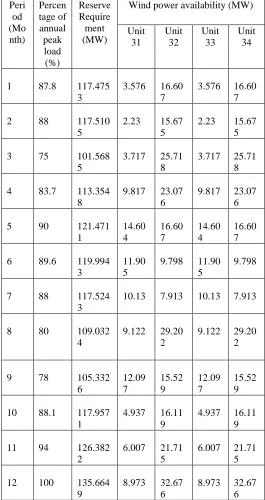
For this test system, the total load is considered as 5260MW. Table 4.1 shows the load pattern, reserve requirement and wind farm output. Each wind farms hold 30 wind turbine units with 4MW capacities. Here, the value of RESW is assumed to be 10% of total wind power availability of each wind farms. For illustration, reserve
[image:4.612.317.582.199.699.2]requirement of this test system at third period is 232.9323MW. It is found by summing two parts. ie., 1. 230.914 (5% of total load) and 2. 2.0183 (10% of wind power availability
).
Table 4.1 Load Pattern, Reserve Requirement and
Wind Farm Output.
Peri od (Mo nth)
Percen tage of annual peak load (%)
Reserve Require
ment (MW)
Wind power availability (MW)
Unit 31
Unit 32
Unit 33
Unit 34
1 87.8 117.475
3
3.576 16.60 7
3.576 16.60 7
2 88 117.510
5
2.23 15.67 5
2.23 15.67 5
3 75 101.568
5
3.717 25.71 8
3.717 25.71 8
4 83.7 113.354
8
9.817 23.07 6
9.817 23.07 6
5 90 121.471
1
14.60 4
16.60 7
14.60 4
16.60 7
6 89.6 119.994
3
11.90 5
9.798 11.90 5
9.798
7 88 117.524
3
10.13 7.913 10.13 7.913
8 80 109.032
4
9.122 29.20 2
9.122 29.20 2
9 78 105.332
6
12.09 7
15.52 9
12.09 7
15.52 9
10 88.1 117.957 1
4.937 16.11 9
4.937 16.11 9
11 94 126.382
2
6.007 21.71 5
6.007 21.71 5
12 100 135.664
9
8.973 32.67 6
© 2017, IRJET | Impact Factor value: 5.181 | ISO 9001:2008 Certified Journal
| Page 662
The minimum, average and standard deviation of the objective function of GS problem solved by FFO method is calculated and are tabulated in Table 6.2 for five different populations. Table 4.1 shows the best result of this GS problem utilizing 100 iterations and 100 trails.
On comparing results of all five populations obtained by FFO method, we can conclude that the proposed FFO has a total cost which is less for population size 10 than the other populations’ say 20, 30, 40 & 50.
That is, the total cost value decreases with decrease in population size. The accuracy of the results of all trails for five different populations in FFO method is also tabulated in Table 4.2.
The equation for calculating accuracy of the results is as follows :
Accuracy=∑ , ( )
Optimal generation scheduling results for Supplying Load (reserve) Contribution for test system is tabulated in table A 1.4. This table includes the data for one year (12 months). The optimal generation scheduling results for supplying load contribution in test system has 34 generating units.
Table 4.2 The Simulation Results for Different
Population Sizes of FFO algorithm For 100
Iterations and 100 Trails in Test System
(30C+4W).
Total Cost (M$)
Appr
oach
Popula tion
Mini mum Cost
Aver age Cost
Standar d Deviati on
Accuracy
FFO
10 450.4 4
450.0 58
1.89934 6
47.36615
20 451.1 1
455.2 72
2.40502 45.14859
30 452.6 7
459.7 34
3.24830 8
48.18827
40 454.1 2
459.1 40
2.69121 3
49.16466
50 455.1 8
461.7 43
2.95783 9
59.37484
The unit capacity, fixed O&M cost and variable O&M cost for the test system holding 30 conventional units and 4 wind farms having total load of 5260MW is tabulated in table A 1.2.
Sensitivity Analysis of Parameters’ Selection for Proposed GWO in Test System
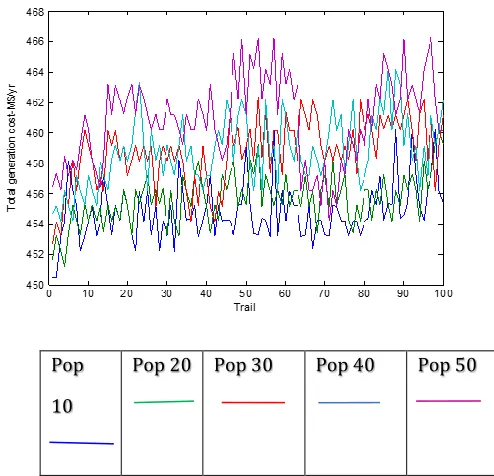
The simulations are made for several population sizes with different trails and various iterations are performed to find the convergence characteristics of the proposed FFO method.
The result of sensitivity analysis of acceleration parameters is presented in Fig.6.3 for different population sizes in test system solved by FFO method.
Convergence Characteristics of Proposed FFO in Test System with 100 Iterations.
0 10 20 30 40 50 60 70 80 90 100
5.12 5.14 5.16 5.18 5.2 5.22 5.24
trail
to
ta
l
g
e
n
e
ra
ti
o
n
c
o
s
t-M
$
/y
r
Pop
10
[image:5.612.334.581.158.396.2]© 2017, IRJET | Impact Factor value: 5.181 | ISO 9001:2008 Certified Journal
| Page 663
The values of population size and number of iterations in Fig.6.3. are (10,100) in the test system. On comparing the convergence characteristics of proposed FFO method with the convergence characteristics of PSO method [4], it is seen that the PSO method results in premature convergence and is trapped in local optimum, while the proposed FFO method converges toward the global optimum.
5 CONCLUSIONS
A new optimization method called FFO algorithm is employed for solving the generation scheduling (GS) problem and the formulation and implementation of the solution method is carried out successfully for the integrated wind thermal power generating system. A new position update tactic that is integrated in the FF method is employed to satisfy the constraints by the solutions of this problem.
The output of FFO method in a test system (30C+4W) is compared among the results obtained for different population sizes say 10, 20, 30, 40 & 50. From this it is noted that the population size 10 led to the best optimal solution. The above simulation results show that the proposed meta-heuristic and swarm intelligence based FFO algorithm has better computational efficiency and it is shown that the firefly (FFO) algorithm obtains near optimal solutions for GS problems.
Using the common population size 10, the performance of the proposed FFO method is compared with the performance of PSO method to prove that the FFO has better computational efficiency in reducing the total cost.
6. REFERENCES
[1] X.S Yang,”Engineering Optimization: An introduction with metaheuristic Applications”, Wiley & Sons, New Jersey, 2010.
[2] X. S. Yang, “Nature-Inspired Metaheuristic Algorithms”, Luniver Press, 2008
[3] X.-S Yang, (2009)"Firefly algorithms for multimodal optimization" in:Stochastic algorithms: Foundations and Applications, SAGA 2009, Lecture notes in computer sciences,Vol 5792,pp.169-178
[4] X.-S Yang, (2010)"Firefly algorithm, L'evy flights and global optimization", in: Research and development in Intelligent Systems XXVI (Eds
M.Bramer, R.Ellis, M.Petridis), Springer London, pp.209-218
[5] X. S. Yang, (2010). “Firefly Algorithm Stochastic Test Functions and Design Optimization”. Int. J. Bio- Inspired Computation, vol.2, No. 2, pp.78-84, 2010.
[6] Gandomi A., Yang X. and Alavi A. 2011. Mixed variable structural optimization using firefly algorithm. Computers and Structures. 89(23): 2325-2336.
[7] GAO M., He X., Luo D., Jiang J. and Teng Q. 2013. Object tracking using firefly algorithm. IET Computer Vision.7 (4): 227-237.
[8] Yu S., Yang S. and Su S. 2013. Self-Adaptive Step Firefly Algorithm. Journal of Applied Mathematics. pp. 1-8.
[9] Nigam. D., “Wind power development in india”, Ministry of new and renewable energy Government of India, New delhi, https://www. irena .org.
[10] Yang X. and Karamanoglu M. 2013. Swarm Intelligence and Bio-Inspired Computation. Swarm Intelligence and Bio Inspired Computation.pp.3-23.
[11] R. Rahmani, R. Yusof, M. Seyedmahmoudian, and S. Mekhilef,“Hybrid technique of ant colony and particle swarm optimization forshort term wind energy forecasting,” Journal of Wind Engineering and Industrial Aerodynamics, vol. 123, pp. 163-170, December 2013.
[12.] M. Dorigo and G. Di Caro, “Ant colony optimization: a new metaheuristic,” Proceedings of the IEEE Congress on Evolutionary Computation, 1999, pp. 1470-1477.
[13] B. Bhushan and S. S. Pillai, “Particle swarm optimization and firefly algorithm: performance analysis,” Proceedings of the 3rd IEEE International Advance Computing Conference (IACC), 2013, pp. 746 – 751.
[14] P. R. Srivatsava, B. Mallikarjun, and X. –S. Yang, “Optimal test sequence generation using firefly algorithm,” Swarm and Evolutionary Computation, vol. 8, pp. 44-53, February 2013.