THE CONSEQUENCES OF SPECIALIZATION: DECISION MAKING IN U.S. FEDERAL SPECIALIZED COURTS
Ryan J. Williams
A dissertation submitted to the faculty of the University of North Carolina at Chapel Hill in partial fulfillment of the requirements for the degree of Doctor of Philosophy in the
Department of Political Science in the College of Arts and Sciences.
Chapel Hill 2019
Approved by: Kevin T. McGuire Isaac Unah
ABSTRACT
Ryan J. Williams: The Consequences of Specialization: Decision Making in U.S. Federal Specialized Courts
(Under the direction of Kevin T. McGuire)
ACKNOWLEDGMENTS
Throughout this process, the prospect of writing these acknowledgements always seemed like the faint glimmer of light at the end of the proverbial tunnel. They may not have been “closer than they appear,” but they are here now nonetheless. First, I want to thank my family for their love and support. To my parents: thank you for encouraging me and giving me the support and tools to explore my interests. Thank you to my siblings: Jonathan, Lauren, and Nicole, for frequent conversations, games, and our shared experiences. To my
grandmother: thank you for showing me the meaning of hard work and service.
I want to thank the professors at UNC and beyond who helped shape my academic interests and offered me valuable advice as I navigated both graduate school and the academic job market. Thank you to my advisor, Kevin McGuire, for your comments and suggestions and for sticking with me as an advisee. Thank you to Isaac Unah for actively seeking me out as a co author and for introducing me to the world of specialized courts. To Jason Roberts, thank you for showing me the world of scoresheet and that institutions matter. Thank you to Virginia Gray for a wonderful introduction to teaching and for the feedback at State Politics Working Group. To Brett Curry, thank you for reading my dissertation and for being the best conference chair and discussant. Thank you also to Chris Clarke and the graduate student members of the State Politics Working Group for providing thoughtful comments on earlier drafts of this project. To the administrative staff in the UNC political science department, you are the real heroes that make everything work. Thank you for all that you do.
Forever! To Lucia Bird: thank you for sci-fi talks and pickleball. To Shep Stearns, Leah Christiani, Caroline Carlson and Amy Sentementes: “There’s a path you take, and a path not taken, the choice is up to you my friend.”
TABLE OF CONTENTS
LIST OF TABLES . . . ix
LIST OF FIGURES . . . xii
CHAPTER 1: INTRODUCTION . . . 1
Introduction . . . 1
Specialization in the Federal Judiciary . . . 6
Dissertation Overview . . . 10
CHAPTER 2: PATTERNS OF APPOINTMENTS TO SPECIALIZED COURTS . . 13
Introduction . . . 13
Patterns of Appointments to Specialized Courts . . . 15
The Senate Attention Gap . . . 16
Patronage . . . 18
ABA Ratings . . . 21
Discussion and Conclusion . . . 25
CHAPTER 3: IN SEARCH OF EXPERTISE IN SPECIALIZED COURTS . . . 27
Introduction . . . 27
The Court of Appeals for Veterans Claims . . . 29
Previous Occupation in Specialized Courts . . . 34
Theoretical Contributions . . . 39
Ideology and Expertise . . . 42
Ideology on the Court of Appeals for Veterans Claims . . . 44
Data and Methods: Single-Judge Decisions . . . 45
Results . . . 52
Discussion and Conclusion . . . 65
CHAPTER 4: REPEAT PLAYERS IN SPECIALIZED COURTS . . . 69
Introduction . . . 69
The Court of Appeals for the Federal Circuit . . . 72
Party Capability Theory and Attorney Expertise . . . 73
Data and Methods . . . 77
Measuring Attorney Expertise . . . 79
Controls . . . 81
Results . . . 84
Discussion and Conclusion . . . 89
CHAPTER 5: LIKE A DEAD FISH . . . 91
Introduction . . . 91
Law, Standards of Review, and Jurisprudential Regimes . . . 92
Data . . . 97
Methods . . . 100
Results . . . 101
Discussion . . . 110
Conclusion . . . 112
CHAPTER 6: CONCLUSION . . . 113
Dissertation Overview . . . 113
Future Research . . . 119
Concluding Thoughts . . . 121
APPENDIX A: SUPPORTING INFORMATION FOR CHAPTER 2 . . . 124
APPENDIX B: SUPPORTING INFORMATION FOR CHAPTER 3 . . . 132
Previous Occupation Analysis . . . 147
Extra Analysis . . . 156
APPENDIX C: SUPPORTING INFORMATION FOR CHAPTER 4 . . . 166
APPENDIX D: SUPPORTING INFORMATION FOR CHAPTER 5 . . . 169
LIST OF TABLES
1 Federal Specialized Jurisdiction Courts . . . 10
2 Generalist vs. Specialized Judges’ Confirmation Votes . . . 19
3 ABA Ratings of Article III Specialized Court Judges . . . 23
4 Comparing ABA Ratings of Specialized and Generalist Court Appointees . . . 24
5 Coding Rules: Components of Expertise . . . 48
6 Summary Statistics-Single-Judge Decisions Data . . . 50
7 Summary Statistics-Panel Decisions Data . . . 52
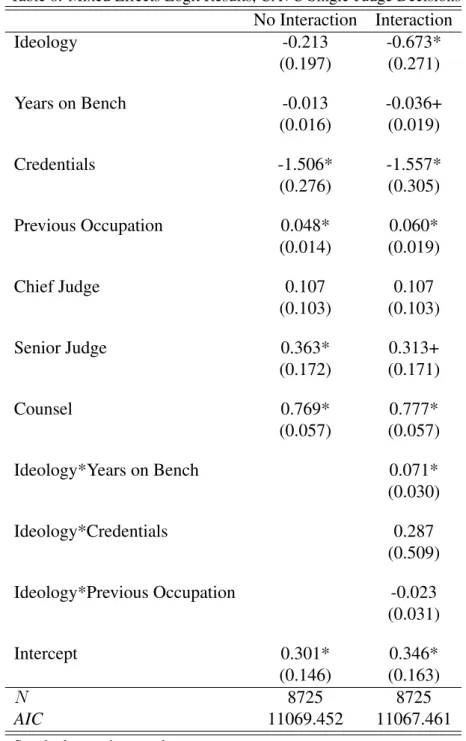
8 Mixed Effects Logit Results, CAVC Single-Judge Decisions . . . 54
9 Mixed Effects Logit Results, CAVC Panel Decisions . . . 61
10 Attorney Expertise . . . 75
11 Summary Statistics-Panel Decisions Data . . . 83
12 Logit Results, Sample of Federal Circuit Patent Decisions . . . 86
13 Summary Statistics: Weekly Data . . . 99
14 Weekly Regression Discontinuity Results . . . 103
15 Regression Discontinuity Estimates for Different Bandwidths and Specifications 109 16 Regression Discontinuity Estimates for Different Bandwidths and Specifications 110 17 Percentage of CAVC Merits Dispositions 2010-2016 . . . 111
18 Confirmation Votes of Judges of the Federal Specialized Jurisdiction Courts . . 124
19 Confirmation Votes of Active Senior Judges of the Federal Specialized Courts . 125 20 Confirmation Votes of Judges of the Generalist Appellate Courts . . . 126
21 Confirmation Votes of Judges of the Generalist Appellate Courts . . . 127
22 Confirmation Votes of Judges of the Generalist Appellate Courts . . . 128
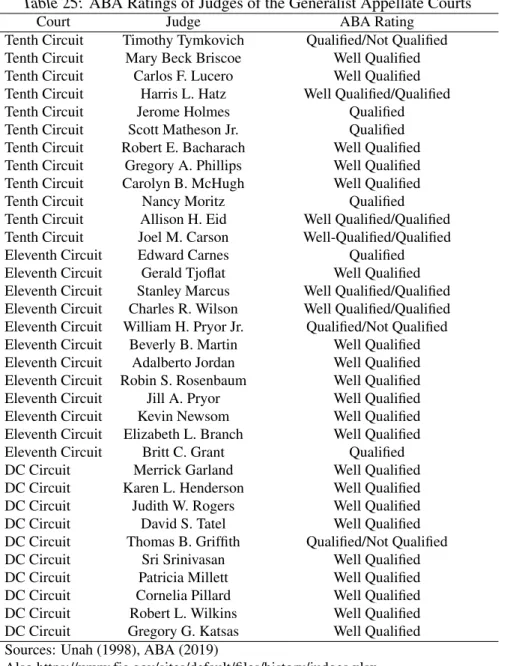
23 ABA Ratings of Judges of the Generalist Appellate Courts . . . 129
24 ABA Ratings of Judges of the Generalist Appellate Courts . . . 130
26 Previous Experience of the Current Judges of the Court of Appeals for the
Armed Forces . . . 132
27 Previous Experience of the Senior Judges of the Court of Appeals for the Armed Forces . . . 133
28 Previous Experience of the Current Judges of the Court of Appeals for the Federal Circuit . . . 135
29 Previous Experience of the Senior Judges of the Court of Appeals for the Federal Circuit . . . 136
30 Previous Experience of the Current Judges of the Court of Federal Claims . . . 137
31 Previous Experience of the Senior Judges of the Court of Federal Claims . . . 138
32 Previous Experience of the Current Judges of the Court of International Trade . 140 33 Previous Experience of the Senior Judges of the Court of International Trade . 140 34 Previous Experience of the Current Judges of the Tax Court . . . 142
35 Previous Experience of the Senior Judges of the Tax Court . . . 143
36 Previous Experience of the Current Judges of the Court of Appeals for Veterans Claims . . . 145
37 Previous Experience of the Senior Judges of the Court of Appeals for Veterans Claims . . . 146
38 Summary Statistics . . . 151
39 Mixed Effects Logit Results, CAVC Decisions 2010-2016 . . . 153
40 Mixed Effects Logit Results, CAVC Decisions 2010-2016 . . . 155
41 Mixed Effects Logit Results Ideology Centered, CAVC Decisions 2010-2016 . 157 42 Mixed Effects Logit Results, CAVC Single-Judge Decisions 2013-2016 . . . . 158
43 Non-Centered Results . . . 159
44 Mixed Effects Logit Centered Results, CAVC Single-Judge Decisions . . . 160
45 Mixed Effects Logit Results, CAVC Single-Judge Decisions Mixed Cases Included . . . 161
LIST OF FIGURES
1 United States Federal Judiciary . . . 12
2 Percentage of Current Specialized Court Judges by President . . . 16
3 Same Executive Agency as Appointing President . . . 21
4 ABA Ratings of Article III Specialized Court Judges . . . 24
5 Specialized-Generalist Comparison . . . 25
6 Models of Expertise . . . 34
7 Previous Judicial Experience . . . 37
8 Previous Congressional and Executive Experience . . . 38
9 Importance of Technical Credentials vs. Years on Bench . . . 41
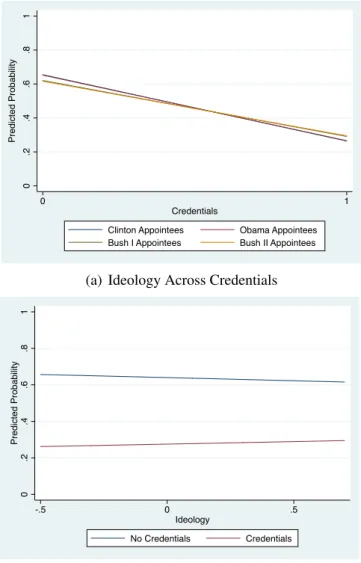
10 Predicted Probability of Ruling for Veteran . . . 55
11 Predicted Probability of Ruling for Veteran-Ideology and Credentials . . . 57
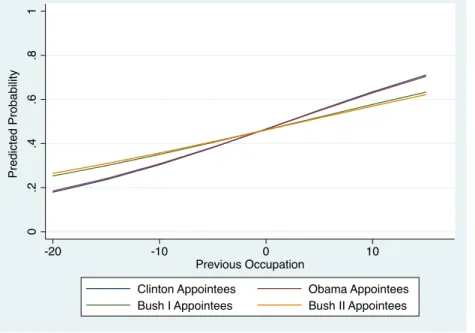
12 Predicted Probability of Ruling for Veteran-Ideology Across Previous Occupation . . . 58
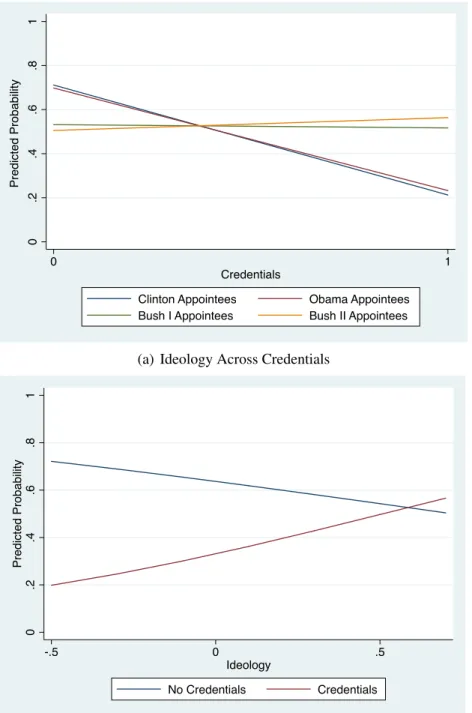
13 Predicted Probability of Ruling for Veteran-Ideology Across Years on Bench . 59 14 Predicted Probability of Ruling for Veteran-Ideology and Credentials . . . 63
15 Predicted Probability of Ruling for Veteran-Ideology Across Previous Occupation . . . 64
16 Predicted Probability of Ruling for Veteran-Ideology Across Years on Bench . 65 17 Impact of Previous Court Advocacy . . . 88
18 Impact of Patent Bar Registration . . . 88
19 Impact of IP Law School . . . 89
20 Regression Discontinuities without Controls . . . 104
21 Regression Discontinuities with Controls . . . 105
22 Placebo Test at Different Cutoffs . . . 107
23 Placebo Test at Different Cutoffs . . . 108
25 Previous Experience-Court of Appeals for the Federal Circuit . . . 137
26 Previous Experience-Court of Federal Claims . . . 139
27 Previous Experience-Court of International Trade . . . 141
28 Previous Experience-Tax Court . . . 144
29 Previous Experience-Court of Appeals for Veterans Claims . . . 147
30 Predicted Probability of Ruling for Veteran . . . 154
31 Frequency Distribution Previous Attorney Arguments . . . 167
CHAPTER 1: INTRODUCTION
Introduction
Specialization is perhaps the defining feature of institutional organization in almost every facet of professional life. Automobile mechanics repair cars by specializing in the inner workings of the automobile. Doctors effectively treat patients by specializing in specific parts of human anatomy. And lawyers help their clients by specializing in particular areas of law. Specialization is equally characteristic of most aspects of government.1 In the United States Congress, specialization is the focal attribute of the standing committee system, a core characteristic of its legislative organization since the early 19th century (Gamm and Shepsle, 1989).2 Proponents of both distributional and informational theories of congressional
organization give important attention to the role of specialization in the committee system (Shepsle and Weingast, 1987; Gilligan and Krehbiel, 1987; Weingast and Marshall, 1988; Gilligan and Krehbiel, 1990; Krehbiel, 1992; Shepsle and Weingast, 1994). In these theories, committee specialization allows members of Congress to obtain particularistic benefits or provide important bill information to non-committee members. A product of specialization, expertise plays a central role in Krehbiel’s (1992) information theory of legislative
organization, where the committee system’s investment in gaining expertise serves to reduce the larger congressional body’s uncertainty over the connection between policy instruments and policy outcomes. Moreover, specialization is central to David Mayhew’s (1974) theory of congressional behavior. The congressional committee system, according to Mayhew, allows members to specialize within a given jurisdiction and helps facilitate the member’s reelection goal by making a member’s credit-claiming appeals more credible to constituents back home.
Specialization also forms a key component of the institutionalization process for
1As Cole Porter might phrase it, even educated bureaucrats do it.
governmental organizations. Among other factors, the presidency was not fully
institutionalized until the introduction of the Executive Office of the President, the Office of Management and Budget, and the White House Office, organizations heavily reliant on specialization (Ragsdale and Theis III, 1997). Additionally, the institutionalization of the House of Representatives was partly a result of the growth of committee autonomy and importance (Polsby, 1968).
Finally, specialization and division of labor are indisputably the vital instruments to a successful, working bureaucracy. The lack of specialized experience among several of President Trump’s cabinet appointees alarmed some members of the public and government, as bureaucratic specialization is largely taken for granted. Indeed, we would be concerned if air traffic controllers were not specialists in directing aviation routes, if military commanders were not specialists in tactical strategy, or if NASA scientists knew little about astronomy.
However, specialization in the judiciary, particularly at the federal level, has proceeded at a slower pace.3 This appears to be, at least in part, a result of a prevailing preference for generalist judges among judicial scholars and legal practitioners who have decried
specialization in the judiciary.4 Martin Shapiro (1968) writes that when judges specialize “they lose the one quality that clearly distinguishes them from administrative lawmakers” (53). Concurring with this opinion, Tenth Circuit Judge Deanell Reece Tacha noted: “I like the fact that federal judges are generalists. I often say that judges may be the last generalists left in professional life, and I have resisted mightily any suggestion that the federal courts become specialized in any particular area.”5Opponents have further argued that specialization
leads to narrow perspectives that create biases, limit understanding, and lead to capture by
3This is unlike many countries in Latin America and Europe, where specialized courts are more common. For example, many European countries have constitutional courts charged with hearing constitutional questions. The Federal Constitutional Court in Germany is a prime example (Vanberg, 2004; Comella, 2011; Garoupa, Gomez-Pomar and Grembi, 2013). Other countries have courts with specific jurisdictional purviews, such as the Land and Environment Court of New South Wales (Preston, 2012).
4Cheng (2008) writes that legal culture “celebrates the generalist judge...[and has] a deep-seated aversion to specialization” (520-521).
external interests (Baum, 2011). Most famously, writing in 1982 on the creation of the Court of Appeals for the Federal Circuit, legal scholar and judge Richard Posner feared
specialization would create job dissatisfaction among judges and decrease objectivity by engendering legal tunnel vision, thereby promoting instability in law (Posner, 1982).
Yet, despite this preference for generalization, Congress and state and local entities continue to create specialized courts and give them jurisdiction over narrow areas of law. This growth in specialized courts has occurred in spite of those policymakers involved in the creation of specialized courts demonstrating little understanding of the operation and
performance of such courts. For example, during the debate over the formation of the Court of Veterans Appeals, a member of the House Veterans’ Affairs Committee remarked: “So far as I know...” the Tax Court and Court of Military Appeals “...are both doing a thoroughly
competent job” (Quoted in Baum, 2011, 212).6
Like government policymakers, political scientists have directed little attention toward the workings of these courts, focusing their efforts toward the more traditional generalist courts such as the U.S. Supreme Court, the circuit courts of appeals, and the district courts.7 While the decisions of the U.S. Supreme Court are of immense importance in directing legal policy, creating bound precedent, and shaping legal doctrine, the Court currently hears only 75 cases a year on average, limiting its ability to influence certain legal areas. Moreover, the growth of the administrative state has put increasing pressure on the federal court system to address issues arising from administrative agencies, leading to jurisdiction over such technical issues being transferred from the general appellate courts to more specialized judicial bodies.8
6Further, despite the intense debate surrounding the creation of the Court of Appeals for the Federal Circuit and Chief Justice William Rehnquist’s prediction of close scrutiny of this court, the Supreme Court fully reviewed none of the Federal Circuit’s antidumping or countervailing duty cases (Unah, 1997).
7The literature on U.S. specialized courts within the political science discipline is concentrated within the hands of only a handful of scholars, the most notable of these being Lawrence Baum (Baum, 1977, 1990, 1994, 2011), Isaac Unah on the Court of International Trade and the Court of Appeals for the Federal Circuit (Hansen, Johnson and Unah, 1995; Unah, 1997, 1998, 2001), Robert Howard on the Tax Court (Howard and Nixon, 2003; Howard, 2004, 2005, 2010; Howard and Brazelton, 2014), and the writing partnership of Brett Curry and Banks Miller on the Court of Appeals for the Federal Circuit and specialization within generalist courts (Miller and Curry, 2009, 2013; Curry and Miller, 2015).
The importance of the obscure and technical areas of administrative law these specialized federal courts deal with may not be immediately apparent. However, these courts have a large direct impact on many Americans, including the millions of Americans who seek veterans’ benefits and those seeking to protect their intellectual property. For example, the importance of specialized courts in these areas of law can be demonstrated by the Court of Appeals for the Federal Circuit and the Court of Appeals for Veterans Claims (CAVC), the two courts subject to multivariate analysis in this dissertation.
First, according to former Senator Orrin Hatch (R-Utah), the creation of the Court of Appeals for the Federal Circuit provides “reassurance and predictability” and helps protect intellectual property and patent rights, which are worth over 5 trillion dollars and make up almost three-fourths of U.S. corporate assets (Hatch, 2010, 517). Second, prior to the creation of the Court of Appeals for Veterans Claims (CAVC) in 1988, veterans were prevented from challenging their claims denials in court. Decisions over benefits awards were entirely within the hands of three-member panels in regional offices housed within the Department of
Veterans Affairs’ (VA) Veterans Benefits Administration.9 The decisions of these panels were
subject only to internal appellate review by the Board of Veterans’ Appeals (BVA). The VA is a massive federal bureaucratic agency, employing over 300,000 people10and serving more
than 9 million veterans in the United States.11 The VA is among the top five funded federal agencies, and since its creation in 1930, the department has administered the distribution of veterans’ benefits. In fiscal year 2002, the VA paid more than twenty-two billion dollars in disability compensation to veterans (Lowenstein and Guggenheim, 2005).12 In fiscal year
reaching nearly 10,400. Moreover, from 1995 to 2005, the number of appeals filed in the US Courts of Appeals increased from 50,072 to 68,743 (Curry and Miller, 2015).
9Prior to 1930, the benefits programs were administered by departments within the Departments of War, the Interior, and the Treasury (Ridgway, 2010).
10Edwards (2014). “Number of VA Employees.” http://www.cato.org/blog/number-va-employees.
11Estimates from CNN (2019) at http://www.cnn.com/2014/05/30/us/department-of-veterans-affairs-fast-facts/.
2005, the figure was $30.8 billion for disability compensation, death compensation, and pensions (Allen, 2007). Moreover, almost one out of every four people in the country is eligible for a benefit from the VA.
The creation of the Court of Appeals for Veterans Claims made VA benefit decisions subject to judicial review for the first time. Possessing exclusive review over BVA findings of fact, the court’s appellate position makes it an important player in the decision to award billions of federal dollars, and its rulings can have huge impacts on VA policy. While the Court of Appeals for the Federal Circuit is empowered to hear appeals from the CAVC, the Federal Circuit’s jurisdiction to review CAVC decisions is limited to consideration of “the validity of any statute or regulation or any interpretation thereof” that the CAVC relied on in making its decision.13 Similarly, the Federal Circuit cannot review factual determinations unless a constitutional issue is present. Thus, the direction of veterans’ law is largely in the hands of the Court of Appeals for Veterans Claims.
Thus, the issues arising in a variety of legal areas that now occupy the dockets of specialized courts, ranging from patent law to veterans claims and from the income tax to bankruptcy appeals, allow these courts the opportunity to greatly shape the direction of legal policy in many important areas of law. Given the lack of scholarly and policy-maker attention, an increasingly relevant part of the American court system has been overlooked, making study of judicial outcomes on these courts vital to a full understanding of the American judiciary. For judicial scholars, of great import is addressing the deficiency in our understanding of the consequences of specialization for these courts. Does specialization lead to the negative consequences feared by the legal practitioners quoted above, or does judicial specialization present positive developments beyond easing the workloads of generalist courts? Rather than leading to tunnel vision or litigant capture, the creation of specialized courts has the potential
$71.4 billion of which was discretionary funding. Figures obtained from Shane III (2015) at
http://www.militarytimes.com/story/military/2015/12/16/budget-omnibus-fy16-defense-veterans-affairs-pentagon/77416466/. Moreover, the VA’s budget will likely continue to increase; President Trump’s proposed VA budget for fiscal year 2020 was $220.2 billion, $97 billion of which was discretionary funding. SeeAnnual Budget Submission(2019) at http://www.va.gov/budget/products.asp.
for more positive consequences or the creation of neutral virtues, such as creating uniformity and consistency in law, encouraging efficient workload completion, and allowing judges to develop expertise (Baum, 2011). These questions are ripe for consideration, and the presence of more narrowly focused specialized courts, where cases in the same specific area of law are continuously heard, offers the ideal opportunity to address how judicial specialization affects judges’ decision making. At its core, this dissertation is aimed at exploring the consequences that specialization has for the federal judiciary. Before presenting an overview of the
dissertation, I provide a brief sketch of the landscape of specialization in the federal judiciary.
Specialization in the Federal Judiciary
Specialized courts can be organized into two categories based on their purview. In the first category, there are those that are focused on regulatory or administrative control. These courts often review the decisions of regulatory agencies, and the federal government is often the defendant. In the second category are courts that are oriented toward rehabilitation or therapeutic jurisprudence (Unah and Williams, 2017). These courts are found at the state and local level and represent much of the recent growth in specialized courts. This therapeutic jurisprudence or problem-solving court movement has expanded from drug courts to mental health courts, domestic violence courts, and veterans treatment courts. As a study of
specialization in the federal judiciary, this dissertation focuses on the first category. These specialized federal courts, such as the Tax Court, which resolves federal income tax disputes, and the Court of Appeals for Veterans Claims, with jurisdiction over decisions of the Board of Veterans’ Appeals, are distinguished in a number of important ways from the more familiar generalist courts, which include the United States Supreme Court, the 12 U.S. circuit courts of appeals,14and the 94 federal district courts. These differences can be organized according to
relative obscurity, institutional design, and jurisdiction (Unah and Williams, 2017). Specialized courts are traditionally “lesser known, yet still powerful, courts in the federal system” (Diascro and Ivers, 2006, 74). While these courts are becoming more familiar to academics and policymakers, particularly those state and local actors engaged in the
problem-solving, therapeutic jurisprudence revolution, the average citizen is largely
unfamiliar with these courts. Moreover, it has been legal scholars rather than social scientists who prioritized the study of specialized courts. The importance of specialized courts was recognized even in the early 20th century, as Felix Frankfurter and James Landis wrote: “An important phase in the history of the federal judiciary deals with the movement for the establishment of tribunals whose business was to be limited to litigation arising from a
restricted field of legislative control” (1928, 147). This lack of attention on the part of citizens is not surprising given the limited knowledge most citizens demonstrate regarding the
judiciary in general.15 Further, the often complex and policy-specific issues of specialized courts makes their activities largely inaccessible to the general public.
Interestingly, while recent decades have seen great growth and structural changes in judicial specialization, particularly at the state and local level, specialized courts at the federal level are not entirely a new development. The first specialized federal court, the Court of Claims, was created in 1855, and some specialized courts have been dissolved, such as the Commerce Court. Moreover, many of today’s operating specialized courts existed in earlier forms. For example, the Court of International Trade was created in 1890 as the Board of General Appraisers, and the Tax Court was established in 1924 as the Board of Tax Appeals. Many of these courts subsequently underwent changes to their jurisdictions or merged with other courts. Originally composed of a trial and appellate level, the current Court of Federal Claims emerged in 1992 after a name change and the loss of its appellate level to the new Court of Appeals for the Federal Circuit.
With respect to design, while specialized court judges, like generalist federal courts, are often appointed by the sitting president and confirmed by the Senate, the majority of specialized courts are created by Congress through powers arising under Article I, Section 8 of the Constitution to “constitute tribunals inferior to the Supreme Court.” Because their existence is derived from Article I of the Constitution, these courts are called Article I courts.
15See Dost (2015), “Dim public awareness of Supreme Court as major rulings loom,” at
Moreover, judges on these courts are not afforded the protections of lifetime tenure and salary security granted to judges whose courts are created under Article III of the Constitution: “The judicial Power of the United States, shall be vested in one supreme Court, and in such inferior Courts as the Congress may from time to time ordain and establish.”16The Court of Federal
Claims, the Tax Court, the Court of Appeals for Veterans Claims, the bankruptcy courts, and the Court of Appeals for the Armed Forces are all Article I courts. However, a few specialized courts do possess Article III status, including the Court of International Trade and the Court of Appeals for the Federal Circuit, which possesses appellate jurisdiction over a number of the above courts, as well as certain types of cases arising from the U.S. district courts. In fact, the Court of Appeals for the Federal Circuit is the only specialized Article III appellate court.
Beyond institutional status and constitutional protections, specialized courts are unique because of the nature of their jurisdictions. For example, whereas the generalist circuit courts of appeals possess jurisdiction over a wide-range of legal issues originating within their regional geographies, specialized courts are charged with adjudicating cases in more narrow legal areas, such as the Court of International Trade’s focus on unfair trade cases or the Court of Appeals for the Armed Forces’ review of courts-martial. Specialized courts are not
typically bound by geography like many generalist courts. Certainly, there are elements of specialization in the generalist courts. For example, on the U.S. Supreme Court, judges who are perceived as experts in certain areas may be assigned the Court’s opinion when a case dealing with that issue arises (Brenner, 1984; Brenner and Spaeth, 1986; Maltzman, Spriggs and Wahlbeck, 2000). InRoe v. Wade,17Justice Harry Blackmun was assigned the majority
opinion partly because of his recognized expertise in medical law and history given his long-time role as a counsel to the Mayo Clinic. At the intermediate courts of appeals, some scholars find that judges are assigned to panels based on their subject-matter (Cheng, 2008). For example, an “oil and gas panel” emerged in the Fifth Circuit Court of Appeals following consistent recusals from a number of judges who possessed financial interests in those
16Court-like military commissions and tribunals such as the Combatant Status Review Tribunals (CSRTs) were created by presidential action.
industries (Barrow and Walker, 1988). However, on the whole, judges on these courts are expected to be generalists because they hear and decide cases in many different areas of law. This wide caseload means that they are not afforded the opportunities to become specialists in any one particular aspect of law. So while policymakers specialize, the same is not expected of judges.
The specialization of these narrow-jurisdiction courts means that an important
component of their structure is expertise. Much of the dissertation to follow grapples with the role of expertise in the specialized context. What constitutes expertise in a specialized court? How do we define and measure it? Answering these questions will help us understand perhaps the most important characteristic of what makes specialized courts unique.
Table 1 lists some of the most important federal specialized courts, along with their jurisdictions and constitutional status as Article I or III courts, and Figure 1 presents an organizational chart of the U.S. federal judiciary to show the location of these courts with respect to their generalist brethren.18 This selection of specialized courts reflects those that are oriented toward administrative law or regulatory oversight. For example, the Court of Appeals for Veterans Claims reviews the Department of Veterans Affairs distribution of veterans claims benefits, and the Tax Court reviews income tax decisions of the Internal Revenue Service. This list reflects specialized courts whose judges are appointed by the president and confirmed by the Senate. In other specialized courts, such as the bankruptcy courts or the Foreign Intelligence Surveillance Court, the judges are appointed by other judges. The judges on bankruptcy courts, for example, are appointed by the circuit judges in their geographic area (Howard and Brazelton, 2014).19
While the theoretical framework developed in the chapters to follow largely applies to specialized courts broadly, this dissertation focuses specifically on two of the courts listed in Table 1, one Article I and one Article III court. Specifically, it focuses on the Article I Court
18This chart excludes the District of Columbia Court of Appeals. While also an Article I court that is certainly specialized in its jurisdictional purview, this court is equivalent to a state supreme court in its status as the highest court in the District of Columbia. See Courts (2019) at https://www.dccourts.gov/court-of-appeals.
of Appeals for Veterans Claims (CAVC) and the Article III Court of Appeals for the Federal Circuit. Of the courts featured in Table 1, the CAVC is the youngest, having been created in 1988. The CAVC solely reviews appeals from veterans who were denied claims benefits by the Department of Veterans Affairs. The court’s heavy reliance on single-judge disposition as its primary method of case adjudication makes it unique among federal courts, especially among courts with appellate capacity. The Court of Appeals for the Federal Circuit’s caseload is wider in range than most specialized courts,20but the plurality of its cases concerns patents. This wide caseload results from the Federal Circuit’s position as an appellate specialized court charged with reviewing decisions from a number of specialized courts.
Table 1: Federal Specialized Jurisdiction Courts
Court Jurisdiction Status
Court of Appeals for the Handles appeals from the Court of Federal Claims, Article III Federal Circuit Court of International Trade, and Court of Appeals for
Veterans Claims. Handles claims against administrative agencies involving federal employees and contracts, patents and trademarks, and customs duties. Appeals go to the US Supreme Court.
Court of Appeals for the Handles appeals in military case, including courts-martial. Article I Armed Forces Appeals go to the US Supreme Court.
Court of International Trade International trade cases seeking administrative Article III protection against foreign dumping and countervailing
duties as well as customs duties. Appeals go to Court of Appeals for the Federal Circuit.
Court of Federal Claims Financial claims against the federal government, Article I including contract disputes, bid protests, military pay,
tax refunds, and takings. Appeals go to Court of Appeals for the Federal Circuit.
Tax Court Tax cases involving assessments. Appeals go to the Article I various U.S. Courts of Appeals.
Court of Appeals for Handles appeals from the Board of Veterans’ Appeals Article I Veterans Claims involving denial of veterans’ disability and survivor benefits.
Appeals go to Court of Appeals for the Federal Circuit. Information Sources: Unah and Williams (2017) and Baum (2011).
Dissertation Overview
Ultimately, specialization is a key part of how political scientists understand political institutions and is a chief characteristic of executive, congressional, and bureaucratic bodies in the United States. However, political scientists have yet to adequately examine the
consequences of specialization in the judiciary. This dissertation seeks to fill that gap, by
considering the consequences of introducing specialization to the federal judiciary. In total, this dissertation consists of four substantive, empirical chapters.
Chapter 2 explores the patterns of appointments to specialized courts, focusing specifically on judicial qualifications and executive and interest group influence in the confirmation process. Noting the stark disparities in the attention the U.S. Senate gives to specialized court nominees compared to generalist nominees, I use American Bar Association (ABA) ratings to compare the qualifications of these nominees. The next two chapters feature the role of expertise in specialized courts as a primary concern. Chapter 3 considers the role that expertise plays in a specialized context. Rather than assuming specialization on the part of specialized court judges, I construct a theoretical framework that partitions judicial
expertise into three component parts. In this framework, expertise is derived from 1) Previous Professional Occupation; 2) Credentials or Educational Attainment; and/or 3) Experience on the Court. I then consider how these different components influence the ability of specialized court judges to apply ideology to their decision making. In the fourth chapter, I turn from judicial expertise to attorney expertise, and I explore how different dimensions of attorney expertise impact their clients’ chances of winning cases in a specialized court. This chapter builds on the role of litigant resources in court by developing expectations for how specialized court judges should respond differently to expert attorneys than do generalist court judges.
In the fifth chapter, I turn from expertise to the role of a law in a specialized court, specifically, whether an institutional shift in a specialized court’s interpretation of its standard of review alters the proportion of decisions it issues in favor of its primary litigant. Judicial scholars have long pitted ideological factors against legal ones in attempting to explain judges’ decisions. However, rather than pitting ideology against law, I seek to understand the role of law as an institutional constraint rather than as a mechanistic force in judges’
Fig. 1: United States Federal Judiciary
CHAPTER 2: PATTERNS OF APPOINTMENTS TO SPECIALIZED COURTS
Introduction
Despite the growth in specialized courts and their increasing role in tackling issues in a number of important legal areas, political scientists have devoted little attention to
understanding specialized courts, focusing their efforts toward the more traditional generalist courts such as the U.S. Supreme Court and the federal district courts. Moreover, evidence suggests that specialized courts are often formed ad hoc, without sufficient consideration of the courts’ prospects for success, and by policymakers who display ignorance over their conduct (Baum, 2011).21 This inattention to specialized courts extends to the Senate’s treatment of presidential appointments to such courts, which constitutes the focus of this chapter. After documenting the disparity in attention between generalist and specialized court confirmations, I consider whether specialized court judges display greater or lesser
qualifications than their confirmed generalist counterparts.22
Specialized courts have a large amount of administrative influence in the federal government and private sector, so if there is indeed a lack of attention paid to their nominees, then this would be a normatively important issue. Larry Baum (1977) writes: “Specialization tends to increase the influence of litigant groups over judicial decisions, and that increased
21See the quote from a former member of the House Veterans’ Affairs Committee member in the first chapter. Further, despite the intense debate surrounding the creation of the Court of Appeals for the Federal Circuit and Chief Justice William Rehnquist’s prediction of close scrutiny of this court, the Supreme Court fully reviewed none of the Federal Circuit’s antidumping or countervailing duty cases (Unah, 1997).
22I recognize the potential for the exaggeration of inattention to specialized courts in my choice of
influence may lead to policies that differ significantly from those made by generalist courts” (846). Baum’s work indicates that specialized court decisional trends can be influenced by litigant interests. In particular, Baum finds that the Patent Bar was able to exert significant influence on the selection of justices to the Court of Customs and Patent Appeals (CCPA) such that the court subsequently reversed Patent Office decisions at a greater rate (Baum, 1977, 2011). Further, research on specialized courts such as the Tax Court (Howard, 2005), the Court of Appeals for the Federal Circuit (Miller and Curry, 2009, 2013), Bankruptcy Appellate Panels (Howard and Brazelton, 2014), and the Court of Appeals for Veterans Claims (Williams, 2017) indicates that judges on these courts engage in ideological decision making despite the technical nature of the issues under consideration.
In sum, policymakers’ inattention to specialized courts may have important
consequences for who wins and who loses before these courts and for the direction of law in specialized areas. This chapter considers the patterns of appointments to specialized courts, demonstrates greater Senate attention to generalist court judges than specialized ones, and seeks to adjudicate between two possibilities. First, the lack of contention over specialized court nominees may signal that these judges are well-qualified, superbly credentialed individuals possessed of the requisite amount of expertise and experience to perform their prospective roles. If this is the state of affairs, then senators’ lack of contention is justified and no problem exists. However, if this is not the case and senators are not giving in-depth
consideration to nominees with less than ideal qualifications and credentials, then the Senate is shirking its constitutionally mandated advice and consent role and placing greater power in the hands of the president and committed interest groups to shape law and policy in certain legal areas. In this chapter, I adjudicate between these possibilities by using American Bar Association (ABA) ratings to compare the qualifications of generalist to those of specialized court nominees. I turn now to exploring the landscape of specialization in the federal
Patterns of Appointments to Specialized Courts
I begin with a look at the landscape of specialization in the federal judiciary. Table 1 in the introduction lists the six federal specialized jurisdiction courts subject to presidential appointment and Senate confirmation.23 Column 2 details the jurisdiction and issues
considered by each court, and column 3 lists each court’s constitutional status (Article I or Article III court). The primary distinction between Article I and Article III courts lies in their constitutional protections, as judges on Article I, unlike Article III, courts are appointed for finite term lengths and do not possess constitutionally-imposed salary security. Before delving into the patterns of appointments of judges to these courts, a note on the partisan breakdown of these judges.24 Figure 2 shows the percentage of current specialized court judges appointed
by Democratic and Republican presidents. Of the 52 active, specialized court judges, 42 percent (22) were appointed by Republican presidents, and 55 percent (30) were appointed by Democratic presidents. The appointees of George W. Bush and Barack Obama make up 83 percent (43) of the current judges.25
23Although its judges are also subject to this selection process, the District of Columbia Court of Appeals is excluded because it is equivalent to a state supreme court.
24Interestingly, the Court of International Trade’s enacting statute, the Customs Act of 1980, states that “No more than five...judges shall be from the same political party.” However, while this requirement is meant to limit partisanship and ideology on the court, presidents are free to select nominees who, while demonstrably independent or unaffiliated in their party registration, actually share the president’s policy views (Brown, 1982; Unah, 1998).
Fig. 2:Percentage of Current Specialized Court Judges by President
The Senate Attention Gap
In this section, I explore whether the judges confirmed to specialized courts received similar attention during their Senate confirmation proceedings as did their generalist
counterparts.26 Table 2 presents a comparison of confirmation votes of the 12 generalist
circuit courts of appeals with the six specialized courts whose judges are subject to
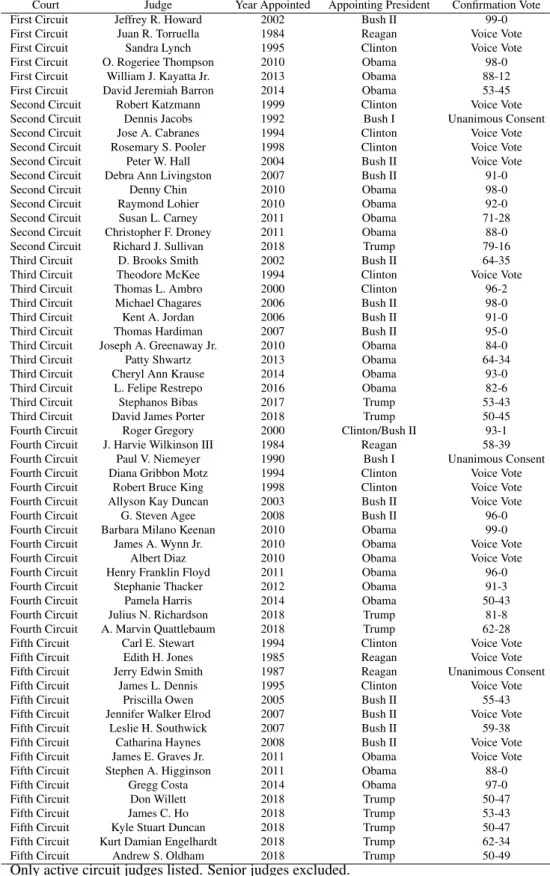
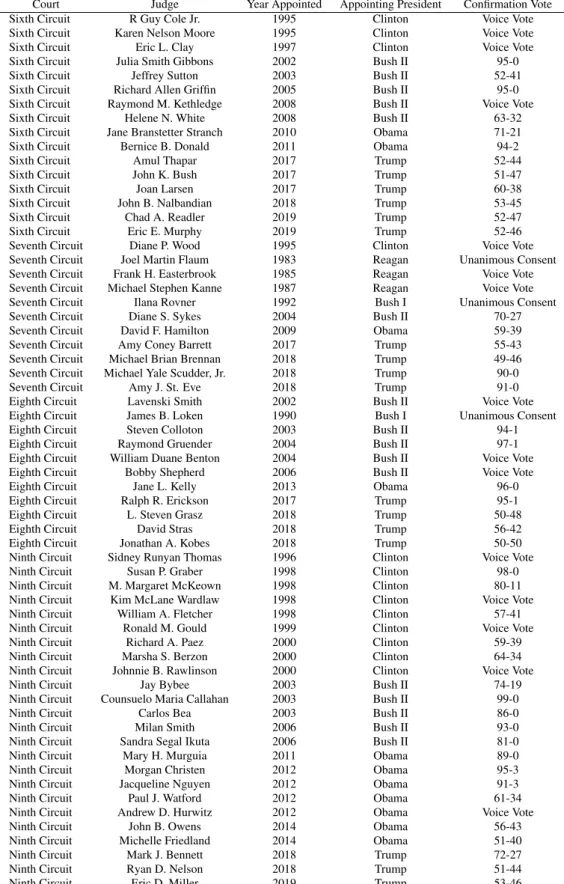
presidential appointment and Senate confirmation. The third column shows the percentage of currently sitting judges on each court who were confirmed by unanimous consent or voice vote, while the fourth column shows the percentage of confirmed judges who received at least one vote against their nomination. Confirmation statistics for individual judges and the identity of their appointing president are presented in Tables 18 and 19 (for specialized court judges) and Tables 20, 21, and 22 (for generalist circuit court judges) in the appendix of this chapter.27 Of the 52 currently sitting specialized court judges, 41 (79%) were confirmed by voice vote or by unanimous consent. Further, of the remaining 11 judges who were subjected to a recorded vote, only 2 (3.8%) received any votes against them. These percentages are
26Confirmation vote histories were found using Congress.gov and searching under nominations.
fairly consistent across the six specialized courts listed in the table, as all current judges of the Court of Appeals for the Armed Forces, the Tax Court, and the Court of Appeals for Veterans Claims were confirmed by voice vote or unanimous consent. Moreover, at least 80% of Court of Federal Claims and Court of International Trade judges were confirmed in this manner. While only 25% of Federal Circuit judges received voice votes or unanimous consent, only one current judge received any votes against their nomination.28
Finally, when active senior judges are included, the number receiving confirmation by voice vote or unanimous consent rises to 86 (88%) out of 98 judges. Only one of these senior judges received any votes against them. In federal courts, judges who are at least 65 years of age and have served for at least 15 years may opt for senior status, a form of semi-retirement. These judges hear fewer cases and their seat becomes vacant.
This evidence suggests that judicial nominations to specialized courts are
non-controversial in nature. Separating active and senior judges is instructive because there may be generational differences in how the Senate treats judicial nominees. With respect to the Supreme Court, Senators have increasingly subjected Court nominees to greater scrutiny. For example, Ruth Bader Ginsburg and Antonin Scalia, both considered to sit on opposite ends of the ideological spectrum, were each confirmed with more than 90 senators in support. However, recent nominees such as Elena Kagan and Neil Gorsuch both received greater opposition. While this certainly reflects increased political polarization, it is useful to observe that this pattern of increasing scrutiny does not seem to apply to specialized court judges.
To explore this phenomenon further, it is instructive to compare the treatment of specialized court appointments to that of appointments to the generalist circuit courts of appeals. Of the 156 currently sitting judges, 48 (31%) were confirmed by voice vote or unanimous consent, while 108 (69%) received a recorded vote and 73 (47%) received at least one vote against them. The percentage of voice vote/unanimous consent confirmations ranges from 8.3% for the 3rd Circuit to 45.4% for the 2nd and 7th Circuits, while the percentage of judges receiving votes against them ranges from 18.1% for the 2nd Circuit to 62.5% for the
6th Circuit.
Additionally, while the growth in partisan warfare in the U.S. Senate has made the generalist court nominees of recent presidents (George W. Bush, Obama, and Trump) more contentious, this same pattern is not present for nominees to specialized courts. Of President Trump’s 33 confirmed nominees to the generalist circuit courts, 21 (64%) received more than 40 votes in opposition. In contrast, all seven of Trump’s confirmed specialized court nominees were confirmed by voice vote.29
A comparison between the generalist appellate courts and the Court of Appeals for the Federal Circuit and the Court of Appeals for the Armed Forces is particularly useful because the Supreme Court may exercise appellate review over each of these courts. Of the 17 non-senior judges currently hearing cases on the Court of Appeals for the Armed Forces and the Federal Circuit, only one judge received any votes opposed to his nomination. Thus, in comparison to their generalist counterparts, specialized court judges face much less scrutiny from senators. While a number of logical possibilities may explain this pattern (boundedly rational senators opting to direct their limited policy attention to more immediately observable issues, for example (Jones, 2001)), this pattern is normatively troublesome given the
aforementioned administrative responsibility of specialized courts and evidence that these courts may be subject to disproportionate litigant influence and a propensity for ideological decision making. As suggested in the introduction to this chapter, a lack of Senate attention to specialized court appointees may give greater discretion to presidents to select their more favored nominees. Thus, the next section reviews existing evidence that specialized court appointments result from political patronage and presents descriptive data to examine this claim.
Patronage
The literature on judicial selection to specialized courts is scant, and much of this work has focused on the perceived role that political patronage plays in nominations to these courts (Unah, 1998). As Unah (1998) notes:
Table 2:Generalist vs. Specialized Judges’ Confirmation Votes
Court Type %Voice/Unanimous Consent %With Votes Against
1st Circuit Generalist Article III 33.3% 33.3%
2nd Circuit Generalist Article III 45.4% 18.1%
3rd Circuit Generalist Article III 8.3% 50%
4th Circuit Generalist Article III 40% 40%
5th Circuit Generalist Article III 43.7% 46.6%
6th Circuit Generalist Article III 25% 62.5%
7th Circuit Generalist Article III 45.4% 36.3%
8th Circuit Generalist Article III 36.3% 54.5%
9th Circuit Generalist Article III 20.8% 54.1%
10th Circuit Generalist Article III 25% 41.6%
11th Circuit Generalist Article III 25% 50%
DC Circuit Generalist Article III 30% 60%
Federal Circuit Specialized Article III 25% 8.3%
Armed Forces Specialized Article I 100% 0%
Federal Claims Specialized Article I 80% 20%
International Trade Specialized Article III 83.3% 0%
Tax Court Specialized Article I 100% 0%
Veterans Claims Specialized Article I 100% 0%
All Generalist 30.7% 46.7%
All Specialized 78.8% 3.8%
With Active Senior Judges 87.7% 3.1%
“Because of the presumed ineffectiveness of senatorial courtesy when it comes to vacancies on specialized courts, the president and his lieutenants in the White House and the Department of Justice are thought to have free rein in picking individuals to those courts, with scant, if any opposition from senators.
Consequently, it is generically thought that the president uses these positions as plums for rewarding patronage or loyal service or for accomplishing constituency obligations...the popular thinking is that the president doles out these ‘spoils’ without paying much attention to such qualities as the judicial temperament, legal competence, and integrity of the appointee” (23).
appointments to the Court of International Trade (CIT) and the Court of Appeals for the Federal Circuit provide empirical examination of this question. Unah reports that patronage, partisanship, and interest groups play important roles in appointments to specialized courts. As regards patronage, at the time of Unah’s study, many judges on the CIT had little
international trade experience, and New York Senator D’Amato appeared to use the CIT for patronage appointments, as six of eight judges appointed to the court in 1991 were from New York. President Clinton also appointed two judges to the court who were close personal friends.
If patronage plays a role in selecting judges for specialized courts, it may be expected that presidents and their staff draw from familiar names and faces when selecting nominees to these courts. Such individuals may have come to the attention of White House officials in their careers in the executive branch. For example, senior Federal Circuit judge S. Jay Plager worked in the Office of Management and Budget (OMB) during the Reagan and Bush administrations as the OMB Associate Director and Administrator of the Office of Information and Regulatory Affairs. Plager was then appointed to the Federal Circuit by President George H.W. Bush. Given that nothing in Judge Plager’s background suggests experience with patents, international trade, or contracts, his appointment may reasonably be seen as a patronage or partisan appointment. Patronage can also take the form of rewarding individuals for loyal service to the administration or the political party. This type of
appointment may characterize a handful of specialized court judges. For example, senior CIT judge Jane Restani was a member of the Justice Department during the Carter and Reagan administration. Restani had no previous experience in international trade when she was asked by a Reagan DOJ official to accept an appointment to the court. Restani admitted her
Interestingly, a sizable number of specialized court appointees with executive agency experience served in the executive agencies of their appointing presidents. Of the 55 judges who worked in cabinet-level executive agencies,3029 (53%) worked in the executive branch
of their appointing branch. Figure 3 presents the percentages broken down by senior and current judges. A higher percentage of senior judges exhibit this pattern than current judges. Moreover, of the six specialized courts considered in this study, the Tax Court is the venue most subject to this pattern in appointments. While this pattern certainly does not prove that specialized court judges attain their positions due to presidential patronage, it does reinforce the notion that presidents draw from familiar individuals when making their appointments.
Fig. 3: Same Executive Agency as Appointing President
ABA Ratings
Having considered the potential for specialized court appointments to result from presidential patronage, I address this chapter’s central question by considering the qualifications of the judges who occupy these specialized jurisdiction courts. Again, if specialized court judges exhibit sufficient qualifications for their positions, then concern over the Senate’s potentially lax treatment of their nominations may be lessened.31 First, a
30This includes organizations housed under the Executive Office of the President.
subjective and distilled look at the qualifications of specialized court judges can be observed in the American Bar Association’s (ABA) Standing Committee on the Federal Judiciary ratings of judicial nominees. While the majority of specialized court nominees are not rated by the ABA because of their Article I status, two specialized courts are Article III-designated courts: The Court of Appeals for the Federal Circuit and the Court of International Trade. Nominees to these courts are rated by the ABA, and those ratings for both current and active senior judges are presented in Table 3. ABA ratings of judicial nominees are on a three item scale (Not Qualified, Qualified, and Well Qualified). Single entries in Column 3 indicate a unanimous rating by the committee, while multiple entries present the rating of the committee majority first and the committee minority’s rating second. From the table, one observes that only one judge received less than a unanimous Qualified rating: Court of International Trade Judge Jennifer Choe-Groves. In Figure 4(a) below, I collapse ABA ratings of Federal Circuit judges into two categories. The first category includes any judge who received at least a minority committee rating of Well Qualified. The second category includes judges who received a rating of Qualified. According to the figure, a greater percentage of senior Federal Circuit judges received at least a minority committee rating of Well Qualified. Figure 4(b) collapses ABA ratings of Court of International Trade judges into three categories. The first two categories are identical to those from Figure 4(a), while the third category includes the single judge who received a Qualified/Not Qualified rating. We can see that current
International Trade judges received higher ratings on average than did senior judges, as no senior judge received even a minority rating of Well Qualified. Overall, however, nominees to these two courts demonstrate at least a modicum of requisite qualifications in the eyes of the ABA.
Moreover, using ABA ratings I can test critics’ contention that specialized court judges are generally less qualified than generalist court appointees. Figure 5 and Table 4 compare the ABA ratings of generalist circuit court and specialized court judges (combining senior and current Federal Circuit and International Trade judges together). For a complete list of ABA ratings of generalist court judges, please see Tables 23, 24, and 25 in the
appendix. From the figure and table, one observes that a greater percentage of generalist judges receive higher ratings from the ABA. Moreover, a chi-square test reveals that the ABA ratings of specialized and generalist courts are statistically different at thep < 0.05level of significance. Thus, based on ABA ratings, there does appear to be some truth to critical assessments of the qualifications of specialized court judges. However, this difference in qualifications should not be overstated, as all but one specialized court judge received at least a rating of unanimously qualified. Moreover, a greater percentage of generalist court judges received at least a minority rating of Not Qualified.
Table 3:ABA Ratings of Article III Specialized Court Judges
Court Judge ABA Rating Status
Federal Circuit Sharon Prost Qualified/Well Qualified Current
Federal Circuit Pauline Newman Qualified Current
Federal Circuit Alan David Lourie Well Qualified/Qualified Current
Federal Circuit Timothy B. Dyk Qualified Current
Federal Circuit Kimberly Ann Moore Qualified Current
Federal Circuit Kathleen M. O’Malley Well Qualified Current
Federal Circuit Jimmie V. Reyna Well Qualified Current
Federal Circuit Evan Wallach Well Qualified Current
Federal Circuit Ricard G. Taranto Well Qualified Current
Federal Circuit Raymond T. Chen Well Qualified Current
Federal Circuit Todd M. Hughes Qualified Current
Federal Circuit Kara Fernandez Stoll Well Qualified Current Federal Circuit Haldane Robert Mayer Well Qualified Senior Federal Circuit S. Jay Plager Qualified/Well Qualified Senior Federal Circuit Raymond Clevenger III Qualified/Well Qualified Senior Federal Circuit Alvin Anthony Schall Well Qualified/Qualified Senior Federal Circuit William Curtis Bryson Well Qualified Senior
Federal Circuit Richard Linn Qualified Senior
International Trade Timothy C. Stanceu Qualified Current International Trade Leo M. Gordon Well Qualified Current International Trade Mark A. Barnett Well Qualified/Qualified Current International Trade Claire R. Kelly Well Qualified Current International Trade Jennifer Choe-Groves Qualified/Not Qualified Current International Trade Gary S. Katzmann Well Qualified Current
International Trade Jane A. Restani Qualified Senior
International Trade Thomas J. Aquilino Jr. Qualified Senior International Trade Richard W. Goldberg Qualified Senior
International Trade Richard K. Eaton Qualified Senior
Sources: Unah (1998), ABA (2019)
Also https://www.fjc.gov/sites/default/files/history/judges.xlsx
ABA ratings are on a three item scale (Not Qualified, Qualified, Well Qualified) Single entries in Column 3 reflect unanimous ratings.
Table 4:Comparing ABA Ratings of Specialized and Generalist Court Appointees Court Type Well Qualified/Qualified Qualified Not Qualified Total Generalist Circuit Court 118 (76%) 24 (15%) 14 (9%) 156 (100%) Specialized Courts 17 (60%) 10 (36%) 1 (4%) 28 (100%) Total 135 (73%) 34 (19%) 15 (8%) 184 (100%)
ABA rating of specialized court judges is statistically different from that of generalist court judges (χ2= 6.8806)
Fig. 4:ABA Ratings of Article III Specialized Court Judges
(a) Federal Circuit
Discussion and Conclusion
This chapter has sought to address a deficiency in judicial scholars’ understanding of appointments to federal courts by providing an overview of the patterns of appointments to specialized federal courts. While generalist court appointees, including circuit court and Supreme Court nominees, receive a moderate to high amount of scrutiny from the U.S. Senate, this level of attention seems lacking for specialized court appointees. Yet, the growth of the administrative state and the transfer of jurisdiction over technical and specific areas of law from generalist to specialized courts means that specialized courts play an important role in formulating the direction of law in the United States. Thus, explaining this lack of attention is important in light of the two possibilities presented in the introduction to this chapter. First, senators may give little attention to these nominees because they are well qualified and deserving of appointment based on their merit. Second, senators are largely ignoring the merits of specialized court appointees and implicitly granting great discretion over specialized court selection to the president, White House officials, and other interested groups. Inherent within each of the possibilities is the potential for political patronage to color appointments to specialized courts, a criticism leveled against specialized court judges and moderately
supported by previous scholarship (Unah, 1998). To adjudicate between these possibilities, I examined the qualifications of the judges who are appointed to specialized courts. Comparing ABA ratings of generalist and specialized court appointees demonstrates a statistically
significant difference in the subjectively-assessed qualifications of these judges, with
specialized court judges possessing slimmer qualifications on the whole than generalist court judges. This analysis seems to support specialized court critics such as Judge Richard Posner, who argue that the characteristics of specialized courts create disincentives for well qualified judges to accept appointments to these courts. However, the generalizability of this result should be viewed with three reservations. First, the ABA only provides ratings for Article III judges, and only two specialized courts have Article III status. Thus, only a small number of specialized court judges are included in this analysis. Second, the results of the chi-square test may reflect the choice to collapse the ABA ratings into three categories. Third and perhaps most importantly, the ABA ratings of specialized court judges do not indicate that these judges are unqualified. As Figure 5 shows, the majority of specialized court judges fall into the top category. Thus, it seems unfair to characterize specialized court judges as unqualified or poorly credentialed. While generalist court judges do receive higher ABA ratings, the ABA ratings of Federal Circuit and International Trade judges paint a picture of qualified jurists.
Ultimately, the lack of Senate attention/involvement, the concerns of legal practitioners, and the potential for presidents to use specialized court appointments as patronage, as well as the ABA ratings comparisons, provide a normative foundation to investigate the decision making of specialized court judges. The differences in qualifications and policymaker attention between specialized and generalist court judges may have
CHAPTER 3: IN SEARCH OF EXPERTISE IN SPECIALIZED COURTS: IDEOLOGY AND EXPERTISE IN THE COURT OF APPEALS FOR VETERANS
CLAIMS
Introduction
By introducing specialization to the judiciary through the creation of specialized courts, policymakers generate a number of important consequences. On the one hand,
specialization creates opportunities for efficiency,32quality, and uniformity in legal action, or
what Baum (2011) calls the three neutral virtues. Specialized court judges should have more agreement on legal principles, more consistent precedent, and more efficient caseload completion. Moreover, we might expect that transferring jurisdiction over technical matters from generalist to specialized courts would improve the quality of judicial decisions. Inherent within these virtues, however, is the important role played by expertise. Hearing the same technical issues again and again, judges on specialized courts can apply or develop expertise to deal with such complex cases, improving on the decision quality of generalist judges in these areas. Furthermore, expert judges should feel comfortable with the body of law, relying less on outside information or signals from lawyers, and should produce an output of higher quality given their sole focus on this area of law. Familiarity with the subject matter and the similarity of cases should cultivate better decision making (Baum, 2011). Due to the wide range of issues they adjudicate, generalist judges are not afforded the same opportunities to develop such subject matter expertise.
However, expertise can also greatly influence a court’s decision making in ways that go beyond these organizational benefits. Importantly for regulatory specialized courts in particular, first, the accumulation of expertise affects how judges treat bureaucratic agencies. While generalist court judges are more reliant on litigants and agencies for the bulk of their
information in technically complex cases, the expertise of a specialized court allows its judges to be less reliant on litigants for relevant information, placing the court on more equal footing with these agencies. Thus, the decisions of specialized courts tend to be less deferential to the agencies they review than are the decisions of generalist courts (Sheehan, 1992; Hansen, Johnson and Unah, 1995; Howard, 2005).33 Second, while ideology is a consistently strong
predictor of decision making on generalist courts (Segal and Spaeth, 2002; Hettinger, Lindquist and Martinek, 2004), more limited evidence exists to support this finding in specialized courts. Further, there are reasons to expect that ideology would not apply to decision making in this more technical setting. Since specialized judges are repeatedly hearing the same types of cases, it may be expected that they will more readily apply existing law and precedent to the very technical issues before them, leaving less room for their
ideology to play a role. Thus, the following explores the relationship between expertise and ideology, since there is reason to think that relationship might be different in specialized courts than in generalist courts.
Finally, it is important to understand that levels of expertise vary on any court,
specialized or general, and such differences in expertise create differences in decisions among justices. Moreover, the role that expertise plays on a specialized court will differ from court to court, depending on the area of law the court is charged with overseeing. In this chapter, I examine expertise as a consequence of specialization in the judiciary and consider the unique role expertise plays in the jurisprudence of judges on specialized courts. Focusing my
attention on the Court of Appeals for Veterans Claims (CAVC), I broaden previous
conceptions of judicial expertise, emphasize the nature of expertise as dependent on the issues occupying a court’s docket, and demonstrate how expertise works in tandem with ideology to inform decision making. Specifically, I examine how expertise impacts the CAVC’s
relationship with the bureaucratic agency it reviews, the Board of Veterans’ Appeals (BVA).
Focusing on the CAVC is informative because it affords the opportunity to extend previous understanding of expertise on other specialized courts, such as the Court of Appeals for the Federal Circuit (Miller and Curry, 2009), to a court that has received almost no scholarly attention from political scientists. Further, the CAVC’s unique method of adjudicating the vast majority of its cases by a single judge rather than three-judge panels allows for an analysis that removes some strategic considerations judges may have, such as expectations about how their colleagues will rule. By relying on single-judge decisions as its primary resolution method, the CAVC acts more like a federal district court than an appellate body.
The Court of Appeals for Veterans Claims
For two hundred years, veterans were prevented from challenging denials of their benefits claims in court. Instead, regional office panels within the Department of Veterans Affairs’ (VA) Veterans Benefits Administration had sole authority over benefits decisions, which were subject only to internal appellate review by the Board of Veterans’ Appeals (BVA).34
The creation of the Court of Appeals for Veterans Claims as a court of record separate from the Department of Veterans Affairs made VA benefit decisions subject to judicial review for the first time. Possessing exclusive jurisdiction over the decisions of the Board of
Veterans’ Appeals, the Court of Appeals for Veterans Claims is a relatively new court in the federal judiciary.35 Originally established as the United States Court of Veterans Appeals, the
34Prior to 1930, the benefits programs were administered by departments within the Departments of War, the Interior, and the Treasury (Ridgway, 2010). In fact, Congress has provided support to the nation’s veterans since the country’s founding. In 1789, Congress began providing veterans pensions, and by World War I, veterans benefits programs also provided disability compensation, insurance, and vocational training for disabled servicemen (Lowenstein and Guggenheim, 2005). Until the early twentieth century, these programs were administered and benefits were allocated by agencies within the Departments of War, the Interior, and the Treasury (Ridgeway, 2010). Authority for these programs transferred to the Veterans Administration (VA) upon its creation in 1930. Unique among federal agencies, the benefits decisions of these agencies were insulated from judicial review. The Tucker Act of 1887 exempted citizens from pursuing pension claims, including veterans’ claims, in the Court of Claims (Sisk, 2003), and the Administrative Procedure Act of 1946 effectively excluded the VA from its oversight procedures (Hagel and Horan, 1994).
court was renamed under the Veterans’ Programs Enhancement Act of 1999.
The CAVC has seven permanent and two temporary judges. Although the court is an Article I tribunal, its judges are appointed by the president and confirmed by the Senate, just like Article III judges. Appointments are for fifteen years, but retired judges are eligible to serve as a recall-eligible senior judge with all the authority and powers of an active judge.
Most cases before the court concern disability or survivor benefits, and a smaller percentage deal with education benefits, life insurance, and home loan foreclosure
(Lowenstein and Guggenheim, 2005). Moreover, the CAVC is unique among federal courts in its manner of adjudicating cases. The traditional method of case resolution in appellate courts, both specialized and generalist, is via three-judge panels. In contrast, about 98% of merit decisions on the CAVC are resolved by single judges. Examining how this method of adjudicating cases impacts the court’s decisions is instrumental in understanding the court’s role in the federal judiciary. As Smith (2003) notes: “No other federal appellate court may exercise similar power to have a single judge decide an appeal on its merits” (279). According to the CAVC’s internal operating procedures, single-judge decisions are not precedential and cannot establish new rules of law. Instead, single-judge adjudication is more appropriate for error correction than for law-giving (Allen, 2007).36 However, despite the court’s stated procedures, Ridgway, Stichman and Riley (2016) finds that the court does use single-judge disposition for cases that present novel issues of law. Thus, these single-judge decisions are more than just simple applications of court precedent to current cases.
The CAVC has one of the highest caseloads of any federal appellate court, as
36The internal operating procedures of the CAVC, available at http://www.vetapp.uscourts.gov/documents/ IOP2004.pdf, determine whether an appealed case is appropriate for single-judge or panel consideration. After an appeal is filed with the court, the appeal is assigned to a screening judge, a position that rotates among the judges, who determines whether the case is ripe for single-judge or panel treatment. The screening judge evaluates an appeal on the following to determine if it qualifies for single-judge adjudication:
(1) does not establish a new rule of law;
(2) does not alter, modify, criticize, or clarify an existing rule of law; (3) does not apply an established rule of law to a novel fact situation;
(4) does not constitute the only recent, binding precedent on a particular point of law within the power of the Court to decide;