Investigating the binding interaction between human factor XIII and fibrinogen Abstract
Venous thrombosis occurs when pathological clotting arises in the venous circulation. Factor XIII (FXIII) crosslinks fibrin, increasing the mechanical stability of clots. FXIII binds to fibrinogen, which accelerates enzymatic activation of FXIII. Recent work implicated FXIII-fibrinogen binding as a determinant of thrombus size. Murine studies suggest that FXIII-fibrinogen γ-chain residues 390-396, which are highly conserved in human fibrinogen, mediate this binding. We hypothesized that mutating human γ-chain residues 390-396 would disrupt FXIII-fibrinogen binding. We expressed the native γ-module (residues γ148-411, γ-modNat) and a γ-module with residues 390-396 mutated to alanines (γ-mod390-396A). γ-mod390-396A exhibited decreased affinity for FXIII relative to γ-modNat in an enzyme-linked immunosorbent assay, suggesting that γ-chain
residues 390-396 mediate FXIII-fibrinogen binding in humans. Future studies will use γ-modNat as “bait” to probe FXIII for the residues involved in fibrinogen binding. Identification of the binding residues on FXIII may yield a potential target for reducing venous thrombosis.
Introduction
As many as 1,000,000 cases of venous thrombosis and pulmonary embolism, collectively termed venous thromboembolism, arise every year in the United States with a mortality rate of 30% within 30 days of incidence.1 Venous thrombosis occurs when pathologic clotting arises in venous circulation.2 These intravenous clots, termed venous thrombi, are mainly composed of red blood cells and fibrin.2 Coagulation is activated in vein valve pockets, leading to thrombin-mediated conversion of soluble plasma fibrinogen into insoluble fibrin. Fibrin then polymerizes, forming the framework of the clot. Venous thrombi can detach from the endothelium and
occlude lung vasculature in a process called pulmonary embolism.
Recently, the Wolberg laboratory determined that FXIII activity contributes to venous thrombosis.3 FXIII is a protransglutaminase that circulates as a tetramer composed of two catalytic A subunits and two inhibitory B subunits (FXIII-A2B2). FXIII is activated during
Boutelle 2 subunits.6 Activated FXIII covalently crosslinks fibrin, strengthening the clot and rendering it more resistant to lysis.7 FXIII crosslinking of fibrin also promotes red blood cell retention in
venous thrombi and consequently, determines venous thrombus size.3,8
FXIII and fibrinogen circulate as a tightly-bound complex (KD ~10 nM9), and fibrinogen
delivers bound FXIII to nascent clots. The majority of FXIII in plasma is bound to fibrinogen.10 FXIII-fibrinogen binding accelerates FXIII activation by promoting FXIII-B dissociation and thrombin-mediated cleavage of FXIII-A activation peptide.11 However, the residues that mediate
FXIII-fibrinogen binding are currently unknown. Aleman et al. found that mice with residues 390-396 on the γ-chain of fibrinogen mutated to alanines (Fibγ390-396A) showed delayed FXIII activation relative to wild-type. This finding suggests that fibrinogen residues 390-396 facilitate FXIII binding in blood.3 Consistent with this observation, Fibγ390-396A fibrinogen displays 6-fold reduced binding affinity for FXIII compared to wild-type fibrinogen and a corresponding 5-fold decrease in FXIII activation rate.3 In venous thrombosis models, Fibγ390-396A mice produce smaller thrombi with reduced red blood cell content, similar to FXIII-A-deficient mice.3
Interestingly, Fibγ390-396A mice do not exhibit a bleeding phenotype. Collectively, these findings
suggest that the FXIII-fibrinogen interaction is a potential target for reducing venous thromboembolism while limiting the risk for bleeding.
Boutelle 3 FXIII-A2B2 do not crosslink the 390-396A mutant module as effectively as wild-type
γ-module.
Materials and Methods Materials and Instruments
Full-length human fibrinogen cDNA was provided by Dr. Susan Lord (University of North Carolina at Chapel Hill). Taq polymerase was obtained from New England BioLabs, Inc. (Ipswich, MA). Forward and reverse primers for the γ-modules (fibrinogen γ-chain residues
148-411) were purchased from Eurofins Genomics (Huntsville, AL). FastDigest® Restriction Enzymes (BamHI, NdeI, HindIII, NcoI) and GeneJET PCR Purification and Gel Extraction Kits were obtained from Thermo Scientific (Pittsburgh, PA). Polyclonal anti-human fibrinogen was from Dako (Carpinteria, CA). Human FXIII-A2B2, thrombin, and anti-human FXIII-A antibody
were from Enzyme Research Laboratories (South Bend, IN). SureBlue™ TMB Microwell Peroxidase Substrate (1-Component) was from Kirkegaard & Perry Laboratories, Inc.
(Gaithersburg, MD). Recombinant FXIII-A2 was a generous gift of Novo Nordisk (Bagsværd,
Denmark). QuikChange Site-Directed Mutagenesis Kit was from Agilent Technologies (Cedar Creek, TX). Mutagenesis primers and anti-human FXIII-B antibody were from Sigma-Aldrich (St. Louis, MO). Corifact® Human FXIII concentrate was from CSL Behring (King of Prussia, PA). Centrifugal filters (5 kDa cut-off) were purchased from EMD Millipore (Bellerica, MD). FeBABE was from Dojindo Molecular Technologies, Inc. (Rockville, MD).
Expression of γ-module in E. coli
Expression of γ-module in E. coli was based on a method established by Medved et al.12
Boutelle 4 restriction enzyme sites for BamHI and NdeI directly upstream of the γ-module start codon and a reverse primer containing a site for HindIII following the stop codon (Figure 1). PCR was carried out with a Techne Progene FRROG05Y Thermocycler. γ-module DNA was isolated from the
initial PCR product in agarose gel, which was stained with ethidium bromide (0.5 μg/mL). Next, the PCR product was digested with BspHI and HindIII,and pET28b vector was digested with with NcoI and HindIII for 2 hours at 37°C. The digested insert and vectors were ligated, and DH5α E. coli was transformedwith the resultant plasmid. Transformed E. coli were grown on
agar plates with kanamycin, which selects for E. coli with the pET28b vector. Following in vivo
amplification of vectors, a colony PCR technique was performed to amplify the plasmid DNA and identify positive colonies. DNA from positive colonies was sequenced by Eton Biosciences (Durham, NC) to screen for point mutations. Positive DNA from the colony PCR was used to transform Rosetta™ Cells (Novagen, Darmstadt, Germany). γ-module expression was induced with isopropyl β-D-1-thiogalactopyranoside. After expressing protein overnight, the protein was
isolated, re-solubilized, and re-folded in vitro because E. coli releases the γ-module in inclusion bodies.12
Enzyme-Linked Immunosorbent Assay (ELISA) of FXIII and γ-module
A high-binding 96-well microplate was coated with human FXIII-A2B2 and incubated for
1 hour at room temperature. After incubation, the wells were washed with 20 mM
4-(2-hydroxyethyl)-1-piperazineethanesulfonic acid (pH 7.4), 150 mM NaCl (HBS) containing 1 mM Ca2+ (HBS plus Ca2+) and incubated with Cappel horseradish peroxidase-goat-anti-human fibrinogen antibody at 4°C overnight to deplete the antibody of anti-FXIII activity. Additional wells were coated with either 10 µg/mL FXIII or bovine serum albumin in HBS plus Ca2+ and
Boutelle 5 90 minutes. After washing again, γ-module (3.2 nM - 50 µM) was added to the wells and
incubated for 1 hour. Wells were then washed with HBS plus Ca2+, and anti-FXIII activity
depleted antibody was added and incubated for 60 minutes. Finally, the wells were washed with HBS plus Ca2+, SureBlue™ substrate was added, and reactions were monitored at 600 nm on a SpectraMax Plus 384 Microplate Reader (Molecular Devices, Sunnyvale, CA). We measured the maximum rate of change in absorbance (Vmax) and correlated Vmax with FXIII-γ-modulebinding
affinity.
Crosslinking of γ-module by FXIII
To examine the kinetics of γ-module crosslinking by FXIII-A2B2 (0.077 mg/mL, 240 nM,
final) or recombinant FXIII-A2 (0.040 mg/mL, 240 nM, final), FXIII was incubated with
γ-module (0.4 mg/mL, final) at room temperature and FXIII activation was triggered with
thrombin (5 nM, final) and calcium (5 mM, final). All reactions were performed in Tris-buffered saline (40 mM Tris base, 150 mM NaCl, 1 mM CaCl2, pH 7.4). Reactions were stopped by the
addition of sodium dodecyl sulfate (SDS) loading dye and boiling for 5 minutes. To determine the rate of FXIII solution phase activation the reactions were repeated without γ-module. Samples were analyzed by SDS-polyacrylamide gel electrophoresis (SDS-PAGE) and Western blotting, probing for fibrinogen and FXIII-A.
Site-directed mutagenesis of γ-module and tethered cleavage
Primers were designed to induce cysteine substitutions at residues 389, 393, and 397 of the γ-module, termed γ-modF389C, γ-modT393C, and γ-modG397C, respectively. Using the
Boutelle 6 for use in tethered cleavage chemistry. Purified γ-modG397C was dialyzed into metal removal buffer (30 mM 3-(N-morpholino)propanesulfonic acid, 4 mM ethylenediaminetetraacetic acid (EDTA), pH 8.2) to scour metal ions from the protein for 24 hours at 4°C. FXIII-A2B2 (isolated
from Corifact® Human FXIII concentrate by size exclusion chromatography) was concurrently dialyzed against cutting buffer (50 mM 3-(N-morpholino)propanesulfonic acid, 120 mM NaCl, 0.1 mM EDTA, 10 mM MgCl2, 10% glycerol, pH 8.0) for 24 hours at 4°C. A 5 kDa cut-off
centrifugal filter was used to buffer exchange γ-modG397C from metal removal buffer to
conjugation buffer (30 mM 3-(N-morpholino)propanesulfonic acid, 100 mM NaCl, 1 mM EDTA, 5% glycerol, pH 8.2). The cleaving reagent, the iron chelate of bromoacetamidobenzyl-EDTA (FeBABE), was suspended in conjugation buffer, and the FeBABE solution was added to the γ-module and incubated for 1 hour at 37°C. FeBABE-conjugated γ-module was buffer
exchanged into cutting buffer with a new 5 kDa cut-off centrifugal filter, and this solution was mixed with the FXIII in cutting buffer solution for 30 minutes, followed by a 10-minute
Boutelle 7 Results
FXIII shows reduced binding affinity for γ-mod390-396A compared to γ-modNat
Previous findings implicate murine fibrinogen γ-chain residues 390-396 in FXIII
binding.7 Since γ-chain residues 390-396 are highly conserved between mouse and human, we hypothesized that these residues also mediate FXIII-fibrinogen binding in humans. To test this hypothesis, we isolated human γ-module (fibrinogen γ-chain residues 148-411) constructs with (γ-mod390-396A) and without (γ-modNat) the 390-396A mutation and compared binding of these
constructs to FXIII with an ELISA. We calculated dissociation constants (KD) for
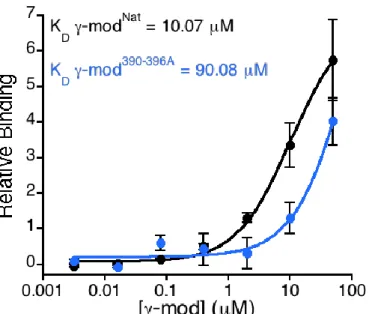
FXIII-γ-module binding and found that, compared to γ-modNat, γ-mod390-396A had reduced affinity for FXIII-A2B2 (10.07 versus 90.08 µM, respectively, Figure 2). These data suggest human γ-chain
residues 390-396 contribute to FXIII-fibrinogen binding.
Solution phase-activated FXIII crosslinks γ-modNat more readily than γ-mod390-396A
FXIII-A2B2 binding to fibrinogen accelerates enzymatic activation. Accordingly, Aleman
et al. observed delayed FXIII-A2B2 activation and fibrin crosslinking in clots formed from
plasma from mice expressing γ390-396A fibrinogen.3 To investigate the role of these residues in human FXIII activation and crosslinking, we incubated γ-modNat and γ-mod390-396A with
thrombin, calcium, and recombinant FXIII-A2 or FXIII-A2B2. We then detected γ-module
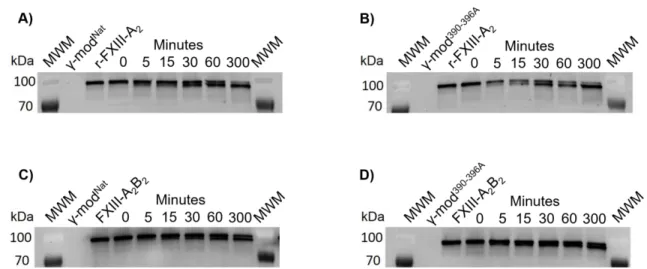
crosslinked species using SDS-PAGE and by Western blotting with anti-human fibrinogen antibody. These experiments showed thatboth recombinant FXIII-A2 and FXIII-A2B2
crosslinked γ-modNat more readily than γ-mod390-396A (Figure 3A-D).
Boutelle 8 of both FXIII-A2B2 and recombinant FXIII-A2 was identical in the γ-modNat and γ-mod390-396A
crosslinking reactions (4A-D). Subsequent solution-phase FXIII assays without γ-module indicated identical FXIII activation to that observed in the crosslinking reactions for both FXIII-A2B2 and recombinant FXIII-A2 (Figure 5A-B). The identical activation rates observed in the
presence and absence of fibrinogen suggest FXIII activation is occurring in solution in the crosslinking assays as it is in the solution-phase experiments. Consequently, the effects of the reduced binding affinity of FXIII with γ-mod390-396A compared to γ-modNat do not manifest in this
assay. Therefore, the decrease in crosslinking of γ-mod390-396A compared to γ-modNat may be a result of disrupted protein structure in the γ-mod390-396A that hinders FXIII activity.
FeBABE Cleavage of FXIII
FeBABE reagent cleaves peptide chains within a 12-angstrom radius and is used in tethered cleavage chemistry. Although we have localized binding of FXIII to fibrinogen γ-chain residues 390-396, the FXIII residues mediating this interaction remain unknown. To map the residues on FXIII that bind to fibrinogen, we conducted tethered cleavage chemistry of FXIII with FeBABE. By conjugating FeBABE reagent to γ-module near residues 390-396, we anticipated that cleavage would occur at FXIII residues located near this motif. The reactions with FeBABE-γ-modG397C conjugates yielded unique bands compared to control reactions
Boutelle 9 Discussion
Given the importance of FXIII-fibrinogen interactions in murine thrombosis, studying these interactions in human proteins may reveal new targets to reduce venous thromboembolism. We generated human fibrinogen γ-module in its native form and with alanine mutations to the proposed FXIII-binding region (residues 390-396) and compared the binding affinities of the constructs to FXIII via ELISA. With calculated KD values of 10.07 µM and 90.08 µM
respectively, γ-modNat and γ-mod390-396A both showed significantly decreased FXIII affinity
compared to full-length fibrinogen (KD ~ 10 nM5). Thus, although γ-module bound FXIII in my
experiments, the data suggest other components of full-length fibrinogen are important for FXIII-fibrinogen binding or that the γ-module is not in its native conformation. Nonetheless, the higher affinity of γ-modNat versus γ-mod390-396A to FXIII supports my hypothesis that γ-chain
residues 390-396 contribute to FXIII-fibrinogen interactions in humans.
The crosslinking assays indicate that FXIII cannot crosslink γ-mod390-396A as efficiently as γ-modNat. The band pattern of FXIII activation peptide cleavage is identical in crosslinking
reactions and solution-phase reactions without γ-module. Given that crosslinking reactions do not utilize pre-incubated FXIII and γ-module, these results suggest that FXIII was not bound to either γ-module when activated in the crosslinking experiments. The inefficiency of γ-mod 390-396A crosslinking relative to γ-modNat crosslinking, therefore, cannot be attributed to hindered
FXIII activation due to deficient FXIII binding. Instead inefficient crosslinking might be the result of the 390-396A mutation disrupting γ-module structure in a way that impairs crosslinking.
Given the identical cleavage patterns of FeBABE-FXIII conjugated protein in the final control and the experimental reactions, any cleavage of FXIII is likely due to FeBABE
Boutelle 10 mediating cleavage at the binding site. Excess FeBABE likely remained in the γ-module solution after conjugation and mixed with FXIII, subsequently conjugating to FXIII cysteine residues during the FXIII-γ-modG397C incubation. These results indicate that the cleavage products of the reaction do not represent the fibrinogen binding residues of FXIII. Further experiments will more stringently buffer exchange free non-γ-module-conjugated FeBABE reagent out of the reaction.
In future studies, we will reassess my approach to use FeBABE to identify the FXIII residues that bind fibrinogen. The γ-module has proven problematic to work with in that it is difficult to purify and has a much lower affinity for FXIII than the full-length protein. We are exploring the use of a yeast expression system that could dramatically increase γ-module yields and purity.13 Alternatively, we will conduct studies with full-length fibrinogen rather than the γ-module. For these experiments, we will introduce chemical crosslinks between FXIII and fibrinogen, which will link the binding domains together. By then utilizing protein cleavage, SDS-PAGE, Western blotting, and mass spectrometry, we will analyze the cleavage products for a fragment containing peptides from both FXIII and fibrinogen.14 We hypothesize that the cleavage fragment containing both FXIII and fibrinogen residues will contain the respective binding domains for each protein. Better understanding of the FXIII-fibrinogen interaction may provide targets for new anti-thrombotic therapies.
Acknowledgements
Boutelle 11 in her laboratory. To all the members of the Wolberg laboratory, thank you for making the
laboratory an exciting place to conduct science. Finally, thank you to my Honors in Biology peers, Emma D’Agostino and Cathy Anderson, for editing and workshopping this paper with me.
References
1. Wolberg AS, Aleman MM, Leiderman K, Machlus KR. Procoagulant activity in hemostasis and thrombosis: Virchow's triad revisited. Anesth Analg. 2012;114(2):275- 285.
2. Heit JA. Venous thromboembolism epidemiology: implications for prevention and management. Semin Thromb Hemost. 2002;28 Suppl 2:3-13.
3. Aleman M, Byrnes JR, Wang JG, Tran R, Di Paola J, Mackman N, Degen JL, Flick MJ, Wolberg AS. Factor XIII activity mediates red blood cell retention in venous thrombi. J Clin Invest. 2014;124(8):3590-600.
4. Takagi T and Doolittle RF. Amino acid sequence studies on factor XIII and the peptide released during its activation by thrombin. Biochemistry. 1974;13(4):750-756.
5. Hornyak TJ and Shafer JA. Role of calcium ion in the generation of factor XIII activity.
Biochemistry. 1991;30(25):6175-6182.
6. Curtis CG, Brown KL, Credo RB, Domanik RA, Gray A, Stenberg P, and Lorand L. Calcium-dependent unmasking of active center cysteine during activation of fibrin stabilizing factor. Biochemistry. 1974;13(18):3774-3780.
Boutelle 12 8. Byrnes JR, Duval C, Wang Y, Hansen CE, Ahn B, Mooberry MJ, Clark MA, Johnsen
JM, Lord ST, Lam WA, Meijers JCM, Ni H, Ariens RAS, and Wolberg AS. Factor XIIIa-dependent retention of red blood cells in clots is mediated by fibrin α-chain crosslinking.
Blood. 2015;126:1940-1948.
9. Greenberg CS, Shuman MA. The zymogen forms of blood coagulation factor XIII bind specifically to fibrinogen. J Biol Chem. 1982;257(11):6096-6101.
10. Kohler HP, Grant PJ. The role of factor XIIIVal34Leu in cardiovascular disease. Q J Med. 1999;92:67-72
11. Credo RB, Curtis CG, Lorand L. Ca2+-related regulatory function of fibrinogen. Proc Natl Acad Sci U S A. 1978;75(9):4234-4237.
12. Medved L, Litvinovich S, Ugarova T, Matsuka Y, Ingham K. Domain structure and functional activity of the recombinant human fibrinogen gamma-module (gamma148- 411). Biochemistry. 1997;36(15):4685-4693.
13. Yee VC, Pratt KP, Côté HC, Trong IL, Chung DW, Davie EW, Stenkamp RE, Teller DC. Crystal structure of 30 kDa C-terminal fragment from the gamma chain of human
fibrinogen. Structure. 1997:15;5(1):125-38.
Boutelle 13
Figure 1. Forward and reverse primers used in γ-module PCR. The forward primer contained restriction enzyme sites for BamHI and NdeI, and the reverse primer contained a restriction enzyme site for HindIII.
Figure 2. FXIII-A2B2 shows reduced affinity for γ-mod390-396A compared to γ-modNat.
FXIII-γ-module binding was measured by ELISA. Briefly, microplates were coated with 10 μg/mL FXIII-A2B2 and blocked with HBS plus Ca2+ plus 1% bovine serum albumin. γ-modNat and 390-396A were added to the wells, and binding was detected with a peroxidase-conjugated
Boutelle 14 Figure 3. FXIII-mediated crosslinking of γ-modNat and γ-mod390-396A. Crosslinking of
γ-module by recombinant(r)-FXIII-A2 (A, B) or FXIII-A2B2 (C, D) was measured by incubating
γ-modNat (A, C) or γ-mod390-396A (B, D) with FXIII in the presence of thrombin (5 nM) and CaCl2
(5 mM). Timed samples were analyzed by SDS-PAGE and Western blotting with anti-human fibrinogen antibody. Control lanes marked as γ-modNat or γ-mod390-396A contain only γ-module
Boutelle 15 Figure 4. FXIII-A subunit activation during crosslinking. Activation rates of r-FXIII-A2 (A,
B) and FXIII-A2B2 (C, D) during crosslinking were measured by incubating γ-modNat (A, C) or
γ-mod390-396A (B, D) with FXIII in the presence of thrombin (5 nM) and CaCl
2 (5 mM). FXIII
activation was detected by re-probing membranes from crosslinking reactions with an anti-human FXIII-A antibody. FXIII activation corresponds with a molecular weight shift following activation peptide cleavage. Control lanes marked as γ-modNat or γ-mod390-396A contain only
γ-module without FXIII and thrombin.
Figure 5. Solution-phase activation of FXIII-A2B2 and r-FXIII-A2. Solution-phase activation
rates of r-FXIII-A2 (A) and FXIII-A2B2 (B) were measured by incubating FXIII in the presence
of thrombin (5 nM) and CaCl2 (5 mM). Timed samples were quenched and analyzed by
Boutelle 16 Figure 6. Tethered cleavage chemistry of γ-modG397C. In the “Reaction” lanes, γ-modG397C was
treated with FeBABE reagent and subsequently incubated with FXIII-A2B2. “High Reaction”
contained a higher concentration of γ-modG397C compared to the “Low Reaction”. “Reactions”
and lanes termed “+ trigger” received the ascorbic acid and hydrogen peroxide trigger and were reacted for 30 seconds before being quenched with sample buffer. Controls contained γ-modG397C
alone, FXIII alone, FXIII plus trigger, γ-modG397C plus FXIII plus trigger, and
FeBABE-γ-modG397C conjugate plus FXIII (not triggered). Samples were analyzed by SDS-PAGE and