Running head: AIDING NURSES’ RECOGNITION OF HUMAN TRAFFICKING IN AN EMERGENCY DEPARTMENT
1
Aiding Nurses’ Recognition of Human Trafficking in an Emergency Department: A Pilot Module
Madeline White
A project presented to the faculty of The University of North Carolina at Chapel Hill
in fulfillment of the requirements for Undergraduate Honors
Date completed: March 21, 2019
AIDING NURSES’ RECOGNITION OF TRAFFICKING IN AN ED 2
Abstract
Although slavery was abolished in the United States in 1865, modern-day slavery, also known as human trafficking, is still very real. Human trafficking is a global problem that has recently been gaining more awareness. Healthcare facilities, and particularly emergency departments (ED), are one of the few places that allow for interaction with victims while they are being trafficked. Therefore, ED nurses have a responsibility to these victims; however, they can only be effective if they are educated about the prevalence, characteristics, and necessary response to identify human trafficking. Previous studies have shown that, although education is effective at improving nurses’ identification of victims of human trafficking, very few nurses have been educated. The aim of this project was to create an educational module for nurses in an ED that addresses human trafficking. In order to do this, a PowerPoint and corresponding VoiceThread were constructed following the structure of Learning Made Simple (LMS) modules, the
AIDING NURSES’ RECOGNITION OF TRAFFICKING IN AN ED 3
Introduction
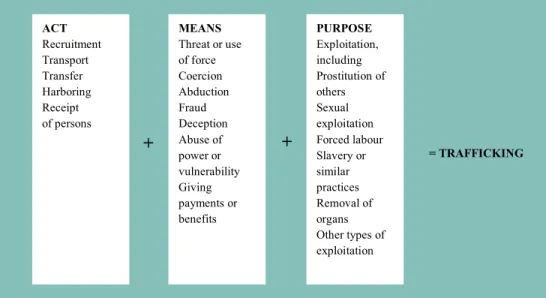
Human trafficking is a public health epidemic with vast impact around the world. It is defined as “a form of modern-day slavery in which traffickers use force, fraud, or coercion to control victims for the purpose of engaging in commercial sex acts or labor services against his/her will” (Human Trafficking, n.d.). The United Nations Office on Drugs and Crime (UNODC) developed the Action-Means-Purpose (AMP) Model to describe the three main elements of human trafficking (UNODC, 2015). The Action is the recruiting, transporting, harboring, or receiving of an individual (UNODC, 2015). The Means refers to force, fraud, or coercion used in order to maintain control over the person or persons, although it is not necessary for children under the age of 18 (UNODC, 2015). The Purpose is labor or commercial sexual exploitation (UNODC, 2015).
Figure 1. The Action Means Purpose Model (UNODC, 2015).
Human trafficking (HT) is a massive global issue with more slaves reported in the world right now than ever before (Peters, 2013). Victims have been identified in 124 different countries (Hachey & Phillippi, 2017), and it is estimated that 20.9 million people are trafficked each year, making it a $150 billion industry (Hachey & Phillippi, 2017). It is difficult to estimate the impact
ACT Recruitment Transport Transfer Harboring Receipt of persons MEANS Threat or use of force Coercion Abduction Fraud Deception Abuse of power or vulnerability Giving payments or benefits PURPOSE Exploitation, including Prostitution of others Sexual exploitation Forced labour Slavery or similar practices Removal of organs Other types of exploitation
= TRAFFICKING
AIDING NURSES’ RECOGNITION OF TRAFFICKING IN AN ED 4 of human trafficking because of the secret and covert nature of the crime. However, the number of victims, whether it is an underestimate or an overestimate, is too high. Human trafficking was recognized as a worldwide crisis by the United Nations (UN) in 2000 (Peters, 2013). The UN defined human trafficking as “the recruiting, transporting, transferring, harboring, or receiving of persons for profit while subjecting them to sexual exploitation, forced labor or slavery, or debt bondage” and classified it as a crime (Peters 2013). In 2015, the UNODC established the “Blue Heart Campaign,” and made a blue heart the international symbol for human trafficking (Stevens & Berishaj, 2016). This campaign raises awareness about HT throughout the world in an effort to eliminate the practice. Like any business, human trafficking grows based on supply and demand. Human traffickers primarily target people in vulnerable situations so the supply of victims is always present. Demand for HT has grown due to the global economic issues and the need for cheap labor and services (Peters, 2013). This has made HT the second largest and fastest
growing organized crime; however, it is predicted to pass drug trade and become the first largest organized crime because while drugs can only be sold once, people can be sold again and again (Peters, 2013).
AIDING NURSES’ RECOGNITION OF TRAFFICKING IN AN ED 5 within the US or those who are taken out of the country (Peters, 2013). The National Human Trafficking Hotline (NHTH) reports 26,557 calls and 8,524 cases reported in 2017 (Hotline Statistics, 2017). The large disparity between estimated and reported numbers of cases of HT demonstrate the need for awareness and training for all people throughout the United States. It is a highly secretive and deceptive crime, which also contributes to why so few cases of HT are actually reported.
The United States government has recognized human trafficking as a global and
nationwide problem and has taken steps to raise awareness and promote education. In 2000, the Trafficking Victims Protection Act was created in order to protect victims of human trafficking who were brought into the United States (Stevens & Berishaj, 2016). It provides the opportunity for victims to obtain a T-visa, which allows them to stay in the United States as long as they help with the prosecution of their trafficker. President Barack Obama spoke out strongly against human trafficking and designated January as National Human Trafficking awareness month (Stevens & Berishaj, 2016). In 2015, Congress passed the “Trafficking Awareness Training Health Care Act” for training for healthcare providers and within schools of medicine and nursing (Powell, Dickens, & Stoklosa, 2017). Right now, the “SOAR to Health and Wellness Act” is waiting on the Senate’s vote. If passed, it would allow the Department of Health and Human Services to establish a program to educate healthcare providers on HT (Powell et al., 2017).
Background
AIDING NURSES’ RECOGNITION OF TRAFFICKING IN AN ED 6 gender minorities (Hotline Statistics, 2017). UNC Hospitals, a tertiary care facility in Chapel Hill with over 900 beds, is a state hospital committed to finding ways to improve the health of all North Carolinians (UNC Health Care, n.d.). This mission requires that they be on the front line of recognizing new health risks to the community and combating them. Because of the growing risk human trafficking places on the people of North Carolina, UNC Hospitals must act by putting protocols and policies in place.
As healthcare providers (HCP), nurses are in a key position to combat this form of slavery. According to a 2014 study, 87.8% of victims of human trafficking reported contact with a healthcare provider while they were being trafficked (Lederer & Wetzel, 2014). However, HCPs are not aware that victims of HT seek medical care (Ramnauth, Benitez, Logan, Abraham, & Gillum, 2018). Approximately 96% of victims that had interactions with healthcare workers while being trafficked expressed that they were not given any information about trafficking during their visit (Donahue, Schwien, & LaVallee, 2019). Victims reported going to hospitals, emergency rooms, Planned Parenthood, women’s health clinics, primary care providers and others for a variety of problems including physical injuries, sexually transmitted infections, birth control prescriptions, and abortions, during their victimization (Lederer & Wetzel, 2014).
AIDING NURSES’ RECOGNITION OF TRAFFICKING IN AN ED 7 HT because of the huge percentage of victims who need healthcare services while being
trafficked.
As the most trusted profession (Brenan, 2018), nurses have a unique role and opportunity in the identification and care for victims of human trafficking. Nurses spend more time with their patients than most other members of the healthcare team, so they have an increased opportunity to establish trust, rapport, and open conversations. They are on the front line of caring for HT victims (Stevens & Berishaj, 2016). Every time a victim of HT comes to the hospital or clinic is an opportunity for identification and change. It provides a chance to separate the victim from the trafficker and participate in conversation and assessment. Therefore, lack of training in nurses is a missed opportunity for victims to receive aid (Ramnauth et al., 2018). A recent study reported that 84% of nurses had not received training in HT (Ramnauth et al., 2018). By increasing nurses’ awareness of HT, we can decrease the number of opportunities that are lost. Human trafficking can happen to anyone no matter the age, gender, ethnicity, culture, etc. so nurses in every department need to be educated and prepared (Ramnauth et al., 2018).
While victims of human trafficking go to all areas of healthcare, the majority are seen in the emergency department (ED) (Lederer & Wetzel, 2014). Lederer’s study reported that 63.3% of victims who received healthcare while trafficked were treated at the ED (Lederer & Wetzel, 2014); however, 89% of ED personnel have not received training on human trafficking (Donahue et al., 2019). They are trained on sexual assault, domestic violence, and child abuse, but not typically on HT (Grace et al., 2014). Although some of the signs of all of these are the same, HT is different in many ways and can be more difficult to identify. The nurse is often the first
AIDING NURSES’ RECOGNITION OF TRAFFICKING IN AN ED 8 Association has recognized the important position ED nurses are in and is pushing for mandatory education on HT (Donahue et al., 2019).
A 2014 study found that, before education, only 8.8% of ED providers felt
knowledgeable on HT and 25.8% knew who to call (Grace et al., 2014). The ED providers received an education that consisted of a PowerPoint presentation including the background of HT, relevance of the information to healthcare, physical and psychological signs, and referral options for victims (Grace et al., 2014). After this education, 60.9% felt knowledgeable and 98.8% knew who to call (Grace et al., 2014). Healthcare providers described the number one barrier to identification of victims of HT as lack of education (Beck et al., 2015). The second highest barrier reported was lack of awareness (Beck et al., 2015). By providing training that gives both education and awareness, we can greatly reduce the barriers between nurses and victim identification.
AIDING NURSES’ RECOGNITION OF TRAFFICKING IN AN ED 9 for girls and 11-13 years old for boys, and of these children, 80-90% have a history of sexual abuse (Hachey & Phillippi, 2017).
Key signs of human trafficking are classified by physical characteristics, psychological characteristics, and situational red flags. Physical characteristics include signs of violence, especially to the head and face, sexual violence, recurrent sexually transmitted infections, malnutrition, and delayed treatment of serious medical problems (Hachey & Phillippi, 2017; Peters, 2013). Depression, post-traumatic stress disorder (PTSD), anxiety, and substance abuse can all affect victims of HT (Lederer & Wetzel, 2014; Hachey & Phillippi, 2017). Red flags include: if the patient does not speak English, reports an inconsistent personal story, is uncertain of their present location, shows a lack of control of money, has a tattoo showing ownership, and has a partner present who controls the conversation and answers questions (Hachey & Phillippi, 2017; Lamb-Susca & Clements, 2018; Stevens & Berishaj, 2016).
The purpose of this honors project is to develop an educational module on HT specifically designed for emergency department nurses. The aim of the module is to educate nursing staff on the prevalence, characteristics, and effective response to human trafficking. As a significant public health issue, human trafficking impacts every facet of care. Nurses take a holistic view of care for patients, but they cannot say they are caring for the whole person when opportunities for freedom to be restored are overlooked.
Methods
AIDING NURSES’ RECOGNITION OF TRAFFICKING IN AN ED 10 resulted from these searches. These articles were reviewed and 15 were eliminated from the scoping study because they were not applicable to the study. The remaining articles were reviewed and given a tag of “Background”, “Global”, “US”, “NC”, “Healthcare”, “Nursing”, “ED”, and/or “Methods” depending on how they were relevant to the scoping study.
UNC Hospitals uses Learning Made Simple (LMS) modules for education of employees. Certain modules are assigned to employees based on job description, unit of work, and access to specific exposures. These modules are required for continued employment. The LMS modules are a compilation of informational slides and review or quiz questions. In order to develop the educational module, the general compliance training modules currently assigned annually to employees of UNC Hospitals were reviewed, including modules on sepsis, blood-borne pathogens, and tuberculosis. The typical components of LMS modules are instructions for navigating the course, the objectives of the module, the definition of the topic, signs and
symptoms of the problem, high risk populations, and a knowledge check. The knowledge check consists of questions about the subject matter either at the end of the module or included
throughout. Some presentations incorporated eye-catching graphics, notes with additional information, a voice-over reading the information from the slides, and a time requirement for each slide.
Microsoft PowerPoint and VoiceThread were used to create the human trafficking educational module and record a voice-over. The format of the LMS modules was followed in making the PowerPoint, which included the objectives of the module, the definition of human trafficking, the scope of the problem, characteristics to look for, high risk groups, how to
AIDING NURSES’ RECOGNITION OF TRAFFICKING IN AN ED 11 completed, it was downloaded to VoiceThread and a voice-over was recorded to make the module more engaging and to provide additional information
(https://unc.voicethread.com/share/12130818/).
In order to assess the usability and clarity of the module, a survey was created with Google Forums and distributed to eight students in the nursing school of different genders, ethnicities, and backgrounds. The survey had 10 questions total: 7 yes-or-no questions and 3 short answer questions with a space for additional comments (Appendix B). Five of the nursing students responded to the invitation to watch the educational module and complete the survey. Adjustments were made to the module based on the responses of the students. All respondents reported that the module was easy to navigate, the progression of information made sense, the topic was applicable to their nursing practice, and it covered all of the objectives listed. When asked what they learned in the module, most reported that they did not know how widespread the problem was or the characteristics to look for. All respondents reported that they would
recommend that the module be used in the ED. Based on the survey responses, the module was determined to be easily usable, well designed, and very informative.
Discussion
AIDING NURSES’ RECOGNITION OF TRAFFICKING IN AN ED 12 This project had certain limitations related to the time frame and scope of the project. Because of this, the author was unable to communicate with nurse managers in the emergency department. Doing so would have allowed the feasibility of presenting the educational module to ED nurses to be examined. No survivors of human trafficking were shown the module for
feedback although communication with survivors was crucial in the evidence-based research examined in the scoping study. Another limitation was that the survey used to assess the usability of the educational module was completed by nursing students, and not by ED nurses. Because of time constraints and a convenience sample, nursing students were asked to participate. Related to this, the sample size of respondents was very small.
This project is just a first step in many necessary steps. Because of the largely secretive nature of human trafficking, few hospitals are prepared to combat HT in their community and within their hospital. An essential part of this project is the realization that so much more needs to be done. There are clinical implications for nursing practice, policy development, and
legislative advocacy. For example, increased awareness of HT by the ED nurse and applying that in practice could change the lives of victims. Moreover, a policy must be developed in each hospital around the country that addresses human trafficking not only in the emergency department, but throughout the hospital. These policies must be community-specific,
multidisciplinary, and trauma-informed. There is an additional need for nurses to be active in advocating for legislation addressing human trafficking. Legislation can have huge implications for the prevention of HT, education of healthcare providers, and resources for survivors;
AIDING NURSES’ RECOGNITION OF TRAFFICKING IN AN ED 13
Conclusion
AIDING NURSES’ RECOGNITION OF TRAFFICKING IN AN ED 14 References
Banks, D. & Kyckelhahn, T., (2011). Characteristics of suspected human trafficking incidents, 2008-2010. Retrieved from http://www.bjs.gov/content/pub/pdf/cshti0810.pdf
Beck, M. E., Lineer, M. M., Melzer-Lange, M., Simpson, P., Nugent, M., & Rabbitt, A. (2015). Medical providers’ understanding of sex trafficking and their experience with at-risk patients. Pediatrics, 135(4), e895–902. doi:10.1542/peds.2014-2814
Brenan, M. (2018). Nurses again outpace other professions for honesty, ethics [website]. Retrieved from https://news.gallup.com/poll/245597/nurses-again-outpace-professions-honesty-ethics.aspx
Donahue, S., Schwien, M., & LaVallee, D. (2019). Educating emergency department staff on the identification and treatment of human trafficking victims. Journal of Emergency Nursing. doi:10.1016/j.jen.2018.03.021
Grace, A. M., Lippert, S., Collins, K., Pineda, N., Tolani, A., Walker, R., … Horwitz, S. M. (2014). Educating health care professionals on human trafficking. Pediatric Emergency Care, 30(12), 856–861. doi:10.1097/PEC.0000000000000287
Hachey, L. M., & Phillippi, J. C. (2017). Identification and management of human trafficking victims in the emergency department. Advanced Emergency Nursing Journal, 39(1), 31–51. doi:10.1097/TME.0000000000000138
Hotline Statistics (2017). National Human Trafficking Hotline [website]. Retrieved from https://humantraffickinghotline.org/states
AIDING NURSES’ RECOGNITION OF TRAFFICKING IN AN ED 15 Lamb-Susca, L., & Clements, P. T. (2018). Intersection of human trafficking and the emergency department. Journal of Emergency Nursing. doi:10.1016/j.jen.2018.06.001
Lederer, L., & Wetzel, C. (2014). The Health Consequences of Sex Trafficking and Their Implications for Identifying Victims in Healthcare Facilities. Annals of Health Law / Loyola University Chicago, School of Law, Institute for Health Law, 23(1), 61–91.
Long, E., & Dowdell, E. B. (2018). Nurses’ perceptions of victims of human trafficking in an urban emergency department: A qualitative study. Journal of Emergency Nursing, 44(4), 375–383. doi:10.1016/j.jen.2017.11.004
United Nations Office on Drugs and Crime. (2015). Human trafficking. Retrieved from
http://www.unodc.org/unodc/en/human-trafficking/what-is-human-trafficking.html
Peters, K. (2013). The growing business of human trafficking and the power of emergency nurses to stop it. Journal of Emergency Nursing, 39(3), 280–288.
doi:10.1016/j.jen.2012.03.017
Powell, C., Dickins, K., & Stoklosa, H. (2017). Training US health care professionals on human trafficking: where do we go from here? Medical Education Online, 22(1), 1267980. doi:10.1080/10872981.2017.1267980
Ramnauth, T., Benitez, M., Logan, B., Abraham, S. P., & Gillum, D. (2018). Nurses’ awareness regarding human trafficking. International Journal of Security and Networks, 3(2), 76. doi:10.20849/ijsn.v3i2.389
Stevens, M., & Berishaj, K. (2016). The anatomy of human trafficking: learning about the blues: A healthcare provider’s guide. Journal of Forensic Nursing,12(2), 49–56.
AIDING NURSES’ RECOGNITION OF TRAFFICKING IN AN ED 16 UNC Health Care (n.d.). About Us [website]. Retrieved from
AIDING NURSES’ RECOGNITION OF TRAFFICKING IN AN ED 17 Appendix A
AIDING NURSES’ RECOGNITION OF TRAFFICKING IN AN ED 25 Appendix B