Systematic Review of Medication Synchronization in Community Pharmacy Practice
By Michael Patti Chelsea Phillips Renfro
Rachael Posey Gabrielle Wu
Kea Turner Stefanie Ferreri
Honors Thesis
UNC Eshelman School of Pharmacy University of North Carolina at Chapel Hill
January 14, 2019
Approved:
Abstract
Background: Medication non-adherence costs more than 100 billion dollars in avoidable hospitalizations yearly. As a result, community pharmacies have implemented medication synchronization programs to improve adherence. One function of most medication
synchronization programs is the alignment of all of a patient’s medications to refill on a single date. While aligning refills is a standard aspect of most programs, other features vary making it difficult to identify which program components lead to improved adherence.
Objective: To review available literature and identify core components of medication synchronization and associated implementation techniques in community pharmacy.
Methods: A systematic review was performed by searching electronic databases for studies, reviews, and other sources for grey literature discussing medication synchronization in community pharmacy settings. Studies were eligible for inclusion if they documented the operation of medication synchronization program in a community pharmacy. A framework analysis identified common themes present in the literature.
Results: Twenty-six studies met criteria for final inclusion in this review. The majority of studies were retrospective cohorts, commentaries, and implementation guides. A wide variety of core components were included as part of medication synchronization program descriptions in the available literature. The authors were able to identify several core components that were consistent throughout most of the published literature. These components were the identification and enrollment of patients, inclusion of a medication review and patient
assessment, the alignment of refills, a formal process for preparation of medications, and the delivery of medications and other services.
Conclusions: This review identified several common themes of medication synchronization in the literature. The authors believe this will help standardize medication synchronization within community pharmacy and facilitate future research. Themes found in this review provide the foundation upon which a consensus definition of medication synchronization can be built.
Systematic Review of Medication Synchronization in Community Pharmacy Practice
Michael Patti, PharmD Candidate is a student pharmacist at UNC Eshelman School of Pharmacy, University of North Carolina at Chapel Hill.
Chelsea Phillips Renfro, PharmD, is an Assistant Professor at the University of Tennessee Health Science
Center College of Pharmacy, Memphis, TN.
Rachael Posey, MLS was the Pharmacy Librarian and Coordinator of Systematic Review Services for the Health Sciences Library at the University of North Carolina at Chapel Hill while this review was being
conducted. She currently is employed as the Health & Life Sciences Research Librarian and Associate
Director at the William Rand Kenan Jr. Library of Veterinary Medicine at North Carolina State University.
Gabrielle Wu, PharmD Candidate is a student pharmacist at UNC Eshelman School of Pharmacy, University of North Carolina at Chapel Hill.
Kea Turner, MPH, MA, PhD is a postdoctoral fellow at the University of California at San Diego School of Medicine.
Stefanie P. Ferreri, PharmD, BCACP, CDE, FAPhA is Clinical Professor, Executive Vice-Chair and Co-Director, PGY1 Independent Pharmacy Ownership Residency Program, Division of Practice Advancement
and Clinical Education, UNC Eshelman School of Pharmacy, University of North Carolina at Chapel Hill.
Funding Sources
This research did not receive any specific grant from funding agencies in the public, commercial, or
Introduction
Patient non-adherence to prescribed therapy is a major driver of healthcare expenditures in the
United States (U.S.). In a survey of 1,020 patients performed by the National Community Pharmacy
Association, more than half reported multiple incidences of non-adherence each year.1 This pattern of
non-adherence may be related to the numerous medications that patients are expected to manage.2
The Centers for Disease Control and Prevention (CDC) found that nearly 40% of adults, 65 years or older,
reported taking 5 or more prescription medications.3 This medication burden has been shown to have a
direct impact on adherence, as patients have identified that high frequency of pharmacy visits poses
both economic and social hardships.4 To increase the likelihood of patient medication adherence,
community pharmacies have begun offering medication synchronization programs specifically targeted
at reducing the number of pharmacy visits.
Medication synchronization is a service offered in more than 20,000 pharmacies in the U.S. to
alleviate poor medication adherence.5 Medication synchronization functions by aligning all a patient’s
medications to refill on a single date each month to minimize trips to the pharmacy. Due to the rapid
growth of service, pharmacy associations offer many different medication synchronization programs,
including programs by the American Pharmacists Association (APhA) and other organizations.6-8 While
aligning all refills on one date is a standard aspect of these programs, other features of these programs,
such as flexible payment plans, delivery options, and comprehensive medication reviews, are quite
variable.
While aspects of the programs differ, medication synchronization has demonstrated a positive
impact on adherence. Prior studies have indicated rates of adherence 2 to 6 times higher in patients
enrolled in a medication synchronization program compared to patients managing their refills on their
own.9-11 These adherence improvements have been shown, despite increased medication expenditure
synchronization programs as well as improving operational efficiency and revenue for participating
pharmacies.12-14
Because the components of medication synchronization programs are not standardized, it is
difficult to identify which correlate with improved adherence. Few studies have attempted to
characterize the differences between these programs, with most focusing on one pharmacy chain or
users of a single medication synchronization program.10,11,15,16 A previous study by Krumme et al.
attempted to identify the core components, or the features required to maintain the fidelity of the
innovation of effective programs; however, this review used the recommendations of an expert panel to
decide which programs, but not which components, were considered “exemplary.”16 A common
definition of the components and identification of the core components of medication synchronization
is currently lacking in the literature. Without these items, it is difficult to determine the correlation
between medication synchronization program features and improved adherence.
In addition to a need for defining the core components of medication synchronization, a
description of the implementation of the program in pharmacies is also needed. While thousands of
pharmacies have begun offering medication synchronization to patients, little information exists on the
implementation of the service. Implementation science is the study of the environment and conditions
required for successful implementation of an innovation or service. 17,18 Few studies have used
implementation science to examine how medication synchronization is implemented. These studies
focus only on a specific program, not the overarching components of medication synchronization
programs as a whole. 19
Objective
The objective of this study is to identify the core components of medication synchronization and
their associated implementation techniques in community pharmacies. Identifying the core
components of medication synchronization will allow researchers to examine which components of
focus implementation efforts on the components that drive performance and can eliminate ineffective
components, saving time and resources.
Methods
This study was conducted according to PRISMA guidelines.20 Further details can be found in the
protocol for this systematic review, which has been registered with the PROSPERO register of systematic
reviews registration #:CRD42016051371.21
Search Strategy
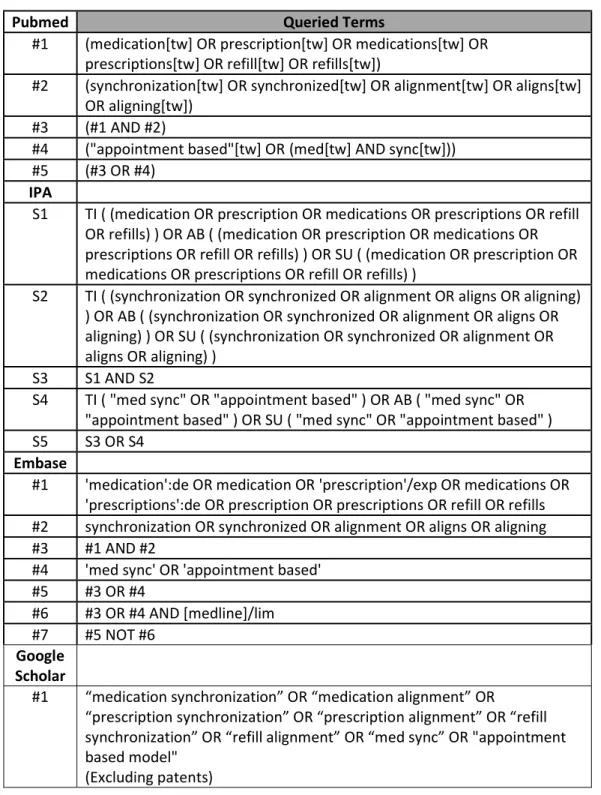
We searched for studies and reviews in MEDLINE® (via PubMed), Embase, and International
Pharmaceutical Abstracts (IPA) from date of database inception through January 31, 2018 using general
terms for medication, prescription, or refill combined with terms for synchronization or alignment or
terms for appointment-based programs. We used medical subject headings (MeSH) or Embase subject
headings (Emtree) where available and keywords when applicable. A complete list of MeSH terms and
subject headings can be found listed in Table 1. We included additional grey literature from Google
Scholar, pharmacy associations and corporate entities.
Study Selection
Criteria for study inclusion were English language documentation of the operation of medication
synchronization program in a community pharmacy setting. The reviewers chose to include only English
language literature due to the review’s focus on the United States healthcare system and healthcare
expenditures. Medication synchronization operations include implementation techniques, methods of
patient enrollment, and clinical services offered as part of the program, such as comprehensive
medication management, disease state management, patient education, point of care testing or vaccine
recommendations. For the purposes of this study, a community pharmacy setting includes independent
pharmacies, traditional chains, supermarket chains, mass-merchant chains, and outpatient pharmacies.
The medication synchronization articles included a heterogeneous mixture of peer-reviewed and
varied in study design. The authors decided to use an inclusive approach to selecting studies for the
systematic review (e.g., including qualitative, multiple types of study designs) so that relevant articles
were not excluded. This allowed the authors to obtain a comprehensive understanding of how
medication synchronization has been implemented. We excluded articles that did not detail the
operation of a medication synchronization program, those in a non-community pharmacy setting,
abstracts, conference papers, and patents.
Reporting of Findings and Framework Analysis
It was initially planned to conduct a meta-analysis; however, due to the heterogeneity of studies found,
this type of analysis was not able to be conducted. Therefore, extracted data have been summarized
and reported qualitatively, and a framework analysis was conducted. A framework analysis was used
because the study started with an a priori framework to guide the literature search.22 This method
involves 1) familiarization – getting to know the literature for a given topic; 2) identifying a thematic
framework that guides text selection from the studies; 3) indexing and charting – abstracting data from
studies and organizing them within a matrix; and 4) interpretation – analyzing the data from each of the
matrix cells and summarizing the data using descriptive statistics.
Data Extraction
Two authors independently extracted the following data using an electronic data collection
form: Citation, PubMed ID (if applicable), year of publication, article objective(s), study population,
study design, primary outcome, secondary outcome, number of community pharmacy sites, type of
community pharmacy, location (country and state if applicable), medication synchronization
program used, pharmacy team involvement and medication synchronization program features.
Data were sorted based upon the specific program features using the definitions set by
Krumme et al. as a framework. These program features included, but were not limited to:
reinforce adherence and link to other services, care integration, flexible solutions for patients, and
techniques to ensure pharmacist/staff buy-in.16
Data Analysis for Core Component Identification
Data were analyzed by creating a matrix (i.e. Excel workbook) and abstracted text selections
based on the framework.23,24 The authors reviewed the free-text descriptions of the medication
synchronization programs and used similarities to group them into categories, using Krumme et al.
as a framework, that would eventually inform the identification of core components of medication
synchronization. When the research team encountered text selections that did not fit into the
framework categories, the categories were modified to ensure that new data was not missed. Two
authors reviewed the identified medication synchronization text selections and were able to reach
consensus that these text selections best represented the available categories.
Data Analysis for Implementation Strategies
In addition to program features, data related to medication synchronization implementation
were also synthesized and categorized using implementation strategies defined by Waltz et al and
Powell et al.25-27 Implementation strategy was defined as “a systematic intervention process to
adopt and integrate evidence-based health innovations (e.g., QI) into usual care” (p.124).27 These 9
strategies are as follows 1) Engage consumers; 2) Use evaluative and iterative strategies; 3) Change
infrastructure; 4) Adapt and tailor to the context; 5) Develop stakeholder interrelationships; 6) Use
financial strategies; 7) Support clinicians; 8) Provide interactive assistance; and 9) Train and educate
stakeholders.
Results
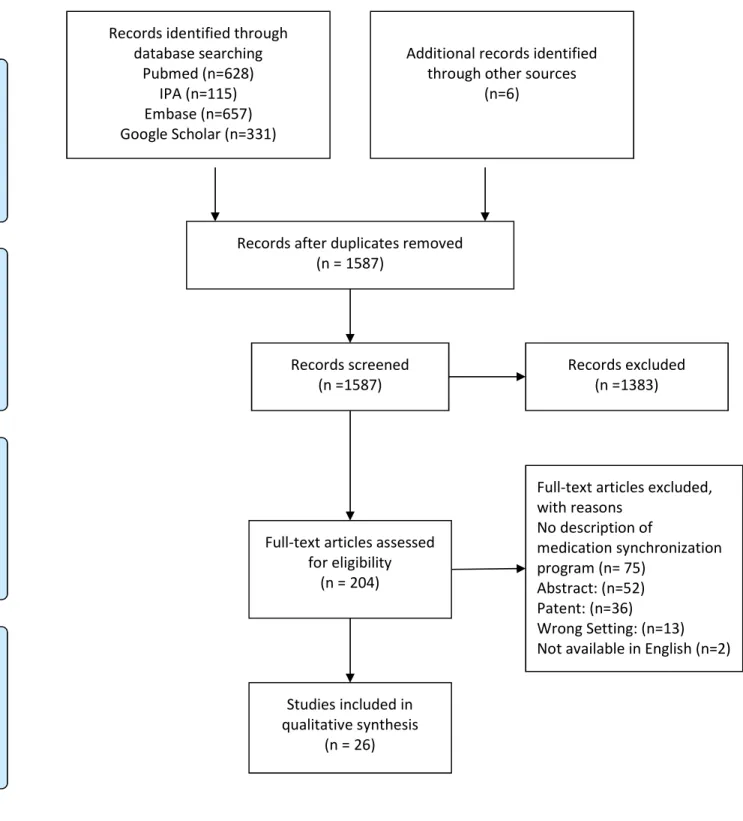
Our search identified 1731 articles via database searching, and an additional 6 articles were
found via the review of grey literature. Following removal of duplicates, 1587 articles were
review. A total of 178 articles were then excluded for: failing to describe a medication
synchronization program (n=75), available as abstracts/conference papers only (n=52), patents
(n=36), not being in the community pharmacy setting (n=13), and the full-text not being available in
English (n=2).
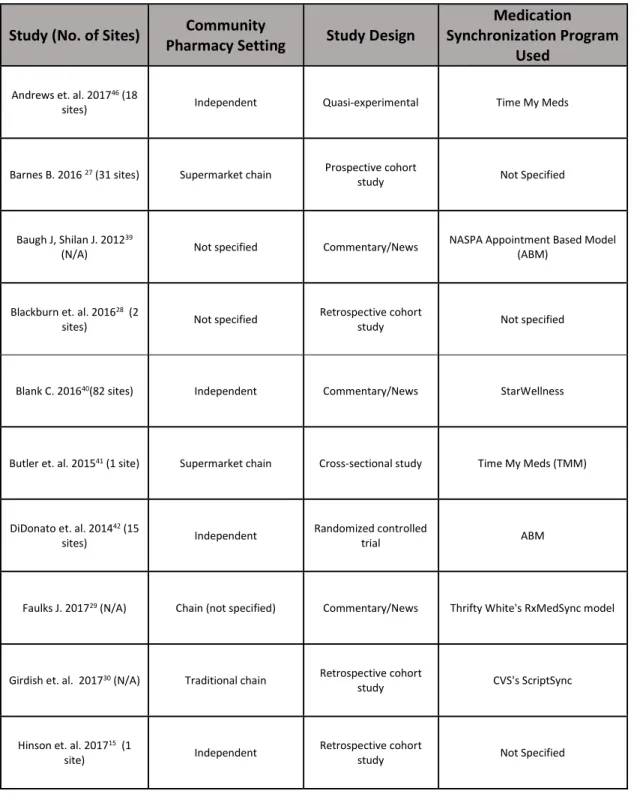
The 26 articles (Table 2) from the United States that met criteria for final inclusion included 7
retrospective cohort studies, 5 commentary articles, 3 implementation guides, 2 randomized
control trials, 2 quasi-experimental, 2 cross-sectional studies, 1 prospective cohort study, 1
observational cohort study, 1 mixed-methods study, 1 review, and 1 association white paper.
8,10,11,15,16,28-48
Twelve studies assessed the potential improvement in medication adherence associated
with medication synchronization enrollment, with adherence most frequently defined as proportion
of days covered > 0.8.10,11,15,28,29,31-34,43,45,47,48 Only 2 studies, Didonato et al and Krumme et al
(2018), assessed clinical outcomes associated with medication synchronization, which were systolic
and diastolic blood pressures as an outcome of adherence to anti-hypertensive medication and
incidence of major adverse cardiovascular events respectively.4333
Of the included studies, the most common pharmacy practice environments for medication
synchronization programs were independent pharmacies (n=11), traditional chains (n=4),
supermarket chains (n=4), non-specified chains (n=4), and mass merchant chains (n=1).
8,10,15,16,28,30-34,38,39,41-45,47,48 Seven articles did not specify their practice setting beyond a general mention of
community pharmacy or the identification of their target audience as community pharmacies.
11,29,35-37,40,46 The most commonly identified medication synchronization program type was the
appointment-based model (n=12).10,16,32-34,36-38,40,43,44,49 The observed program features as
previously defined by Krumme et al were pharmacist consultation to reinforce adherence and link
identify opportunities (n=16), care integration (n=9), techniques for pharmacist buy-in (n=4), and
other (n=2).8,10,11,15,16,28-48 The 2 other feature responses were technician training and providing
patient enrollment cards. 35,44
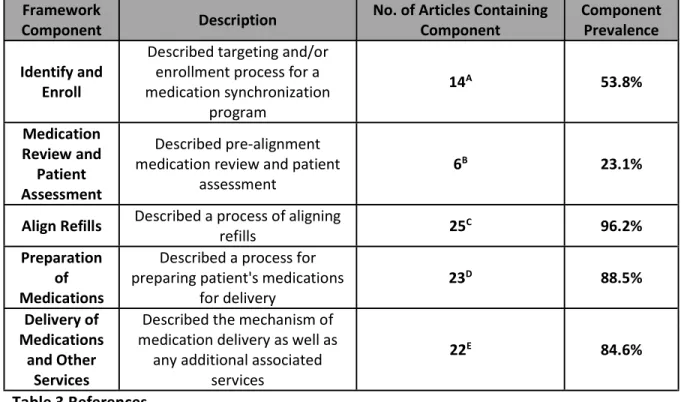
The results of the framework analysis revealed 5 common medication synchronization
themes, representing potential core components, (Table 3) that appeared multiple times within the
reviewed literature. These themes were: 1) the identification and enrollment of patients (n= 14), 2)
medication review and patient assessment (n=6), 3) alignment of refills (n=25), 4) preparation of
medications (n=23), and 5) delivery of medications and other services (n=22). The 3 most common
themes, alignment of refills, preparation of medications, and delivery of medications and other
services, focused on managing the patient from the point of refill alignment onwards. The 2 least
common themes were enrolling appropriate patients and optimizing medication regimens prior to
the initial refill alignment. Only 2 articles described a medication synchronization program that
contained all five themes.11,30
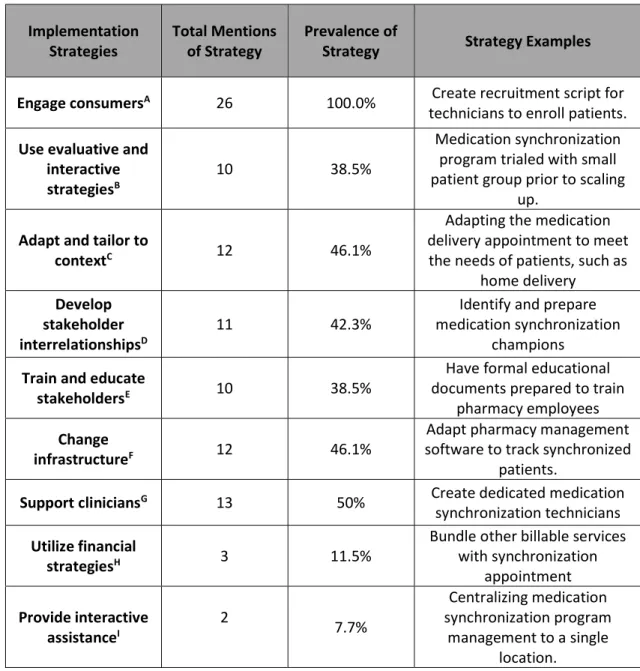
Medication synchronization implementation data were extracted and grouped into nine
categories utilizing the implementation framework published by Waltz et al (Table 4).26 All studies
contained at least one identifiable implementation strategy. Overall, the most commonly occurring
category of implementation technique was engaging consumers with all 26 studies offering
techniques for engaging pharmacy customers. The remaining implementation strategies were
observed with much lower frequencies in the reviewed literature. These were the use of
evaluative and interactive strategies (n=10), adapt and tailor to context (n=12), develop stakeholder
interrelationships (n=11), train and educate stakeholders (n=10), change infrastructure (n=12),
support clinicians (n=13), utilize financial strategies (n=3), and lastly providing interactive assistance
Discussion
Medication synchronization has been characterized as an adherence intervention involving
multiple processes; central amongst these processes is the alignment of medications to refill. This
definition is supported by 26 reviewed articles in the systematic review. However, due to the
heterogeneity of study designs and included program descriptions a consensus definition of
medication synchronization was not clear after the systematic literature review. Additionally, the
lack in outcomes-based research seen in the available literature, adds support to the claim that
medication synchronization is poorly defined.33,43
To effectively study outcomes associated with an intervention, that intervention must be
clearly defined, and the current fractured nature of medication synchronization has limited the
ability of researchers to study its clinical effects with only two identified studies looking directly at
clinical outcomes as opposed to surrogate outcomes related to adherence.33,43 These studies
selected a specific medication synchronization intervention which may not be generalizable to all
medication synchronization programs.33,43
Based on the observed components, many programs treat medication synchronization as a
process that starts with the alignment of refills, with most studies focusing on alignment,
medication preparation, and medication delivery.15,16,35-37,39,40,42-44,46,48 Of the programs describing
pre-alignment processes, the identification and enrollment of appropriate medication
synchronization patients was the most common. This aspect of medication synchronization is one
that is often overlooked. Medication synchronization may not be appropriate for all patients (e.g.,
patients taking as needed medications or whom are already highly adherent).15,37 Several programs
had clearly defined enrollment criteria, often a particular number of chronic medications, to target
those patients who might both best benefit from medication synchronization and be the best use of
While it is clear that many programs seek to enroll the appropriate patients, what is less
clear is a process for optimizing medication regimens prior to aligning refills. A basic medication
review is shared by nearly all programs, but a comprehensive medication review for medication
optimization prior to the initial medication alignment was rarely identified.11,28,30,41,45,47 This current
practice is inefficient because the pharmacies dedicate a significant amount of time considering
patient specific factors, such as patient finances or need for home delivery, when selecting a
synchronization date and if a medication change is required post-synchronization the whole process
must be repeated. If a patient’s medications are not optimized (for example, an ACE inhibitor that
is not at goal dose), then it would best serve the pharmacy to attempt to rectify this deficiency
before synchronizing and filling. Additionally, pharmacists would be remiss not to use this
opportunity for a comprehensive clinical review of medications to demonstrate their potential to
improve patient outcomes through medication synchronization. However, there is a paucity of
information in the literature on the programs’ consideration of the clinical appropriateness of the
medications to be synchronized.
The literature is consistent when discussing the processes of filling and delivering the
patient’s medications once the synchronization process is complete. Nearly all studies describe a
process of contacting the patient approximately seven days prior to their synchronization date to
confirm the medications to be refilled and address recent doctors’ visits or
hospitalizations.8,10,11,15,16,28-32,34-36,38,40,42-48 Once the medications have been filled the process of
delivering medications is described in many studies as featuring an opportunity to provide other
patient services, such as medication therapy management or immunizations.
8,10,11,15,16,29-34,36,38,39,41-44,46,47
While the core components of medication synchronization are a focus of this review, they
medication synchronization program. This review identified several interesting trends in how
community pharmacies implement and operate their medication synchronization programs. As
seen in Table 4, the most common implementation strategies focus on educating and recruiting
patients into the medication synchronization programs (n=26), but similar processes targeted at
other stakeholders (n=11), such as pharmacy staff and local healthcare providers, occur with much
less frequency. 8,10,11,15,16,28-48 This trend was also supported by the rare occurrence of techniques
for pharmacist buy-in, as defined by Krumme et al, since only 4 were observed in the reviewed
studies.16,36,37,46
A lack of stakeholder education and buy-in could pose a significant challenge to the success
of a medication synchronization program, as stakeholders, including pharmacists, technicians, and
cashiers, may be unable to handle the additional workflow created by aggressive patient
recruitment. Lack of stakeholder buy-in also speaks to a missed opportunity for these pharmacies
to communicate with local providers, and often forgotten group of stakeholders, to educate them
regarding the potential advantages of medication synchronization programs. As seen in two
studies, this has the potential to lead to a formalized referral process for non-adherent patients
adding a new source of patients and revenue to the pharmacy.28,45
Given the challenging practice environment that community pharmacists
are faced with, where the goal is to provide the best patient care while minimizing overhead cost,
efficiently involving all staff members in medication synchronization operation is key. However,
while the majority (n=23) of studies describe pharmacist involvement, less than half (n=12) make
mention of how technicians are involved, and even fewer (n=10) mention other staff such as
cashiers. 8,10,11,15,16,28-34,36-47 Whether this is due to the primary burden of medication
synchronization falling on pharmacists or if the literature is not adequately capturing other staff
Lastly, implementation of medication synchronization does not end once the first patient is
synchronized, as there is always room to improve and optimize as more patients are recruited.
While evaluative and interactive strategies were one of the more common implementation
strategies seen in the literature (n=10), the sub-strategies associated with continuous improvement
such as quality monitoring (n=4), auditing and providing feedback (n=2), purposefully re-examining
the implementation (n=1), and obtaining and using patient/consumer feedback (n=1) were all
observed with relatively low frequency. This could indicate that community pharmacies may be
allowing medication synchronization to stagnate instead of optimizing the intervention to maximize
its efficiency and impact.
Taken as a whole, the components and implementation strategies observed in the literature
create a preliminary picture of the core components required for a medication synchronization
program. A medication synchronization program featuring the components observed in this review
should contain a standardized process to; 1)target and enroll patients, 2)review the patient and
their medications, 3)select the medications to be synchronized as well as their synchronization date
based on patient specific factors, 4) contact the patient and prepare the medications for delivery, 5)
delivery of the patient’s medications. These components create a high touch program centered on
overall patient care that can serve as an anchor for the multitude of clinical services that are gaining
in popularity within community pharmacy practice.
The framework analysis conducted in this systematic review further supports core
components of medication synchronization considered by Renfro et al.50 In that study the
researchers vetted the core components found in this review with community pharmacy luminaries
from across the United States.50 The luminary interviews found the core components to be
A consistent definition of medication synchronization core components can be used to show
both the clinical and financial benefits that medication synchronization may bring to community
pharmacies. Utilizing these core components as a standard, future research can track if adherence
to these components generates improvements in medication adherence in addition to clinical and
financial outcomes. This can be used in community pharmacy practice to justify additional
reimbursements based on the quality of their medication synchronization program.
Limitations
There are potential limitations associated with the methods of a systematic review. The
first is the potential for selection bias as the authors chose to restrict reviewed literature to articles
only published in the English language. Publication bias is another limitation inherent in systematic
reviews as negative and non-significant study results are sometimes not submitted for publication.
While this is not as significant in the case of this review as outcomes were not the focus, publication
bias may have artificially restricted the quantity of literature available to the authors.
The reviewed literature was heterogenous in number and type of practice sites, as well as
study designs and outcomes. The majority of the reviewed studies were qualitative or had a small
sample size, thus limiting the generalizability of this review. This made it difficult for the authors to
accurately weigh the significance of data. Additionally, the available literature in many instances
did not thoroughly describe the medication synchronization intervention as part of their methods,
which posed a challenge when attempting to identify core components. The heterogeneity of our
dataset and the lack of consistent reporting across studies limited our ability to analyze the data in a
systematic fashion resulting in a framework analysis. Further studies are needed that assess
medication synchronization in a larger sample size.
The standardization of an intervention is a necessary prior to performing any
outcomes-based research. However, as is seen in this review of medication synchronization literature, the
adherence intervention known as medication synchronization is not standardized in community
pharmacy practice. Medication synchronization programs have the potential to become a
standardized intervention linking multiple adherence and clinical services in community pharmacy
practice. The standardization of medication synchronization programs across community pharmacy
practice will help to ensure the quality of the medication synchronization programs offered to
patients, thereby improving the overall quality of community pharmacy practice.
This review provides the foundation upon which a consensus definition of medication
synchronization can be built. This is a key first step to performing outcomes-based research to
prove the potential value medication synchronization can bring both to cost and clinical outcomes.
References
1. National Community Pharmacist Association. Medication adherence in America: a national
report card. 2013;
http://www.ncpanet.org/pdf/reportcard/AdherenceReportCardPresentation-FINAL.pdf. Accessed November 5, 2018.
2. Odegard PS, Capoccia K. Medication taking and diabetes: a systematic review of the literature.
Diabetes Educ. 2007;33(6):1014-1029; discussion 1030-1011.
3. National Center for Health S. Health, United States. Health, United States, 2015: With Special Feature on Racial and Ethnic Health Disparities. Hyattsville, MD: National Center for Health Statistics (US); 2016.
4. Brown MT, Bussell JK. Medication Adherence: WHO Cares? Mayo Clinic Proceedings.
2011;86(4):304-314.
5. Bonner L. Med Sync Catching on Across Nation. 2015;
https://www.pharmacist.com/med-sync-catching-across-nation. Accessed November 5, 2018.
6. Align My Refills. 2016; http://www.aphafoundation.org/align-my-refills/about-medsync.
Accessed November 5, 2018.
7. Pharmacy’s appointment based model: a prescription synchronization program that improves
adherence. 2013;
http://www.aphafoundation.org/sites/default/files/ckeditor/files/ABMWhitePaper-FINAL-20130923(3).pdf#sthash.kfiyOeA8.dpuf. Accessed November 5, 2018.
8. Medication Synchronization Playbook. Health Mart Pharmacy. 2015.
9. Nguyen E, Sobieraj DM. The impact of appointment-based medication synchronization on
medication taking behaviour and health outcomes: A systematic review. J. Clin. Pharm. Ther.
10. Holdford D, Saxena K. Impact of Appointment-Based Medication Synchronization on Existing Users of Chronic Medications. J Manag Care Spec Pharm. 2015;21(8):662-669.
11. Holdford DA, Inocencio TJ. Adherence and persistence associated with an appointment-based
medication synchronization program. J. Am. Pharm. Assoc. (2003). 2013;53(6):576-583.
12. Roebuck MC, Liberman JN, Gemmill-Toyama M, Brennan TA. Medication adherence leads to
lower health care use and costs despite increased drug spending. Health Aff (Millwood).
2011;30(1):91-99.
13. Patterson JA, Holdford DA, Saxena K. Cost-benefit of appointment-based medication
synchronization in community pharmacies. Am. J. Manag. Care. 2016;22(9):587-593. 14. Smart Retailing Rx. It's time to start offering medication synchronization. 2014;
https://join.healthmart.com/patient-care-counseling/time-start-offering-medication-synchronization/. Accessed November 5, 2018.
15. Hinson JL, Garofoli GK, Elswick BM. The impact of medication synchronization on quality care criteria in an independent community pharmacy. J. Am. Pharm. Assoc. (2003). 2017;57(2):236-240.
16. Krumme AA, Isaman DL, Stolpe SF, Dougherty S, Choudhry NK. Prevalence, effectiveness, and
characteristics of pharmacy-based medication synchronization programs. Am. J. Manag. Care.
2016;22(3):179-186.
17. Metz A. Practice Profiles: A Process for Capturing Evidence and Operationalizing Innovations.
http://nirn.fpg.unc.edu/sites/nirn.fpg.unc.edu/files/resources/NIRN-Metz-WhitePaper-PracticeProfiles.pdf. Accessed November 5, 2018.
18. Bauer MS, Damschroder L, Hagedorn H, Smith J, Kilbourne AM. An introduction to
implementation science for the non-specialist. BMC Psychol. 2015;3:32.
19. Patterson J, Holdford D. Understanding the dissemination of appointment-based
synchronization models using the CFIR framework. Res. Social Adm. Pharm. 2017;13(5):914-921. 20. Moher D, Liberati A, Tetzlaff J, Altman DG. Preferred reporting items for systematic reviews and
meta-analyses: the PRISMA statement. PLoS Med. 2009;6(7):e1000097.
21. Renfro C, Ferreri S, Patti M, Wu G, Posey R. Identifying the core components of medication synchronization in community pharmacy. 2016;
http://www.crd.york.ac.uk/PROSPERO/display_record.php?ID=CRD42016051371. Accessed
November 5, 2018.
22. Dixon-Woods M, Cavers D, Agarwal S, et al. Conducting a critical interpretive synthesis of the literature on access to healthcare by vulnerable groups. BMC Med. Res. Methodol. 2006;6(1):35. 23. Ritchie J LJ, McNaughton Nicholls C, Ormston R. Qualitative research practice: A guide for social
science students and researchers. Thousand Oaks, Ca: SAGE Publications Inc.; 2013.
24. Gale NK, Heath G, Cameron E, Rashid S, Redwood S. Using the framework method for the
analysis of qualitative data in multi-disciplinary health research. BMC Med. Res. Methodol.
2013;13(1):117.
25. Waltz TJ, Powell BJ, Matthieu MM, et al. Use of concept mapping to characterize relationships among implementation strategies and assess their feasibility and importance: results from the Expert Recommendations for Implementing Change (ERIC) study. Implement Sci. 2015;10:109. 26. Powell BJ, Waltz TJ, Chinman MJ, et al. A refined compilation of implementation strategies:
results from the Expert Recommendations for Implementing Change (ERIC) project.
Implementation Science. 2015;10(1):21.
27. Powell BJ, McMillen JC, Proctor EK, et al. A compilation of strategies for implementing clinical innovations in health and mental health. Med. Care Res. Rev. 2012;69(2):123-157.
28. Barnes B. Appointment Based Medication Synchronization: A Comparison of Three Model
29. Blackburn DF, Tran D, Quiring C. Evaluation of a refill synchronization program in two community pharmacies. J. Am. Pharm. Assoc. (2003). 2016;56(6):656-659.
30. Faulks J. Driving patient adherence and outcomes through appointment-based refill programs.
Vol 20172017.
31. Girdish C, Shrank W, Freytag S, et al. The impact of a retail prescription synchronization program on medication adherence. J. Am. Pharm. Assoc. (2003). 2017;57(5):579-584.e571.
32. Holdford D. Simplify My Meds Appointment-Based Medication Synchronization Pilot Study
Report. Prepared for the National Community Pharmacists Association.
33. Krumme AA, Glynn RJ, Schneeweiss S, et al. Medication Synchronization Programs Improve
Adherence To Cardiovascular Medications And Health Care Use. Health Aff. (Millwood).
2018;37(1):125-133.
34. Painter JT, Moore G. Addressing Medication Non-Adherence through Implementation of an
Appointment-Based Medication Synchronization Network. Alexandria, VA: National Community Pharmacists Association.
35. Patient Centric Model: Operations Manual. National Alliance of State Pharmacy Associations.
36. Pharmacy's Appointment Based Model: A Prescription Synchronization Program that Improves
Adherence. APhA Foundation White Paper. 2013.
37. Pharmacy's Appointment Based Model: Implementation Guide for Pharmacy Practice. APhA
Foundation White Paper. 2013
38. Yap D. Improving adherence in appointment-based model. Pharmacy Today. 2013;19(11):42-43.
39. Larkin H. Patient care at med sync improves outcomes, revenue. Drug Topics. 2016;160(8). 40. Baugh J, Shilan J. Key Findings and Results of the Appointment Based Model. Vol 15:32.
41. Blank C. Synchronized meds boost patient adherence, pharmacy efficiency. Drug Topics.
2016;160(7).
42. Butler KT, Ruisinger JF, Bates J, Prohaska ES, Melton BL. Participant satisfaction with a
community-based medication synchronization program. J. Am. Pharm. Assoc. (2003).
2015;55(5):534-539.
43. DiDonato KL, Vetter KR, Liu Y, May JR. Examining the effect of a medication synchronization or an education program on health outcomes of hypertensive patients in a community pharmacy setting. INNOVATIONS in. 2014.
44. Kadia NK, Schroeder MN. Community Pharmacy-Based Adherence Programs and the Role of
Pharmacy Technicians: A Review. J. Pharm. Technol. 2015;31:51.
45. Omerza KE. The Economic Impact of a Pharmacy-Based Hybrid Medication Adherence Model in
Patients with Metabolic Syndrome. 2015.
46. Pinto SL, Bechtol RA, Omerza K, Conner T. Determining patient satisfaction, perception of value,
and monetary worth associated with adherence packaging and pharmacy services. Value Health.
2014;17(3):A139.
47. Andrews SB, Marcy TR, Osborn B, Planas LG. The impact of an appointment-based medication
synchronization programme on chronic medication adherence in an adult community pharmacy population. J. Clin. Pharm. Ther. 2017;42(4):461-466.
48. Talsma J. Med synchronization through community pharmacies brings greater adherence. Drug
Topics. 2014(MAR).
49. Medication Syncrhonization Playbook. Health Mart Pharmacy. 2015.
50. Renfro CP, Patti M, Ballou JM, Ferreri SP. Development of a medication synchronization
common language for community pharmacies. J. Am. Pharm. Assoc. (2003).
Figure 1: Study Selection Process
Records identified through database searching
Pubmed (n=628) IPA (n=115) Embase (n=657) Google Scholar (n=331)
Sc re en in g In cl ud ed El ig ib ili ty Id en tif ic at io n
Additional records identified through other sources
(n=6)
Records after duplicates removed (n = 1587)
Records screened (n =1587)
Records excluded (n =1383)
Full-text articles assessed for eligibility
(n = 204)
Full-text articles excluded, with reasons
No description of
medication synchronization program (n= 75)
Abstract: (n=52) Patent: (n=36)
Wrong Setting: (n=13) Not available in English (n=2)
Studies included in qualitative synthesis
Table 1: Search Terms and Associated Databases
Pubmed Queried Terms
#1 (medication[tw] OR prescription[tw] OR medications[tw] OR
prescriptions[tw] OR refill[tw] OR refills[tw])
#2 (synchronization[tw] OR synchronized[tw] OR alignment[tw] OR aligns[tw]
OR aligning[tw])
#3 (#1 AND #2)
#4 ("appointment based"[tw] OR (med[tw] AND sync[tw]))
#5 (#3 OR #4)
IPA
S1 TI ( (medication OR prescription OR medications OR prescriptions OR refill
OR refills) ) OR AB ( (medication OR prescription OR medications OR prescriptions OR refill OR refills) ) OR SU ( (medication OR prescription OR medications OR prescriptions OR refill OR refills) )
S2 TI ( (synchronization OR synchronized OR alignment OR aligns OR aligning)
) OR AB ( (synchronization OR synchronized OR alignment OR aligns OR aligning) ) OR SU ( (synchronization OR synchronized OR alignment OR aligns OR aligning) )
S3 S1 AND S2
S4 TI ( "med sync" OR "appointment based" ) OR AB ( "med sync" OR "appointment based" ) OR SU ( "med sync" OR "appointment based" )
S5 S3 OR S4
Embase
#1 'medication':de OR medication OR 'prescription'/exp OR medications OR
'prescriptions':de OR prescription OR prescriptions OR refill OR refills
#2 synchronization OR synchronized OR alignment OR aligns OR aligning
#3 #1 AND #2
#4 'med sync' OR 'appointment based'
#5 #3 OR #4
#6 #3 OR #4 AND [medline]/lim
#7 #5 NOT #6
Google Scholar
#1 “medication synchronization” OR “medication alignment” OR
“prescription synchronization” OR “prescription alignment” OR “refill synchronization” OR “refill alignment” OR “med sync” OR "appointment based model"
Table 2: Characteristics of Studies Included in the Review
Study (No. of Sites) Pharmacy Setting Community Study Design Synchronization Program Medication Used
Andrews et. al. 201746 (18
sites) Independent Quasi-experimental Time My Meds
Barnes B. 2016 27 (31 sites) Supermarket chain Prospective cohort
study Not Specified
Baugh J, Shilan J. 201239
(N/A) Not specified Commentary/News NASPA Appointment Based Model (ABM)
Blackburn et. al. 201628 (2
sites) Not specified Retrospective cohort study Not specified
Blank C. 201640(82 sites) Independent Commentary/News StarWellness
Butler et. al. 201541 (1 site) Supermarket chain Cross-sectional study Time My Meds (TMM)
DiDonato et. al. 201442 (15
sites) Independent Randomized controlled trial ABM
Faulks J. 201729 (N/A) Chain (not specified) Commentary/News Thrifty White's RxMedSync model
Girdish et. al. 201730 (N/A) Traditional chain Retrospective cohort
study CVS's ScriptSync
Hinson et. al. 201715 (1
Holdford D. Prepared for the National Community
Pharmacists Association.31
(3 sites)
Traditional chain Retrospective cohort study ABM
Holdford et. al. 201311
(N/A) Not specified Retrospective cohort study Sync My Meds
Holdford et. al. 201510 (71
sites) Chain (not specified) Quasi-experimental ABM
Kadia et. al. 201643 (N/A) Traditional Chain Review Script Your Future, Simplify My
Meds, ABM
Krumme et. al. 201616
(5534 Sites)
Independent,Chain (not specified),Traditional
chain,Supermarket chain,Mass merchant chain
Mixed methods ABM and Simplify My Meds
Krumme et al. 201832
(1200 sites)
Chain (not specified),Supermarket
chain Retrospective Cohort Study ABM
Larkin H. 201638 (N/A) Independent Commentary/News Not Specified
Medication Synchronization Playbook.
Health Mart Pharmacy. 201548
Independent Implementation Guide Heath Mart ABM
Omerza K. 201544 (N/A) Independent Randomized controlled
trial Not Specified
Painter et. al. 201533 (82
sites) Independent Retrospective cohort study Simplify My Meds and StarWellness, ABM
Patient Centric Model: Operations Manual. National Alliance of State Pharmacy Associations.34
Pharmacy's Appointment Based Model: A
Prescription Synchronization Program that Improves Adherence.
APhA Foundation White Paper. 201335
Not specified White Paper ABM
Pharmacy's Appointment Based Model: Implementation Guide for
Pharmacy Practice. APhA Foundation White Paper.
201336
Not specified Implementation Guide ABM
Pinto et. al. 201445 (1 site) Not specified Cross-sectional study Not Specified
Talsma J. 201447 (10 sites) Independent Observational Cohort Not Specified
Table 3: Medication Synchronization Framework
Framework
Component Description No. of Articles Containing Component Component Prevalence
Identify and Enroll
Described targeting and/or enrollment process for a medication synchronization
program
14A 53.8%
Medication Review and
Patient Assessment
Described pre-alignment medication review and patient
assessment 6
B 23.1%
Align Refills Described a process of aligning refills 25C 96.2% Preparation
of Medications
Described a process for preparing patient's medications
for delivery 23
D 88.5%
Delivery of Medications
and Other Services
Described the mechanism of medication delivery as well as
any additional associated services
22E 84.6%
Table 3 References A.8,10,11,27-37
Table 4: Implementation Strategies Observed in The Literature 24,25
Implementation
Strategies Total Mentions of Strategy Prevalence of Strategy Strategy Examples
Engage consumersA 26 100.0% Create recruitment script for
technicians to enroll patients.
Use evaluative and interactive
strategiesB 10 38.5%
Medication synchronization program trialed with small patient group prior to scaling
up.
Adapt and tailor to
contextC 12 46.1%
Adapting the medication delivery appointment to meet the needs of patients, such as
home delivery
Develop stakeholder
interrelationshipsD 11 42.3%
Identify and prepare medication synchronization
champions
Train and educate
stakeholdersE 10 38.5%
Have formal educational documents prepared to train
pharmacy employees
Change
infrastructureF 12 46.1%
Adapt pharmacy management software to track synchronized
patients.
Support cliniciansG 13 50% Create dedicated medication
synchronization technicians
Utilize financial
strategiesH 3 11.5%
Bundle other billable services with synchronization
appointment
Provide interactive
assistanceI 2 7.7%
Centralizing medication synchronization program
management to a single location.