Shared lexical-semantic features and the
animacy effect in early-course psychosis
Martina Sekulić Sović1 • Vlasta Erdeljac1 • Iva Kužina1 • Mija Vandek1 • Ninoslav Mimica2,3 • Draženka Ostojić2,4 • Aleksandar Savić2,31University of Zagreb, Faculty of Humanities and Social Sciences, Department of Linguistics, 2University Psychiatric Hospital Vrapče, 3University of Zagreb, School of Medicine, Chair of
Psychiatry and Psychological Medicine, and 4University of Zagreb, Faculty of Law, Social Work
Study Centre
Abstract
Language deficits in psychosis, and in schizophrenia, are presumed to be due to increased activation and connectivity of the semantic memory, which is determined by lexical-seman-tic features of concepts. The aim of this study was to analyse the influence of shared lexi-cal-semantic features on language processing in patients with first-episode and early-course psychosis. The study included 15 Croatian-speaking patients from the University Psychiat-ric Hospital Vrapče, Zagreb, diagnosed with first-episode and early-course psychosis and a healthy control group. The subjects performed a lexical-semantic decision task in which the primes and the target words were either related as hypernym and hyponym or were un-related, and in which the target words represented either animate or inanimate concepts. Two results analyses were conducted: one on the taxonomic (hyponym–hypernym) condi-tion and one on the animacy (living/non-living stimulus) condicondi-tion. The patient group was less accurate on the taxonomy condition because the taxonomy relations were dependent on their shared features. The patients’ activation of shared features was higher, and their inhibition was reduced. Consequently, the patients will have a greater number of concepts activated and not inhibited. For the inanimate concepts, a high correlation of distinctive fea-tures is characteristic, while the animate concepts have a high correlation of shared feafea-tures. The presupposition is that the greater activation of shared features influenced the patients’ answers, so the distinctive features had no influence. Thus, the control group had higher accuracy for inanimate concepts.
Key words: lexical-semantic features, early-onset psychosis, taxonomy relations, animacy https://doi.org/10.17234/9789531758314.06
1. Introduction
The language dysfunction in schizophrenia is explained with a theory that at-tributes language abnormalities to abnormalities in the structure and function of semantic memory, which in turn lead to the language abnormalities (Spitzer et al., 1993; Aloia et al., 1998, as cited in Kuperberg, 2010). Perhaps the most influential theory of positive thought disorder in schizophrenia is connected with the hyperactivity of spreading activation in semantic memory (Ballerini, 2016) which stems from faster and more automatic spread of activation through semantic memory (Manschreck et al., 1988; Spitzer et al., 1993, as cited in Ku-perbeg, 2010). This model is tied to the network model of semantic memory (Collins & Loftus, 1975), which presupposes its organization as a structure of concepts in a distributed connectionist system memory in which words and concepts are linked within a network according to their degree of association or co-occurrence (Collins & Loftus, 1975; Anderson, 1983, as cited in Kuperberg, 2010). Each concept is represented by a node of interconnected links which are different overlapping features and relations of the concept. The activation of con-cepts in this model depends on the activation and overlapping of feature acti-vation and the connectivity of the network (Minzerberg, 2002; Tyler & Moss, 2001), which is presumed to be increased in schizophrenia. A higher activation of concepts in the semantic memory requires a heightened inhibition of the con-cepts which have been activated, and this inhibition is believed to decrease in psychosis and schizophrenia. Furthermore, in psychotic disorders, and specif-ically in schizophrenia, cognitive and lexical-semantic deficits may occur as a syndrome of dysfunctional connectivity and functional changes in the language network (Agcaoglu et al., 2017; Cavelti et al., 2018).
Furthermore, semantic deficits associated with FTD (formal thought disor-der) could include impaired access to semantic concepts (Leeson et al., 2005), as well as degraded or disorganized storage of semantic information (Rossell & David, 2006, as cited in Summer et al., 2018). Assaf et al. (2007) suggest that FTD symptoms in schizophrenia may not extend from a disruption of the semantic network but are secondary to a selective dysfunction in specific components of semantic operations related to semantic object retrieval. They showed that FTD is specifically associated with impaired object recall from features in the seman-tic memory and not with other semanseman-tic processes (such as synonym and cate-gory judgment). Furthermore, they demonstrated the neural abnormalities that underlie this semantic deficit. The patients retrieved more objects based on un-related (distant) features and did so more slowly than the healthy controls. These results are generally in accord with the hypothesis of far-spreading activation.
From a psycholinguistic point of view, word retrieval depends on the connec-tivity of the language network and can be facilitated by shared
lexical-seman-tic features. A question arises concerning the effect of different types of shared and distinctive features. According to the conceptual structure account (Tyler & Moss, 2001), concepts that share the animacy feature predict more correlated intercategory features (and weak correlation of distinctive properties), while in-animate concepts have higher correlation of distinctive features (and weak cor-relation of shared properties). The animacy feature refers both to the quality and quantity of features. Greater correlations in shared features facilitate the activa-tion of a greater number of conceptual features of the same category, suggesting that the activation of animate concepts will co-activate a more distributed con-ceptual network. In a study on a speeded feature verification task carried out on healthy participants, Randall et al. (2004) concluded that the subjects processed distinctive, but highly correlated, features of inanimate concepts faster than dis-tinctive features of inanimate concepts that are not highly correlated, but Cree et al. (2006) found no differences in the processing speed of distinctive features of animate and inanimate concepts and concluded that they are both processed more quickly than shared features. Studies on pathologies with structural lesions stress the importance of distinctive features and predict the preservation of in-animate concepts on account of the preservation of highly correlated distinc-tive features. Since the distinction between animate and inanimate concepts in selective deficits in patients is common (Mahon & Caramazza, 2003), Bonin et al. (2013) suggest an animacy effect category which refers to the presupposition that the stimuli with the animacy feature are processed differently than the stim-uli without it (Van Arsadal et al., 2013, as cited in Bonin et al., 2013). A high-er activation of shared features is expected in neurofunctional disordhigh-ers such as first-episode and early-course psychosis, which results in greater activation of concepts in the semantic memory. We presuppose that more intercategory correlated features will account for an equal activation of a higher number of concepts in the same category. Correlated properties are those which frequently occur together; they are more robust to damage because they support one anoth-er with mutual activation (Pilgrima et al., 2013; Tylanoth-er & Moss, 2001).
Furthermore, taxonomy relations are also dependent on their shared fea-tures. From a neurocognitive view, taxonomic categories are generally similar-ity-based; that is, they have shared attributes, while thematic categories are not based on similarity (i.e. shared features) but on extrinsic relations between two objects. Taxonomic knowledge tells us the properties of a set of objects, where-as thematic knowledge tells us how other categories relate to that set (Murphy, 2010, as cited in Lewis et al., 2015). While taxonomic categories are represent-ed only by their associations to features (Rogers & McClelland, 2004), they do not include relations formed by thematic knowledge. Nevertheless, while taxo-nomic knowledge includes the properties of an object and its concept, thematic knowledge also includes taxonomic knowledge, as it needs to show how other
categories and their constituents relate to the features of concepts so it can form a thematic relation. As taxonomic categories are similarity based and fall under the same superordinate relations, their features are largely shared. When con-cepts are activated, their relatedness will differ in terms of the amount of infor-mation linking them. The higher the relatedness effect, the faster the subjects will answer, due to saliency and the number of their relations. Since taxonomy categories presuppose a high number of shared features, their relatedness effect is expected to be highly accounted for. In a neurofunctional imaging study, Lew-is et al. (2015) raLew-ised the question of whether taxonomic and thematic informa-tion are represented together, and their results show that taxonomic relainforma-tions strongly predicted anterior temporal lobe activation, and both kinds of relations influenced the temporoparietal junction.
According to the theoretical framework that describes schizophrenia as a syndrome of an inadequate integration of connections and global functional changes in brain regions that are crucial for language processing, the presuppo-sition is that highly correlated shared features will be activated more quickly and that the activation will spread faster within them in the semantic memory.
Greater correlations in intercategory features facilitate the activation of a higher number of conceptual features of the same semantic category, suggesting that the activation of animate concepts co-activates a more distributed concep-tual network. The assumption is that patients with early-course psychosis will have greater activation in the semantic memory for animate words than for in-animate ones in hierarchy relations because of the stronger correlation of shared properties.
Moreover, it is assumed that there will be no differences in accuracy with inanimate concepts between the two subject groups, while the patients will have lower accuracy on animate concepts because of a higher activation of shared features. Higher activation of shared features is also expected with the taxonomy condition. Since subjects with first-episode and early-course psychosis have re-duced inhibition, which is necessary on both conditions as there is higher acti-vation, the assumption is that the patients will have a higher amount of incorrect answers because relations and concepts will be activated and not inhibited.
The aim of this study was to examine how the activation of shared features influences lexical-semantic processing in patients with first-episode and ear-ly-course psychosis. The patients were expected to be significantly statistically less accurate on taxonomy relations (hyponymy and hyperonymy condition) on account of the activation of shared features. Furthermore, the control group was expected to have statistically higher accuracy on inanimate concepts because of the activation of distinctive features, while the patient group results on accuracy would not differ on animate and inanimate concepts because of a heightened activation of shared features.
2. Methods 2.1. Participants
The study recruited 15 Croatian-speaking patients from the University Psychiatric Hospital Vrapče, Zagreb, diagnosed with first-episode and early-course psychosis. On average, the patients were 26.85 years old and had finished 13.6 years of ed-ucation. At the time of the study, their average time after the onset of illness was 9.07 months. Their average time after the initiation of therapy was 5.13 months. All patients were receiving antipsychotic treatment, and their average daily dose of antipsychotics expressed in chlorpromazine equivalents was 507.78 mg. Informed consent had been obtained from all of the participants before the administration of the test, and the test had been approved by the Ethics Committee of the University Psychiatric Hospital Vrapče (Registry number: 23-305/8-18). The control group for the first analysis consisted of 15 healthy subjects, and for the second, 19 healthy subjects, matched with the patients by age, sex, and by their dominant hand. 2.2 Materials and procedure
The subjects performed a lexical-semantic decision task. The stimuli were present-ed visually on a computer screen. In some cases, the prime and the target word were related as hyponym and hypernym, while in others, they were unrelated. In addition, the target words represented either animate or inanimate concepts. The prime word was presented for 1000 ms. A 100-ms window followed, after which the target word was presented for 3000 ms. The stimuli were used and consistently balanced, having been taken from Psiholeks_HR (Erdeljac, Sekulić Sović & Miklić, 2018), an online psycholinguistic database including measures for 2000 Croa-tian words based on data collected from 100 participants. In the database, each word is described according to specified linguistic criteria (morphosyntactic: part of speech; phonological-phonetic-orthographic: number of syllables, number of phonemes, number of letters), and each word is attributed with the measures and values of five psycholinguistic parameters: subjective word frequency, imageability, abstractness/concreteness, word familiarity, age of acquisition, and word associa-tions. The subjects answered yes or no to the following question: “Does the second word you read represent an animate concept?”. Accuracy and reaction times were measured using E-prime 2.0 software (Psychology Software Tools, Pittsburgh) (Schneider et al., 2012). Two independent analyses were conducted, each depend-ing on the different organization of the stimulus materials. The first analysis in-cluded 30 stimulus word-pairs, 15 word-pairs in a hyponymy/hypernymy relation and 15 not related in any taxonomy relation. The second analysis included 26 stim-ulus word-pairs, 13 with the animacy feature (i.e. representing living concepts) and 13 without the animacy feature (i.e. representing non-living concepts).
3. Results
3.1. Statistical analysis of the taxonomy condition
The data distribution was non-normal, and the variances were not homoge-neous. Therefore, non-parametric analyses were applied. Differences in the accuracy and time reaction between the two conditions (lexical-semantically related vs. unrelated words) were analysed using a Wilcoxon signed-rank test and Friedman ANOVA, respectively, while Whitney U test was used for testing differences between two independent groups. P value was set to .05; however, Bonferroni correction for multiple comparisons was applied. Statistical analyses were performed using IBM SPSS Statistics 23.0.
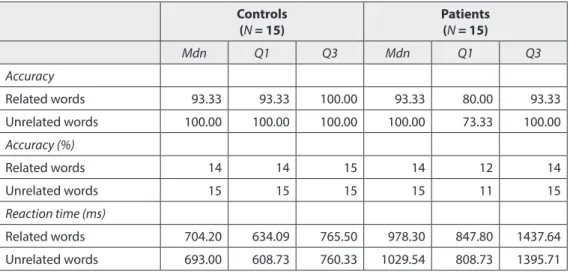
Table 1. Descriptive data (median and interquartile range) for the accuracy and reaction time on lexical-semantically related and unrelated words in the control and patient groups
Controls
(N = 15) Patients(N = 15)
Mdn Q1 Q3 Mdn Q1 Q3
Accuracy
Related words 93.33 93.33 100.00 93.33 80.00 93.33
Unrelated words 100.00 100.00 100.00 100.00 73.33 100.00
Accuracy (%)
Related words 14 14 15 14 12 14
Unrelated words 15 15 15 15 11 15
Reaction time (ms)
Related words 704.20 634.09 765.50 978.30 847.80 1437.64
Unrelated words 693.00 608.73 760.33 1029.54 808.73 1395.71
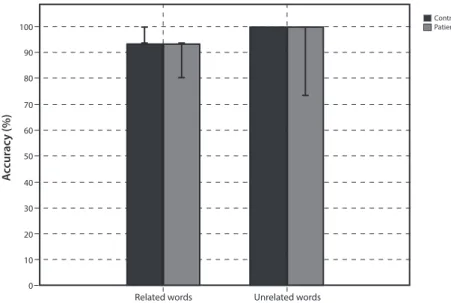
The Wilcoxon signed-rank test for dependent samples showed that there was no significant difference in accuracy between related and unrelated words in the control group (T(15) = 7.0, z = 1.18, p = 0.2367, r = .31), nor in the patients’ group (T(15) = 34.00, z = 0.39, p = .6949, r = .10), which can be seen in Figure 1. However, there was a significant difference in accuracy between the groups: a lower percentage of accuracy was observed in the patients than in the controls, but only for related words (U(15, 15) = 62.00, z = 2.27, p = .0229, r = .41), while there was no difference in accuracy between the two groups for the unrelated words (U(15, 15) = 77.50, z = 1.73, p = .0834, r = .32).
Controls Patients
Unrelated words Related words
A
ccur
ac
y (%)
0 10 20 30 40 50 60 70 80 90 100
Figure 1. Control- and patient-group accuracy for related and unrelated words (median and interquartile range presented)
There was no significant difference in the reaction time (ms) between related and unrelated words either in the control group (T(15) = 43.00, z = 0.97, p= .3343, r = .25) or in the patients’ group (T(15) = 41.00, z = 1.08, p= .2805, r = .28), which can be seen in Figure 2. However, there was a significant difference in the reaction time between the groups, where longer reaction times were observed in the patients than in the controls both for related words (U(15, 15) = 8.00, z = -4.33, p<0.001, r = -.79) and unrelated words (U(15, 15) = 21.00, z = -3.80,
Controls Patients
Unrelated words Related words
Reac
tion time (ms)
0 200 400 600 800 1000 1200 1400 1600
Figure 2. Reaction time (ms) of control and patient groups for related and unrelated words (median and interquartile range presented)
3.2. Statistical analysis of the animacy condition
The data distribution was non-normal, and the variances were not homoge-neous. Therefore, non-parametric analyses were applied. The differences in ac-curacy and reaction time between the two conditions (animate vs. inanimate) were analysed using a Wilcoxon signed-rank test and Friedman’s ANOVA, re-spectively, while a Whitney U test was used to test the differences between the two independent groups. The p-value was set to .05; however, the Bonferroni correction for multiple comparisons was applied. Statistical analyses were per-formed using IBM SPSS Statistics 23.0.
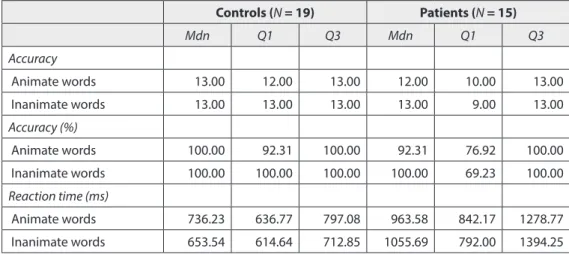
Table 2. Descriptive data (median and interquartile range) on the accuracy and reaction time of the control and patient groups for animate and inanimate words
Controls (N = 19) Patients (N = 15)
Mdn Q1 Q3 Mdn Q1 Q3
Accuracy
Animate words 13.00 12.00 13.00 12.00 10.00 13.00
Inanimate words 13.00 13.00 13.00 13.00 9.00 13.00
Accuracy (%)
Animate words 100.00 92.31 100.00 92.31 76.92 100.00
Inanimate words 100.00 100.00 100.00 100.00 69.23 100.00
Reaction time (ms)
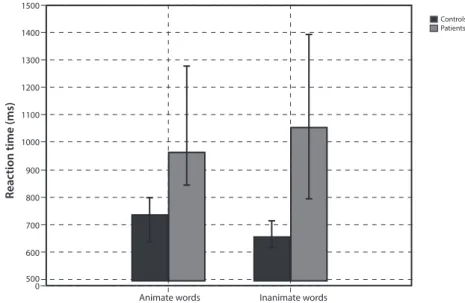
Animate words 736.23 636.77 797.08 963.58 842.17 1278.77
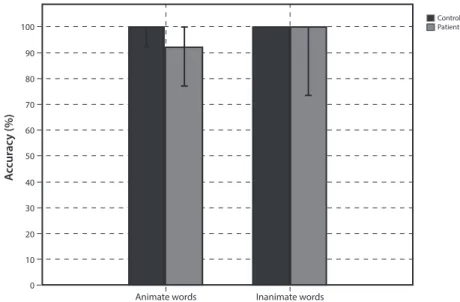
The Wilcoxon signed-rank test for dependent samples showed that the patients’ group displayed no significant difference in accuracy for animate vs. inanimate words in (T(15) = 30.00, z = 0.27, p = 0.7897, r = .07), which can be seen in Fig-ure 1. However, the accuracy of the control group was significantly higher for the inanimate words than for animate words(T(15) = 0.00, z = 2.02, p = .04312, r
= .52). Although there was no significant difference between the groups for the animate words (U(15, 15) = 71.00, z = 1.85, p = 0.0637,r = .34), there was a signif-icant difference between the groups for the inanimate words (U(15, 15) = 60.00,
z = 2.18, p = 0.0033, r = .40), where the control group had a higher level of accuracy.
Controls Patients
Inanimate words Animate words
A
ccur
ac
y (%)
0 10 20 30 40 50 60 70 80 90 100
Figure 3. Control- and patient-group accuracy for animate and inanimate words (median and interquartile range presented)
When reaction time was taken into account, the Wilcoxon signed-rank test for dependent samples showed that there was no significant difference in the reac-tion time (ms) on animate and inanimate words among the control group (T(15) = 26.00, z = 1.93, p = 0.0535, r = .50) nor among the patients’ group (T(15) = 53.00, z = 0.40, p= 0.6910, r = .10), which can be seen in Figure 2. However, there was a significant difference in the reaction time between the two groups: longer reaction times were observed in the patients than in the controls for both ani-mate words (U(15, 15) = 14.00, z = -4.09, p<0.001, r = -.75) and inanimate words (U(15, 15) = 19.00, z = -3.88, p<0.001, r = -.71).
Controls Patients
Inanimate words Animate words
Reac
tion time (ms)
0 500 600 700 800 900 1000 1100 1200 1300 1400 1500
Figure 4. Control- and Patient-group reaction times (ms) on animate and inanimate words (median and interquartile range presented)
4. Discussion
The patient group was significantly less accurate on the taxonomy condition than the control group. The higher activation of shared features, both highly correlat-ed sharcorrelat-ed features of animate concepts and weakly correlatcorrelat-ed sharcorrelat-ed features of inanimate concepts, demanded heightened inhibition, which failed and resulted in the activation of incorrect relations in the semantic memory and lower accu-racy in the patient group. Furthermore, when shared features were not activated, there were no differences in accuracy between the two groups.
The control group had statistically higher accuracy on inanimate concepts, and the patient group’s accuracy results did not differ on animate and inanimate concepts. Inanimate concepts have more distinctive features, both correlated and non-correlated, which influenced the answers of the control group the most. On the other hand, in the patient group there were no differences in accuracy, as shared features were highly activated in both the animate and the inanimate concepts.
According to Studerus et al. (2016), neurocognitive variables likely play an important role in multi-domain prediction models because cognitive deficits are considered core features of schizophrenic psychoses. The greatest impairments appear to be present in the domains of verbal memory, speed of processing, and working memory (e.g. Schaefer et al., 2013; Fatouros-Bergman et al., 2014; Mesholam-Gately et al., 2009). Furthermore, meta-analyses suggest that, at the onset of psychosis, cognitive performance is on average about one standard
der-ivation (SD) below been consistently demonstrated in all cognitive domains with medium to large effect sizes and cannot be attributed to effects of antipsychotics because unmediated and medicated patients are similarly affected (e.g. Fatou-ros-Bergman et al., 2014). According to Riecher-Rössler and McGorry (2016), impaired performance across a wide range of cognitive domains, especially in the areas of working memory, verbal fluency verbal memory, and speed of in-formation processing, could potentially be used for improving the accuracy of prediction (e.g. Riecher-Rössle et al., 2009; Fusar-Poli et al., 2012).
5. Conclusion
Assessment of the processing of specific lexical-semantic features alongside neu-ropsychological evaluation might be a valuable tool as an indicator and predic-tor of particular phases and/or courses of illness. Both analyses confirmed that the activation of shared features influenced language processing in subjects with first-episode and early-course psychosis differently than in healthy subjects. This influence can be observed in accordance with the model of spreading activation of the semantic memory in schizophrenia because the activation of shared fea-tures caused slower reaction times and a higher amount of incorrect answers in the patient group, which is presumed to be a result of greater activation and a reduced inhibition of the concepts in the semantic memory.
References
Agcaoglu, O., Miller, R., Damaraju, E., Rashid, B., Bustillo, J., Cetin, M. S., Van Erp, T. G. M., McEwen, S., Preda, A., Ford, J. M., Lim, K. O., Manoach, D. S., Mathalon, D. H., Potkin, S. G., & Calhoun, V. D. (2018). Decreased hemispheric connectivity and decreased intra- and inter- hemisphere asymmetry of resting state functional
network connectivity in schizophrenia. Brain Imaging and Behavior, 12(3), 615–630.
Assaf, M., Rivkin, P., Kraut, M., Calhoun, V., Hart, J. Jr, & Pearlson, G. (2007). Applicati-ons of models to understanding cognitive dysfunction: Schizophrenia and semantic
memory. In J. Hart, Jr. & J. H. Kraut (Eds.), Neural Basis of Semantic Memory (pp.
133–145). Cambridge: Cambridge University Press.
Ballerini, M. (2016). Semantic processing and semantic experience in people with sc-hizophrenia: A bridge between phenomenological psychopathology and
neuros-cience? Journal of Psychopathology, 22, 94–105.
Bonin, P., Gelin, M., & Bugaiska, A. (2013). Animates are better remembered than
inanimates: further evidence from word and picture stimuli. Memory & Cognition,
42(3), 370–382.
Cavelti, M., Winkelbeiner, S., Federspiel, A., Walther, S., Stegmayer, K., Giezendanner, S., Laimböck, K., Dierks, T., Strik, W., Horn, H., & Homan, P. (2018). Formal
tho-ught disorder is related to aberrations in language-related white matter tracts in
pa-tients with schizophrenia. Psychiatry Research: Neuroimaging, 279, 40–50.
Collins, A. M. & Loftus, A. S. (1975). A spreading activation theory of semantic
proce-ssing. Psychological Review, 82, 407–428.
Cree, G. S., McNorgan, C., & McRae, K. (2006). Distinctive features hold a privileged status in the computation of word meaning: Implications for theories of semantic
memory. Journal of Experimental Psychology: Learning, Memory, and Cognition, 32,
643–658.
Erdeljac, V., Sekulić Sović, M., & Miklić D. (2018). Psycholingustic Database – Psiho-lex_HR. Zagreb: Department of Linguistics, Faculty of Humanities and Social Scien-ces, University of Zagreb.
Fatouros-Bergman, H., Cervenka, S., Flyckt, L., Edman, G., & Farde, L. (2014).
Me-ta-analysis of cognitive performance in drug-naïve patients with schizophrenia.
Sc-hizophrenia Research, 158, 156–162.
Fusar-Poli, P., Deste, G., Smieskova, R., Barlati, S., Yung, A. R., Howes, O., Stieglitz, R. D., Vita, A., McGuire, P., & Borgwardt, S. (2012). Cognitive functioning in
prodro-mal psychosis: A meta-analysis. Archives of general psychiatry, 69(6), 562–571.
Kuperberg, G.R. (2010). Language in schizophrenia part 1: An introduction. Language
and Linguistics Compass, 4, 576–589.
Leeson, V. C., Simpson, A., McKenna, P. J., & Laws, K. R. (2005). Executive inhibition
and semantic association in schizophrenia. Schizophrenia Research, 74, 61–67.
Lewis, G. A., Poeppel, D., & Murphy, G. L. (2015). The neural bases of taxonomic and
thematic conceptual relations: An MEG study. Neuropsychologia, 68, 176–189.
Mahon, B. Z., & Caramazza, A. (2003). Constraining questions about the organisation
and representation of conceptual knowledge. Cognitive Neuropsychology, 20, 433–
450.
Mesholam-Gately, R. I., Giuliano, A. J., Goff, K. P., Faraone, S. V., & Seidman, L. J. (2009).
Neurocognition in first-episode schizophrenia: A meta-analytic review.
Neuropsyc-hology, 23(3), 315–336.
Minzenberg, M. J., Ober, B. A., & Vinogradov, S. (2002). Semantic priming in
schizop-hrenia: A review and synthesis. Journal of the International Neuropsychological
So-ciety, 8(5), 699–720.
Pilgrima, L. K., Moss, H. E., & Tyler, L. K. (2005). Semantic processing of living and
nonliving concepts across the cerebral hemispheres. Brain and Language, 94, 86–93.
Randall, B., Moss, H. E., Rodd, J. M., Greer, M., & Tyler, L. K. (2004). Distinctiveness
and correlation in conceptual structure: Behavioral and computational studies.
Jo-urnal of Experimental Psychology: Learning, Memory, and Cognition, 30, 393–406.
Riecher-Rössler A., & McGorry P. D. (2016). Early detection and intervention in
psyc-hosis. In A. Riecher-Rössler & P. D. McGorry (Eds.), Early Detection and
Interventi-on in Psychosis: State of the Art and Future Perspectives (Key Issues in Mental Health,
vol. 181, pp. 179–189) Basel: Karger.
Riecher-Rössler, A., Pflueger, M. O., Aston, J., Borgwardt, S. J., Brewer, W. J., Gschwan-dtner, U., & Stieglitz, R. D. (2009). The efficacy of using cognitive status in predicting
Rogers, T. T., & McClelland, J. L. (2004). Semantic cognition: A parallel distributed
pro-cessing approach. Cambridge, MA: MIT Press.
Schaefer, J., Giangrande, E., Weinberger, D. R., & Dickinson, D. (2013). The global co-gnitive impairment in schizophrenia: Consistent over decades and around the
wor-ld. Schizophrenia Research, 150(1), 42–50.
Schneider, W., Eschman, A., & Zuccolotto, A. (2012). Using E-prime, 2.0 software, Psy-chology Software Tools, Pittsburgh: PsyPsy-chology Software Tools, Inc.
Studerus, E., Papmeyer, M., & Riecher-Rössler, A. (2016). Neurocognition and motor functioning in the prediction of Psychosis. In A. Riecher-Rössler & P. D. McGorry,
(Eds.), Early detection and intervention in psychosis: State of the art and future
perspe-ctives (Key Issues in Mental Health, vol. 181, pp. 179–189). Basel: Karger.
Summer, P. J., Bell, I. H., & Rossell, S. L. (2018). A systematic review of task-based fun-ctional neuroimaging studies investigating language, semantic and executive
proce-sses in thought disorder. Neuroscience and Biobehavioral Reviews, 94, 59–75.
Tyler, L. K., & Moss, H. E. (2001). Towards a distributed account of conceptual knowled-ge. Trends in Cognitive Sciences, 5, 244–252.