
Acta Cryst.(2003). E59, m57±m58 DOI: 10.1107/S1600536803000813 Md. Alamgir Hossainet al. [K(C12H24O6)][AuCl2]
m57
metal-organic papers
Acta Crystallographica Section E Structure Reports
Online
ISSN 1600-5368
A potassium crown ether complex with
dichloroaurate(I)
Md. Alamgir Hossain, Douglas R. Powell and Kristin Bowman-James*
Department of Chemistry, University of Kansas, Malott Hall, Room 2010, 1251 Wescoe Hall Dr., Lawrence, KS 66045-7582, USA
Correspondence e-mail: [email protected]
Key indicators Single-crystal X-ray study
T= 100 K
Mean(C±C) = 0.002 AÊ
Rfactor = 0.017
wRfactor = 0.047
Data-to-parameter ratio = 27.2
For details of how these key indicators were automatically derived from the article, see http://journals.iucr.org/e.
#2003 International Union of Crystallography Printed in Great Britain ± all rights reserved
The title compound, (1,4,7,10,13,16-hexaoxacyclooctane)-potassium dichloroaurate(I), [K(C12H24O6)][AuCl2], consists
of potassium ion encapsulated by the 18-membered crown ether 1,4,7,10,13,16-hexaoxacyclooctane and a linear dichloro-aurate(I) monoanion. The potassium occupies a crystal-lographic center of symmetry with a ring coordination number of six, and two chlorides in axial sites at a distance of 3.2306 (5) AÊ. The linear anionic species sits on another crystallographic center of symmetry.
Comment
Although cations are the dominant species in the coordination chemistry of crown ethers, the counter-anions can also play an important role in the binding mode, cation±anion pairing, and the geometry of the structure (Bajaj & Poonia, 1988). Current interests of a number of researchers are thus also focused on the coordination chemistry of anions (Bianchi et al., 1997). Our interests in this area involve exploring dual host receptors (Kavallieratos et al., 2000; Qian et al., 2001), extending previous work to anionic metal complexes.
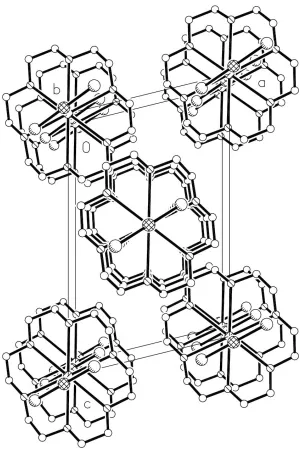
The formula unit of (I) is shown in Fig. 1. The linear di-chloroaurate(I) and the 18-crown-6 potassium complex form in®nite alternating cation/anion layers, separated by 3.9618 (2) AÊ, along thebaxis (Fig. 2).
The crown ether adoptsD3dsymmetry, as observed in most
other complexes of 18-crown-6 (Dunitz et al., 1974). The potassium ion is located at the center of the crown and is coordinated to the six O atoms with an average KÐO bond distance of 2.810 AÊ, which is consistent with previously reported results (2.801 AÊ; Seiler et al., 1974). The linear di-chloroaurate anions sit above and below the plane of the crown ether, with one of the Cl atoms closer to the potassium [3.2306 (5) AÊ] than is the gold [3.9618 (2) AÊ]. The presence of two chlorides approximately above and below the potassium ion thus completes a pseudo-hexagonal bipyramidal coord-ination sphere for the alkali metal ion.
Experimental
Equimolar amounts (0.065 mmol each) of 18-crown-6 and potassium tetrachloroaurate(III) were dissolved in methanol. Single crystals of the reduced gold complex with the potassium crown ether complex were grown by diffusion of diethyl ether into the methanolic solution of the mixture.1H NMR (500 MHz, CDCl
3, TMS):3.66 (t, CH2).13C
NMR (125 MHz, CDCl3, TMS):70.4 (CH2). MS (FAB):m/z303
(18C6 + K)+.
Crystal data [K(C12H24O6)][AuCl2]
Mr= 571.28 Monoclinic, P21=n
a= 8.7583 (4) AÊ b= 7.9237 (4) AÊ c= 13.8393 (6) AÊ
= 103.785 (2)
V= 932.76 (8) AÊ3
Z= 2
Dx= 2.034 Mg mÿ3 MoKradiation Cell parameters from 4929
re¯ections
= 3.0±30.5 = 8.42 mmÿ1
T= 100 (2) K Prism, colorless 0.310.160.11 mm Data collection
Bruker APEX diffractometer
!scans
Absorption correction: multi-scan (SADABS; Sheldrick, 1996; Blessing, 1995)
Tmin= 0.180,Tmax= 0.458
7528 measured re¯ections
2800 independent re¯ections 2470 re¯ections withI> 2(I) Rint= 0.019
max= 30.5
h=ÿ11!12 k=ÿ10!11 l=ÿ19!17 Re®nement
Re®nement onF2
R[F2> 2(F2)] = 0.017
wR(F2) = 0.047
S= 1.04 2800 re¯ections 103 parameters
H-atom parameters constrained
w= 1/[2(F
o2) + (0.0272P)2 + 0.1888P]
whereP= (Fo2+ 2Fc2)/3 (/)max< 0.001
max= 1.66 e AÊÿ3
min=ÿ1.15 e AÊÿ3
Crystal decay was determined by remeasuring the ®rst 50 frames of data at the end of data collection and comparing the intensities from the ®rst and last runs. All H atoms were constrained with a riding
model. Residual peaks > 0.5 e AÊÿ3and troughs < 0.5 e AÊÿ3were near
the Au and K atoms.
Data collection:SMART(Bruker, 1998); cell re®nement:SMART; data reduction: SAINT (Bruker, 1998); program(s) used to solve structure: SHELXTL (Sheldrick, 1997); program(s) used to re®ne structure:SHELXTL; molecular graphics:SHELXTL; software used to prepare material for publication:SHELXTL.
This research was sponsored by the Environmental Management Science Program, Of®ces of Science and Envir-onment Management, US Department of Energy, under grant DE-FG-96ER62307. The authors thank the National Science Foundation (CHE-0079282) and the University of Kansas for funds to acquire the diffractometer and computers used in this study.
References
Bajaj, A. V. & Poonia, N. S. (1988).Coord. Chem. Rev.87, 55±213. Bianchi, A., Garcia-Espana, E. & Bowman-James, K. (1997). Editors.
Supramolecular Chemistry of Anions. New York: Wiley. Blessing, R. H. (1995).Acta Cryst.A51, 33±38.
Bruker (1998).SMARTandSAINT. Bruker AXS Inc., Madison, Wisconsin, USA.
Dunitz, J. D., Dobler, M., Seiler, P. & Phizackerley, R. P. (1974).Acta Cryst. B30, 2733±2738.
Kavallieratos, K., Danby, A., VanBerkel, G. J., Kelly, M. A., Sachleben, R. A., Moyer, B. A. & Bowman-James, K. (2000).Anal. Chem.72, 5258±5264. Qian, Q., Wilson, G. S., Bowman-James, K. & Girault, H. H. (2001).Anal.
Chem.73, 497±503.
Seiler, P., Dobler, M. & Dunitz, J. D. (1974).Acta Cryst.B30, 2744±2745. Sheldrick, G. M. (1996).SADABS. University of GoÈttingen, Germany. Sheldrick, G. M. (1997).SHELXTL.Bruker AXS Inc., Madison, Wisconsin,
USA.
Figure 2
A packing diagram of (I). H atoms have been omitted for clarity. Figure 1
supporting information
sup-1
Acta Cryst. (2003). E59, m57–m58
supporting information
Acta Cryst. (2003). E59, m57–m58 [doi:10.1107/S1600536803000813]
A potassium crown ether complex with dichloroaurate(I)
Md. Alamgir Hossain, Douglas R. Powell and Kristin Bowman-James
S1. Comment
Although cations are the dominant species in the coordination chemistry of crown ethers, the counter-anions can also
play an important role in the binding mode, cation–anion pairing, and the geometry of the structure (Bajaj & Poonia,
1988). Current interests of a number of researchers are thus also focused on the coordination chemistry of anions
(Bianchi et al., 1997). Our interests in this area involve exploring dual host receptors (Kavallieratos et al., 2000; Qian et
al., 2001), expanding previous work to anionic metal complexes.
The unique formula unit of (I) is shown in Fig. 1. The linear dichloroaurate(I) and the 18-crown-6 potassium complex
form infinite alternating cation/anion layers, separated by 3.9618 (2) Å, along the b axis (Fig. 2).
The crown ether adopts D3 d symmetry as observed in most other complexes of 18-crown-6 (Dunitz et al., 1974). The
potassium ion is located at the center of the crown and is coordinated to the six O atoms with an average K···O bond
distance of 2.810 Å, which is consistent with previously reported results (2.801 Å; Sieler et al., 1974). The linear
di-chloroaurate anions sit above and below the plane of the crown ether with one of the Cl atoms closer to the potassium
[3.2306 (5) Å] than is the gold [3.9618 (2) Å]. The presence of two chlorides approximately above and below the
potassium ion thus completes a pseudo-hexagonal bipyrimidal coordination sphere for the alkali metal ion.
S2. Experimental
Equimolar amounts (0.065 mmol each) of 18-crown-6, potassium and tetrachloroaurate(III) were dissolved in methanol.
Single crystals of the reduced gold complex with the potassium crown ether complex were grown from diffusion of
di-ethyl ether into the methanolic solution of the mixture. 1H NMR (500 MHz, CDCl
3, TMS): δ 3.66 (t, CH2). 13C NMR (125
MHz, CDCl3, TMS): δ 70.4 (CH2). MS (FAB): m/z 303 (18 C6 + K)+.
S3. Refinement
Crystal decay was determined by remeasuring the first 50 frames of data at the end of data collection and comparing the
intensities from the first and last runs. All H atoms were constrained using the AFIX 23 parameter in SHELXL97.
Figure 1
supporting information
sup-3
[image:5.610.155.459.67.518.2]Acta Cryst. (2003). E59, m57–m58 Figure 2
The packing diagram for (I). H atoms have been omitted for clarity.
(I)
Crystal data
[K(C12H24O6)][AuCl2] Mr = 571.28
Monoclinic, P21/n a = 8.7583 (4) Å b = 7.9237 (4) Å c = 13.8393 (6) Å β = 103.785 (2)° V = 932.76 (8) Å3 Z = 2
F(000) = 552 Dx = 2.034 Mg m−3
Mo Kα radiation, λ = 0.71073 Å Cell parameters from 4929 reflections θ = 3.0–30.5°
Bruker APEX diffractometer
Radiation source: fine-focus sealed tube Graphite monochromator
ω scans
Absorption correction: multi-scan
(SADABS; Sheldrick, 1996; Blessing, 1995) Tmin = 0.180, Tmax = 0.458
7528 measured reflections 2800 independent reflections 2470 reflections with I > 2σ(I) Rint = 0.019
θmax = 30.5°, θmin = 2.5° h = −11→12
k = −10→11 l = −19→17
Refinement Refinement on F2 Least-squares matrix: full R[F2 > 2σ(F2)] = 0.017 wR(F2) = 0.047 S = 1.04 2800 reflections 103 parameters 0 restraints
Primary atom site location: structure-invariant direct methods
Secondary atom site location: difference Fourier map
Hydrogen site location: inferred from neighbouring sites
H-atom parameters constrained w = 1/[σ2(F
o2) + (0.0272P)2 + 0.1888P] where P = (Fo2 + 2Fc2)/3
(Δ/σ)max < 0.001 Δρmax = 1.66 e Å−3 Δρmin = −1.15 e Å−3
Special details
Geometry. All e.s.d.'s (except the e.s.d. in the dihedral angle between two l.s. planes) are estimated using the full covariance matrix. The cell e.s.d.'s are taken into account individually in the estimation of e.s.d.'s in distances, angles and torsion angles; correlations between e.s.d.'s in cell parameters are only used when they are defined by crystal symmetry. An approximate (isotropic) treatment of cell e.s.d.'s is used for estimating e.s.d.'s involving l.s. planes.
Refinement. Refinement of F2 against ALL reflections. The weighted R-factor wR and goodness of fit S are based on F2, conventional R-factors R are based on F, with F set to zero for negative F2. The threshold expression of F2 > σ(F2) is used only for calculating R-factors(gt) etc. and is not relevant to the choice of reflections for refinement. R-factors based on F2 are statistically about twice as large as those based on F, and R- factors based on ALL data will be even larger.
Fractional atomic coordinates and isotropic or equivalent isotropic displacement parameters (Å2)
x y z Uiso*/Ueq
K1 0.5000 0.5000 0.5000 0.01508 (12)
Au1 0.5000 1.0000 0.5000 0.01592 (4)
Cl1 0.68346 (5) 0.83457 (6) 0.45636 (3) 0.02577 (9)
O1 0.21989 (13) 0.60565 (15) 0.54438 (9) 0.0194 (2)
C2 0.11670 (19) 0.7040 (2) 0.47040 (13) 0.0224 (3)
H2A 0.1581 0.8201 0.4696 0.027*
H2B 0.0114 0.7103 0.4848 0.027*
C3 0.10560 (19) 0.6203 (2) 0.37168 (13) 0.0224 (3)
H3A 0.0726 0.5013 0.3745 0.027*
H3B 0.0265 0.6788 0.3194 0.027*
O4 0.25593 (13) 0.62761 (14) 0.34885 (8) 0.0190 (2)
C5 0.2505 (2) 0.5690 (2) 0.25103 (13) 0.0218 (3)
H5A 0.1803 0.6420 0.2016 0.026*
H5B 0.2089 0.4524 0.2428 0.026*
C6 0.4136 (2) 0.5733 (2) 0.23527 (12) 0.0221 (3)
supporting information
sup-5
Acta Cryst. (2003). E59, m57–m58
H6B 0.4597 0.6869 0.2514 0.026*
O7 0.50738 (14) 0.44985 (17) 0.29831 (9) 0.0188 (2)
C8 0.6639 (2) 0.4462 (2) 0.28588 (14) 0.0213 (3)
H8A 0.7113 0.5600 0.2974 0.026*
H8B 0.6637 0.4112 0.2172 0.026*
C9 0.75772 (19) 0.3232 (2) 0.35897 (12) 0.0208 (3)
H9A 0.7008 0.2146 0.3556 0.025*
H9B 0.8606 0.3020 0.3434 0.025*
Atomic displacement parameters (Å2)
U11 U22 U33 U12 U13 U23
K1 0.0135 (3) 0.0188 (3) 0.0135 (3) 0.00158 (13) 0.0043 (2) 0.00069 (13) Au1 0.01654 (6) 0.01508 (6) 0.01601 (6) −0.00128 (2) 0.00365 (4) −0.00002 (2) Cl1 0.02336 (18) 0.02127 (18) 0.0352 (2) −0.00012 (16) 0.01197 (16) −0.00407 (17) O1 0.0200 (5) 0.0181 (5) 0.0204 (6) 0.0045 (4) 0.0057 (4) −0.0006 (4) C2 0.0160 (7) 0.0211 (8) 0.0312 (9) 0.0048 (6) 0.0077 (6) 0.0052 (7) C3 0.0137 (7) 0.0262 (9) 0.0255 (9) −0.0013 (6) 0.0011 (6) 0.0049 (7) O4 0.0161 (5) 0.0229 (6) 0.0169 (6) −0.0010 (4) 0.0018 (4) −0.0003 (4) C5 0.0261 (8) 0.0193 (8) 0.0167 (8) −0.0003 (6) −0.0015 (6) −0.0014 (6) C6 0.0305 (9) 0.0204 (9) 0.0147 (8) 0.0009 (7) 0.0042 (6) 0.0014 (6) O7 0.0206 (6) 0.0195 (6) 0.0174 (6) −0.0003 (5) 0.0064 (5) 0.0019 (5) C8 0.0258 (9) 0.0221 (8) 0.0195 (8) −0.0045 (7) 0.0125 (7) −0.0028 (7) C9 0.0200 (7) 0.0204 (8) 0.0250 (8) −0.0010 (6) 0.0118 (6) −0.0045 (6)
Geometric parameters (Å, º)
K1—O1 2.7955 (11) O1—C2 1.4251 (19)
K1—O4 2.7994 (11) C2—C3 1.501 (3)
K1—O7 2.8353 (12) C3—O4 1.427 (2)
K1—Cl1 3.2306 (5) O4—C5 1.421 (2)
K1—Au1 3.9618 (2) C5—C6 1.497 (2)
Au1—Cl1 2.2644 (4) C6—O7 1.432 (2)
Au1—K1i 3.9619 (2) O7—C8 1.422 (2)
O1—C9ii 1.4214 (19) C8—C9 1.500 (3)
O1ii—K1—O1 180.0 Cl1—K1—Au1 34.856 (8)
O1—K1—O4 60.14 (3) Au1iii—K1—Au1 180.0
O1—K1—O4ii 119.86 (3) Cl1—Au1—Cl1iv 180.0
O4—K1—O4ii 180.0 Cl1—Au1—K1 54.627 (11)
O1—K1—O7 119.03 (3) Cl1iv—Au1—K1 125.373 (11)
O4—K1—O7 60.49 (3) Cl1—Au1—K1i 125.373 (11)
O1—K1—O7ii 60.97 (3) Cl1iv—Au1—K1i 54.627 (11)
O4—K1—O7ii 119.51 (3) K1—Au1—K1i 180.0
O7—K1—O7ii 180.0 Au1—Cl1—K1 90.517 (14)
O1—K1—Cl1 107.27 (3) C9ii—O1—C2 112.39 (13)
O4—K1—Cl1 83.64 (2) C9ii—O1—K1 113.20 (9)
O1—K1—Cl1ii 72.73 (3) O4—C3—C2 108.70 (13)
O4—K1—Cl1ii 96.36 (2) C5—O4—C3 111.98 (13)
O7—K1—Cl1ii 101.42 (3) C5—O4—K1 116.12 (9)
Cl1—K1—Cl1ii 180.0 C3—O4—K1 113.62 (9)
O1—K1—Au1iii 107.43 (2) O4—C5—C6 108.34 (13)
O4—K1—Au1iii 111.17 (2) O7—C6—C5 108.92 (14)
O7—K1—Au1iii 81.94 (3) C8—O7—C6 111.69 (13)
Cl1—K1—Au1iii 145.144 (8) C8—O7—K1 111.76 (10)
O1—K1—Au1 72.57 (2) C6—O7—K1 111.08 (10)
O4—K1—Au1 68.83 (2) O7—C8—C9 108.71 (14)
O7—K1—Au1 98.06 (3) O1ii—C9—C8 107.91 (13)
O1ii—K1—Au1—Cl1 5.60 (3) O1ii—K1—O4—C5 26.95 (11)
O1—K1—Au1—Cl1 −174.40 (3) O1—K1—O4—C5 −153.05 (11)
O4—K1—Au1—Cl1 −110.37 (3) O7—K1—O4—C5 12.39 (10)
O4ii—K1—Au1—Cl1 69.63 (3) O7ii—K1—O4—C5 −167.61 (10)
O7—K1—Au1—Cl1 −56.41 (3) Cl1—K1—O4—C5 92.84 (10)
O7ii—K1—Au1—Cl1 123.59 (3) Cl1ii—K1—O4—C5 −87.16 (10)
O1ii—K1—Au1—Cl1iv −174.40 (3) Au1iii—K1—O4—C5 −54.54 (11)
O1—K1—Au1—Cl1iv 5.60 (3) Au1—K1—O4—C5 125.46 (11)
O4—K1—Au1—Cl1iv 69.63 (3) O1ii—K1—O4—C3 158.97 (10)
O4ii—K1—Au1—Cl1iv −110.37 (3) O1—K1—O4—C3 −21.03 (10)
O7—K1—Au1—Cl1iv 123.59 (3) O7—K1—O4—C3 144.40 (11)
O7ii—K1—Au1—Cl1iv −56.41 (3) O7ii—K1—O4—C3 −35.60 (11)
Cl1ii—K1—Au1—Cl1iv 0.02 (10) Cl1—K1—O4—C3 −135.15 (10)
O1ii—K1—Cl1—Au1 −174.40 (3) Cl1ii—K1—O4—C3 44.85 (10)
O1—K1—Cl1—Au1 5.60 (3) Au1iii—K1—O4—C3 77.47 (10)
O4—K1—Cl1—Au1 61.59 (3) Au1—K1—O4—C3 −102.53 (10)
O4ii—K1—Cl1—Au1 −118.41 (3) C3—O4—C5—C6 −177.34 (13)
O7—K1—Cl1—Au1 122.70 (3) K1—O4—C5—C6 −44.57 (15)
O7ii—K1—Cl1—Au1 −57.30 (3) O4—C5—C6—O7 67.51 (17)
O4—K1—O1—C9ii −146.63 (11) C5—C6—O7—C8 179.26 (14)
O4ii—K1—O1—C9ii 33.37 (11) C5—C6—O7—K1 −55.22 (15)
O7—K1—O1—C9ii −161.12 (10) O1ii—K1—O7—C8 −17.46 (10)
O7ii—K1—O1—C9ii 18.88 (10) O1—K1—O7—C8 162.54 (10)
Cl1—K1—O1—C9ii −74.83 (10) O4—K1—O7—C8 148.09 (12)
Cl1ii—K1—O1—C9ii 105.17 (10) O4ii—K1—O7—C8 −31.91 (12)
Au1iii—K1—O1—C9ii 108.52 (10) Cl1—K1—O7—C8 58.99 (11)
Au1—K1—O1—C9ii −71.48 (10) Cl1ii—K1—O7—C8 −121.01 (11)
O4—K1—O1—C2 −14.08 (10) Au1iii—K1—O7—C8 −91.95 (11)
O4ii—K1—O1—C2 165.92 (10) Au1—K1—O7—C8 88.05 (11)
O7—K1—O1—C2 −28.58 (12) O1ii—K1—O7—C6 −142.94 (12)
O7ii—K1—O1—C2 151.42 (12) O1—K1—O7—C6 37.06 (12)
Cl1—K1—O1—C2 57.72 (11) O4—K1—O7—C6 22.62 (10)
Cl1ii—K1—O1—C2 −122.28 (11) O4ii—K1—O7—C6 −157.38 (10)
Au1iii—K1—O1—C2 −118.93 (10) Cl1—K1—O7—C6 −66.49 (10)
supporting information
sup-7
Acta Cryst. (2003). E59, m57–m58
C9ii—O1—C2—C3 178.36 (13) Au1iii—K1—O7—C6 142.57 (11)
K1—O1—C2—C3 45.44 (15) Au1—K1—O7—C6 −37.43 (11)
O1—C2—C3—O4 −65.27 (17) C6—O7—C8—C9 176.08 (14)
C2—C3—O4—C5 −172.93 (13) K1—O7—C8—C9 50.94 (15)
C2—C3—O4—K1 53.07 (15) O7—C8—C9—O1ii −70.56 (17)

![Di μ chloro bis[chloro(tricyclohexylphosphine κP)mercury(II)]](data:image/gif;base64,R0lGODlhAQABAIAAAP///wAAACH5BAEAAAAALAAAAAABAAEAAAICRAEAOw==)