www.wjpr.net Vol 4, Issue 4, 2015. 734
PARALLEL QUANTITATIVE ESTIMATION OF GALLIC ACID IN
AQUEOUS EXTRACT OF EMBLICA OFFICINALIS AND
POLY-HERBAL DOSAGE FORM (CAPSULE) BY RP-HPLC TO ASCERTAIN
THE AUTHENTICITY OF THIS INGREDIENT IN THE DEVELOPED
FORMULATION.
A. Singh*, P. Raghaw, B. Dwivedi, R. Singh, P.Pant, M.M.Padhi
Central Council for Research in Ayurvedic Sciences, Janakpuri-110058, Delhi.
ABSTRACT
In the present study Gallic acid is Parallelly quantified by optimized RP-HPLC method in pharmaceutically developed poly-herbal dosage form (capsule) and aqueous extract of Emblica officinalis fruit to examine the authenticity of this ingredient in finished dosage form. The Chromatographic analysis was performed on Shimadzu 10AVP HPLC System using Phenomenex Luna C18 reverse-phase column (4.6 x 250mm, 5μ particle size). The mobile phase comprised of
Water: Acetonitrile : Acetic acid(90 : 10 : 0.2 v/v)at a flow rate of 1.0
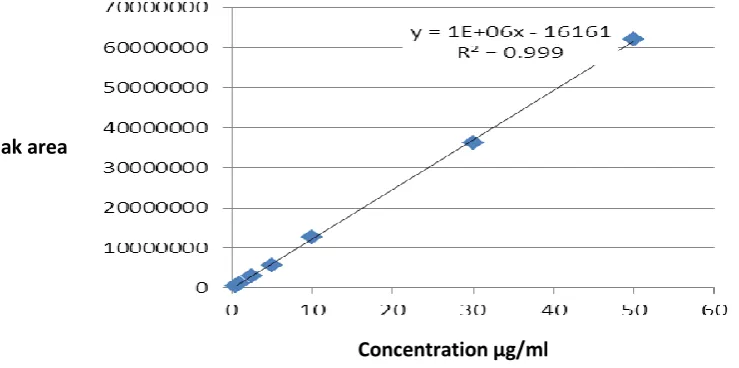
ml/min and 272nm as detection wavelength. The regression equation showed good linearity in the range of 0.5-50μg/mL for Gallic acid (R2 > 0.9997) between the peak areas of each marker and concentration. The retention time was 4.31min and the amount of gallic acid in aqueous extract and poly-herbal formulation of Emblica officinalis was found to be 14.17%w/w and 1.95%w/w respectively.
KEYWORDS:Emblica officinalis, Gallic acid, HPLC.
INTRODUCTION
Emblica officinalis is effective in the treatment of amlapitta viz., peptic ulcer.[1,2] The fruits exhibit hypolipidaemic and antiatherosclerotic effects in the rabbits and rats.[3,4] The extract of amla also has antimicrobial properties.[5,6] Amla is an antioxidant with free radical scavenging properties.[7] Hepatoprotective,[8] adaptogenic,[9] antimutaginic,[10] cytoprotective
Volume 4, Issue 4, 734-742. Research Article ISSN 2277– 7105
Article Received on 16 Jan 2014,
Revised on 11 Feb 2015, Accepted on 07 Mar 2015
*Correspondence for
Author
Dr. A. Singh
Central Council for
Research in Ayurvedic
Sciences,
www.wjpr.net Vol 4, Issue 4, 2015. 735
and antitumor[11] antifungal,[12] were also exhibited by Amla. The Gallic acid is the basis for the quality control of Emblica officinalis (aqueous extract of fruit) and other plant-derived drugs from the herb. It is difficult to identify a particular component in a poly-herbal formulation containing more than two herbs or a mixture of different herbal powder or extracts. Gallic acid usually found as a chemical constituent (poly-phenolic) in medicinal herbs (citrus fruits) viz. Emblica officinalis, Terminalia chebula, Terminalia bellirica etc. The poly-herbal formulation under study contains Emblica officinalis together with other three plants ingredients. The main aim of the present study is to estimate gallic acid by
RP-HPLC in ingredient as well as in finished formulation and to verify its presence (qualitative & quantitative) and ascertain the Presence of Emblica officinalis in the pharmaceutically developed poly-herbal dosage form (capsule).
MATERIALS AND METHODS
Plant material and preparation of extract: The aqueous extract of dry fruit of Emblica officinalis (authenticated by voucher specimen (LIH No. 6934) was procured from an
authentic supplier and the standard operating procedure to process it is as follows: The dry raw material was ground into coarse powder using a high-speed blender. This coarse powder was extracted with 60 liters of de-mineralized water by heating for 2 hours at 80 oC. Aqueous layer was decanted after cooling and the residual marc was extracted three times more using 45 liters of water every time. All the extracts were combined and filtered. Filtrate was concentrated under vacuum at 70-80 oC for 3 to 4 hours. Finally this extract was dried in vacuum tray drier at 70-80 o C for 14 to 16 hours. The dried extract was milled, sieved and packed in polythene bags for further use. The herb: extract ratio was found to be 25:10 and the yield was 40% on dried basis.
Chemicals and reagents: Gallic acid of 98.5 % purity was procured from M/s Natural Remedies Pvt. Ltd., Bangalore. Acetonitrile, methanol, toluene, ethyl acetate, formic acid, HPLC grade water of analytical grade were purchased from M/s. Rankem Ltd. and double-distilled water was used in all experiments.
www.wjpr.net Vol 4, Issue 4, 2015. 736
stock solution is transferred to 10mL standard volumetric flask. Volume is made up to the mark with water: Acetonitrile: Acetic acid (90: 10: 0.2 v/v). Then it is filtered with 0.22μ filter. Prepared sample solution was analyzed.
Sample preparation of poly-herbal formulation: To prepare the sample of poly-herbal formulation, 20 capsules were taken, opened and crushed in mortar Pestle. From that, accurately weighed 584mg powder transferred to 25mL standard flask. Volume is made up to the mark with water: Acetonitrile: Acetic acid(90 : 10 : 0.2 v/v), sonicated for 10 min. It was filtered with 0.22μ filter to obtain sample stock solution. Aliquot of 0.5ml from this sample
stock solution is transferred to 10mL standard volumetric flask. Volume is made up to the mark with water: Acetonitrile: Acetic acid(90 : 10 : 0.2 v/v). Then it is filtered with 0.22μ
filter. Prepared sample solution was analyzed.
Table 1: Chromatographic Conditions of HPLC for Gallic acid.
Mobile Phase Water : Acetonitrile : Acetic acid(90 : 10 : 0.2 v/v) Stationary Phase Phenomenex Luna C18 (4.6 x 250mm, 5μ particle size) Wavelength 272 nm
Run time 8 min
Flow Rate 1 mL/min
Injection Volume 20 μL Temperature Ambient
Mode of Operation Isocratic elution
Preparation of Calibration Curve for HPLC: To prepare the calibration curve for HPLC, aliquots of 0.1, 0.3, 0.5mL standard stock solution (1000μg/mL) was transferred to 10mL of
volumetric flasks and made up to the mark with water : Acetonitrile : Acetic acid(90 : 10 : 0.2 v/v) to get concentration of 10, 30, 50μg/mL. Aliquot of 0.1, 0.2, 0.5, 1mL from 50μg/mL
was transferred to 10mL of volumetric flasks and made up to the mark with water: Acetonitrile: Acetic acid(90 : 10 : 0.2 v/v) to get concentration of 0.5, 1, 2.5, 5μg/mL
respectively. The calibration curve was plotted using peak area versus drug concentration as
www.wjpr.net Vol 4, Issue 4, 2015. 737 Figure 1: Linearity Graph of Gallic acid for HPLC.
Table 2: Linearity of Gallic acid, for assessing the linearity, the least square regression equation was adopted
Concentration (μg/mL) Peak Area Slope Intercept R2
0.5 604490 1236331 161618 0.999773
1 1123993
2.5 2890614
5.0 5770210
10.0 12597730
30.0 36303160
50.0 61975314
Statistical analysis: Statistical calculations were carried out with the Microsoft Excel 2007 for Windows software package. Average, Sum, Standard Deviation (STDEV), Regression
(RSQ) for Statistical Calculation, and Scattered Chart were used for Linearity; P values > 0.05 were considered to be significant.
RESULT AND DISCUSSION
Determination of Gallic acid in aqueous extract of Emblica officinalis and compound (Capsule) formulation: The amount of gallic acids in Emblica officinalis and in formulated Capsule were analyzed using optimized chromatographic method. The standards of different
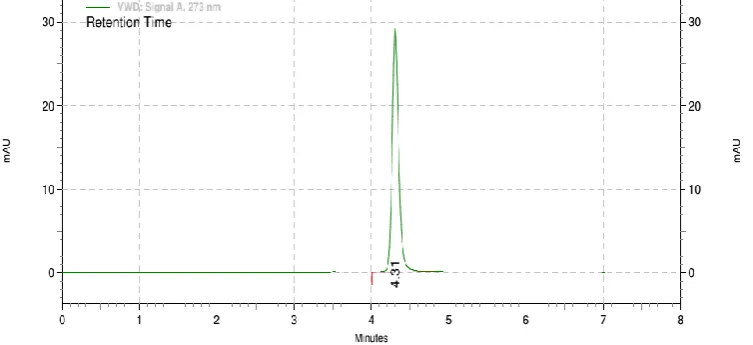
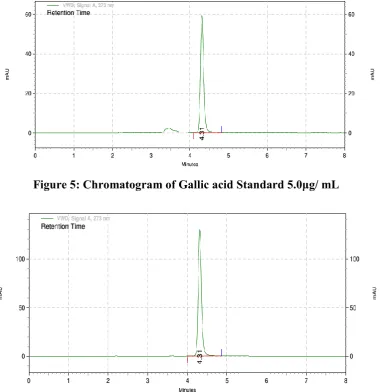
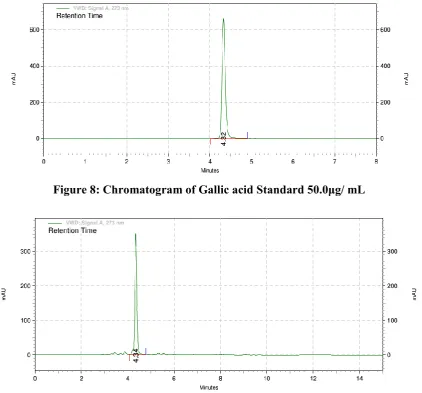
strengths, samples & compound formulation were injected in the HPLC column and peak areas were used for analysis of content by the regression equation. The developed mobile phase gave optimal separation, with well-defined and well-resolved sharp peaks in both standard and sample (Figure 2-10) at Retention time 4.31-4.34 for gallic acid,
Peak area
www.wjpr.net Vol 4, Issue 4, 2015. 738 Figure 2: Chromatogram of Gallic acid Standard 0.5μg/ mL
Figure 3: Chromatogram of Gallic acid Standard 1.0μg/ mL
[image:5.595.116.493.529.701.2]www.wjpr.net Vol 4, Issue 4, 2015. 739 Figure 5: Chromatogram of Gallic acid Standard 5.0μg/ mL
Figure 6: Chromatogram of Gallic acid Standard 10.0μg/ mL
[image:6.595.101.495.519.704.2]www.wjpr.net Vol 4, Issue 4, 2015. 740 Figure 8: Chromatogram of Gallic acid Standard 50.0μg/ mL
Figure 9: Chromatogram of Water extract of Emblica officinalis (dried fruit pericarp).
[image:7.595.84.508.513.693.2]www.wjpr.net Vol 4, Issue 4, 2015. 741
As the amount of gallic acid in Water extract of Emblica officinalis (dried fruit pericarp) reported in API is NLT 5.5%.[13] This raw material as such is used as one of the ingredient together with other three in the dosage form under study. The gallic acid in ingredient i,e, aqueous extract of Emblica officinalis was 14.17% w/w which complied the prescribed limit as mentioned in pharmacopoeias.
The amount of Gallic acid present in Emblica officinalis raw drug and extract reported in several official pharmacopoeias viz.
Pharmacopoeias Gallic acid in Emblica officinalis fruit
Ayurvedic Pharmacopoeia of
India(API)[13] NLT 0.8% raw drug & NLT 7.5 (Water extract)
QSIMP [14] 0.015-.022%(in fresh fruit)
Indian pharmacopoeia(IP)[15] NLT 1.0 per cent w/w (dried fruit pericarp)
However it is found 1.95% w/w in polyherbal formulation as analyzed by HPLC. Since the other ingredients except Emblica officinalis of the formulation do not or contain gallic acid in traces hence the gallic acid in this poly-herbal drug has driven from Emblica officinalis
ingredient only.
CONCLUSION
This study authenticate the presence of Emblica officinalis ingredient on the basis of gallic acid in the the pharmaceutically developed poly-herbal dosage form (capsule). The amount of gallic acid in polyherbal formulation was found 1.95% w/w and 14.17% w/w in ingredient i,e, aqueous extract of Emblica officinalis obtained by RP-HPLC method.
ACKNOWLEDGMENT
The authors are very grateful to the Director General, Central Council for Research in Ayurvedic Sciences, New Delhi for providing the desired facilities and encouragement to carry out this work.
REFERENCES
1. Al-Rehailya AJ, Al-Howirinya TS, Al- Sohaibanib MO, Rafatullaha S. Gastroproteetive effects of ‘Amla’ Emblica officinalis on in vivo test models in rats. Phytomedicine, 2002;
www.wjpr.net Vol 4, Issue 4, 2015. 742
2. Sairam K, Rao CV, Babu MD, Kumar KV, Agrawal VK, Goel, RK. Antiulcerogenic effect of methanolic extract of Emblica officinalis: an experimental study. Journal of Ethnopharmacology, 2002; 82(1): 1-9.
3. Anil L, Vijayalakshmi NR. Antioxidant action of flavonoids from Mangifera indica and
Emblica officinalis in hypercholesterolemic rats. Food Chemistry, 2003; 83: 569-574. 4. Yokozawa T, Kim HY, Kim HJ, Okubo T, Chu DC, Juneja LR. Amla (Emblica officinalis
Gaertn.) prevents dyslipidaemia and oxidative stress in the ageing process. British Journal of Nutrition, 2007; 97(6): 1187-95.
5. Ahmed I, Mehmood Z, Mohammad F. Screening of some Indian medicinal plants for their antimicrobial properties. Journal of Ethnopharmacology, 1998; 62: 183-93.
6. Saeed S, Tariq P. Antibacterial activities of Emblica officinalis and Coriandrum sativum
against Gram negative urinary pathogens. Pakistan journal of Botany, 2007; 39(3): 913-917.
7. Bhattacharya A, Chatterjee A, Ghosal S, Bhattacharya S K. Antioxidant activity of active tannoid principles of Emblica officinalis (amla). Indian Journal of Experimental Biology, 1999; 37: 676-680.
8. Mir AI, Kumar B, Tasduq SA, Gupta DK, Bhardwaj S, Johri RK. Reversal of hepatotoxin-induced pre fibrogenic events by Emblica officinalis-a histological study. Indian Journal of Experimental Biology, 2007; 45(7): 626-629.
9. Rege NN, Thatte UM, Dahanukar SA. Adaptogenic properties of six rasayana herbs used in Ayurvedic medicine. Phytotherapy Research, 1999; 13: 275-91.
10.Kaur S, Arora S, Kaur K. The in vitro antimutagenic activity of Triphala- an Indianherbal drug. Food and Chemical Toxicology, 2002; 40: 527-534.
11.Jose JK, Kuttan G, Kuttan R. Antitumour activity of Emblica officinalis. Journal of Ethnopharmacology, 2001; 75: 65-69.
12.Dutta BK, Rahman I, Das TK. Antifungal activity of Indian Plant extracts. Mycoses,
1998; 41: 535-536.
13.Ayurvedic Pharmacopoeia of India, Dept. of AYUSH, Ministry of Health and Family
Welfare, Government of India, New Delhi, Part-I, 2009; VIII: 1-12.
14.Quality Standards of Indian Medicinal Plants, Indian Council of Medical Research, New Delhi, 2010; 8: 160-172.