Unsupervised Search for The Optimal Segmentation for Statistical
Machine Translation
Cos¸kun Mermer1,2
1Bo˘gazic¸i University, Bebek, Istanbul, Turkey
2T ¨UB˙ITAK-UEKAE, Gebze, Kocaeli, Turkey
Abstract
We tackle the previously unaddressed problem of unsupervised determination of the optimal morphological segmentation for statistical machine translation (SMT) and propose a segmentation metric that takes into account both sides of the SMT training corpus. We formulate the objec-tive function as the posterior probability of the training corpus according to a genera-tive segmentation-translation model. We describe how the IBM Model-1 transla-tion likelihood can be computed incremen-tally between adjacent segmentation states for efficient computation. Submerging the proposed segmentation method in a SMT task from morphologically-rich Turkish to English does not exhibit the expected im-provement in translation BLEU scores and confirms the robustness of phrase-based SMT to translation unit combinatorics. A positive outcome of this work is the described modification to the sequential search algorithm of Morfessor (Creutz and Lagus, 2007) that enables arbitrary-fold parallelization of the computation, which unexpectedly improves the translation per-formance as measured by BLEU.
1 Introduction
In statistical machine translation (SMT), words are normally considered as the building blocks of translation models. However, especially for mor-phologically complex languages such as Finnish, Turkish, Czech, Arabic etc., it has been shown that using sub-lexical units obtained after morpho-logical preprocessing can improve the machine translation performance over a word-based sys-tem (Habash and Sadat, 2006; Oflazer and Durgar El-Kahlout, 2007; Bisazza and Federico, 2009). However, the effect of segmentation on
transla-tion performance is indirect and difficult to isolate (Lopez and Resnik, 2006).
The challenge in designing a sub-lexical SMT system is the decision of what segmentation to use. Linguistic morphological analysis is intuitive, but it is language-dependent and could be highly am-biguous. Furthermore, it is not necessarily opti-mal in that (i) manually engineered segmentation schemes can outperform a straightforward linguis-tic morphological segmentation, e.g., (Habash and Sadat, 2006), and (ii) it may result in even worse performance than a word-based system, e.g., (Dur-gar El-Kahlout and Oflazer, 2006).
A SMT system designer has to decide what segmentation is optimal for the translation task at hand. Existing solutions to this problem are predominantly heuristic, language-dependent, and as such are not easily portable to other lan-guages. Another point to consider is that the op-timal degree of segmentation might decrease as the amount of training data increases (Lee, 2004; Habash and Sadat, 2006). This brings into ques-tion: For the particular language pair and training corpus at hand, what is the optimal (level of) sub-word segmentation? Therefore, it is desirable to learn the optimal segmentation in an unsupervised manner.
In this work, we extend the method of Creutz and Lagus (2007) so as to maximize the transla-tion posterior in unsupervised segmentatransla-tion. The learning process is tailored to the particular SMT task via the same parallel corpus that is used in training the statistical translation models.
2 Related Work
com-pare the resulting translation performances in an Arabic-to-English task. Shen et al. (2007) use a subset of the morphology and apply only a few simple rules in segmenting words. Durgar El-Kahlout and Oflazer (2006) tackle this problem when translating from English to Turkish, an ag-glutinative language. They use a morphologi-cal analyzer and disambiguation to arrive at mor-phemes as tokens. However, training the trans-lation models with morphemes actually degrades the translation performance. They outperform the word-based baseline only after some selec-tive morpheme grouping. Bisazza and Federico (2009) adopt an approach similar to the Arabic segmentation studies above, this time in a Turkish-to-English translation setting.
Unsupervised segmentation by itself has gar-nered considerable attention in the computational linguistics literature (Poon et al., 2009; Snyder and Barzilay, 2008; Dasgupta and Ng, 2007; Creutz and Lagus, 2007; Brent, 1999). However, few works report their performance in a translation task. Virpioja et al. (2007) used Morfessor (Creutz and Lagus, 2007) to segment both sides of the par-allel training corpora in translation between Dan-ish, FinnDan-ish, and SwedDan-ish, but without a consistent improvement in results.
Morfessor, which gives state of the art results in many tests (Kurimo et al., 2009), uses only mono-lingual information in its objective function. It is conceivable that we can achieve a better segmenta-tion for translasegmenta-tion by considering not one but both sides of the parallel corpus. A posssible choice is the post-segmentation alignment accuracy. How-ever, Elming et al. (2009) show that optimizing segmentation with respect to alignment error rate (AER) does not improve and even degrades ma-chine translation performance. Snyder and Barzi-lay (2008) use bilingual information but the seg-mentation is learned independently from transla-tion modeling.
In Chang et al. (2008), the granularity of the Chinese word segmentation is optimized by train-ing SMT systems for several values of a granular-ity bias parameter and it is found that the value that maximizes translation performance (as measured by BLEU) is different than the value that maxi-mizes segmentation accuracy (as measured by pre-cision and recall).
One motivation in morphological preprocess-ing before translation modelpreprocess-ing is “morphology
matching” as in Lee (2004) and in the scheme “EN” of Habash and Sadat (2006). In Lee (2004), the goal is to match the lexical granularities of the two languages by starting with a fine-grained seg-mentation of the Arabic side of the corpus and then merging or deleting Arabic morphemes us-ing alignments with a part-of-speech tagged En-glish corpus. But this method is not completely unsupervised since it requires external linguistic resources in initializing the segmentation with the output of a morphological analyzer and disam-biguator. Talbot and Osborne (2006) tackle a spe-cial case of morphology matching by identifying redundant distinctions in the morphology of one language compared to another.
3 Method
Maximizing translation performance directly would require SMT training and decoding for each segmentation hypothesis considered, which is computationally infeasible. So we make some conditional independence assumptions using a generative model and decompose the posterior probabilityP(Mf|e, f). In this notation eandf
denote the two sides of a parallel corpus andMf
denotes the segmentation model hypothesized for f. Our approach is an extension of Morfessor (Creutz and Lagus, 2007) so as to include the translation model probability in its cost calcula-tion. Specifically, the segmentation model takes into account the likelihood of both sides of the parallel corpus while searching for the optimal segmentation. The joint likelihood is decomposed into a prior, a monolingual likelihood, and a translation likelihood, as shown in Eq. 1.
P(e, f, Mf) =P(Mf)P(f|Mf)P(e|f, Mf)
(1) Assuming conditional independence between e and Mf given f, the maximum a posteriori
(MAP) objective can be written as:
ˆ
Mf = arg max
Mf
P(Mf)P(f|Mf)P(e|f) (2)
The role of the bilingual component P(e|f)
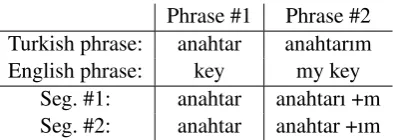
Phrase #1 Phrase #2 Turkish phrase: anahtar anahtarım English phrase: key my key
[image:3.595.74.271.61.131.2]Seg. #1: anahtar anahtarı +m Seg. #2: anahtar anahtar +ım
Table 1: Example segmentation hypotheses
higher than Seg. #2 (e.g., due to the high fre-quency of the observed morph “+m”). On the other hand, a bilingual segmenter is expected to assign a higher alignment probability P(e|f) to Seg. #2 than Seg. #1, because of the aligned words key||anahtar, therefore ranking Seg. #2 higher.
The two monolingual components of Eq. 2 are computed as in Creutz and Lagus (2007). To sum-marize briefly, the priorP(Mf)is assumed to only
depend on the frequencies and lengths of the indi-vidual morphs, which are also assumed to be in-dependent. The monolingual likelihoodP(f|Mf)
is computed as the product of morph probabilities estimated from their frequencies in the corpus.
To compute the bilingual (translation) likeli-hood P(e|f), we use IBM Model 1 (Brown et al., 1993). Let an aligned sentence pair be rep-resented by (se, sf), which consists of word
se-quencesse = e1, ..., el andsf = f1, ..., fm.
Us-ing a purely notational switch of the corpus labels from here on to be consistent with the SMT lit-erature, where the derivations are in the form of P(f|e), the desired translation probability is given by the expression:
P(f|e) = P(m|e) (l+ 1)m
m Y
j=1
l X
i=0
t(fj|ei), (3)
The sentence length probability distribution P(m|e) is assumed to be Poisson with the ex-pected sentence length equal tom.
3.1 Incremental computation of Model-1
likelihood
During search, the translation likelihood P(e|f)
needs to be calculated according to Eq. 3 for every hypothesized segmentation.
To compute Eq. 3, we need to have at hand the individual morph translation probabilitiest(fj|ei).
These can be estimated using the EM algorithm given by (Brown, 1993), which is guaranteed to converge to a global maximum of the likelihood for Model 1. However, running the EM algorithm to optimization for each considered segmentation
model can be computationally expensive, and can result in overtraining. Therefore, in this work we used the likelihood computed after the first EM iteration, which also has the nice property that P(f|e) can be computed incrementally from one segmentation hypothesis to the next.
The incremental updates are derived from the equations for the count collection and probability estimation steps of the EM algorithm as follows. In the count collection step, in the first iteration, we need to compute the fractional countsc(fj|ei)
(Brown et al., 1993):
c(fj|ei) =
1
l+ 1(#fj)(#ei), (4)
where (#fj) and (#ei) denote the number of
occur-rences offjinsf andeiinse, respectively.
Letfk denote the word hypothesized to be
seg-mented. Let the resulting two sub-words befpand
fq, any of which may or may not previously exist
in the vocabulary. Then, according to Eq. (4), as a result of the segmentation no update is needed for c(fj|ei) for j = 1. . . N, j 6= p, q, i = 1. . . M
(note thatfk no longer exists); and the necessary
updates ∆c(fj|ei) for c(fj|ei), where j = p, q;
i= 1. . . M are given by:
∆c(fj|ei) =
1
l+ 1(#fk)(#ei). (5)
Note that Eq. (5) is nothing but the previous count value for the segmented word,c(fk|ei). So,
all needed in the count collection step is to copy the set of valuesc(fk|ei)toc(fp|ei)andc(fq|ei),
adding if they already exist.
Then in the probability estimation step, the nor-malization is performed including the newly added fractional counts.
3.2 Parallelization of search
In an iteration of the algorithm, all words are pro-cessed in random order, computing for each word the posterior probability of the generative model after each possible binary segmentation (splitting) of the word. If the highest-scoring split increases the posterior probability compared to not splitting, that split is accepted (for all occurrences of the word) and the resulting sub-words are explored re-cursively for further segmentations. The process is repeated until an iteration no more results in a sig-nificant increase in the posterior probability.
Word-based Morfessor Morfessor-p Morfessor-bi 51.4
51.6 51.8 52 52.2 52.4 52.6 52.8 53 53.2 53.4
Segmentation method
[image:4.595.322.521.69.218.2]BLEU score
Figure 1: BLEU scores obtained with different segmentation methods. Multiple data points for a system correspond to different random orders in processing the data (Creutz and Lagus, 2007).
are affected by the decision in the current step. This leads to a sequential search and does not lend itself to parallelization.
We propose a slightly modified search proce-dure, where the segmentation decisions are stored but not applied until the end of an iteration. In this way, the cost calculations (which is the most time-consuming component) can all be performed independently and in parallel. Since the model is not updated at every decision, the search path can differ from that in the sequential greedy search and hence result in different segmentations.
4 Results
We performed in vivo testing of the segmenta-tion algorithm on the Turkish side of a Turkish-to-English task. We compared the segmenta-tions produced by Morfessor, Morfessor modi-fied for parallel search (Morfessor-p), and Mor-fessor with bilingual cost (MorMor-fessor-bi) against the word-based performance. We used the ATR Basic Travel Expression Corpus (BTEC) (Kikui et al., 2006), which contains travel conversa-tion sentences similar to those in phrase-books for tourists traveling abroad. The training cor-pus contained 19,972 sentences with average sen-tence length 5.6 and 7.7 words for Turkish and English, respectively. The test corpus consisted of 1,512 sentences with 16 reference translations. We used GIZA++ (Och and Ney, 2003) for post-segmentation token alignments and the Moses toolkit (Koehn et al., 2007) with default param-eters for phrase-based translation model genera-tion and decoding. Target language models were
1.558 1.56 1.562 1.564 1.566 1.568 1.57 x 10⁶ 51.4
51.6 51.8 52 52.2 52.4 52.6 52.8 53 53.2 53.4
Morfessor cost
BLEU score
1.072 1.074 1.076 1.078 1.08 1.082 1.084 x 10⁶ 51.8
52 52.2 52.4 52.6 52.8 53 53.2 53.4 53.6
Morfessor-bi cost
BLEU score
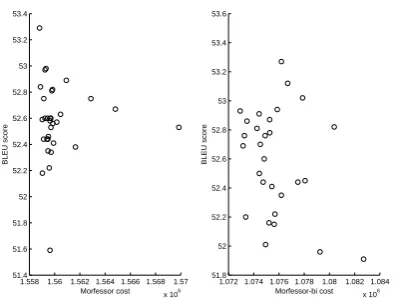
Figure 2: Cost-BLEU plots of Morfessor and Morfessor-bi. Correlation coefficients are -0.005 and -0.279, respectively.
trained on the English side of the training cor-pus using the SRILM toolkit (Stolcke, 2002). The BLEU metric (Papineni et al., 2002) was used for translation evaluation.
Figure 1 compares the translation performance obtained using the described segmentation meth-ods. All segmentation methods generally im-prove the translation performance (Morfessor and Morfessor-p) compared to the word-based models. However, Morfessor-bi, which utilizes both sides of the parallel corpus in segmenting, does not con-vincingly outperform the monolingual methods.
In order to investigate whether the proposed bilingual segmentation cost correlates any better than the monolingual segmentation cost of Mor-fessor, we show several cost-BLEU pairs obtained from the final and intermediate segmentations of Morfessor and Morfessor-bi in Fig. 2. The cor-relation coefficients show that the proposed bilin-gual metric is somewhat predictive of the trans-lation performance as measured by BLEU, while the monolingual Morfessor cost metric has almost no correlation. Yet, the strong noise in the BLEU scores (vertical variation in Fig. 2) diminishes the effect of this correlation, which explains the incon-sistency of the results in Fig. 1. Indeed, in our ex-periments even though the total cost kept decreas-ing at each iteration of the search algorithm, the BLEU scores obtained by those intermediate seg-mentations fluctuated without any consistent im-provement.
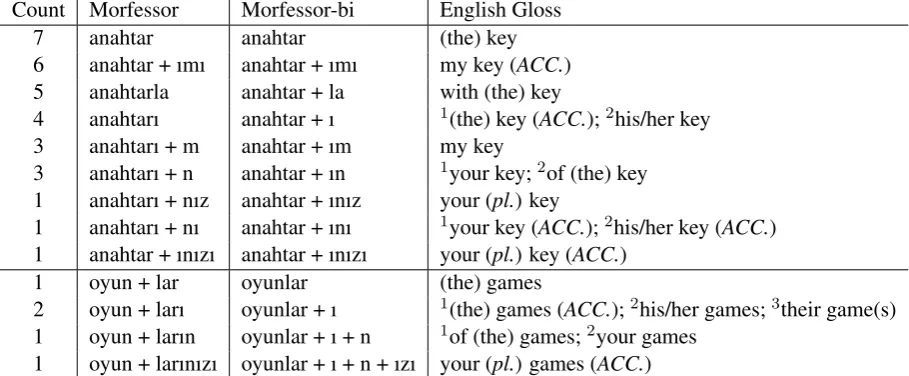
[image:4.595.89.280.70.218.2]Count Morfessor Morfessor-bi English Gloss 7 anahtar anahtar (the) key 6 anahtar + ımı anahtar + ımı my key (ACC.) 5 anahtarla anahtar + la with (the) key
4 anahtarı anahtar + ı 1(the) key (ACC.);2his/her key 3 anahtarı + m anahtar + ım my key
3 anahtarı + n anahtar + ın 1your key;2of (the) key 1 anahtarı + nız anahtar + ınız your (pl.) key
1 anahtarı + nı anahtar + ını 1your key (ACC.);2his/her key (ACC.) 1 anahtar + ınızı anahtar + ınızı your (pl.) key (ACC.)
1 oyun + lar oyunlar (the) games
2 oyun + ları oyunlar + ı 1(the) games (ACC.);2his/her games;3their game(s) 1 oyun + ların oyunlar + ı + n 1of (the) games;2your games
[image:5.595.72.527.64.252.2]1 oyun + larınızı oyunlar + ı + n + ızı your (pl.) games (ACC.)
Table 2: Sample segmentations produced by Morfessor and Morfessor-bi
Morfessor-bi: (i) to consistently identify the root word “anahtar” (top portion), and (ii) to match the English plural word form “games” with the Turk-ish plural word form “oyunlar” (bottom portion). Monolingual Morfessor is unaware of the target segmentation, and hence it is up to the subsequent translation model training to learn that “oyun” is sometimes translated as “game” and sometimes as “games” in the segmented training corpus.
5 Conclusion
We have presented a method for determining opti-mal sub-word translation units automatically from a parallel corpus. We have also showed a method of incrementally computing the first iteration pa-rameters of IBM Model-1 between segmentation hypotheses. Being language-independent, the pro-posed algorithm can be added as a one-time pre-processing step prior to training in a SMT system without requiring any additional data/linguistic re-sources. The initial experiments presented here show that the translation units learned by the proposed algorithm improves on the word-based baseline in both translation directions.
One avenue for future work is to relax some of the several independence assumptions made in the generative model. For example, independence of consecutive morphs could be relaxed by an HMM model for transitions between morphs (Creutz and Lagus, 2007). Other future work includes optimiz-ing the segmentation of both sides of the corpus and experimenting with other language pairs.
It is also possible that the probability distribu-tions are not discriminative enough to outweigh
the model prior tendencies since the translation probabilities are estimated only crudely (single it-eration of Model-1 EM algorithm). A possible candidate solution would be to weigh the transla-tion likelihood more in calculating the overall cost. In fact, this idea could be generalized into a log-linear modeling (e.g., (Poon et al., 2009)) of the various components of the joint corpus likelihood and possibly other features.
Finally, integration of sub-word segmentation with the phrasal lexicon learning process in SMT is desireable (e.g., translation-driven segmenta-tion in Wu (1997)). Hierarchical models (Chiang, 2007) could cover this gap and provide a means to seamlessly integrate sub-word segmentation with statistical machine translation.
Acknowledgements
The authors would like to thank Murat Sarac¸lar for valuable discussions and guidance in this work, and the anonymous reviewers for very useful com-ments and suggestions. Murat Sarac¸lar is sup-ported by the T ¨UBA-GEB˙IP award.
References
Arianna Bisazza and Marcello Federico. 2009. Mor-phological Pre-Processing for Turkish to English
Statistical Machine Translation. InProc. of the
In-ternational Workshop on Spoken Language
Transla-tion, pages 129–135, Tokyo, Japan.
M.R. Brent. 1999. An efficient, probabilistically
P.F. Brown, V.J. Della Pietra, S.A. Della Pietra, and R.L. Mercer. 1993. The mathematics of statistical
machine translation: Parameter estimation.
Compu-tational Linguistics, 19(2):263–311.
Pi-Chuan Chang, Michel Galley, and Christopher D. Manning. 2008. Optimizing Chinese word
segmen-tation for machine translation performance. In
Pro-ceedings of the Third Workshop on Statistical Ma-chine Translation, pages 224–232, Columbus, Ohio.
David Chiang. 2007. Hierarchical phrase-based
trans-lation. Computational Linguistics, 33(2):201–228.
M. Creutz and K. Lagus. 2007. Unsupervised models for morpheme segmentation and morphology learn-ing. ACM Transactions on Speech and Language Processing, 4(1):1–34.
Sajib Dasgupta and Vincent Ng. 2007.
High-performance, language-independent morphological
segmentation. In Proceedings of HLT-NAACL,
pages 155–163, Rochester, New York.
˙Ilknur Durgar El-Kahlout and Kemal Oflazer. 2006. Initial explorations in English to Turkish statistical
machine translation. In Proceedings of the
Work-shop on Statistical Machine Translation, pages 7– 14, New York City, New York, USA.
Jakob Elming, Nizar Habash, and Josep M. Crego. 2009. Combination of statistical word alignments based on multiple preprocessing schemes. In Cyrill Goutte, Nicola Cancedda, Marc Dymetman, and
George Foster, editors,Learning Machine
Transla-tion, chapter 5, pages 93–110. MIT Press.
Nizar Habash and Fatiha Sadat. 2006. Arabic prepro-cessing schemes for statistical machine translation. In Proc. of the HLT-NAACL, Companion Volume: Short Papers, pages 49–52, New York City, USA.
G. Kikui, S. Yamamoto, T. Takezawa, and E. Sumita.
2006. Comparative study on corpora for speech
translation. IEEE Transactions on Audio, Speech
and Language Processing, 14(5):1674–1682.
Philipp Koehn, Hieu Hoang, Alexandra Birch, Chris Callison-Burch, Marcello Federico, Nicola Bertoldi, Brooke Cowan, Wade Shen, Christine Moran, Richard Zens, Chris Dyer, Ondrej Bojar, Alexandra Constantin, and Evan Herbst. 2007. Moses: Open source toolkit for statistical machine translation. In
Proceedings of the 45th Annual Meeting of the Asso-ciation for Computational Linguistics, Companion Volume: Proceedings of the Demo and Poster Ses-sions, pages 177–180, Prague, Czech Republic.
M. Kurimo, S. Virpioja, V.T. Turunen, G.W. Black-wood, and W. Byrne. 2009. Overview and Results
of Morpho Challenge 2009. InWorking notes of the
CLEF workshop.
Young-Suk Lee. 2004. Morphological analysis for
sta-tistical machine translation. InProceedings of
HLT-NAACL, Companion Volume: Short Papers, pages 57–60, Boston, Massachusetts, USA.
Adam Lopez and Philip Resnik. 2006. Word-based
alignment, phrase-based translation: What’s the
link? InProceedings of the 7th Conference of the
Association for Machine Translation in the Ameri-cas (AMTA-06), pages 90–99.
Franz Josef Och and Hermann Ney. 2003. A
sys-tematic comparison of various statistical alignment
models. Computational Linguistics, 29(1):19–51.
Kemal Oflazer and ˙Ilknur Durgar El-Kahlout. 2007.
Exploring different representational units in
English-to-Turkish statistical machine translation. In Proceedings of the Second Workshop on Statis-tical Machine Translation, pages 25–32, Prague, Czech Republic.
Kishore Papineni, Salim Roukos, Todd Ward, and Wei-Jing Zhu. 2002. BLEU: a method for automatic
evaluation of machine translation. In Proceedings
of 40th Annual Meeting of the Association for Com-putational Linguistics, pages 311–318, Philadelphia, Pennsylvania, USA.
Hoifung Poon, Colin Cherry, and Kristina Toutanova.
2009. Unsupervised morphological segmentation
with log-linear models. In Proceedings of
HLT-NAACL, pages 209–217, Boulder, Colorado.
Fatiha Sadat and Nizar Habash. 2006. Combination of Arabic preprocessing schemes for statistical
ma-chine translation. InProc. of the 21st International
Conference on Computational Linguistics and 44th Annual Meeting of the Association for Computa-tional Linguistics, pages 1–8, Sydney, Australia.
Wade Shen, Brian Delaney, and Tim Anderson. 2007.
The MIT-LL/AFRL IWSLT-2007 MT system. In
Proc. of the International Workshop on Spoken Lan-guage Translation, Trento, Italy.
Benjamin Snyder and Regina Barzilay. 2008.
Un-supervised multilingual learning for morphological
segmentation. In Proceedings of the 46th Annual
Meeting of the Association for Computational Lin-guistics: HLT, pages 737–745, Columbus, Ohio.
A. Stolcke. 2002. SRILM-an extensible language
modeling toolkit. InSeventh International
Confer-ence on Spoken Language Processing, volume 3.
David Talbot and Miles Osborne. 2006. Modelling
lexical redundancy for machine translation. In
Pro-ceedings of the 21st International Conference on Computational Linguistics and 44th Annual Meet-ing of the Association for Computational LMeet-inguis-
Linguis-tics, pages 969–976, Sydney, Australia.
S. Virpioja, J.J. V¨ayrynen, M. Creutz, and M. Sade-niemi. 2007. Morphology-aware statistical machine translation based on morphs induced in an
unsuper-vised manner. InMachine Translation Summit XI,
pages 491–498, Copenhagen, Denmark.
D. Wu. 1997. Stochastic inversion transduction
gram-mars and bilingual parsing of parallel corpora.