Efficient Collective Entity Linking with Stacking
Zhengyan He† Shujie Liu‡ Yang Song† Mu Li‡ Ming Zhou‡ Houfeng Wang†∗
†Key Laboratory of Computational Linguistics (Peking University) Ministry of Education,China ‡Microsoft Research Asia
[email protected] {shujliu,muli,mingzhou}@microsoft.com [email protected] [email protected]
Abstract
Entity disambiguation works by linking am-biguous mentions in text to their correspond-ing real-world entities in knowledge base. Re-cent collective disambiguation methods en-force coherence among contextual decisions at the cost of non-trivial inference processes. We propose a fast collective disambiguation approach based on stacking. First, we train a local predictorg0with learning to rank as base learner, to generate initial ranking list of can-didates. Second, topkcandidates of related instances are searched for constructing expres-sive global coherence features. A global pre-dictorg1 is trained in the augmented feature space and stacking is employed to tackle the train/test mismatch problem. The proposed method is fast and easy to implement. Exper-iments show its effectiveness over various al-gorithms on several public datasets. By learn-ing a rich semantic relatedness measure be-tween entity categories and context document, performance is further improved.
1 Introduction
When extracting knowledge from natural language text into a machine readable format, ambiguous names must be resolved in order to tell which real-world entity the name refers to. The task of linking names to knowledge base is known as entity linking or disambiguation (Ji et al., 2011). The resulting text is populated with semantic rich links to knowledge base like Wikipedia, and ready for various down-stream NLP applications.
∗Corresponding author
Previous researches have proposed several kinds of effective approaches for this problem. Learning to rank (L2R) approaches use hand-crafted features
f(d, e)to describe the similarity or dissimilarity be-tween contextual document dand entity definition
e. L2R approaches are very flexible and expres-sive. Features like name matching, context similar-ity (Li et al., 2009; Zheng et al., 2010; Lehmann et al., 2010) and category context correlation (Bunescu and Pasca, 2006) can be incorporated with ease. Nevertheless, decisions are made independently and inconsistent results are found from time to time.
Collective approaches utilize dependencies be-tween different decisions and resolve all ambiguous mentions within the same context simultaneously (Han et al., 2011; Hoffart et al., 2011; Kulkarni et al., 2009; Ratinov et al., 2011). Collective ap-proaches can improve performance when local ev-idence is not confident enough. They often utilize semantic relations across different mentions, and is why they are calledglobal approaches, while L2R methods fall into local approaches (Ratinov et al., 2011). However, collective inference processes are often expensive and involve an exponential search space.
We propose a collective entity linking method based on stacking. Stacked generalization (Wolpert, 1992) is a powerful meta learning algorithm that uses two levels of learners. The predictions of the first learner are taken as augmented features for the second learner. The nice property of stacking is that it does not restrict the form of the base learner. In this paper, our base learner, an L2R ranker, is first employed to generate a ranking list of candidates.
At the next level, we search for semantic coherent entities from the top k candidates of neighboring mentions. The second learner is trained on the aug-mented feature space to enforce semantic coherence. Stacking is employed to handle train/test mismatch problem. Compared with existing collective meth-ods, the inference process of our method is much faster because of the simple form of its base learner. Wikipedians annotate each entity with categories which provide another source of valuable seman-tic information. (Bunescu and Pasca, 2006) pro-pose to generalize beyond context-entity correla-tions(d, e)with word-category correlations(w, c). However, this method works at word level, and does not scale well to large number of categories. We explore a representation learning technique to learn the category-context association in latent semantic space, which scales much better to large knowledge base.
Our contributions are as follows: (1) We pro-pose a fast and accurate stacking-based collective entity linking method, which combines the benefits of both coherence modeling of collective approaches and expressivity of L2R methods. We show an effective usage of ranking list as global features, which is a key improvement for the global predictor. (2) To overcome problems of scalability and shal-low word-level comparison, we learn the category-context correlation with recent advances of repre-sentation learning, and show that this extra seman-tic information indeed helps improve entity linking performance.
2 Related Work
Most popular entity linking systems use the L2R framework (Bunescu and Pasca, 2006; Li et al., 2009; Zheng et al., 2010; Lehmann et al., 2010). Its discriminative nature gives the model enough flexibility and expressivity. It can include any fea-tures that describe the similarity or dissimilarity of context d and candidate entity e. They often per-form well even on small training set, with carefully-designed features. This category falls into thelocal
approach as the decision processes for each mention are made independently (Ratinov et al., 2011).
(Cucerzan, 2007) first suggests to optimize an ob-jective function that is similar to the collective
ap-proach. However, the author adopts an approxi-mation method because of the large search space (which isO(nm)for a document withmmentions, each with n candidates). Various other methods like integer linear programming (Kulkarni et al., 2009), personalized PageRank (Han et al., 2011) and greedy graph cutting (Hoffart et al., 2011) have been explored in literature. Our method without stacking resembles the method of (Ratinov et al., 2011) in that they use the predictions of a local ranker to gen-erate features for global ranker. The differences are that we use stacking to train the local ranker to han-dle the train/test mismatch problem and topk candi-dates to generate features for the global ranker.
Stacked generalization (Wolpert, 1992) is a meta learning algorithm that uses multiple learners out-puts to augment the feature space of subsequent learners. It utilizes a cross-validation strategy to ad-dress the train set / testset label mismatch problem. Various applications of stacking in NLP have been proposed, such as collective document classification (Kou and Cohen, 2007), stacked dependency parsing (Martins et al., 2008) and joint Chinese word seg-mentation and part-of-speech tagging (Sun, 2011). (Kou and Cohen, 2007) propose stacked graphical learning which captures dependencies between data with relational template. Our method is inspired by their approach. The difference is our base learner is an L2R model. We search related entity candidates in a large semantic relatedness graph, based on the assumption that true candidates are often semanti-cally correlated while false ones scattered around.
3 Method
In this section, we first introduce our base learner and local features used; next, the stacking train-ing strategy is given, followed by an explana-tion of our global coherence model with aug-mented feature space; finally we explain how to learn category-context correlation with representa-tion learning technique.
3.1 Base learner and local predictorg0
Entity linking is formalized as follows: given an ambiguous name mention m with its con-textual document d, a list of candidate entities
e1, e2, . . . , en(m) ∈ C(m) is generated for m, our
predictor g will generate a ranking score g(ei) for each candidate ei. The ranking score will be used to construct augmented features for the next level learner, or used by our end system to select the an-swer:
ˆ
e= arg max
e∈C(m)g(e) (1)
In an L2R framework, the model is often defined as a linear combination of features. Here, our fea-turesf⃗(d, e)are derived from documentdand can-didatee. The model is defined asg(e) =w ⃗⃗f(d, e). In our problem, we are given a list of training data
D={(di, ei)}. We want to optimize the parameter
⃗
w, such that the correct entity has a higher score over negative ones. This is done via a preference learning techniqueSV Mrank, first introduced by (Joachims, 2002). The following margin based loss is mini-mized w.r.tw⃗:
L= 1 2∥w⃗∥
2+C∑ξ
d,e′ (2)
s.t. ⃗w(f⃗(d, e)−f⃗(d, e′))≥1−ξd,e′ (3)
ξd,e′ ≥0 (4)
where C is a trade-off between training error and margin size; ξ is slacking variable and loops over all query documentsdand negative candidatese′ ∈ C(m)− {e}.
This model is expressive enough to include any form of features describing the similarity and dis-similarity ofdande. We only include some typical features seen in literature. The inclusion of these features is not meant to be exhaustive. Our purpose is to build a moderate model in which some of the
Surface matching:
1. mention stringm exactly matches candidate
e, i.e.m=e
2. neitherm is a substring ofenor eis a sub-string ofm
3.m̸=eandmis a substring ofe
4.m̸=eandeis a substring ofm
5. m ̸= eandm is a redirect pointing to ein Wikipedia
6.m̸=eandestarts withm
7.m̸=eandeends withm
Context matching:
1. cosine similarity of TF-IDF score between context and entire Wikipedia page of candidate 2. cosine similarity of TF-IDF score between context and introduction of Wikipedia page 3. jaccard distance between context and entire Wikipedia page of candidate
4. jaccard distance between context and intro-duction of Wikipedia page
Popularity or prominence feature:
percentage of Wikipedia hyperlinks pointing to
egiven mentionm, i.e. P(e|m)
Category-context coherence model:
cat0andcat1(details in Section 3.4)
Table 1: Features for local predictorg0.
useful features like string matching and entity pop-ularity cannot be easily expressed by collective ap-proaches like (Hoffart et al., 2011; Han et al., 2011). The features for level 0 predictorg0 are described
in Table 1. The reader can consult (Li et al., 2009; Zheng et al., 2010; Lehmann et al., 2010) for further reference.
3.2 Stacking training for global predictorg1
Stacked generalization (Wolpert, 1992) is a meta learning algorithm that stacks two “levels” of pre-dictors. Level 0 includes one or more predictors
h(0)1 , h(0)2 , . . . , h(0)K :Rd→R, each one is trained on the originald-dimensional feature space. The level 1 predictorh(1) : Rd+K → Ris trained in the aug-mented(d+K)-dimensional feature space, in which predictions at level 0 are taken as extra features in
h(1).
graphi-cal learning for learning and inference on relational data. In stacked graphical learning, dependencies among data are captured byrelational template, with which one searches forrelated instancesof the cur-rent instance. The augmented feature space does not necessarily to bed+K. Instead, one can con-struct any declarative feature with the original data and predictions of related instances. For instance, in collective document classification (Kou and Co-hen, 2007) employ relational template to extract documents that link to this document, then apply a COUNT aggregator over each category on neighbor-ing documents as level 1 features.
In our entity linking task, we use a single predic-tor g0 trained with local features at level 0.
Com-pared with (Kou and Cohen, 2007), both g0 andg1
are L2R models rather than classifier. At level 1, for each document-candidate entity pair, we use the re-lational templateN(x)to find related entities for en-tityx, and construct global features with some func-tion G({g0(n)|n ∈ N(x)}) (details in Sec. 3.3). The global predictor g1 receives as input the
origi-nal features plusG.
One problem is that if we useg0trained on the
en-tire training set to predict related instances in train-ing set, the accuracy can be somehow different (typ-ically lower) for future unseen data.g1with this
pre-diction as input doesn’t generalize well to test data. This is known as train/test mismatch problem. To mimic test time behavior, training is performed in a cross-validation-like way. LetDbe the entire train-ing set:
1. SplitDintoLpartitions{D1, . . . ,DL}
2. For each splitDi:
2.1 Train an instance ofg0onD − Di
2.2 Predict all related instances inDiwith this predictorg0
2.3 Augment feature space forx∈ Di, withG applied on predictions ofN(x)
3. Train level 0 predictor g0 on entireD, for
ex-panding feature space for test data
4. Train level 1 predictor g1 on entire D, in the
augmented feature space.
In the next subsection, we will describe how to construct global features from the predictions ofg0
on neighborsN(x)withG.
3.3 Enforcing coherence with global featuresG
If one wants to identify the correct entity for an am-biguous name, he would possibly look for related entities in its surrounding context. However, sur-rounding entities can also exhibit some degree of ambiguity. In ideal cases, most true candidates are inter-connected with semantic links while negative candidates are scattered around (Fig. 1). Thus, we ask the following question: Is there any highly rele-vant entity to this candidate in context? Or, is there any mention with highly relevant entity to this can-didate in the topkranking list of this mention? And how many those mentions are? The reason to look up topkcandidates is to improve recall.g0may not
perfectly rank related entity at the first place, e.g. “Mitt Romney” in Figure 1.
Assume the ambiguous mention set is M. For each mentionmi ∈ M, we rank each entity ei,j ∈
C(mi) by its score g0(ei,j). Denote its rank as
Rank(ei,j). For each entity ein the candidate set
E = {ei,j|∀ei,j ∈ C(mi),∀mi ∈ M}, we search related instances foreas follows:
1. search inE for entities with semantic related-ness above a threshold ({0.1,0.3,0.5,0.7,0.9});
2. select those entities in step (1) with Rank(e)
less than or equal tok(k∈ {1,3,5});
3. map entities in step (2) to unique set of men-tionsU, excluding currentm, i.e.e∈C(m).
This process is relatively fast. It only involves a sparse matrix slicing operation on the large pre-computed semantic relatedness matrix in step (1), and logical operation in step (2,3). The following features are fired concerning the unique setU:
- ifU is empty;
- ifU is not empty;
- if the percentage|U|/|M|is above a threshold (e.g. 0.3).
Barack Obama Democratic Party (United States)
Mitt Romney Republican Party (United States)
Obama, Fukui
Obama, Nagasaki
Democratic Party (Italy)
Democratic Party (Serbia)
Republican Party of Minnesota
Republicanism
Romney, West Virginia
HMS Romney (1694)
... ... ... ...
received national attention during his campaign ... with his vectory in the March [[Obama|Barack Obama]]
[[Democratic Party|Democratic Party (United States)]]primary ... He was re-elected president in November
[image:5.612.94.519.66.132.2]2012, defeating [[Republican|Republican Party (United States)]] nominee [[Romney|Mitt Romney]]
Figure 1: Semantic links for collective entity linking. Annotation[[mention|entity]]follows Wikipedia conventions.
Finally, the semantic relatedness measure of two entitiesei,ejis defined as the common in-links ofei andej in Wikipedia (Milne and Witten, 2008; Han et al., 2011):
SR(ei, ej) = 1−
log(max(|A|,|B|))−log(|A∩B|) log(|W|)−log(min(|A|,|B|))
(5) whereA andB are the set of in-links for entity ei andejrespectively, andW is the set of all Wikipedia pages.
Our method is a trade-off between exact collec-tive inference and approximating related instance with top ranked entities produced by g0. Most
collective approaches take all ambiguous mentions into consideration and disambiguate them simulta-neously, resulting in difficulty when inference in large search space (Kulkarni et al., 2009; Hoffart et al., 2011). Others resolve to some kinds of ap-proximation. (Cucerzan, 2007) construct features as the average of all candidates for one mention, in-troducing considerable noise. (Ratinov et al., 2011) also employ a two level architecture but only take top 1 prediction for features. This most resembles our approach, except we use stacking to tackle the train/test mismatch problem, and construct different set of features from top k candidates predicted by
g0. We will show in our experiments that this indeed
helps boost performance.
3.4 Learning category-context coherence modelcat
Entities in Wikipedia are annotated with rich se-mantic structures. Category network provides us with another valuable information for entity link-ing. Take the mention “Romney” as an
exam-ple, one candidate “Mitt Romney” with category “Republican party presidential nominee” co-occurs frequently with context like “election” and “cam-paign”, while another candidate “Milton Romney” with category “Utah Utes football players” is fre-quently observed with context like “quarterback” and “backfield”. The category network forms a di-rected acyclic graph (DAG). Some entities can share category through the network, e.g. “Barack Obama” with category “Democratic Party presidential nom-inees” shares the category “United States presiden-tial candidates by party” with “Mitt Romney” when travelling two levels up the network.
(Bunescu and Pasca, 2006) propose to learn the category-context correlation at word level through category-word pair features. This method creates sparsity problem and does not scale well because the number of features grows linearly with both the number of categories and the vocabulary size. More-over, the category network is somewhat noisy, e.g. travelling up four levels of the hierarchy can result in over ten thousand categories, with many irrelevant ones.
Rather than learning the correlation at word level, we explore a representation learning method that learns category-context correlation in the latent se-mantic space. Supervised Sese-mantic Indexing (SSI) (Bai et al., 2009) is trained on query-document pairs to predict their degree of matching. The compar-ison is performed in the latent semantic space, so that synonymy and polysemy are implicitly handled by its inner mechanism. The score function between queryqand documentdis defined as:
where W is learned with supervision like click-through data.
Given training data{(qi, di)}, training is done by randomly sampling a negative targetd−. The model optimizesW such thatf(q, d+) > f(q, d−). Thus, the training objective is to minimize the following margin-based loss function:
∑
q,d+,d−
max(0,1−f(q, d+) +f(q, d−)) (7)
which is also known as contrastive estimation (Smith and Eisner, 2005).
W can become very large and inefficient when we have a big vocabulary size. This is addressed by re-placingW with its low rank approximation:
W =UTV +I (8)
here, the identity term I is a trade-off between the latent space model and a vector space model. The gradient step is performed with Stochastic Gradient Descent (SGD):
U ←U+λV(d+−d−)qT,
if 1−f(q, d+) +f(q, d−)>0 (9)
V ←V +λU q(d+−d−)T,
if 1−f(q, d+) +f(q, d−)>0. (10) whereλis the learning rate.
The query and document are not necessary real query and document. In our case, we treat our problem as: given the occurring context of an tity, retrieving categories corresponding to this en-tity. Thus, we use context as query q and the cat-egories of this candidate entity as d. We also treat the definition page of an entity as its context, and first train the model with definition pages, because definition pages exhibit more focused topic. This considerably accelerates the training process. To reduce noise, We input the categories directly con-nected with one entity as a word vector. The input can be a TF-IDF vector or binary vector. We denote model trained with normalized TF-IDF and with bi-nary input ascat0andcat1respectively.
4 Experiments
4.1 Datasets
Previous researches have used diverse datasets for evaluation, which makes it hard for comparison
with others’ approaches. TAC-KBP has several years of data for evaluating entity linking system, but is not well suited for evaluating collective ap-proaches. Recently, (Hoffart et al., 2011) anno-tated a clean and much larger dataset AIDA 1 for collective approaches evaluation based on CoNLL 2003 NER dataset. (Ratinov et al., 2011) also re-fined previous work and contribute four publicly available datasets 2. Thanks to their great works, we have enough data to evaluate against. Accord-ing to the settAccord-ing of (Hoffart et al., 2011), we split the AIDA dataset for train/development/test with 946/216/231 documents. We train a separate model on the Wikipedia training set for evaluating ACE/QUAINT/WIKI dataset (Ratinov et al., 2011). Table 2 gives a brief overview of the datasets used.
For knowledge base, we use the Wikipedia XML dump3 to extract over 3.3 million entities. We use annotation from Wikipedia to build a name dictio-nary from mention string m to entity e for can-didate generation, including redirects, disambigua-tion pages and hyperlinks, follows the approach of (Cucerzan, 2007). For candidate generation, we keep the top 30 candidates by popularity (Tbl. 1). Note that our name dictionary is different from (Ratinov et al., 2011) and has a much higher recall. Since (Ratinov et al., 2011) evaluate on “solvable” mentions and we have no way to recover those men-tions, we re-implement their global features and the final scores are not directly comparable to theirs.
4.2 Methods under comparison
We compare our algorithm with several state-of-the-art collective entity disambiguation systems. The AIDA system proposed by (Hoffart et al., 2011) use a greedy graph cutting algorithm that iteratively re-move entities with low confidence scores. (Han et al., 2011) employ personalized PageRank to prop-agate evidence between different decisions. Both algorithms use simple local features without dis-criminative training. (Kulkarni et al., 2009) pro-pose to use integer linear programming (ILP) for inference. Except our re-implementation of Han’s
1available at http://www.mpi-inf.mpg.de/yago-naga/aida/ 2
http://cogcomp.cs.illinois.edu/Data, we don’t find the MSNBC dataset in the zip file.
3
Dataset ndocs non-NIL
identified solvable
AIDA dev 216 4791 4791 4707 AIDA test 231 4485 4485 4411 ACE 36 257 238 209(185) AQUAINT 50 727 697 668(588) Wikipedia 40 928 918 854(843)
Table 2: Number of mentions in each dataset. “identi-fied” means the mention exists in our name dictionary and “solvable” means the true entity are among the top 30 candidates by popularity. Number in parenthesis shows the results of (Ratinov et al., 2011).
method, both AIDA and ILP solution are quite slow at running time. The online demo of AIDA takes over 10 sec to process one document with mod-erate size, while the ILP solution takes around 2-3 sec/doc. In contrast, our method takes only 0.2-3 sec/doc, and is easy to implement.
(Ratinov et al., 2011) also utilize a two layer learner architecture. The difference is that their method use top 1 candidate generated by local learner for global feature generation , while we search the topk candidates. Moreover, stacking is used to tackle the train/test mismatch problem in our model. We re-implement the global features of (Ratinov et al., 2011) and use our local predictor
g0 for level 0 predictor. Note that we only
imple-ment their global features concerning common in-links and inter-connection (totally 9 features) for fair comparison because all other models don’t use com-mon outgoing links for global coherence.
4.3 Settings
We implementSV Mrankwith an adaptation of lin-ear SVM in scikit-llin-earn (which is a wrapper of Li-blinear). The category-context coherence model is implemented with Numpy configured with Open-Blas library, and we train this model on the entire Wikipedia hyperlink annotation. It takes about 1.5d for one pass over the entire dataset. The learning rateλis set to 1e-4 and training cost before update is below 0.02.
Parameter tuning:there aren’t many parameters to tune for both g0 andg1. The context document
window size is fixed as 100 for compatibility with
(Ratinov et al., 2011; Hoffart et al., 2011). The num-ber of candidates is fixed to top 30 ranked by entity’s popularity. Increase this value will generally boost recall at the cost of lower precision.
We introduce the following default parameter for global features ing1. The number of fold for
stack-ing is set to{1,5,10} (see Table 4, default is 10; 1 means no stacking, i.e. trainingg0 with all training
data and generating level 1 features for training data directly with thisg0). The numberk for searching
neighboring entities with relational template is set to{1,3,5,7} (e.g. in step 2 of Section 3.3k = 5; default is 5).
For category-context modeling, the vocabulary sizes of context and category are set to top 10k and 6k unigrams by frequency. The latent dimension of low rank approximation is set to 200.
Performance measures: For all non-NIL queries, we evaluate performance with micro pre-cision averaged over queries and macro prepre-cision averaged over documents. Mean Reciprocal Rank (MRR) is an information retrieval measure and is defined as |Q1|∑|iQ|rank1
i, whereranki is the rank
of correct answer in response to query i. For ACE/AQUAINT/WIKI we also give the accuracy of “solvable” mentions, but this is not directly compa-rable to (Ratinov et al., 2011). Our name dictionary is different from theirs and ours has a higher recall rate (Tbl. 2). Hence, the “solvable” set is different.
k recall k recall
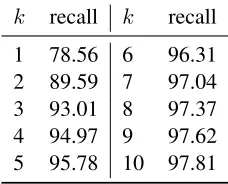
[image:7.612.369.483.464.556.2]1 78.56 6 96.31 2 89.59 7 97.04 3 93.01 8 97.37 4 94.97 9 97.62 5 95.78 10 97.81
Table 3: Topkrecall for local predictorg0.
4.4 Discussions
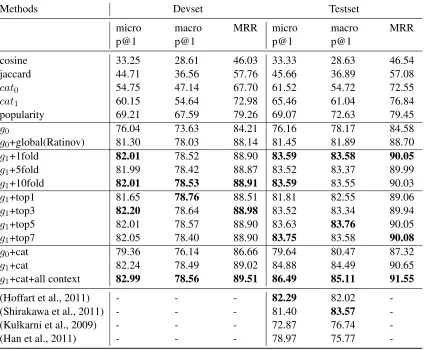
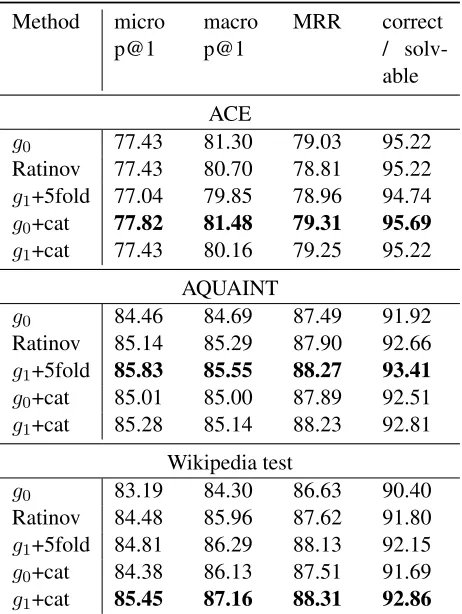
Table 4 shows the evaluation results on AIDA dataset and Table 5 shows results on datasets ACE/AQUAINT/WIKI.
Methods Devset Testset
micro p@1
macro p@1
MRR micro p@1
macro p@1
MRR
cosine 33.25 28.61 46.03 33.33 28.63 46.54 jaccard 44.71 36.56 57.76 45.66 36.89 57.08
cat0 54.75 47.14 67.70 61.52 54.72 72.55 cat1 60.15 54.64 72.98 65.46 61.04 76.84
popularity 69.21 67.59 79.26 69.07 72.63 79.45
g0 76.04 73.63 84.21 76.16 78.17 84.58 g0+global(Ratinov) 81.30 78.03 88.14 81.45 81.89 88.70 g1+1fold 82.01 78.52 88.90 83.59 83.58 90.05 g1+5fold 81.99 78.42 88.87 83.52 83.37 89.99 g1+10fold 82.01 78.53 88.91 83.59 83.55 90.03 g1+top1 81.65 78.76 88.51 81.81 82.55 89.06 g1+top3 82.20 78.64 88.98 83.52 83.34 89.94 g1+top5 82.01 78.57 88.90 83.63 83.76 90.05 g1+top7 82.05 78.40 88.90 83.75 83.58 90.08 g0+cat 79.36 76.14 86.66 79.64 80.47 87.32 g1+cat 82.24 78.49 89.02 84.88 84.49 90.65 g1+cat+all context 82.99 78.56 89.51 86.49 85.11 91.55
(Hoffart et al., 2011) - - - 82.29 82.02 -(Shirakawa et al., 2011) - - - 81.40 83.57 -(Kulkarni et al., 2009) - - - 72.87 76.74 -(Han et al., 2011) - - - 78.97 75.77
-Table 4: Performance on AIDA dataset. Maximal value in each group are highlighted with bold font. topkmeans up tokcandidates are used for searching related instances with relational template.
better than word level features. Group 5 in Table 4 shows cat information generally boosts perfor-mance for both predictorg0andg1.
Effect of stacking: Group 3 in Table 4 shows the results with different fold in stacking training. 1 fold means trainingg0 with all training data and directly
augment training data with thisg0. Surprisingly, we
do not observe any substantial difference with vari-ous fold size. We deduce it is possible the way we fire global features with top k candidates that alle-viates the problem of train/test mismatch when ex-tending feature space forg1. Despite the ranking of
true entity can be lower in testset than in training set, the semantic coherence information can still be captured with searching over topkcandidates.
Effect of topkglobal features:Group 4 in Table 4 shows the effect ofkong1 performance. Clearly,
increasing k generally improves precision and one
possible reason is the improvement in recall when searching for related instances. Table 3 shows the topkrecall of local predictorg0. Further increasing kdoes not show any improvement.
[image:8.612.95.520.59.409.2]Method micro p@1
macro p@1
MRR correct / solv-able
ACE
g0 77.43 81.30 79.03 95.22
Ratinov 77.43 80.70 78.81 95.22
g1+5fold 77.04 79.85 78.96 94.74 g0+cat 77.82 81.48 79.31 95.69 g1+cat 77.43 80.16 79.25 95.22
AQUAINT
g0 84.46 84.69 87.49 91.92
Ratinov 85.14 85.29 87.90 92.66
g1+5fold 85.83 85.55 88.27 93.41 g0+cat 85.01 85.00 87.89 92.51 g1+cat 85.28 85.14 88.23 92.81
Wikipedia test
g0 83.19 84.30 86.63 90.40
Ratinov 84.48 85.96 87.62 91.80
[image:9.612.72.303.57.364.2]g1+5fold 84.81 86.29 88.13 92.15 g0+cat 84.38 86.13 87.51 91.69 g1+cat 85.45 87.16 88.31 92.86
Table 5: Evaluation on ACE/AQUAINT/WIKI datasets.
trained on Wikipedia, the annotation style can be quite different.
Finally, as we analyze the development set of AIDA, we discover that some location entities rely on more distant information across the context, as we increase the context to the entire contextual doc-ument, we can gain extra performance boost.
4.5 Error analysis
As we analyze the development set of AIDA, we find some general problems with location names. Loca-tion name generally is not part of the main topic of one document. Thus, comparing context with its definition is not realistic. Most of the time, we can find some related location names in context; but other times, it is not easily distinguished. For in-stance, in “France beats Turkey in men’s football...” France refers to “France national football team” but our system links it to the country page “France” be-cause it is more popular. This can be addressed by modeling finer context (Sen, 2012) or local syntac-tic pattern (Hoffart et al., 2011). In other cases,
our system misclassifies “New York City” for “New York” and “Netherlands” for “Holland” and “Peo-ple’s Republic of China” for “China”, because in all these cases, the latter ones are the most popu-lar in Wikipedia. It is even hard for us humans to tell the difference based only on context or global coherence.
5 Conclusions
We propose a stacking based collective entity link-ing method, which stacks a global predictor on top of a local predictor to collect coherence information from neighboring decisions. It is fast and easy to im-plement. Our method trades off between inefficient exact search and greedily assigning mention with lo-cal predictor. It can be seen as searching related entities with relational template in stacked graphi-cal learning, with beam size k. Furthermore, we adopt recent progress in representation learning to learn category-context coherence model. It scales better than existing approaches on large knowledge base and performs comparison in the latent semantic space. Combining these two techniques, our model consistently outperforms all existing more sophisti-cated collective approaches in our experiments.
Acknowledgments
This research was partly supported by Ma-jor National Social Science Fund of China(No. 12&ZD227),National High Technology Research and Development Program of China (863 Program) (No. 2012AA011101) and National Natural Science Foundation of China (No.91024009).
References
B. Bai, J. Weston, D. Grangier, R. Collobert, O. Chapelle, and K. Weinberger. 2009. Supervised semantic index-ing. InThe 18th ACM Conference on Information and Knowledge Management (CIKM).
R. Bunescu and M. Pasca. 2006. Using encyclopedic knowledge for named entity disambiguation. In Pro-ceedings of EACL, volume 6, pages 9–16.
S. Cucerzan. 2007. Large-scale named entity disam-biguation based on wikipedia data. InProceedings of EMNLP-CoNLL, volume 6, pages 708–716.
Pro-ceedings of the 34th international ACM SIGIR con-ference on Research and development in Information Retrieval, pages 765–774. ACM.
J. Hoffart, M.A. Yosef, I. Bordino, H. F¨urstenau, M. Pinkal, M. Spaniol, B. Taneva, S. Thater, and G. Weikum. 2011. Robust disambiguation of named entities in text. InProceedings of the Conference on Empirical Methods in Natural Language Processing, pages 782–792. Association for Computational Lin-guistics.
Heng Ji, Ralph Grishman, Hoa Trang Dang, Kira Grif-fitt, and Joe Ellis. 2011. Overview of the tac 2011 knowledge base population track. InProceedings of the Fourth Text Analysis Conference.
Thorsten Joachims. 2002. Optimizing search engines using clickthrough data. InProceedings of the eighth ACM SIGKDD international conference on Knowl-edge discovery and data mining, pages 133–142. ACM.
S.S. Kataria, K.S. Kumar, R. Rastogi, P. Sen, and S.H. Sengamedu. 2011. Entity disambiguation with hierar-chical topic models. InProceedings of KDD.
Zhenzhen Kou and William W Cohen. 2007. Stacked graphical models for efficient inference in markov ran-dom fields. InSDM.
S. Kulkarni, A. Singh, G. Ramakrishnan, and S. Chakrabarti. 2009. Collective annotation of wikipedia entities in web text. In Proceedings of the 15th ACM SIGKDD international conference on Knowledge discovery and data mining, pages 457–466. ACM.
J. Lehmann, S. Monahan, L. Nezda, A. Jung, and Y. Shi. 2010. Lcc approaches to knowledge base population at tac 2010. InProc. TAC 2010 Workshop.
F. Li, Z. Zheng, F. Bu, Y. Tang, X. Zhu, and M. Huang. 2009. Thu quanta at tac 2009 kbp and rte track. In
Proceedings of Test Analysis Conference 2009 (TAC 09).
Andr´e FT Martins, Dipanjan Das, Noah A Smith, and Eric P Xing. 2008. Stacking dependency parsers. In
Proceedings of the Conference on Empirical Methods in Natural Language Processing, pages 157–166. As-sociation for Computational Linguistics.
D. Milne and I.H. Witten. 2008. Learning to link with wikipedia. In Proceedings of the 17th ACM con-ference on Information and knowledge management, pages 509–518. ACM.
L. Ratinov, D. Roth, D. Downey, and M. Anderson. 2011. Local and global algorithms for disambiguation to wikipedia. InProceedings of the Annual Meeting of the Association of Computational Linguistics (ACL). P. Sen. 2012. Collective context-aware topic models
for entity disambiguation. InProceedings of the 21st
international conference on World Wide Web, pages 729–738. ACM.
M. Shirakawa, H. Wang, Y. Song, Z. Wang, K. Nakayama, T. Hara, and S. Nishio. 2011. Entity disambiguation based on a probabilistic taxonomy. Technical report, Technical Report MSR-TR-2011-125, Microsoft Research.
N.A. Smith and J. Eisner. 2005. Contrastive estimation: Training log-linear models on unlabeled data. In Pro-ceedings of the 43rd Annual Meeting on Association for Computational Linguistics, pages 354–362. Asso-ciation for Computational Linguistics.
Weiwei Sun. 2011. A stacked sub-word model for joint chinese word segmentation and part-of-speech tagging. InACL, pages 1385–1394.
David H Wolpert. 1992. Stacked generalization. Neural networks, 5(2):241–259.
![Figure 1: Semantic links for collective entity linking. Annotation [ [ me n t i o n | e n t i t y ] ] follows Wikipedia conventions.](https://thumb-us.123doks.com/thumbv2/123dok_us/1367529.669911/5.612.94.519.66.132/figure-semantic-collective-linking-annotation-follows-wikipedia-conventions.webp)