This is a post-peer-review, pre-copyedit version of an article published in Instructional Science. The final authenticated version is available online at
http://dx.doi.org/10.1007/s11251-016-9380-2
All figures and tables referred to in the text can be found at the end of the article.
Please cite this article as:
Developing Argumentation Skills in Mathematics through Computer-Supported Collaborative Learning: The Role of Transactivity
Freydis Vogel1, Ingo Kollar2, Stefan Ufer3, Elisabeth Reichersdorfer1, Kristina Reiss1, &
Frank Fischer4
1Technical University of Munich,
School of Education,
Arcisstr. 21, 80333 Munich, Germany
2 University of Augsburg,
Universitätsstr. 10, 86159 Augsburg, Germany
3LMU Munich,
Chair of Mathematics Education, Theresienstr. 39, 80333 Munich, Germany
4LMU Munich,
Chair of Education and Educational Psychology, Leopoldstr. 13, 80802 Munich, Germany
Corresponding author:
Freydis Vogel, [email protected], phone: +49 89 289 25101, fax: +49 89 289 25172
Abstract
Collaboration scripts and heuristic worked examples are effective means to scaffold
university freshmen’s mathematical argumentation skills. Yet, which collaborative learning processes are responsible for these effects has remained unclear. Learners presumably will gain the most out of collaboration if the collaborators refer to each other’s contributions in a dialectic way (dialectic transactivity). Learners also may refer to each other’s contributions in a dialogic way (dialogic transactivity). Alternatively, learners may not refer to each other’s contributions at all, but still construct knowledge (constructive activities). This article investigates the extent to which constructive activities, dialogic transactivity, and dialectic transactivity generated by either the learner or the learning partner can explain the positive effects of collaboration scripts and heuristic worked examples on the learners’ disposition to use argumentation skills. We conducted a 2×2 experiment with the factors collaboration script and heuristic worked examples with N = 101 math teacher students. Results showed that the learners’ engagement in self-generated dialectic transactivity (i.e., responding to the learning partner’s contribution in an argumentative way by critiquing and/or integrating their learning partner’s contributions) mediated the effects of both scaffolds on their disposition to use argumentation skills, whereas partner-generated dialectic transactivity or any other measured collaborative learning activity did not. To support the disposition to use
argumentation skills in mathematics, learning environments should thus be designed in a way to help learners display dialectic transactivity. Future research should investigate how
learners might better benefit from the dialectic transactivity generated by their learning partners.
Keywords:
Developing Argumentation Skills in Mathematics through Computer-Supported Collaborative Learning: The Role of Transactivity
Argumentation skills are required for individuals to be able to participate in
apparently open-ended discussions not only in political and philosophical domains, but also in domains that are usually more driven by formal rules and deductive approaches such as mathematics. An engagement in meaningful activities like mathematical argumentation and proof is increasingly postulated as a goal of mathematical education (National Council of Teachers of Mathematics 2000). Boero (1999) proposed a process model of mathematical proof that starts from finding a conjecture and proceeds to the final formulation of a proof through phases of exploration as well as phases of systematization. This model includes iterative steps of balancing informal explorations and corresponding mathematical arguments that can collaboratively be discussed with others (Reiss, Heinze, Renkl, & Groß 2008). The discussion with others is considered a promising way to strengthen the approach to solving the proof task, since others may bring in new ideas and perspectives to refine original ideas and arguments.
of argumentation skills, which includes the skills to formulate structurally sound arguments (Toulmin 1958) and to engage in argumentative discourse with a learning partner, consisting of sequences of arguments, counterarguments, and syntheses (Leitão 2000).
Yet, engaging in meaningful argumentation is challenging for students. As prior research has shown, they rarely justify claims and often do not take counter-arguments into account (Sadler 2004). Within the mathematical domain, Heinze, Reiss, and Rudolph (2005) found that high school students failed to produce logical chains of more than one argument in geometry proof tasks. Prospective mathematics teachers (i.e., students in teacher education) are an especially reasonable target group to support in learning argumentation in the
mathematical context. These students might not yet be able to engage in meaningful mathematical argumentation, but they will be expected to teach the corresponding skills in their future employment as teachers (Forman, Larreamendy-Joerns, Stein, & Brown 1998; National Council of Teachers of Mathematics 2000).
We might expect students in teacher education to already possess social-discursive argumentation skills to a certain degree, yet it is likely that they have used these skills more in other contexts such as everyday discussions or political debates than in a mathematical or scientific context. Therefore, supporting teacher students in argumentation in the
developing new argumentation skills. It is reasonable, that this not only helpful for argumentation processes in this new context, but also an important step in the long-term development of general argumentation skills. Even though the acquisition of argumentation skills might take years it shouldn’t keep us from searching ways and methods to support argumentation, and it is our aim to find out how instructional means should be designed to foster argumentation skills or at least the disposition to use argumentation skills.
From a cognitive perspective, in our study it is important what the individual can learn within the collaborative learning scenario. Therefore, in the following we describe how collaborative learning activities can change the learner’s individual dispositions and help to acquire different knowledge and skills.
The Potential of Collaborative Activities for Learning to Argue in Mathematics
To change students’ disposition towards argumentation, collaborative learning activities that are in line with deep cognitive processing need to be activated. A number of studies have focused on the role of collaborative learning activities within educational settings (e.g., Choi, Land, & Turgeon 2005; De Vries, Lund, & Baker 2002; Schwarz & Linchevski 2007; Schwarz, Schur, Pensso, & Tayer 2011). Research about collaborative learning activities has especially attributed high potential to so-called transactive activities. Transactive activities are described as discourse moves by which one learner actively builds on a learning partner’s contributions to further construct knowledge, an example of which would be answering the learning partner’s questions (Teasley 1997).
be more relevant than constructive activities for reaching high-level individual learning outcomes through collaborative learning (Chi 2009). This assumption is due to the fact that transactive activities make it necessary to thoroughly elaborate on the learning partner’s contributions and to monitor one’s own previous contributions in light of the partner’s possible criticism (e.g. De Wever, Van Keer, Schellens, & Valcke 2010; Ismail & Alexander 2005).
However, previous research on collaborative learning activities displays two gaps: (1) the paucity of related studies to investigate the role of distinct types of transactivity that might differ in their predictive power for learning; and (2) the lack of research on whether a learner benefits only from his or her own social-discursive activities during collaboration, or (also) from the learning partner’s social-discursive activities.
The dialectic-dialogic distinction for assessing learning activities raises the question of whether dialectic or dialogic activities are better for promoting individual learning
outcomes of collaborative learning. For instance, in their study about undergraduates learning about evolutionary theory in dyads, Asterhan and Schwarz (2009) found that students learned better conceptual (i.e., domain-specific) knowledge when they engaged in “dialectical
argumentation” compared to when they were engaged in (dialogic) “consensual explanation.” In this study, we thus differentiate between dialectic transactivity and dialogic transactivity. According to Wegerif’s (2008) conceptual work and the distinction made in the study by Asterhan and Schwarz (2009), we assume that an engagement in dialectic transactivity should yield higher individual learning gains than an engagement in dialogic transactivity.
In this study, we analyze to what extent the different kinds of transactivity contribute to the disposition to use domain-general social discursive argumentation skills and how they mediate the effects of specific instructional support (heuristic worked examples and
collaboration scripts). In contrast, Asterhan and Schwarz (2009) studied the effect of similar learning activities on domain-specific (evolutionary theory) learning outcomes under one common instructional condition, which encouraged all students to engage in dialectical argumentation.
that case, the learner might not deeply elaborate (or even notice) the partner’s contributions, or react to them in a transactive way. In fact, Jiménez-Aleixandre, Bugallo Rodríguez, and Duschl (2000) showed that the quality and quantity of contributions that are made in a small group within a collaborative learning process are not necessarily equally distributed among the learning partners, so it is plausible to differentiate between the partners’ own and others’ contributions in a learning group. Moreover, studies with different designs and learning outcomes suggest that students’ individual learning outcomes might be predicted by argumentative contributions that are self-generated rather than by argumentative contributions that are generated by a learning partner (e.g., Asterhan & Schwarz 2009). Furthermore, one learner might use the other learner as a model in terms of argumentation skills and learn by observing the partner’s activities (van Gog & Rummel 2010). This scenario, however, requires high-quality arguments that are explicit enough to serve as a model, which is seldom observed spontaneously in collaborative argumentation. Moreover, to learn from models it often requires additional stimulation to ensure that the model is actually used (van Gog & Rummel 2010). This raises the question of whether all learning partners benefit equally from all social-discursive learning activities or whether their benefit is reduced to the activities they actually produce themselves as compared to those only observed in the behavior of the learning partner.
Scaffolding Argumentation in the Domain of Mathematics
structuring the content, collaboration scaffolds support the sequence of social-discursive exchange between learning partners (Leitão 2000). In the following section, we describe in detail heuristic worked examples as domain-specific scaffolds (Reiss & Renkl 2002) and collaboration scripts as domain-general collaboration scaffolds (Fischer, et al. 2013).
Heuristic worked examples
Traditional worked examples present a task description, the single solution steps, and the correct solution to a problem (e.g., Atkinson, Derry, Renkl, & Wortham 2000). They were shown to be helpful for the acquisition of skills needed to solve well-defined problems in well-defined domains such as probability theory. Yet, to be beneficial in ill-defined domains that allow for the selection of different solution paths and heuristics, worked examples need to offer flexible access to the heuristic strategies that underlie the process of solving ill-defined problems (e.g., Paas & van Merriënboer 1994). To adapt traditional worked examples to the needs of solving ill-defined mathematical proof problems, Reiss and Renkl (2002) introduced heuristic worked examples, which include a description of how an imaginary learner solves ill-defined problems in a way that matches the assumptions of a domain-specific experts’ model. Heuristic worked examples demonstrate a set of heuristic strategies that vary in the degree to which they are immediately productive for finding a solution among different proof tasks.
So far, research about heuristic worked examples has focused more on individual learners and less on collaborative learning activities, which are relevant when learners are asked to study heuristic worked examples in teams (Hilbert, Renkl, Kessler, & Reiss 2008). Therefore, how learners can benefit from learning collaboratively with heuristic worked examples is still unknown. Nevertheless, by displaying heuristic strategies by which some may lead to impasses and others lead to a successful solution (e.g., in a proof task),
in that way engage in high-level argumentation. However, the collaborative use of heuristic worked examples might be challenging for learners, which is why more direct guidance on how to argue with each other in a group might additionally be necessary to lead to an engagement in high-level collaboration and eventually individual learning. Such guidance may come in the form of collaboration scripts.
Collaboration scripts
Collaboration scripts distribute roles and activities among learners and then sequence activities and role changes to guide learners through a collaborative learning process that is beneficial for their learning (Fischer et al. 2013; King 2007; Kollar, Fischer, & Hesse 2006). Scripts that are designed to foster argumentation prompt the learners to fulfill adequate activities within each step of an argumentative discourse cycle (e.g., Hron, Hesse, Cress, & Giovis 2000; Kopp & Mandl 2011; Scheuer, McLaren, Weinberger, & Niebuhr 2013; Weinberger, Stegmann, & Fischer 2010) or distribute discussion roles among the learning partners with specific activities that are attached to each role (e.g., De Wever et al. 2010; Strijbos, Martens, Jochems, & Broers 2004). During the past decade, a large variety of argumentation scaffolds, and more specifically collaboration scripts for computer-supported collaborative learning, has been investigated (Noroozi, Weinberger, Biemans, Mulder, & Chizari, 2012). For instance, in a study by Stegmann, Wecker, Weinberger, and Fischer (2012), undergraduate educational science students learned with a collaboration script that sequenced their argumentation. The study revealed that students learning with the
collaboration script outperformed students learning without the collaboration script in developing argumentation skills. Indeed, collaboration scripts may further be designed to have an impact on collaborative learning processes, especially on transactivity (Fischer et al. 2013; King 1997; Noroozi, Biemans, Weinberger, Mulder, & Chizari 2013), and – as
disposition to use argumentation skills. This mechanism was recently formulated for learning with collaboration scripts in the transactivity principle of the script theory of guidance
(Fischer et al. 2013), which states that “The more a given CSCL [Computer-Supported Collaborative Learning] practice requires the transactive application of knowledge, the better this knowledge is learned through participation in this CSCL practice” (p. 58). However, given the rather domain-general nature of the collaboration script concept, what seems promising is a combination with heuristic worked examples that take the peculiarities of the domain into account and thus give direction to the topics of discussion that seem fruitful to solve mathematical proof tasks (Vogel, Wecker, Kollar & Fischer, 2016).
The Current Study
Authors (2014) have investigated the effects of learning with heuristic worked examples and a collaboration script on different components of mathematical argumentation skills. In their study, the heuristic worked examples guided the learners through the process of mathematical proof (Boero 1999), and the collaboration script supported learners in producing certain kinds of argument sequences (Leitão 2000). The results showed that both scaffolds had a significant positive effect on learners’ acquisition resp. disposition to use social-discursive mathematical argumentation skills (Authors 2014). The present article provides an in-depth process analysis of the data from the collaborative learning sessions collected by Authors (2014) in their study. This data source was not analyzed in the 2014 paper. In particular, this article investigates the role of transactive learning activities in explaining positive effects of learning with heuristic worked examples and collaboration scripts on the disposition to use argumentation skills
collaborative learning activities (constructive activities, dialogic transactivity, and dialectic transactivity)?
argumentation. Therefore, we also expected the constructive activities to mediate the positive effects of both types of instructional support, heuristic worked examples and collaboration scripts. However, we expected dialectic transactivity to have the strongest mediating effects between the two scaffolds and the learner’s disposition to use argumentation skills.
Research Question 2. To what extent are the effects of heuristic worked examples and the collaboration script on the disposition to use argumentation skills mediated by partner-generated collaborative learning activities (constructive activities, dialogic transactivity, and dialectic transactivity)?
We also expected the partner-generated activities to mediate the positive effects of heuristic worked examples and the collaboration script on the disposition to use
argumentation skills. For the same reasons as stated in RQ1, both scaffolds were expected to positively influence the activities for all learners. The learning partner’s activities may then comprise an additional source of information for the learner to elaborate on and in turn practice argumentation (e.g., Clark & Sampson 2007). Beyond that, the learning partner’s dialectic transactivity might function as a model for the learner to engage in argumentation as a collaborative practice (e.g., Ismail & Alexander 2005). However, a question arises as to whether the effects of both scaffolds would be mediated by the partner-generated
contributions. In fact, one might be skeptical about the existence of such a mediating effect because learners might not deeply elaborate on the partner’s contributions. Thus, we expected that the mediating effect of the partner-generated collaborative learning activities would be less pronounced than the mediating effect of the self-generated collaborative activities.
Method
Participants and Design
Overall, N = 101 (57 female and 44 male) students were included in the study presented in this article. Their mean age was Mage = 20.04 (SDage = 2.41), and their average final high school grade was Mgrade = 2.09 (SDgrade = 0.58) with grades ranging from 1.00 = excellent to 3.50 = satisfactory. We established a 2×2 experimental design with collaboration scripts (with, N = 48 students vs. without, N = 53 students) and heuristic worked examples (with N = 53 students vs. without, N = 48 students) as the independent variables. Participants were randomly assigned to one of the four experimental conditions.
Instructional Setting
The study took place on five consecutive weekdays. Pre-test data were collected on the first day, and the post-test took place on the fifth day. On the second, third, and fourth days, the participants took part in one treatment session per day (45 minutes each). For each treatment session, new dyads (same and mixed gender) were formed to reduce the effect that a single specific participant or dyad might have. To avoid large discrepancies in learning prerequisites of the participants learning together in one dyad, the assignment of learners to the learning dyads was controlled by the median split of the participants’ final high school grade (Mdngrade = 2.10). Only participants within the same half of the sample determined by the median split (i.e., with similar final high school grades) were randomly assigned to a learning dyad.
Setting and Learning Environment
them to learn about the expected conjecture, because the feedback would have been an additional type of instructional support. Nevertheless, in other parts of the introductory course, before the beginning of the intervention, participants created conjectures to a different mathematical topic in groups and received feedback from tutors. The learning partners of each dyad were seated on opposite sides of a table and were each equipped with one laptop and a graphics tablet that allowed them to draw and write into a graphical chat that was implemented in the computer-supported learning environment that was installed on the laptops. Face-to-face communication was allowed as well.
The computer-supported learning environment we used allowed for the implementation of the four experimental conditions. More information about how the computer-supported learning environment looked and how the different conditions were realized in the learning environment can be found in Authors (2014). On the left half of the computer screen, the learning environment presented the mathematical proof task, a
calculator with basic functions, and domain-specific lecture notes (available in all
conditions), as well as the heuristic worked examples (in the conditions with heuristic worked examples) or only the problem to be solved (in the conditions without heuristic worked examples). On the right half of the screen, the students were able to share text and drawings by using the text and graphic chat function (available in all conditions). The students were allowed to create an unlimited number of pages for their written communication and browse through the pages during the current treatment session. Since learning partners were co-present, they also were allowed to talk about their suggestions face-to-face. In the conditions with the collaboration script, the upper right side of the screen displayed the script prompts.
Independent Variables
about the sequence of argumentation and the rules for formulating arguments that they were supposed to follow in the subsequent treatment sessions. In all experimental conditions, students were requested to alternately work on the proof tasks individually and discuss their ideas with their learning partner, taking notes of the most important aspects.
Heuristic worked examples. In the conditions with heuristic worked examples, we presented a possible solution for each of the three proof tasks. The heuristic worked examples were split into the six steps of mathematical proofs (adapted from Boero 1999) and described how an imaginary peer applied different heuristic strategies to make progress within each of these steps. To increase the need for discussion, the two students of each dyad were presented with slightly different heuristic worked examples for each task. In contrast, in the conditions without heuristic worked examples, students had to work on the mathematical proof tasks by themselves through problem solving, without receiving guidance either on the steps of the mathematical proof or on heuristic strategies beyond the instructional video shown at the start of the first treatment session.
Collaboration script. In the conditions with a collaboration script, the collaborative discussion of the learning dyads was sequenced into three phases: (1) argument, (2)
according to Toulmin’s (1958) model of argument construction (including claims, data, and qualifiers). In the conditions without a collaboration script, students were asked to discuss their ideas without receiving any guidance for their discussion (unstructured collaboration).
Dependent Variables
For the pre- and post-test measure of the disposition to use argumentation skills, we used a paper-pencil test that requested students to individually describe typical phases and activities they would expect to find in a discussion about a science topic (e.g, whether hot water freezes faster than cold water in the refrigerator). We deliberately chose a topic different from mathematics for these tests to see whether students would be able to transfer their disposition to use argumentation skills from mathematics to different domains, assuming that the argumentation skills that should be used in the learning environment would also be helpful in domains beyond mathematics. The test consisted of a prompt to describe typical phases and activities of a discussion and five empty fields in which students could describe the phases of a discussion in an open format. The students’ answers were coded for the number of argumentative elements they included (pro-argumentation, counter-argumentation, integration of arguments, and response to other’s arguments). After training, two independent coders coded the answers separately, reaching sufficient inter-rater reliability for coding each of the four elements on average (MCohen’s κ = .82; κminimum = .76, κmaximum = .93). The correctly
mentioned elements in each student’s answer were summed to yield an overall measure of argumentation skills, with values ranging from 0 to 4 (for more detailed information about the test, see Authors 2014).
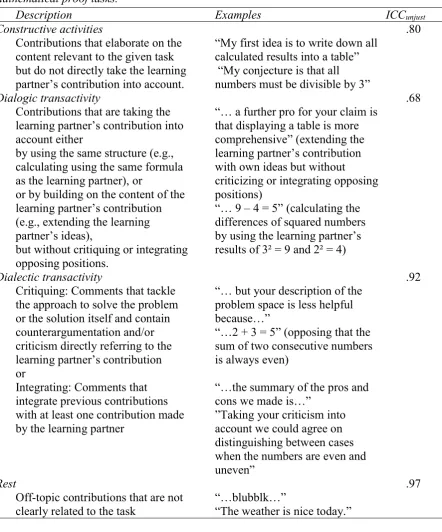
transactivity) or a rest category (see Table 2 for exact descriptions and examples for each category). The rest category was not included into further calculations in the current study. After coding, the frequencies of contributions containing constructive activities, dialogic transactivity, and dialectic transactivity were summed for each learner separately. Inter-rater reliability was calculated based on the frequencies of contributions that were summed for each category. After training, a sufficient inter-rater reliability was achieved for a sample of the contributions of 22 participants across all conditions and treatment sessions (see Table 2 for exact ICC values of each category). The remaining turns were then coded separately by one trained coder.
Validity of the Measure for the Disposition to Use of Argumentation Skills
To test the validity and usefulness of the measure for the disposition to use
argumentation skills as a predictor for the student’s ability to engage in collaborative problem solving and discussion about mathematical proof tasks, we assessed the relation between the post-test disposition to use argumentation skills and the engagement in collaborative problem solving after treatment for each student. For this purpose, the students were paired together in new learning dyads in which they were requested to work on another mathematical proof task, similar to those that were used during the treatment phases. During this post-test task, the students used the same learning environment as in the treatment phases, but without any means of instructional support. Two raters practiced with a coding scheme to assess the number of turns in the chat protocol in which students engaged in the discussion about the given mathematical proof task. After this training, the raters achieved a good inter-rater agreement based on double-coding of > 20% of all included chat protocols (ICCunjust = .94). The remaining turns were then assessed separately by one of the two raters.
mathematical proof task were significantly positively correlated (r = .31, p = .002). A partial correlation of both measures that controlled for the pre-test measure of the use of
argumentation skills also revealed a significantly positive correlation (r = .30, p = .003). Thus, the validity of our measure for the disposition to use argumentation skills might be confirmed because learners who showed a better performance in our test of the disposition to use argumentation skills were actually more engaged in collaborative discussions during an unguided mathematical proof task.
Statistical Analyses
We used linear regressions to determine the extent to which the different collaborative learning activities mediated the effects of heuristic worked examples and the collaboration script on the students’ disposition to use argumentation skills. To test for mediation of the predictors in the linear regression model, we used the bootstrapping procedure recommended by Preacher and Hayes (2004). The calculations for the bootstrapping were conducted by the MEDIATE SPSS macro provided by Hayes and Preacher (2014).
Results
Preliminary Results
Using analyses of covariance, Authors (2014) showed that learning with heuristic worked examples and learning with the collaboration script in the context of mathematical proof had substantial positive effects on the disposition to use argumentation skills. Yet, there was no significant interaction effect between the two independent variables. For the
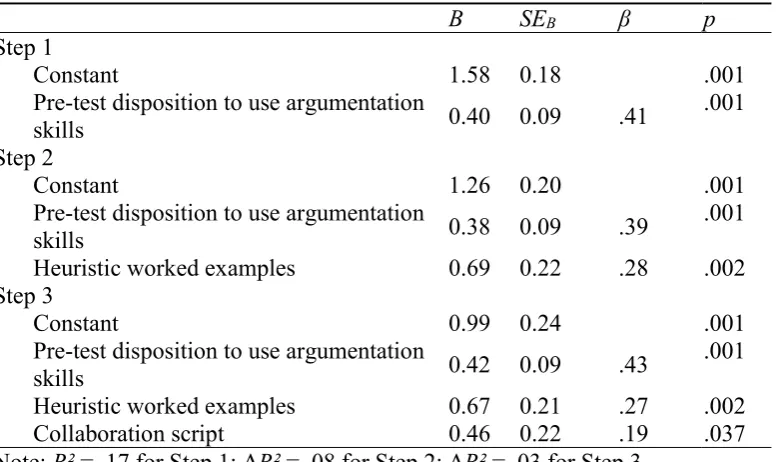
the collaboration script was excluded from the model because it was not a significant predictor for the disposition to use argumentation skills (β = .028, p = .86; ΔR < .001).
As both the heuristic worked examples and the collaboration script had significant positive effects on students’ disposition to use argumentation skills, it is worthwhile to further investigate the collaborative learning processes to identify possible mediators of the effect of the heuristic worked examples and the collaboration script on the disposition to use
argumentation skills as hypothesized in the research questions.
RQ 1: Mediation by the Learners’ Self-Generated Activities
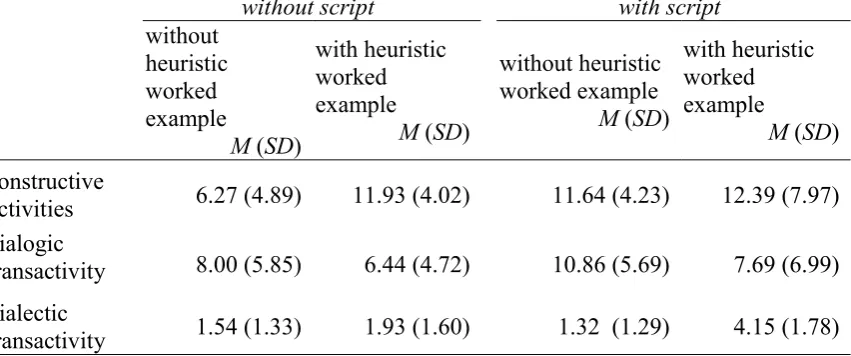
Descriptively, the analysis of the appearance of the different collaborative learning processes within each condition yielded that, in general, constructive activities were used the most, followed by dialogic transactivity, and dialectic transactivity (see Table 4 for the collaborative learning processes used per learner per condition). To answer the first research question, we conducted linear regression analyses and the bootstrapping procedure as recommended by Preacher and Hayes (2004). As predictors for the post-test disposition to use argumentation skills, we used the group indicators for heuristic worked examples and the collaboration script in the regression model. Additionally, the pre-test disposition to use argumentation skills was included as a covariate and we entered as mediators the frequencies of the three self-generated activities (constructive activities, dialogic transactivity, and dialectic transactivity).
worked examples as a predictor for the disposition to use argumentation skills was reduced, which indicates the presence of a mediation effect. The bootstrapping procedure showed that neither constructive activities (CI95%: LLCI = -0.03; ULCI = 0.27) nor dialogic transactivity (CI95%: LLCI = -0.06; ULCI = 0.21) were significant mediators. Only the frequency of dialectic transactivity generated by the students during the learning process mediated significantly the effect of heuristic worked examples on the disposition to use argumentation skills
(CI95%: LLCI = 0.05; ULCI = 0.46).
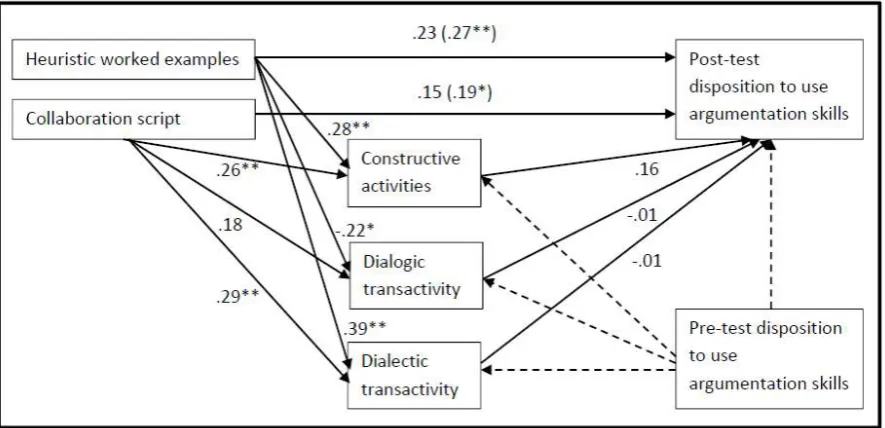
Collaboration script. The results showed that the collaboration script was a positive predictor for the frequencies of the three self-generated activities, namely, constructive activities, dialogic transactivity, and dialectic transactivity (see Fig. 1). By including the frequencies of the three self-generated activities into the regression model, the coefficient of the collaboration script as a predictor for the disposition to use argumentation skills was reduced, which indicates the presence of a mediation effect. Also for the collaboration script, the bootstrapping procedure showed that neither constructive activities (CI95%: LLCI = -0.03;
ULCI = 0.28) nor dialogic transactivity (CI95%: LLCI = -0.21; ULCI = 0.05) were significant mediators. Only the frequency of dialectic transactivity generated by the students during the learning process mediated significantly the positive effect of the collaboration script on the disposition to use argumentation skills (CI95%: LLCI = 0.03; ULCI = 0.41).
RQ 2: Mediation by the Partner-Generated Activities
Because students were also exposed to the contributions made by their learning partners, RQ 2 asked to what extent partner-generated contributions also mediated the effects of heuristic worked examples and the collaboration script on the disposition to use
regression model. Additionally, pre-test disposition to use argumentation skills was included as a covariate, and this time the frequencies of the three partner-generated activities
(constructive activities, dialogic transactivity, and dialectic transactivity) were included as mediators.
Heuristic worked examples. In parallel to the results for the self-generated activities, heuristic worked examples served as a positive predictor for the frequencies of partner-generated constructive activities as well as dialectic transactivity, and as a negative predictor for the frequency of partner-generated dialogic transactivity (see Fig. 2). The bootstrapping procedure showed that none of the three partner-generated activities were significant mediators for the effect of the heuristic worked examples on the disposition to use argumentation skills: not constructive activities (CI95%: LLCI = -0.02; ULCI = 0.36), nor dialogic transactivity (CI95%: LLCI = -0.13; ULCI = 0.15), nor dialectic transactivity (CI95%: LLCI = -0.24; ULCI = 0.21).
Collaboration script. The results showed that the collaboration script was a positive predictor for the frequencies of each of the three partner-generated activities, namely
constructive activities, dialogic transactivity, and dialectic transactivity (see Fig. 2). Also for the collaboration script, the bootstrapping procedure showed that neither partner-generated constructive activities (CI95%: LLCI = -0.02; ULCI = 0.34), nor partner-generated dialogic transactivity (CI95%: LLCI = -0.14; ULCI = 0.10), nor partner-generated dialectic transactivity (CI95%: LLCI = -0.19; ULCI = 0.16) were a significant mediator for the effect on the disposition to use argumentation skills.
Qualitative Results
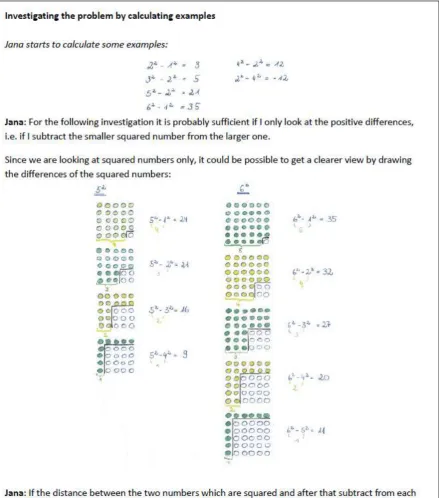
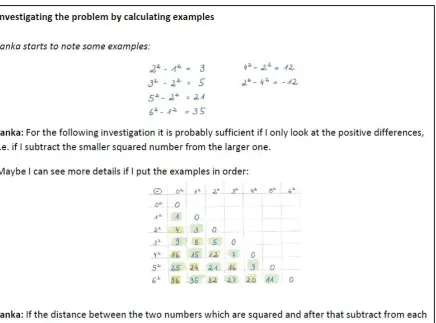
skills (see Table 5) to one transcript of a learner (Sebi) in the condition with heuristic worked examples and without the collaboration script, who had a rather low learning gain in the disposition to use argumentation skills (see Table 6). The excerpts are taken from the first treatment session that presented the proof task: “Choose some squared numbers. Calculate the differences per two squared numbers. Formulate a conjecture and prove it!” The excerpts depict more precisely the part of the learning process in which the learners in each dyad were presented with two different versions of how to display the first examples calculated within the given problem space. More specifically, one learner had access to a version, in which the examples were displayed by drawn circles (see Fig. 3), and the other learner had access to a version, in which the examples were displayed in a table (see Fig. 4).
A comparison of the two transcripts shows clearly that Lisa and her learning partner (Table 5) use the whole spectrum of different learning activities, especially dialectic
transactivity, whereas Sebi and his partner (Table 6), use only constructive activities. The difference that can be seen between the learner with a rather high learning gain (Lisa) and the learner with a rather low learning gain (Sebi) depicts what we found to mediate the effect of the heuristic worked examples and the collaboration script on the disposition to use
argumentation skills in the quantitative analysis of this study.
Discussion
The results showed that, overall, both the heuristic worked examples and the
collaboration script had substantial (mostly positive) effects on the different types of learning activities generated by the students during the collaborative learning process. This finding aligns with results of previous studies that emphasized the importance of providing additional domain-specific scaffolds (e.g., content schemes; content-specific graphical representations) to take full advantage of the support with collaboration scripts (e.g., Ertl, Kopp, & Mandl 2006; Hron, Cress, Hammer, & Friedrich 2007; Vogel et al, 2016). Whereas the script prompted the students to directly perform argumentative moves by guiding them through an argumentation sequence of formulating arguments, counterarguments, and integrations (Leitão 2000), the heuristic worked examples provided rich domain-specific material to argue about (see Fig. 3 and Fig. 4), which may have increased the opportunities to engage in
collaborative learning processes when compared to situations in which students had to develop solutions themselves. Also, the fact that the two learning partners received slightly different heuristic worked examples may have contributed to this effect. According to Dillenbourg and Hong (2008), such a distribution of learning material increases the collaborative effort for the learners to reach a shared understanding and thus may cause a higher amount of interaction between the learners as well as better learning (e.g., Clark & Sampson 2007; Molinari, Sangin, Dillenbourg, & Nüssli 2009).
The results concerning RQ 1 underpin the importance of transactivity in collaborative learning processes to explain individual learning (Chi 2009; Fischer et al. 2013; Noroozi et al. 2013; Teasley 1997). However, the results show that it is useful to differentiate among
various aspects of transactivity. As the mediation analyses showed, the positive effects of the heuristic worked examples and the collaboration script on students’ disposition to use
activities. This means that providing domain-specific scaffolds such as the heuristic worked examples indeed plays an important role in helping learners to engage in dialectic
transactivity during the collaborative learning process and thereby to acquire the disposition to use argumentation skills (Hron et al. 2007; Sadler 2004). At the least, learners can change their disposition to use their argumentation skills in the mathematical and science domains by reconfiguring their already learned components of argumentation skills (Fischer et al. 2013). Also, referring to the learning partner in an argumentative way (i.e., criticizing or integrating the learning partner’s arguments), as was directly scaffolded by the collaboration script, is important for developing a disposition to use such argumentation skills (Fischer et al. 2013).
Learning from collaboration scripts might be criticized due to the suspicion that knowledge might be acquired only by memorizing the description of the prompts offered with the collaboration script rather than the actual realization of the scripted strategy (Wecker, Kollar, & Fischer 2011), especially if the post skill test is on a rather declarative level. The post-test disposition to use argumentation skills that was shown to be mediated by students’ actual use of dialectic transactivity while learning collaboratively argues against this possible criticism. Rather, the results show that indeed the mechanism through which the disposition to use argumentation skills was acquired was that of performing what was
suggested by the script ‒ that is, by engaging in high-level collaborative learning activities. The kind of knowledge students acquired that way can then form the basis for the
development of skills for engagement in argumentative discourse (Anderson 1996), which is also supported by the positive correlation between the learners’ performance in the post-test on the disposition to use argumentation skills and the learner’s engagement in an unsupported collaborative learning discourse.
skills (see results concerning RQ 2). Thus, for changing one’s disposition to use argumentation skills it seems to be more important that learners generate dialectic transactivity themselves rather than merely to be exposed to a learning partner who is generating dialectic transactivity. This makes sense, as learners by necessity need to be actively and cognitively engaged in processing the partner’s contribution when generating dialectic transactivity while a partner’s transactive statement sometimes may (but often also may not) be processed with comparable effort (e.g. Asterhan & Schwarz 2009; Chi, Roy, & Hausmann 2008). This statement, of course, does not imply that the learning partner is not important. Dialectic transactivity by definition requires the learning partner’s contribution to build on and refer to. On a more social and less cognitive level, being faced with a partner who constantly works with one’s own statements may even serve as a model to act similarly. However, our results seem to imply that being exposed to this kind of modeling is not enough for one’s own learning; instead, the power of transactivity for learning to argue lies primarily in modifying one’s own thinking by reflecting on the thoughts of another learner.
Conclusions
Given these results, one implication for theory building concerns the transactivity principle stated in the Script Theory of Guidance (Fischer et al. 2013). Our results provide preliminary justification for a more specific reformulation of this principle, as they seem to imply the need to differentiate between the learners’ self-generated and partner-generated dialectic transactivity, at least for the mathematics context used in this study. A reformulation of this principle might state that the more a given CSCL practice for argumentation requires the generation of dialectic transactivity, the better the learner changes the disposition to use
argumentation skills due to the dialectic transactivity generated by the learner her/himself
evidence accumulates in future research, one interesting question for future studies would relate to how learners might be supported to also take advantage of the dialectic transactivity contributed by their learning partners.
Certainly, this study is not without limitations. First, the extent to which the results generalize to other domains is an open question. With respect to the importance of dialectic transactivity for the development of the disposition to use argumentation skills, generalization may be straightforward because the way we operationalized dialectic transactivity consisted more of domain-general categories (criticizing, integrating) that may easily be adapted to communication in other domains. Also, the fact that the disposition to use argumentation skills was measured in a different domain supports the assumption that students might be capable of transferring what they learned to other contexts. However, the effects of the two types of scaffolding on the collaborative learning process need to be considered with more attention when trying to generalize the results. The part of the effect that can be attributed to the heuristic worked examples might be rather difficult to transfer to a different context because the heuristic worked examples by definition provide domain-specific support, here based on a specific process model of mathematical proofs (Boero 1999). To make the heuristic worked examples approach work in other domains, adaptations are, of course, inevitable.
Another limitation is that the test measuring the students’ disposition to use
together, which makes it methodologically challenging to estimate the learner’s individual learning gain (Cress 2008).
A further limitation refers to how much the learners used dialectic transactivity throughout the treatment sessions. The fact that the use of dialectic transactivity was a rather rare event might have biased the probability for this variable to be a significant mediator. Therefore, our interpretation must be received carefully, and further studies are needed to support or refute our conclusion. Nevertheless, the learning partner’s use of dialectic transactivity has been equally seldom, but did not turn out to be a significant mediator. Therefore, we see the result of self-generated dialectic transactivity being a mediator for the disposition to use argumentation skills as rather robust.
In conclusion, our study shows that the disposition to use domain-general argumentation skills can be enhanced in a domain that is not prototypical for a discursive domain. To do so,
however, the learning environment needs to offer well-designed domain-specific support to provide learners with structured content to use in their argumentation. Moreover, both collaboration scaffolding and domain-specific scaffolding need to be designed with a specific
References
Anderson, J. R. (1996). A Simple Theory of Complex Cognition. American Psychologist, 51(4), 355–365. doi:10.1037/0003-066X.51.4.355
Asterhan, C. S. C., & Schwarz, B. B. (2009). Argumentation and explanation in conceptual change: Indications from protocol analyses of peer-to-peer dialog. Cognitive Science,
33(3), 374–400. doi:10.1111/j.1551-6709.2009.01017.x
Atkinson, R. K., Derry, S. J., Renkl, A., & Wortham, D. (2000). Learning from examples: Instructional principles from the worked examples research. Review of Educational Research, 70(2), 181–214. doi:10.3102/00346543070002181
Authors, (2014).
Boero, P. (1999). Argumentation and mathematical proof: A complex, productive, unavoidable relationship in mathematics and mathematics education. Preuve: International Newsletter on the Teaching and Learning of Mathematical Proof, (July/August 1999). Retrieved from
http://www.lettredelapreuve.it/OldPreuve/Newsletter/990708Theme/990708ThemeU K.html
Chi, M. T. H. (2009). Active-constructive-interactive: A conceptual framework for differentiating learning activities. Topics in Cognitive Science, 1(1), 73–105. doi:10.1111/j.1756-8765.2008.01005.x
Chi, M. T. H., Roy, M., & Hausmann, R. G. M. (2008). Observing tutorial dialogues
collaboratively: Insights about human tutoring effectiveness from vicarious learning.
Cognitive Science, 32(2), 301–341. doi:10.1080/03640210701863396
Chi, M. T. H., & Wylie, R. (2014). The ICAP framework: Linking cognitive engagement to active learning outcomes. Educational Psychologist, 49(4), 219–243.
Choi, I., Land, S. M., & Turgeon, A. J. (2005). Scaffolding peer-questioning strategies to facilitate metacognition during online small group discussion. Instructional Science,
33(5-6), 483–511. doi: 10.1007/s11251-005-1277-4
Clark, D. B., & Sampson, V. D. (2007). Personally seeded discussions to scaffold online argumentation. International Journal of Science Education, 29(3), 253–277. doi:10.1080/09500690600560944
Cohen, G. C. (1994). Restructuring the classroom: Conditions for productive small groups.
Review of Educational Research, 64(1), 1–35. doi:10.3102/00346543064001001 Cress, U. (2008). The need for considering multilevel analysis in CSCL research ‒ An appeal
for the use of more advanced statistical methods. International Journal of Computer-Supported Collaborative Learning, 3(1), 69–84. doi:10.1007/s11412-007-9032-2 De Vries, E., Lund, K., & Baker, M. (2002). Computer-mediated epistemic dialogue:
Explanation and argumentation as vehicles for understanding scientific notions. The Journal of the Learning Sciences, 11(1), 63–103. doi:10.1207/S15327809JLS1101_3 De Wever, B., Van Keer, H., Schellens, T., & Valcke, M. (2010). Structuring asynchronous
discussion groups: Comparing scripting by assigning roles with regulation by cross-age peer tutors. Learning and Instruction, 20(5), 349–360.
doi:10.1016/j.learninstruc.2009.03.001
Dillenbourg, P., & Hong, F. (2008). The mechanics of CSCL macro scripts. International Journal of Computer-Supported Collaborative Learning, 3(1), 5–23.
doi:10.1007/s11412-007-9033-1
Fischer, F., Kollar, I., Stegmann, K., & Wecker, C. (2013). Toward a script theory of guidance in computer-supported collaborative learning. Educational Psychologist,
48(1), 56–66. doi:10.1080/00461520.2012.748005
Forman, E. A., Larreamendy-Joerns, J., Stein, M. K., & Brown, C. A. (1998). “You’re going to want to find out which and prove it”: Collective argumentation in a mathematics classroom. Learning and Instruction, 8(6), 527–548.
doi:10.1016/S0959-4752(98)00033-4
Hayes, A. F., & Preacher, K. J. (2014). Statistical mediation analysis with a multicategorical independent variable. British Journal of Mathematical and Statistical Psychology,
67(3), 451–470. doi:10.1111/bmsp.12028
Heinze, A., Reiss, K., & Rudolph, F. (2005). Mathematics achievement and interest in mathematics from a differential perspective. ZDM The International Journal on Mathematics Education, 37(3), 212–220. doi:10.1007/s11858-005-0011-7
Hilbert, T. S., Renkl, A., Kessler, S., & Reiss, K. (2008). Learning to prove in geometry: Learning from heuristic examples and how it can be supported. Learning and Instruction, 18(1), 54–65. doi:10.1016/j.learninstruc.2006.10.008
Hron, A., Cress, U., Hammer, K., & Friedrich, H. F. (2007). Fostering collaborative knowledge construction in a video-based learning setting: Effects of a shared workspace and content-specific graphical representation. British Journal of Educational Technology, 38(2), 236–248. doi:10.1111/j.1467-8535.2006.00619.x Hron, A., Hesse, F. W., Cress, U., & Giovis, C. (2000). Implicit and explicit dialogue
structuring in virtual learning groups. British Journal of Educational Psychology,
70(4), 53–64. doi:10.1348/000709900157967
99(2), 67–77. doi:10.3200/JOER.99.2.67-77
Jiménez-Aleixandre, M. P., Bugallo Rodríguez, A., & Duschl, R. A. (2000). “Doing the lesson” or “doing science”: Argument in high school genetics. Science Education,
84(6), 757–792. doi:10.1002/1098-237X(200011)84:6<757::AID-SCE5>3.0.CO;2-F King, A. (1997). ASK to THINK-TEL WHY: A model of transactive peer tutoring for
scaffolding higher level complex learning. Educational Psychologist, 32(4), 221. doi:10.1207/s15326985ep3204_3
King, A. (2007). Scripting collaborative learning processes: A cognitive perspective. In F. Fischer, I. Kollar, H. Mandl, & J. M. Haake (Eds.), Scripting Computer-Supported Collaborative Learning ‒ Cognitive, Computational, and Educational Perspectives
(pp. 13–37). New York, NY: Springer.
Kollar, I., Fischer, F., & Hesse, F. W. (2006). Collaboration scripts ‒ a conceptual analysis.
Educational Psychology Review, 18(2), 159–185. doi:10.1007/s10648-006-9007-2 Kopp, B., & Mandl, H. (2011). Fostering argument justification using collaboration scripts
and content schemes. Learning & Instruction, 21(5), 636–649. doi:10.1016/j.learninstruc.2011.02.001
Kuhn, D., & Crowell, A. (2011). Dialogic argumentation as a vehicle for developing young adolescents’ thinking. Psychological Science, 22(4), 545–552.
http://doi.org/10.1177/0956797611402512
Leitão, S. (2000). The potential of argument in knowledge building. Human Development,
43(6), 332–360. doi:10.1159/000022695
National Council of Teachers of Mathematics (Ed.) (2000). Principles and Standards for School Mathematics. Reston, VA: NCTM.
Noroozi, O., Biemans, H. J. A., Weinberger, A., Mulder, M., & Chizari, M. (2013). Scripting for construction of a transactive memory system in a multidisciplinary CSCL
environment. Learning & Instruction, 25, 1–12. doi:10.1016/j.learninstruc.2012.10.002
Noroozi, O., Weinberger, A., Biemans, H. J. A., Mulder, M., & Chizari, M. (2012). Argumentation-based computer supported collaborative learning (ABCSCL). A systematic review and synthesis of fifteen years of research. Educational Research Review, 7(2), 79–106. doi:10.1016/j.edurev.2011.11.006
Paas, F. G. W. C., & van Merriënboer, J. J. G. (1994). Variability of worked examples and transfer of geometrical problem-solving skills: A cognitive-load approach. Journal of Educational Psychology, 86(1), 122–133. doi: 10.1037/0022-0663.86.1.122
Pease, A., Smaill, A., Colton, S., & Lee, J. (2009). Bridging the gap between argumentation theory and the philosophy of mathematics. Foundation of Science, 14(1-2), 111–135. doi:10.1007/s10699-008-9150-y
Preacher, K. J., & Hayes, A. F. (2004). SPSS and SAS procedures for estimating indirect effects in simple mediation models. Behavior Research Methods, Instruments, & Computers, 36(4), 717–731. doi:10.3758/BF03206553
Reiss, K. M., Heinze, A., Renkl, A., & Groß, C. (2008). Reasoning and proof in geometry: Effects of a learning environment based on heuristic worked-out examples. ZDM The International Journal on Mathematics Education, 40(3), 455–467.
doi:10.1007/s11858-008-0105-0
doi:10.1007/BF02655690
Sadler, T. D. (2004). Informal reasoning regarding socioscientific issues: A critical review of research. Journal of Research in Science Teaching, 41(5), 513–536.
doi:10.1002/tea.20009
Scheuer, O., McLaren, B., Weinberger, A., & Niebuhr, S. (2013). Promoting critical, elaborative discussions through a collaboration script and argument diagrams.
Instructional Science, 1–31. Doi:10.1007/s11251-013-9274-5
Schwarz, B. B., & Linchevski, L. (2007). The role of task design and argumentation in cognitive development during peer interaction: The case of proportional reasoning.
Learning and Instruction, 17(5), 510–531. doi:10.1016/j.learninstruc.2007.09.009 Schwarz, B., Schur, Y., Pensso, H., & Tayer, N. (2011). Perspective taking and synchronous
argumentation for learning the day/night cycle. International Journal of Computer-Supported Collaborative Learning, 6(1), 113–138. doi:10.1007/s11412-010-9100-x Stegmann, K., Wecker, C., Weinberger, A., & Fischer, F. (2012). Collaborative
argumentation and cognitive elaboration in a computer-supported collaborative learning environment. Instructional Science, 40(2), 297–323. doi:10.1007/s11251-011-9174-5
Strijbos, J. W., Martens, R. L., Jochems, W. M. G., & Broers, N. J. (2004). The effect of functional roles on group efficiency: Using multilevel modeling and content analysis to investigate computer-supported collaboration in small groups. Small Group Research, 35(2), 195–229. doi:10.1177/1046496403260843
Teasley, S. D. (1997). Talking about reasoning: How important is the peer in peer collaborations? In L. B. Resnick, R. Saljo, C. Pontecorvo, & B. Burge (Eds.),
Discourse, Tools, and Reasoning: Situated Cognition and Technologically Supported
Thurston, W. P. (1994). On proof and progress in mathematics. Bulletin of the American Mathematical Society, 30(2), 161–177. doi:10.1090/S0273-0979-1994-00502-6 Toulmin, S. (1958). The Uses of Argument. Cambridge: Cambridge University Press.
van Gog, T., & Rummel, N. (2010) Example-based learning: Integrating cognitive and social-cognitive research perspectives. Educational Psychology Review, 22(2), 155–174. doi: 10.1007/s10648-010-9134-7
Vogel, F., Wecker, C., Kollar, I., & Fischer, F. (2016). Socio-cognitive scaffolding with computer-supported collaboration scripts: a meta-analysis. Educational Psychology Review. http://doi.org/10.1007/s10648-016-9361-7
Wecker, C., Kollar, I., & Fischer, F. (2011). Explaining the effects of continuous and faded scripts on online search skills: The role of collaborative strategy practice. In H. Spada, G. Stahl, N. Miyake, & N. Law (Eds.), Connecting Computer-Supported
Collaborative Learning to Policy and Practice: CSCL 2011 Conference Proceedings.
Volume I — Long Papers (pp. 390–397). International Society of the Learning Sciences.
Wegerif, R. (2008). Dialogic or dialectic? The significance of ontological assumptions in research on educational dialogue. British Educational Research Journal, 34(3), 347– 361. doi:10.1080/01411920701532228
Figures
Fig. 1 Standardized beta weights in the path model of the mediator analysis for the effects of the heuristic worked examples and the collaboration script on the disposition to use
Fig. 2 Standardized beta weights in the path model of the mediator analysis for the effects of the heuristic worked examples and the collaboration script on the disposition to use
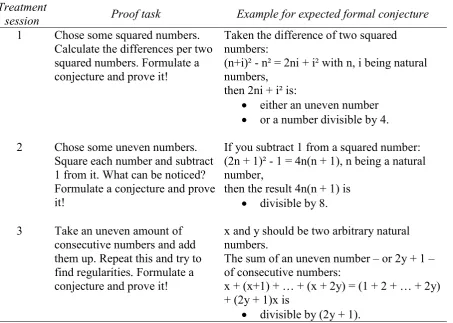
[image:39.595.76.519.75.289.2]Table 1
Proof task and the formal conjectures the learners worked with collaboratively in the three treatment sessions.
Treatment
session Proof task Example for expected formal conjecture
1 Chose some squared numbers. Calculate the differences per two squared numbers. Formulate a conjecture and prove it!
Taken the difference of two squared numbers:
(n+i)² - n² = 2ni + i² with n, i being natural numbers,
then 2ni + i² is:
either an uneven number
or a number divisible by 4.
2 Chose some uneven numbers. Square each number and subtract 1 from it. What can be noticed? Formulate a conjecture and prove it!
If you subtract 1 from a squared number: (2n + 1)² - 1 = 4n(n + 1), n being a natural number,
then the result 4n(n + 1) is
divisible by 8.
3 Take an uneven amount of consecutive numbers and add them up. Repeat this and try to find regularities. Formulate a conjecture and prove it!
x and y should be two arbitrary natural numbers.
The sum of an uneven number – or 2y + 1 – of consecutive numbers:
x + (x+1) + … + (x + 2y) = (1 + 2 + … + 2y) + (2y + 1)x is
Table 2
Descriptions and examples for constructive activities, dialogic transactivity, dialectic
transactivity and the rest category during the collaborative learning process in the context of mathematical proof tasks.
Description Examples ICCunjust
Constructive activities
Contributions that elaborate on the content relevant to the given task but do not directly take the learning partner’s contribution into account.
“My first idea is to write down all calculated results into a table” “My conjecture is that all
numbers must be divisible by 3”
.80
Dialogic transactivity
Contributions that are taking the learning partner’s contribution into account either
by using the same structure (e.g., calculating using the same formula as the learning partner), or
or by building on the content of the learning partner’s contribution (e.g., extending the learning partner’s ideas),
but without critiquing or integrating opposing positions.
“… a further pro for your claim is that displaying a table is more comprehensive” (extending the learning partner’s contribution with own ideas but without criticizing or integrating opposing positions)
“… 9 – 4 = 5” (calculating the differences of squared numbers by using the learning partner’s results of 3² = 9 and 2² = 4)
.68
Dialectic transactivity
Critiquing: Comments that tackle the approach to solve the problem or the solution itself and contain counterargumentation and/or criticism directly referring to the learning partner’s contribution or
Integrating: Comments that integrate previous contributions with at least one contribution made by the learning partner
“… but your description of the problem space is less helpful because…”
“…2 + 3 = 5” (opposing that the sum of two consecutive numbers is always even)
“…the summary of the pros and cons we made is…”
”Taking your criticism into account we could agree on distinguishing between cases when the numbers are even and uneven”
.92
Rest
Off-topic contributions that are not clearly related to the task
“…blubblk…”
“The weather is nice today.”
Table 3
Summary of stepwise regression analysis with pre-test disposition to use argumentation skills, heuristic worked examples and collaboration script, as predictors for students’ post-test disposition to use argumentation skills.
B SEB β p
Step 1
Constant 1.58 0.18 .001
Pre-test disposition to use argumentation
skills 0.40 0.09 .41
.001 Step 2
Constant 1.26 0.20 .001
Pre-test disposition to use argumentation
skills 0.38 0.09 .39
.001 Heuristic worked examples 0.69 0.22 .28 .002 Step 3
Constant 0.99 0.24 .001
Pre-test disposition to use argumentation
skills 0.42 0.09 .43 .001
Heuristic worked examples 0.67 0.21 .27 .002
Collaboration script 0.46 0.22 .19 .037
Table 4
Mean and standard deviation (in parentheses) for the amount of individual use of different collaborative learning processes per condition.
without script with script
without heuristic worked example
M (SD)
with heuristic worked example
M (SD)
without heuristic worked example
M (SD)
with heuristic worked example
M (SD) constructive
activities 6.27 (4.89) 11.93 (4.02) 11.64 (4.23) 12.39 (7.97) dialogic
transactivity 8.00 (5.85) 6.44 (4.72) 10.86 (5.69) 7.69 (6.99) dialectic
Table 5
Excerpt from the learning process in the condition with heuristic worked examples and collaboration script.
Learner Excerpt Categorization
Lisa [...] Jana first draws the squared numbers which she subtracts from each other as circles to investigate them more precisely.
She suspects: if the distance of the two numbers is odd, then the result is also odd and if the distance is even, then [the result] is also even
Constructive activity
Partner and how many circles does she draw? Dialogic transactivity Lisa for example 9 circles for 3 squared Dialogic transactivity Partner ah, yes and if she then subtracts 3 squared then she
eliminates 3 circles no 9
[…]
Dialogic transactivity
Lisa good :) Constructive activity
what speaks pro Jana’s approach [drawing circles] speaks that she tries to illustrate the task in order to simplify it
Partner but, in my opinion are circles not suitable for illustration because they are very cumbersome and complex for larger numbers
in my proposal a better method is used to illustrate the problem
Janka uses a table which looks like that
Dialectic transactivity
she then enters the results into the table this method is also suitable for relatively large numbers
Lisa right
I think it would be good to use the circle-method for small numbers
and for larger numbers the table
by this procedure the task would be illustrated
Dialectic transactivity
Table 6
Excerpt from the learning process in the condition with heuristic worked examples and without collaboration script.
Learner Excerpt Categorization
Partner
[…]
She first tries to note some examples and then she tries to find commonalities and discrepancies within the calculated examples. Finally, she packs two approaches in so-called numbers-squares and finds her result after observations of these squares.
Constructive activity
Sebi Janka first makes some exemplifying calculations. In her examples she finds that odd numbers and even numbers result in an odd number. Only even
numbers result in an even number. Then she makes a table from 6^2 to 6^2 and can see that the distance between the numbers which are squared and then subtracted is crucial for the resulting number (odd or even). For an odd distance the resulting number is also odd, otherwise it is not.
Advantage (approach with the table): The table helps through a large pool of resulting numbers --> can easily recognize commonalities
Disadvantage (approach with the table: a large amount of calculations
Constructive activity
Partner Advantage: Drawing is clearly arranged, easily understandable and one can see the commonalities within the squares
Constructive activity