i
Applying Intelligence Amplification in
Decision Making
Luyao Liu
Master Thesis
Business information technology
Faculty of Electrical Engineering, Mathematics and Computer Science
Applying Intelligence Amplification in
Decision Making
Master Thesis
Author
Luyao LiuStudy Business Information Technology
Faculty of Electrical Engineering, Mathematics and Computer Science University of Twente, Enschede, The Netherlands
Student Number s15103702
Email [email protected]
Graduation Committee
PROF. DR. Maria-Eugenia IacobDepartment Email
Industrial Engineering and Business Information Systems University of Twente, Enschede, The Netherlands
DR. IR. Marten van Sinderen
Department Email
Computer Science
University of Twente, Enschede, The Netherlands [email protected]
Andrej Dobrkovic
Department Email
Industrial Engineering and Business Information Systems University of Twente, Enschede, The Netherlands
Acknowledgements
This thesis is the result of the final research project for my master study Business Information Technology at the University of Twente. The last six months have been an inspiring journey in the research area of Intelligence Amplification and Synchromodality which were totally new topics to me at first. During this project, I have learned a lot about the promising value of human-machine collaboration in the future technology development. I really appreciate the help and supports I received to finish my thesis.
Firstly, I would like to thank Andrej Dobrkovic for making this research topic possible and always being patient to supervise me. The weekly meetings and his supports are pivotal to guide me in the right direction and finish the research on time. The weekly discussions and his critical feedback always inspired me new ideas and helped me improve my research. Many thanks also go to my supervisors Maria-Eugenia Iacob and Marten van Sinderen. I really appreciate all the feedback, valuable insights and guidance they offered to me. Without their timely supports, I couldn’t conduct and complete a scientific research.
Special thanks to all the participants who joined the testing. Thank you a lot for taking time to play the serious game. Because of their inputs, I was able to collect important findings and carry out the validation.
Finally, I would like to thank my beloved family and friends for their endless supports and encouragement. It is their care and supports that accompany me to get through my master study.
For now, I hope you will enjoy reading this thesis as much as I enjoyed completing it.
i
Abstract
This thesis explores the application value of intelligence amplification in decision making. The intelligence amplification (IA) highlights humans’ central role in solving a problem. Instead of replacing humans with automation, IA amplifies humans’ intelligence of solving a problem. IA emphasizes the strengths of humans and intelligent agents to overcome their respective limitations through the collaborative effort. In IA system, humans, as a guide, direct and supervise intelligent agents, while intelligent agents, as an assistant, aid humans to complete tasks efficiently and effectively
To apply IA in decision making, this thesis proposes an intelligence amplification (IA) framework. The IA framework introduces six steps of implementing IA in decision making: 1) analysis of decision making process, 2) identification of collaborative tasks, 3) task decomposition, 4) task assignation, 5) design of intelligent agents and 6) implementation. With this IA framework, IA is applied to solve planning problems of synchromodal transport in the simulated environment. Through testing the usefulness of the designed intelligent agents that are built to cooperate with decision makers, the results validate the appropriateness of the task assignment instructed by the proposed IA model. It further helps to validate the practical applicability of the designed IA model in introducing IA to decision making.
The test results show that the collaborative effort of humans and intelligent agents makes a better decision on planning transportation activities than either humans or intelligent agents working alone. The results further indicate the potential practical value of IA in improving decision making on a real business case as well as amplifying decision makers’ capability and performance of making decisions.
ii
Contents
Abstract ... i
List of Figures ... iv
List of Tables ... v
1. Introduction ... 1
1.1. Research background ... 1
1.2. Intelligence amplification ... 1
1.3. Research goal ... 2
1.4. Research questions ... 2
1.5. Research method ... 3
1.6. Thesis structure ... 3
2. Literature review ... 4
2.1. Intelligence Amplification (IA): A literature review ... 4
2.1.1. Literature search and selection process ... 4
2.1.2. IA: the role of human in the IA system ... 6
2.1.3. IA: the relationship between humans and intelligent agents ... 7
2.1.4. IA: what IA is used for, and what benefits can it bring to ... 10
2.1.5. IA: framework / framework mentioned for application ... 13
2.2. Decision making: a literature review ... 14
2.2.1. Literature search and selection process ... 14
2.2.2. Decision making: decision making process ... 16
2.2.3. Decision making: methods or tools are used in decision making ... 17
2.2.4. Decision making: the IA concept in decision making ... 18
2.3. Conclusion ... 19
3. IA framework ... 20
3.1. Problem identification and Motivation... 20
3.2. Objective ... 20
3.3. Design and development ... 20
3.3.1. General decision making process... 23
4. Case study ... 28
4.1. Problem statement ... 28
4.2. Serious game ... 29
4.3. Decision making process ... 31
4.4. Tasks assignment ... 32
4.5. Intelligent agent ... 35
iii
4.6.1. Performance indicators and weight ... 39
4.6.2. Normalization ... 39
5. Results ... 44
5.1. Urgent order identifier ... 44
5.2. Auto assigner ... 45
5.3. Predictor... 48
5.4. Final testing ... 52
5.5. Implication of results ... 55
6. Conclusion ... 57
6.1. Answers to the research question ... 57
6.1.1. Problem background investigation ... 57
6.1.2. Design of the IA framework ... 57
6.1.3. Validation ... 58
6.2. Research Contributions ... 59
6.3. Limitations... 59
6.4. Future research ... 60
References ... 61
iv
List of Figures
Figure 1 IA Literature selection process ... 5
Figure 2 Attributes of an IA problem ... 12
Figure 3 Decision making literature selection process ... 15
Figure 4 Decision making process ... 17
Figure 5 Design Cycle ... 20
Figure 6 IA Framework ... 21
Figure 7 Decision making process ... 22
Figure 8 Knowledge acquisition ... 23
Figure 9 Problem Identification sub-processes... 24
Figure 10 Task assignment ... 25
Figure 11 Activities of humans and intelligent agents in decision making process ... 26
Figure 12 Generate alternatives ... 27
Figure 13 Serious game SynchroMania ... 30
Figure 14 SynchroMania transport planning decision making process ... 32
Figure 15 Task decomposing of generating transport planning ... 33
Figure 16 Task decomposition of optimize transport planning ... 34
Figure 17 Task decomposition of evaluation ... 35
Figure 18 Distribution of cost dataset ... 40
Figure 19 Distribution of % TEU shipped ... 41
Figure 20 Distribution of CO2/TEU ... 41
Figure 21 Distribution of average satisfaction level ... 42
Figure 22 Urgent order identifier ... 44
Figure 23 Results of Urgent order identifier ... 45
Figure 24 Auto assigner ... 46
Figure 25 Automation arrangement ... 47
Figure 26 Results of Auto assigner ... 47
Figure 27 Advanced Ben Barge order1 ... 49
Figure 28 Advanced Ben Barge order2 ... 49
Figure 29 Advanced Ben Barge order3 ... 50
Figure 30 Predictor ... 50
Figure 31 Inverse process of prediction ... 51
Figure 32 Compariosn results of final testing ... 52
Figure 33 The changes of individual performances in the final testing ... 53
v
List of Tables
Table 1 Search query ... 5
Table 2 IA literature review ... 6
Table 3 Literature results of the IA relationship between humans and intelligent agents ... 8
Table 4 The strengths and limitations of humans and intelligent agents ... 9
Table 5 Examples of IA’s benefits and applications ... 11
Table 6 Decision making literature review ... 15
Table 7 Top level tasks ... 24
Table 8 Transporting routes and costs ... 31
Table 9 Connection between intelligent agent's functionalities and tasks ... 38
Table 10 Performance indicators ... 39
Table 11 Normalization of Cost ... 40
Table 12 Normalization of %TEU shipped ... 41
Table 13 Normalization of CO2/TEU ... 42
Table 14 Normalization of average satisfaction level ... 43
1
1.
Introduction
1.1. Research background
The capabilities of computers in calculating, data-processing, information storage and retrieval keep improving, which enables computers to outperform humans in majority of routine operations (Danson et al., 2015). For the last 50 years, computer scientists conducted research in the domain of Artificial Intelligence with the intention of creating computers and software capable of intelligent behavior. These intelligent agents are designed to act autonomously and exhibit human-like intelligence. But computers are designed primarily to solve pre-formulated problems based on available data according to predetermined procedures (Licklider, 1960). It is nearly impossible to foresee all problems in advance. However, there are other aspects like goals, business semantics, cultural idiosyncrasies, and sparks of creativity, that are difficult to be codified into machine language (Danson et al., 2015).
Entering the era of Big Data, the sheer volume and variety of data keep expanding due to the prevailing use of personal devices, the increasing numbers of open platforms and the vast variety of network systems. The more data we integrate from various sources and formats, the less effective data mining can be (Sankar, 2012). The massive unbounded data increases the complexity and difficulty of analytics, which could result in financial and intellectual frustration, confusion and exhaustion (Danson et al., 2015). Hence, even the advanced techniques can be distracting for decision making and will not give insights to people if these technologies are not properly applied.
1.2. Intelligence amplification
Hereby, it is time to reevaluate an alternative vision “instead of replacing human, computers collaboratively work with humans to amplify humans’ intelligence of making effective decisions”, which is Intelligence Amplification (IA).
2
determining criteria, performing evaluation, and handling uncertainties. However, humans’ capabilities are limited in coping with issues at scale, computation and volume. Hence in terms of efficiency, humans need computer to aid with the formulated and real-time thinking. Licklider (1960) suggests that computers do all the routine work to prepare humans for the insights to make a decision.
One of IA’s traits is that IA amplifies humans’ intelligence in dealing with complex issues. Specifically, IA allows humans to focus on a broader context while allowing technology to address standard rules that can be codified and executed autonomously. According to Sankar (2012), the potential application areas of IA will be extensive with data analytical applications. The medical community can identify the virus structure with the help of computer, and diagnose cancer by accessing as many patients medical record as possible. The intelligence community can inspect global calls, texts, and emails to identify possible terrorists or credit risk decisions. Police department can integrate and analyze data from multiple locals, states, and federal sources to conduct the crime analyst, resolving crime in real time. Farmers can use the data collected by their equipment, from almost every foot of each planting row, to increase crop yields. Risk and fraud detection, preventative maintenance, and productivity in supply chain are also viable candidates for applying IA (Danson et al., 2015).
Hereby there are great possibilities for IA to become critical for the competitive success in business. In the business world, decision making is a vital part as decision exists in all activities and functions of a business. The correct and appropriate decisions ensure the success of that business. However, it is not always easy to make the right decision because of uncertainties, the uniqueness nature of a problem, diverse goals, various stakeholders, and the lack of relevant information (McBurney, n.d.). Therefore, it is meaningful for this thesis to study whether and how IA can improve decision making to make a business competitive and successful.
1.3. Research goal
The goal of this thesis is to evaluate IA’s practical value in improving decision making. In order to achieve this research goal, this thesis needs to find out an approach to implement IA.
The approach of applying IA into decision making in this thesis focuses on the business operations of decision making process. Business goals and requirements vary from organization to organization. Each business requires a variety of activities and methods to support the business requirements. In the meantime, each business scenario demands multiple data velocity, structure, and analytics complexity. Thus, the solution in this project aims to introduce a reference framework that guides IA practical application in decision making.
1.4. Research questions
The main research question of this thesis is:
How to apply intelligence amplification in decision making?
This question is divided into the following underlining questions, which need to be answered in order to provide an answer to the main research question:
3
a. What is the current state of the art in scientific literature concerning the use of IA?
b. What is the current state of the art in scientific literature on decision making? 2. What kind of IA framework is best suited for decision making?
a. What kind of IA model/framework are available?
b. What constructs should be included in the designed IA framework? c. What relationships between constructs should exist in the designed IA
framework?
3. What are the advantages and disadvantages of applying the IA framework? a. How to apply the IA framework in simulated environment?
b. What effects are produced by applying the IA framework in simulated environment?
c. Do the effects prove that IA offers superior insights to decision making? d. To which extent is the IA framework applicable for a real case on different
business areas and projects?
1.5. Research method
The design science research methodology (DSRM) (Peffers et al., 2007) is used to guide this thesis. There are three phases in this thesis: problem investigation, design and validation. The first step is to define the research problem and justify the value of a solution, followed by defining the objectives of the solution (Peffers et al., 2007). The problem will be further investigated by the literature review. To conduct a thorough and structured literature review, the method of Webster and Watson (2002) is applied as the guide, together with the five-stage grounded theory method proposed by Wolfswinkel et al. (2013) for rigorously reviewing literature.
Then the artifact is designed to improve the problem context and satisfy the design requirements (Peffers et al., 2007). The artifact in this thesis is a framework that introduces the IA concept in decision making process.
Next is to validate the artifact in the problem context. The validation first needs to demonstrate how to use the designed framework to solve a problem. In this thesis, the validation method is a case study. Since the real-life context is complex and has many external influencing factors, the proposed IA framework will be validated in the simulated environment, a serious game about transport planning. The serious game allows to conduct testing in a simplified real-life context so that the validation of the application effects of the proposed IA framework can be completed effectively and efficiently.
Evaluation follows to measure how well the framework supports IA’s application in decision making. In the end, this thesis communicates and discusses the results of validation, the artifact effectiveness, and the future improvement.
1.6. Thesis structure
4
2.
Literature review
This chapter provides a background on Intelligence Amplification (IA) and decision making, based on a systematic review of previous literature.
To conduct a thorough and structured literature review, this thesis uses the method of Webster and Watson (2002) as a guide, together with the five-stage grounded theory method proposed by Wolfswinkel et al. (2013) for rigorously reviewing literature. First step is to formulate questions that need to be answered through the literature review. Then a forward search is conducted with introducing the search query and selection process. Next, a short literature overview is presented. In the end, a Backward Search is conducted on the selected articles to get sufficient knowledge from the studied literature.
The search engine is SciVerse Scopus. The Scopus supports many search specification options and searches quickly through the world’s largest database of title, abstract, and author information of leading scientific articles. Google Scholar is used to search for full text of the selected articles.
2.1. Intelligence Amplification (IA): A literature review
In this section, the IA concept is investigated. First, the overview of literature search and selection process is presented. In the second part, the role of human in IA system is discussed, followed by the description of relationship between humans and intelligent agents. Then the application of IA is discussed and finally the frameworks/frameworks of applying IA are introduced.
2.1.1. Literature search and selection process
Based on the research goals and the research questions, it is necessary to find out what has been studied about the intelligence amplification (IA) by answering the following knowledge questions.
1. What is the role of human in IA system?
2. What is the relationship between humans and intelligent agents? 3. What is the application of IA? What are the benefits of applying IA? 4. What kind of model / framework is mentioned for application?
This thesis uses the concept of “intelligent agent” to represent a class of the autonomous intelligent agents (like computer and software) that are able to pursue goals, perceive their environment, react on the environment, learn from other agents, and update its knowledge base. (Mills and Stufflebeam, n.d.)
There hasn’t been a uniform definition of the IA concept and researchers haven’t reached a consensus about its values in practical applications. In order to get enough related and useful articles, the literature search uses more than one query. Table 1 shows the search query as entered in the website of Scopus.Com in November, 2015 and the search results of each query. The asterisk sign (*) helps to include all results for multiple worlds defining the same or similar words. So the search term ’*man’, includes both ‘man’ and ‘human’, and the search term ‘augment*’ includes ‘augment’, ‘augmenting’ and ‘augmented’.
5
[image:14.595.187.409.483.737.2]The subject areas are limited to ‘computer science’, ‘social science’, ‘decision science’, and ‘business management and accounting’.
Table 1 Search query
Search query Search results
TITLE-ABS-KEY("intelligence amplification") 14 TITLE-ABS-KEY ( "amplified intelligence" ) 5 TITLE-ABS-KEY ( "intelligence augmentation" ) 20 TITLE-ABS-KEY ( "augment* intelligence" ) 15 TITLE-ABS-KEY ( "*man computer symbiosis" ) 29 TITLE-ABS-KEY ( "*man machine symbiosis") 39 TITLE-ABS-KEY ( "*man machine collaboration" ) AND (
TO ( SUBJAREA , "COMP" ) OR TO ( SUBJAREA , "SOCI" ) OR
LIMIT-TO ( SUBJAREA , "DECI" ) OR LIMIT-LIMIT-TO ( SUBJAREA , "BUSI" ) )
79
TITLE-ABS-KEY ( "*man computer collaboration" ) 73 TITLE-ABS-KEY ( "*man computer cooperation" ) 69 TITLE-ABS-KEY ( "*man machine cooperation" ) AND ( LIMIT-TO
( SUBJAREA , "COMP" ) OR LIMIT-TO ( SUBJAREA , "SOCI" ) OR LIMIT-TO ( SUBJAREA , "DECI" ) OR LIMIT-TO ( SUBJAREA , "BUSI" ) )
150
Summary 493
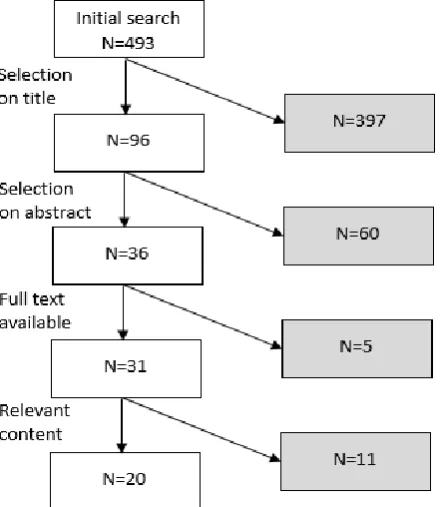
The initial search resulted in 493 results. Figure 1 illustrates the selection process of the relevant articles. In the first phase, articles were selected by the relevance of the title. In the second phase, articles were selected based on the abstract. Then, this thesis filtered out the articles that aren’t accessed to retrieve the full text. The final papers were selected according to the relevance of the content.
6
[image:15.595.29.573.118.526.2]Table 2 provides the overview about which literature addresses which knowledge questions. Table 2 IA literature review
Role of human
Relationship between humans and intelligent agents
The application of IA and the
benefits
Framework / framework
1 Ahmed and Hasan, 2014 p321 p320-325 p322
2 Arsene et al.,2015 p1827 p1827-P1833
3 Brangier and Adele, 2011 p14-15 & p20
4 Casini et al., 2015 p200 & p205 p200-201 p200-202
5 Garcia, 2010 p338 p338-339 p339-344
6 Cummings, 2014 p62-68 p63-68
7 Griffith and Greitzer, 2007 p42 p43-49 p43
8 Jacucci et al., 2014 p5-13 p11-13
9 Kondo et al., 2010 p471-474 p472-474 p471 & p482 p474-p479
10 Lange et al., 2014 p97-98
11 Lesh et al., 2004 p1290-1294
12 Ramchurn et al., 2015 p8 & p22-23 p1-4
13 Reda et al, 2013 P1-6 p4-6
14 Roy, 2004 p121-122 p123
15 Stumpf et al., 2009 p1-2 p22
16 Sun and Cai, 2011 p1
17 Tan et al., 2009 p152 & p154 p153-155
18 Williams et al., 2014 p4690 p4690-4692 p4695
19 Woolley and Stanley, 2014 p1 & p3 p1 & p8
20 Xia and Maes, 2013 p2 p2-5 p2-3
2.1.2. IA: the role of human in the IA system
7
The fully automated processing without humans’ intervention is error prone (Casini et al., 2015). In Casini et al (2015) research, humans’ involvement dramatically increased the system’s accuracy by preventing the error propagation. The results of Stumpf et al (2009) study also indicate the benefits of humans working hand-in-hand with intelligent agents. Woolley and Stanley (2014) demonstrate that humans’ insights significantly reduce problem’s complexity and enable to find solutions faster than the fully-automated process.
In general, the above researches mention the benefits of involving humans in resolving complex and dynamic problems, in comparison to the full automation. But, the aim of these researches to involve humans is to help overcome the limitations of automation. They didn’t pay attention to how humans’ capabilities are influenced. Concerning the IA concept, this thesis, not only requires humans’ involvement but more importantly highlights the human’s central role in solving problems.
2.1.3. IA: the relationship between humans and intelligent agents
Licklider’s vision of IA is the man-computer symbiosis. Brangier and Adele (2011) identify four types of the human-technology symbiosis: extension, evolution, action, and
Co-dependence. They regard symbiosis as an interdependent relationship between two entities
that both benefit from cohabitation. They further present technosymbiosis to describe the relationship that technologies assist the involved human to improve the degree of efficiency and quality. Xia and Maes (2013) believe that the system and the user can learn from each other to achieve co-evolution. Griffith and Greitzer (2007) view the symbiosis as the symbiotic interaction between humans and the information. Jacucci et al. (2014) summarize the interdependence between humans and machines as: telepresence, affective computing,
persuasive technology, mixed initiative interaction, and symbiosis. Symbiosis magnifies
human abilities through the reciprocity of computer and humans.
There are also researches discussing the relationship between humans and intelligent agents in terms of different tasks.
Ahmed and Hasan (2014) implement the “Human – Agent Teamwork” concept in their detection system where humans supervise the autonomous agent. If the user is unable or not interested to control the agent, the agent has ability to take decisions based on predefined rules and priorities. If the decision made by the agent does not satisfy the user, the user can make changes to minimize the error rate. For Kondo et al. (2010), the relationship between the user and the recognition system is collaborative and mutually beneficial. The recognition system provides the user with his/her expected supports and in return, the function of recognition system is enhanced by the user’s involvement. Tan et al. (2009) classify the human-machine cooperation into four types: independent operation, synchronized
cooperation, simultaneous cooperation, and assisted cooperation.
According to Garcia (2010), the intelligent agents provide useful complement to humans’ problem solving abilities by expanding their knowledge base. Williams et al. (2014) also hold a complementary viewpoint to cooperatively fuse the efforts of humans and computers. The ways they introduce to leverage humans and automated algorithms for improving object recognition are: 1. humans aid automated algorithms via the active feedbacks; 2. automated
algorithms aid humans through saving resources (time and human effort), offering the rough estimates and providing the complementary information. The automated algorithms benefit
8
et al (2015) develop a similar form of humans’ intervention in an asynchronous way: a) systems ask feedbacks from the operator; b) the random inspection by the operator; c) the operator chooses to inspect drill-down. Both the human operator and machines mutually provide active assistances in a close and continuous interaction to improve the entire system’s performance (Casini et al., 2015).
Based on the above literature review, the relationship of humans and intelligent agents in the IA system can be summarized as collaborative, interdependent, mutually beneficial and complementary. Table 3 reflects the results of the literature review concerning the relationship.
Table 3 Literature results of the IA relationship between humans and intelligent agents
Collaborative Interdependent Mutually Beneficial
Complementary
Brangier and Adele (2011)
Xia and Maes (2013)
Griffith and Greitzer (2007)
Jacucci et al. (2014)
Ahmed and Hasan (2014)
Kondo et al. (2010)
Garcia (2010)
Williams et al. (2014)
Casini et al (2015)
In Table 3, most of researches mention that humans and intelligent agents complement each other in the IA system. That is, IA combines the strengths of humans and intelligent agents to overcome their respective limitations through the collaborative effort.
9
Table 4 The strengths and limitations of humans and intelligent agents
Attributes Human Intelligent agents
Speed (Cummings, 2014) (Casini et al., 2015)
Comparatively slow Superior Calculation accuracy
(Cummings, 2014) (Casini et al., 2015)
Comparatively weak Superior
Information capacity & Memory (Cummings, 2014) (Griffith and Greitzer 2007) (Garcia, 2010)
Limited in single channel to gain information. Good at making principles and strategies
Superior in searching, retrieving, processing and integrating large volumes of data from multichannel, and tracking & updating status of tasks Reasoning (Cummings,
2014) (Griffith and Greitzer 2007)
Inductive & Deductive reasoning Deductive reasoning
Handling uncertainty (Griffith and Greitzer 2007)
Superior in anomaly detection / recognition and adaptability to change
Weak, depends on formal and restricted pre-program setting. Analysis (Cummings,
2014) (Griffith and Greitzer 2007) (Casini et al., 2015)
Better at judgement, problem identification, contextual evaluation, pattern recognition, nuanced assessment
Good at the quantitative assessment and results presentation
Creativity (Griffith and Greitzer 2007)
Superior in innovation and creative insights
Comparatively weak, good at advising on alternatives
The collaboration of human – agent combines humans’ flexibility and intelligent agents’ efficiency to address the complex requirements (Tan et al., 2009). Intelligent agents perform efficiently in identifying task status, suggesting alternatives, monitoring, processing information, and testing hypotheses (Griffith and Greitzer, 2007). Humans’ performance will be augmented through these effective functions without losing control, which attributes to the intelligent agent’s ability to implicitly detect the human goals. In decision making process, Garcia (2010) explains that autonomous agents are important in dealing with tremendous amounts of information, systematically exploring a variety ranges of alternative choices, checking the decision’s consistency with norms, and detecting changes. While, humans play a fundamental role to creatively think of solutions and visually perceive patterns. Levels of automation help to understand how humans can interact with a complex system in decision making (Cummings, 2014) (Roy, 2004).
However, instead of thinking about which tasks are performed by humans and which by automation, Casini et al. (2015) suggest to think about how tasks can be best shared by humans and intelligent agents working cooperatively, and how competencies of humans and intelligent agents can be enhanced through an appropriate form of mutual interaction. When there is a risk of overload, humans should know clearly and concentrate on the most critical tasks that they are superior to automation in addressing, while the automation takes charge of making other less “human-critical” decisions (Lange et al., 2014).
10
2.1.4. IA: what IA is used for, and what benefits can it bring to
There are researches using the “human-computer collaboration” concept to address complicated tasks successfully.
Williams et al. (2014) present strategies to cooperatively employ the skills of human operators and the automated computer algorithms in the task of underwater object recognition. From the experimental results of a real mine search, they demonstrate that fusing the skills of humans and computers significantly improves the performance which is beyond when humans and computers working alone, due to diversity of views and available complementary information. Kondo et al. (2010) also introduce the “human-computer collaboration” concept to improve the accuracy of object recognition.
In the medical area, Arsene et al. (2015) use the idea of collaborating specialists with software to achieve the knowledge sharing among all specialists and to increase the diagnosis accuracy. Garcia (2010) also suggests to apply IA in the fault diagnosis. In the study of Ahmed and Hasan (2014), the teamwork of an agent and a human gives a better performance to detect the cancer. Their results show that the early detection of breast cancer becomes fruitful and effective, and the decisions become more accurate because of humans’ creativity and the agent’s intelligent.
Reda et al. (2013) adopt a human-computer collaborative analysis that lets a human analyst and a computer to work together to accurately identify the movement of terrestrial insects. The computer semi-automatically processes the video visual segment and tracks insects, while the human analyst makes judgements, interprets insects’ behaviors, and gives corrective interventions in an ambiguous situation to improve the tracking precision.
Garcia (2010) and Ramchurn et al. (2015) evaluate the human-agent collaboration in an uncertain environment, the dynamic disaster response. Their results present that the planning agent augments humans’ performance by providing useful instructions and taking into account the human capabilities and preferences. In the process of path planning, Sun and Cai (2011) integrate humans’ perception, knowledge and experience with the computer’s power and accuracy of computing to reduce the complexity of reality conditions and meet the real-time requirements.
The examples showed in literature take advantage of the collaboration of humans and computers, but don’t realize this benefit belongs to the IA concept. And most focus on the improvement of the entire system’s performance in completing tasks, without specifically studying the amplification effects of humans’ intelligence. As concluded in Section 2.1.2, humans play a crucial role in IA system, thus there is a need to study whether humans’ activities and capabilities are amplified by IA.
From literature, we can indicate that IA not only helps to improve the entire system’s performance of completing tasks, but also magnifies humans’ performance along various cognitive and physical dimensions (Roy, 2004). The Media Lab introduces the potential ‘10x’ human performance, for instances: extend human’s physical abilities; access to large stores
11
humans’ understanding of problems from a variety of contexts, and form more creative insights by the support of computers.
For Garcia (2010), IA amplifies humans’ capability of making better decisions in choosing alternatives of goal oriented tasks. Humans benefit greatly from the knowledge manipulation and extraction as well as from the systematic examination of the ranges of alternatives. Jacucci et al. (2014) believe that the collective symbiotic system is a prospective theme. Amplifying humans’ capabilities of searching can be achieved not only by chaining users to accumulate all the users’ knowledge and discoveries, but also by combining a human with the automated search (Woolley and Stanley, 2014). In Woolley and Stanley’s approach, the rate and quality of searching is accelerated by leveraging humans’ knowledge without burdening the user with the responsibility of evaluating all the candidates, much of which was automated by the novelty search.
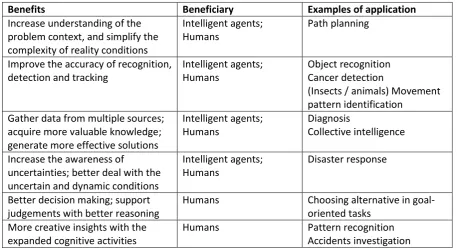
[image:20.595.70.528.336.586.2]As mentioned in Section 2.1.3, IA is a mutual beneficial relationship that both humans and intelligent agents can benefit from. Table 5 depicts examples of IA’s mutual benefits and applications in the literature.
Table 5 Examples of IA’s benefits and applications
Benefits Beneficiary Examples of application
Increase understanding of the problem context, and simplify the complexity of reality conditions
Intelligent agents; Humans
Path planning
Improve the accuracy of recognition, detection and tracking
Intelligent agents; Humans
Object recognition Cancer detection
(Insects / animals) Movement pattern identification
Gather data from multiple sources; acquire more valuable knowledge; generate more effective solutions
Intelligent agents; Humans
Diagnosis
Collective intelligence Increase the awareness of
uncertainties; better deal with the uncertain and dynamic conditions
Intelligent agents; Humans
Disaster response
Better decision making; support judgements with better reasoning
Humans Choosing alternative in goal-oriented tasks
More creative insights with the expanded cognitive activities
Humans Pattern recognition
Accidents investigation
12
Figure 2 Attributes of an IA problem
1. High need of humans’ cognitive capability
When the problem or situation is vague and ambiguous, humans’ interpretation, judgement and corrective intervention are critical to understand problem and recognize the goal of resolution. Especially, when the problem is unique and needs to consider multiple factors or criteria at the same time, a nature of an IA problem has been found that multiple objectives cannot easily be combined into one single objective (Riddell and Wallace, 2011). Due to the lack of the understanding of problem context, the complete automation is faced with the risk of acquiring inappropriate knowledge, conducting wrong procedures and pursuing wrong goals. In this case, humans play a crucial role in reducing problem’s complexity and defining goals by their cognitive capabilities. Besides, humans can direct and supervise intelligent agents, as a guide, to find solutions faster and effectively accomplish tasks. Moreover, humans can pour their innovative and creative insights to achieve an optimal solution. 2. High requirement of efficiency
Most of complex tasks need to integrate vast volumes of heterogeneous data to generate more alternatives for an optimized solution, which requires computer aided resolution. As illustrated in Table 4, intelligent agents are superior in processing large volumes and variety of data in terms of speed, information capacity and memory. Besides, in most of time, the problem with many variables and constraints requires to be solved within the limited amount of time. Automation can address the routine work with complex requirements by its efficient functions to save time and efforts. Hence, humans need the intelligent agent, as an assistant, to fulfill tasks efficiently and effectively.
3. High degree of uncertainty
There is a highly frequent occurrence of uncertainties or unexpected circumstances. Coping with uncertainties needs real-time adjustments to the dynamic changes of environmental conditions and affecting variables. It is known that automation is inherently brittle in unanticipated events because automation can only account for the quantifiable variables identified beforehand. In the contrary, humans are superior in making intuitive decisions by detecting and assessing both quantifiable and qualitative information. Humans’ flexibility and cognitive abilities can simplify the complexity of problem and enable to make a rapid response to unforeseen and uncertain situations. Thus, under a high uncertain circumstance, the decision-making loop needs humans to provide flexibility and creativity in problem solving.
An IA
Problem
High
cognition
High
efficiency
13
In a word, when it is necessary to combine automation’s efficiency with humans’ flexibility and originality to address complex, ambiguous and uncertain problems in real time, it may be a potential area that IA can contribute to.
2.1.5. IA: framework / framework mentioned for application
There are some studies explaining their ways of introducing the human-machine collaboration to solve practical problems. Kondo et al. (2010) propose a loop-back framework of collaborative recognition by using user’s feedback to improve unfavorable situations. Ahmed and Hasan (2014) build an agent learning mechanism to include humans’ inputs through a human-agent teamwork. Tan et al. (2009) believe that the task frame working approach is a good way to enhance the human-machine collaboration through defining goals, roles, and task activities. Reda et al. (2013) present a human-computer collaborative workflow with a human-guided video processing method to acquire and analyze insects’ behaviors.
There are also some researches discussing the requirements of a good human-intelligent agent collaboration. Casini et al. (2015) regard observability & directability and predictability
& learning as the bases of a successful and resilient human-machine teamwork. The
observability enhances humans’ ability to understand and evaluate the situation, while the directability helps humans to implement their goals. Stumpf et al. (2009) conclude three components of humans’ interaction in an intelligent system: 1) the intelligent system should
explain its reasoning to humans, 2) humans should reason their adjustments and critiques, 3) make use of humans’ feedbacks to benefit the system and ultimately benefit the human. Lesh
et al. (2004) argue that the true symbiosis requires to achieve three elements: a
complementary and effective division of labor between human and computer; an explicit representation in the computer of the user’s abilities, intentions, and beliefs; and the utilization of nonverbal communication modalities.
Most of above studies involve humans’ tacit knowledge by making using of humans’ inputs or feedback as a way to achieve the collaboration of humans and intelligent agents in solving problems. Only Garcia (2010) presents the AGUIA (Agents’ Guidance for human Intelligence Amplification) framework for IA. The AGUIA has two basic constructs: 1) the agents that use knowledge to enhance users’ understanding of problems and help users explore alternatives to find a better solution; and 2) the agents that collect knowledge in the context of the problem resolution for updating the knowledge base. Therefore, there is a lack of applicable framework for implementing IA.
14
On the other hand, we still need to be aware of the potential challenges of implementing IA. The challenges and effects can be: 1) the adversarial effects caused by humans’ intervention (Casini et al., 2015) (Xia and Maes, 2013), 2) the increasing burden of humans (Williams et al., 2014), 3) the inappropriate interaction design (Ramchurn et al., 2015) (Roy, 2004), 4) the complexity of humans’ nature (Tan et al., 2009), 5) humans’ biased reasoning (Garcia, 2010), 6) humans becoming dependent on intelligent agents (Xia and Maes, 2013) and 7) ethical questions (Xia and Maes, 2013).
The design process for implementing IA either starts with a human approach that improves humans’ performance with the decision support technologies, or starts with an automated approach that enhances automation results with humans’ inputs (Casini et al., 2015). To develop an IA system that integrates humans and intelligent agents, we should first analyze the entire system as a whole and then answer the questions about where, when and which level that humans and automation should be in the decision-making loop (Cummings, 2014). Defining roles and assigning tasks of humans and intelligent agents are critical in successfully designing an effective collaboration architecture. The design process will be further introduced in Section 3.
2.2. Decision making: a literature review
In this section, the concept of decision making is investigated. After the overview of search and selection processes, the concept of decision making process is discussed. Then the methods and tools used in decision making are introduced. In the end, this thesis explores whether IA is valuable to be applied in decision making.
2.2.1. Literature search and selection process
The below knowledge questions need to be answered, in order to gain insights from academic literature.
1. What are the processes of decision making?
2. What methods and tools are used in decision making? 3. Is the IA concept needed in decision making?
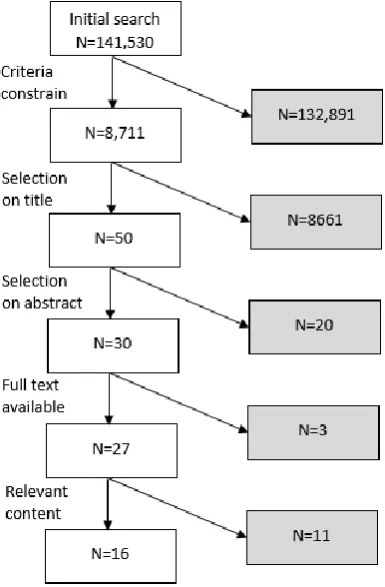
This thesis focuses on decision making process, thus the keyword of query is ‘decision making process’. The search resulted in 141,530 results. To narrow down the number of search results, the following criteria were used:
1. The research involves the methods or technology to study decision making process 2. Papers are published between 2010-2015
3. Search is limited to subject areas ‘computer science’, ‘decision science’, and ‘business management and accounting’
The search query as entered in Scopus.com in November, 2015 is:
( KEY ( decision making process ) AND ( KEY ( method ) OR TITLE-ABS-KEY ( technology ) ) ) AND PUBYEAR > 2009 AND ( LIMIT-TO ( SUBJAREA , "COMP" ) OR LIMIT-TO ( SUBJAREA , "BUSI" ) OR LIMIT-TO ( SUBJAREA , "DECI" ) )
15
abstract. Then, this thesis filtered out unavailable articles. In the end, 16 articles were selected in terms of the relevance of the full content. Figure 3 presents the selection process.
[image:24.595.203.396.113.407.2]Figure 3 Decision making literature selection process
During the review process, I also used the Backwards Search in order to gain sufficient knowledge on the studied literature. Table 6 provides an overview on which articles give an answer to which search questions. There are two articles that indirectly address the research questions, thus, Table 6 shows 14 articles instead of 16.
Table 6 Decision making literature review
Decision making process Method/tool IA in decision making
1 Akhouayri et al., 2012 p167 & p171
2 Andrade et al., 2006 p179-180 p179
3 Antunes et al., 2014 p276 p272
4 Draghici et al., 2013 p65
5 Elmegreen et al., 2014 p944 p945 p944 & p948
6 Guillemette et al., 2014 p619 p618
7 Moreno-Jiménez et al., 2012 p1922 p1923 p1921
8 Negoita et al., 2013 p4-5
9 Nutt, 2008 p425-427 & p446-447 10 Pkirs.utep.edu, 2007 P1
11 Roberto, 2004 p625-628, p639 & p653
12 Saaty, 2008 p85
13 Umassd.edu, 2015 p1
16
2.2.2. Decision making: decision making process
Decision making means taking actions to make choices that produce outcomes with the immediate and downstream effects (Nutt, 2008). Decision makers make decisions by following the process that consists of tactical steps. These steps facilitate individuals to find out what to do and to reason their actions. The efficient decision making means that the process executes smoothly and decision makers select a course of actions in a timely manner. The effective decision making is that the selected course of actions meet the objectives established during the decision process (Roberto, 2004). The key factors influencing decision making have been: the context of decision making environment, the content of decision, the
action-taking procedures to make a decision, and the relationships among the previous factors
(Nutt, 2008). Negoita et al. (2013) also conclude the factors shaped decision making which are the nature of issue, solution types, politics, and individual factors.
The quality of a decision depends on the performance of decision making process that offers insights into the sequence and nature of actions about how to make a decision (Guillemette et al., 2014). Simon develops a three-stage framework of decision making: intelligence, design,
and choice(Pkirs.utep.edu, 2007). The intelligence phase identifies the problem and gathers information concerning the problem. The design phase develops possible solutions for the problem. Finally, the choice phase evaluates all alternatives and selects a final solution. Some researchers studied decision making based on Simon’s framework. Guillemette et al. (2014) evaluate the performance of decision making process based on Simon’s framework. Antunes et al. (2014) extend the Simon’s framework to four phases: Intelligence, Design, Choice and
Implementation & Evaluation. Negoita et al. (2013) also identify decision making process into
three phases. They explain that the decision process begins with the identification phase when the key objectives and direction are identified. Then the development phase follows to analyze related solutions. Through evaluating the criteria and priorities, during the selection
phase, decision makers select the best alternative solution. Elmegreen et al. (2014) present
decision making in three steps too: 1) acquire information about the consequences of possible actions, 2) evaluate alternative actions with defined weights, and 3) make judgements about choosing which action.
Some researchers define decision making process in more detail. In Nutt’s (2008) research, the steps of decision making are: intelligent gathering, direction setting, option development,
evaluation, and reactive implementation. The ELECTRE method proposed by Draghici et al.
(2013) defines the main decision making process as: problem statement, decision criteria
hierarchy establishment, mathematical framework definition, optimal solution result, and optimal solution implementation. According to Umassd.edu (2015), decision making is the
process of selecting alternatives by setting goals, collecting information, and assessing alternative values. There are seven steps to make an effective decision: 1. Identify the decision,
2. Gather relevant information, 3. Identify alternatives, 4. Weight evidence, 5. Choose among alternatives, 6. Take action, 7. Review decision and consequences.
17
Then, the Selection phase follows to assess all alternatives and select a final solution. Finally, the selected solution need to be implemented in the Implementation & Evaluation phase so that we can evaluate the results of implementation and further decide whether to redevelop or make a new decision.
Figure 4 Decision making process
2.2.3. Decision making: methods or tools are used in decision making
Two methods are often employed in decision making for selecting anappropriate resolution of complex problems.
The analytic hierarchy process (AHP) is an extensively used multi-criteria decision making (MCDM) approach (Moreno-Jiménez, 2012). AHP is a theory that measures pairwise comparisons and relies on the judgements of experts to determine the priority scales. AHP analyzes the problem within a hierarchy structure of decision making process, from the top (objectives) through the intermediate level (criteria and sub-criteria), and on to the lowest level (alternatives). With the AHP method, the decision is made in four steps: 1. Define the
problem and information collection, 2. Structure the decision hierarchy, 3. Construct a set of pairwise comparison matrices, 4. Weigh the priorities. (Saaty, 2008)
Another method is the Fuzzy logic theory. Fuzzy logic deals with the reasoning of partial truth where the truth value ranges between completely true and completely false (Akhouayri, 2012). According to Andrade et al (2006), Fuzzy logic is a convenient approach for decision making as this method incorporates linguistic statements into formal frameworking. Hence, the expert opinions and subjective information can be combined with the theoretical knowledge by Fuzzy logic, which ensures a rational decision making when handling complex and dynamic problems. The Fuzzy rule to classify inputs is based on IF-THEN rule:
IF variable IS adjective THEN class
Information technology (IT) has been applied as a useful tool to support decision making (Guillemette et al., 2014). For examples, Visual analytics tools support decisions by boosting humans better insights (Zhong et al., 2016), ERP Systems provide individual workers with great supports in evaluating alternatives (Guillemette et al., 2014), Executive Information System plays an important role in gathering data for decision making (Guillemette et al., 2014), as well as the various decision making support systems (DSS) etc. During decision making process, we need information to guide our decisions and actions towards the desired goal. Antunes (2014) explains how DSS supports decision making through processing and sharing information: (1) information extraction and selection; (2) information integration; (3)
information extension, exploration and explanation; (4) information interpretation, event detection, and prediction; (5) information tracking and post-event analysis; (6) frameworks presentation; (7) sharing decisions. Elmegreen et al. (2014) demonstrate that the computer
simulation supports decision making by rapidly creating, merging, searching, displaying and analyzing data from various resources. Zhong et al. (2016) mention that the visual
Decision Identification
Solutions
Identification Selection
18
technologies help decision making by (1) synthesizing information and deriving insights from
massive, dynamic, ambiguous and conflicting data; (2) detecting the expected and discovering the unexpected; (3) providing timely, defensible and understandable assessments; and (4) effectively communicating assessment for actions.
In conclusion, the AHP method and the Fuzzy logic theory assist decision makers in the Selection phase to make a choice among alternatives. The IT tools support decision making mainly through extracting, diffusing, and visualizing relevant knowledge of the problem resolutions to decision makers. On the other hand, the effective supports provided by IT tools also indicate the benefits to involve intelligent agent(s) into decision making.
2.2.4. Decision making: the IA concept in decision making
As one of humans’ fundamental cognitive characteristics, decision making emphasizes the human’s vital role in decision making process (Moreno-Jiménez et al., 2012). Moreno-Jiménez et al. (2012) highlight the importance of human factors in acquiring knowledge during decision making, such as humans’ education and their continuous learning abilities. Zhong et al. (2016) mention that the tacit knowledge is essential to create insights of an optimal decision. The tacit knowledge is derived from personal experiences which is difficult to be codified into a program. Andrade et al. (2006) also state that embodying humans’ tacit knowledge and reasoning into decision making improves the business intelligence and helps achieve the strategic goals more effectively. Hereby, this thesis can state that there is a need to take into account humans’ tacit knowledge, mental capabilities and creativity in decision making process.
Section 2.2.3 indicates the benefits of IT tools’ support in assisting decision makers to achieve efficient operations, such as information searching, scenario analyses, and hypothesis testing. Particularly when the decision requires to be made within limited time and there is a need to handle unstructured and enormous amounts of data from various sources, intelligent agents can efficiently and effectively aid humans to make a decision in a short time.
Each step of decision making is a challenging task for either humans or machines to successfully and smoothly complete, for instance, the task of weighing alternatives (Elmegreen et al., 2014). The complexity of business problems in reality increases the difficulty to make a proper and right decision due to real-time requirements, the uniqueness of problem, lack of relevant information, diverse goals, various stakeholders as well as the high occurrence rate of uncertainties. Elmegreen et al. (2014) argue that it is inability to make a single best decision by either a human or a computer. Humans may disagree or be confused with the outcomes that are automatically made by automation. They suggest that computers aid humans in decision making by providing humans with more valuable information to augment their existing knowledge, and humans are involved in the decision making loop considering the broad context and making the final decision.
Thereby, from the above literature review, the necessity of collaborating humans with intelligent agents to make better decisions can be easily identified. In other words, the findings from literature indicate that decision making is a potential research area to study IA’s application.
19
the IA research on humans’ cognitive activity tends to be more oriented towards attention and perception process, and less towards decision making and thinking (Griffith and Greitzer, 2007). Hereby, the research value of this thesis is to prove IA’s practical value in decision making.
2.3. Conclusion
This thesis aims to evaluate IA’s benefits and values in practical application. In IA system, humans play a central role in problem resolution and IA augments humans’ intelligence of solving a problem. Humans, as a guide, direct and supervise intelligent agents, while intelligent agents, as an assistant, aid humans to fulfill tasks efficiently and effectively. IA emphasizes the strengths of humans and intelligent agents to overcome their respective limitations through the collaborative effort. Hereby in IA system, humans and intelligent agents have a collaborative, mutually beneficial and complementary relationship. Due to this relationship, IA improves the entire system’s performance of problem solving.
There are many researches taking advantage of the collaborative effort of humans and computers without realizing the IA concept. Besides, most of them focus on the benefits in overcoming the limitation of automation and improving the performance of entire system in completing tasks. Few specifically study IA’s amplification effects of humans’ intelligence. Thus, the thesis contributes to explore IA’s benefits and study whether humans’ capabilities and performance are amplified by IA.
In order to evaluate IA’s benefits, there is a need to find ways to apply IA in problem solving. Since IA is in its infancy, the current state of art is lack of the applicable framework for implementing IA. This finding indicates the importance of designing an approach on how to accomplish this task. Thus the goal of solution is to develop a framework that provides instructions of IA implementation.
In terms of achieving IA, it is necessary to effectively explore the collaborative effort of utilizing the best of humans and intelligent agents. As IA amplifies the system as a whole, we can firstly think about the desired state of completing tasks, instead of considering humans or intelligent agents separately. Then we analyze and frame the whole aggregated process to meet this desired state. During the process analysis, the task assignment can be settled according to the nature of specific tasks.
20
3.
IA framework
This chapter applies the design science research methodology (DSRM) (Peffers et al., 2007) to develop an IA framework. The design activities are based on the design cycle, namely, problem investigation, treatment design, and treatment validation (Wieringa, 2014). Figure 5 describes the six activities of DSRM in the design cycle.
Figure 5 Design Cycle
3.1. Problem identification and Motivation
As discussed in the previous literature review, decision making is a good candidate to study IA’s benefits in practical application. However, the research into the field of IA has been less towards decision making. Since there is an increasing desire to have the collaboration of humans and intelligent agents in decision making process, the problem context of this thesis has been chosen in the decision making area. Considering decision making’s business value, this thesis explores: 1) how IA influences decision making and 2) whether humans can benefit from the amplification of decision making.
In order to prove IA’s value in improving decision making, there is a need to find a way to introduce IA to decision making. Thus the problem of this thesis is about how to apply IA in decision making.
3.2. Objective
The objective of the solution is to develop a framework that gives instructions to apply IA in decision making process. Such a framework should explore the collaborative effort of utilizing the best of humans and intelligent agents, and represent where, when and which level of decision making process that humans and intelligent agents should be in. In other word, the designed framework should solve the task assignment problem. In terms of achieving IA, the framework should also help to decide and design the functionalities of intelligent agents based on the allocated tasks.
3.3. Design and development
21
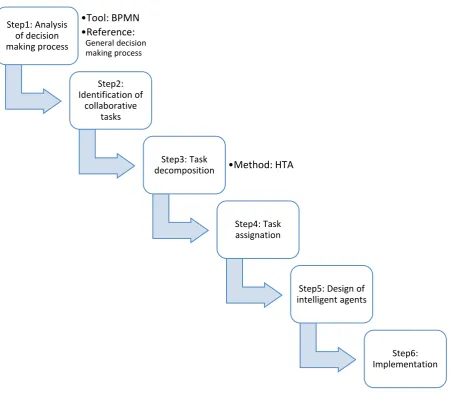
[image:30.595.76.528.121.522.2]the steps of implementing IA in decision making. Figure 6 presents the framework proposed by this thesis.
Figure 6 IA Framework
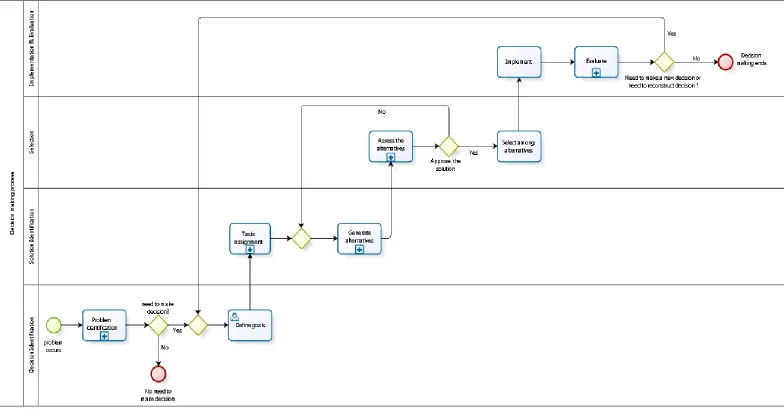
The first step of applying IA is to analyze decision making process based on a specific case. The tool to model decision making process is the Business Process Modeling Notation (BPMN). The general decision making process is explained in Figure 7. Each certain case can base on this general decision making process to build its own specific process. In the first step, the main activities of making a decision can be classified to three types of tasks: automation task, human task as well as the collaborative task on the basis of the nature of tasks. Figure 11 indicates the potential collaborative tasks in the activities of decision making. The collaborative tasks need to be further decomposed to sub tasks that can be assigned to one entity, either humans or intelligent agent. The method of task decomposition is the hierarchical task analysis (HTA). Then, according to the result of task assignment, the functionalities of intelligent agents can be defined. The built intelligent agents are implemented to work with decision makers so that we can evaluate the effects of collaboration.
Step1: Analysis of decision making process
•Tool: BPMN •Reference:
General decision making process
Step2: Identification of
collaborative tasks
Step3: Task
decomposition •Method: HTA
Step4: Task assignation
Step5: Design of intelligent agents
22
23
3.3.1. General decision making process
Figure 7 describes the steps of decision making process. This general introduction of each decision making phase helps to better figure out where, when and which level that decision makers and intelligent agents should be in decision making process, and facilitate the understanding of what tasks of decision making should be assigned to humans and intelligent agents.
Knowledge Base
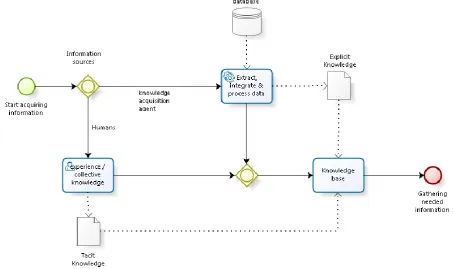
[image:32.595.69.523.400.669.2]The whole decision making process requires a knowledge base that gathers the needed information to better understand the problem, generate alternatives, select and evaluate the best solution in the given context. The knowledge may be either in the form of explicit knowledge that is available in norms, standards and regulations, or tacit knowledge in the decision maker’s minds, experiences and common sense (Garcia, 2010). Moreover, the knowledge evolves with time and circumstances thus it needs to be updated accordingly. According to Table 4, the intelligent agent is superior to humans in handling enormous volumes of heterogeneous information. Along with the ability to learn from other agents, the intelligent agent is able to interact with humans and integrates humans’ tacit knowledge to update its knowledge based. As humans are limited in dealing with complex situations due to the difficulties in perceiving context and exploring the range of alternatives, there is a need to have a knowledge acquisition agent that elicits knowledge in the context of problem resolutions to augment humans’ intelligence during decision making process. Figure 8 explains the process to acquire knowledge.
Figure 8 Knowledge acquisition
Decision Identification phase
Decision making process is triggered by the occurrence of problem in the Decision
Identification phase. The problem should be identified and understood before deciding
24
to always keep aware of variants and frequently track updates in a constant changing world. Thus, this thesis lets the intelligent agent to perceive changes and continuously maintain humans’ awareness of the problem occurrence. The knowledge acquisition agent at that time provides humans with the information related to the problem context in order to help humans better understand the problem and, in the meantime, to avoid humans’ misconceptions and biases (Garcia, 2010). Most of times, problems are novel and anomaly that need humans’ reasoning to frame the information gathered from the knowledge
acquisition agent for the sake of a comprehensive and right understanding of the context (See
Figure 9). After figuring out the problem, if the decision maker recognizes the need to find a solution of the problem, in the next step, they define the goals of resolution to guide the following generation, selection and evaluation processes. If the decision maker thinks there is no need to make a decision or can wait to consider the problem in the future, then the process comes to an end.
Figure 9 Problem Identification sub-processes
Solution Identification phase
The Solution Identification phase starts with assigning tasks to intelligent agents and humans to accomplish the goal defined in the Decision Identification phase. Figure 11 reflects that the task assignment is done by an intelligent agent while in the beginning the intelligent agent requires humans to define the rules of task allocation. Task analysis is a scientific approach to framework tasks by defining goals and activities (Tan et al, 2009). This thesis adopts the hierarchical task analysis (HTA) method to decompose the tasks in the generating, selecting and evaluating processes into hierarchies of sub tasks. Table 7 identifies the top level tasks that need to be divided into sub tasks regarding to a specific problem. The further task decomposition will be introduced in the next chapter based on a case study.
Table 7 Top level tasks
Decision making process
Solution
identification phase
Selection phase Implementation & evaluation
Task 1. Generate
alternatives
2. Assess alternatives 3. Evaluation
25
The skill-based task can be accomplished by sensory-motor actions that require very little or no conscious control to perform once the intention is formed (Cummings, 2014). Automation is superior in skill-based tasks because such tasks have a clear feedback loop to identify the differences between a desired outcome and the actual result. The rule-based tasks are highly rehearsed by rules, routines, or procedures to select a course of action (Cummings, 2014). Intelligent agents with optimization algorithms work primarily at the rule-based level. However, when faced with uncertainties, automation may not store the relevant information or doesn’t include variables that impact the final solution. In this case, humans’ high level cognition is required to decide the criteria and weight of an optimal solution. Hereby, the rule-based tasks need the collaboration of humans and automation to create a better solution. The humans’ power of induction is critical in the knowledge-based and expertise tasks. Humans’ judgement and intuition are essential to deal with the situations where the goal is ambiguous, uncertainty is high and mathematically optimal solutions are unavailable. The induction of humans is difficult for computer programming to replicate, especially the true expertise. Considering efficiency, humans can make use of the intelligent agents’ advantages in speed, calculation accuracy, memory and information processing capacity to complete the knowledge-based tasks.
Therefore, tasks can be done by automation, human alone or their collaboration. The collaborative tasks can be further decomposed into sub-tasks that are assigned to and finished by a specific agent, either humans or intelligent agents.
Figure 10 Task assignment
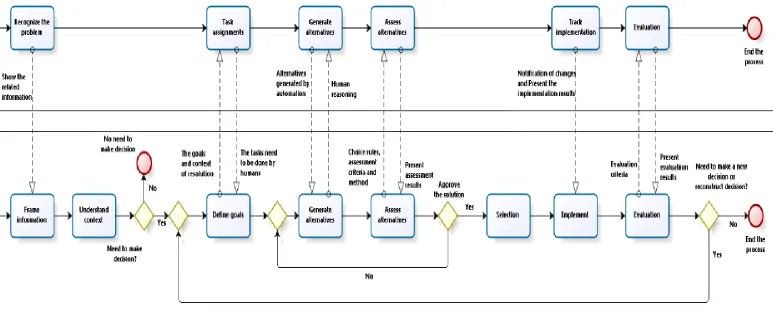
This thesis also modeled the activities of humans and intelligent agents and their relationships in decision making process by BPMN (See Figure 11). Figure 11 clearly presents which task is assigned to which entity, humans or intelligent agents. Also, Figure 11 helps to identify which tasks are accomplished by a human-intelligent agent collaborative work, which are Generate
alternatives, Assess alternatives, and Evaluation. These three collaborative tasks are also the
26