1
Reconstructing the EU Discourse on
Migration: A Cosmopolitan Perspective
Bachelor Thesis
Abstract
This paper aims to analyse the ideological position in political speeches of the European
Commission towards the migrant and the refugee within the context of the ongoing ‘refugee crisis’ in Europe. As a consequence of the recent influx of migrants in Europe and following
chaotic events, the unknown and unfamiliar forms a sort of risk and unease, in our human
nature, for the peoples of Europe and the leaders of the Member States alike. For that
reason, leaders of the Member States can take advantage of that fact and exploit those fears
and anxieties of their audience for the purpose of their, often nationalist and populist,
agendas. Accordingly, the question arises whether the Commission’s ideological position
nourishes that sort of exploitation, or expresses a rather cosmopolitan attitude towards
migrants that puts their audience’s fears at ease instead of fuelling them. The latter was
found as was expected while answering the main research question of this paper, which is
To what extent is the migrant, in the European Commission speeches within the context of the ‘refugee crisis’ in the time frame of 2014 until 2016, being addressed in accordance with cosmopolitan values?
Keywords: Refugee; Migration; Cosmopolitanism; European Commission; Crisis-labelling
By: Abraham Naous
University of Twente
October 10, 2016
Supervisors:
2
Contents
1. Introduction
2. Concepts of Addressing Migrants
2.1. The Discourse of Cosmopolitanism
2.2. Four Cosmopolitan Ways of Addressing Migrants
2.2.1. The First Form of Migrants: The Refugee
2.2.2. The Second Form of Migrants: The Irregular Migrant
2.2.3. The Third Form of Migrants: The Economic Migrant
2.2.4. The Fourth Form of Migrants: The EU Citizen – the Migrant in Intra-EU
‘Mobility’
2.3. Concluding Remarks
3. Methodology
3.1. Methods of Data Collection
3.2. Methods of Content Analysis
3.3. Concluding remarks
4. Findings (Data Analysis)
4.1. Cosmopolitan Addressing of the Refugee
4.2. Cosmopolitan Addressing of the Irregular Migrant
4.3. Cosmopolitan Addressing of the Economic Migrant
4.4. Cosmopolitan Addressing of the EU Citizen – the Migrant within Intra-EU
‘Mobility’
4.5. Concluding Remarks
5. Conclusion
6. Appendices
3
4
1. Introduction
The recent ‘migration crisis’, caused by an influx of refugees in Europe “pushed by the rule of arbitrary violence” and conflict in the Middle East “to abandon their homes (Bauman, 2016, p. 6)”, has ignited a discourse on issues surrounding addressing the migrant (Bauman,
2016; Thym, 2016; Morris, 2015) and refugee. Bauman (2016) argues and provides insight
on how politicians have exploited fears and anxieties that have become widespread for the
purpose of their own, often nationalist, agendas. Anything that is unknown and unfamiliar
creates a sort of risk and unease for the people, including politicians of Member States, and
that is in our human nature. Politicians can take advantage of that fact vis-à-vis
crisis-labelling as well to cultivate their own agenda, especially with the rising populism (Bauman,
2016), which can include points of building [metaphorical] walls and closing borders
(Bauman, 2016; Long, 2014). This thought, introduced by the status quo of academic
literature, is the driving force and main reason that led me to question whether
Commissioners, under the Jean-Claude Juncker leadership, are also doing the same in their
speeches in terms of exploiting the fears of their audience, or rather the opposite; the sort of
opposite that can be referred to as cosmopolitan (Nussbaum, 1997; Skrbis & Woodward,
2013). The migration crisis, therefore, serves as an excellent case to find out whether
cosmopolitanism indeed plays a role, and the extent to which cosmopolitan values hold.
Furthermore, concerning the refugee, Lavenex (2001), in her paper about the
Europeanization of refugee policies and its implication on refugees, emphasizes the fact that
“much of the European integration literature has tended to focus on [...] the tension between state sovereignty and supranational governance”, which is a “more vertical dimension of
levels of governance, whereas the process of Europeanization also consists of a more
substantive dimension which concerns the contents of governance”, such as the “tension between internal security considerations and human rights issues (p. 852).” In this paper, the
focus will be on the latter. The social relevance this research has to offer is based on the
benefits of cosmopolitanism or (potentially) institutionalising cosmopolitanism (Dower, 2010),
since many scholars argue, including Nussbaum (1997) and Beck (2007), that
cosmopolitanism can potentially reduce the growing global discord and hence solve some of
the fundamental problems and crises in the world (Naseem & Hyslop-Margison, 2006; Skrbis
& Woodward, 2013), notwithstanding the critique of cosmopolitanism by several others
(Dower, 2010). Starting with the fact that the EU is an established entity and a recognized
global actor (in spite of its many weaknesses and blend of ongoing crises (Beck and Grande,
2007)), academics look up to the EU with [cosmopolitan] expectations or guarantees
5 After having the main issues, and what can be built on the state-of-the-art academic
literature, identified, the main research question is therefore, articulately, as follows:
To what extent is the migrant, in the European Commission speeches within the context of the ‘refugee crisis’ in the time frame of 2014 until 2016, being addressed in accordance with cosmopolitan values?
After proposing the main research question, which is a descriptive one, it has been decided
that qualitative content analysis (Babbie, 2013; Norris, 2003) is the most appropriate
research design in this type of research for answering it. Similar research designs and
issues have been found through a review of the state-of-the-art of the body of scholarship. In
terms of scientific relevance, the paper ‘Position Taking in European Parliament Speeches’
by Proksch and Slapin (2010) is a part of the most recent research done vis-à-vis conducting
content analysis as a research design on analysing ideological positions in political
speeches. The authors used a new computer-based technique called Wordfish to analyse
content of speeches from the European Parliament. “The technique uses an explicit
parametric model of word counts and simply scales the word counts to reduce the data to a
single dimension (Proksch and Slapin, 2010, p. 594).” Whereas, the research design of
content analysis used in this paper is specifically called conceptual content analysis (Carley,
1990), in which not only the appearance of words is coded but also phrases of text or even
paragraphs and their relationship with actors and concerns, which requires a degree of
interpretation to identify concepts or categories present in the speeches during the coding
process (Busch & Paul, 2013; Popping, 2000; Cheng, et al., 2008). Moreover, Proksch and
Slapin (2010) argue that “the Wordfish algorithm is not the only computer based content analysis technique that can be applied to study ideology in political text (p. 595).” The aim of
this paper, therefore, is to build on the existing body of scholarship by analysing speeches
from the Commission to find out whether, and to what extent, Commissioners express
cosmopolitan ideological positions in addressing the migrant and the refugee.
According to Van Dijk (2011), “[...] an anti-immigration stance may not only be based on a racist ideology [...] but also on a nationalist or xenophobic ideology that aims to defend ‘our’
nation (and its language, custom, and culture) against the arrival and large-scale settlement
of any strangers (pp. 380-381).” The EU is not a nation state, in the first place, to be having
a nationalist ideology and it is also well known from its mission and values that it seeks to
break down the borders and not the opposite; however, it is also argued that “political groups like the EU are not borderless, but establish their own ‘fortress’ for their own members.
Cosmopolitanism seeks to sack the fortress (Ossewaarde, 2007, p. 382).” Accordingly, the
6 borders externally. Therefore, questions arise on how open the EU is to the ‘outside’. Thus,
in that sense the EU, although it has an anti-nationalistic identity, fits well within the criteria
for questioning whether and to what extent it endorses cosmopolitanism – and most
precisely in relation to the refugee and migrant. However, this paper is about the European
Commission’s current attitude in its speeches towards refugees and other forms of migrants,
where the migration crisis is an excellent case, as mentioned earlier, for this research. A
cosmopolitan ideological position of the Commission may be under pressure from leaders of
Member States as a consequence of the recent chaotic events including terrorist attacks and
the influx of migrants, therefore another area of focus in this paper, as a follow-up
sub-question sub-question to the main research sub-question is centred on finding out whether the
Commission remains persistent in its ideological position promoting the spirit of
cosmopolitanism, or takes a somewhat non-cosmopolitan stance in its speeches towards
refugees and other migrants because of such pressures. Additionally, the speeches of the
Commission will be analysed for their consistency – in terms of consistency of occurrence of
[cosmopolitan] ideological features derived from the coding scheme (Chapter 3.2: Figure
3.1) – from one speech to the other, and the speeches consistency with the Commission’s
agenda on migration posted on the Commission’s website.
This paper will proceed as follows. The second chapter will provide a conceptual and a
theoretical framework, where the ways certain forms of migrant are being addressed by the
EU in academic literature will be explored, and chosen cosmopolitan theories will be
clarified, theorizing the research question. In the third chapter, the methods used for
answering the research question will be presented. The fourth chapter of this paper will point
out the findings (data analysis) of the content analysis on the speeches, where a
comprehensive data analysis will be carried out pointing out the observations on
[cosmopolitan] ideological positions in addressing the migrant, and the means by which the
observations can be interpreted. Finally, a concluding chapter will be in order to sum up the
findings, point out the limitations of this paper, and give an explicit answer to my research
7
2. Concepts of Addressing Migrants
This chapter explores four types of migrants, and those are the refugee, the irregular migrant
(European Commission, 2016), the economic migrant (Bauman, 2016), and EU citizens in
the context of intra-EU mobility (European Commission, 2016), and how those migrants are
being addressed and treated by the EU in academic literature. The reason specifically those
four types of migrant where chosen to be analysed is because those types are the most
addressed by the EU. This chapter starts with a section offering a theoretical framework
clarifying the term cosmopolitanism, and narrows down certain cosmopolitan theories that
are believed to be the most useful ones when put into practicenot only in theoretical terms
but also in political systems in the ‘real world’. The reason many other theories or
cosmopolitan visions will be left out of this paper is mainly because of their considerable
critique and also impracticalities in the ‘real world’. One example would be cosmopolitan
visions regarding world citizenship, for instance, where it is proven to be impractical or even
impossible with the absence of a world state. As Skrbis & Woodward (2013) put it:
“Philosophers and sociologists alike find it notoriously difficult not only to define the term but also to agree on just who befits the label ‘cosmopolitan’. We understand and are sympathetic to the definitional complexities around cosmopolitanism, but as sociologists we cannot accept that an agreement on the attributes of ‘cosmopolitan’ is so elusive that engagement becomes pointless (p. 2).”
Nonetheless, the first section of this chapter titled, ‘The Discourse of Cosmopolitanism’, will
narrow down certain values of cosmopolitanism an entity (potentially the European
Commission), adopting such an ideological position, would advocate. After the first section of
this chapter, follows four sections, titled: ‘The First Form of Migrants: The Refugee’, where I
will offer a brief background of how the refugee crisis is being handled and how the refugees
are being addressed and dealt with in the European Union; The Second Form of Migrants:
The ‘Irregular’ Migrant, as termed by the EU Commission; The Third Form of Migrants: The economic migrant, which illustrates how ‘gifted’ and highly skilled migrants, which include
expats, international students and tourists, are being addressed and treated in the EU, once
first admission (Visa) granted and before first admission; The Fourth Form of Migrants:
Intra-EU Migrant in the Context of ‘Mobility’, as termed by the Commission, within the Intra-EU’, where also the emergence of a ‘Cosmopolitan Europe’ will be explained by going through the
different forms and stages that contributed in the making of what Europe is today. This
section slightly drifts away into the vertical dimension of levels of governance, where it also
tackles topics of cultural significance of Europeanization and its relationship with
8 contents of governance (Lavenex, 2001). The purpose of this chapter is to form a
foundation, in means of what other scholars have found concerning addressing migrants, for
conducting the main research of this paper.
2.1. The Discourse of Cosmopolitanism
“What may have been a liberating ideology yesterday may be an oppressive one today. For instance, whereas classical liberalism was once an ideology that advocated individual freedom and motivated the struggle against feudalism, today it may be adhered to by those who are against the freedom of racial or ethnic Others who want to migrate to ‘our’ country (Van Dijk, 2011, p. 380).”
First of all, to shed light on the origins of the term cosmopolitanism, in simple words, it is an
ideology that denotes that all human beings belong to a single community, founded on a
shared morality (Nussbaum, 1997). The word cosmopolitan derives from the Greek word
kosmopolites, which is a formation from the word ‘cosmos’ and the word ‘citizen’, which
literally means citizen of the world or the globe, according to Britannica Encyclopedia.
However, for the purpose of the research of this paper, certain types of cosmopolitanism will
be conceptualised. This will enable us to construct a relationship between certain
cosmopolitan values and the ideological position of the Commission speeches later in this
paper. Delanty (2006) illustrates three types or dimensions of cosmopolitanism, namely,
moral, political and cultural cosmopolitanism, and provides a comprehensive theoretical
framework as he guides us through several theories and applications of cosmopolitanism.
The first type is termed moral cosmopolitanism, which is the dominant conception of
cosmopolitanism because of its strong emphasis on the universalism of the cosmopolitan
ethic or morality, where a person’s loyalty is given to the universal human community. Marta
Nussbaum works as a contemporary example of cosmopolitanism as a moral universalism.
As part of conceptualising the concept of cosmopolitanism, Nussbaum’s (1997) concept, Stoic cosmopolitanism, is about regarding “[...] our deliberations as, first and foremost,
deliberations about human problems of people in particular concrete situations, not
problems, growing out of a local or national identity that confines and limits our moral
aspirations (Nussbaum, 1997, p. 7).” Recognizing the fact that anyone could have been born
anywhere, cosmopolitanism is about not allowing differences of nationality or class or ethnic
membership or even gender to erect barriers between us and our fellow human beings.
Cosmopolitanism is about recognizing humanity wherever it occurs, and giving its primary
ingredients, reason and moral capacity, our utmost loyalty and respect. In this sense,
according to Dower (2010) “the cosmopolitan at least wishes to assess how well or badly
nation states, and the international system, deliver on the goals that the cosmopolitan
9 programs, more open and generous immigration and refugee policies, stronger measures to
deal with environmental problems, reductions in armaments together with the general
promotion of peace anywhere, concern about human rights violations elsewhere and
appropriate responses to them, and so on (p.13).” However, the main disadvantage of moral
or ethical cosmopolitanism is that, according to Delanty (2006), to this point it lacks a
nuanced sociological dimension and assumes a too strong universalistic sense of universal
humanity.
The second type is termed political cosmopolitanism:
“The revival of cosmopolitanism in recent times is due to the rise of an explicitly political conception of cosmopolitanism relating to citizenship and democracy. [...] Strong conceptions of cosmopolitanism can be found in notions of world polity as advocated by John Meyer or notions of cosmopolitan democracy as put forward by David Held and others. These approaches generally take globalization as the basis for a new conception of a transnational democracy beyond the nation-state. [...] There is also a firm commitment to universalism in these approaches [...].It is in reconciling the universalistic rights of the individual with the need to protect minorities that the cosmopolitan moment is most evident. In this context cosmopolitan citizenship is understood in terms of a cultural shift in collective identities to include the recognition of others. Such developments have arisen as a result of cultural pluralization arising from migration, ethnic multiculturalism, cultural diversity of all kinds and the growing demands for the recognition of different life choices (Delanty, 2006, pp. 29, 30).”
The third type, termed cultural cosmopolitanism, takes a largely strong form in current theory
where many social theorists have put effort to reconceptualise the notion of society in
regards to cosmopolitanism. There are several examples of cultural cosmopolitanism which
can be found in theories including, Manuel Castells’s conception of networks, Urry’s
alignment of cosmopolitanism based on the fact of mobilities, Latour’s notion of hybridity,
and the idea of modernity itself as plural, which is the predominant concept that has
extensive possibilities in relation to cosmopolitanism (Delanty, 2006). Delanty (2006) argues
that “from a wider historical sociology cosmopolitan possibilities are increasingly being noted in modernity itself in terms of the interaction of different modernities”:
10 In this logic, cosmopolitanism is seen in the recognition of the differences of the ‘Other’ in
plurality and living alongside the differences through acceptance rather than the formation of
a universal order. In the end, in simpler words, having communicative models of world
openness is the utmost broad conclusion of cultural cosmopolitanism (Delanty, 2006).
“The idea of a cosmopolitan Europe will be defended against the alternatives, which are a ‘national Europe’, that is a Europe of nations, on the one side and on the other, ‘global Europe’ where an internationalist EU-led Europe plays a major role in the world. A
cosmopolitan Europe [...] is a more accurate designation of the emerging form of
Europeanization as a mediated and emergent reality of the national and the global.
Underlying it is a dynamic of self-transformation (Delanty, 2005, p. 406).”
2.2. Four Cosmopolitan Ways of Addressing Migrants
2.2.1. The First Form of Migrants: The Refugee
The refugee is the migrant that possesses the right to asylum, and, in accordance with
universal principles and UN resolutions, which all countries must conform to, must never be
rejected or sent back to his unsafe country of origin where they fled from (Goldenziel, 2016).
Instead, the refugee must always be offered protection and life essentials by universal law
(Goldenziel, 2016). In this part, I will provide a brief background of the refugee crisis and
give a perspective of how EU and Member States are handling it. I will explain the
resettlement and relocation [of refugees] mechanisms as well and how they are embedded
in universal principles, as Suhrke (1998) puts it, it starts from the thought that helping
refugees is a mutually held moral duty and obligation under international law. The term
‘crisis’ will be briefly clarified along with its possible implications.
The European Commission constantly and persistently calls for collective action instead of
leaving it to the Member States (European Commission, 2016) and even, in some cases, to
third countries (i.e. Turkey) alone. This is shown evident though the resettlement and
relocation mechanisms within the EU for the current refugee crisis, which constitutes the
essence of collective action and responsibility sharing and can be associated with
cosmopolitanism. Suhrke (1998) introduces the concept of burden-sharing during refugee
emergencies and how it originated: “An early proposal for global sharing was promoted by
legal scholars in the late 1970s. The idea was to assign refugees worldwide by matching
refugee preferences with host countries ranked according to an index of wealth and
population density (Suhrke, 1998, p. 397)”. Later on, at the time of the 1997 Albanian crisis,
11 order to be prepared in case of a mass overflow of refugees. This mechanism does not only
serve as a burden reducer for some host-counties, but also better serves the people in need
of refuge; hypothetically speaking, it avoids the tendency for weaker and poorer states in the
South to restrict asylum if the richer states do not take their ‘fair share’ of refugees . “By
guaranteeing that a state will not alone face a refugee or migration emergency, the
insurance scheme is also a reasonable guarantee that the institution of asylum will be kept
intact since states are more likely to offer protection if they can share the burden (Suhrke,
1998, p.398).”
The EU is works on a stronger policy for identifying and sending third-country (non-EU
citizens) ‘irregular’ migrants (European Commission, 2016) back to their countries of origin,
with the notable exception of refugees and asylum seekers. Identifying irregular migrants is
an issue, sending them back is an issue, and processing asylum seekers for resettlement
and relocation among the Member States is another. Therefore, with the sudden overflow of
migrants seeking entry in European borders, the situation can pose quite a challenge, since
the EU is not a nation-state; it requires a lot of cooperation and reaching consensus between
the Member States and other endless matters. In this sense crisis-labelling might be
justified. However, Jeandesboz and Pallister-Wilkins (2014) assess and critique the purpose
behind crisis labelling by European “professionals of politics” during the recent Arab uprisings and the migration ‘crisis’ that followed. Jeandesboz and Pallister-Wilkins (2014) believe a migration ‘crisis’ has been invented or made-up so that certain adoption and
practice of emergency measures could be facilitated which could not have been made
possible before such labelling. In their article, they begin by defining crisis and what it does
as a category of practice. They further explain how having a ‘crisis’ can enable new patterns of action or justify the persistence of established ones. “[...] the framing of an issue in
security terms leads to its removal from the scope of normal politics and opens the possibility
for emergency or exceptional measures (Jeandesboz and Pallister-Wilkins, 2014, p.2)”.
Furthermore, they draw attention to how astonishingly crisis labelling shifted without doubt
from the “stability of autocratic allies in the war on terror and neoliberal expansion” into crisis labelling about migration “before even the first boat landed on Lampedusa”, which reveals
the constantly slack nature of crisis labelling. The issue of crisis-labelling is interesting and
can also be discussed whether it has an anti-cosmopolitan connotation or not, however, it
12 2.2.2. The Second Form of Mgrants: The Irregular Migrant
The term, irregular migrant, is used in the EU to describe migrants who migrate to the EU
but do not possess the right to asylum; such migrants come from countries that are marked
‘safe’ in the EU, and because they are not refugees, the EU’s policy towards them, like any
other sovereign state, is to send them back to their country of origin. The irregular migrant
can as well be related to Nail’s (2015) figures of migration, which include the nomad, the
barbarian, the vagabond, and the proletariat. According to Elizabeth Collett (2016, March),
from the Migration Policy Institute webpage, “EU law currently allows for returns under two
circumstances. First, individuals who do not apply or do not qualify for asylum are
considered “irregular migrants” and are eligible to be returned to Turkey [in the example of
the Turkey-Greece border] under an existing readmission agreement with Greece (pending
the implementation in June 2016 of a readmission agreement between the European Union
and Turkey). Second, individuals who submit asylum claims but are determined to have
arrived from a country where they had or could have claimed protection (a “safe third country” or “first country of asylum,” the EU criteria for which include the right
to nonrefoulement and the ability to both request and receive protection) are considered inadmissible to the European Union and eligible for return (Collett, 2016, March).” By this we
understand that even refugees, in practice, might not be allowed to enter the EU and as well
be returned as irregular migrants if they migrate straight from another ‘safe’ third country to the EU. In this case the EU is giving the responsibility to the refugee’s first country of asylum
by returning back to it to take care of them, instead of opening their doors. Such practices
and loopholes in universal law used by the EU, which are fit to be questioned, whether they
comply with the moral aspects of cosmopolitanism (Nussbaum, 1997) or not, will be briefly
compared later in this paper to what is being said in the Commission speeches.
2.2.3. The Third Form of Migrants: The Economic Migrant
The economic migrant (Bauman, 2016), is often given labels such as ‘expat’ in the media,
(for EU citizen economic migrants, given the term ‘labour migrants’ by the European
Commission), tourist and international student. First admission (Thym, 2016) or Visa, is
usually granted for such a migrant based on a certain criteria. For example, an international
student must first be admitted to an educational institution (i.e. University) in the foreign
country (destination) to which they had provided certain documents and diplomas to prove
their level of education, in order to be granted a Visa for the purpose of study. All forms of
economic migrants must as well prove they have sufficient means before being granted a
13 the foreign country where they graduated, and might as well be granted a permanent
residence permit or even citizenship for being highly skilled migrants. High-skilled non-EU
citizens can obtain The Blue Card, which is an approved EU-wide work permit and allows
them to live and work in any Member State that is subject to the proposal (European Union
Council Directive 2009/50/EC).
Moreover, Thym (2016) argues, as long as, for instance, first admission is concerned
(admission of third-country nationals to the EU by granting them a visa: no free entrance or
movement to third-country nationals) the cosmopolitan outlook invites European societies to
welcome long-term residents (migrants who had had first admission by visa procedures and
been given a residence permit to reside in the EU) as equal members with equal rights, and,
yet, it does not replace citizenship by universal personhood (Thym, 2016)
2.2.4. The Fourth Form of Migrants: The EU Citizen – the Migrant in Intra-EU ‘Mobility’
Nationals of the Member States of the EU are also European citizens. Thym (2016) gives an
example on the use of language, where the Commission prefers labelling intra-EU
movements as ‘mobility’ rather than ‘migration’, as a way of emphasising its ‘domestic’ character. Within intra-EU mobility, however, “even an unemployment rate of 25% would not
allow [Germany, for instance] to refuse the entry of EU workers; it is the individual right of
each [EU] citizen whether to seek employment in Bucharest or in Helsinki. Similarly, states
cannot require language skills. A Portuguese worker may spend his entire life in Marseille
without speaking a single word of French (Thym, 2016, p. 4).” “What happens when you
remove race, class, ethnicity, inequality, borders, barriers, and cultural disadvantage from
immigration? Answer: you get ‘free movers’ (Favell, 2009, p. 177).” Such EU migrants,
however, are still small in numbers. Studies show that nowadays around 1 in 50 Europeans
lives outside of their Member State of origin, which is much less than non-EU-citizen
immigrants. Favell (2009) continues to argue, “The ‘Eurostars’, [as he calls them according to the EU flag] are at the heart of the EU Commission’s efforts to build Europe through
dynamic mobility policies; the talk nowadays is not about moving coal miners and factory
workers [as it dates back to 1957] [...], the talk at heart [...], rather, is the movement of
professionals, the skilled and the educated (p. 178).” This also applies, in section 2.2.3 of
this chapter, to the economic non-EU-citizen migrant, where it is seen quite evident that first
admission (Visa) and long term residence permits are easily granted to high-skilled migrants
as well.
14 From the legal perspective, Thym (2016) presents examples on how ‘citizens’ and ‘foreigners’ are being treated in EU law, and to what extent migration law has a cosmopolitan outlook. “Europe’s domestic mobility regime is regularly referred to as a model in theoretical accounts of transnational or post-national citizenship (Thym, 2016, p. 1).” Thym (2016),
however, addresses what is missing in many studies, and that is the legal regime for people
without the nationality of an EU member state, with the notable exception of refugees. It is
known as a fact that the EU, like any nation-state’s immigration policy, seeks to send ‘irregular’ migrants, back to their countries of origin. Thym’s academic analysis contributes in his paper to the reconstruction of what ‘citizenship’ and ‘alienage’ mean in contemporary EU
law. He argues that third-country nationals (non-EU citizens) and migrant EU citizens have
something in common: they both live in a country of which they do not possess nationality.
The difference is that “every migrant has rights, but not all migrants are citizens (p. 16).”
Moreover, Thym (2016) forms a conclusion in his paper from his legal perspective,
concerning all forms of non-EU-citizen-migrants, that there is always room for “intermediate solutions, which may be conceptualised as the cosmopolitan outlook of EU migration law”, where it is neither about “full citizenship with equal rights nor alienage without legal protection (p. 16).” In this context, the EU reaches out beyond the boundaries of citizenry
and accepts all people, in their alienage, as moral persons with rights.
2.3. Concluding Remarks
Historically speaking, Europe now is a product of consequential migrations all through
history (Bauman, 2016). “Europe has been made, unmade, and remade through the
movements of peoples. [...] contemporary Europe has essentially emerged out of a crucible
of local, regional, and international population movements over the centuries. (Favell, 2009,
p. 167) The EU consists of nations of different cultures and identities. Increasingly with the
emergence of the EU, Ulrich Beck argues, according to Morris (2015), “[...] that transnational
forces are reshaping the nature of the nation state, blurring the boundaries between
migrants and citizens, and shifting the locus of legitimacy from the national to the
transnational level (p. 3).” In view of that, and as a follow-up to the discussion on modernity as plural brought by Delanty (2006) in the first section of this chapter, “European cultural and
political modernity was formed out of the interactions and mutual interpenetration of different
models of modernity, in particular the French and German, but also the British and later
American modernity. It may be suggested that in the present time European modernity is
undergoing a further cosmopolitan transformation arising from the encounter with the
non-European world, as a result of migration, multiculturalism, globalization (Delanty, 2006,
15 In this chapter, three types of cosmopolitan theory has been clarified, namely, moral/ethical,
political, and cultural cosmopolitanism, and four selected types of migrants in Europe have
been illustrated and shown through existing literature the extent they are being addressed in
a cosmopolitan manner by the EU. Additionally, this chapter drew attention to various
studies and literature on the extent to which the EU has a cosmopolitan outlook, which
included sociological, legal and political perspectives. It has been revealed in this chapter
the vicious circle, and that is how the migrant (in the broad sense of the term), has an impact
on the emergence of a Cosmopolitan Europe, and at the same time how Europe being
cosmopolitan affects the migrant in general. In the next chapter, it is intended to test whether
the European Commission endorses a high degree of cosmopolitanism in its speeches in
addressing the refugee and the other types of migrants, which is an opposite approach to
exploiting the fears and anxieties of its audience.
16
3. Methodology
This chapter is about how the research of this paper will be conducted to test whether and to
what extent the Commission addresses the migrant in a cosmopolitan manner. The methods
used in this paper focus on the four types of migrant mentioned earlier in this paper in the
context of the refugee crisis within the time frame of 2014 until 2016. For that reason, the
chosen method to carry out this research is conceptual content analysis (Carley, 1990).
Content analysis has been proven to be an appropriate research design for analysing
ideological positions in political speeches (Proksch & Slapin, 2010). A content analysis on
the speeches from the European Commission (see Chapter 7: Appendix) will enable us to
understand the language used by various Commissioners contained in their speeches, and
therefore help us uncover whether the Commissioners are exploiting the fears and anxieties
of their audience or the opposite that is contained in the values of cosmopolitanism. The
reason why Commission speeches were chosen is because of the significance behind who
produces them and who consumes them; speeches of the European Commission are
produced by the executive arm of the EU that is the Commission, which is supposed to have
an influential power over several political actors, and those speeches are mainly consumed
by politicians of the Member States (European Commission, 2016), leaders who are capable
of influencing change in their national governments. The occurrences of certain agreed-upon
cosmopolitan language (Beck, 2007; Delanty, 2006; Dower, 2010; Nussbaum, 1997;
Ossewaarde, 2007; Skrbis & Woodward, 2013) and its frequencies will enable us to draw
conclusions. This chapter introduces the data collection methods where the speeches
collected will be described, and the methods of content analysis.
3.1. Methods of Data Collection
The reason the scientific method of this paper is restricted to the European Commission is
because of the fact that it is considered the executive arm of the EU. The Commission’s leadership plays a significant agenda-setting role in the EU and the ‘European Project’, and
therefore is a good starting point for a larger-scale analysis, for instance, of political
speeches’ consistency with EU practices and other possible comparative studies. My
strategy for choosing to analyse the content of European Commission speeches (see an
overview of the speeches in Chapter 7: Appendix) specifically, instead of other types of
documents, such as Press Releases, is because the speeches are the direct words of
politicians and richer with examples of language use; other forms of documents, such as
press releases of the Commission, are merely reports of, for instance, how much money
17 actual discourse where the intention also matters. By intention it is meant an explicit
intention of certain Commissioners for saying or stating something, found within the
speeches, since any implicit intentions would mean hidden agenda and are almost
impossible to measure. For instance, if there is a phrase as such advocating any of the
aforementioned indicators to cosmopolitanism but followed by another phrase that can be an
indication for a motive such as ‘boosting our national economy’ that suggests values that are
either against or not associated with cosmopolitan values, this will open the way for
interpretation whether the intention was cosmopolitan or just plainly better for the economy
or other strategic decision that might go along with any notion like nationalism. Moreover, the
speeches of Commissioners are mainly consumed by politicians and leaders of the Member
States, members of the European Parliament and European Council, which are the main
audience of the Commission. Therefore, the significance of this is that the language used in
the speeches will be influential mainly for such audience (policy makers of Member States).
Those speeches, however, are accessible for everyone of interest as well.
The data collection methods are mainly through using the search engine offered in the
European Commission’s website. The process of finding Commission speeches related to
the migration crisis was difficult. Certain tactics were specifically used in searching for
Commission speeches because they were hard to find. For instance, the keyword ‘SPEECH’
in capital letters had to be used in the search engine of the European Commission and
Google search, as it is exactly written by the Commission, in order to find only speeches and
not other forms of documents including press releases and fact sheets. Moreover, the
keywords, ‘EU’, ‘Commission’, ‘migration crisis’, and ‘refugee’, were used next to the
keyword ‘SPEECH’, within the time frame of ‘2014 until 2016’, to gather the speeches with
related content. After searching for the aforementioned keywords the relevant speeches
were found among a list of other irrelevant results. Speeches were chosen from every year
within the past 3 years that is 2014, 2015 and 2016. An amount of 20 documented
Commission Speeches from various Commissioners were selected, which were the only
ones that could be found on the issue of the recent migration crisis specifically, however, at
the same time they quantify to a sufficient sample size for this research.
It has been revealed that the selected speeches of Commissioners all include content that
relate to or represent the categories mentioned in the coding scheme (Figure 3.1), and each
one of the categories is represented by the content (phrase or paragraph) at least once. In
other words, all of the features of cosmopolitanism according to the coding scheme were
found in the content. All the content of all the speeches turned out to be cosmopolitan in
addressing the refugee and asylum seeker. The other forms of migrants are not addressed
18 likely because of the fact that only speeches that are related to the migration crisis were
selected. Some of the analysed speeches, however, also consisted of parts where other
matters – such as solving economic and welfare issues for instance – were discussed. Parts
or sections of speeches that are not related to migration were not coded accordingly
because of their inapplicability to this study.
3.2. Methods of Content Analysis
Referring to Ossewaarde’s (2007) example on the two ‘strangers’ mentioned in his paper; one ‘stranger’ was perceived and therefore treated as a solution to a conflict, while the other,
in a different scenario, was perceived and treated as a source of conflict. In this context and
accordingly how is the migrant and the refugee being addressed? Are the migrant and the
refugee being addressed like the first ‘stranger’ seen as a solution and a source of hope, or
as the second ‘stranger’ who was seen as a source of conflict? Offering a preliminary
answer to those questions prior to the actual analysis of the speeches, the refugee crisis is
seen as a challenge on the one hand, which had as well contributed to the reasons why they
are calling it a crisis. In this case, crisis-labelling can reflect to what might have been
intended and that is putting emphasis on the challenge of receiving refugees rather than the
advantage, which can relate to ‘exploiting’ the fears and anxieties of their audience. On the
other hand the speeches show, besides conveying how challenging it is, that Europe must
be up to the challenge, and are willing to look at the bright side of migration instead, which is
encouraging and quite the opposite of taking advantage of, and nurturing, people’s
insecurities and fears of newcomers especially refugees.
On this foundation, the ‘categories’ in the coding scheme for content analysis are developed
based on phrases in the texts that imply any of certain features of cosmopolitanism.
Evidently, qualitative data is used for this kind of research. There are terms that can be open
for interpretation, such as ‘crisis’ labelling, whether, from an eagle’s eye point of view, they
endorse cosmopolitanism or form an obstacle to it instead. Crisis-labelling, however, is not
part of the coding scheme, but it will be observed and the context it was used in will be
interpreted in accordance with the coding scheme. For that matter, a study of the intention
behind crisis labelling must be in order, for making a better judgement while interpretation.
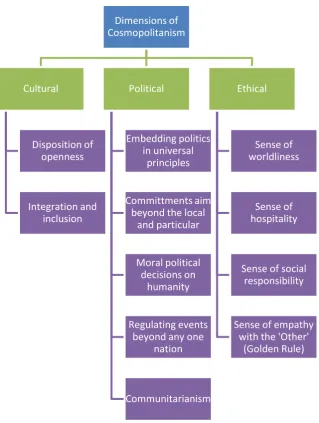
The dimensions and categories are based on a text by Skrbis & Woodward (2013): “Cultural
dimension: concurring with Nussbaum, there are different ways of being cosmopolitan, but
19 conception of openness is for us an epistemological principle of cosmopolitanism: it limits
and fixates the definitional horizon by reminding us that beyond openness lies a sphere of all
things un-cosmopolitan. Political dimension: cosmopolitan commitment is also a political
commitment, which encourages us to appreciate and recognize difference, embed our
politics in universal principles and commit ourselves to the dethronement of one’s unique
cultural identity. This dimension extends into institutional and global domains when
cosmopolitan political commitments aim beyond the local and particular and morph into
institutionally committed cosmopolitan principles. At this global level cosmopolitanism refers
to an ambition or project of [developing] regimes of global governance, and legal-institutional
frameworks for regulating events and processes, which reach beyond any one nation.
Ethical dimension: this dimension is integral to cosmopolitanism in all its forms and is
defined by and inclusive ethical core that emphasizes worldliness, hospitality and
communitarianism. In this book we will specifically address the question of cosmopolitan
ethics in relations to two highly controversial social phenomena. The first relates to the way
in which refugee issues are currently being dealt with. This case is instructive because it
goes to the very core of the notion of hospitality towards migrants and how cosmopolitan
20
Figure 3.1: Coding Scheme for Content Analysis
In order to carry out a conceptual content analysis (Carley, 1990), identifying frequent and
indicative group of texts and statements throughout the set of documents is necessary.
Merely the occurrence or existence of concepts is informative but quite limited; however, the
frequency shows where there is more emphasis as well. The frequency of categories in
general might be higher in speeches from 2015 than 2014 and 2016, simply because more
speeches were collected from 2015 (11 speeches) than 2014 (5 speeches) and 2016 (4
speeches). After the coding process for content analysis, the occurrences and frequencies of
categories have been documented. Manifest and latent content is analyzed (Babbie, 2013).
A certain pattern in the language used has been found evident. Drawing conclusions from
qualitative data, involves a certain degree of interpretation of the pieces of text collected as
well, however that does not undermine the scientific method used to ensure a representative Dimensions of
Cosmopolitanism
Cultural
Disposition of openness
Integration and inclusion
Political
Embedding politics in universal
principles
Committments aim beyond the local
and particular
Moral political decisions on
humanity
Regulating events beyond any one
nation
Communitarianism
Ethical
Sense of worldliness
Sense of hospitality
Sense of social responsibility
Sense of empathy with the 'Other'
21 interpretation of the categories. What the phrases imply, in what context they have been
held, and how they can be related to my conceptualized notion of cosmopolitanism and its
categories is all part of the process of manual (by hand instead of using a software) content
analysis. The reason I intended to carry it out by hand was to ensure that phrases where
said in the appropriate context, as well as the fact that I am coding for phrases or even
paragraphs and not merely words. Furthermore, since statements and sometimes whole
paragraphs could represent certain categories, it was more proper to carry it out by hand, in
order to avoid any misleading errors in coding and misinterpretation. For instance, the use of
metaphors and jargon can also count as examples where the need for interpretation is at
hand, and in such cases sometimes it needs to be clarified which side of my argument are
they on (pro- or anti- cosmopolitanism).
Starting with clarifying the category ‘disposition of openness’, it is based on the notion of the
recognition of the ‘Other’. As Delanty (2006) put it, “[...] against notions of globalisation and
universality, on the one side, and plurality and particularism on the other, the cultural
dimension of cosmopolitanism consists more in the creation and articulation of
communicative models of world openness in which societies undergo transformation (p. 35).”
Disposition of openness therefore is a rather broad category; however it is considered the
heart of cultural cosmopolitanism. The context of integration and inclusion in my coding
scheme is not in means of seeking to change the ‘Other’, but instead by accepting the
‘Other’ the way they are. In this sense, any integration and inclusion policies or statements
mentioned in the documents (speeches) must comply with this meaning of integration in
order to fit under this category, and thus be counted as cosmopolitan. Taking a hypothetical
statement as an example that seeks to integrate migrants into the European education
system, labour market... etc so that migrants can, on the one side, benefit from being treated
as equals, and on the other contribute to the society of their destination. Embedding politics
in universal principles is mainly about complying with the charter of human rights and UN
resolutions concerning universal law, such as the right to asylum and international protection
for refugees fleeing from unsafe countries and areas of conflict, violence and oppression.
The category ‘commitments aim beyond the local and particular’ implies that the
Commission is committed to solve issues with the ‘Other’ abroad in unparticular areas
outside of Europe. For instance, when the Commission makes commitments to countries,
like Jordan, Lebanon, or any other territory in the Middle East affected by the Syrian conflict,
for providing them with financial aid and support schemes to help reduce their burden and
challenges in times of a refugee crisis, would be an example. Moreover, cooperating with
transit countries such as Turkey and Northern African countries also falls under this
22 aid where needed, working on voluntary humanitarian admission schemes, or any other
decisions and resolutions that emphasize the importance of human safety, dignity and
wellbeing. Moreover, for instance, since irregular migrants do not possess the right to stay in
Europe, nonetheless making decisions on treating them with dignity and in compliance with
their rights and human rights in general also counts under this category. An example of
‘regulating events beyond any one nation’ is when, for instance, the EU works closely with
countries abroad in projects involving the creation of suitable refugee camps, educational,
humanitarian, or any other supportive facilities in their counties of origin. Furthermore, this
category can highly relate to ‘Communitarianism’ in Intra-EU context, however,
Communitarianism more precisely applies to the relationships between the EU and its
Member States, and the Member States with each other. Deciding on regulating events
beyond any one nation in an Intra-EU context, such as having a common European asylum
policy/system, from a collectivist approach at the European level as a community where
solidarity and responsibility sharing are essential, fits both categories. A sense of worldliness
is rather a broad category that covers statements showing a sense of connectedness and
interest to worldly issues and events. An opposite of this category would be isolation.
Exerting a sense of hospitality is about being explicitly welcoming to migrants, especially
refugees in my case, along with the implications that come with it such as the willingness to
providing them with life essentials upon arrival including appropriate shelter and so on. As it
comes to having a sense of social responsibility, being socially responsible is about taking
the initiative for acting on solving global social problems. Conveying a sense of social
responsibility involves taking responsibility in solving social issues inside and outside of the
EU; for instance, feeling responsible in ending inequality and starvation in the world is
considered as socially responsible. However in this case, social responsibility will be more
precisely related to issues of refugees, without leaving out the rest. Last but not least of the
categories is being adorned with a sense of empathy. Revealing a sense of empathy is an
additional concept, one that is not often expected to be found among politicians nowadays.
Be that as it may, a sense of empathy is not only about conveying or expressing feelings of
compassion and pity for the sufferings of the ‘Other’, but also putting, most importantly, one’s self in the shoes of the ‘Other’. Moreover, the Biblical Golden Rule is attached to this category, which states ‘do as you would be done by’, because it goes hand in hand with
empathy. Therefore, any phrases in the speeches that qualify this conceptualisation of
empathy will fall or be counted under this category as well.
In addition, statements or phrases may fall under a combination of categories. For example,
various statements found in the Speeches that portrayed a sense of empathy also showed a
23 marked by millions of Europeans fleeing from religious or political persecution, from war,
dictatorship, or oppression [...] imagine it were you, your child [...] sleeping in the streets, in
the rain [...] (SPEECH/15/5614).” Another example, the statement, “these are global issues, and we need to face them together, in partnership (SPEECH/16/365),” would fall under both categories ‘sense of worldliness’ and ‘communitarianism’. Finally, analysing the Speeches in
accordance with the coding scheme that I have created will allow me to measure the extent
of cosmopolitanism the Speeches endorse in addressing the refugee, and thus help
generate a final answer to my research question. It will also provide a guideline in analysing
the other forms of migrant studied in this paper.
3.3. Concluding Remarks
In this chapter, the methodology was clarified on how this research is conducted. All the
issues concerning my methods of data collection and content analysis were explained. In the
next chapter, my findings will be presented. Observations in the speeches analysed will be
24
4. Findings (Data Analysis)
This chapter is mainly about what has been observed in the documented speeches collected
in terms of addressing migrants in accordance with cosmopolitanism and its interpretation.
The Commission is shown to express different cosmopolitan values for addressing each type
of migrant – the refugee, the irregular migrant, the economic migrant, and Intra-EU Migrant.
For instance certain features of cosmopolitanism can be adopted in addressing one form of
migrant but not the other, for practical and legal reasons. In this chapter the different
cosmopolitan ways of addressing those four types of migrants will be analyzed; the aim is to
show the different phases and issues of cosmopolitanism and how, for instance, the degree
of cosmopolitan emphasis can be different when addressing one type of migrant (i.e. the
refugee) compared to another type of migrant (i.e. the irregular migrant).
According to the European Commission’s (2016) webpage for priorities on the migration
agenda, headlines include: ‘saving lives and securing internal borders’; ‘reducing the
incentive for irregular migration’; ‘a strong common asylum policy’; ‘a new policy on legal
migration’. Those headlines can be considered as a summary of the policy areas discussed
in the Speeches collected on the issue of migration. However, a full analysis of the speeches
will provide more detail and depth concerning the frequency and existence of the categories
(coding scheme) in the speeches and whether the speeches differ from each other. This
chapter of data analysis will be split into four sections, accordingly: Cosmopolitan
Addressing of the Refugee; Cosmopolitan Addressing of the Irregular Migrant; Cosmopolitan
Addressing of the Economic Migrant; and Cosmopolitan Addressing of the EU Citizen – the Migrant within Intra-EU ‘Mobility’. But before analysing how each migrant was addressed
separately, first, it is important to point out what is observed in the results of the coding
process in accordance with the scheme (Figure 3.1).
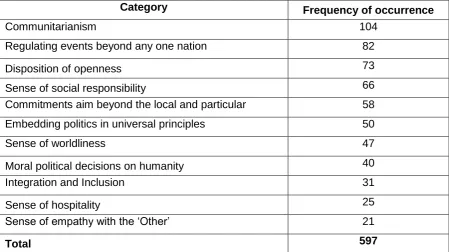
The following table (Table 4.1) shows the frequency of occurrences of each of the
coding-scheme categories in the European Commission speeches within the time frame of 2014
until 2016. The columns total indicates the sum of frequency of occurrences of the
categories all together. The frequency of occurrence in Table 4.1 signifies a level of
persistence of categories, and provides, all-in-all, a certain measure to the degree of
cosmopolitanism the European Commission endorses in its speeches. Certain trends are
found in the table. The categories are sorted in descending order (downward) in terms of
frequency of occurrences. The category ‘Communitarianism’, for instance, occurred 104
times, which is the most frequent of all.
25
Table 4.1: Frequency of occurrences of cosmopolitan categories in the Commission speeches
One way to interpret constantly calling for a communitarian approach is that it can imply two
intentions; supranational state-building, and Nussbaum’s (1997) cosmopolitan notion of a
shared community. The Commission, therefore, in the speeches, when it calls for common
approaches for further solidarity and responsibility sharing it goes hand in hand with
Nussbaum’s (1997) notion of moral cosmopolitanism. Yet, at the same time, when the
Commission calls for a common approach, such as having a common European asylum
policy, it can imply supranational governance in the direction of supranational state building,
which is not necessarily cosmopolitan (Eriksen, 2007). The Commission shows to have a
supranational leadership style in guiding the Member States but the content of governance
and the context it was held in, such as ‘more solidarity and responsibility sharing’, is
cosmopolitan most of the times, as was observed. Beck and Grande (2007) also agree with
the thought that harmonizing the policies and eliminating national differences is not
cosmopolitan, but recognizing them is, which further supports the idea that having a
common European asylum policy within the context of communitarianism may not be very
cosmopolitan from Beck and Grande’s (2007) perspective.
It also appears from Table 4.1 that regulating events, such as humanitarian activities,
beyond any one nation state, is the second most frequent concept. The frequency somewhat
shows how important a category is to the Commission. ‘A disposition of openness’, which is rather a broad cultural dimension of cosmopolitanism, and ‘a sense of social responsibility’ come next. ‘A sense of empathy’ is the least frequently occurred category. However, a sense
Category Frequency of occurrence
Communitarianism 104
Regulating events beyond any one nation 82
Disposition of openness 73
Sense of social responsibility 66
Commitments aim beyond the local and particular 58
Embedding politics in universal principles 50
Sense of worldliness 47
Moral political decisions on humanity 40
Integration and Inclusion 31
Sense of hospitality 25
Sense of empathy with the ‘Other’ 21
26 of empathy is expected to occur less than other categories because empathy is only needed
when there is an emotional reaction, which leaves the priority to other categories in most
other cases, as a form of interpretation. Emotional reactions usually happen when there are
crises in whatever context, however, further research is required on the issue of empathy
and its psychological impact.
4.1. Cosmopolitan Addressing of the Refugee
Commissioner Avramopoulos states that “Openness and security are two equally important
pillars of the European edifice. One of the reasons for so many lost lives is that it is too difficult for people seeking protection to enter the EU legally (SPEECH/14/1601).” Similarly,
President Juncker calls for “...opening legal channels for migration [because] if there are
more, safe and controlled roads to Europe, we can [...] make the illegal work of human
traffickers less attractive (SPEECH/15/5614).”
It is observed from the words of Commissioner Avramopoulos and President Juncker that
they both seek to open legal channels for migrants and refugees as opposed to closing
borders, but with having better control over the borders. The reason for opening legal
channels, as observed, is mainly for making it easier for migrants and refugees to reach
Europe safely, and by this also lowering the demand for the services of illegal human
traffickers.
One way to interpret this observation, since many statements concerning strengthening the
external borders of the EU were found, strengthening external borders and enhancing
control does not necessarily mean calls for closing borders, however, there is a strong focus
on tackling human trafficking and migrant smuggling in order to, on the one hand, safeguard
migrants’ lives (whether refugees or irregular) by putting an end to perilous ways for people
migrating to Europe, and on the other hand, tackle the issue of irregular migration by
enhancing the capacity to identify and stem the flows of migrants entering European soil
through irregular channels and determine whether they qualify for asylum and international
protection, or plainly irregular migrants coming from ‘safe’ countries of origin who do not
possess the right to stay in Europe. The issues surrounding irregular migrants in relation to
cosmopolitanism will be discussed in more detail in section 4.2. Nonetheless, those
statements express certain cosmopolitan features or values and fall under the
coding-scheme (Figure 3.1) categories ‘disposition of openness’, ‘sense of social responsibility’, ‘moral political decision on humanity’, and a disputable ‘sense of hospitality’ – disputable
27 stay; opening legal channels does not imply that, once migrants have reached Europe, they
will not be denied entry for some reason.
According to Vice-President Frans Timmermans, “We need to make sure that we provide
more support for people to be able to live decent lives in dignity in the camps where they are
in Jordan, Lebanon and Turkey. We need to make sure that we help those countries to
afford these people the opportunity to work, to take up jobs, and one of the major elements
we need to look at is to provide education for children – that is of the greatest importance
(SPEECH/15/6079).”
Statements as such, expressing a sense of social responsibility, worldliness, and regulating
events beyond anyone nation where also commitments aim beyond the local and particular,
were found several times in the speeches. This shows that the Commission has a sense of
responsibility not only for events happening within the borders of the EU but also for people
– especially refugees in this case – in need of life essentials including protection, education
and employment opportunities. This can also be related to statements found in the speeches
concerning reaching Europe’s 2020 poverty targets which show a sense of social
responsibility and worldliness. Nussbaum (1997) and Skrbis & Woodward, (2013), as
argued in chapter 2.1, strongly support those moral values of ethical cosmopolitanism, in
relation to helping people with their problems regardless of their locality or nationality. Yet,
again, this study does not analyse the practices and what is actually being done, which can
diminish the rosy picture painted here; however it reveals rather the ideological position and
intention of the Commission expressed in the speeches, which is the aim of this research.
Commissioner Cecilia Malmström, in her speech in 2014, said “I will focus on a fundamental
right that is very close to my heart, one that is easy to proclaim in theory, but more
complicated to defend in practice: the right to asylum (SPEECH/14/244).”
This is a very interesting observation. Commissioner Malmström confirms my argument
concerning the possible discrepancy between speeches and practice. When Commissioner
Malmström states that the right to asylum is easier to proclaim in theory than to defend in
practice, she implies that what has been said is not necessarily what has and will be done.
However, stating this can also mean that the Commission puts an effort in advocating
cosmopolitan values, however, the extent to which those values hold highly depends on
complications, which can be caused by pressures from the Member States, and whether the
Commission can handle such pressures while trying to preserve unity in the EU against the
rising populism. Furthermore, Thym (2016), in chapter 2.1 of this paper, briefly argues how
complicated it is determining who qualifies the right to asylum and its legal loopholes. There