Original citation:
Wei, C. H. and Li, Chang-Tsun (2006) A logistic regression approach to content-based mammogram retrieval. Coventry, UK: Department of Computer Science, University of Warwick.
Permanent WRAP url:
http://wrap.warwick.ac.uk/61497
Copyright and reuse:
The Warwick Research Archive Portal (WRAP) makes this work by researchers of the University of Warwick available open access under the following conditions. Copyright © and all moral rights to the version of the paper presented here belong to the individual author(s) and/or other copyright owners. To the extent reasonable and practicable the material made available in WRAP has been checked for eligibility before being made available.
Copies of full items can be used for personal research or study, educational, or not-for-profit purposes without prior permission or charge. Provided that the authors, title and full bibliographic details are credited, a hyperlink and/or URL is given for the original metadata page and the content is not changed in any way.
A note on versions:
The version presented here is a working paper or pre-print that may be later published elsewhere. If a published version is known of, the above WRAP url will contain details on finding it.
A LOGISTIC REGRESSION APPROACH TO
CONTENT-BASED MAMMOGRAM RETRIEVAL
Chia-Hung Wei and Chang-Tsun Li
Department of Computer Science
University of Warwick
Coventry CV4 7AL,UK
{rogerwei, ctli}dcs.warwick.ac.uk
ABSTRACT
Content-based image retrieval (CBIR) has been proposed to address the problem of image retrieval from medical image databases. Relevance feedback, explaining the user’s query concept, can be used to bridge the semantic gap and improve the performance of CBIR systems. This paper proposes a learning method for relevance feedback, which develops logistic regression models to generalize the 2-class problem and provide an estimate of probability of class membership. To build the model, relevance feed-back is used as the training data and the iteratively re-weighted least squares method is applied to estimate the parameters of the regression curve and compute the maxi-mum likelihood. After logistic regression models are fit-ted, discriminating features are selected by the measure of goodness of fit statistics. The weights of those discrimi-nating features are determined based on their individual contributions to the maximum likelihood. The probability of class membership can therefore be obtained for each image of the database. Experimental results show that the proposed learning method can effectively improve the average precision from 41% to 63% through five itera-tions of relevance feedback rounds.
1. INTRODUCTION
In hospitals and medical institutes, a large number of medical images are produced in ever increasing quantities and used for diagnostics and therapy. Content-based im-age retrieval (CBIR) has been proposed to address the problem of image retrieval from medical image databases. Content-based image retrieval refers to the retrieval of images whose contents are similar to a query example, using information derived from the images themselves, rather than relying on accompanying text indices or exter-nal annotation. One of the main challenges in CBIR is the semantic gap between low-level features that can be ex-tracted from the images and the descriptions that are meaningful to users. To bridge this gap, machine learning
methods have to be incorporated for automatic association of such descriptions to the low-level features. To identify what the user is looking for in the current session, the user has to be included in the retrieval process. The process of finding the user’s target is called a retrieval session, which can be divided into several rounds. In each round the user provides feedback regarding the search results by identi-fying images as either relevant or irrelevant ones (i.e. rele-vance feedback). Based on this relerele-vance feedback, the system learns the common visual features of the images and returns improved results to the user.
Content-based image retrieval has been proposed by the medical community for inclusion into picture archiv-ing and communication systems (PACS), which integrates imaging modalities and interfaces with hospital and de-partmental information systems in order to manage the storage and distribution of images to radiologists, physi-cians, specialists, clinics, and imaging centers [2]. Image searching in PACS is currently carried out according to the alphanumerical order of textual attributes of images. However, the information which users are interested in is the visual content of medical images rather than that resid-ing in alphanumerical format. The content of images is a powerful and direct query which can be used to search for images containing similar content. In addition, computer-aided diagnosis and case-based reasoning create strong needs for CBIR technology.
are presented in Sections 4 and 5. Section 6 presents the conclusions of this study.
[image:3.612.55.293.113.298.2]2. OVERVIEW OF THE PROPOSED IMAGE RETRIEVAL FRAMEWORK
Figure 1. The proposed framework for image retrieval.
The proposed content-based retrieval framework as shown in Figure 1 can be divided into off-line feature extraction and on-line image retrieval. In off-line feature extraction, the contents of the images in the database are pre-processed, extracted and described with a feature vector, also called a descriptor. The feature vectors of the images constitute a feature dataset stored in the database. In on-line image retrieval, the user can submit a query example to the retrieval system to search for a desired image. The similarities between the feature vectors of the query ex-ample and those of the mammograms in the feature data-set are computed and ranked. It should be noted that fea-ture vectors are divided into the geometric feafea-ture layer and the texture feature layer. The geometric feature layer is the first layer and a threshold valueδ is set for select-ing the prospective images. As the distance of similarity will be normalized into the range 0 to 1, the threshold is set in the range0≤δ ≤1. Only those prospective images are further considered for their similarity in the texture feature layer. Retrieval is conducted by applying an in-dexing scheme to provide an efficient way of searching the image database. Finally, the system ranks the similar-ity and returns the images that are most similar to the query example. This is called the initial search stage for a given query.
In abnormal mammograms, what doctors and radi-ologists are interested in are particular objects, such as calcium deposits and masses, because they are major signs of malignancy on mammograms. When comparing the similarity between two mammograms, characteristics of image content are taken into account based on their patho-logical importance. For this reason, similarity measures are divided into two different layers in the proposed
sys-tem. The objective of the first layer is to sift out calcifica-tion mammograms from the whole image database and locate those mammograms with a similar size of calcium spots as the query example. The second layer considers the density of calcification spots and structure of breast tissue including density and distribution of fat, and direc-tion
dbacks. The learning me s presented in Section 3.
3. LEARNING METHOD FOR RELEVANCE FEEDBACK
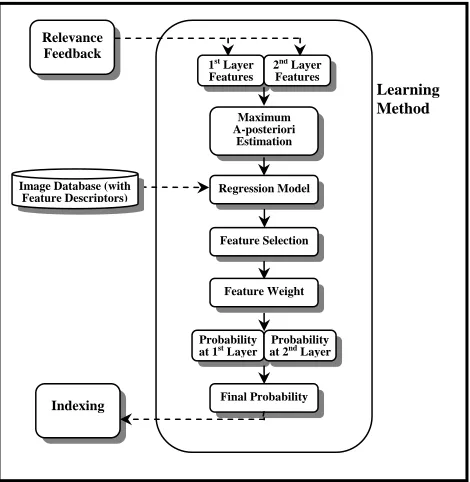
this tudy proposes a learning method shown in Figure 2.
The proposed learning method for relevance edback.
ality of breast muscle.
If the user is not satisfied with the initial search re-sults, the user can conduct a relevance feedback stage. The user provides relevance feedback to the retrieval sys-tem in order to search further (following the dashed lines’ arrows in Figure 1). To supply relevance feedback, the user simply identifies the positive image that is relevant to the query. The system subsequently analyzes the features of the user’s feedback using a learning method and then returns refined results. This relevance feedback round can be repeated until the user is satisfied with the results or unwilling to offer any more fee
thod i
At the relevance feedback stage the task of the system is to learn user’s relevance feedback, which are formed from user’s subjective judgment on returned images. Common characteristics in relevant images reveal the user’s search target and are what the user is interested in. To analyze the common characteristics and make a prediction, s
Figure 2.
fe Mammo-
grams Image Database (with Feature Descriptors)
Off-line Feature Extraction On-line Image Retrieval
Query Example
Feature Extraction
Feature Extraction
Relevance Feedback
Learning Method Result
Display
Similarity Measure Geometric
Features Texture Features Indexing
The User
Relevance Feedback
1stLayer
Features
2nd Layer
Features
Maximum osteriori A-p
Estimation
Regression Model
Probability at 1st
Layer
Probability at 2nd
Layer
Indexing
Feature Selection
Final Probability
Method Learning
Feature Weight Image Database (with
[image:3.612.313.548.438.679.2]As described in Section 2, image features are divided into two different layers. The proposed method firstly collects relevance feedback as the training data, which is regarded as two different data sets. The first set includes the geometric features and the second set includes the texture features. The two sets of training data are then used to develop their individual logistic regression models, which are generalized linear models with binomial re-sponse and logit [3]. Next, the maximum a-posteriori
method iteratively re-weighted least squares (IRLS) is applied to solve a least squares problem and estimate the parameters of the regression curve. When logistic regres-sion models are developed, all database images are fit into the regressions. Discriminating features are then selected by the measure of goodness-of-fit statistics. The weights of the discriminating features are determined based on their individual contributions to the maximum likelihood. The probability of membership can be obtained for each image in the database. As two different feature layers are used to develop its individual regression model, each im-age can obtain two different probabilities for a different feature layer. The final probability that an image belongs to the relevant class will be obtained by multiplying these two probability rates. It is noted that, at the initial search stage, the similarity between any two images is measured by the mathematical distance of two points in the multi-dimensional system using a distance metric. At the rele-vance feedback stage, image similarity is completely based on the probability estimation. The detailed process is described in the following subsections.
3.1. Logistic Regression
Logistic regression is a mathematical modeling approach that can be used to describe the relationship of real-valued independent variables to a dichotomously dependent vari-able [4]. Suppose the response y of an image can take one of two possible values 0 and 1. y = 1 if the image is rele-vant to the query example; otherwise y = 0. Let x =
be the feature vector of an image. Since the output variable y only takes on values for the retrieval result, the logistic function can be used to repre-sent resulting in the range of . The lo-gistic regression forms an s-shaped curve in which y ap-proaches 1 as x , or 0 as x . The a-posteriori
probability of the class membership can be modeled via the linear function
T k x x x, ,..., ) ( 1 2
} 1 , 0 { ∈ ) | (y x
E y∈{0,1}
∞ → →−∞ k kx x x x
f( )=β0+β1 1+β2 2+...+β
where β =(β0,β1,...,βk) represents the weight vector, including the biasβ0. The conditional probability of
la-bel y given the feature vector x is expressed as
x x x e e e x x y
P β β
β β µ β − + = + = = = 1 1 1 ) | ( ) , | 1 ( (2) x x e e x x y P β β β µ
β −−
+ = − = = 1 ) | ( 1 ) , | 0 ( (3)
The output of is interpreted as an estimate of a prob-ability
)
(
x
f
) , | 1 (y x βP = when equation (1) is transformed by the logit function.
⎥ ⎦ ⎤ ⎢ ⎣ ⎡ − = ) , ( 1 ) , ( ln )} , ( { β µ β µ β µ x x x logit x e e e e x x x x β β β β β = ⎥⎦ ⎤ ⎢⎣ ⎡ = ⎥ ⎥ ⎥ ⎥ ⎦ ⎤ ⎢ ⎢ ⎢ ⎢ ⎣ ⎡ + + = − − − − 1 ln 1 1 1 ln (4)
The set of adjustable parametersβof the regression curve is key to developing the regression model. How to deter-mine the parameters is described in the following section.
3.2. Maximum A-posteriori Estimation
Maximum a-posteriori estimation, which is maximizing the likelihood through the choice of the parameter esti-mates, is used to obtain estimates of the parameters for logistic regression. In this study, the iteratively re-weighted least squares (IRLS) algorithm is applied to solve a least squares problem in order to estimate the maximum a-posteriori parameters. The IRLS algorithm takes first and expected derivatives to obtain the score and information matrix and then develop a Fisher scoring pro-cedure for maximizing the log-likelihood [4]. Suppose a logistic regression model is fit to a set of n samplesX =
,…, , which are randomly drawn from a binomial distribution. The conditional likelihood of a single observation can be expressed as
) ,
(x1 y1 (xn,yn)
i
i i y
y i i i x x x y
P( | ,β)=µ( |β) (1−µ( |β))1− (5)
Then, the conditional likelihood of the whole dataset is written as
∏
= − − = n i y i yi i i
x x X Y P 1 1 )) | ( 1 ( ) | ( ) , |
( β µ β µ β (6)
The conditional log-likelihood is
∑
= − − + = n i i i i i x y x y Y X l 1 )) | ( 1 log( ) 1 ( ) | ( log ( ) , |(β µ β µ β
The conditional log-likelihood equation can be solved by taking gradients (7) (1) ⎟ ⎟ ⎠ ⎞ ⎜ ⎜ ⎝ ⎛ ∂ ∂ − − − ∂ ∂ = ∂ ∂
∑
= j i i i j i i n i i j x x y x x y Y X l β β µ β µ β β µ β µ ββ ( | )
)) | ( 1 ( 1 ) 1 ( ) | ( ) | ( 1 ) , | ( 1
By pluggingµ(x|β)of Equation (2) in Equation (8) and let the results equal to 0, a set of nonlinear equations can be obtained as
∑
= − = + − n i x i i k i e y x 1 0 ) 1 1 ( βNewton’s method is a general procedure for finding the roots of an equation f(θ)=0 based on the recursion [4].
) ( ) ( 1 t t t t f f θ θ θ θ ′ − = +
Although Newton’s method is to find the minimum of a function f, the maximum of a functionf(θ)is given when its derivative f′(θ)=0. Hence, plugging in f′(θ) for
) (θ
f above, it results in
) ( ) ( 1 t t t t f f θ θ θ θ ′′ ′ − = +
The parameter
β
is a vector in logistic regression. The Newton-Raphson algorithm is introduced [4]) , | (
1
1 t H l t X Y
t β β
β = − −∇β
+
where represents the vector of partial
de-rivatives of the log-likelihood equation, and )
, | ( X Y l βt β ∇ = ij H j i t X Y l
β β β ∂
∂2 ( | , )
represents the Hessian matrix of second
order derivatives. Then, Fisher scoring is applied to find the solution to the conditional log-likelihood equation. Taking the second derivative of the likelihood score equa-tions gives us
∑
= − − = ∂ ∂ n i i i T i iT x x x x
Y X l 1 2 )) | ( 1 )( | ( ) ( ) , |
( µ β µ β
ββ β
The Newton-Raphson algorithm can be expressed using matrix notation for logistic regression. The diagonal matrix is defined as
n
n
×
⎥ ⎥ ⎥ ⎥ ⎦ ⎤ ⎢ ⎢ ⎢ ⎢ ⎣ ⎡ − − − = )) | ( 1 )( | ( 0 0 0 )) | ( 1 )( | ( 0 0 0 )) | ( 1 )( | ( 2 2 1 1 β µ β µ β µ β µ β µ β µ n n x x x x x x W L M O M LLet Y be an column vector of output values, and X
be the design matrix of size of input values, and
P be the column vector of fitted probability val-ues 1 × n ) 1 ( + × p n ) | ( β
µ xi . The gradient of the log likelihood can be expressed in a matrix form as follows.
∑
= − = ∂ ∂ n i i i i x y x Y X l 1 )) | ( ( ) , |( µ β
β β
) (Y P
XT −
= The Hessian can be expressed as
WX X Y X l T i i − = ∂ ∂ β β β| , )
( (16)
The Newton-Raphson algorithm then becomes ) ( )
(XTWX 1XT Y P old
new=β + − −
β (9)
=(XTWX)−1XTW(Xβold +W−1(Y−P))
WZ X WX XT ) 1 T
( −
=
where Z ≡Xβold +W−1(Y−P). (17) (10)
3.2. Feature Selection
Since a typical CBIR system only requires the user to sub-mit images as query examples, no assumptions are made with regards to the characteristics of the content. To look for images with various characteristics, the system has to extract as many low-level features as possible from the images in the databases. Although discriminating features may be extracted, more redundant features may simulta-neously undermine the retrieval performance if they are included into feature descriptors for further similarity measure. For this reason, this study proposes a feature selection process that automatically selects a subset of discriminating features at the relevance feedback stage. As the whole set of database images is fit to the regression model and the value of the maximum likelihood is esti-mated, this system then performs null hypothesis testing using a statistic measure of the goodness-of-fit. The sta-tistic measure of the goodness-of-fit, also called a likeli-hood ratio test, compares a relatively more complex model, called a full model, to a simpler model, called a reduced model, to assess whether the simpler model fits the dataset significantly better. The likelihood ratio test begins with a measure of deviance between the full model that contains the observed features, and the reduced model that is the same as the full one except that the observed features are not included. The deviance can be compared to a chi-square distribution.
(11) (12) (13) (18) ) log (log
2 f r
i L L
d =− −
where represents the maximum likelihood for the full
model and represents the maximum likelihood for the reduced model. If the full and the reduced models are both identical, the ratio of the full to the reduced model is one and its logarithm is zero, and therefore the deviance is zero. The likelihood test can assess whether the likeli-hood score is significantly improved as a specific feature is added into the model. To assess the importance of a specific feature , the remaining features are used to ac-count for it and that observed feature is removed from the full model to obtain the reduced model. The null hy-pothesis is shown as follows:
f L r L i x i x (14) (15) 0 :
0 xi =
H1:xi ≠0 ( i = 1, 2,… ,k )
0
H refers to the reduced model with the observed feature
= 0. H1refers to the full model. The predetermined α level of significance is set to 0.05 and the degrees of free-dom (df) is 1. If the null hypothesis is accepted, it can be inferred that feature does not have a significant effect on the maximum likelihood estimation because the devi-ance is too small. Otherwise, feature has a significant effect on the complex model.
i x
i x
In addition to feature selection, this method further assesses the contribution from each discriminating feature and then determines the individual weighting based on their contributions. If feature is assessed to have sig-nificant contributions on the maximum likelihood score, the weight is computed via an exponential function
i x
i w
i d i e
w = − , where di=−2(logLf −logLr)
which results in . If feature makes a great contribution with an extremely large deviance value , the weight approaches one. On the contrary, the weight
approaches to zero. 1
0≤wi ≤ xi
i d
i w
i w
3.3. Probability of Similarity
At the relevance feedback stage, the logistic regression can provide each image of the database with the a-posteriori probability Pc (i.e. probability at 1
st
layer in Figure 2.) of membership that is thought of as a relevant image. Similarly, each image obtains another probabil-ityPt (i.e. probability at 2
nd
layer in Figure 2.) of member-ship that belongs to the relevant-image class. The final probabilityPfis calculated as follows:
t c f PP P =
which represents each image’s final score for the mem-bership of the relevant-image class. Similar to the design in similarity measure described in Section 2, where a threshold valueθ is set at the first feature layer, the thresholdδ is also set at the 1st layer. As represents a probability rate, the range of
c P
δ is 0≤δ ≤1.
4. PERFORMANCE EVALUATION
The objective of this study is to apply the proposed learn-ing method and framework to retrieve mammograms con-taining similar calcium deposits and structure of breast tissue
4.1. Mammogram Data Set
There are 750 images of size 200 200 pixels, each cropped from the Region Of Interest (ROI) of one
mam-mogram. Among the 750 images, 250 of them contain calcification phenomenon while the other 500 do not. Calcification mammograms are classified into two differ-ent categories: micro-classifications and macro-classifications. Micro-calcifications, tiny calcium depos-its less than 1/50 of an inch in size, are the most common mammographic sign of ductal carcinoma in situ (DCIS), which is a cancer that has not spread into neighboring breast tissue [1]. Macro-calcifications refer to larger, coarse calcium deposits.
×
(19)
4.2. Feature Extraction
To describe the mammogram contents, a total of 14 geo-metric and textural features were used in this study. Those features were separately used in two different lay-ers.
(20)
Geometric Layer
It is observed that calcifications usually appear as spots which are the brightest areas when compared to the other breast tissues. Therefore, three operators with different sizes (3x3, 4x4, 5x5) are developed to detect the calcifica-tion spots, which creates three features [6]. Since the first layer is mainly used to verify whether an image has any calcium spots and the size of those calcium spots, geomet-ric features are used to sift out similar mammograms.
Textural Layer
In an attempt to further discriminate the density of calcifi-cation spots and structure of breast tissue including den-sity and distribution of fat, and directionality of breast muscle, the second layer makes use of textural features to analyze the image textures and compare the texture simi-larity between two images. The following features based on texture analysis were derived using the co-occurrence matrix: Contrast, Correlation, Inverse Difference Moment (also Homogeneity), Angular Second Moment (also En-ergy), Variance, Entropy, Different Variance, Different Entropy, Sum Average, Sum Variance, and Sum Entropy. (21)
4.3. Relevance Feedback Process
im-prove the precision within a few iterations. Five iterations are conducted to learn the user’s preference for each search session. In each round only relevant images are required to be identified as feedback, which will be accu-mulated throughout the whole session.
4.4. Experimental Results
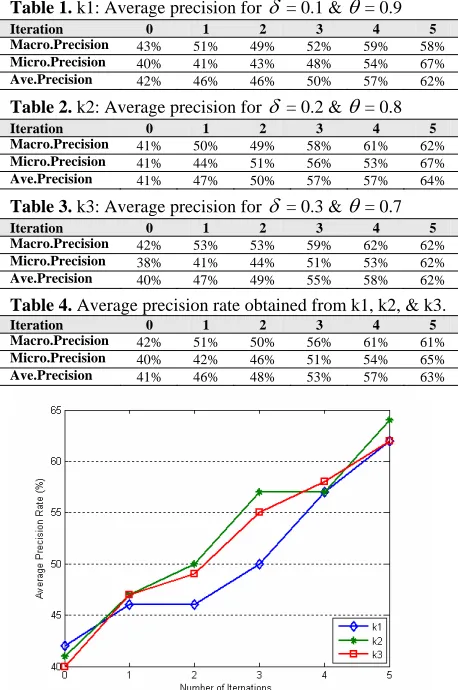
[image:7.612.316.521.74.224.2]This study investigates different values of the thresh-oldsδ at the initial search stage and θat the relevance feedback stage. In Table 1-4, iteration 0 indicates the pre-cision at initial search stage before relevance feedback is involved. Iteration 1-5 indicates the precision at the rele-vance feedback stage. Three combinations (k1, k2, k3) of thresholdsδ andθare adopted to test the performance of our system. Combination k1 sets the most rigid thresh-oldδ andθ. The results show that k1, k2, and k3 can obtain 62%, 64%, 62% on average precision. The results show that the average precision of macro-calcification can reach 61%; Micro-calcification can reach 65% by iteration 5.
Table 1. k1: Average precision for δ = 0.1 & θ= 0.9 Iteration 0 1 2 3 4 5 Macro.Precision 43% 51% 49% 52% 59% 58%
Micro.Precision 40% 41% 43% 48% 54% 67%
Ave.Precision 42% 46% 46% 50% 57% 62%
Table 2. k2: Average precision for δ = 0.2 & θ= 0.8 Iteration 0 1 2 3 4 5 Macro.Precision 41% 50% 49% 58% 61% 62%
Micro.Precision 41% 44% 51% 56% 53% 67%
Ave.Precision 41% 47% 50% 57% 57% 64%
Table 3. k3: Average precision for δ = 0.3 & θ= 0.7 Iteration 0 1 2 3 4 5 Macro.Precision 42% 53% 53% 59% 62% 62%
Micro.Precision 38% 41% 44% 51% 53% 62%
Ave.Precision 40% 47% 49% 55% 58% 62%
Table 4. Average precision rate obtained from k1, k2, & k3. Iteration 0 1 2 3 4 5 Macro.Precision 42% 51% 50% 56% 61% 61%
Micro.Precision 40% 42% 46% 51% 54% 65%
Ave.Precision 41% 46% 48% 53% 57% 63%
Figure 4. Comparison of average precision on macro-calcifications and micro-macro-calcifications based on Table 4.
5. CONCLUSIONS
In this study, a learning method has been proposed to pre-dict the probability of membership for content-based im-age retrieval. The proposed method develops logistic regression models, conducts features selection, and de-termines the weights of the discriminating features. The proposed method was evaluated using mammograms con-taining microcalcifications and macrocalcifications. The results show that the learning method can both learn two different types of calcification characteristics and improve the precision rate of image retrieval. Future work will explore other maximum likelihood estimation methods to rapidly obtain a smooth regression curve. A large variety of mammograms with pathological characteristics will be included into the image dataset to further investigate the learning and retrieval effectiveness.
7. REFERENCES
[1] El-Naqa, I., Yang, Y., Galatsanos, N. P., Nishikawa, R. M., and Wernick, M. N. “A similarity learning approach to content-based image retrieval: Application to digital mammography,”
IEEE Transactions on Medical Imaging, Vol. 23, No. 10, pp.
1233-1244, 2004.
[2] Huang, H. K., “PACS, image management, and imaging informatics,” In D. Feng, W. C. Siu, & H. J. Zhang (Eds.), Mul-timedia information retrieval and management: Technological
fundamentals and applications, Springer, New York, USA, pp.
347-365, 2003.
[3] Kleinbaum, D. G., Logistic regression, Springer-Verlag, New York, USA, 2002.
[4] Komarek, P., and Moor, A. W., “Making logistic regression a core data mining tool with TR-IRLS,” Proceedings of the fifth
IEEE international conference on data mining, Houston, USA,
pp. 685-688, 2005.
[5] Wei, C.-H., and Li, C.-T., “Calcification descriptor and rele-vance feedback learning algorithms for content-based mammo-gram retrieval,” Proceedings of the international workshop on
digital mammography 2006, LNCS, Manchester, UK, 2006.
[image:7.612.49.278.334.679.2]