University of Warwick institutional repository: http://go.warwick.ac.uk/wrap
A Thesis Submitted for the Degree of PhD at the University of Warwick
http://go.warwick.ac.uk/wrap/36133
This thesis is made available online and is protected by original copyright. Please scroll down to view the document itself.
DECiSiON SUPPORT SYSTEMS FOR TAR(ET SEUING
& RESOURCE ALLOCATION iN UNIT &
MULTI-LEVEL ORGAN1SATIONS US1N( DATA
ENVELOPMENT ANALYSIS
BY
ANTREAS 0. A THANASSOPOUL Os
THESIS SUBMITTED FOR THE DEGREE OF DOCTOR OF PHILOSOPHY UNIVERSITY OF WARWICK
SCHOOL OF INDUSTRIAL AND BUSINESS STUDIES
A çoiepwpivo
ce óAous ócrouc 1épouv va 5Ivouv
TABLE OF CONTENTS
CHAPTER 1 Developing a research agenda of management control &
planning in multi-unit organisations
1. Introduction ... I
2. The essence of multi-unit organisations (MUO)...2
2.1. For-profit and not-for-profit MUOs...4
2.2. Managerial control and planning in MUOs...5
3.
Managing resources in organisations: Concepts & current
practice ... 8
3.1. Objectives for unit level resource allocation...10
3.1.1. Improve the short-run achievements... 11
3.1.2. Reward the good pe,formers over time... 11
3.1.3. Supporting underpeiforming entities with high potential... 12
3.2. Resource management methods & performance ...13
4. Resource management and improved performance...17
4.1. Relation between organisational structure and resource allocation...17
4.1.1. "Need" versus 'Market" resource allocation... 18
4.1.2. Project specific versus recurrent resource allocation...19
5. Conclusions and research implications...20
CHAPTER 2 Recent developments for assessing performance:
The evolution of frontier analysis methods
1. Introduction ... 22
2. Aspects of the multi-disciplinary nature of performance
measurement ... 24
3. The evolution of frontier analysis ... 28
3.2. Frontier analysis via Data Envelopment Analysis ...32
3.3. Production possibilities and efficient frontiers ...34
3.4. Linear programming models for assessing efficiency ...37
3.5. An alternative formulation of DEA: The defensive LP model ...39
3.6. Decomposing technical efficiency...41
3.7. Economies of scale & most productive scale size...44
4. Managerial implications of DEA ...47
5. Recent developments of frontier analysis...49
6. Conclusion ... 55
CHAPTER 3 Target setting as an aid for control & planning
in "need based" MUOs
1. Introduction-Motivation ...57
2. Performance issues in non-profit MUOs ... 59
3. Assessing performance through target (goal) setting...62
3.1. Efficiency assessments and target setting...64
3.2. Principles of effective target setting ...66
3.2.1. Operationalfeasibility of the assessed targets...67
3.2.2. Value revelation...68
3.2.3. incorporating preferences over input/output improvements...69
3.2.4. Reflect desired global organisational peiformance...70
3.2.5. Develop support mechanisms to monitor the targets' achievement...71
4. Managerial & operational implications of target setting...72
4.1. Projections on the efficient frontier...73
4.2. From efficient frontier to improved directions...74
4.3. Extended Pareto efficient strategies...76
5. Conclusions ...77
CHAPTER
4
Analytic tools for assessing performance targets &
their economic implications
1. Introduction ... 78
2.1. Current association between DEA and target setting ...79
2.2. Models for Prioritised Target (PT) setting...81
2.3. Extensions to the basic PT model...85
3. Setting global performance targets ... 88
4. Economic information from the prioritised target models .... . 93
4.1. DEA & marginal rates of transformation: Background...93
4.2. Prioritised targets and productivity tradeoffs...99
4.2.1. MRTand imputed prices in linear programming...101
4.3. An illustrative example...101
5. Conclusions ... 108
CHAPTER 5
Centralised target-based planning models in multi-unit &
multi-level organisations
1. Introduction ... 110
2. Multi-unit & multi-level planning systems ... 112
2.1. Decomposition approach for planning ...114
2.2. Composition approach for planning ...116
3. Rethinking multi-level planning ... 116
3.1. Equity, efficiency and effectiveness as objectives of planning...117
4. Centralised target-based planning ... 119
4.2. DMUs' representation in the CTP model...124
4.3. Estimating global input-output targets...125
4.3.1. Policy making managerial decisions...125
4.3.2. Targets estimated by the global (industry) target model in M4.4...125
4.4. Goal deviation variables & the objective function...127
4.5. Operationalising the target-based planning model...129
4.6. Centralised target-based planning & the principles of target setting...132
CHAPTER
6 Decentralised target-based planning in multi-unit &
multi-level organisa tions
1. Introduction
...
136
2. Decentralised targetbased planning
...
137
2.1. A network representation of MULOs...138
2.1.1. DMUs' operation in a network structure...141
2.2. Objectives and co-ordination in MULO networks...142
3. Goal programming for decentralised target-based planning..145
3.1. Effectiveness within the decentralised planning model...147
3.2. Efficiency & individual unit representation...148
3.3. Defining equity goals in the decentralised planning model ...151
3.4. Incorporate policy constraints in the planning model ...151
3.5. The objective function of DIP as a planning instrument...152
4. Operationalising the decentralised target-based planning
model
...
153
4.1. Selection of input-output variables...153
4.2. Solution process of DTP...154
4.3. Efficiency and optimality in the solution of DTP ...158
4.4. Decentralised planning model & the principles of target setting...159
CHAPTER 7
Diagnostic analysis and decision support for a-priori
resource allocation
1. Introduction-motivation ... 162
2. Concepts of performance in profit-making MUOs ...
1642.1. The notion of market efficiency...167
2.2. The notion of cost efficiency and profitability ...168
2.3. Frontier analysis for assessing performance of profit making MUOs...169
3
.Thecasestudy ... 172
3.1. Ascertaining factors affecting the market efficiency of pubs ...172
3.1.1. Internal inputs...174
3.1.2. External inputs ...175
4. Managerial tools for diagnostic analysis ...177
4.1. Assessing aggregate market efficiency...177
4.2. Assessing site-specific market efficiency...179
4.3. Identifying role model operating practices (benchmarking)...180
4.3.1. Identifying benchmark pubs...183
5. Conclusions ... 186
CHAPTER
8
Planning analysis and decision support for a-priori
resource allocation
1. Introduction ... 188
2. Assessing improved scale size (ISS) targets ...190
2.1. Illustrating the improved scale-size model on real data ...194
2.1.1. Summarising the improved scale-size results for the set of 154 pubs...197
2.1.2. Practical use of dfferent market efficiency models...198
2.2. Market efficiency & returns to scale...199
3. Assessing outlet viability ... 201
3.1. Profits impacts on scale-size strategy (PRISS)...204
4. Assessing service-mix effectiveness ... 209
4.1. Non-parametric models for service-mix effectiveness...211
CHAPTER 9 Assessing marginal impacts of investments on the
performance of organisational units
1. Introduction ... 215
2. Isolating the effects of investment on market efficiency...216
2.1 Isolating investment impacts on market efficiency...218
2 .2 Practical aspects of the method developed ...220
3.
Disentangling market and investment effects on market
efficiency: An illustration using data on pubs...223
3.2. The DEA models used...225
3.3. Estimating the input-output levels of a pub...227
4. Results ... 229
5. Conclusions ... 234
CHAPTER 10
Conclusions and further research avenues
1. Introduction ... 236
2. Decision support for
a-posterior/diagnosisand planning...238
2 .1. DSS: phase one...239
2 .2. DSS: Phase two...240
2 .3. DSS: phase three ...242
3. Decision support for a-pr/or/diagnosis & planning ... 243
4. Frontier analysis and decision support: avenues for further research ... 246
4.1. Combining the target-based methods of the thesis with traditional resource allocationapproaches...247
4.1.1. Implications for frontier analysis modelling...249
4.2. Linking the diagnostic & planning tools developed in market based MUOs with decisionmaking processes...250
4.2.1. Market efficiency ...250
4.2.2. From decision support to decision making...251
APPENDICES
APPENDIX OF CHAPTER 4
Appendix4A
... The Dual formulation of the flexible prioritised model ...Appendix4B...ii
Targets estimated by the flexible targets model in M4.3 are efficient ...ii
Appendix4C...iv
Incorporating policy conditions in the flexible targets model ...iv
Appendix40...v
MRT& relatively efficient DMUs...v
Appendix4E...vii
Globaltargets assessment & productivity tradeoffs...vii
APPENDIX OF CHAPTER 6
Appendix6A...ii
Estimating ranges of optimal weights for inputs/outputs...Ii
Appendix6B...iii
Decentralisedplanning objectives & inequality...iii
Thetarget-based planning model revised...vi
Appendix6C...ix
Testing for non-inferior solutions in the DTP model in M6.4 ...ix
APPENDIX OF CHAPTER 7
Appendix7A
... TheBrewing industry in the UK ... Descriptiveand statistical analysis of the input-output set...iiiAppendix7B...vi
Theassociation between pubs' size and efficiency ...vi
SYNOPSIS
This thesis is concerned with the development of decision support systems for determining performance targets and allocating resources in multi-unit organisations. These organisations are organised into networks of decision making units (DMUs) that seek to satisfy demand for services in the public sector or attract demand for services in the for profit making sector. Mathematical programming methods in general, and data envelopment analysis in particular are the methods chiefly used throughout the thesis. The decision support systems sought to address two distinct problems faced by multi-unit organisations.
The first is concerned with the allocation of recurrent type of budgets to decision making units which use their resources without interference from their headquarters. This type of problem is called a-posteriori decision support and it is addressed by developing a framework of effective target setting. Data envelopment analysis models are developed for setting targets at the DMU and the global organisational levels. Two target-based resource allocation models are then developed seeking to encapsulate alternative organisational structures and objectives of resource allocation, namely equity, effectiveness and efficiency. The second case concerns problems where the allocation of resources is made directly to prespecified DMUs. This problem is called a-priori decision support which includes a phase of managerial diagnosis and planning. In the diagnostic phase performance targets for different management tiers are assessed, and systematic procedures of micro level benchmarking are developed. In the planning phase targets for improving the scale size of individual units are assessed, the long & short run viability of the network of outlets is examined and, fmally, the marginal impacts of past investments on the performance of DMUs are investigated. The two phases of the decision support system would aid management in making decisions regarding the future of individual DMUs (e.g. investment, expansion, divestment). Application of the method to a network of 154 public houses is
throughout the relevant chapters of the thesis.
Declaration
During the preparation of this thesis in the period October 1989 to December 1994 a number of research and conference papers were prepared as listed below. The remaining parts of the thesis are unpublished.
[1]. "Separating market efficiency from profitability and its implications for planning"
(1995) in the Journal of Operational Research Society Vol. 46(1) which was also
presented at the: First OR-research conference in Salford, December 1991. The paper has been written jointly with Emmanuel Thanassoulis and includes some aspects covered in chapter seven of the thesis applied, however, on a different set of data. I hold full responsibility for the ideas put forward and the empirical implementation that followed.
[2]. "Assessing the marginal impacts of investments on the performance of organisational units", forthcoming in the International Journal of Production Economics, it has also been presented at the: Third European conference in productivity analysis, Louvain, Belgium 1993. The paper has been written jointly
with E. Thanassoulis and covers aspects of chapter nine of the thesis. I hold full responsibility for the theoretical model of the paper and its empirical illustration. [3]. "Performance improvement decision aid systems in retailing organisations using data
envelopment analysis", forthcoming the Journal of Productivity Analysis. The
paper includes some aspects covered in chapter eight of the thesis applied, however, on a different case study.
[4]. "The evolution of non-parametric frontier analysis for assessing performance: Current progress and future directions", forthcoming in the SPOUDAI an
International Journal of Management Science published by the University of
Piraeus. The paper includes aspects covered in chapter two of the thesis.
[5]. "Goal programming and data envelopment analysis (GoDEA) models for target-based multi-level planning: Allocating grants to the Greek local authorities", Warwick Business School Research paper No. 143. The paper includes the theoretical model covered in the chapter five of the thesis.
[6]. "Integrating efficiency assessments with resource allocation in public sector organisations", National Operational Research conference, Birmingham, September
1992.
[7]. "Resource allocation in service organisations with multiple operating units using data envelopment analysis", EURO XII / TIMS XXXI conference, Helsinki, June 1992.
[8]. "Improving resource allocation decisions in the public sector through efficiency assessments", Invited paper in the IFORS 93 Xffl, Lisbon, Portugal, July 1993. [9]. "Performance improvement decision support in organisations with multi-tier
management", Invited paper in the best of British section of the ORSA-TIMS conference, Boston, April 1994.
[10]. "Assessing performance and develop cost efficiency & target setting scenarios in "virgin industries" using DEA: The case of Greek local authorities", EURO XIII / OR 36 conference, Glasgow, UK, July 1994.
A CKNOWLEDGEMENTS
There are many people that have influenced the completion of this thesis.
I am wholehartly indebted to my parents (Demitries and Vadiliki) and my sister (Lina) for their financial and moral support during the completion of the thesis. They were there when it was really necessary for me!!
My supervisor Emmanuel Thanassoulis. It is very difficult to describe how influential and beneficial was his presence in preparing this thesis. I recall the tensions and discussions with Emmanuel during the preparation of the thesis with terrifying feelings. I wish, however, more PhD students have the type of supervision I received.
Robert Dyson, for giving advice at the very beginning of the thesis for a secondment in an organisation and for his useful comments regarding the content, style and presentation of the thesis.
Jim Storbeck for his advice, and humorous support while he was visiting Warwick Business School in the period 199 1/92. My colleague and friend Joan Ballantine for her patience in reading some of the earlier chapters of the thesis. Chris Strickland for working together at times and days when only the security of the University was around. I would also like to thank research colleagues and friends that gave me good ideas and advice in presenting my research at various national and international conferences: Rachel Allen, Knox Lovell, Larry Seiford, Phil VanEckaut, Finn Forsund, Kostas Triantis.
Finally, financial support from the Science and Engineering Council and Warwick Business School during the first two years of the thesis are acknowledged. I would also want to express my gratitude to the XXX brewery who supplied data and relevant information concerning the empirical part of the dissertation.
LIST OF TABLES
No. Title Page
Table 2.1 Criteria for identifying returns to scale (output expansion case) 46
Table 2.2 Returns to scale for the six DMUs 47
Table 2.3 Target setting using DEA 48
Table 2.4 Efficient algorithmic procedures using the Warwick-DEA 54
Table 3.1 Classification of goals 62
Table 3.2 Target setting Vs. efficiency assessment 65
Table 3.3 Principles of effective target setting 66
Table 4.1 Special cases of the prioritised target (PT) model 84
Table 4.2 A three-output one-input production technology 101
Table 4.3 Prioritised targets & exchange rates for unit K 104
Table 5.1 Developing planning scenarios 127
Table 7.1 Criteria for identifying benchmarks 184
Table 8.1 Improved scale size targets with exogenously fixed inputs/outputs 191
Table 8.2 Controllable and uncontrollable inputs for planning targets 194
Table 8.3 Improved scale-size targets for pub 15 194
Table 8.4 Aggregate & ISS targets for pub 131 195
Table 8.5 Average aggregate & improved scale size targets 196
Table 8.6 Estimating returns to scale of pubs 198
Table 8.7 Expected profits from ISS targets 206
Table 8.8 Improved scale-size & profit implications (Overall sample set) 207
Table 8.9 Service-mix impacts on market efficiency 209
Table 8.10 Assessing service mix effectiveness 211
Table 9.1 Capital Investment in public houses 223
( 000 per pub that received investment that year)
Table 9.2 Variables for assessing the market efficiency 224
Table 9.3 Investment effectiveness indices 229
Table 9.4 Investment effectiveness I'' 231
Table 9.5 Investment effects for pubs of each category 232
Table 10.1 Features of centralised and decentralised target-based DSS 240
LIST OF FIGURES
No. Title Page
Figure 1.1 Managerial control & planing in MUOs 7
Figure 1.2 Policy & capacity domains in MUOs 9
Figure 1.3 Resource allocation & MUO structure 17
Figure 2.1 Alternative views on performance measurement 24
Figure 2.2 Farrell decomposition of efficiency 29
Figure 2.3 Input-output systems for frontier analysis 33
Figure 2.4 Farrell Vs. pareto efficient frontiers 36
Figure 2.5 Efficient frontiers & returns to scale assumptions 42
Figure 2.6 Classifying local economies of scale 44
Figure 2.7 Free disposal efficient frontiers 50
Figure 3.1 Global targets and resource transferability 70
Figure 3.2 Target setting strategies 72
Figure 4.1 A simple example of the prioritised target model 83
Figure 4.2 Efficient facets and rates of substitution 93
Figure 4.3 Prioritised targets and productivity tradeoffs 96
Figure 4.4 Envelopment of inefficient units on full dimension facets 101
Figure 5.1 Planning methods in MUOs 112
Figure 5.2 Rationale of the centralised planning system 119
Figure 6.1 Input-Output network flow models 139
Figure 6.2 Objectives of resource management 142
Figure 6.3 Decision support for decentralised target-based planning 154
Figure 7.1 Decision & control in multi level profit making organisations 163
Figure 7.2 Diagnosis & planning issues in profit MUOs 164
Figure 7.3 Extrinsic & intrinsic attributes of market efficiency 166
Figure 7.4 Attributes of cost efficiency 167
Figure 7.6 Factors affecting the market efficiency of pubs 172
Figure 7.7 Distribution of aggregate market efficiency of pubs 177
Figure 7.8 Distribution of aggregate & site-specific market efficiency of pubs 178
Figure 8.1 Aggregate (7L ) versus ISS (
K)
market efficiency scale factors 199Figure 8.2 Market efficiency Vs. profitability 200
Figure 8.3 Short-run viability: site-specific market efficiency Vs. profitability 202
Figure 8.4 Long-run viability: improved scale-size efficiency Vs. profitability 203
Figure 9.1 Average site-specific market efficiency of pubs 228
Figure 10.1 Decision support for target based planning 238
Figure 10.2 Diagnosis & planning as decision aids for MUOs in market settings 243
Figure 10.3 Frontier analysis & research directions 245
GLOSSARY
CRS CTP DEA DMU DSS DTP FDH FPT ISS MPSS MAT MULO MUO P1 PIMS PRISS PPBS PPM PT ROl SWOT VFM VRS ZBBConstant Returns to Scale efficiency model (chapter 2)
Centralised Target-based Planning model ( chapter 5)
Data Envelopment Analysis ( chapter 2)
Decision Making Unit ( chapter 1)
Decision Support System ( chapters 5, 6, 7, and 10)
Decentralised Target-based Planning model ( chapter 6)
Free Disposal Hull ( chapter 2)
Flexible Prioritised Target model ( chapter 4)
Improved Scale Size target model ( chapter 8)
Most Productive Scale Size model ( chapter 2 and 8)
Marginal Rates of Transformation ( chapter 4)
Multi-Unit Multi-Level Organisations ( chapter 8)
Multi Unit Organisations
Performance Indicators ( chapter 1 and chapter 3)
Profit Impacts of Market Strategy (chapter 1)
Profit Impacts on Scale-size Strategy (chapter 8)
Programme Planning Budgeting System ( chapter 1)
Product Portfolio Matrices ( chapter 1 and 8)
Prioritised Target model ( chapter 4)
Return on Investment ( chapter 1, 7 and 9)
Strengths Weaknesses Opportunities and Threat analysis ( chapter 1)
Value for Money Audit ( chapter 1 and 3)
Variable Returns to Scale efficiency ( chapter 2)
Zero Base Budgeting ( chapter 1)
PROLEGOMENA & THESIS STRUCTURE
Performance measurement, target setting and resource allocation are key issues in the managerial agenda of for-profit and not-for-profit organisations. It is widely recognised that organisations' viability rests more than ever on their ability to achieve and sustain high levels of internal and external performance at all levels of their operations.
Performance measurement, however, is not a set of numerical figures obtained mechanisticly by a particular function of the organisation or by some external consultants. In this thesis, performance is viewed as an integrated part of the organisational operations. The latter implies coordination and integration between performance measurement and decision making (i.e. resource allocation).
The integration of performance measurement and resource allocation in multi-unit organisations is a key theme of the thesis. This is pursued via the development of decision support mechanisms that seek to incorporate managerial preferences, from different levels of the organisational hierarchy, in developing systematic processes for setting targets and allocating resources.
The thesis is organised in three thematic sections of ten chapters in total. Section one (chapters 1 and 2) defines the problem area of the thesis, whilst a literature review reports on methods for resource allocation and performance measurement. Section two (chapters 3, 4, 5 and 6) is concerned with the development of decision support systems for target setting and resource allocation in a-posteriori decision making. That is, DMUs of the organisation are responsible for deploying resources allocated centrally by top management in the form of budgets. Section three (chapters 7, 8 and 9) contains decision support systems for a-priori decision making. That is, DMUs are allocated resources from their headquarters to undertake specific tasks (projects). The thesis concludes in chapter 10 with an overall assessment of its achievements and a discussion of possible avenues for further research. The structure of the thesis is discussed in more detail next.
SECTION 1
MANAGING MULTI-UNIT ORGANISATIONS: CURRENT PRACTICE & FUTURE DEVELOPMENTS
Chapters one and two develop the research agenda of the thesis and also review the state of the art methodologies in the field of our research. As research objective we have envisaged the development of decision support mechanisms that will enable management to link
control and planning mechanisms in multi-unit organisations. Control and planning will be
operationalised using target setting and resource allocation respectively.
Chapter one outlines the research questions addressed in the thesis. illustrative examples of multi-unit organisations are used as vehicles for introducing the concepts of control and planning. The general definitions concerning performance measurement and resource allocation are followed by a review of the state of the art methodologies for resource management with particular emphasis on their ability to capture performance characteristics. The chapter leads into developing a broad classification of multi-unit organisations and also the nature of their control/planning problems which will be explored further in the subsequent chapters.
Chapter two focuses on the state of the art methods for assessing performance and it is organised in two parts. In the first part the political, accounting, economic and management science dimensions of performance measurement are discussed. Frontier analysis is then presented as an attempt to synthesise these alternative views. The chapter proceeds analysing the technical framework of frontier analysis with particular emphasis given to issues that will be used in the main part of the thesis.
SECTION 2
TARGET SETTING & RESOURCE PLANNING
IN A -POSTERIOR! RESOURCE MA NA GEMENT
In the research agenda discussed in chapter one a distinction is made between "market" and "relative need" oriented cases of performance measurement and resource planning. This section focuses on the development of performance based decision support methods for "relative need" cases. In need based resource allocation the management of individual operating DMUs decide on the use of centrally allocated global resources. This relative flexibility of DMUs, to allocate resources to various activities according to their discretion, creates an a-posteriori decision making framework. The development of decision support mechanisms for this type of problem constitutes the research agenda of this section.
Section 2 is divided into four chapters as can be seen in the pictorial representation below.
A-posterior! decision making framework
Chapt3___—_— ---Capter 4
Target setting as aid Analytic tools for asssessing for control & planning performance targets &
economic implications
Target-based planning models
Chapt5___—---hapter 6
Centralised model Decentralised model
In chapter three it is argued that in a-posteriori decision making performance measurement and planning mechanisms should be linked. This is not feasible, however, as performance measurement and resource management are not compatible by being parts of distinct organisational processes, namely control and planning. Target setting is introduced as an effective instrument for linking control and planning processes in MUOs. The enhanced role of target setting needs to be supported by a set of target setting principles. More advanced operational models need to be developed in order to address the principles of target setting.
Chapter four draws upon the conclusions of chapter three and develops frontier based models to assess performance targets in line with the principles of target setting. A prioritised target framework model is put forward for assessing performance targets at the individual activity centre and also at the global organisational level. The managerial and economic implications of these models are explored further using a numerical example. Chapter five seeks to pursue the resource management objective of the decision support system. A target-based planning model is put forward anticipating the links between target setting and resource allocation in multi-unit multi-level organisations. This was done having found limited support from the current literature on multi-level planning to address this type of problems. The planning model in this chapter is appropriate for organisations that adopt a centralised behavioural system of decision making. Issues related with the characteristics of this model and its ability to satisfy the principles of target setting as well as the planning objectives of MIJLOs are also discussed.
Chapter six concludes the a-posteriori decision support section by putting forward an alternative framework for target-based planning. This framework seeks to capitalise on the case of the decentralised approach to decision making. Crucial issues here are the representation of individual activity centres on the planning process, and also the coordination of the different levels of decision making in the planning process.
SECTION 3
TA RGET SETTING & RESOURCE PLANNING
IN A N A -PRIORI RESOURCE MANA GEMENT
In the previous section (chapters three, four, five and six) a decision support framework was developed for assisting managerial control and planning in not-for-profit multi-unit organisations. This type of problem was called a-posteriori decision support as individual operating DMUs were allocated resources without project specific mission, (e.g. recurrent grant to a university).
This section (chapters seven, eight and nine) seeks to investigate issues of control and planning in cases where DMUs are selected a-priori for allocating resources. This is a problem often met when capital investment decisions are made in for-profit or not-for-profit organisations. The nature of capital investment requires development of a-priori decision support framework where investment opportunities are identified, evaluated and thus capital is allocated. The term a-priori indicates the project-based character of capital investment decisions. It is argued that the development of effective a-priori decision making processes should provide diagnostic and planning related management support.
A pictorial representation of how this section is organised is given below:
A-Priori decision making framework
9
Diagnostic Planning Investment
analysis analysis impacts on
performance
\7 /
Empirical _________ Empirical
illustration / illustration II
Chapter seven is concerned with diagnostic problems of performance in for-profit making multi-unit organisations. A key issue of the diagnostic analysis, is the definition of market and cost efficiency as separate, although related components of performance. Market efficiency is used as a tool for assessing the extent to which for-profit making DMUs utilise
their market potential and generate sales. The presence of a two tier management in multi-unit organisations makes it necessary to distinguish the assessed market efficiency for each tier of management. This chapter is also concerned with the identification of "role operating practices" that can be used as benchmarks within organisations. These ideas are illustrated using a set of 154 pubs from one of the major UK breweries.
Chapter eight seeks to develop decision support mechanisms with planning orientation. This is pursued by developing models for assessing improved scale size targets which is the key issue of the chapter. It concerns the elimination of DMUs' inefficiencies due to the wrong scale size of operation. The long run viability of outlets is assessed using their profitability and market efficiency scores. Finally, the effectiveness of service mix provided by individual outlets is another important element that would affect planning decisions in organisations.
In chapter nine we seek to advance the current methodology for assessing the effectiveness of capital investment decisions on the infrastructure of individual DMUs. As the use of accounting measures is by no means sufficient for assessing the impacts of infrastructure investments, a DEA based methodology is developed to address the question more effectively. The estimated investment effectiveness indices seek to evaluate the extent to which past investment policies have succeeded in improving the market efficiency of individual DMUs. The latter in conjunction with the planning market efficiency targets estimated in chapter eight can provide invaluable information on the selection of the most prominent DMUs during the capital investment process. The method developed was applied on the set of pubs used in the previous chapters.
Chapter ten is the concluding chapter of the thesis. An overall evaluation will be made of the extent to which the thesis objectives as stated in chapter one were achieved. A validation framework will be proposed for assessing the usefulness of control and planning models developed in the thesis. Finally, the chapter proposes avenues of further research.
Chapter 1
Developing a research agenda of management
control and planning in multi-unit organisations
1. Introduction
Multi-unit organisations (MUOs) are perceived within general organisational clusters regarding the nature of their services e.g. food sector (grocery chains), financial services (bank branches), public service sector (schools and hospitals), utilities (electricity generating plants), etc. The practices followed for assessing performance and managing resources are very often determined by the characteristics of the industrial sector an organisation belongs to. In the Brewing industry, for example, most companies use periodic profitability figures (e.g. profit per ft2 of bar area) in order to monitor outlet performance while in the telecommunications industry the cost per connection has widespread applicability as a key measure of performance (see Manzini and Thalmann (1994)).
Despite the presence of alternative methods for assessing performance there is always a core set of indicators which are considered by organisations as the most important. As the role of performance measurement is rising significantly over time, some questions can be posed regarding the appropriateness of the traditional performance measurement methods to cater for the demanding features of the changing economic/business environment. The linkage between performance measurement and decision making mechanisms (e.g. resource allocation) is one of the issues that has gained considerable popularity during the last two
decades'. This issue is one of the primary motives of this research, whose principle observations can be stated as follows.
The development and implementation of synergistic processes between
performance measurement and resource planning can aid the effectiveness of
control and planning mechanisms in MUOs.
. Methods currently used for assessing performance and allocating resources in MUOs are not always compatible. The development of synergies between the
two would require methodological enhancements.
The thesis ultimately develops and implements models and processes which link performance measurement and resource management in MUOs.
The remainder of this chapter is organised as follows. An introductory analysis of the nature and basic features of MUOs is followed by a discussion of the concepts of managerial control and planning applied in MUOs. In the context of this study performance measurement is considered as the basic component of managerial control, whilst resource management is considered as the basic function of managerial planning. Most resource allocation methods developed since the evolution of scientific management by Taylor (1911) sought to improve organisational performance. The extent to which performance is incorporated effectively within these resource management methods is examined using evidence drawn from the literature. A research framework focusing on resource management and performance measurement in MUOs is then developed revealing topics to be considered in the remainder of the thesis.
2. The essence of multi-unit organisations (MUO)
During the last 20 years there has been a considerable shift in Western Economies and in the UK in particular towards service sector economic activities. New patterns of interactions between customers and suppliers have emerged following the growth in service sector activities. Organisations sought to be as close as possible to their customers and customers needs. Business strategies (e.g. gigantism in the size of International Business Machines) that led firms successful in the past are theoretically and practically inappropriate at present. New types of organisational structures (e.g. reduction or elimination of middle management
3
in large corporations) emerge as we move towards the end of the century (see Tom Peters: Liberation management, 1992).
An interesting type of organisational structure is that of the multi-unit organisations which share, as a common feature, the presence and management of multiple activity centres. In the profit sector one can find retail stores organised into networks, manufacturing plants with multiple sites, etc. Activity centres in the private sector tend to be called "profit units" whilst in the public sector "cost or service units". However, this is not always the case as for instance bank branches are considered more as activity and less as profit centres. Illustrative examples of MUOs can be found in different facets of economic activity: Commercial banks, Public houses and Restaurants, Supermarket chains, Insurance companies, Sales forces, Air transport companies, Hospitals, Educational institutions, Patrol stations, Post offices, Police departments, Manufacturing plants, and Electricity and water productionldistribution units.
For-profit and not-for-profit MUOs, have followed a steady pattern of expansion (and often over expansion). In the not-for-profit sector this was a result of the interpretation given by successive central governments to the tax payers' pressure for higher quantity and quality of services (equitable provision of services) in the post second world war era. It was in the early eighties that the over expansion trend was challenged for its inefficiency but more importantly its macroeconomic implications. In the for-profit sector on the other hand the annual reports of many corporations give particular emphasis to the increasing number of their outlets as a sign of strength. Excess capacity in many for-profit making industries (e.g. bank branches, patrol stations and supermarkets) has resulted in marginal revenues that do not exceed the marginal costs.
MUOs have many similarities in their structural and operating characteristics: Producing/delivering multiple goods and services,
Are organised into spatial networks that are linked hierarchically,
Individual units of MUOs operate under internal and external "market"2 conditions.
2
4
Different levels of management are involved in the administration of individual decision making units (DMUs) depending on the type of decisions concerned. For example, a bank branch is affected by its own manager, by the regional planning management and by the central headquarters of the bank for policy, marketing, resource levels and other issues. The presence of intermediate levels of decision making can lead to tradeoffs and internal conflicts between the different levels of management. At the most extreme, one can argue that in certain cases (e.g. capital investment decisions) MUOs operate as internal markets where the different levels of administration "compete" for higher authority and access to decision making. The immediate implication of this is that the assessment of a DMU's performance should accommodate the different levels of management that have a direct or indirect impact on its operations.
2.1. For-profit and not-for-profit MUOs
Undoubtedly, for-profit organisations are affected by the competitive market in which they operate. The fundamental objective of a profit making enterprise is to penetrate its market and generate profit. Profit, however, is not the only criterion that dominates resource allocation decisions. Galbraith (1977), among other influential writers, notes the existence of a wide spectrum of criteria regarding the objectives of profit making organisations. For example, shareholders' satisfaction, market share, long range stability, return on investment, and adaptation to technological innovations and economic shake-ups.
Not-for-profit organisations are mainly involved in the delivery of public and social goods (health, education, social security, emergency services and charity services). Resource allocation, decision making and performance measurement in these organisations is always a composite function of governmental policies, citizens' expectations and management's reactions.
to get the highest possible returns from its decisions to allocate resources in one or the other way.
Management is always expected to make decisions towards maximising the organisational "welfare". Welfare is conceptualised as the satisfaction of organisational aims (mission). These aims are expressed through the development of objectives; objectives are then transformed into goals; goals lead to organisational targets and overall they constitute a welfare structure (function) of an organisation. The maximisation of this welfare will be supported in the thesis by the development of effective resource management and performance measurement methods which are parts of the more general concepts of planning and control in MUOs.
2.2. Managerial control and planning in MUOs
Managerial control and planning are inextricably linked concepts in the operation of organisations. There is a host of organisational behaviour, business policy and accounting literature concerned with issues of organisational control and planning.
There is no unique definition describing managerial control, Hogler and Hunt (1993). However, most research seems to agree that Antony's (1965) definition "control is the process of assuring that the organisation does what management wants done" is universally accepted as a starting point. Theories of control have been developed along the lines of organisational and agency theory approaches. The organisational approach, Ouchi (1979), recognises a performance measurement and a social based control strategy.
In this research the performance led strategy has been adopted and therefore control encompasses output and behavioural issues. The representation of behavioural issues in assessing performance is discussed, in detail, in chapter four where the extent to which goals and targets are achieved is assesed incorporating managerial priorities.
The agency theory approach draws upon the economic and accounting theory of control. The fundamental concept is that of contracting, which is based on the dual scheme between
principals and agents. Following the principal-agent paradigms control is realised via
behavioural and outcome based strategies.
6
rational, efficiency based, and both distinguish between behavioural and outcome based control. Insofar as the differences between the two theories are concerned, Eisenhardt (1985) notes differences in costs, rewards, information, and uncertainty.
In summary, the organisational and agency approaches are complementary. The organisational approach emphasises:
• The importance of task characteristics to the choice of control methods,
• The existence of social control as an alternative to performance based control.
Agency theory adds to the organisational approach emphasis on:
• Information systems
• Uncertainty
• Costs
• Rewards
Management control in isolation of the methodology adopted for its support is an important aspect of organisational design, Eisenhardt (1985). Rotch (1993) defines a conceptual framework of management control using a set of five components: Performance, Strategy, Organisational structure, Direction and Motivation. Based on this framework Rotch argues the importance of considering the interrelationships between these components in a management control system.
Chapter 1: Developing a research agenda of management control & planning in MUOs
Figure 1.1
Managerial control & planning in MUOs
Multi Unit Organ isation
Organisational Strategy & Structure
nageme Manageme
Control, \. Planriina
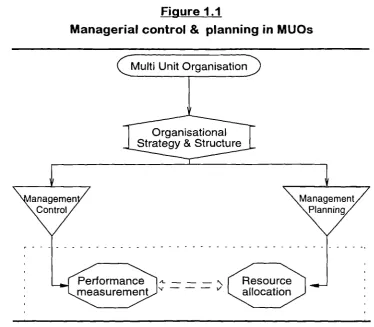
There is a number of assumptions portrayed in Figure 1.1 concerning management control and planning. Organisational strategy and structure are considered as the starting points of MUOs management which is then employs control and planning mechanisms for realising the strategies. Performance measurement and resource allocation are among the most typical perceptions of management control and planning mechanisms in MUOs. Furthermore, in Figure 1.1 an extended conception of management control is advocated, which enhances the role of control from a simple feedback mechanism towards an integrated process that interacts with the very nature of organisational design. This type of control systems seek to relax the traditional view that management control follows on and is inferior to the organisational design process.
A dialectic consideration of organisational control and planning processes would need to expand the traditional performance measurement and performance reporting features of control. It is argued that this enhancement of control mechanisms can be achieved by linking performance measurement with target setting and resource allocation processes.
performance. These alternative perspectives can also be found when analysing the development of planning (resource allocation) processes in MUOs. The effects of alternative perspectives of performance assessment are discussed in more detail in chapter two.
3. Managing resources in organisations: Concepts & current practice
The operation of organisations is based on the use and deployment of resources. There is a variety of tangible (e.g. human resources) and intangible (e.g. information) factors that can be considered as resources. It is argued, however, that resources (inputs) have no value unless organised into systems which ensure that resources will be transformed into goods and services (outputs). The design of effective systems for allocating, managing and controlling resources determines the organisational success. Issues concerned with the allocation and mix of resources and also with the relation between resource management and organisational structure are discussed next.
Decisions concerning resource allocation deal with two principal issues:
The broad issue of how resources should be allocated between the various functions, departments, divisions, and separate units.
ii. The more detailed considerations of !1..QW resources should be mixed and ultimately deployed within organisational units.
In the parlance of resource auditing resource mix reflects the "technology" employed by individual units anchor organisations. As Gold (1981) emphasised, an on-going scientific debate exists concerning the significance of input/output mix and scale/size problems in the neo-classical production theory. Chapter 2 will show that the economic approach for assessing efficiency assumes that the input/output mix of the assessed units/firms is to be pre served.
The amount of allocated resources among different operating functions is guided by the achievement of strategic/corporate organisational plans. The distinction between the amount of used inputs versus the optimal mix of inputs reflects the fundamental economic definitions of performance (technical and allocative efficiency, Fare (1988)) which are analysed in chapter two.
Chapter 1: Developing a research agenda of management control & planning in MUOs
(1987) and Argenti (1989). It can be argued that resource management is concerned with the capacity constraints whilst corporate and strategic planning reflects ppiicy constraints in view of the global organisational profile. This is portrayed graphically in Figure 1.2.
Figure 1.2
Policy & capacity domains in MUOs
.i Policy Domain ..' Capadlly Domain
Individual Unit level +
catlaTarget Seffing n,,)
+ Global Organisational level
+ .
Direction of influence
Figure 1.2 portrays the mechanism guiding the association between policy and capacity constraints in a MUO. Resource availability 3 influences the decision making process towards the global organisational achievements. In contrast, the policy constraints affect the allocation of resources at the individual unit level. The two issues, deciding at the
macro and implementing at the micro level need to be addressed separately. This is due to the fact that the objectives/criteria for making decisions at the micro and macro level are different. Macro level resource commitments encapsulate a "feasible" version of the strategic vision of the organisation due to capacity limitations. On the other hand, micro level resource commitments facilitate the achievement of strategic and corporate targets with reference at the individual operating unit. The case of global and unit level decision making will be considered in more detail in chapters five and six with operational models that will address both problems simultaneously.
To facilitate the disentanglement of capacity and policy domains let us consider a commercial bank. The total amount of capital to be allocated amongst bank branches in a time period forms the capacity domain of the bank. In other words, the bank's central
management has a given amount of capital to allocate among a set of operating activity centres, namely bank branches 4. The achievement of Corporate objectives of the bank are customised per individual branch and supported by appropriate resources. Illustrative cases of short run objectives concern profitability achievements; capital investment; the level of controllable expenses, etc. The long run objectives of the bank are concerned with its market share; the type of targeted clients; the number of operating branches, the policies regarding its major competitors, etc.
The capital available for investment will, effectively, influence the bank's expectations concerning the achievement of its short andlor long run objectives. For instance, the extent of redecoration in the branches' network is a function of capital availability. However, the actual implementation of the allocation process follows the opposite direction. The aim of accomplishing the policy objectives of the bank will drive the allocation of resources at the individual bank branch's level.
The previous example highlights the two way communication regarding the association between target setting and resource allocation in MUOs. Resource management overshadows target setting at the global organisational level. On the other hand in the management of individual operating units the allocation of resources is guided by the targets' achievement. The two way association between target setting and resource allocation creates trade-offs within multi-unit and multi-level organisations that will be discussed in more detail in chapters five and six.
3.1. Objectives for unit level resource allocation
The allocation of resources between operating entities is a major concern of corporate and strategic planning, Johnson and Scholes (1988). Resource allocation decisions have to be compatible with the short, as well as ig run organisational welfare. Organisational objectives need, therefore, to guide the resource allocation processes. The term objective indicates a preferred direction of movement for an organisation 5 , Keeney and Raiffa (1976). To measure and stimulate the achievement of individual objectives organisations
Generally speaking organisations decide at the beginning of each year on a level of expenditure. It is then a distinct issue to allocate resources to various organisational functions.
Chapter 1: Developing a research agenda of management control & planning in MUOs 11
use sets of criteria. For example, the objective of profit maximisation can be reflected using as criteria return on investment, return on equity, return on assets, residual income, etc. An objective for maximising the quality in the provision of health services can be reflected using patients' perspectives, recovery rate and quality adjusted life years (QALY).
A set of aims affecting resource management at the individual unit level is as follows: • Improve the short-run achievements
• Reward the good performers over time
• Support underperforming units with high potential Discussion for each attribute is provided below.
3.1.1. Improve the short-run achievements
The time horizon of achievements sought by organisations is affected by the nature of their stakeholders. A public limited company (plc), for example, may seek short run achievements in order to increase its share price in the stock market. Coates (1989) argues that in the post-1980 period in the UK the short run organisational performance has proven to be a highly significant factor guiding decision making. Short-termism in isolation can be a very dangerous practice with very adverse implications on the long run viability of organisations.
3.1.2. Reward the good performers over time
This attribute relates both to the short and the long run success of an organisation. Organisations seek to identify units with good operating practices and use them as benchmarks. Benchmarking has become a very fashionable tool of business policy, (see Journal of Business Strategy, (1993)). However, the identification of benchmark units is not sufficient if it is not supported by corresponding motivation mechanisms with the following characteristics.
a. Quantity
A good performer is a potential candidate (not always 6) for being given additional resources.
6
12
b. Effort
Rewarding the good performers provides stimuli for the underperforming operating units to improve their efficiency.
Evidently, "rewarding the good performers" has a "means to an end" character concerning the accomplishment of organisational objectives. In effect, rewarding "benchmarks" is a necessary but not sufficient condition for improved performance. Penalising the "bad performers" on the other hand, which could be seen as a natural by-product of the rewarding mechanism, could worsen the position of poor performers.
Needless to say the definition and identification of "good and bad performers" is a very important issue. MUOs are currently employing traditional profitability ratios in the private sector or performance indicators in the public sector for identifying good and bad operating practices. Chapters seven and eight discuss in more depth the limitation of these methods to assess performance and identify benchmarks.
3.1.3. Supporting underperforming entities with high potential
As mentioned earlier on, the management of MUOs allocates resources in order to achieve organisational objectives. A for-profit organisation, for example, allocates resources to increase demand for marketed products/services. To pursue this task management is called upon to identify individual units with products and services with the highest marketable prospects and then allocate resources. On the other hand, a "regulated" agency (public sector) allocates resources in order to satisfy demand for services under the regulation restrictions imposed by government or other regulating bodies (e.g. equitable provision of services, allowable price increases, allowable rate of return). Allocated resources are used to ensure sufficiency, efficiency and high quality in the provided services in a sector, where the demand is exogenously determined and there is legislation for its satisfaction (e.g. policing, education, health, etc.).
Undoubtedly, in both for-profit and not-for-profit organisations the available resources are scarce. This creates a problem of choice in the actual allocation of resources. Should more
resources be allocated to efficient units or should they be used to support underperforming units to revive their performance ? This dilemma stems from the fact that it is very difficult
13
allocated to efficient units can be underutilised as the unit's performance can be "saturated" due to exogenous factors (e.g. value added achievement at schools may prove to be bounded by the vely poor socio-economic status of the pupils' families). Similar arguments hold in the allocation of resources to inefficient units. Therefore, the current level of performance, in itself, does not indicate whether extra resources need to be allocated to a unit.
It is argued that the allocation of resources should be given priority towards the units with the highest "potential" for improving the overall performance of the organisation. The term "potential" has a twofold interpretation. Firstly, it measures the fertility of the environment in which a unit operates in (e.g. market's size for a profit making unit) and secondly, it reflects the internal ability of the unit to operate effectively (e.g. operating practice). Assessment of the external potential of a unit is particularly useful in the allocation of resources to profit making units and it will be explored further in chapter seven and eight. On the other hand, the tradeoffs between the allocation of resources to individual units and the improvement of the global performance of the organisation are of particular importance to non-profit organisations (see chapters five and six).
In summary, rewarding the good performers as well as supporting the underperforming units with high potential creates managerial trade-offs. Moreover, the achievement of optimum financial or fiscal type (e.g. market share) figures, in the short run could be conflicting with the long run achievements 7 of organisations. Finally, resource allocation needs to consider the potential incompatibilities and trade-offs between the allocation of resources in view of individual units' needs as opposed to those that seek to maximise the
global organisational welfare. This issue is pursued in more detail in chapters five and six of the thesis.
3.2. Resource management methods & performance
Management accounting literature, Ashton et al. (1991) argues that resource management ought to be seen in line with organisational control and planning and not just as "routine" based periodic job.
Undoubtedly, resource allocation is the "bread and butter" for different functions of an organisation. Budgetary planning; investment appraisal; portfolio investment; maintenance expenses and recurrent grants are illustrative cases of resource management in MUOs. This is an area of intense research by the accounting, economics, and management science disciplines during the last 30 years. A plethora of general processes have been developed and applied in various real life organisations e.g. Incremental Resource Allocation, planning Program Budgeting System (PPBS), Zero Base Budgeting (ZBB), Quasi markets (contracts) in the public sector, Profits Impacts on Market Strategy (PIMS), Product Portfolio Management, (PPM) evaluating the resource allocation process in the public and/or private sector of the economy. Despite the presence of numerous models for
resource allocation found in the literature the challenge of performance measurement and
its enhancement as an integral part of resource allocation is yet to be addressed
sufficiently.
A synopsis of the state of the art methodologies of resource management follows next. It draws, mainly on the limitations of traditional resource management methods to encapsulate performance measurement characteristics. This analysis highlights the necessity for enhancing the current perceptions and practices of resource management to integrate it with performance measurement.
Undoubtedly, incremental resource allocation is a common practice for a large number of profit and non-profit organisations. The term "incrementalism" refers to a pattern of marginal change in final allocation of capital relative to some base, which is frequently the previous year's capital allocation, Davis and Dempster (1966). The simple to use and the pragmatic character of incrementalism are necessary but not sufficient conditions for effective resource management. The main drawback of this methodology emanates from the fundamental assumption that the past decisions for allocated resources were used efficiently without any allowances for inefficiency and/or mismanagement.
The dissatisfaction with the incremental method led to the development of alternative methodologies for managing resources like the Program- planning-Budgeting System (PPBS) 8 . The key feature regarding PPBS is the "program" element as being the subject of
Chapter 1: Developing a research agenda of management control & planning in MUOs 15
the resource allocation appraisal in an organisation. For instance in the context of, say, Local Authorities the tax collection service requires collaboration of staff operating in different departments. Under PPBS rules the "program" will be evaluated as if it was a coherent "program" providing the given service. The very demanding procedures (timewise and managerial effort) for implementing PPBS is one of the main drawbacks of the method in real life problems, Coates et al. (1989).
In an attempt to overcome the difficulties of the PPBS a new system, namely Zero-Base Budgeting, has been introduced. In essence, Zero Base Budget (ZBB) is a decentralised mechanism by which management can closely examine and reconsider the resource levels used by operating units. Departmental activities are organised into decision packages which are then prescribed functions, goals, and costs. Each decision is evaluated and ranked in the light of cost-benefit analysis and it is repeated from a zero base9 every year. The method succeeds in focusing managerial attention on reviewing the organisational functions and their costs and benefits. In practice, the management responsible for implementing ZBB has proven very indecisive in articulating preferences over alternative decision units which made the method very time consuming. Finally, the strong judgmentallqualitative character of the method does not allow for the measurement of any direct impacts on the productivity of the operating units, (Sherman (1986)).
A relatively new methodology of resource management in the public sector in the UK is the contract or quasi internal markets with main area of application (at present) the National Health Service in the UK. Resources are allocated by district health authorities to hospitals with the most "attractive" bids concerning particular health services. The basic assumption is that the quasi-competitive market will force hospitals to increase efficiency and therefore reduce the costs of running the National Health System (NHS). Despite the embryonic stage of the system it has already surged a very serious scientific and political debate regarding the evaluation and appropriateness of the quasi-market experiments, Ferlie
(1993). The early signs from the application of the quasi-market system indicate increases in
efficiency whilst strong concerns have been raised regarding the deterioration in equity and possible effectiveness of the provided services. The importance of these objectives of resource management are discussed in more detail in chapter four and six of the thesis.
The Profit Impacts on Market's Strategy (PIMS) system is a popular tool for resource management and strategy evaluation of profit making organisations, Schoeffler (1974). PIMS seeks to combine information from a wide sample of organisations with ultimate scope to provide decision support to companies included in the sample of the system. Nowadays, a whole variety of databases with purposes similar to PIMS can be found around the world. However, the use of very simplistic analytical tools for obtaining statistical forecasts has been criticised as the main limitation of these systems. As it will be argued in chapters seven, eight and nine, the limitation of these models emanates from their inability to disentangle different components of organisational performance (e.g. distinguishing responsibility of different level management) and also from the lack of differentiation between diagnostic and planning focused analyses (see Epstein and Henderson (1989)).
Strategic resource planning has been given great academic and consulting research attention in the late 1960s. Illustrative examples are the Boston Consulting Group (BCG) model, Henderson (1973), the Industry Attractiveness and Business Strength model, Hax and Majluf (1983), the Marakon's model (1980). These models view firms as a portfolio of businesses, each one offering a unique contribution to growth and profitability. The methods adopted are based on the development of product portfolio matrices classifying individual businesses into business clusters with different planning implications. The growth-share matrix systems have had a major contribution to strategic resource planning providing a basis for systematic analysis. Major achievement of this debate is the realisation of the multidimensional nature of any attempts for devising resource management plans in organisations, see Hax and Majluf (1983).
17
4. Resource management and improved performance
"The concept is simple- objectives, results, and resources should all be linked. The application is difficult'°"
The ultimate objective to mould the resource management process into a "performance manifesto" constitutes a managerial aspiration. Undoubtedly, the financiallfiscal difficulties that many countries are facing reinforces the necessity for embracing performance in resource management decisions. This, although very prominent as an idea, has very many operational and practical difficulties. Schick (1990) argues that what is needed is merely to foster a managerial environment which is attentive to performance when funds are parcelled out. However, it seems unlikely that current resource allocation methods are able to encompass performance measurement effectively.
The numerous resource allocation processes discussed earlier on are not very successful in accommodating performance issues within the allocation process. This is mainly a result of the incompatibilities between the managerial processes adopted for allocating resources and those for assessing performance. Some of these incompatibilities are sought to be alleviated in the remainder of the thesis.
4.1. Relation between organisational structure and resource allocation
Heretofore, the discussion on the notion of resource allocation has been seen independently from the structural characteristics of MUOs.
Does the organisational structure of MUOs have an impact on the adopted resource allocation processes?
. Is resource allocation in the National Health Care systems, for instance, the same as the resource allocation in a grocery retailing company?
Are the same analytic methods needed for supporting resource allocation decisions made for covering running costs to the ones covering costs of investment projects?
Resource allocation will be distinguished next into a number of categories depending on the structure and nature of the MUOs concerned.