warwick.ac.uk/lib-publications
A Thesis Submitted for the Degree of PhD at the University of Warwick
Permanent WRAP URL:
http://wrap.warwick.ac.uk/93676
Copyright and reuse:
This thesis is made available online and is protected by original copyright.
Please scroll down to view the document itself.
Please refer to the repository record for this item for information to help you to cite it.
Our policy information is available from the repository home page.
Reasoning about Systems with Evolving Structure
by
Anna Philippou
Thesis
Submitted to the The University of \Varwick
for admission to the degree of
Doctor of Philosophy
Contents
Acknowledg~ents Declarations
Abstract
Glossary
Chapter 1 Introduction
1.1 Mobility...
1.2 Determinacy and Confluence .
1.3 Concurrency Control of B-trees
1.4 Object-oriented languages .
1.5 Summary of the thesis
Chapter 2 Background
2.1 The 7!"v-calculus ..
2.2 Sorting • . . .
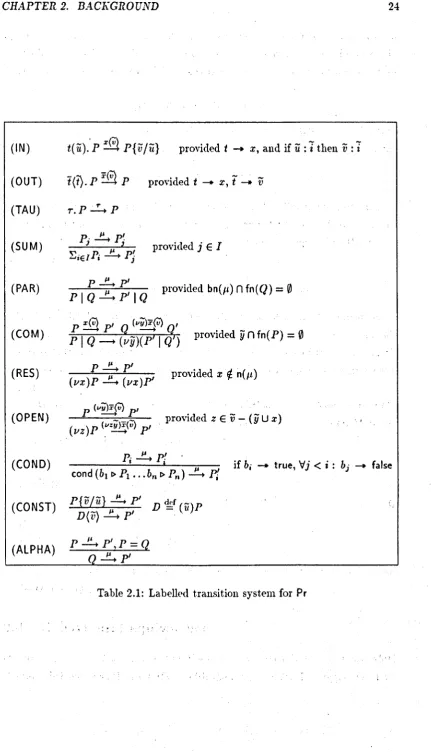
2.3 Labelled transition semantics
2.4 Dehavioural equivalence . . .
2.4.1 Dranching bisimilarity
2.4.2 Coupled simulations
2.4.3 Divergence
2.5 Friendly agents . .
.
.
.
Chapter 3 Determinacy and Confluence
3.1 Determinacy . . . .
3.2 Preserving Determinacy .
3.3 x-determinacy
3.4 Confluence . .
ii v vi vii
...
Vlll 1 2 4 6 8 10 13 14 19...
223.5 Preserving Confluence
3.6 x-confluence
3.7 Divergence .
3.8· II-confluence
3.9 Labelled transition systems
3.10 A Protocol Example . . .
3.10.1 The Algorithm . .
3.10.2 Correctness Proof
Chapter 4 Partial Confluence
4.1 Partial confluence and divergence •
4 2 • dbR -b" 1S1m1 an '1 't y • • • • • • •
4.3 Social confluence . . . . .
4.4 \Vhen names are not new
Chapter 5 Concurrent Operations on B-trees
5.1 The structure . . . .
5.1.1 The low key.
5.2 Correctness Proof . . .
5.2.1 Analysis of
To .
5.2.2 Analysis of Qo
5.2.3 Majn Results
.
5.2.4 Full Results . .
5.3 The Concurrent Search Structure
5.4 Deletion and compression
.
5.4.1 The Algorithms.5.4.2 Correctness . . .
Chapter 6 Concurrent Objects
6.1 The programming language
6.2 The semantic definition
6.3 Determinacy . . . .
6.4 A D-program is confluent
6.5 Transformations
6.6 Correctness . . .
6.6.1 A guarded community
6.6.2 Deadlock freedom
6.6.3 Partial Confluence
6.6.4 Transformation 1 .
6.6.5 Transformation 2 .
Chapter 7 Conclusions and Future Work
7.1 Conclusions . . . .
7.1.1 Determinacy and Confluence in the 1I'v-calculus
7.1.2 B-tree operations . . .
7.1.3 Determinacy in 11'0(3).
7.1.4 The transformations
7.2 Future work: . . . .
7.2.1 Deter~inacy and Confluence
7.2.2 Partial Confl.u~nce and Concurrency Control 7.2.3 Concurrency by transformation
7.2.4 Concurrent Objects . . . .
Bibliography
Index
iv
207
217
224
224
225
226
227
228
229
229 232
232
233
235
Acknowledgments
First of all, I would like to thank my supervisor David Walker without whom this
work would not have been possible. I am indebted to him for acquainting me with
concurrency theory as well as for teaching me the practice and purpose of research.
Throughout the development of this thesis he was always willing to discuss my work
and with his original ideas he guided me through the arguments of the thesis.
Furthermore, I am very grateful to the Department of Computer Science,
University of Warwick, for employing me as a Teaching Assistant during my Ph.D.
studies, providing me with financial support and a valuable experience. :Many thanks
also go to my colleagues in the department for contributing towards a stimulating
and friendly working environment, and Xinxin Liu for interesting discussions while
he was at Warwick. Drafts of chapters of the thesis were read by Leslie Goldberg
and Michael Luck and I am grateful for their useful suggestions on presentation.
I would like to thank my friends for their encouragement and for making my
time at \Varwick enjoyable - in particular, Niki, Tommaso, Irena, :Mike and Paul,
and finally, my parents for the support they have given me over the years.
* * *
This is a revised version of my thesis; I have benefited greatly from the
constructive criticism of my examiners Uathai Joseph and Frits Vaandrager.
Declarations
This thesis was composed by myself and the work is my own unless otherwise stated. Material from the thesis has been published in conference proceedings.
Abstract
This thesis is concerned with the specification and verification of mobile systems, i.e.
systems with dynamicaliy-evolvillg commullicatioll topologies. The expressiveness
alld applicability of the 11" v-calculus, all extellsioll of the 1I"-calculus with first-order
data, is investigated for describing alld reasoning about mobile systems.
The theory of confluence and determinacy in the 1I"v-calculus is studied, with
emphasis on results and techlliques which facilitate process verification. The
util-ity of the 'calculus for giving descriptions which are precise, llatural and amenable
to rigorous allalysis is illustrated in three applications. First, the behaviour of a
distributed protocol is allalysed. The use of a mobile calculus makes it possible to
capture important intuitions cOllcernillg the behaviour of the algorithm; the theory
of confluence plays a central role in its correctness proof. Secondly, au analysis of
concurrent operations on a dynamic search structure, the B-tree, is' carried out.
This exploits results obtained concerning a notion of partial confluence by whose
use classes of systems ill which illteraction between compollents is of a certain
dis-ciplined killd may be allalysed. Fillaliy, the 11" v-calculus is used to give a semalltic
defillitioll for a cOllcurrellt-object programmillg lauguage alld it is shown how this
definition can be used as a basis for reasoning about systems prescribed by programs.
Syntactic conditions on programs are isolated and shown to guaralltee determinacy.
Transformation rules which increase the scope for concurrent activity within
pro-grams without changing their observable behaviour are given and their soundness
proved.
Glossary
The following table summarizes the main notations used in the thesis. The pages
numbers refer to the page where the notation is first used.
PROCESS CONSTRUCTIONS
a,b names 14
t data term
15
t
*
lj field selector15
a· prefix
16
t(u),
1(1),
T input, output and silent prefixes16
D agent constant
16
D ~f (vu)P constant definition 17
D(u) constant application
16
F process abstraction
16
Pr set of process expressions
16
P,Q
process agents16
EiE/aj.Pj process sum
16
PIQ
parallel composition16
0 inactive agent
16
(vx)P restriction
16
cond (tIl> PI, ... , tn I> Pn ) conditional agent
16
!P replication 18
fn(P), bn(P) free and bound names of P
17
obj(a), subj(a) object and subject of a
16
PROCESS SEMANTICS
= o:-equivalence 17
-
structural congruence , 19C Act
,:. ,
set of observable actions 22
Act+ set of actions 22
J-l action 22
IJ
labelled transition 22
--+
fn(jt), bn(J-l), n(J-l) free names, bound names and names of Jt 23
0: camp f3 complementary actions 23
N,~ strong and weak bisimilarity 26
N ' branching bisimilarity
28
=CII coupled equivalence 30
=cw weak coupled equivalence 30
~l d-bisimilarity 32
, '
~l d b- bisimilari ty 32
~tr trace~~quivalence 43
·R
~! dbR-bisimilarity 106
o:lf3 the weight of 0: over f3 "
49
8/0:
the excess of 8 over 0: 54L sort 14
L+ set of actions with positive subject in L 23 L- set of actions with negative subject in L 23
L± L+ UL- 23
cc(p) the convergent core of P 63
TpV the pruning operation 75
pR
pruned transition system of P75
T~l pruned state space of T 103
p~ pruned transition system of P
103
Chapter
1
Introduction
Concurrency is one of the most challenging areas of research in computer science.
The construction, description and analysis of concurrent systems is a difficult task.
The overall behaviour of a concurrent system is the result of the interactions· of
its individual components and their consequent evolution. Many threads of control
may be present and several interactions may take place at the same time, and this
can give rise to subtle and often unanticipated, indeterminate behaviour.
The development of mathematical frameworks for reasoning about concur- .
rent systems has been a major goal of research.· Many models and methods have
been proposed in the past few decades.· One of the most successful among them
has been process calculus. Robin Milner's CCS [Uil80, Mil89] is generally accepted
to be the initiator of this approach. It, and similar theories such as ACP [DW90],
CSP [Hoa85], and Meije [Dou85], model the pure communication and
synchroniza-tion aspects of concurrent systems with the aid of a small selecsynchroniza-tion of basic
con-structors each representing a distinct idea. A limitation of such calculi is that the
set of channels via which a term of the calculus may communicate with its
environ-ment is completely determined by its synta.,< and remains fixed during computation .
. Effectively, this prevents the notion of mobility from being captured in the calculus.
There have been a number of attempts to introduce mobility into process
calculus. The most prominent of these is the 1r-calculus of Milner, Parrow and
Walker [MPW92]. This is a calculus of communicating systems in which one can
naturally express processes which have changing structure. Not only may the
com-ponent agents of a system be arbitrarily linked, but a communication between
ndgh-bours may carry information which changes that linkage. Central to the 1r-calculus
is the notion of name. Processes which share the acquaintance of a,
na~le
may 'useit to communicate with each other and, as names may be passed as objects of
CHAPTER 1. INTRODUCTION 2
teractions, name acquaintances, and thereby the capability to communicate with
other processes, can be acquired. This gives the calculus a much greater
expres-siveness than CCS. For instance, there have been encodings into the 7r-calculus of
the A-calculus [Mi192a], agent-passing process calculi [Th090, San92, Ama93], and
concurrent-object languages ['Val91, Jon93b]. Furthermore, it has been used to
model communication protocols [OP92, Ora94] and data structures [Uil92b]. Over
the last six years it has been a subject of intense research and its mathematical
theory has been substantially developed while automated tools [Vic94] have been
constructed to aid with reasoning about 7r-calculus processes.
The purpose of this thesis is to experiment with a variant of the 7r-calculus
for describing and reasoning about mobile systems. The calculus under study, the
7r v-calculus, is an extension of the polyadic 7r-calculus which accommodates data
values other than names and a kind of conditional agents. We illustrate how it can
be used for giving precise and natural definitions for a variety of systems. Then we
employ the process-calculus descriptions as a basis for reasoning rigorously about the
systems in question. A major benefit of such a study is that it allows us to observe
the mobile process calculus and its associated techniques in action and thus to draw
conclusions regarding their usefulness, limitations and applicability. Furthermore,
it allows the distillation of common patterns of behaviour of mobile systems worthy
of systematic analysis and leads to the refinement of process-algebraic techniques.
In addition, the thesis contains a study of the notion of determinacy and confluence
in the mobile setting, with emphasis on the development of results and techniques
regarding these and related notions which can be used to facilitate process
verifica-tion. Indeed, the theory developed plays a central role in the analysis of all three of
the applications we consider.
In the next section, we give a brief overview of the major attempts to
en-capsulate mobility ill models of concurrency. 'Ve then proceed to discuss the main
motivations and directions followed in the thesis. In the subsequent presentation, it
is assumed that the reader is familiar with process calculi such as CCS and we refer
to [MilS9] for background information.
1.1 Mobility
There have been a number of concurrency, formalisms which allow mobility other
than the 7r-calculus. However, their theory has not yet been fully developed. The
first of these is Hewitt's actor systems [CllSl, AghS6]. An actor is an active
CHAPTER 1. INTRODUCTION 3
asynchronous messages which are themselves actors. New actors may be created as
computation proceeds and the acquaintances of an actor may change. Thus systems
with dynamically-evolving structure can be expressed. The actor model has been
fairly successful in reasoning about mobile systems and it has been used in
study-ing computer architectures and object-oriented languages. However, mathematical
treatment of its basic concepts has not been elaborated and notions of behavioural
equivalences have not been explored, especially when compared with analogous work
on process calculi.
An algebraic formulation of mobility was first achieved by Engberg and
Nielsen [EN86]. Their Extended CCS (ECCS) featured mohility by using label
expressions to capture parametric channels. However, the somewhat difficult
treat-ment of constants, variables and channels hindered its success. The 1r-calculus was
strongly influenced by that work. Features such as the semantic treatment of scope
extrusion and the extension of the definition of bisimulation, originated from the
work on ECCS. However, by removing the distinction between ECCS entities, the
ll'-calculus yields an elegant and uniform framework where only names and agents
are involved .. A refinement of the 1r-calculus, the polyadic 1r-calculus, was presented
in [Mil92b] where communication of tuples was added and a notion of typing of
channels was introduced. Other wor~ on models for processes without the
restric-tion of a fixed initial connectivity includes the DyNe formalism of Kennaway and
Sleep [KS85], which was developed specifically to descrihe parallel graph reduction
in the context of a project to design a parallel processor, and work on paranietric
channels by Astesiano and Zucca [AZ84].
These models achieve mohility by enriching the handling of a channel. Dy
contrast, an alternative approach for achieving mobility, often referred to as the
higher-order approach, is by 'transmitting processes as messages. It was studied by
various authors, including Astesiano and Reggio [AR87] in the setting of algehraic
specification, Doudol [DOti89] in the context of the A-calculus, and Nielson [Nie89]
with emphasis on types. In addition, Thomsen's Calculus of Higher Order
Com-munication (CHOCS, [Th090]) is an extension of CCS where the cOlltent of
com-munication are processes, while Sangiorgi's Higher-Order ll'-calculus (HO~, [San92])
enriched the 1r-calculus to a110w the communication of process abstractions. The
latter author also compared the approaches and showed that such' an extensiOll
CHAPTER 1. INTRODUCTION 4
1.2
Determinacy and Confluence
Many concurrent systems are inherently indeterminate. Consequently, general
mod-els of concurrent systems, and in particular semantic accounts of concurrent
pro-gramming languages, are more complex than those for sequential systems and
lan-guages. However, in constructing a concurrent system or program it is often the
intention that it will operate in a 'well-behaved' way. In particular, it might be
expected that the system will be predictable, in the sense that if the same
ex-. periment is run twice from the initial state of the system then, each time, the
system will exhibit the same behaviour. Such ideas motivated the study of the
notions of determinacy and confluence in concurrent systems, initiated in process
. .
calculi by Milner in [MiISO, MilS9] and subsequently elaborated by other authors
[SanS2, Tof90, GS95, Nes96]. (For background information on determinacy and
confluence see Chapter 11 of [MilS9] and for the precise definitions of the notions
see Chapter 3 of this thesis). The theory has been employed in various contexts.
For example, in [GS95, MiIS9] it was employed for protocol verification, while in
[HP94, Qin91] it was used for on-the-fly reduction of finite state spaces.
Further-more, in [Tof90, Nes96], it was studied and discussed within the context of concurrent
programming.
There appear to be two main benefits of a rigorous study of determinacy and
confluence for concurrent systems. First, given that determinate behaviour may be
significant for a variety of systems, it appears worthwhile to consider the
develop-ment of a compositional method for the construction of determinate and confluent
systems. Indeed, a main motivation behind the theory developed in [MilS9] was to
provide a theoretical framework within which one may build determinate systems
from determinate components. Secondly, determinacy and confluence of systems
may be systematically exploited in formal verification. For instance, one of the
main observations made in [UilSO] was that trace equivalence coincides with
bisim-ilarity for confluent CCS agents. Furthermore, confluent agents are semantically
invariant with respect to internal actions. These facts considerably ease the task of
verifying confluent systems.
In this thesis we perform a rigorous analysis of determinacy in the context
of the 1!' v-calculus. \Ve explore and compare a number of different formalizations
of the notion, each built on a distinct behavioural equivalence, and we investigate
their theory. We also study in some depth which of the calculus constructors
pre-serve confluence and distinguish constructs that may be a source of indeterminacy.
compo-CHAPTER 1. INTRODUCTION 5
nents of a system to access the same resource. For example, suppose that at some
point during the computation of a certain system, two of its components are able to
communicate via a channel with a third. The subsequent behaviour of the system
will, in general, not be independent on which interaction takes place and hen~e, the
behaviour of the system is unpredictable. This possibility is not specific to mobile
systems. Rather, it is a source of indeterminacy for concurrent systems in general.
However, to prevent such situations from arising requires special consideration in a
mobile setting since the topology of a system does not remain fixed during compu- '
tation. Thus, given a mobile agent, it is not sufficient to impose conditions on the
capabilities of using names solely on its initial state. It is also necessary to ensure
that names are used in a disciplined way so that sharing may never arise. Other
features specific to the calculus under study are scoping of names and name
instan-tiation. We address these in detail. A key observation is that in reasoning about
the behaviour of a confluent system it is often sufficient to examine in detail only
a part of its behaviour: from this and the system's confluence it is then possible
to deduce properties of the remaining behaviour. This observation is exploited in
many instances in the thesis .
. It is often the case that systems have some good behavioural properties but
fall short of being confluent. Various authors have been concerned with the
investi-gation of such properties which can be captured formally and exploited for process
verification. \Vith the aim of identifying condi.tions under which combinations of
non-confluent agents yield confluent systems, a study of notions of semi-confluence
was undertaken in [Tof90]. Another notion of partial confluence was introduced
in [LW95a]. Like semi-confluence, the essence of this notion is that the occurrence
of some actions will not preclude the occurrence of some others. However, a
funda-mental difference of partial confluence from the earlier notions of (semi) confluence
is that it does not require agents to be semantically invariant under silent actions.
The motivation behind its definition was to study systems composed of non-confluent
but well-behaved components, capable of state-changing internal actions. Its theory
was developed and it was applied to prove the indistinguishability within an
arbi-trary program context of two classes expressed in a concurrent-object programming
language ..
In the thesis we consider a number of extensions to the theory of partial
confluence in the context of the 1r v-calculus. The first is concerned with extending
the partial confluence theory of [L\V95a] to take explicit account of divergence. The
motivation behind the development was provided by our study of a concurrent-object
CHAPTER 1. INTRODUCTION 6
for concurrent-object programs. In this context, divergence is considered to be an
undesirable property of the systems studied and thus it is appropriate, to employ a
notion of observation equivalence that takes account of infinite silent paths.
A key insight provided by the partial confluence theory of [LW95a.] is that
when reasoning about partial-confluent systems in which interaction is of a certain
disciplined kind, it is sufficient to examine only
a
part of their behaviour. The sys-tems considered can be viewed as consisting of a client and a server which interactin a question-answer fashion, with possibly many questions outstanding at any
mo-ment. An importaut characteristic of these systems is that on accepting a question
from the client, the server immediately assumes a state in which the answer to that
question is determined. Moreover, it is assumed that when a question is invoked
in the client, the name which is supplied for return of an answer is distinct from
answer names supplied in other question invocations. This form of question-answer
interaction is quite common in computer systems. However, it is often the case that
the processing of a question by a server results in a change of the server's state.
For example, the commitment to perform a write of a register in a multiple-read
single-write memory alters the state. \Ve consider two significant generalizations of
the theory of [LW95a.] which relax these two assumptions aud prove that analogous
results hold.
1.3
Concurrency Control of B-trees
Concurrent access to complex data structures and, in particular, structures which
serve as indices to database systems has long been au area of active research in
the database community. One of the main challenges has been to design
struc-tures and their associated operations which provide a high degree of concurrency
. while preventing interference among concurrent processes and efficiently support
multiple users. Furthermore, such structures should be able to handle growth and
to rebalance themselves as the amount of data stored increases and decreases.
A variety of such dynamic structures have been proposed in the literature,
in-cluding dynamic hash data structures [Ell87, Lar78, Lom83] and binary search
trees [KL80, l1L84, Ell80j, and a variety of algorithms have been proposed and
implemented for them.
The structure we investigate in the thesis is the D-tree [Dl\Ii2] which, along
with its variants, is another widely used index structure. Concurrent operations on
such structures have been studied in many papers, including [DS77, K\V82, LY81,
CHAPTER 1. INTRODUCTION 7
on a variant of the B*-tree [\Ved74]. This variant is the Blink_tree of [LY81], and the operations are those of [Sag86] which improve on the operations given in [LY81].
In [LY81] and [SagS6], the structure is described and explained using prose and
diagrams, the algorithms are described using pseudo-code, and the arguments for
their correctness are informal ~hough detailed.
It is generally accepted that it is often very difficult to construct concurrent
systems and give convincing arguments that they satisfy desired properties. Indeed,
without a formal model of the system in question, it can be difficult to even express
precisely what the properties are. In the case of database concurrency control many
varieties of 'serializability' have been proposed and used as criteria by which to
judge algorithms, each suitable for different settings. For instance in [Sag86], the
. . .
notion of 'data serializability' was adopted which requires that any 'schedule of
the operations' arising by executing the algorithms is 'data equivalent to a serial
schedule' and 'preserves the validity of the data structure'.
By using the 7r v-calculus as a basis of our analysis, we may give direct and
succinct descriptions of the operations and the underlying data structure which
capture naturally its dynamically evolving interconnection. In addition, we are
able to assert the criterion of correctness of the system in terms of its observable
, .
behaviour, in contrast with forms of serializability. This is achieved as follows: we
define a simple agent which captures the intended behaviour of the system and assert
that the agent-description of the system and the simple agent are behaviourally
equivalent. The principle that concurrent systems should be compared on the basis
of their observable behaviours is widely held and has been studied in depth' in
concurrency theory, beginning with [UilSO]. It has also been explored extensively
and has been argued to be sound specifically in the area of database concurrency
control in a study of atomic transactions in [L1nVF94]. That study employs
1/0-automata, which are themselves very closely related to process calculus [Vaa91], to
give a uniform analysis of a great variety of concurrency control algorithms.
In our view, the use of a mobile process-calculus for reasoning about such
algorithms has two significa:nt benefits. First, unlike I/O-automata, it allows a
direct representation of changing structure in systems and, secondly, by acting as
unifying framework for the description of a variety of systems, it allows concepts and
techniques developed for the purpose of one application to be generalized and applied
in others. Indeed, verifying the correctness of the B-tree algorithms is significantly
facilitated by the use of the theory of partial confiuence. In fact, the theory enables
us to prove that the full system, in which several search processes may be accessing
CH.4PTER 1. INTRODUCTION 8
it: when each node allows at most one access at a time, and when the whole tree
allows at most one operation to be active at any time. These observations allow us
to obtain results about the full system by analysing the simpler systems.
1.4
Object-oriented languages
The notions of name and mobility are common in many areas of computer
sci-ence. One such area, much studied in the last few years, is that of concurrent
object-oriented programming. A program described by concurrent object-oriented
languages prescribes a system containing a collection of objects which refer to each
other by using names. As computation proceeds new objects may be created and the
linkage among objects may change with the passing of names among objects. Thus,
the ability of the 1r-calculus to directly encode such features makes it promising for
giving semantics to these languages.
The idea of using a process calculus to give a semantic definition to a
con-current programming language was first studied in [Uil80, Mil89], where a simple
concurrent programming language was given a semantics by translation to CCS.
This method was further explored in [Pap92] where the use of CCS for giving
se-mantics to sequential object-oriented languages was studied while in [Vaa90] the
parallel object-oriented language POOL Was given a translation to the language of
ACP. Furthermore, semantics were given by translation to the 1r-calculus and its
variants: for instance, 1r-calculus [Wal91, Jon93b, \VaI95a], Higher-Order 1r-calculus
[Wal95b], CROCS [Th093], 1r-calculus with simple values [Wal94, PW95], and an
extension of 1r-calculus with higher-order abstractions and data other than names
but with only first-order interaction [LW96]. The idea of using mobile calculi as
a framework for studying object-oriented languages was a motivation behind the
development of the Pict programming language [PT94]. This is a language based
on the 1r-calculus within which one may express concurrent objects.
In the thesis we build on work using mobile process calculi as semantic bases
for concurrent-object languages. In our view these general models of concurrent
systems with changing structure are very well suited to giving natural and direct
semantic definitions of such languages. Our main motivation is to experiment with
the semantic definition for a specific concurrent-object lauguage in order to n'ason
rigorously about programs expressed in it. Indeed, a major reason for experimenting
with mobile process calculi for giving semantics to object-oriented languages is the
desire to employ their theory to prove behavioural properties of systems prescribed
CHAPTER
1.INTRODUCTION
9time, the intention is to investigate the calculi themselves, to develop their theory
and explore how they can be refined and enriched in order to capture more
success-fully the features of the systems under study and thus facilitate their specification
and verification.
\Ve begin our analysis by studying the notion of determinacy within the
language and we isolate syntactic conditions which guarantee that programs
con-forming to them are determinate. As demonstrated in our study of determinacy
and confluence in the 11' v-calculus, in order to achieve this, it is sufficient to ensure
that in no state reachable from the initial configuration of a program do two objects
share the ability to communicate with a third. Thus we seek syutactic couditious
on programs which ensure that references to objects may not be shared. To achieve
this without impoverishing the language too severely we augment it with an
expres-sion form which expresses a destructive read of a variable. This gives a means of
expressing cleanly that wheu one object sends to a second object a reference to a
third object, the first object relinquishes the reference to the third. The proof of
the claim that the conditions guarantee determinacy of programs is carried out on
the basis of the translational semantics to the 11' v-calculus. It turns out that the
translation of a program satisfying the conditions is an agent which falls into one of
the classes that our process-calculus study has categorized as determinate and even
confluent.
Motivation for the second part of our study was provided by the work of
C D Jones on the formal development of concurrent programs utilizing ideas from
object-oriented programs. A central part of the development process was the
ap-plication of transformations to increase the scope of concurrent activity within
pro-grams without altering their observable behaviour [Jon93a, Jon93b]. In these papers,
Jones suggested the 11'-calculus as a basis for proving the correctness of these
trans-formations because of its rich algebraic theory and the directness of the semantics
it provides to the language under study. He proceeded to give some arguments for
the correctness of an application of the transformations and raised the challenging
question: under which conditions may the transformation rules be safely applied,
and how may the existing techniques for reasoning about programs be extended and
used to prove their soundness? A central part of this chaU('uge involwd
formaliz-ingan appropriate correctness crit('rion for the soundness of the transformations.
Briefly, this should identify program fragments which, although exhibiting different
observable behaviours, cannot be distinguished by program contexts. A solution to
this problem was provided by Liu and Walker in [LW95a], where the correctness
CHAPTER 1. INTRODUCTION
10
indistinguishability of two classes of a concurrent-object language within arbitrary
program contexts and it was achieved by capturing important properties satisfied
by the classes and legal program contexts. Here our aim is to enunciate syntactic
conditions under which the transformations may be applied and prove that this is
the case. Generalizations of the syntactic conditions which guarantee determinacy
play a role in the rules we consider. Furthermore, the theory of confluence and
partial confluence is central to the proof of correctness. In particular, we observe
that in order to reason about the behaviour of the systems in question it is sufficient
to examine in detail only a part of their behaviourj from this and the fact of the
system's (partial) confluence, it is possible to deduce properties of the remaining
behaviour. \Ve employ the theory of partial confluence accommodating divergence.
This turns out to be necessary as, in considering the correctness of the
transforma-tion rules, the possibility of non-terminatransforma-tion of method invocatransforma-tions must be taken
into account.
Various other theoretical frameworks have been developed and used for
study-ing object-oriented languages. \Vithin the context of the process-calculus approach,
various authors have used extensions of (mobile) process calculi by adding objects
and functional constructs. \Vork in this area includes Oscar Nierstrasz's Object
Cal-culus [Nie91]j furthermore, [Vas94, KY94, San96] concentrate on interpreting typed
objects in process calculi. A different possibility for studying concurrent objects
was offered by the actor model. This has been used for the design of concurrent
object-oriented languages (e.g. AllCL [Yon90]).
Recently, an application-oriented approach was undertaken in the
develop-ment offunctional object calculi [AC94b, AC94a, AC96]. These calculi, which have
primitives for object-oriented features, have been used to account for a range of
object-oriented concepts and have led to the design of object languages (Obliq
[Car95]). All such calculi developed until now are sequential. However, the
ap-proach appears to be very promising and it will be interesting to see it extended to
the concurrent setting.
1.5 Summary of the thesis··
. \ ,
We begin Chapter 2 with an introduction to the 7r v-calculus. We present its syntax
and its operational semantics and we proceed to impose a sorting discipline on
its terms. \Ve continue with a review of aspects of observational equivalence and
divergence which we will employ in the thesis. Finally, we introduce SOllle useful
CHAPTER 1. INTRODUCTION 11
which guarantee that the properties are enjoyed.
In Chapter 3, we carry out a study of the notions of determinacy and
con-fluence in the 7r v-calculus. One of the aims is to derive as simple characterizations
for them as possible, as this will facilitate the confirmation of their satisfaction by
systems. \Ve present three notions based on weak bisimilarity, branching
bisimilar-ity and a divergence-sensitive variant of weak bisimilarbisimilar-ity. The three notions are
closely related and, in fact, the ones based on the first two bisimilarities coincide.
We investigate their preservation by combinators of the calculus and observe that
confluence, which is a stronger notion than determinacy, is preserved by a
reason-ably large class of restricted compositions. \Ve illustrate the theory of confluence.
and the 7r v-calculus with a substantial example: a verification of a protocol taken
from [Vaa95] .. The proof uses a confluel1ce argument which considerably reduces
the complexity of the problem and is facilitated by the use of sorts. Moreover, it
employs mobility to dynamically represent intuitive ideas concerning the protocol.
In Chapter 4, we deepen the analysis of confluence to the partial case. First,
we study a notion of partial confluence which is sensitive to divergence. \Ve develop
some of its theory and extel1d the results of [LW95a] to this setting. Then, we
present two extensions of these results to encompass a wider range of systems. \Ve
refer to the set of properties required of the agents under study as social confluence.
It turns out that in order to achieve one of the extensions it is necessary to refine the
notion of partial confluence to a notion which although not implying determinacy,
can nonetheless be argued to be we11- behaved.
In Chapter 5, we perform a rigorous analysis of concurrent operations on
B-trees. We model the system consisting of the data structure and the operations
as an agent'. The criterion of correctness is formalized in terms of the observable
behaviour of the system under study. More specifically, we define a simple agent
whose observable behaviour describes the expected interactions of the system and
the environment, and assert that the two systems are behaviouraUy equivalent.
\Ve consider two possible interpretations of 'behavioural equivalence' and present
their respective correctness results. These make use of the two versions of the
theory of social confluence. The weaker notion assumes that operation instances
can be distinguished from each other: when a method is invoked the name which is
supplied for the return of the answer is distinct from answer names supplied in other
operation invocations. This notion is adequate for the type of the application and its
correctness proof can be obtained by making use of the simpler version of the theory
of social confluence. Nonetheless, we can show that a full behavioural equivalence
CHAPTER 1. INTRODUCTION
12
improvement to one of the operation algorithms and outline how the existing analysis
can be extended to verify its correctness.
In Chapter 6, we present a semantics by translation to the 7r v-calculus of a
concurrent-object language and employ this to reason rigorously about programs
written in the la.nguage. First, we present syntactic conditions which· guarantee
that programs confor:ining to them are determinate and prove tha.t this is the case
by analysing the agents representing the programs in question and verifying their
confluence by appealing to results of Chapter 3. Subsequently, a generalized version
of these conditions plays a role in the transformation rules we consider. We prove
that the transformations increase the scope for concurrent activity within systems
prescribed by programs without altering their observable behaviour.
Finally, in Chapter 7, we comment on the results obtained and ,,:e present
directions for possible future work.
Chapter
2
Background
In this chapter we review the basic concepts of the mobile process calculus we study
in the thesis, the 1r v-calculus. This is an extension of the polyadic 1r~calculus of
[Mil92b] with data values other than names. We begin with a presentation of its
synta...x and then proceed to its operational semantics given in terms of an early
tran-sition system. The calculus is similar to that of [LW96], but restricted to a simpler
setting: the calculus we consider does not have higher-order process abstractions
and thus is a subset of the calculus introduced in [LW96]. For this chapter, it is
desirable that the reader has some familiarity with (mobile) process calculi such as
CCS [Ui180], since the presentation of the calculus hereby given is intense although
self-con tain~d.
We impose a sorting discipline on the calculus. Unlike the traditional
disci-plines associated with polyadic mobile calculi in the literature, we consider a
poly-morphic system.' Although the system does not guarantee absence of run-time
mis-matches in general; we show that it is 'safe' for a certain subset of the language of
the calculus. An important reason for its adoption is that it assists significantly the
application of the calculus for the specification and analysis of systems.
We continue with a review of aspects of bisimulation and divergence and
conclude the chapter with some useful properties of process communities. First, let
us introduce some gelleralllotation for the thesis.
NOTATION:
• \Ve let
13,
n
range over relations. \Ve write (P,Q) E13
and P13Q interchange-ably .• 13-1
and 88' denote the inverse of 8 and the composition of13
and 8'respec-tively.
CHAPTER 2. BACKGROUND
14
• 0
is the empty set and U,n
are union and intersection on sets. Further, for sets 51 and 52, we write 51 - 52 for {x E 51I
x ~ 52}' \Ye often abbreviate5 U {x} to 5 U x, and similarly for nand .:... .
• \Ve write
x
for a tuple Xl •• 'Xn of syntactic entities and 'use e for the emptysequence. Given
x
= Xl ••• X n , with n ;::: 1, we write hdx
for Xt. lastx
for X n ,tl
x
for X2 ••• Xn andIxl
for the length ofx,
n. Further, we write15:la
for the number of occurrences of a inx.
juxtaposition is concatenation. Given s E /.;* and a E 1\, we write s - a for , the sequence obtained by removing the first occurrence of a from s if it exists
and s otherwise.
2.1
The
7rv·calculus
In this section we present the 1rv-calculus, an extension of the polyadic 1r-calculus
which accommodates data values other than names and a kind of conditional agents.
The main concern in the description is to keep the calculus as simple as possible at
the expense of making some strong assumptions.
We begin the presentation of the calculus by describing its data. We assume
a set of base types, ranged over by B, among which is the Doolean type bool. \Ve
interpret each base type as a domain which we also denote by B. For each value
c of a base type
n
we assume the existence of a constant symbol which denotes c. So for example, true and false, nil are constant symbols of the calculus, the lastrepresenting the undefined value for the types
n.
Uoreover, we assume a set of names,N,
and a set of labels, C, and we let x,y,a,b range over names and loverlab~ls.
We assume a set ofnan~e
sorts, ra.nged over by L a.nda. single labelso~i,
A. Each name has a name sort associated with it and each label is associated withA.
If a name x is associated with a sortL, we say that x is of sort L and write x : L.
We assume infinitely many names of each sort. Formally, the first-order types of the
. . . .
calculus, ranged over by i, are given as follows:
" i
where i1 ••• in are pairwise distinct labels. \Ye refer to the type {il I- it. •.. , in I-in}
CHAPTER 2. BACKGROUND 15
We assume ~ set of variables V, ranged over by
z,
each of which has associated with it one of the base types, or one of the record types. Further, we assume theexistence of function symbols, ranged over by
I.
Each such symbol has an arity Bl X ••• X Bn --+ B where Bi and B are base types and is interpreted as a functionf :
Bl X ••• x Bn --+ B. Combinations of these constructions give rise to the dataterms of the calculus. Ranged over by
t,
the terms and their associated types (wewrite
t : i
if t has typei)
are given inductively as follows:• the names, x
EN,
where if x is of sort L then x: Lj .• the variables,
z
E V, where ifz
is of type i thenz :
ij-J
• constant symbols, where if c is of type B then c: Bj
• function applications,
I(
t}, ... , tn), where ifI :
Bl X ... X Bn --+ Bandti: Bi, then I(t}, ... ,tn ): Bj
• record terms,
{i
l := tl, ... ,in:= tn}, where iftj: ij then {il := t}, ... ,in:=tn}: {ill-
it, ...
,in I- in}j• field selector terms, t
*
ii, where if t :{i1
I-
it, ... , inI-
in} then t*
ii : ii'The values, ranged over by v are the following data terms:
A data term is closed if it contains no variables. The evaluation relation -+ from closed data terms to values is given inductively as follows:
• x -+ x and C -+ Cj
• if tl -+ V}, .. ~, tn -+ Vn then {il := t}, ... , in := t n} -+ {il := t't. ... , in :=
vn}j
• ift -+
{i
l := v}, ••• ,in:= vn } then t*ij -+ 't'j ..It is straightfol'ward to prove that -+ is a function from closed data terms to values
and that if
t :
i,t
-+ v then ·v : i. The following notation is useful:CHAPTER
2.BA.CKGROUND
16
The agent types of the calculus, ranged over bye, are given by
\Ve assume a set of agent constants ranged over by D. Each such constant has an associated agent type, and we assume the existence of an infinite number of
constants of each type. The set Pr of process expressions, ranged over by P and Q, and the abstractions, ranged over by F, are given as follows:
P Laj'Pi
I
PIQ .1 (vx)PI
F(£)
I
cond(tlI>Ph .. '.,tn~Pn)jEI
F ,,- (u)P
I
D
a , , - T
I
t(u)I
I(t)where x ranges over names and u ranges over names and variables. \Ve refer to process expressions and abstractions as agents. The prefixes t(u) and I(t) are called
input and output prefixes respectively, while T is referred to as the internal prefix.
\Ve say that a prefix a occurs guarded in a process Q if each occurrence of a in Q is within some subexpression {3. P where a
i:-
{3. Otherwise a occurs unguarded inQ.
Similarly, we say that a name x occurs guarded (resp. unguarded) inQ
if it appears within a prefix t which occurs guarded (resp. unguarded) in Q. :Moreover,given input and output prefixes t(v},
I(t}
we refer tot
as the subject of the prefixes and tov,
t
as the object of the input and output prefixes respectively. Further, we say that in the input prefix, t occurs in positive subject position (or is a positive subject), whereas in the output prefix it occurs in negative subject position (or is anegative subject). \Ve make use of the following notation.
Notation 2.1.2 We write subj(a) for the subject and obj(a) for the object of a
prefix a. For convenience we also write subj(T) = T.
\Ve make the following assumptions and abbreviations on the above expressions.
\Ve assume that the elements of it are p~rwise distinct. In summations, the set I
is finite and we use the symbol 0 to refer to the empty summation; we also write
PI
+
P2 for the binary summation LiE{I,2} Pi and we often abbreviate a.O to aand (va)(vb)P to (vab)P. Note that if a tuple is empty then the brackets
0
or () are omitted.The formal semantics of the calculus is presented in a later section. In the
meantime we make some general remarks and define SOlUe relevant notions. \Ye begin
by noting that the operators
t(
it). P, (U)P and (vx)Q bind all free OCCUrI"{'nces ofCHAPTER 2. BACKGROUND 17
and bnv(P) of free and bound names and variables of an agent P, defined in the
following table.
P fnv(P) bnv(P)
T.Q
, ' fnv(Q) bnv(Q)
t(u). Q fnv(t) U (fnv(Q) - u) bnv(Q)
Uu
I(i).
Q
fnv(t) U fnv(t) U fnv(Q) bnv(Q)~iEIPi UiE1fnv(P;) UiEI bnv(Pj)
PI
I
P2 fnv(Pt} U fnv(P2 ) bnv(Pd U bnv(P2 )(lIX )Q
fnv(Q) - x bnv(Q) U xF(i) fnv( F) U fnv(t) bnv(
F) -
fnv(i) cond (tt I> PI, ... , tn I> Pn) U19$n(fnv(tj) U fnv(Pi)) Ul$i$n bnv(Pil(u)Q fnv(Q) - it bnv(Q) U it
For the free and bound names and variables on agent constants see below.
The free names and variables of a term are given in the obvious way: fnv( x)
=
x,fnv(
z)
=
z,
fnv( c)=
0
and so on. It is convenient to be able to distinguish betweenthe free names and the free variables in a given sequence. \Ve thus adopt the
following notation:
n(ti)
=
itnN
v(u) = it
n
V\Ve extend this notion to agents and, given an agent P, we write
fn(P) = n(fnv(P», for the f7'ee names of P,
bn(P)
=
n(bnv(P», for the bound names of P, andn(P) = fn(P) U bn(P), for the names of P.
We have the following definition.
Definition 2.1.3 An agent P owns a name x if x E fn(P).
Throughout the thesis we work up to a-conversion on names and variables:
we identify process expressions and abstractions which differ only by change of
bound names and variables, and we write P =
Q
if P andQ
are a-equivalent. Thus we may assume that all bound names/variables of a process are different from eachother and from the free names/variables of the process.
\Ve assume that each agent constant D has a defining equation D
<t
r (u)PCHAPTER 2. BACKGROUND 18
names of agents, we will sometimes omit mentioning all of the parameters where this
is not necessary for the sake of clarity. For example, we may write D
d~f
a( x).x.
D, 'if we intend to maintain a for all uses of D.
Constants are employed to represent infinite behaviour: in the definition
D
~f(u)P, P
may contain occurrences of constants includingD
itself. ThusD
may be compared to a procedure whereu
are the formal parameters andD(i)
is a 'call'of D. A necessary requirement in an application is that thas the correct type. This
is ensured by the use of the sorting which we study in the following section. An
agent constant we will refer to in subsequent sections is 0,
("\ ~f ("\
H - T.H.
Before we proceed, we present an additional form of process expression
deriv-able from the synta."{ which we will often be using: !P is defined by
! P ~f (u)(P
I!
P),where
u
=
fnv(P). This expression, usually referred to as a replicator intuitively represents an unbounded number of copies of P in parallel.A substitution is a type-respecting partial function from names and variables
to ~alues. \Ve ~rite
{v/u}
for the substitution that mapsu
tov
(whereu
consists of pairwise distinct elements). :Moreover, we write 0'( u) for the value of 0' at tt andO'(u)
for{O'(tt)
1 u E u}.Definition 2.1.4 Given a term t the effect of a substitution 0', written to', is defined inductively as follows:
xO'
=O'(x)
ZO'
=O'(z)
cO'
= c(f(t}, •.• ,tn»O'
=l(tlO',' ... , tnO')
({il:=
tl, ... ,in:= tn})O'
= {il:=tIO', ... ,ln:= tnO'}
(t
*
lj)O'
= to'*
f jFurther, the
.
effect of substitution 0' on an agentP,
writtenPO'
is defined below. A, '
substitution does not affect bound names. Thus to ensure that a free name in P
does not become bound in
PO',
we assume that all bound names ofP
have beenCHAPTER 2. BACKGROUND 19
(F{t) )a
=
F(la}( (fi)P)a (fi)( Pa)
(PI 1 P2)a
=
(PIa) 1 (P2a)«vx)P)a (vx)(Pa)
(T.
P)aT.
(Pa)(t(fi). P)a
=
(ta)(fj). (Pa)(t{t). P)a
=
1a(la). (Pa)CEiE/Pi)a
=
~iEl( Pia)( cond (tl r> PI ... tn r> Pn»a
=
cond «tla) r> (PIa), ..• , (tn)a r> (!na»0
\Ve adopt the following precedence among operators, in decreasing order:
application, substitution, replication, prefixing, restriction, parallel composition,
summation, abstraction.
Definition 2.1.5 Structural congruence,
==,
is the smallest congruence over the class of 1r v-calculus agents satisfying the following:'1. P
==
Q
if P =Q.
3. the abelian monoid laws for
I,
P 1Q
==
Q
1 P, P 1(Q
1 R)==
(P 1Q)
1 R,PIO==
P.4. (vx)(vy) P
==
(vy)(vx)P, (vx)O==
O.5. (vx)P 1
Q
==
(vx)(P 1Q),
if x ~fn(Q).
6. (vx)P
+
Q
==
(vx)(P+
Q),
if xrf.
fn(Q).
7. If D
~f
(u)P thenD(i)
==
P{t/ii}.o
2.2 Sorting
The notions of sort and sorting were first introduced in the 1r-calculus in [Mi192b]. A
sorting system in the sense of [Ui192b] consists of a function from names to a set
S
ofCHAPTER 2. BACKGROUND 20
be used to send and to receive tuples of names whose sort is the tuple ob( s). The
main purpose of this device is to ensure that well-sorted (or well-typed) processes
are free from run-time arity mismatches in interactions, such as x(y).
PI
x(z,w}.
Q.
This notion naturally extends to the typing of agents to ensure that the application
of an abstraction is well-typed. For example, the application
D(2)
is well-typed forD
~r
(z)P, z:
int whereas the applicationD(2,
true) is not.Subsequently, various sortings have been proposed in the literature. These
can be divided in two categories: the by-name approach (see [L\V95b] for a discussion
of the approach in a general setting), following :Milner's approach described above,
and the by-structure approach [San95, PS93, VH93]. In the by-name sorting, no
two distinct types are considered to be equal. By contrast, in the by-structure
setting a type is associated with a regular tree and two types are the same if their
corresponding trees are the same. So, for example, if x : s, y : Sf and ob( s)
=
ob( Sf) =(int), then according to the by-structure approach s and Sf are identified, whereas
in the by-name approach they are not. In the sorting discipline we consider for
the 7r v-calculus, we follow the by-name approach. The main reason for this choice
is that it allows us to impose distinctions among names which, although carrying
similar data, have different roles. Such knowledge may be useful in reasoning about
processes, as will become apparent in later chapters.
The sorting system we employ is a special case of the system introduced in [LW95b] where the input and output sort of a name are id~ntical. Thus, well-typed process expressions are defined via a function A which associates ea~h sort i with a
set of tuples of types. Note that the system is polymorphic in nature (contrast
A
with ob above). The intention is that if A( L)
=
{~,... ,
i:}
then a name of sort Lmay be used to communicate tuples of values of type ~, for all j. For example, if
A(L) = {(bool), (bool, L)} then a name of sort L may be used for communicating
boolean values and pairs whose first component is a boolean and whose second
component is a name of sort L.
Allowing a name to carry tuples of different kinds can be quite useful when
specifying systems. Although" as a discipline it does not "enhance the expressiveness
ofthe calculus, it can significantly simplify system descriptions by enabling the use of
a single, multi-purpose name (which can be used in many ways) instea.d of employing
several names to perform distinct kinds of communication. Indeed, the ability of
exploiting typing information to give subtler and simpler analyses for systems is an
important factor in our choice of typing system. The well-typed process expressions
CHAPTER 2. BACKGROUND
21
• ~iEI(tj. Pi : absO, if for each i E I, Pi : absO and
- (ti is of the form
1"(t)
where t: L,t:
i
and7
E A(L), or - (ti is of the fonll t(u) where t : L, u:7
andi
E A(L), or - (ti=
T.• P
I
Q : absO, if P : absO andQ :
absO.• (vx)P: absO, if P : absO.
• cond
(tl
I> PI, ...tn
I> Pn) :
absO, if for each i, Pi : absO and ti : bool.• Fei) : absO, if F :
abs(i)
andt:
i.
• (U)P: abs(i),
ifu :
i
andP :
absO.• D: ~, if D is of type {.
It is easy to see that our type system is, in general, not sound, in the sense
that a well-typed process is not necessarily free from mismatches. For example,
suppose a: A with A(A) = {(A), (A,
An
and letP
=
a(x). 0I
a(b, c}.o.
Then although P is well-typed, it presents a mismatch. This is not surprising as we have imposed a type discipline which allows names to be used in more than one
way. Nonetheless, we might expect that mismatch freedom would be ensul'ed if we
could guarantee that whenever an input prefix t(u) occurs within a process it does so within a summation accompanied by summands with prefixes corresponding to
all possible inputs via
t
allowed by the sorting. For example,Q
= (a(x).O+a(x,y).O) la{b,c).Opresents no mismatch unlike P above. So consider the sublanguage, Pro, generated
by the following agent expressions:
P .. -
Lo;.P;
I PIQ I
(vx)PiEI
F
::=(u)P
I
D
F{t)
where if OJ
=
t(u),t :
i,AU)
=
{i;, ... ,i:}
then there existiI, ...
,jn E I such that (tjlt=
t(Ujk)
andU;;::
r,.,
for,! ~ k ~ n. We say that a type system is soundfor a language if each of its well-typed terms is free of mismatches. \Ve have the